

Lead federated neuromorphic learning for wireless edge artificial intelligence
Open accessPublished version of a preprint
The DOI matches its Crossref record; 51 of the 53 references it cites were found in a registry or an index.
Abstract
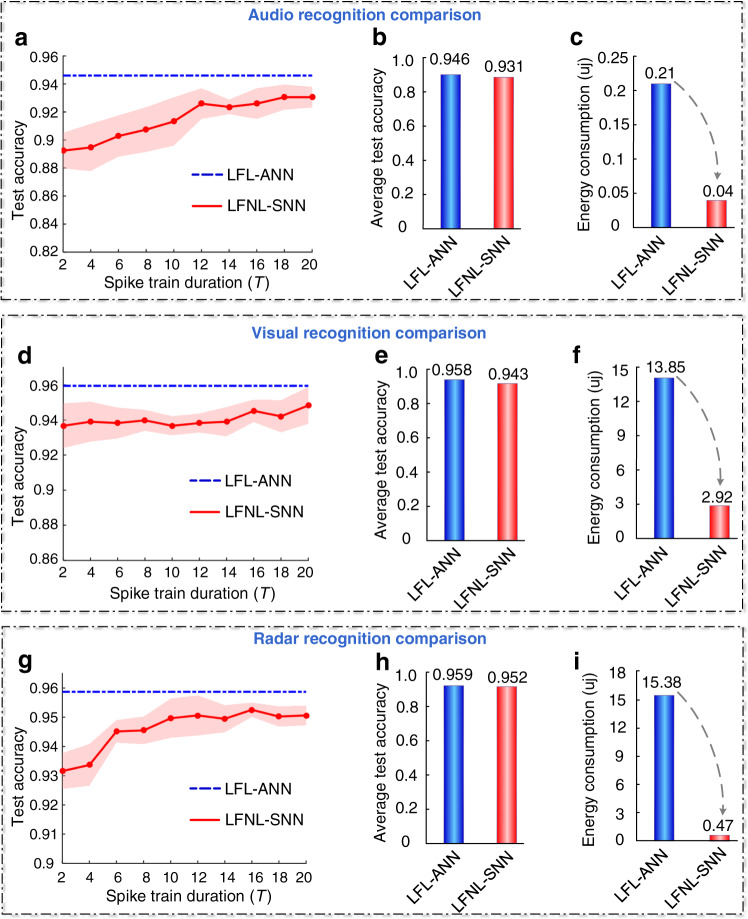
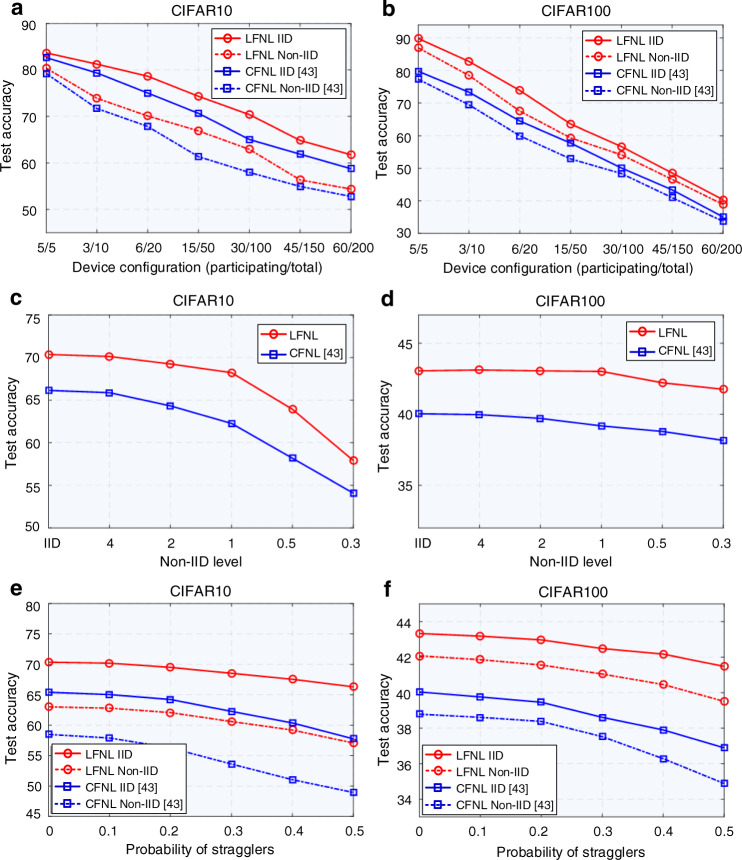
In order to realize the full potential of wireless edge artificial intelligence (AI), very large and diverse datasets will often be required for energy-demanding model training on resource-constrained edge devices. This paper proposes a lead federated neuromorphic learning (LFNL) technique, which is a decentralized energy-efficient brain-inspired computing method based on spiking neural networks. The proposed technique will enable edge devices to exploit brain-like biophysiological structure to collaboratively train a global model while helping preserve privacy. Experimental results show that, under the situation of uneven dataset distribution among edge devices, LFNL achieves a comparable recognition accuracy to existing edge AI techniques, while substantially reducing data traffic by >3.5× and computational latency by >2.0×. Furthermore, LFNL significantly reduces energy consumption by >4.5× compared to standard federated learning with a slight accuracy loss up to 1.5%. Therefore, the proposed LFNL can facilitate the development of brain-inspired computing and edge AI.
Overview
The claims and statistics of this paper haven’t been checked yet.
Free: it reads the open-access text and checks the first 5 claims that cite a source we can check. Create a free account to check every claim.
Integrity signals
Registry
Cites
Statistics
Figures
Verification
Claims the paper makes
The claims and statistics of this paper haven’t been checked yet.
Free: it reads the open-access text and checks the first 5 claims that cite a source we can check. Create a free account to check every claim.
Claims other papers make about this one
Each is checked against this paper’s own text: does it say what the citing paper says it does?
The source backs part of the claim, not all of it — or backs it for a different population, condition or comparison.
In the citing paper
“This unlocks new possibilities for real-time making decisions as well as enhanced confidentiality and safety [81].”
From Edge AI: A survey (2023) · cites this paper as [81]
Experimental — accuracy not yet measuredThe cited source says what the claim attributes to it.
In the citing paper
“Therefore, brain-inspired computing approaches potentially can not only improve the energy efficiency, but also privacy in the processing of sensitive data [226].”
From Brain-inspired computing systems: a systematic literature review (2024) · cites this paper as [226]
Self-check
Percentages, sums and reported differences re-computed from the paper’s own numbers.
The self-check needs the paper’s full text.
Citations
Cites
Very Deep Convolutional Networks for Large-Scale Image Recognition
Simonyan, K., & Zisserman, A. (2014) · arXiv · doi:10.48550/arxiv.1409.1556 · Cited by 114,148
LeCun, Y., Bengio, Y., & Hinton, G. (2015) · Nature · doi:10.1038/nature14539 · Cited by 84,126
Gradient-based learning applied to document recognition
Lecun, Y., Bottou, L., Bengio, Y., & Haffner, P. (1998) · Proceedings of the IEEE · doi:10.1109/5.726791 · Cited by 58,805
Federated Learning: Strategies for Improving Communication Efficiency
Konečný, J., McMahan, H. B., Yu, F. X., Richtárik, P., Suresh, A. T., & Bacon, D. (2016) · arXiv · doi:10.48550/arxiv.1610.05492 · Cited by 3,766
Networks of spiking neurons: The third generation of neural network models
Maass, W. (1997) · Neural Networks · doi:10.1016/s0893-6080(97)00011-7 · Cited by 3,481
Federated Learning in Mobile Edge Networks: A Comprehensive Survey
Lim, W. Y. B., Luong, N. C., Hoang, D. T., Jiao, Y., Liang, Y.-C., Yang, Q., Niyato, D., & Miao, C. (2020) · IEEE Communications Surveys & Tutorials · doi:10.1109/comst.2020.2986024 · Cited by 2,565
Self-citationEdge Intelligence: Paving the Last Mile of Artificial Intelligence With Edge Computing
Zhou, Z., Chen, X., Li, E., Zeng, L., Luo, K., & Zhang, J. (2019) · Proceedings of the IEEE · doi:10.1109/jproc.2019.2918951 · Cited by 2,455
Catastrophic forgetting in connectionist networks
French, R. (1999) · Trends in Cognitive Sciences · doi:10.1016/s1364-6613(99)01294-2 · Cited by 2,311
Adaptive Federated Learning in Resource Constrained Edge Computing Systems
Wang, S., Tuor, T., Salonidis, T., Leung, K. K., Makaya, C., He, T., & Chan, K. (2019) · IEEE Journal on Selected Areas in Communications · doi:10.1109/jsac.2019.2904348 · Cited by 2,232
1.1 Computing's energy problem (and what we can do about it)
Horowitz, M. (2014) · 2014 IEEE International Solid-State Circuits Conference Digest of Technical Papers (ISSCC) · doi:10.1109/isscc.2014.6757323 · Cited by 2,069
Secure, privacy-preserving and federated machine learning in medical imaging
Kaissis, G. A., Makowski, M. R., Rückert, D., & Braren, R. F. (2020) · Nature Machine Intelligence · doi:10.1038/s42256-020-0186-1 · Cited by 1,676
Sheller, M. J., Edwards, B., Reina, G. A., Martin, J., Pati, S., Kotrotsou, A., Milchenko, M., Xu, W., Marcus, D., Colen, R. R., et al. (2020) · Scientific Reports · doi:10.1038/s41598-020-69250-1 · Cited by 1,646
Neuronal Dynamics: From Single Neurons to Networks and Models of Cognition
Gerstner, W., Kistler, W. M., Naud, R., & Paninski, L. (2014) · doi:10.1017/cbo9781107447615 · Cited by 1,515
Energy Efficient Federated Learning Over Wireless Communication Networks
Yang, Z., Chen, M., Saad, W., Hong, C. S., & Shikh-Bahaei, M. (2021) · IEEE Transactions on Wireless Communications · doi:10.1109/twc.2020.3037554 · Cited by 1,153
Edge Intelligence: The Confluence of Edge Computing and Artificial Intelligence
Deng, S., Zhao, H., Fang, W., Yin, J., Dustdar, S., & Zomaya, A. Y. (2020) · IEEE Internet of Things Journal · doi:10.1109/jiot.2020.2984887 · Cited by 1,147
Adversarial attacks on medical machine learning
Finlayson, S. G., Bowers, J. D., Ito, J., Zittrain, J. L., Beam, A. L., & Kohane, I. S. (2019) · Science · doi:10.1126/science.aaw4399 · Cited by 1,088
Swarm Learning for decentralized and confidential clinical machine learning
Warnat-Herresthal, S., Schultze, H., Shastry, K. L., Manamohan, S., Mukherjee, S., Garg, V., Sarveswara, R., Händler, K., Pickkers, P., Aziz, N. A., et al. (2021) · Nature · doi:10.1038/s41586-021-03583-3 · Cited by 884
A Blockchain-Based Decentralized Federated Learning Framework with Committee Consensus
Li, Y., Chen, C., Liu, N., Huang, H., Zheng, Z., & Yan, Q. (2021) · IEEE Network · doi:10.1109/mnet.011.2000263 · Cited by 645
Artificial-Intelligence-Enabled Intelligent 6G Networks
Yang, H., Alphones, A., Xiong, Z., Niyato, D., Zhao, J., & Wu, K. (2020) · IEEE Network · doi:10.1109/mnet.011.2000195 · Cited by 589
Self-citationEstimation of energy consumption in machine learning
García-Martín, E., Rodrigues, C. F., Riley, G., & Grahn, H. (2019) · Journal of Parallel and Distributed Computing · doi:10.1016/j.jpdc.2019.07.007 · Cited by 558
Deep Reinforcement Learning-Based Intelligent Reflecting Surface for Secure Wireless Communications
Yang, H., Xiong, Z., Zhao, J., Niyato, D., Xiao, L., & Wu, Q. (2021) · IEEE Transactions on Wireless Communications · doi:10.1109/twc.2020.3024860 · Cited by 522
Self-citationEnd-to-end privacy preserving deep learning on multi-institutional medical imaging
Kaissis, G., Ziller, A., Passerat-Palmbach, J., Ryffel, T., Usynin, D., Trask, A., Lima, I., Mancuso, J., Jungmann, F., Steinborn, M.-M., et al. (2021) · Nature Machine Intelligence · doi:10.1038/s42256-021-00337-8 · Cited by 513
Communication-efficient federated learning
Chen, M., Shlezinger, N., Poor, H. V., Eldar, Y. C., & Cui, S. (2021) · Proceedings of the National Academy of Sciences · doi:10.1073/pnas.2024789118 · Cited by 397
Self-citationDistributed deep learning networks among institutions for medical imaging
Chang, K., Balachandar, N., Lam, C., Yi, D., Brown, J., Beers, A., Rosen, B., Rubin, D. L., & Kalpathy-Cramer, J. (2018) · Journal of the American Medical Informatics Association · doi:10.1093/jamia/ocy017 · Cited by 340
Lim, W. Y. B., Ng, J. S., Xiong, Z., Jin, J., Zhang, Y., Niyato, D., Leung, C., & Miao, C. (2022) · IEEE Transactions on Parallel and Distributed Systems · doi:10.1109/tpds.2021.3096076 · Cited by 312
Self-citationYang, H., Zhao, J., Xiong, Z., Lam, K.-Y., Sun, S., & Xiao, L. (2021) · IEEE Journal on Selected Areas in Communications · doi:10.1109/jsac.2021.3088655 · Cited by 306
Self-citationUnderstanding Distributed Poisoning Attack in Federated Learning
Cao, D., Chang, S., Lin, Z., Liu, G., & Sun, D. (2019) · 2019 IEEE 25th International Conference on Parallel and Distributed Systems (ICPADS) · doi:10.1109/icpads47876.2019.00042 · Cited by 285
Evaluating the Energy Efficiency of Deep Convolutional Neural Networks on CPUs and GPUs
Li, D., Chen, X., Becchi, M., & Zong, Z. (2016) · 2016 IEEE International Conferences on Big Data and Cloud Computing (BDCloud), Social Computing and Networking (SocialCom), Sustainable Computing and Communications (SustainCom) (BDCloud-SocialCom-SustainCom) · doi:10.1109/bdcloud-socialcom-sustaincom.2016.76 · Cited by 236
Federated Learning in the Sky: Aerial-Ground Air Quality Sensing Framework With UAV Swarms
Liu, Y., Nie, J., Li, X., Ahmed, S. H., Lim, W. Y. B., & Miao, C. (2021) · IEEE Internet of Things Journal · doi:10.1109/jiot.2020.3021006 · Cited by 227
Federated Learning in the Sky: Aerial-Ground Air Quality Sensing Framework with UAV Swarms
Liu, Y., Nie, J., Li, X., Ahmed, S. H., Lim, W. Y. B., & Miao, C. (2020) · arXiv · doi:10.48550/arxiv.2007.12004 · Cited by 227
Stöckl, C., & Maass, W. (2021) · Nature Machine Intelligence · doi:10.1038/s42256-021-00311-4 · Cited by 217
A system hierarchy for brain-inspired computing
Zhang, Y., Qu, P., Ji, Y., Zhang, W., Gao, G., Wang, G., Song, S., Li, G., Chen, W., Zheng, W., et al. (2020) · Nature · doi:10.1038/s41586-020-2782-y · Cited by 208
Froelicher, D., Troncoso-Pastoriza, J. R., Raisaro, J. L., Cuendet, M. A., Sousa, J. S., Cho, H., Berger, B., Fellay, J., & Hubaux, J.-P. (2021) · Nature Communications · doi:10.1038/s41467-021-25972-y · Cited by 195
Graphene memristive synapses for high precision neuromorphic computing
Schranghamer, T. F., Oberoi, A., & Das, S. (2020) · Nature Communications · doi:10.1038/s41467-020-19203-z · Cited by 190
A biomimetic neural encoder for spiking neural network
Subbulakshmi Radhakrishnan, S., Sebastian, A., Oberoi, A., Das, S., & Das, S. (2021) · Nature Communications · doi:10.1038/s41467-021-22332-8 · Cited by 174
Revisiting Batch Normalization for Training Low-Latency Deep Spiking Neural Networks From Scratch
Kim, Y., & Panda, P. (2021) · Frontiers in Neuroscience · doi:10.3389/fnins.2021.773954 · Cited by 172
Brain-inspired global-local learning incorporated with neuromorphic computing
Wu, Y., Zhao, R. J., Zhu, J., Chen, F., Xu, M., Li, G., Song, S., Deng, L., Wang, G., Zheng, H., et al. (2022) · Nature Communications · doi:10.1038/s41467-021-27653-2 · Cited by 153
μBrain: An Event-Driven and Fully Synthesizable Architecture for Spiking Neural Networks
Stuijt, J., Sifalakis, M., Yousefzadeh, A., & Corradi, F. (2021) · Frontiers in Neuroscience · doi:10.3389/fnins.2021.664208 · Cited by 147
Efficient Dropout-Resilient Aggregation for Privacy-Preserving Machine Learning
Liu, Z., Guo, J., Lam, K.-Y., & Zhao, J. (2023) · IEEE Transactions on Information Forensics and Security · doi:10.1109/tifs.2022.3163592 · Cited by 137
Self-citationBayesian Nonparametric Federated Learning of Neural Networks
Yurochkin, M., Agarwal, M., Ghosh, S., Greenewald, K. H., Hoang, T. N., & Khazaeni, Y. (2019) · arXiv (Cornell University) · doi:10.48550/arxiv.1905.12022 · Cited by 133
Fast and energy-efficient neuromorphic deep learning with first-spike times
Göltz, J., Kriener, L., Baumbach, A., Billaudelle, S., Breitwieser, O., Cramer, B., Dold, D., Kungl, A. F., Senn, W., Schemmel, J., et al. (2021) · Nature Machine Intelligence · doi:10.1038/s42256-021-00388-x · Cited by 129
Zhao, Y., Wang, Z., Shen, Z. M., & Sun, F. (2021) · Proceedings of the National Academy of Sciences · doi:10.1073/pnas.2017318118 · Cited by 94
Federated Learning With Spiking Neural Networks
Venkatesha, Y., Kim, Y., Tassiulas, L., & Panda, P. (2021) · IEEE Transactions on Signal Processing · doi:10.1109/tsp.2021.3121632 · Cited by 86 · cited 2×
“CIFAR10 CIFAR100 e f LFNL IID LFNL Non-IID CFNL IID [43] CFNL Non-IID [43] LFNL IID LFNL Non-IID CFNL IID [43] CFNL Non-IID [43]”
Pan, Z., Chua, Y., Wu, J., Zhang, M., Li, H., & Ambikairajah, E. (2020) · Frontiers in Neuroscience · doi:10.3389/fnins.2019.01420 · Cited by 67
Semi-Decentralized Federated Edge Learning for Fast Convergence on Non-IID Data
Sun, Y., Shao, J., Mao, Y., Wang, J. H., & Zhang, J. (2022) · IEEE Wireless Communications and Networking Conference · doi:10.1109/wcnc51071.2022.9771904 · Cited by 67
Chakraborty, I., Roy, D., Garg, I., Ankit, A., & Roy, K. (2020) · Nature Machine Intelligence · doi:10.1038/s42256-019-0134-0 · Cited by 61
Breaking medical data sharing boundaries by using synthesized radiographs
Han, T., Nebelung, S., Haarburger, C., Horst, N., Reinartz, S., Merhof, D., Kiessling, F., Schulz, V., & Truhn, D. (2020) · Science Advances · doi:10.1126/sciadv.abb7973 · Cited by 61
Random sketch learning for deep neural networks in edge computing
Li, B., Chen, P., Liu, H., Guo, W., Cao, X., Du, J., Zhao, C., & Zhang, J. (2021) · Nature Computational Science · doi:10.1038/s43588-021-00039-6 · Cited by 40
Federated Neuromorphic Learning of Spiking Neural Networks for Low-Power Edge Intelligence
Skatchkovsky, N., Jang, H., & Simeone, O. (2020) · ICASSP 2020 - 2020 IEEE International Conference on Acoustics, Speech and Signal Processing (ICASSP) · doi:10.1109/icassp40776.2020.9053861 · Cited by 35
Towards Low-Latency Energy-Efficient Deep SNNs via Attention-Guided CompressionPreprint
Kundu, S., Datta, G., Pedram, M., & Beerel, P. A. (2021) · arXiv (Cornell University) · doi:10.48550/arxiv.2107.12445 · Cited by 20
Vaughan, O. P. H. (2019) · Nature Electronics · doi:10.1038/s41928-018-0198-6 · Cited by 17
Privacy-Enhanced Federated Learning with Weighted Aggregation
Guo, J., Liu, Z., Lam, K., Zhao, J., & Chen, Y. (2021) · Communications in computer and information science · doi:10.1007/978-981-16-7913-1_7 · Cited by 16
Self-citationFinite Meta-Dynamic Neurons in Spiking Neural Networks for Spatio-temporal LearningPreprint
Cheng, X., Zhang, T., Jia, S., et al. (2020) · arXiv (Cornell University) · doi:10.48550/arxiv.2010.03140 · Cited by 9
Research works printed but not linked: 2
- Che, C., Li, X., Chen, C., He, X. & Zheng, Z. A decentralized federated learning framework via committee mechanism with convergence guarantee. Preprint at https://arxiv.org/pdf/2108.00365.pdf (2021). · arXiv
- Chintamani, N., Yash, M., Nikhil, P., Vivek, P. & Sandeep, P. Smart traffic control using deep learning. Preprint at https://github.com/nikhilpatil99/Smart-Traffic-Management-Using-Deep-Learning (2019).
Cited by
Singh, R., & Gill, S. S. (2023) · Internet of Things and Cyber-Physical Systems · doi:10.1016/j.iotcps.2023.02.004 · Cited by 572
Spike-based dynamic computing with asynchronous sensing-computing neuromorphic chip
Yao, M., Richter, O., Zhao, G., Qiao, N., Xing, Y., Wang, D., Hu, T., Fang, W., Demirci, T., Marchi, M. D., et al. (2024) · Nature Communications · doi:10.1038/s41467-024-47811-6 · Cited by 270
“Following this line of thinking, in SNNs, the theoretical energy consumption in the network is also evaluated by FLOPs 28,55,57,58 , which are mainly AC operations and are strongly correlated with the number of spikes.”
Tao, S., Liu, H., Sun, C., Ji, H., Ji, G., Han, Z., Gao, R., Ma, J., Ma, R., Chen, Y., et al. (2023) · Nature Communications · doi:10.1038/s41467-023-43883-y · Cited by 192
Privacy-Preserving Aggregation in Federated Learning: A Survey
Liu, Z., Guo, J., Yang, W., Fan, J., Lam, K., & Zhao, J. (2022) · IEEE Transactions on Big Data · doi:10.1109/tbdata.2022.3190835 · Cited by 263
Self-citationGreen Edge AI: A Contemporary Survey
Mao, Y., Yu, X., Huang, K., Zhang, Y. A., & Zhang, J. (2024) · Proceedings of the IEEE · doi:10.1109/jproc.2024.3437365 · Cited by 187
“Notably, there are recent interests of training SNNs under the framework of FEEL [300], [301] and SNN-based cooperative edge inference [302].”
Background
Metadata
- Authors
- Yang, H., Lam, K.-Y., Xiao, L., Xiong, Z., Hu, H., Niyato, D., & Vincent Poor, H.
- Affiliations
- Nanyang Technological University (SG)
- Xiamen University (CN)
- Singapore University of Technology and Design (SG)
- Corresponding author
- Lam, Kwok-Yan
- Venue
- Nature Communications
- Published
- 2022-07-25
- Volume
- 13
- Issue
- 1
- Pages
- 4269-4269
- ISSN
- 2041-1723 (ISSN-L)
- PMC
- PMC9314401
- OpenAlex
- W4287218656
- Semantic Scholar
- c3eeada16799d0298944dc9d431ad08447dc682c
- Cited by
- 127
- References
- 47
- Citations by year
- 2026: 22 · 2025: 39 · 2024: 28 · 2023: 30 · 2022: 8
- FWCI
- 8.64
- Type
- journal article
- Language
- en
- Update notices
- correction (2022-08-17)
- Open access
- gold
- doi.org
- Licence
- cc-by
- creativecommons.org/licenses/by/4.0 (tdm)
- creativecommons.org/licenses/by/4.0 (vor)
- Locations
- Nature Communications (publishedVersion, cc-by)
- Research Square (acceptedVersion, cc-by)
- PubMed Central (publishedVersion, cc-by)
- PubMed (publishedVersion)
- RePEc: Research Papers in Economics (submittedVersion)
- DOAJ (DOAJ: Directory of Open Access Journals) (submittedVersion, cc-by-sa)
- DR-NTU (Nanyang Technological University) (submittedVersion, cc-by)
- Funders
- National Science Foundation (1908308)
- National Research Foundation (SRG-ISTD-2021-165)
- National Research Foundation Singapore
- Nanyang Technological University (RG16/20, Tier 1)
- National Natural Science Foundation of China (1908308, 61971366, U21A20444, SUTD SRG-ISTD-2021-165)
- Ministry of Education, India
- Singapore University of Technology and Design (SRG-ISTD-2021165)
- Info-communications Media Development Authority
- Topics
- Physical Sciences › Computer Science › Artificial Intelligence › Privacy-Preserving Technologies in Data
- Physical Sciences › Engineering › Electrical and Electronic Engineering › Advanced Memory and Neural Computing
- Physical Sciences › Computer Science › Computer Networks and Communications › IoT and Edge/Fog Computing
- Keywords
- federated learning, spiking neural networks, neuromorphic computing, energy efficiency, privacy preservation, non-IID data, data traffic reduction, edge devices
- MeSH terms
- Artificial Intelligence, Brain, Neural Networks, Computer, Recognition, Psychology
About these checks
Registry, retraction, Cites and statistics results are computed, not judged, with one exception: a printed reference that no index lists is read once by a model before it counts as a citation error. Claims are extracted by a model and kept only when their quote appears verbatim in the text; each cited source is then checked, with a model’s help, for whether it says what the claim relies on. Those verdicts can be wrong — read the claim’s quote and the cited source before relying on one.
Statistics and arithmetic are recomputed, not judged.
Confidence bands are shown only for fields calibrated on our annotated test set. None is calibrated yet, so no band is shown.
What counts as a claim ›How we measure confidence ›How we check this ›
Are you an author, or do you see a problem with this page? Request a review
Data sources
Bibliographic data: Semantic Scholar, OpenAlex, Crossref.
Contains information from the Semantic Scholar Academic Graph Datasets, made available under the ODC Attribution License (ODC-BY 1.0).
Semantic Scholar’s data is described in: Kinney, R., et al. (2023). The Semantic Scholar Open Data Platform. arXiv:2301.10140.
