

Lead federated neuromorphic learning for wireless edge artificial intelligence
Open accessPublished version of a preprint
The DOI matches its Crossref record; 51 of the 53 references it cites were found in a registry or an index.
Abstract
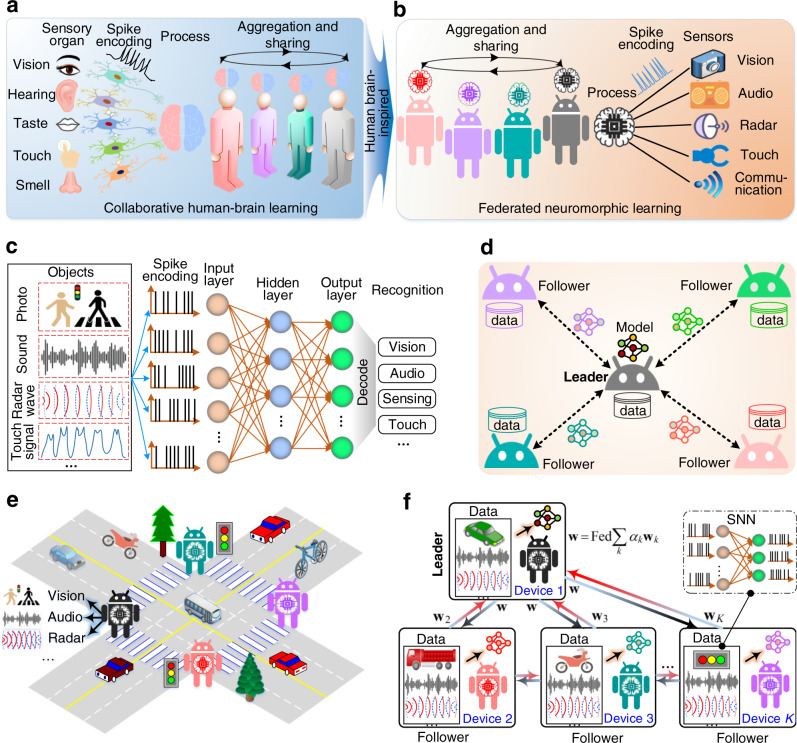
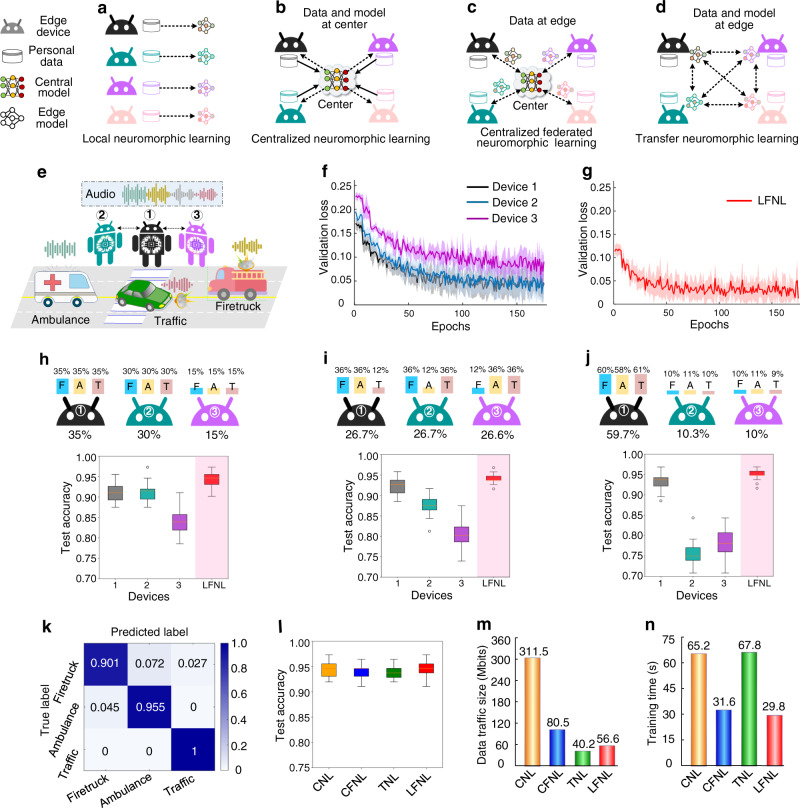
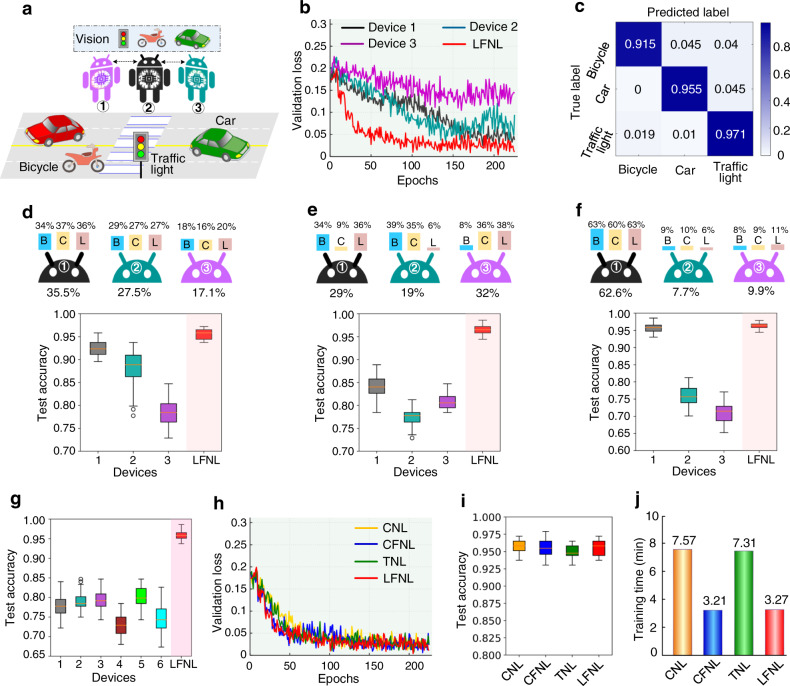
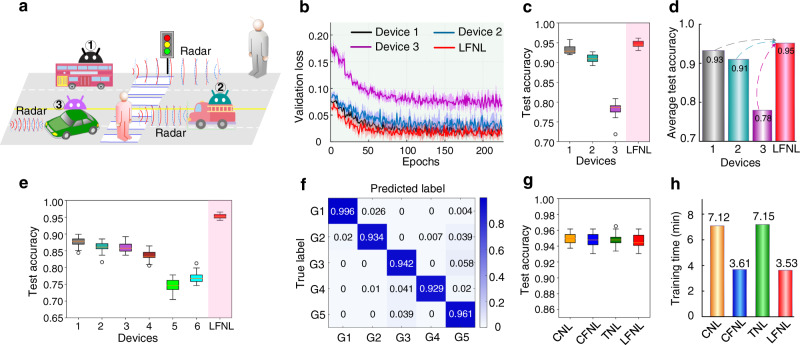
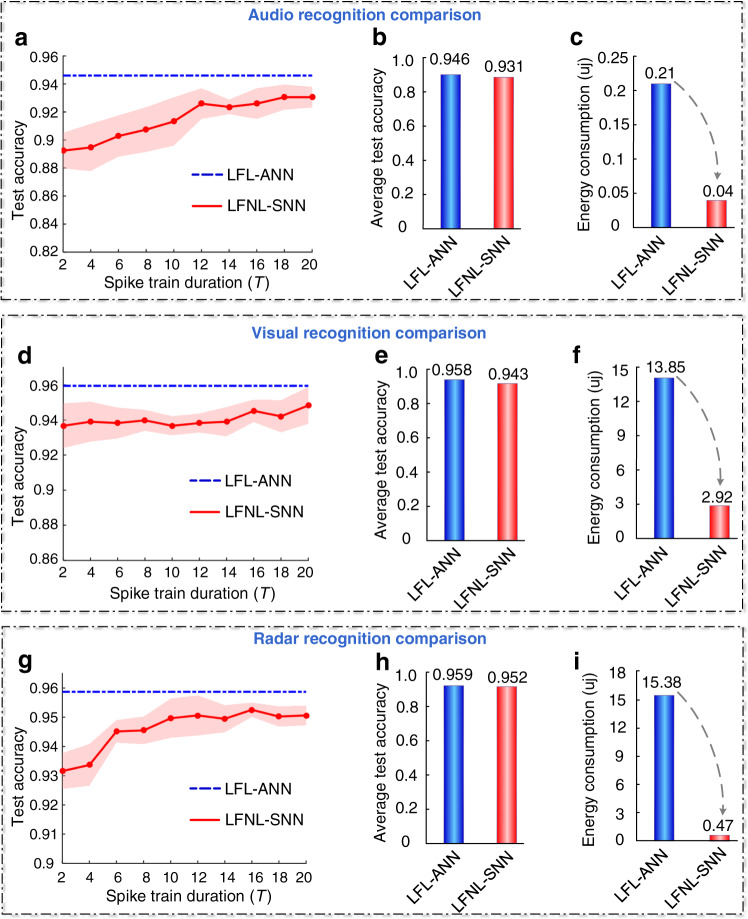
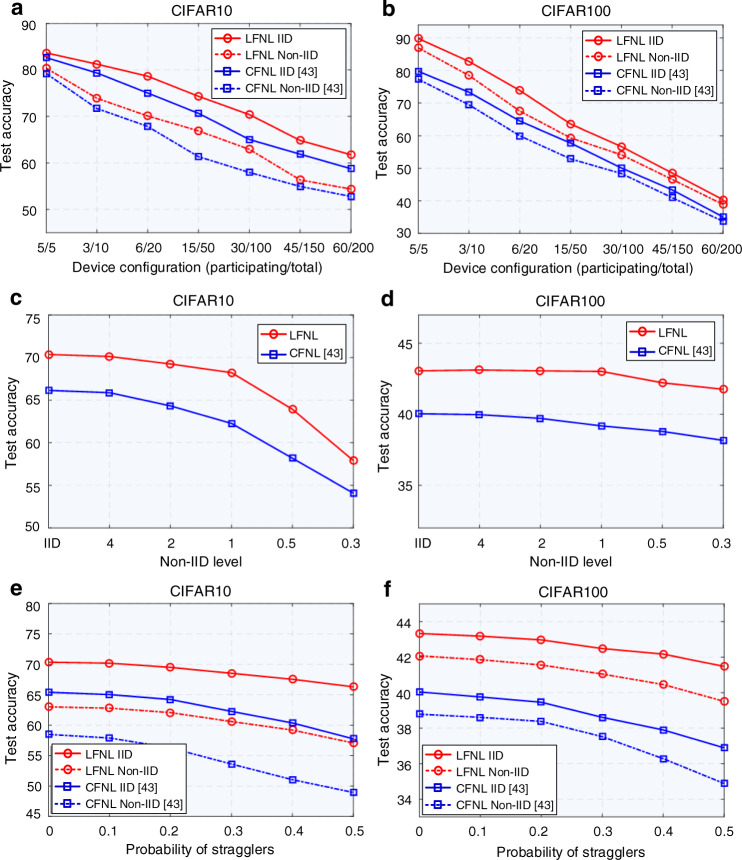
In order to realize the full potential of wireless edge artificial intelligence (AI), very large and diverse datasets will often be required for energy-demanding model training on resource-constrained edge devices. This paper proposes a lead federated neuromorphic learning (LFNL) technique, which is a decentralized energy-efficient brain-inspired computing method based on spiking neural networks. The proposed technique will enable edge devices to exploit brain-like biophysiological structure to collaboratively train a global model while helping preserve privacy. Experimental results show that, under the situation of uneven dataset distribution among edge devices, LFNL achieves a comparable recognition accuracy to existing edge AI techniques, while substantially reducing data traffic by >3.5× and computational latency by >2.0×. Furthermore, LFNL significantly reduces energy consumption by >4.5× compared to standard federated learning with a slight accuracy loss up to 1.5%. Therefore, the proposed LFNL can facilitate the development of brain-inspired computing and edge AI.
Overview
The claims and statistics of this paper haven’t been checked yet.
Free: it reads the open-access text and checks the first 5 claims that cite a source we can check. Create a free account to check every claim.
Integrity signals
Registry
Cites
Statistics
Figures
Verification
Claims the paper makes
The claims and statistics of this paper haven’t been checked yet.
Free: it reads the open-access text and checks the first 5 claims that cite a source we can check. Create a free account to check every claim.
Claims other papers make about this one
Each is checked against this paper’s own text: does it say what the citing paper says it does?
The source backs part of the claim, not all of it — or backs it for a different population, condition or comparison.
In the citing paper
“This unlocks new possibilities for real-time making decisions as well as enhanced confidentiality and safety [81].”
From Edge AI: A survey (2023) · cites this paper as [81]
Experimental — accuracy not yet measuredThe cited source says what the claim attributes to it.
In the citing paper
“Therefore, brain-inspired computing approaches potentially can not only improve the energy efficiency, but also privacy in the processing of sensitive data [226].”
From Brain-inspired computing systems: a systematic literature review (2024) · cites this paper as [226]
Self-check
Percentages, sums and reported differences re-computed from the paper’s own numbers.
The self-check needs the paper’s full text.
Citations
Cites
Very Deep Convolutional Networks for Large-Scale Image Recognition
Simonyan, K., & Zisserman, A. (2014) · arXiv · doi:10.48550/arxiv.1409.1556 · Cited by 114,148
LeCun, Y., Bengio, Y., & Hinton, G. (2015) · Nature · doi:10.1038/nature14539 · Cited by 84,126
Gradient-based learning applied to document recognition
Lecun, Y., Bottou, L., Bengio, Y., & Haffner, P. (1998) · Proceedings of the IEEE · doi:10.1109/5.726791 · Cited by 58,805
Federated Learning: Strategies for Improving Communication Efficiency
Konečný, J., McMahan, H. B., Yu, F. X., Richtárik, P., Suresh, A. T., & Bacon, D. (2016) · arXiv · doi:10.48550/arxiv.1610.05492 · Cited by 3,766
Networks of spiking neurons: The third generation of neural network models
Maass, W. (1997) · Neural Networks · doi:10.1016/s0893-6080(97)00011-7 · Cited by 3,481
Federated Learning in Mobile Edge Networks: A Comprehensive Survey
Lim, W. Y. B., Luong, N. C., Hoang, D. T., Jiao, Y., Liang, Y.-C., Yang, Q., Niyato, D., & Miao, C. (2020) · IEEE Communications Surveys & Tutorials · doi:10.1109/comst.2020.2986024 · Cited by 2,565
Self-citationEdge Intelligence: Paving the Last Mile of Artificial Intelligence With Edge Computing
Zhou, Z., Chen, X., Li, E., Zeng, L., Luo, K., & Zhang, J. (2019) · Proceedings of the IEEE · doi:10.1109/jproc.2019.2918951 · Cited by 2,455
Catastrophic forgetting in connectionist networks
French, R. (1999) · Trends in Cognitive Sciences · doi:10.1016/s1364-6613(99)01294-2 · Cited by 2,311
Adaptive Federated Learning in Resource Constrained Edge Computing Systems
Wang, S., Tuor, T., Salonidis, T., Leung, K. K., Makaya, C., He, T., & Chan, K. (2019) · IEEE Journal on Selected Areas in Communications · doi:10.1109/jsac.2019.2904348 · Cited by 2,232
1.1 Computing's energy problem (and what we can do about it)
Horowitz, M. (2014) · 2014 IEEE International Solid-State Circuits Conference Digest of Technical Papers (ISSCC) · doi:10.1109/isscc.2014.6757323 · Cited by 2,069
Research works printed but not linked: 2
- Che, C., Li, X., Chen, C., He, X. & Zheng, Z. A decentralized federated learning framework via committee mechanism with convergence guarantee. Preprint at https://arxiv.org/pdf/2108.00365.pdf (2021). · arXiv
- Chintamani, N., Yash, M., Nikhil, P., Vivek, P. & Sandeep, P. Smart traffic control using deep learning. Preprint at https://github.com/nikhilpatil99/Smart-Traffic-Management-Using-Deep-Learning (2019).
Cited by
Items 101–143 of 143
An intelligent and lightweight physical layer authentication scheme for MEC-enabled IoT networks
Ma, T., Yang, W., Hu, F., Ma, M., & Qin, C. (2025) · Physical Communication · doi:10.1016/j.phycom.2025.102777 · Cited by 1
Liu, Y., Wang, N., & Ye, X. (2025) · Annals of Operations Research · doi:10.1007/s10479-025-06823-1 · Cited by 3
“Liu and Bi (2023) proposed a method for quantitative risk analysis of treatment plans for tumor patients, which is conducted by mining historical similar patients from electronic health records in multiple hospitals using FL. Yang et al. (2022) proposed a lead federated neuromorphic learning technique, which enables e…”
InfluentialFederated learning with privacy protection and incentive mechanisms based on edge computing
Liu, P., Zhang, M., Shen, Z., & Wang, H. (2025) · Future Generation Computer Systems · doi:10.1016/j.future.2025.108216 · Cited by 1
Pınar, S., Kurt, K. K., & Türkeli, S. (2025) · AJIT-e Academic Journal of Information Technology · doi:10.5824/ajite.2025.04.003.x · Cited by 1
Leveraging 5G RedCap and Spiking Neural Networks for Energy Efficiency in Edge Devices
Kourtis, M. A., Oikonomakis, A., Economopoulos, A., Batistatos, M. C., Kalemai, G., Vasalos, A., Xilouris, G. K., & Trakadas, P. T. (2026) · Telecom · doi:10.3390/telecom7010004 · Cited by 2
“Lead Federated Neuromorphic Learning achieves a greater than 4.5 × energy savings compared to standard federated learning with a less than 1.5% accuracy loss, alongside the 3.5 × data traffic reduction and 2.0 × computational latency reduction using Meta-Dynamic Neuron architectures [36].”
InfluentialEvolutionary patterns and the hierarchical spatial system of modern human-Earth systems
Liu, Y., Huang, X., Su, S., Chen, N., & Hong, W. (2026) · Science China Earth Sciences · doi:10.1007/s11430-025-1789-x · Cited by 2
“In current geographical research, advanced techniques such as big data (Tsai et al., 2021), remote sensing (Wu et al., 2010; Li et al., 2020), and intelligent algorithms (Yang et al., 2022; Bettencourt, 2024) are widely used.”
Real-time frame-level fish feeding behavior detection using a lightweight CNN-TCN architecture
Sha, Z., Li, D., Ma, X., Bayır, A., Loo, S. C. J., & Wang, C. (2026) · Computers and Electronics in Agriculture · doi:10.1016/j.compag.2026.111667 · Cited by 1
Collision-Aware Optimization Framework for Wireless Federated Learning Over Grant-Free NOMA
Atebawone, E., Agyekum, K. O.-B. O., Gadze, J. D., Opare, K. A., Antwi, O. A., Author, A. K., & Author, R. A. (2026) · Wireless Personal Communications · doi:10.1007/s11277-026-12129-7 · Cited by 1
Decentralized Data Sharing Using Searchable Encryption Database with Selective Data Retrieval
Gunawan, A. F., Tjuawinata, I., Lam, K., & Chi, C. (2023) · International Conference on ICT for Smart Society (ICISS) · doi:10.1109/iciss59129.2023.10291467 · Cited by 1
“Such approaches may use various cryptographic tools such as symmetric searchable encryption [22, 23], attribute-based encryption [24, 25], identity-based encryption [26, 27], federated learning [28–30], or their combinations [31– 33].”
MethodSelf-citationYang, R., Li, Z., Yao, J., Zhang, B., Li, Z., Tang, W., Gong, J., Li, Y., Cao, X., Wang, Z., et al. (2024) · Research Square · doi:10.21203/rs.3.rs-3930064/v1 · Cited by 2
AI applications in routine clinical imaging: detection, segmentation, diagnosis, and prognosis
Vaidyanathan, A. (2023) · Research Publications (Maastricht University) · doi:10.26481/dis.20230228av · Cited by 1
Shannon’s Lens: The Catalyst for Cognitive Evolution of Edge Based Smart MachinesPreprint
Rubbani, S. S. (2023) · Research Square · doi:10.21203/rs.3.rs-3298198/v1
Powerful Encoding and Decoding Computation of Reservoir Computing
Li, W., Wu, H., & Yang, D. (2023) · Lecture notes in computer science · doi:10.1007/978-981-99-6483-3_16
Harmonizing Data Streams for Edge AI Protocols to Quantify Shannon's BoundsPreprint
Rubbani, S. S. (2023) · Research Square · doi:10.21203/rs.3.rs-3584273/v1
Reliable Communications for Hypersonic Vehicles: A Reinforcement Learning Approach
Xu, J., Chen, Y., Lin, Z., Du, Y., Yang, H., & Xiao, L. (2023) · Globecom · doi:10.1109/globecom54140.2023.10437344
“In addition, we intend to apply the lead federated neuromorphic learning technique to further bolster the communication performance [20].”
MethodSelf-citationHigh‐Stability Ionic Conductive Filtering Transistors for Bio‐Inspired Signal Processing
Liu, W., Wang, J., Xie, P., Feng, X., Xu, Y., Jin, C., Shi, X., Li, R., Ho, J. C. Y., Yang, J., et al. (2025) · Small · doi:10.1002/smll.202502874
Neuromorphic Computing Chips: Challenges and Trends
Yang, J., & Sawan, M. (2025) · IEEE International Symposium on Circuits and Systems proceedings · doi:10.1109/iscas56072.2025.11043979
Integrating Visual Intelligence With Federated Learning and IoT in Healthcare
Shwetha, G. K., Avasthi, A., Kumar, M., Chandra, S., & Hari, B. S. (2025) · Advances in medical technologies and clinical practice book series · doi:10.4018/979-8-3693-6094-1.ch006
刘, 彦., 黄, 鑫., 苏, 思., 陈, 妮., & Hong, W. (2025) · SCIENTIA SINICA Terrae · doi:10.1360/sste-2025-0134
An Energy-Efficient Neuromorphic Processor Using Unified Refractory Control-Based NoC for Edge AI
Na, S. N. S., & Kim, D. (2025) · Electronics · doi:10.3390/electronics14244959
A Cyber-Physical-Human System Design for Challenging Behaviour Monitoring in People with Dementia
Deters, J. K., Güvenatam, B., Silva, J. A. L., Bergsma, E., Janus, S. I. M., ZUIDEMA, S. U., & Wörtche, H. J. (2026) · Lecture notes in computer science · doi:10.1007/978-3-032-13312-0_6 · Cited by 1
Noreen, S., & Schotten, H. D. (2025) · IEEE Future Networks World Forum (FNWF) · doi:10.1109/fnwf66845.2025.11317190
“For example, neuromorphic systems leverage spiking neural networks (SNNs), which consume energy only when processing event-driven spikes, making them highly suitable for battery-limited or solar-powered platforms [10].”
Sivaprakash, T., & Sarala, R. (2025) · International Conference on NexGen Networks and Cybernetics (IC2NC) · doi:10.1109/ic2nc67409.2025.11376123
“Second, the bandwidth needed for this kind of data transport is unaffordable and cannot be sustained on a large scale [1].”
InfluentialHybrid neuromorphic AI framework for energy-efficient and low-latency supply chain analytics
Karmakar, M., Karthikeyan, P., & Tay, H. L. (2026) · International Journal of Logistics Research and Applications · doi:10.1080/13675567.2026.2645705
Evaluation of APCMA and CSMA/CA in Wireless Brain-Inspired Computing
Nagazawa, R., Ota, H., Sanada, K., Nguyen, K. T., Torikai, H., Hasegawa, M., & Sekiya, H. (2026) · Nonlinear Theory and Its Applications IEICE · doi:10.1587/nolta.17.583
Stretchable bionic motion sensory neuron established with stretchable resistive sensors
Zhang, W., Zhou, S. Y., Gong, B. C., 李, B.-B. 波. L., Wu, L., Yuan, Y. R., Zhai, C. R., Hu, Y. F., & Zhu, L. Q. (2026) · Chinese Physics B · doi:10.1088/1674-1056/ae6902
Privacy-Preserving Online Federated Learning for Massive Infinite Streams
Shi, L., Ren, X.-B., Yang, S.-S., Zhao, C., Hao, Y.-J., & Xu, Z.-L. (2026) · IEEE Transactions on Pattern Analysis and Machine Intelligence · doi:10.1109/tpami.2026.3697332
“most of them only focus on batch learning with static data [8], [9], [10].”
Hu, L., Fu, X. G., Chen, H., Gu, X., Chang, C., Tang, T., Lin, Y., & Gui, G. (2026) · IEEE Transactions on Cognitive Communications and Networking · doi:10.1109/tccn.2026.3704594
“Yang et al. [38] proposed a federated neuromorphic learning (LFNL) technique that employs a decentralized, energy-efficient brain-inspired computing method based on SNN.”
Yang, H., Zhang, J., Xu, C., Huang, Z., Kang, J., & Nie, J. (2026) · IEEE Transactions on Wireless Communications · doi:10.1109/twc.2026.3706543
Self-citationNeuromorphic Federated Learning Models for Next-Generation Wireless Networks
Philip-Kpae, F. O., Imoize, A. L., Faruk, N., & Adam, U. A. (2025) · IEEE Connecting the Unconnected Europe, Middle East, and Africa Regional Summit (CTUS-EMEA) · doi:10.1109/ctus-emea68989.2025.11592261
“The proposed solution leverages Spiking Neural Networks (SNNs), which are energy-efficient and event-driven, to reduce the computational burden on edge devices, improving energy efficiency and privacy in FL settings [3], [4].”
Robust Semantic Communication Enabled by Spiking Neural Networks
Liu, Y., & Li, G. Y. (2026) · IEEE Transactions on Signal Processing · doi:10.1109/tsp.2026.3716906
“We first compare the energy consumption of ANNs and SNNs. Specifically, we adopt an operation-based energy modeling method widely used in prior works [19], [25].”
Rate-Splitting Multiple Access-Enabled Probabilistic Semantic Communication in UAV Networks
Wang, S., Zhang, T., Gan, X., & Xu, W. (2026) · IEEE Internet of Things Journal · doi:10.1109/jiot.2026.3718639
“Recent advances in wireless edge artificial intelligence suggest that future communication systems should move beyond conventional bit-level transmission and focus on delivering task-relevant information, thereby enabling e ffi cient intelligent services at the network edge [7].”
Zhang, J., Li, J., Yang, L., Xu, L., Sun, K., & Wu, Q. (2026) · IEEE Transactions on Communications · doi:10.1109/tcomm.2026.3721656
“However, the limited data processing capabilities of user equipments (UEs) make the deployment, training, and inference of deep neural network (DNN) models locally impossible, resulting in unbearable energy consumption, latency, and inference errors [3].”
Khan, M. W., & Ferscha, A. (2026) · International Conference on Electrical, Computer and Energy Technologies (ICECET) · doi:10.1109/icecet65726.2026.11632825
FedPLN: Federated Learning With Prototype Learning Networks on Non-IID Data
Dai, H., Wen, G., Chang, J., & Chen, C. L. P. (2026) · IEEE Internet of Things Journal · doi:10.1109/jiot.2026.3724967
Xia, T., Zhao, H., Liu, M., Yang, J., Zhu, C., Zhu, H., & Tang, H. (2026) · IEEE Transactions on Parallel and Distributed Systems · doi:10.1109/tpds.2026.3725247
“Neu-romorphic FL integrates SNNs into distributed learning, such as LFNL [31] and FL-SNN [32], but these focus mainly on computation and lack interaction with communication or con-trol.”
Zhang, Y., Wang, X., Wang, T., & Meng, J. (2026) · Advanced Functional Materials · doi:10.1002/adfm.77184
“Beyond individual devices, sys-tem concepts like federated neuromorphic learning (Figure 9k ) point toward privacy-preserving model aggregation across edge nodes [ 125 ].”
Ornelas, I. O. E., Ornelas, A. Y. E., Liu, Z., Guo, Y., & Hernandez-Cruz, N. (2026) · IEEE International Conference on Smart Internet of Things (SmartIoT) · doi:10.1109/smartiot70864.2026.00016
“Neuromorphic approaches have been reported to reduce energy consumption substantially [6], while federated reinforcement learning has been used to jointly optimise computing and communication decisions [7].”
Xu, C., Yang, H., Huang, Z., Zhan, C., & Lin, X. (2026) · IEEE Transactions on Green Communications and Networking · doi:10.1109/tgcn.2026.3734581
“By deploying computing, storage, and network functions close to data sources, MEC enables GDs to o ffl oad computationally intensive tasks to nearby edge servers, thereby reducing their computational burden, alleviating core network tra ffi c, and improving task processing e ffi ciency [5], [6].”
Self-citationNetwork Aware Hierarchical Aggregation for Scalable Distributed Meta-Learning in Edge Environments
Mutlag, A. A., Hadi, H. J., Al-Araji, Z. J., & Hasan, B. T. (2026) · Journal of Techniques · doi:10.51173/jt.v8i3.2967
“Yang and colleagues [26] developed a neuromorphic federated learning architecture that operated in wireless edge intelligence environments to measure system latency and learning accuracy through experiments with distributed deployment.”
Dao, Q. T., Lim, W. Y. B., McNiven, B. D. E., Canberk, B., Vo, N., Shin, H., & Duong, T. Q. (2026) · IEEE Transactions on Network Science and Engineering · doi:10.1109/tnse.2026.3742943
“Despite these architectural and algorithmic advancements, the training of deep neural networks in FL still demands substantial computational and energy resources [14].”
InfluentialSNN-NeuroEdge: Federated Continual Learning on Neuromorphic Edge
Hussain, A., & Ferscha, A. (2026) · IEEE International Conference on Intelligent Systems · doi:10.1109/is71416.2026.11727287
“Each pair of these capabilities has been studied in isolation—FL with continual learning [17], [18], continual learning with SNNs [19], [20], and FL with SNNs [15], [16]—but no prior work converts a CNN to a quantized SNN and deploys it on real neuromorphic hardware for federated continual learning.”
Yang, H., Huang, D., Su, J., Liu, S., & Lu, H. (2026) · IEEE Transactions on Communications · doi:10.1109/tcomm.2026.3748000
Self-citation
Metadata
- Authors
- Yang, H., Lam, K.-Y., Xiao, L., Xiong, Z., Hu, H., Niyato, D., & Vincent Poor, H.
- Affiliations
- Nanyang Technological University (SG)
- Xiamen University (CN)
- Singapore University of Technology and Design (SG)
- Corresponding author
- Lam, Kwok-Yan
- Venue
- Nature Communications
- Published
- 2022-07-25
- Volume
- 13
- Issue
- 1
- Pages
- 4269-4269
- ISSN
- 2041-1723 (ISSN-L)
- PMC
- PMC9314401
- OpenAlex
- W4287218656
- Semantic Scholar
- c3eeada16799d0298944dc9d431ad08447dc682c
- Cited by
- 127
- References
- 47
- Citations by year
- 2026: 22 · 2025: 39 · 2024: 28 · 2023: 30 · 2022: 8
- FWCI
- 8.64
- Type
- journal article
- Language
- en
- Update notices
- correction (2022-08-17)
- Open access
- gold
- doi.org
- Licence
- cc-by
- creativecommons.org/licenses/by/4.0 (tdm)
- creativecommons.org/licenses/by/4.0 (vor)
- Locations
- Nature Communications (publishedVersion, cc-by)
- Research Square (acceptedVersion, cc-by)
- PubMed Central (publishedVersion, cc-by)
- PubMed (publishedVersion)
- RePEc: Research Papers in Economics (submittedVersion)
- DOAJ (DOAJ: Directory of Open Access Journals) (submittedVersion, cc-by-sa)
- DR-NTU (Nanyang Technological University) (submittedVersion, cc-by)
- Funders
- National Science Foundation (1908308)
- National Research Foundation (SRG-ISTD-2021-165)
- National Research Foundation Singapore
- Nanyang Technological University (RG16/20, Tier 1)
- National Natural Science Foundation of China (1908308, 61971366, U21A20444, SUTD SRG-ISTD-2021-165)
- Ministry of Education, India
- Singapore University of Technology and Design (SRG-ISTD-2021165)
- Info-communications Media Development Authority
- Topics
- Physical Sciences › Computer Science › Artificial Intelligence › Privacy-Preserving Technologies in Data
- Physical Sciences › Engineering › Electrical and Electronic Engineering › Advanced Memory and Neural Computing
- Physical Sciences › Computer Science › Computer Networks and Communications › IoT and Edge/Fog Computing
- Keywords
- federated learning, spiking neural networks, neuromorphic computing, energy efficiency, privacy preservation, non-IID data, data traffic reduction, edge devices
- MeSH terms
- Artificial Intelligence, Brain, Neural Networks, Computer, Recognition, Psychology
About these checks
Registry, retraction, Cites and statistics results are computed, not judged, with one exception: a printed reference that no index lists is read once by a model before it counts as a citation error. Claims are extracted by a model and kept only when their quote appears verbatim in the text; each cited source is then checked, with a model’s help, for whether it says what the claim relies on. Those verdicts can be wrong — read the claim’s quote and the cited source before relying on one.
Statistics and arithmetic are recomputed, not judged.
Confidence bands are shown only for fields calibrated on our annotated test set. None is calibrated yet, so no band is shown.
What counts as a claim ›How we measure confidence ›How we check this ›
Are you an author, or do you see a problem with this page? Request a review
Data sources
Bibliographic data: Semantic Scholar, OpenAlex, Crossref.
Contains information from the Semantic Scholar Academic Graph Datasets, made available under the ODC Attribution License (ODC-BY 1.0).
Semantic Scholar’s data is described in: Kinney, R., et al. (2023). The Semantic Scholar Open Data Platform. arXiv:2301.10140.
