

The DOI matches its Crossref record; 70 of the 70 references it cites were found in a registry or an index.
Augmented tactile-perception and haptic-feedback rings as human-machine interfaces aiming for immersive interactions
Open accessAbstract
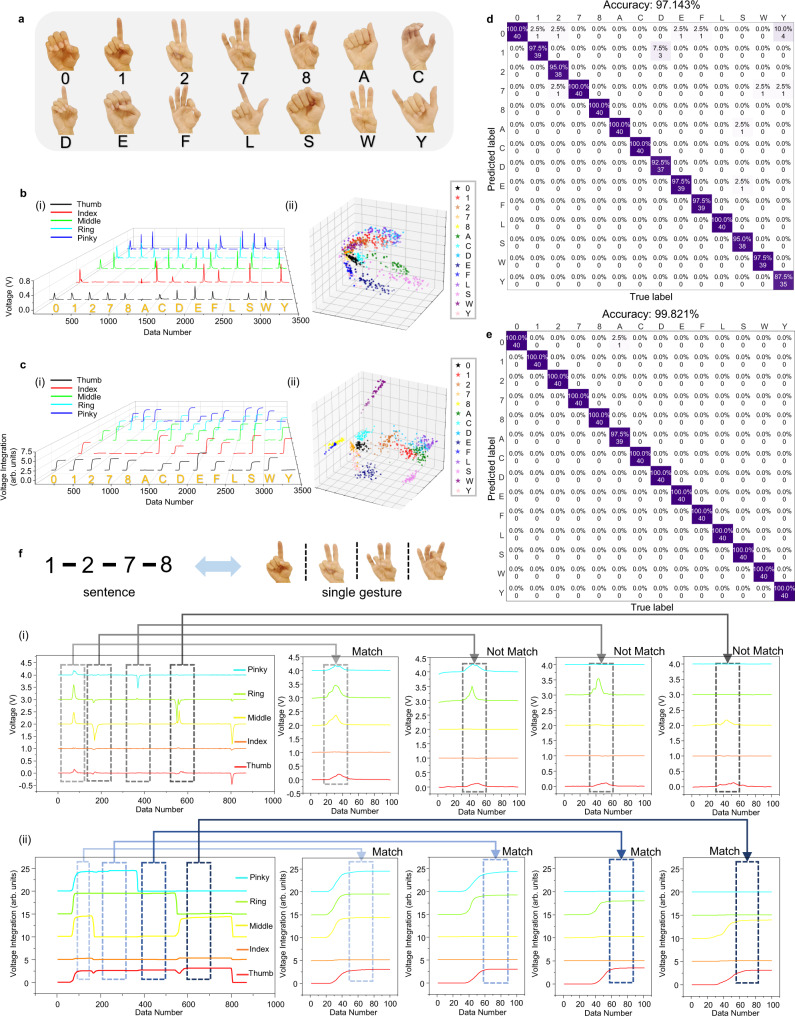
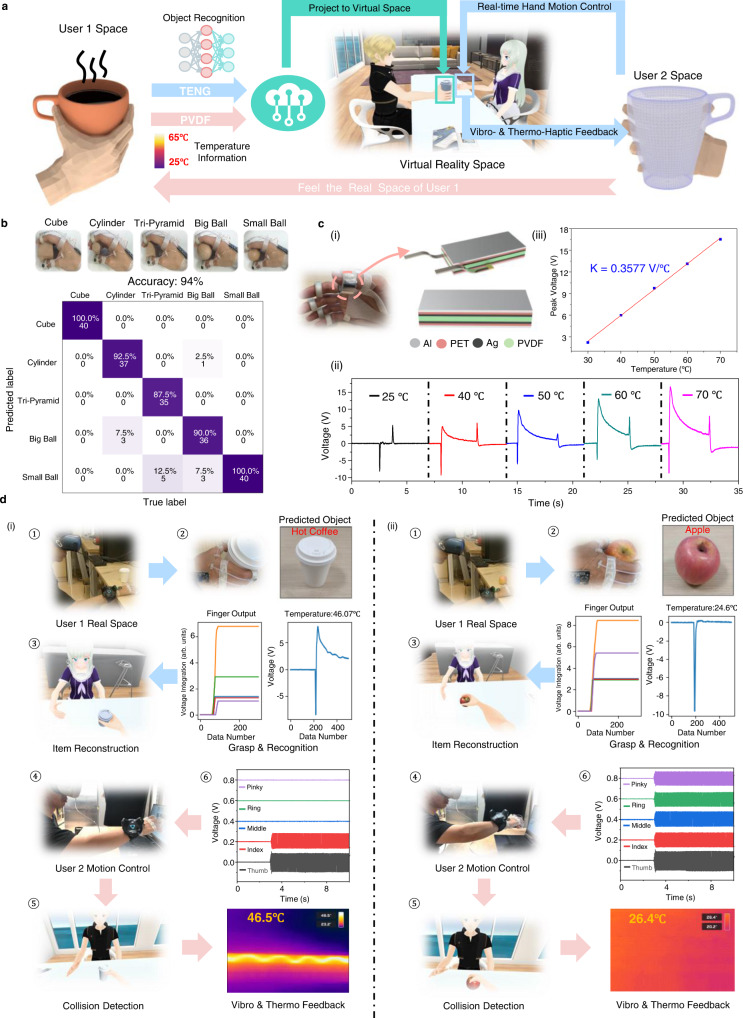
Advancements of virtual reality technology pave the way for developing wearable devices to enable somatosensory sensation, which can bring more comprehensive perception and feedback in the metaverse-based virtual society. Here, we propose augmented tactile-perception and haptic-feedback rings with multimodal sensing and feedback capabilities. This highly integrated ring consists of triboelectric and pyroelectric sensors for tactile and temperature perception, and vibrators and nichrome heaters for vibro- and thermo-haptic feedback. All these components integrated on the ring can be directly driven by a custom wireless platform of low power consumption for wearable/portable scenarios. With voltage integration processing, high-resolution continuous finger motion tracking is achieved via the triboelectric tactile sensor, which also contributes to superior performance in gesture/object recognition with artificial intelligence analysis. By fusing the multimodal sensing and feedback functions, an interactive metaverse platform with cross-space perception capability is successfully achieved, giving people a face-to-face like immersive virtual social experience.
Overview
The claims and statistics of this paper haven’t been checked yet.
Free: it reads the open-access text and checks the first 5 claims that cite a source we can check. Create a free account to check every claim.
Integrity signals
Registry
Cites
Statistics
Figures



Verification
Claims the paper makes
The claims and statistics of this paper haven’t been checked yet.
Free: it reads the open-access text and checks the first 5 claims that cite a source we can check. Create a free account to check every claim.
Claims other papers make about this one
Each is checked against this paper’s own text: does it say what the citing paper says it does?
In the citing paper
“Additionally, immersive interactions in virtual reality (Fig. 1g, h) 50,51 and driver behavior monitoring in intelligent vehicles (Fig. 1i) [52][53][54] rely on HMIP technology to accurately capture complex motion intentions.”
From Recent advances in intelligent wearable systems: from multiscale biomechanical features towards human motion intent prediction (2026) · cites this paper as [51]
Self-check
Percentages, sums and reported differences re-computed from the paper’s own numbers.
The self-check needs the paper’s full text.
Citations
Cites
Vision based hand gesture recognition for human computer interaction: a survey
Rautaray, S. S., & Agrawal, A. (2015) · Artificial Intelligence Review · doi:10.1007/s10462-012-9356-9 · Cited by 1,526
Learning the signatures of the human grasp using a scalable tactile glove
Sundaram, S., Kellnhofer, P., Li, Y., Zhu, J.-Y., Torralba, A., & Matusik, W. (2019) · Nature · doi:10.1038/s41586-019-1234-z · Cited by 1,162
Conductive Fiber‐Based Ultrasensitive Textile Pressure Sensor for Wearable Electronics
Lee, J., Kwon, H., Seo, J., Shin, S., Koo, J. H., Pang, C., Son, S., Kim, J. H., Jang, Y. H., Kim, D. E., et al. (2015) · Advanced Materials · doi:10.1002/adma.201500009 · Cited by 1,152
3D Virtual worlds and the metaverse: Current status and future possibilities
Dionisio, J. D. N., III, W. G. B., & Gilbert, R. (2013) · ACM Computing Surveys · doi:10.1145/2480741.2480751 · Cited by 1,151
Skin-integrated wireless haptic interfaces for virtual and augmented reality
Yu, X., Xie, Z., Yu, Y., Lee, J., Vazquez-Guardado, A., Luan, H., Ruban, J., Ning, X., Akhtar, A., Li, D., et al. (2019) · Nature · doi:10.1038/s41586-019-1687-0 · Cited by 1,025
Self-citationSign-to-speech translation using machine-learning-assisted stretchable sensor arrays
Zhou, Z., Chen, K., Li, X., Zhang, S., Wu, Y., Zhou, Y., Meng, K., Sun, C., He, Q., Fan, W., et al. (2020) · Nature Electronics · doi:10.1038/s41928-020-0428-6 · Cited by 841
Pyroelectric materials and devices for energy harvesting applications
Bowen, C. R., Taylor, J., LeBoulbar, E., Zabek, D., Chauhan, A., & Vaish, R. (2014) · Energy Environ. Sci. · doi:10.1039/c4ee01759e · Cited by 836
Highly Stretchable and Transparent Metal Nanowire Heater for Wearable Electronics Applications
Hong, S., Lee, H., Lee, J., Kwon, J., Han, S., Suh, Y. D., Cho, H., Shin, J., Yeo, J., & Ko, S. H. (2015) · Advanced Materials · doi:10.1002/adma.201500917 · Cited by 788
Pyroelectric Nanogenerators for Harvesting Thermoelectric Energy
Yang, Y., Guo, W., Pradel, K. C., Zhu, G., Zhou, Y., Zhang, Y., Hu, Y., Lin, L., & Wang, Z. L. (2012) · Nano Letters · doi:10.1021/nl3003039 · Cited by 784
Zhu, M., Sun, Z., Zhang, Z., Shi, Q., He, T., Liu, H., Chen, T., & Lee, C. (2020) · Science Advances · doi:10.1126/sciadv.aaz8693 · Cited by 784
Self-citation
Cited by
The Metaverse: A new digital frontier for consumer behavior
Hadi, R., Melumad, S., & Park, E. S. (2024) · Journal of Consumer Psychology · doi:10.1002/jcpy.1356 · Cited by 393
Yang, Y., Guo, X., Zhu, M., Sun, Z., Zhang, Z., He, T., & Lee, C. (2023) · Advanced Energy Materials · doi:10.1002/aenm.202203040 · Cited by 337
Self-citationTriboelectric tactile sensor for pressure and temperature sensing in high-temperature applications
Liu, Y., Wang, J., Liu, T., Wei, Z., Luo, B., Chi, M., Zhang, S., Cai, C., Gao, C., Zhao, T., et al. (2025) · Nature Communications · doi:10.1038/s41467-024-55771-0 · Cited by 291
Wang, H., Ding, Q., Luo, Y., Wu, Z., Yu, J., Chen, H., Zhou, Y., Zhang, H., Tao, K., Chen, X., et al. (2024) · Advanced Materials · doi:10.1002/adma.202309868 · Cited by 290
Soft Sensors and Actuators for Wearable Human–Machine Interfaces
Park, J., Lee, Y., Cho, S., Choe, A., Yeom, J., Ro, Y. G., Kim, J., Kang, D.-H., Lee, S., & Ko, H. (2024) · Chemical Reviews · doi:10.1021/acs.chemrev.3c00356 · Cited by 272
Metadata
- Authors
- Sun, Z., Zhu, M., Shan, X., & Lee, C.
- Affiliations
- National University of Singapore (SG)
- Agency for Science, Technology and Research (SG)
- Corresponding author
- Lee, Chengkuo
- Venue
- Nature Communications
- Published
- 2022-09-05
- Volume
- 13
- Issue
- 1
- Pages
- 5224-5224
- ISSN
- 2041-1723 (ISSN-L)
- PMC
- PMC9445040
- OpenAlex
- W4294677009
- Cited by
- 532
- References
- 70
- Citations by year
- 2026: 79 · 2025: 164 · 2024: 160 · 2023: 120 · 2022: 9
- FWCI
- 32.87
- Type
- journal article
- Language
- en
- Open access
- gold
- doi.org
- Licence
- cc-by
- creativecommons.org/licenses/by/4.0 (tdm)
- creativecommons.org/licenses/by/4.0 (vor)
- Locations
- Nature Communications (publishedVersion, cc-by)
- PubMed Central (publishedVersion, cc-by)
- PubMed (publishedVersion)
- RePEc: Research Papers in Economics (submittedVersion)
- DOAJ (DOAJ: Directory of Open Access Journals) (submittedVersion, cc-by-sa)
- Funders
- National University of Singapore (A-0005947-20-00)
- National Key Research and Development Program of China (2019YFB2004800, R‐2020‐S‐002)
- Topics
- Physical Sciences › Engineering › Biomedical Engineering › Advanced Sensor and Energy Harvesting Materials
- Life Sciences › Neuroscience › Cognitive Neuroscience › Tactile and Sensory Interactions
- Physical Sciences › Engineering › Mechanical Engineering › Teleoperation and Haptic Systems
- Keywords
- wearable devices, virtual reality, somatosensory perception, gesture recognition, multimodal sensing, metaverse
- MeSH terms
- Haptic Technology, Artificial Intelligence, Feedback, Humans, Touch, Touch Perception
About these checks
Registry, retraction, Cites and statistics results are computed, not judged, with one exception: a printed reference that no index lists is read once by a model before it counts as a citation error. Claims are extracted by a model and kept only when their quote appears verbatim in the text; each cited source is then checked, with a model’s help, for whether it says what the claim relies on. Those verdicts can be wrong — read the claim’s quote and the cited source before relying on one.
Statistics and arithmetic are recomputed, not judged.
Confidence bands are shown only for fields calibrated on our annotated test set. None is calibrated yet, so no band is shown.
What counts as a claim ›How we measure confidence ›How we check this ›
Are you an author, or do you see a problem with this page? Request a review
How to cite
Cite CoChat for the checks on this page, and the paper for its own findings.
- This page
- CoChat. (2026). Citation check: Augmented tactile-perception and haptic-feedback rings as human-machine interfaces aiming for immersive interactions. https://app.cochat.ai/papers/10.1038/s41467-022-32745-8
- The paper
- Sun, Z., Zhu, M., Shan, X., & Lee, C. (2022). Augmented tactile-perception and haptic-feedback rings as human-machine interfaces aiming for immersive interactions. Nature Communications. https://doi.org/10.1038/s41467-022-32745-8
Data sources
Bibliographic data: Semantic Scholar, OpenAlex, Crossref.
Contains information from the Semantic Scholar Academic Graph Datasets, made available under the ODC Attribution License (ODC-BY 1.0).
Semantic Scholar’s data is described in: Kinney, R., et al. (2023). The Semantic Scholar Open Data Platform. arXiv:2301.10140.
