

Sexually dimorphic estrogen sensing in skeletal stem cells controls skeletal regeneration
Open accessThe DOI matches its Crossref record; 73 of the 73 references it cites were found in a registry or an index.
Abstract
Sexually dimorphic tissues are formed by cells that are regulated by sex hormones. While a number of systemic hormones and transcription factors are known to regulate proliferation and differentiation of osteoblasts and osteoclasts, the mechanisms that determine sexually dimorphic differences in bone regeneration are unclear. To explore how sex hormones regulate bone regeneration, we compared bone fracture repair between adult male and female mice. We found that skeletal stem cell (SSC) mediated regeneration in female mice is dependent on estrogen signaling but SSCs from male mice do not exhibit similar estrogen responsiveness. Mechanistically, we found that estrogen acts directly on the SSC lineage in mice and humans by up-regulating multiple skeletogenic pathways and is necessary for the stem cell’s ability to self- renew and differentiate. Our results also suggest a clinically applicable strategy to accelerate bone healing using localized estrogen hormone therapy.
Overview
The claims and statistics of this paper haven’t been checked yet.
Free: it reads the open-access text and checks the first 5 claims that cite a source we can check. Create a free account to check every claim.
Integrity signals
Registry
Cites
Statistics
Figures
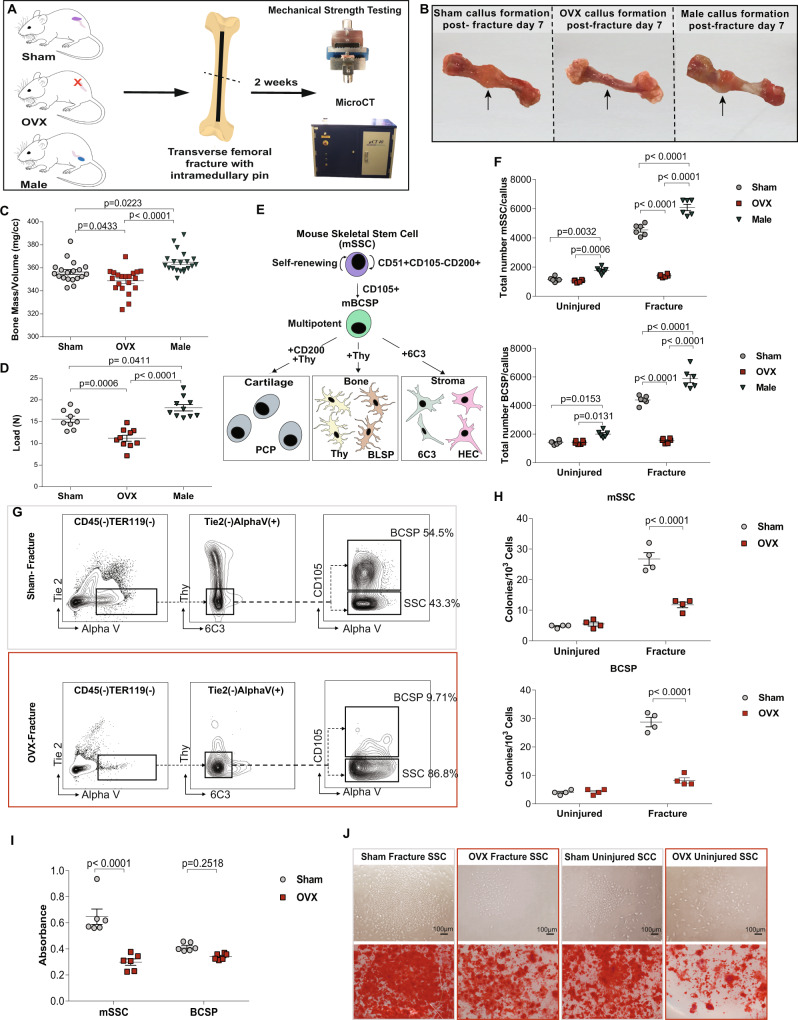
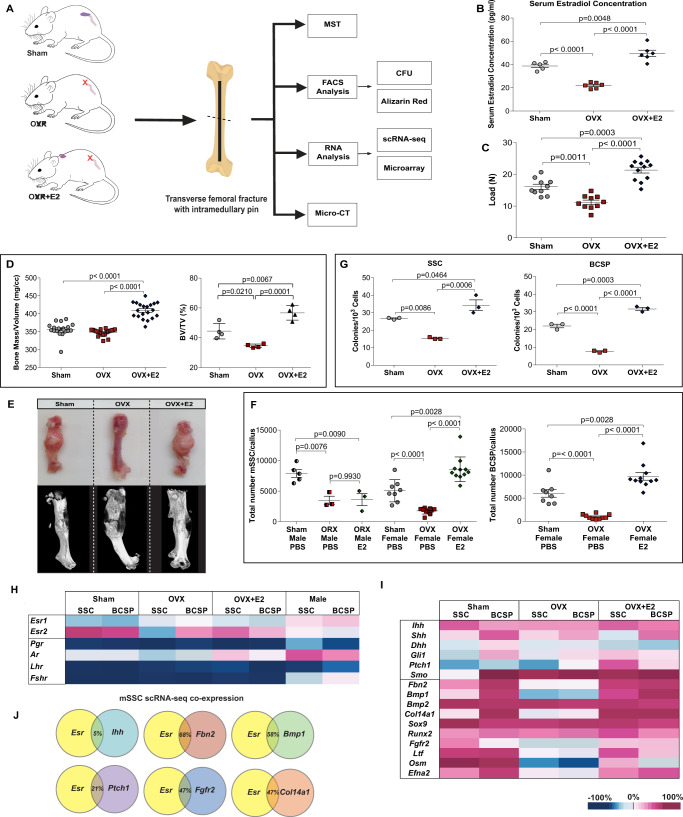
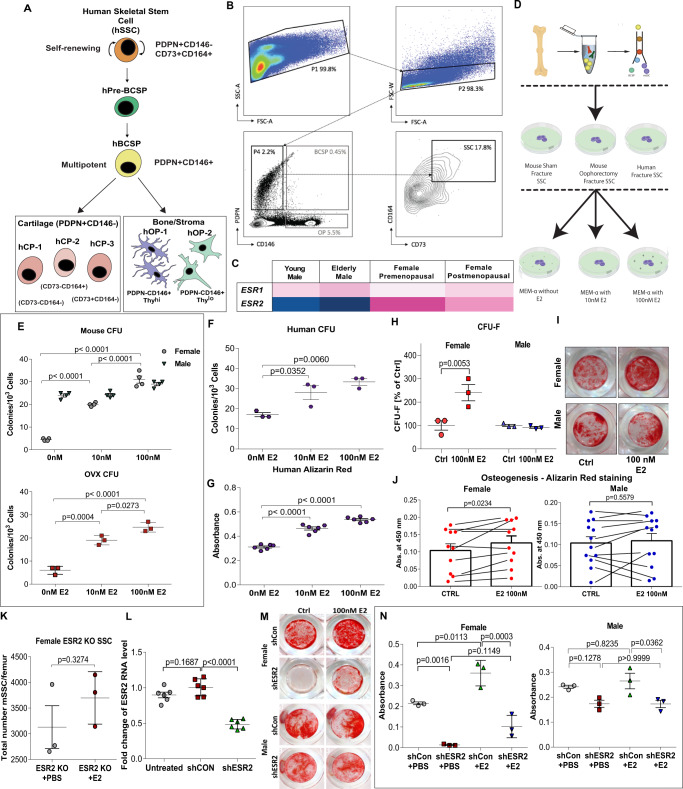
![Fig. 4 Localized delivery of 17-beta estradiol rescues SSC expansion in skeletal regeneration. A Schematic of unilateral localized delivery of 17-beta estradiol PLGA nanoparticle scaffold (OVX + LE2) and contralateral PBS PLGA nanoparticle scaffold (OVX + PBS). Representative images demonstrate a smaller callus in the OXR + PBS (top) compared to OVX + LE2 (bottom) fracture callus at post fracture day 7. Black arrows point to areas of endochondral ossification. B Serum estradiol levels of sham vs OVX vs OVX + LE2 mice demonstrate no increase in serum estradiol levels in the localized rescue group (n = 6). C Assessment of bone mineral density (BMD) of trabecular bone in healing femora from sham (grey) vs OVX (red) vs OVX + LE2 (blue) mice (n = 10). D Maximal load to fracture (in newtons) of healing femora from sham vs OVX vs OVX vs OVX + LE2 mice (n = 10)]. E, F Relative rescue of absolute cell numbers of mSSCs (E) and BCSPs (F) in sham (grey) vs OVX with sham local rescue (red) vs OVX with localized E2 mice (blue) (n = 5) (mSSCs and BCSPs). No relative rescue in male mice with localized E2 (yellow) compared to male with sham local rescue (green). G, H Colony-forming assay of mSSCs (G) and BCSPs (H) isolated at post-fracture day 7 from Sham, OVX, and OVX + LE2 mice. mSSCs and mBCSP were plated in biological and technical triplicates. I Schematic showing the effect of stimulation ESR2 on postmenopausal osteoporosis and the related protein interaction pathways. J Schematic showing the cellular and molecular mechanisms underlying impaired ovariectomized skeletal regeneration. Sham environment (left), OVX environment (center), and impaired fracture repair in OVX environment can be rescued by supplying localized E2 sensing (right). The data in B,C,D,E,F,G,H are expressed as the means ± s.e.m; ordinary two-way ANOVA followed by Tukey’s multiple comparisons test; exact P value are indicated in the figures. For data and statistics, see Source Data File.](https://figures.cochat.ai/paper-figures/42d1dafb13f845f69d3e14eca3480940/sexually-dimorphic-estrogen-sensing-in-skeletal-stem-cells-controls-skeletal-figure-4.jpg)
Verification
Claims the paper makes
The claims and statistics of this paper haven’t been checked yet.
Free: it reads the open-access text and checks the first 5 claims that cite a source we can check. Create a free account to check every claim.
Claims other papers make about this one
Each is checked against this paper’s own text: does it say what the citing paper says it does?
The source backs part of the claim, not all of it — or backs it for a different population, condition or comparison.
In the citing paper
“Estrogen also directly regulates skeletal stem cell regeneration in both mice and humans but does not directly affect osteoclast function.”
From Osteoimmunology of Fracture Healing. (2024) · cites this paper as [97]
Experimental — accuracy not yet measuredThe source backs part of the claim, not all of it — or backs it for a different population, condition or comparison.
In the citing paper
“Loss of function in post-menopausal women could be rescued with E2 treatments [97].”
From Osteoimmunology of Fracture Healing. (2024) · cites this paper as [97]
Experimental — accuracy not yet measuredThe cited source says what the claim attributes to it.
In the citing paper
“Estrogen also directly regulates skeletal stem cell regeneration in both mice and humans but does not directly affect osteoclast function.”
From Osteoimmunology of Fracture Healing. (2024) · cites this paper as [97]
Self-check
Percentages, sums and reported differences re-computed from the paper’s own numbers.
The self-check needs the paper’s full text.
Citations
Cites
STAR: ultrafast universal RNA-seq aligner
Dobin, A., Davis, C. A., Schlesinger, F., Drenkow, J., Zaleski, C., Jha, S., Batut, P., Chaisson, M., & Gingeras, T. R. (2013) · Bioinformatics · doi:10.1093/bioinformatics/bts635 · Cited by 51,709 · cited 1×
“M20 usingSTARv.2.6.1plus 69 (withanaverageof more than 70% of uniquely mapped reads), and counts per million (CPM) was calculated using RSEM v.1.3.1plus 70 .”
InfluentialRSEM: accurate transcript quantification from RNA-Seq data with or without a reference genome
Li, B., & Dewey, C. N. (2011) · BMC Bioinformatics · doi:10.1186/1471-2105-12-323 · Cited by 22,179
SCANPY: large-scale single-cell gene expression data analysis
Wolf, F. A., Angerer, P., & Theis, F. J. (2018) · Genome Biology · doi:10.1186/s13059-017-1382-0 · Cited by 8,881
Epidemiology and outcomes of osteoporotic fractures
Cummings, S. R., & Melton, L. J. (2002) · The Lancet · doi:10.1016/s0140-6736(02)08657-9 · Cited by 3,821
Breast cancer and hormone-replacement therapy in the Million Women Study
(2003) · The Lancet · doi:10.1016/s0140-6736(03)14065-2 · Cited by 2,993
Therapeutic Approaches to Bone Diseases
Rodan, G. A., & Martin, T. J. (2000) · Science · doi:10.1126/science.289.5484.1508 · Cited by 1,767 · cited 2×
“It is well accepted that bone loss in OVX mice is the result of an imbalance of bone deposition and resorption leading to reduced skeletal mass and structural deterioration of skeletal tissue 5,29 .”
Black, D. M., & Rosen, C. J. (2016) · New England Journal of Medicine · doi:10.1056/nejmcp1513724 · Cited by 1,712
Reaching a Genetic and Molecular Understanding of Skeletal Development
Karsenty, G., & Wagner, E. F. (2002) · Developmental Cell · doi:10.1016/s1534-5807(02)00157-0 · Cited by 1,601 · cited 1×
“While a number of systemic hormones and transcription factors are known to regulate proliferation and differentiation of osteoblasts and osteoclasts, the mechanisms that determine sexually dimorphic differences in bone regeneration have been elusive 5 – 7 .”
Skewer: a fast and accurate adapter trimmer for next-generation sequencing paired-end reads
Jiang, H., Lei, R., Ding, S.-W., & Zhu, S. (2014) · BMC Bioinformatics · doi:10.1186/1471-2105-15-182 · Cited by 1,521 · cited 1×
“Raw reads were further processed using skewer v.0.2.2 for 3 ′ quality trimming, 3 ′ adaptor trimming, and removal of degenerate reads 68 .”
InfluentialTargeting cellular senescence prevents age-related bone loss in mice
Farr, J. N., Xu, M., Weivoda, M. M., Monroe, D. G., Fraser, D. G., Onken, J. L., Negley, B. A., Sfeir, J. G., Ogrodnik, M. B., Hachfeld, C. M., et al. (2017) · Nature Medicine · doi:10.1038/nm.4385 · Cited by 1,182 · cited 2×
“…the bone healing de fi ciencies in OVX mice, we also observed that expression of several mediators of bone healing, including Indian Hedgehog ( Ihh ) 30 , Bone Morphogenetic Protein 1 ( Bmp1 ) 47 , Fibrillin 2 ( Fbn2 ) 48 , Fibroblast Growth Factor Receptor 2 ( Fgfr2 ) 49 , and Oncostatin-M ( Osm )…”
Research works printed but not linked: 1
- Robert D. Nerenz, Benjamin Boh, Tietz Textbook of Laboratory Medicine, (Seventh Edition): Reproductive endocrinology and related disorders Ch. 58 (Elsevier, 2022).
Cited by
Insights and implications of sexual dimorphism in osteoporosis
Zhang, Y., Xie, N., Sun, X., Nice, E. C., Liou, Y., Huang, C., Zhu, H., & Shen, Z. (2024) · Bone Research · doi:10.1038/s41413-023-00306-4 · Cited by 185
“32 The mortality rate following osteoporotic fractures is greater in men than in women.”
BackgroundA vertebral skeletal stem cell lineage driving metastasis
Sun, J., Hu, L., Bok, S., Yallowitz, A. R., Cung, M., McCormick, J., Zheng, L. J., Debnath, S., Niu, Y., Tan, A. Y., et al. (2023) · Nature · doi:10.1038/s41586-023-06519-1 · Cited by 102
Skeletal stem and progenitor cells in bone development and repair
Trompet, D., Melis, S., Chagin, A. S., & Maes, C. (2024) · Journal of Bone and Mineral Research · doi:10.1093/jbmr/zjae069 · Cited by 116
Osteoimmunology of Fracture Healing.
Molitoris, K. H., Huang, M., & Baht, G. S. (2024) · Current Osteoporosis Reports · doi:10.1007/s11914-024-00869-z · Cited by 84
Skeletal stem and progenitor cells in bone physiology, ageing and disease
Melis, S., Trompet, D., Chagin, A. S., & Maes, C. (2024) · Nature Reviews Endocrinology · doi:10.1038/s41574-024-01039-y · Cited by 104
“Local oestrogen administration could therapeutically improve bone regeneration 171 .”
Hydrogel Drug Delivery Systems for Bone Regeneration
Bai, L., Tao, G., Feng, M., Xie, Y., Cai, S., Peng, S., & Xiao, J. (2023) · Pharmaceutics · doi:10.3390/pharmaceutics15051334 · Cited by 75
The Role of Sex Differences in Bone Health and Healing
Ortona, E., Pagano, M. T., Capossela, L., & Malorni, W. (2023) · Biology · doi:10.3390/biology12070993 · Cited by 68
Cisneros, E. P., Morse, B. A., Savk, A., Malik, K., Peppas, N. A., & Lanier, O. L. (2024) · Journal of Nanobiotechnology · doi:10.1186/s12951-024-02954-y · Cited by 80
A maternal brain hormone that builds bone
Babey, M. E., Krause, W. C., Chen, K., Herber, C. B., Török, Z., Nikkanen, J., Rodríguez, R., Zhang, X., Navarro, F., Wang, Y., et al. (2024) · Nature · doi:10.1038/s41586-024-07634-3 · Cited by 65
Self-citationCrawford, A. J., Forjaz, A., Bons, J., Bhorkar, I., Roy, T., Schell, D., Queiroga, V., Ren, K., Kramer, D., Huang, W., et al. (2024) · Science Advances · doi:10.1126/sciadv.adp6285 · Cited by 30
“These assembloids were not stimulated with β - estradiol to best reflect the postmenopausal conditions of the reference fallopian tube donor, where estrogen levels are low ( 66 , 85 , 86 ) and fewer epithelial cells are ciliated ( 25 , 62 , 66 ).”
BackgroundBai, T., Li, X., Zhang, H., Yang, W., Lv, C., Du, X., Xu, S., Zhao, A., & Xi, Y. (2024) · Environmental Research · doi:10.1016/j.envres.2024.118580 · Cited by 20
Global burden, trends and forecast analysis of extremity fractures based on GBD 2021
Wang, X., Huang, J.-W., Hu, J., Ma, X., Huang, Z. Y., Zhu, J., Zhu, K., & Zhang, C. (2025) · International Journal of Surgery · doi:10.1097/js9.0000000000002449 · Cited by 18
Treating sex and gender differences as a continuous variable can improve precision cancer treatments
Yang, W., & Rubin, J. B. (2024) · Biology of Sex Differences · doi:10.1186/s13293-024-00607-1 · Cited by 17
“…including response to genotoxic stress [3, 4], DNA repair [5, 6], mutational burden and oncogenic mechanisms [7, 8], metabolism [9, 10], and cell cycle regulation [11–13], as well as in systems biology including: immunity [14], metabolism [15, 16], tissue repair [17, 18], and longevity [19, 20].”
BackgroundDecoene, I., Svitina, H. M., Hamed, M. B., Economou, A., Stegen, S., Luyten, F. P., & Papantoniou, I. (2025) · Bone Research · doi:10.1038/s41413-025-00418-z · Cited by 22
“…potentially requiring different protocols speci fi c for patient populations based on biological sex, 114 including the addition of hormones at the proliferation stage, 106,115,116 or adaptive supplementation of additional growth factors to guide cell fate towards the hypertrophic lineage.”
Effects of Aging on the Immune and Periosteal Response to Fracture in Mice
King, J. S., Wan, M., Kim, A., Prabhu, S., Novak, S., Kalajzić, I., Delany, A. M., & Sanjay, A. (2024) · Bone · doi:10.1016/j.bone.2025.117524 · Cited by 9
Analyzing Sex-Specific Dimorphism in Human Skeletal Stem Cells
Niemann, T., Joneleit, J., Storm, J., Nacke, T., Wähnert, D., Kaltschmidt, C., Vordemvenne, T., & Kaltschmidt, B. (2023) · Cells · doi:10.3390/cells12232683 · Cited by 9
“According to a murine study by Andrew and coworkers, skeletal stem cell-mediated bone regeneration in females is driven by estrogen signaling, while the male counterpart does not respond to estrogen [21].”
BackgroundEffects of Immobilization and Swimming on the Progression of Osteoarthritis in Mice
Xue, T., Ning, K., Yang, B., Dou, X., Liu, S., Wang, D., & Xu, H. (2022) · International Journal of Molecular Sciences · doi:10.3390/ijms24010535 · Cited by 8
“Moreover, only male rats were used in this study, but it is worth noting that a sexually dimorphic phenomenon was found in some previous studies [46].”
MethodPrecision-engineered biomimetics: the human fallopian tubePreprint
Crawford, A. J., Forjaz, A., Bhorkar, I., Roy, T., Schell, D., Queiroga, V., Ren, K., Kramer, D., Bons, J., Huang, W., et al. (2023) · bioRxiv (Cold Spring Harbor Laboratory) · doi:10.1101/2023.06.06.543923 · Cited by 8
Whitfield, T., Hosseini, F. S., Orlando, J. D., Deng, C., Lo, K. W. ‐., Kan, H.-M., Ghosh, D., Sydlik, S. A., & Laurencin, C. T. (2025) · Regenerative Biomaterials · doi:10.1093/rb/rbaf074 · Cited by 9
“Many groups have shown sex-dependent differences in fracture healing such as Andrew et al . who demonstrated that female mice have more estrogen receptor 2 on their skeletal stem cells, leaving them dependent upon estradiol during fracture healing while male mice were unresponsive to it [113].”
Deciphering the skeletal interoceptive circuitry to control bone homeostasis
Wu, Y., Guo, J., Chen, Z., Zhang, F., Chow, B., Chen, Z., Yeung, K., & Qiao, W. (2025) · BMEMat · doi:10.1002/bmm2.12138 · Cited by 8
Ragab, M., Wieland, J., de Melo, C. W. Á., Agibalova, T., Ermolova, A., Durner, N., Hempel, A., Heindl, F., Maurer, H. C., Steiger, K., et al. (2025) · Journal of Crohn s and Colitis · doi:10.1093/ecco-jcc/jjaf038 · Cited by 7
“55,57 Berger et al. highlighted the presence of sexual dimorphism in the response of colonoids to pharmacological M3R modulation in the context of pre-natal stress.”
Li, X., Zheng, N., Zhang, W., Yu, Y., Li, Y., Sun, S., Ji, Y., & Wang, S. (2024) · Ecotoxicology and Environmental Safety · doi:10.1016/j.ecoenv.2024.117353 · Cited by 6
Yang, X., Li, Y., Guo, J., Wang, J., Li, S., Yang, Z., Niu, P. C., Jiang, Y., Song, M., & Hai, Y. (2025) · Frontiers in Pharmacology · doi:10.3389/fphar.2025.1530194 · Cited by 5
Xiao, X., Chen, L., Deng, M., Liu, J., Cai, J., & Su, C. (2025) · Geriatrics · doi:10.3390/geriatrics10030066 · Cited by 4
Shira, K. A., Murdoch, B. M., Davenport, K. M., Becker, G. M., Xie, S., Colacchio, A. M., Bass, P. D., Colle, M. J., & Murdoch, G. K. (2023) · Genes · doi:10.3390/genes14081629 · Cited by 3
Guo, Q., Zhao, H., Dong, Z., Cheng, H., Zhu, M., & Fang, Z. (2024) · Aging and Disease · doi:10.14336/ad.2024.0201 · Cited by 13
Weldon, K. C., Longaker, M. T., & Ambrosi, T. H. (2025) · Stem Cells · doi:10.1093/stmcls/sxaf006 · Cited by 5
Self-citationDonor Variability and 3D Culture Models Influence Human Mesenchymal Stem Cell Differentiation
Jones, S., Tai, M., Ayushman, M., Peasah, A. D., Johannsen, J., & Yang, F. (2026) · Tissue Engineering Part A · doi:10.1089/ten.tea.2025.0028 · Cited by 8
Self-citationSkeletal Stem Cells: A Basis for Orthopaedic Pathology and Tissue Repair
Cong, T., Morse, K. W., Sosa, B. R., Lane, J. M., Rodeo, S. A., & Greenblatt, M. B. (2024) · Journal of Bone and Joint Surgery · doi:10.2106/jbjs.24.00905 · Cited by 3
Sex differences in oncology: from molecular mechanisms to personalized therapy
Frantsiyants, E. M., Bandovkina, V. A., Shikhlyarova, A. I., Surikova, E. I., Neskubina, I. V., & Cheryarina, N. D. (2026) · South Russian Journal of Cancer · doi:10.37748/2686-9039-2026-7-1-6 · Cited by 2
Accounting for sex differences as a continuous variable in cancer treatmentsPreprint
Rubin, J. B., & Yang, W. (2023) · Research Square · doi:10.21203/rs.3.rs-3120372/v1 · Cited by 4
Brain-Derived CCN3 Is An Osteoanabolic Hormone That Sustains Bone in Lactating FemalesPreprint
Babey, M. E., Krause, W. C., Herber, C. B., Chen, K., Nikkanen, J., Rodriquez, R. G., Zhang, X., Navarro, F., Wang, Y., Villeda, S., et al. (2023) · bioRxiv (Cold Spring Harbor Laboratory) · doi:10.1101/2023.08.28.554707 · Cited by 2
Self-citationAge-dependent development of the interincisive suture: a CT-based study on prevalence and dimensions
Graef, J. J., Staeber, M., Schmeißer, M. J., & Schumann, S. (2025) · Anatomical Science International · doi:10.1007/s12565-025-00901-x · Cited by 1
“Although modest, these sex differences suggest the influence of biological factors, such as hormonal regulation, that contribute to suture maturation in a sex-specific manner (Andrew et al. 2022).”
Osteocytic FSH inhibition rescues bone mass and boosts fracture healing in ovariectomized mice
Liu, Z., Sun, M., Zhou, H., Cheng, L.-B., Li, X., Chen, B., Wang, C., Li, C. R., Wang, D., Li, Y., et al. (2025) · Life Sciences · doi:10.1016/j.lfs.2025.124121 · Cited by 1
Bone biology in aging periodontal and peri‐implant tissues
Issa, D. R., Intini, G., & Clark, D. (2026) · Periodontology 2000 · doi:10.1111/prd.70035 · Cited by 2
Accounting for sex differences variability in the design of sex-adapted cancer treatmentsPreprint
Yang, W., & Rubin, J. B. (2023) · medRxiv · doi:10.1101/2023.04.22.23288966
“…in cell biology including, response to genotoxic stress [3, 4], DNA repair [5, 6], mutational burden [7, 8], metabolism [9, 10], and cell cycle regulation [11-13], as well as in systems biology including: immunity [14], metabolism [15, 16], tissue repair [17, 18], and longevity [19, 20].”
What’s New in Musculoskeletal Basic Science
Gugala, Z. (2023) · Journal of Bone and Joint Surgery · doi:10.2106/jbjs.23.01003
Effects of Aging on the Immune and Periosteal Response to Fracture in MicePreprint
King, J. S., Wan, M., Kim, A., Novak, S., Prabhu, S., Kalajzić, I., Delany, A. M., & Sanjay, A. (2024) · bioRxiv (Cold Spring Harbor Laboratory) · doi:10.1101/2024.11.06.622348
Cabrera-Pérez, R., Carreras‐Sánchez, I., Roig-Molina, Á., López‐Fernández, A., Portas-Torres, I., Batlle‐Morera, L., Vélez, R., & Vives, J. (2025) · Cells · doi:10.3390/cells14120862
“A higher sensitivity to sex hormones and thus, ovarian function, has been described as the main cause accounting for this sexually dimorphic response [56,57].”
Кірюк, М. О. (2025) · Oral and General Health · doi:10.22141/ogh.6.2.2025.231
Yang, W., & Rubin, J. B. (2024) · Figshare · doi:10.6084/m9.figshare.26706948
Yang, W., & Rubin, J. B. (2024) · Figshare · doi:10.6084/m9.figshare.26706945
Yang, W., & Rubin, J. B. (2024) · Figshare · doi:10.6084/m9.figshare.25609267
Yang, W., & Rubin, J. B. (2024) · Figshare · doi:10.6084/m9.figshare.25608807
Yang, W., & Rubin, J. B. (2024) · Figshare · doi:10.6084/m9.figshare.26706939
Yang, W., & Rubin, J. B. (2024) · Figshare · doi:10.6084/m9.figshare.26706942
Yang, W., & Rubin, J. B. (2024) · Figshare · doi:10.6084/m9.figshare.26706936
Lima, L. C. D., Cavalcante, I. R., Rocha, F. E. O., Jorge, J. O., Martins, T., Madeira, M. F. M., Campagnole‐Santos, M. J., Macari, S., Nascentes, C. C., Nunes, E. H. M., et al. (2026) · Calcified Tissue International · doi:10.1007/s00223-025-01465-8
FSH Signaling in Osteoporosis and Alzheimer’s Disease
Sims, S. L., Şen, F., Korkmaz, F., Barak, O., Cheliadinova, U., Yuen, T., Zaidi, M., & Kim, S. (2026) · Current Osteoporosis Reports · doi:10.1007/s11914-026-00958-1
Waheed, H., Khurshid, T., Dildar, N., & Qamar, A. (2026) · Asian Journal of Neurosurgery · doi:10.1055/s-0046-1820446
“34,35 A statistically signi fi - cant effect of sex on TD ( p 0.001) was observed, with males exhibiting larger mean values than females.”
InfluentialHan, Y. K., Jang, G., Park, Y. R., Lim, H. J., & Park, K. M. (2026) · Naunyn-Schmiedeberg s Archives of Pharmacology · doi:10.1007/s00210-026-05405-7
“Estrogen, a principal female sex hormone, promotes wound healing by regulating cellular growth, development, differentiation, proliferation, and immune responses (Campbell et al. 2010; Villa et al. 2015; Andrew et al. 2022).”
Staubli, F., Man, K., de Silva, L. S., Nurmohamed, S. J., Janssen, N. G., Bergsma, J. E., Longoni, A., & Gawlitta, D. (2026) · Regenerative Biomaterials · doi:10.1093/rb/rbag125
“This placed both CMs and autografts in a hormonally dynamic context, where sex hormones may influence bone turnover and healing kinetics [44, 45].”
The role and therapeutic potential of vitamins in fracture healing
Yu, Q., Yu, G., Dong, H., Wang, C., Guan, M., Shi, B., & Li, Z. (2026) · Nutrition Journal · doi:10.1186/s12937-026-01360-4 · Cited by 1
“The fracture healing process is influenced by a multitude of factors, including inflammatory mediators, mechanical signals, hypoxic conditions, aging, pharmacological effects, and lifestyle-related factors of the patient [5–9].”
Addressing Overlooked Variables in Preclinical Fracture Repair Research for Improved Translation
Capobianco, C., Schmidt‐Bleek, K., Haffner‐Luntzer, M., Bahney, C. S., Roberts, J. L., Silva, M. J., & Lang, A. (2026) · Journal of Orthopaedic Research® · doi:10.1002/jor.70268
Skeletal stem and progenitor cell niche organization, regulation and repair
Chen, K., & Ambrosi, T. H. (2026) · Reviews in Endocrine and Metabolic Disorders · doi:10.1007/s11154-026-10080-3 · Cited by 1
Self-citation
Metadata
- Authors
- Andrew, T. W., Koepke, L. S., Wang, Y., Lopez, M., Steininger, H., Struck, D., Boyko, T., Ambrosi, T. H., Tong, X., Sun, Y., Gulati, G. S., Murphy, M. P., Marecic, O., Tevlin, R., Schallmoser, K., Strunk, D., Seita, J., Goodman, S. B., Yang, F., Longaker, M. T., Yang, G. P., & Chan, C. K. F.
- Affiliations
- Stanford Medicine (US)
- Stanford University (US)
- University of Alabama at Birmingham (US)
- Stanford Health Care (US)
- University of Salzburg (AT)
- RIKEN (JP)
- Corresponding author
- Yang, George P.
- Chan, Charles K. F.
- ORCID
- Andrew, Tom W.
- Wang, Yuting
- Steininger, Holly
- Struck, Danielle
- Boyko, Tatiana
- Ambrosi, Thomas H.
- Tong, Xinming
- Sun, Yuxi
- Gulati, Gunsagar S.
- Murphy, Matthew P.
- Marecic, Owen
- Tevlin, Ruth
- Schallmoser, Katharina
- Strunk, Dirk
- Seita, Jun
- Goodman, Stuart B.
- Yang, Fan
- Longaker, Michael T.
- Yang, George P.
- Chan, Charles K. F.
- Venue
- Nature Communications
- Published
- 2022-10-30
- Volume
- 13
- Issue
- 1
- Pages
- 6491-6491
- ISSN
- 2041-1723 (ISSN-L)
- PMC
- PMC9618571
- OpenAlex
- W4307953166
- Semantic Scholar
- f051b117eac9592f0ed522d7d2a94f20be1fcc30
- Cited by
- 51
- References
- 73
- Citations by year
- 2026: 10 · 2025: 14 · 2024: 16 · 2023: 10 · 2022: 1
- FWCI
- 3.67
- Type
- journal article
- Language
- en
- Update notices
- correction (2024-09-13)
- Open access
- gold
- doi.org
- Licence
- cc-by
- creativecommons.org/licenses/by/4.0 (tdm)
- creativecommons.org/licenses/by/4.0 (vor)
- Locations
- Nature Communications (publishedVersion, cc-by)
- PubMed Central (publishedVersion, cc-by)
- PubMed (publishedVersion)
- eScholarship (California Digital Library) (submittedVersion, cc-by)
- RePEc: Research Papers in Economics (submittedVersion)
- DOAJ (DOAJ: Directory of Open Access Journals) (submittedVersion, cc-by-sa)
- Funders
- U.S. Department of Veterans Affairs (I01 BX003754)
- Prostate Cancer Foundation
- Arthritis National Research Foundation
- American Federation for Aging Research
- Oak Foundation
- European Commission (733006, HORIZON2020, 731377)
- National Research Foundation
- Deutsche Forschungsgemeinschaft (733006, 399915929)
- National Institutes of Health (I01BX003754, 1s10od023497-01, S10 RR02933801, 1s10od028493-01a1)
- National Institute on Aging (K99AG066963, K99-R00AG049958-01A1, R00AG049958)
- National Heart, Lung, and Blood Institute (U01HL099776)
- National Institute of General Medical Sciences (K08GM069677)
- National Institute of Dental and Craniofacial Research (R56DE025597, R21DE024230, R21DE019274, U24DE026914, R01DE026730, R01DE021683, R01DE027323)
- Topics
- Life Sciences › Biochemistry, Genetics and Molecular Biology › Molecular Biology › Bone Metabolism and Diseases
- Health Sciences › Medicine › Orthopedics and Sports Medicine › Bone health and osteoporosis research
- Life Sciences › Biochemistry, Genetics and Molecular Biology › Cell Biology › Mesenchymal stem cell research
- Keywords
- skeletal stem cells, estrogen signaling, sex differences, bone regeneration, fracture healing, osteogenic differentiation, osteoclastogenesis, stem cell self-renewal, sex hormones
- MeSH terms
- Animals, Cell Differentiation, Estrogens, Female, Humans, Male, Osteoblasts, Osteoclasts, Stem Cells, Mice
About these checks
Registry, retraction, Cites and statistics results are computed, not judged, with one exception: a printed reference that no index lists is read once by a model before it counts as a citation error. Claims are extracted by a model and kept only when their quote appears verbatim in the text; each cited source is then checked, with a model’s help, for whether it says what the claim relies on. Those verdicts can be wrong — read the claim’s quote and the cited source before relying on one.
Statistics and arithmetic are recomputed, not judged.
Confidence bands are shown only for fields calibrated on our annotated test set. None is calibrated yet, so no band is shown.
What counts as a claim ›How we measure confidence ›How we check this ›
Are you an author, or do you see a problem with this page? Request a review
Data sources
Bibliographic data: Semantic Scholar, OpenAlex, Crossref.
Contains information from the Semantic Scholar Academic Graph Datasets, made available under the ODC Attribution License (ODC-BY 1.0).
Semantic Scholar’s data is described in: Kinney, R., et al. (2023). The Semantic Scholar Open Data Platform. arXiv:2301.10140.
