

The DOI matches its Crossref record; its reference list is not available.
Improving de novo protein binder design with deep learning
Open accessPublished version of a preprint
Abstract
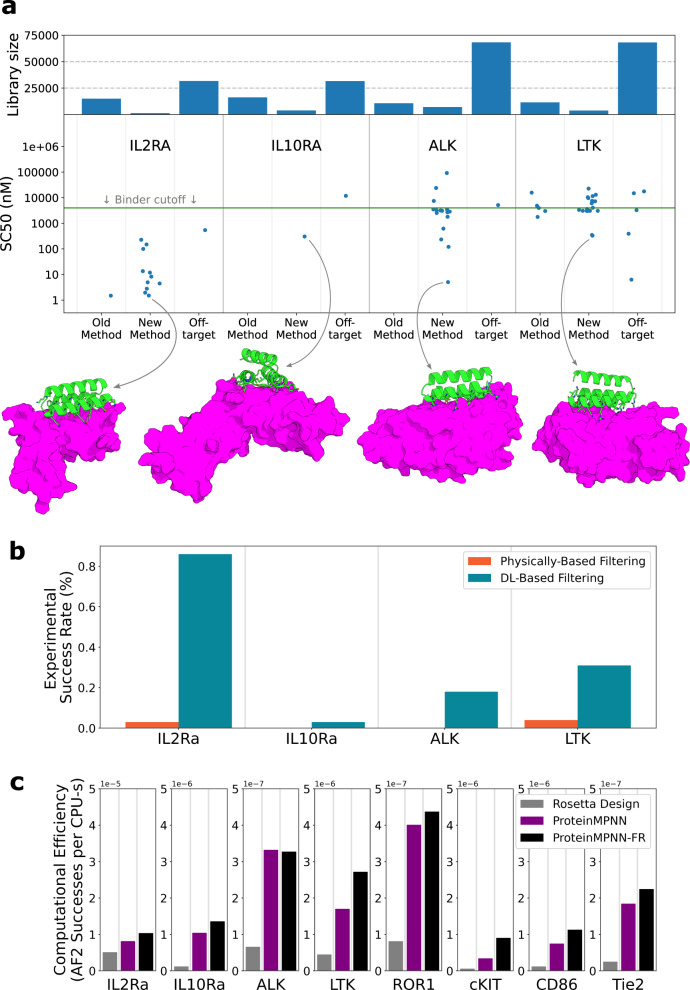
Recently it has become possible to de novo design high affinity protein binding proteins from target structural information alone. There is, however, considerable room for improvement as the overall design success rate is low. Here, we explore the augmentation of energy-based protein binder design using deep learning. We find that using AlphaFold2 or RoseTTAFold to assess the probability that a designed sequence adopts the designed monomer structure, and the probability that this structure binds the target as designed, increases design success rates nearly 10-fold. We find further that sequence design using ProteinMPNN rather than Rosetta considerably increases computational efficiency.
Overview
The claims and statistics of this paper haven’t been checked yet.
Free: it reads the open-access text and checks the first 5 claims that cite a source we can check. Create a free account to check every claim.
Integrity signals
Registry
Cites
Statistics
Figures

Verification
Claims the paper makes
The claims and statistics of this paper haven’t been checked yet.
Free: it reads the open-access text and checks the first 5 claims that cite a source we can check. Create a free account to check every claim.
Claims other papers make about this one
Each is checked against this paper’s own text: does it say what the citing paper says it does?
The source backs part of the claim, not all of it — or backs it for a different population, condition or comparison.
In the citing paper
“This measure of in silico success has been found to correlate with experimental success4,7,26 and is significantly more stringent than template modelling (TM)-score-based metrics used elsewhere5,16,27–29”
From De novo design of protein structure and function with RFdiffusion (2023) · cites this paper as [26]
Experimental — accuracy not yet measuredThe source backs part of the claim, not all of it — or backs it for a different population, condition or comparison.
In the citing paper
“RFdiffusion, when combined with improved filtering26 raises experimental success rates by two orders of magnitude”
From De novo design of protein structure and function with RFdiffusion (2023) · cites this paper as [26]
Experimental — accuracy not yet measuredThe source backs part of the claim, not all of it — or backs it for a different population, condition or comparison.
In the citing paper
“subsequently, using ProteinMPNN for sequence design and AF2 for design filtering was found to improve design success rates26”
From De novo design of protein structure and function with RFdiffusion (2023) · cites this paper as [26]
Experimental — accuracy not yet measured
Self-check
Percentages, sums and reported differences re-computed from the paper’s own numbers.
The self-check needs the paper’s full text.
Citations
No citation lists for this paper
No citation lists for this paper yet — checked again daily.
References 41 · Cited by 402
Metadata
- Authors
- Bennett, N. R., Coventry, B., Goreshnik, I., Huang, B., Allen, A., Vafeados, D., Peng, Y. P., Dauparas, J., Baek, M., Stewart, L., DiMaio, F., De Munck, S., Savvides, S. N., & Baker, D.
- Affiliations
- University of Washington (US)
- Howard Hughes Medical Institute (US)
- Ghent University (BE)
- Corresponding author
- Baker, David
- ORCID
- Venue
- Nature Communications
- Published
- 2023-05-06
- Volume
- 14
- Issue
- 1
- Pages
- 2625-2625
- ISSN
- 2041-1723 (ISSN-L)
- PMC
- PMC10163288
- OpenAlex
- W4375856225
- Cited by
- 402
- References
- 41
- Citations by year
- 2026: 126 · 2025: 161 · 2024: 83 · 2023: 28
- FWCI
- 35.35
- Type
- journal article
- Language
- en
- Open access
- gold
- doi.org
- Licence
- cc-by
- creativecommons.org/licenses/by/4.0 (tdm)
- creativecommons.org/licenses/by/4.0 (vor)
- Locations
- Nature Communications (publishedVersion, cc-by)
- bioRxiv (Cold Spring Harbor Laboratory) (acceptedVersion, cc-by-nc-nd)
- PubMed Central (publishedVersion, cc-by)
- PubMed (publishedVersion)
- Ghent University Academic Bibliography (Ghent University) (submittedVersion, cc-by)
- RePEc: Research Papers in Economics (submittedVersion)
- DOAJ (DOAJ: Directory of Open Access Journals) (submittedVersion, cc-by-sa)
- Funders
- Howard Hughes Medical Institute
- United States Department of Defense | Defense Advanced Research Projects Agency (HR001120S0052)
- Microsoft
- The Audacious Project at the Institute for Protein Design
- The Donald and Jo Anne Petersen Endowment for Accelerating Advancements in Alzheimer’s Disease Research
- Vlaams Instituut voor Biotechnologie
- Fonds Wetenschappelijk Onderzoek
- Topics
- Life Sciences › Biochemistry, Genetics and Molecular Biology › Molecular Biology › Protein Structure and Dynamics
- Life Sciences › Biochemistry, Genetics and Molecular Biology › Molecular Biology › vaccines and immunoinformatics approaches
- Life Sciences › Pharmacology, Toxicology and Pharmaceutics › Drug Discovery › Computational Drug Discovery Methods
- Keywords
- de novo protein design, protein binder design, deep learning, AlphaFold2, RoseTTAFold, ProteinMPNN, energy-based design, protein-protein binding, sequence design, computational efficiency
- MeSH terms
- Deep Learning, Protein Binding, Proteins, Protein Engineering
About these checks
Registry, retraction, Cites and statistics results are computed, not judged, with one exception: a printed reference that no index lists is read once by a model before it counts as a citation error. Claims are extracted by a model and kept only when their quote appears verbatim in the text; each cited source is then checked, with a model’s help, for whether it says what the claim relies on. Those verdicts can be wrong — read the claim’s quote and the cited source before relying on one.
Statistics and arithmetic are recomputed, not judged.
Confidence bands are shown only for fields calibrated on our annotated test set. None is calibrated yet, so no band is shown.
What counts as a claim ›How we measure confidence ›How we check this ›
Are you an author, or do you see a problem with this page? Request a review
How to cite
Cite CoChat for the checks on this page, and the paper for its own findings.
- This page
- CoChat. (2026). Citation check: Improving de novo protein binder design with deep learning. https://app.cochat.ai/papers/10.1038/s41467-023-38328-5
- The paper
- Bennett, N. R., Coventry, B., Goreshnik, I., Huang, B., Allen, A., Vafeados, D., Peng, Y. P., Dauparas, J., Baek, M., Stewart, L., DiMaio, F., De Munck, S., Savvides, S. N., & Baker, D. (2023). Improving de novo protein binder design with deep learning. Nature Communications. https://doi.org/10.1038/s41467-023-38328-5
Data sources
Bibliographic data: Semantic Scholar, OpenAlex, Crossref.
Contains information from the Semantic Scholar Academic Graph Datasets, made available under the ODC Attribution License (ODC-BY 1.0).
Semantic Scholar’s data is described in: Kinney, R., et al. (2023). The Semantic Scholar Open Data Platform. arXiv:2301.10140.
