

Adaptive bias correction for improved subseasonal forecasting
Open accessThe DOI matches its Crossref record; 48 of the 48 references it cites were found in a registry or an index.
Abstract
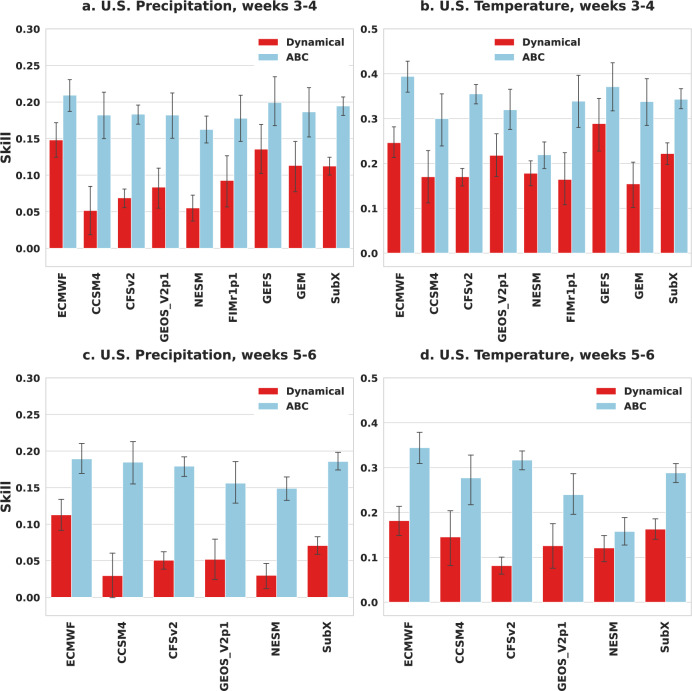
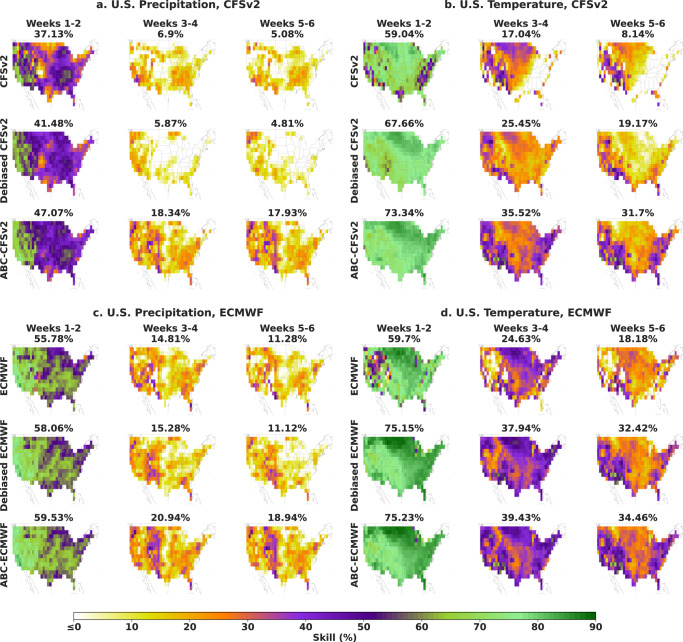
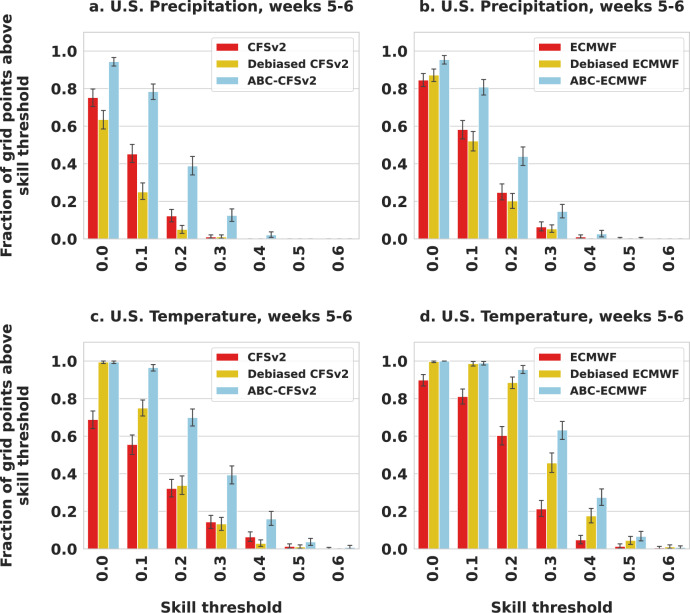
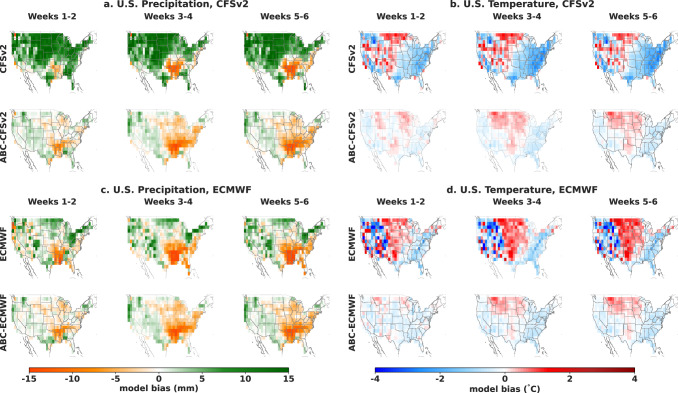
Subseasonal forecasting—predicting temperature and precipitation 2 to 6 weeks ahead—is critical for effective water allocation, wildfire management, and drought and flood mitigation. Recent international research efforts have advanced the subseasonal capabilities of operational dynamical models, yet temperature and precipitation prediction skills remain poor, partly due to stubborn errors in representing atmospheric dynamics and physics inside dynamical models. Here, to counter these errors, we introduce an adaptive bias correction (ABC) method that combines state-of-the-art dynamical forecasts with observations using machine learning. We show that, when applied to the leading subseasonal model from the European Centre for Medium-Range Weather Forecasts (ECMWF), ABC improves temperature forecasting skill by 60–90% (over baseline skills of 0.18–0.25) and precipitation forecasting skill by 40–69% (over baseline skills of 0.11–0.15) in the contiguous U.S. We couple these performance improvements with a practical workflow to explain ABC skill gains and identify higher-skill windows of opportunity based on specific climate conditions.
Overview
The claims and statistics of this paper haven’t been checked yet.
Free: it reads the open-access text and checks the first 5 claims that cite a source we can check. Create a free account to check every claim.
Integrity signals
Registry
Cites
Statistics
Figures
Verification
Claims the paper makes
The claims and statistics of this paper haven’t been checked yet.
Free: it reads the open-access text and checks the first 5 claims that cite a source we can check. Create a free account to check every claim.
Claims other papers make about this one
Each is checked against this paper’s own text: does it say what the citing paper says it does?
The check wasn’t confident either way, so it gives no verdict — never disputed.
In the citing paper
“However, these systems often exhibit considerable biases13–17, particularly in predicting extreme events18.”
From A machine learning model that outperforms conventional global subseasonal forecast models (2024) · cites this paper as [17]
Experimental — accuracy not yet measured
Self-check
Percentages, sums and reported differences re-computed from the paper’s own numbers.
The self-check needs the paper’s full text.
Citations
Cites
The NCEP/NCAR 40-Year Reanalysis Project
Kalnay, E., Kanamitsu, M., Kistler, R., Collins, W., Deaven, D., Gandin, L., Iredell, M., Saha, S., White, G., Woollen, J., et al. (1996) · Bulletin of the American Meteorological Society · doi:10.1175/1520-0477(1996)077<0437:tnyrp>2.0.co;2 · Cited by 28,360 · cited 1×
“For our explanatory variables, we obtained the daily PCs of 10 hPa and 500 hPa stratospheric geopotential height [51] extracted from global 1948-2010 loadings, the daily PCs of sea surface temperature and sea ice concentration [52] using global 1981-2010 loadings, the daily MJO phase [38], and the bimonthly MEI.”
Method"Why Should I Trust You?": Explaining the Predictions of Any Classifier
Ribeiro, M. T., Singh, S., & Guestrin, C. (2016) · Proceedings of the 22nd ACM SIGKDD International Conference on Knowledge Discovery and Data Mining · doi:10.1145/2939672.2939778 · Cited by 17,555
17. A Value for n-Person Games
Shapley, L. S. (1953) · Contributions to the Theory of Games (AM-28), Volume II · doi:10.1515/9781400881970-018 · Cited by 6,950
Locally Weighted Regression: An Approach to Regression Analysis by Local Fitting
Cleveland, W. S., & Devlin, S. J. (1988) · Journal of the American Statistical Association · doi:10.1080/01621459.1988.10478639 · Cited by 5,742
Anomalous collapses of Nares Strait ice arches leads to enhanced export of Arctic sea ice
Moore, G. W. K., Howell, S. E. L., Brady, M., Xu, X., & McNeil, K. (2021) · Nature Communications · doi:10.1038/s41467-020-20314-w · Cited by 5,155
Daily High-Resolution-Blended Analyses for Sea Surface Temperature
Reynolds, R. W., Smith, T. M., Liu, C., Chelton, D. B., Casey, K. S., & Schlax, M. G. (2007) · Journal of Climate · doi:10.1175/2007jcli1824.1 · Cited by 4,335 · cited 1×
“For our explanatory variables, we obtained the daily PCs of 10 hPa and 500 hPa stratospheric geopotential height [51] extracted from global 1948-2010 loadings, the daily PCs of sea surface temperature and sea ice concentration [52] using global 1981-2010 loadings, the daily MJO phase [38], and the bimonthly MEI.”
MethodWheeler, M. C., & Hendon, H. H. (2004) · Monthly Weather Review · doi:10.1175/1520-0493(2004)132<1917:aarmmi>2.0.co;2 · Cited by 2,891 · cited 2×
“For our explanatory variables, we obtained the daily PCs of 10 hPa and 500 hPa stratospheric geopotential height [51] extracted from global 1948-2010 loadings, the daily PCs of sea surface temperature and sea ice concentration [52] using global 1981-2010 loadings, the daily MJO phase [38], and the bimonthly MEI.”
MethodThe quiet revolution of numerical weather prediction
Bauer, P., Thorpe, A., & Brunet, G. (2015) · Nature · doi:10.1038/nature14956 · Cited by 2,729 · cited 2×
“Dynamical models have shown increasing skill in accurately forecasting the weather [32], but they still contain systematic biases that compound on subseasonal time scales and suppress forecast skill [33, 34, 35, 36].”
(2014) · Climate Change 2013 – The Physical Science Basis · doi:10.1017/cbo9781107415324.020 · Cited by 1,629
Assessing objective techniques for gauge‐based analyses of global daily precipitation
Chen, M., Shi, W., Xie, P., Silva, V. B. S., Kousky, V. E., Wayne Higgins, R., & Janowiak, J. E. (2008) · Journal of Geophysical Research: Atmospheres · doi:10.1029/2007jd009132 · Cited by 1,250 · cited 1×
“As ground-truth measurements, we extracted daily gridded observations of average 2-meter temperature in ◦C [47] and precipitation in mm [48, 49, 50].”
Method
Research works printed but not linked: 11
- National Academies of Sciences Engineering and Medicine. in Next Generation Earth System Prediction: Strategies for Subseasonal to Seasonal Forecasts (The National Academies Press, Washington, DC, 2016).
- Vitart F Robertson AW Anderson DL Subseasonal to seasonal prediction project: bridging the gap between weather and climate Bull. World Meteorol. Organ. 2012 61 23
- Srinivasan, V., Khim, J., Banerjee, A. & Ravikumar, P. Subseasonal climate prediction in the western US using Bayesian spatial models. in Proceedings of the Thirty-Seventh Conference on Uncertainty in Artificial Intelligence, ser. Proceedings of Machine Learning Research vol. 161, July 27–30 (eds de Campos, C. & Maathuis, M. H.) 961–970 (PMLR, 2021).
- Panofsky, H. A. & Brier, G. W. in Some Applications of Statistics to Meteorology (Pennsylvania State University Press, University Park, PA, USA, 1968).
- Hersbach H Decomposition of the continuous ranked probability score for ensemble prediction systems Weather Forecast. 2000 15 559 570 10.1175/1520-0434(2000)015<0559:DOTCRP>2.0.CO;2 · DOI · Paper page
- Wolter, K. & Timlin, M. S. Monitoring ENSO in COADS with a seasonally adjusted principal component index. in Proc. of the 17th Climate Diagnostics Workshop 52–57 (1993).
- Dutra E Johannsen F Magnusson L Late spring and summer subseasonal forecasts in the northern hemisphere midlatitudes: biases and skill in the ECMWF model Monthly Weather Rev. 2021 149 2659 2671
- Lundberg, S. M. & Lee, S.-I. A unified approach to interpreting model predictions. in Advances in Neural Information Processing Systems Vol. 30 (eds Guyon, I. et al.) (Curran Associates, Inc., 2017).
- Xie, P., Chen, M. & Shi, W. CPC unified gauge-based analysis of global daily precipitation. in 24th Conf. on Hydrology Vol. 2 (Amer. Meteor. Soc, Atlanta, GA, 2010).
- Wilks, D. S.Statistical Methods in the Atmospheric Sciences, ser. Vol. 100 (International Geophysics. Academic Press, 2011).
- Kingma, D. P. & Ba, J. Adam: a method for stochastic optimization. in 3rd International Conference on Learning Representations, ICLR 2015, San Diego, CA, USA, May 7–9, 2015, Conference Track Proceedings (eds Bengio, Y. & LeCun, Y.) (2015).
Cited by
Materia, S., García, L. P., van Straaten, C., O, S., Mamalakis, A., Cavicchia, L., Coumou, D., de Luca, P., Kretschmer, M., & Donat, M. (2024) · WIREs Climate Change · doi:10.1002/wcc.914 · Cited by 130
“…the dynamical models they correct, relating error characteristics to the weather circumstances under which they occur, thus expanding the physical understanding of extremes that would be limited by only using numerical models (Mouatadid et al., 2023; Silva et al., 2022; van Straaten et al., 2023).”
A machine learning model that outperforms conventional global subseasonal forecast models
Chen, L., Zhong, X., Li, H., Wu, J., Lu, B., Chen, D., Xie, S.-P., Wu, L., Chao, Q., Lin, C., et al. (2024) · Nature Communications · doi:10.1038/s41467-024-50714-1 · Cited by 105
Skillful subseasonal soil moisture drought forecasts with deep learning-dynamic models
Lesinger, K., & Tian, D. (2025) · Nature Communications · doi:10.1038/s41467-025-62761-3 · Cited by 42
“To increase dynamic models (DM) forecast reliability and reduce model biases, post-processing bias-correction techniques are applied to DM forecasts with respect to observations (or reanalysis), which have improved subseasonal forecast skill of temperature, precipitation, windspeed, and organized motion associated wit…”
Global Prediction of Flash Drought Using Machine Learning
Xu, L., Zhang, X., Wu, T., Yu, H., Du, W., Zhang, C., & Chen, N. (2024) · Geophysical Research Letters · doi:10.1029/2024gl111134 · Cited by 31
“…relatively accurate forecasts of precipitation, temperature, winds and other influential factors at least days to weeks in advance, which still faces difficulties in current weather models (Bi et al., 2023; Espeholt et al., 2022; Lam et al., 2023; Lesinger et al., 2024; Mouatadid et al., 2023).”
InfluentialXiong, Z., Zhang, Z., Gui, H., Chen, X., Hu, S., Gao, L., He, Y., Qiu, J., & Xin, Q. (2025) · IEEE Transactions on Geoscience and Remote Sensing · doi:10.1109/tgrs.2025.3543611 · Cited by 28
“The NCEP CFSv2, widely used in global climate prediction, provides meteorological forecasts with a nine-month lead time and a spatial resolution of 0.2 ◦ [46], [47].”
Influential
Metadata
- Authors
- Mouatadid, S., Orenstein, P., Flaspohler, G., Cohen, J., Oprescu, M., Fraenkel, E., & Mackey, L.
- Affiliations
- University of Toronto (CA)
- Instituto Nacional de Matemática Pura e Aplicada (BR)
- Massachusetts Institute of Technology (US)
- Atmospheric and Environmental Research (US)
- Cornell University (US)
- Microsoft Research New England (United States) (US)
- Corresponding author
- Mouatadid, Soukayna
- Mackey, Lester
- ORCID
- Venue
- Nature Communications
- Published
- 2023-06-15
- Volume
- 14
- Issue
- 1
- Pages
- 3482-3482
- ISSN
- 2041-1723 (ISSN-L)
- PMC
- PMC10272189
- OpenAlex
- W4380872517
- Cited by
- 54
- References
- 48
- Citations by year
- 2026: 21 · 2025: 20 · 2024: 12 · 2023: 1
- FWCI
- 5.96
- Type
- journal article
- Language
- en
- Open access
- gold
- doi.org
- Licence
- cc-by
- creativecommons.org/licenses/by/4.0 (tdm)
- creativecommons.org/licenses/by/4.0 (vor)
- Locations
- Nature Communications (publishedVersion, cc-by)
- PubMed Central (publishedVersion, cc-by)
- PubMed (publishedVersion)
- arXiv (Cornell University) (submittedVersion)
- Open Access Server of the Woods Hole Scientific Community (Woods Hole Scientific Community) (submittedVersion, cc-by)
- DOAJ (DOAJ: Directory of Open Access Journals) (submittedVersion, cc-by-sa)
- NOAA Institutional Repository (submittedVersion, cc-by)
- arXiv (Cornell University) (cc-by)
- Funders
- United States Department of Commerce | National Oceanic and Atmospheric Administration (OAR-WPO -2021-2006592)
- National Science Foundation (PLR-1901352)
- Climate Change AI Innovation grant Microsoft AI for Earth grant
- Topics
- Physical Sciences › Earth and Planetary Sciences › Atmospheric Science › Meteorological Phenomena and Simulations
- Physical Sciences › Environmental Science › Global and Planetary Change › Climate variability and models
- Social Sciences › Decision Sciences › Management Science and Operations Research › Forecasting Techniques and Applications
- Keywords
- subseasonal forecasting, temperature prediction, precipitation forecasting, ECMWF ensemble forecasts, contiguous United States
- MeSH terms
- Climate, Forecasting, Temperature, Weather, Droughts, Floods
About these checks
Registry, retraction, Cites and statistics results are computed, not judged, with one exception: a printed reference that no index lists is read once by a model before it counts as a citation error. Claims are extracted by a model and kept only when their quote appears verbatim in the text; each cited source is then checked, with a model’s help, for whether it says what the claim relies on. Those verdicts can be wrong — read the claim’s quote and the cited source before relying on one.
Statistics and arithmetic are recomputed, not judged.
Confidence bands are shown only for fields calibrated on our annotated test set. None is calibrated yet, so no band is shown.
What counts as a claim ›How we measure confidence ›How we check this ›
Are you an author, or do you see a problem with this page? Request a review
How to cite
Cite CoChat for the checks on this page, and the paper for its own findings.
- This page
- CoChat. (2026). Citation check: Adaptive bias correction for improved subseasonal forecasting. https://app.cochat.ai/papers/10.1038/s41467-023-38874-y
- The paper
- Mouatadid, S., Orenstein, P., Flaspohler, G., Cohen, J., Oprescu, M., Fraenkel, E., & Mackey, L. (2023). Adaptive bias correction for improved subseasonal forecasting. Nature Communications. https://doi.org/10.1038/s41467-023-38874-y
Data sources
Bibliographic data: Semantic Scholar, OpenAlex, Crossref.
Contains information from the Semantic Scholar Academic Graph Datasets, made available under the ODC Attribution License (ODC-BY 1.0).
Semantic Scholar’s data is described in: Kinney, R., et al. (2023). The Semantic Scholar Open Data Platform. arXiv:2301.10140.
