

The DOI matches its Crossref record; 62 of the 62 references it cites were found in a registry or an index.
Accelerating the prediction and discovery of peptide hydrogels with human-in-the-loop
Open accessAbstract
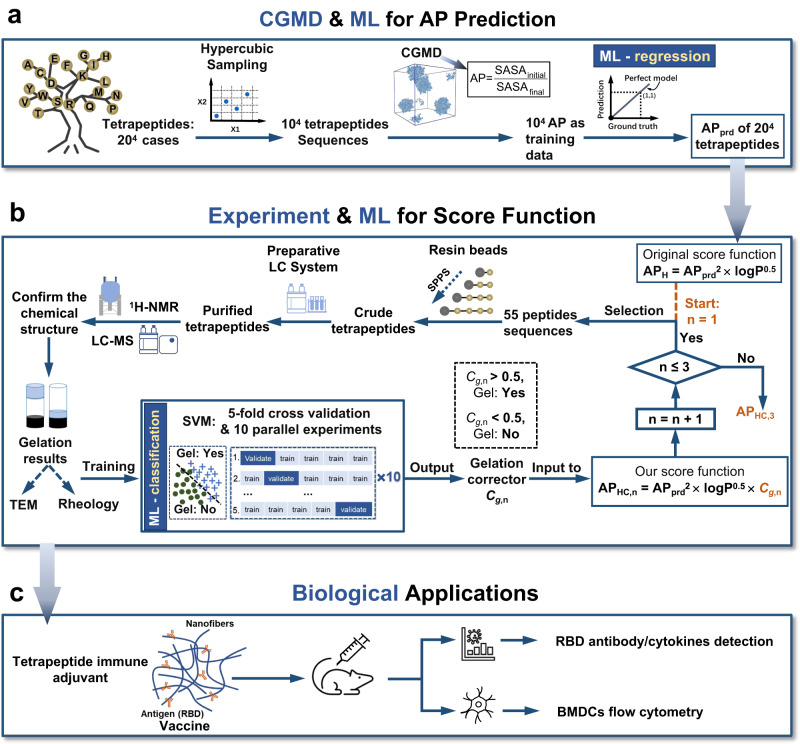
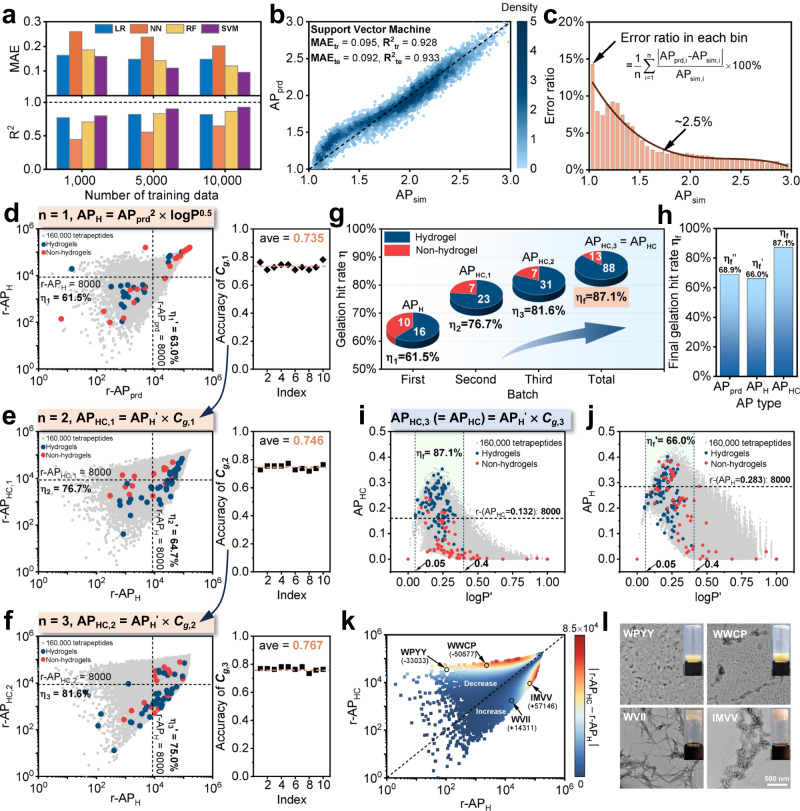
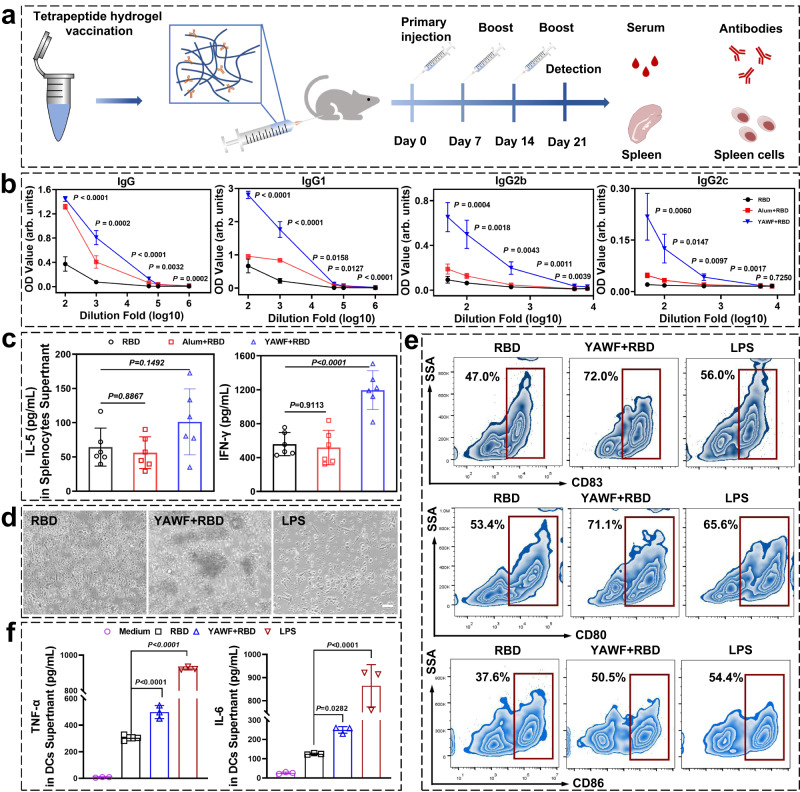
The amino acid sequences of peptides determine their self-assembling properties. Accurate prediction of peptidic hydrogel formation, however, remains a challenging task. This work describes an interactive approach involving the mutual information exchange between experiment and machine learning for robust prediction and design of (tetra)peptide hydrogels. We chemically synthesize more than 160 natural tetrapeptides and evaluate their hydrogel-forming ability, and then employ machine learning-experiment iterative loops to improve the accuracy of the gelation prediction. We construct a score function coupling the aggregation propensity, hydrophobicity, and gelation corrector C g , and generate an 8,000-sequence library, within which the success rate of predicting hydrogel formation reaches 87.1%. Notably, the de novo-designed peptide hydrogel selected from this work boosts the immune response of the receptor binding domain of SARS-CoV-2 in the mice model. Our approach taps into the potential of machine learning for predicting peptide hydrogelator and significantly expands the scope of natural peptide hydrogels.
Overview
The claims and statistics of this paper haven’t been checked yet.
Run the check — free, no account needed. It reads the open-access text and checks the sources it cites.
Integrity signals
Registry
Cites
Statistics
Figures
Verification
Claims the paper makes
The claims and statistics of this paper haven’t been checked yet.
Run the check — free, no account needed. It reads the open-access text and checks the sources it cites.
Claims other papers make about this one
Each is checked against this paper’s own text: does it say what the citing paper says it does?
The source backs part of the claim, not all of it — or backs it for a different population, condition or comparison.
In the citing paper
“However, their application to soft materials remains challenging because of complex, multiscale structure–property relationships4–6.”
From Data-driven de novo design of super-adhesive hydrogels (2025) · cites this paper as [5]
Experimental — accuracy not yet measured
Self-check
Percentages, sums and reported differences re-computed from the paper’s own numbers.
The self-check needs the paper’s full text.
Citations
Cites
Scikit-learn: Machine Learning in Python
Pedregosa, F., Varoquaux, G., Gramfort, A., Michel, V., Thirion, B., Grisel, O., Blondel, M., Müller, A., Nothman, J., Louppe, G., et al. (2012) · arXiv · doi:10.48550/arxiv.1201.0490 · Cited by 71,016
Abraham, M. J., Murtola, T., Schulz, R., Páll, S., Smith, J. C., Hess, B., & Lindahl, E. (2015) · SoftwareX · doi:10.1016/j.softx.2015.06.001 · Cited by 27,190
GROMACS: A message-passing parallel molecular dynamics implementation
Berendsen, H. J. C., van der Spoel, D., & van Drunen, R. (1995) · Computer Physics Communications · doi:10.1016/0010-4655(95)00042-e · Cited by 10,488
A note on a general definition of the coefficient of determination
NAGELKERKE, N. J. D. (1991) · Biometrika · doi:10.1093/biomet/78.3.691 · Cited by 5,927
An Introduction to Kernel and Nearest-Neighbor Nonparametric Regression
Altman, N. (1992) · The American Statistician · doi:10.1080/00031305.1992.10475879 · Cited by 5,657
The MARTINI Force Field: Coarse Grained Model for Biomolecular Simulations
Marrink, . J., Risselada, H. J., Yefimov, S., Tieleman, D. P., & de Vries, A. H. (2007) · The Journal of Physical Chemistry B · doi:10.1021/jp071097f · Cited by 5,641
CHARMM36 all-atom additive protein force field: Validation based on comparison to NMR data
Huang, J., & MacKerell, A. D. (2013) · Journal of Computational Chemistry · doi:10.1002/jcc.23354 · Cited by 4,537
What is a support vector machine?
Noble, W. S. (2006) · Nature Biotechnology · doi:10.1038/nbt1206-1565 · Cited by 4,450
Random Forest: A Classification and Regression Tool for Compound Classification and QSAR Modeling
Svetnik, V., Liaw, A. I., Tong, C., Culberson, J. C., Sheridan, R. P., & Feuston, B. P. (2003) · Journal of Chemical Information and Computer Sciences · doi:10.1021/ci034160g · Cited by 3,613
Latin hypercube sampling and the propagation of uncertainty in analyses of complex systems
Helton, J. C., & Davis, F. J. (2003) · Reliability Engineering & System Safety · doi:10.1016/s0951-8320(03)00058-9 · Cited by 2,719
Research works printed but not linked: 2
- Mueller, T., Kusne, A. G. & Ramprasad, R. Machine learning in materials science: Recent progress and emerging applications. Rev. Comput. Chem. 29, 186–273 (2016).
- Seber, G. A. & Lee, A. J. Linear regression analysis. (John Wiley & Sons, 2012).
Cited by
Sorted by citations
Data-driven de novo design of super-adhesive hydrogels
Liao, H., Hu, S., Yang, H., Wang, L., Tanaka, S., Takigawa, I., Li, W., Fan, H., & Gong, J. P. (2025) · Nature · doi:10.1038/s41586-025-09269-4 · Cited by 169
“Emerging tools, such as data mining (DM) and machine learning (ML), are transforming the field by advancing the analysis of complex behaviours, improving property predictions and driving theory and modelling development 5,10–13 .”
InfluentialSelf-citationExploring the Potential of Artificial Intelligence for Hydrogel Development—A Short Review
Neguț, I., & Bita, B. I. (2023) · Gels · doi:10.3390/gels9110845 · Cited by 130
De novo design of self-assembling peptides with antimicrobial activity guided by deep learning
Liu, H., Song, Z., Zhang, Y. L., Wu, B., Chen, D., Zhou, Z., Zhang, H., Li, S., Feng, X., Huang, J., et al. (2025) · Nature Materials · doi:10.1038/s41563-025-02164-3 · Cited by 133
Self-citationAI-driven 3D bioprinting for regenerative medicine: From bench to bedside
Zhang, Z., Zhou, X., Fang, Y., Xiong, Z., & Zhang, T. (2024) · Bioactive Materials · doi:10.1016/j.bioactmat.2024.11.021 · Cited by 126
Self-citationSmart hydrogel: A new platform for cancer therapy
Li, G., Fu, Z.-M., Li, H., Wei, R., Guo, J., Wang, H., & Qi, J. (2025) · Advances in Colloid and Interface Science · doi:10.1016/j.cis.2025.103470 · Cited by 100
Self-citation
Metadata
- Authors
- Xu, T., Wang, J., Zhao, S., Chen, D., Zhang, H., Fang, Y., Kong, N., Zhou, Z., Li, W., & Wang, H.
- Affiliations
- Westlake University (CN)
- Corresponding author
- Li, Wenbin
- Wang, Huaimin
- ORCID
- Venue
- Nature Communications
- Published
- 2023-06-30
- Volume
- 14
- Issue
- 1
- Pages
- 3880-3880
- ISSN
- 2041-1723 (ISSN-L)
- PMC
- PMC10313671
- OpenAlex
- W4382775111
- Cited by
- 132
- References
- 62
- Citations by year
- 2026: 42 · 2025: 44 · 2024: 39 · 2023: 7
- FWCI
- 8.45
- Type
- journal article
- Language
- en
- Open access
- gold
- doi.org
- Locations
- Nature Communications (publishedVersion, cc-by)
- PubMed Central (publishedVersion, cc-by)
- PubMed (publishedVersion)
- RePEc: Research Papers in Economics (submittedVersion)
- DOAJ (DOAJ: Directory of Open Access Journals) (submittedVersion, cc-by-sa)
- The HKU Scholars Hub (University of Hong Kong) (submittedVersion)
- Funders
- National Natural Science Foundation of China (82022038)
- Topics
- Physical Sciences › Materials Science › Biomaterials › Supramolecular Self-Assembly in Materials
- Physical Sciences › Chemistry › Organic Chemistry › Chemical Synthesis and Analysis
- Physical Sciences › Materials Science › Materials Chemistry › Machine Learning in Materials Science
- Keywords
- peptide hydrogels, tetrapeptide, machine learning, human-in-the-loop, interactive machine learning, peptide self-assembly, aggregation propensity, hydrophobicity, de novo peptide design, SARS-CoV-2 receptor-binding domain, immune response
- MeSH terms
- COVID-19, SARS-CoV-2, Amino Acid Sequence, Animals, Humans, Peptides, Hydrogels, Mice
About these checks
Registry, retraction, Cites and statistics results are computed, not judged, with one exception: a printed reference that no index lists is read once by a model before it counts as a citation error. Claims are extracted by a model and kept only when their quote appears verbatim in the text; each cited source is then checked, with a model’s help, for whether it says what the claim relies on. Those verdicts can be wrong — read the claim’s quote and the cited source before relying on one.
Statistics and arithmetic are recomputed, not judged.
Confidence bands are shown only for fields calibrated on our annotated test set. None is calibrated yet, so no band is shown.
What counts as a claim ›How we measure confidence ›How we check this ›
Are you an author, or do you see a problem with this page? Request a review
