

The DOI matches its Crossref record; 51 of the 51 references it cites were found in a registry or an index.
High density lithium niobate photonic integrated circuits
Open accessPublished version of a preprint
Abstract
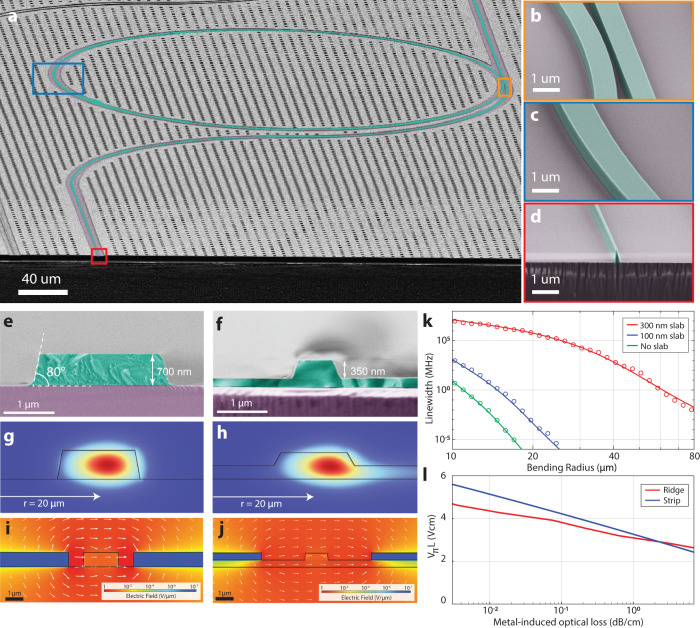
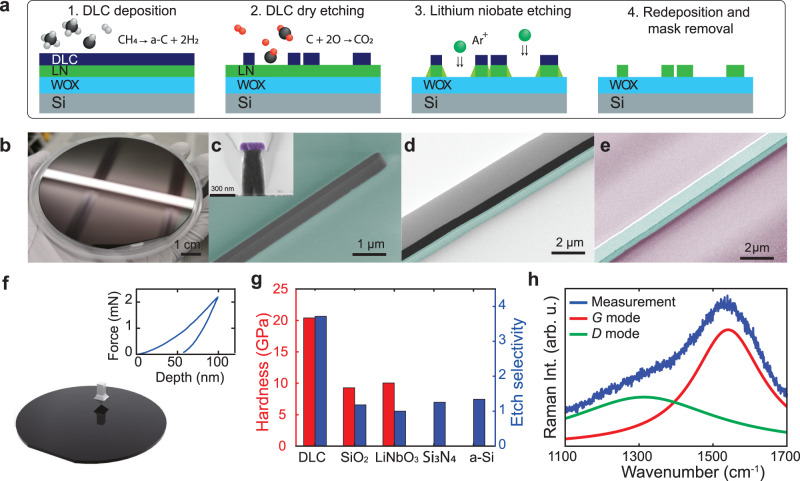
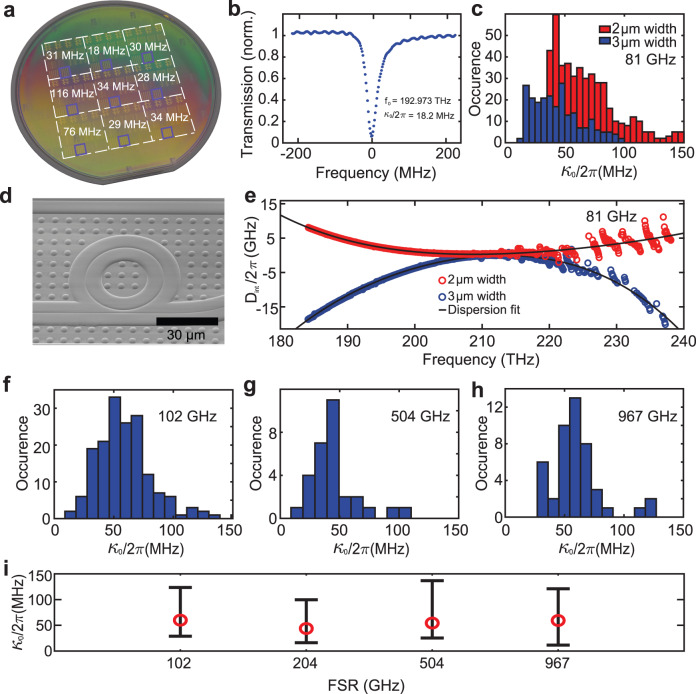
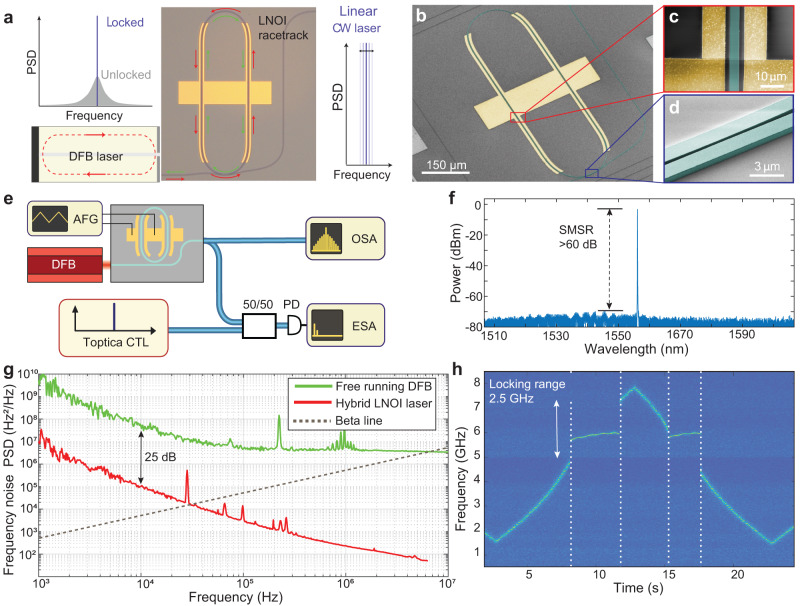
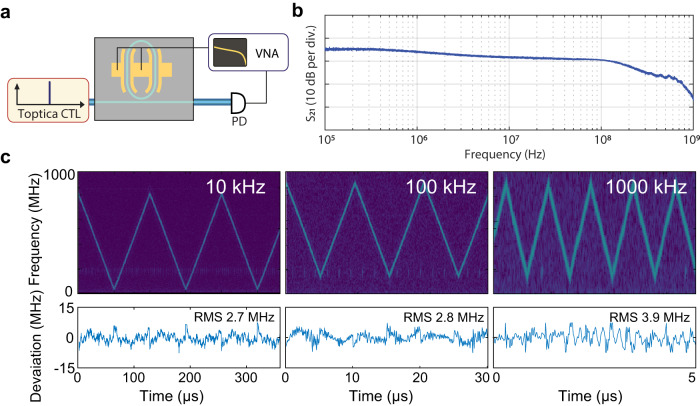
Abstract Photonic integrated circuits are indispensable for data transmission within modern datacenters and pervade into multiple application spheres traditionally limited for bulk optics, such as LiDAR and biosensing1. New applications and higher performance are enabled by the diversification of optical waveguide materials past silicon-on-insulator. Of particular interest are ferroelectrics such as Lithium Niobate, which exhibit a large electro-optical Pockels effect enabling ultrafast and efficient modulation, but are difficult to process via dry etching2. For this reason, etching tightly confining waveguides - routinely achieved in silicon or silicon nitride - has not been possible. Diamond-like carbon (DLC) was discovered in the 1950s 3 and is a material that exhibits an amorphous phase, excellent hardness, and the ability to be deposited in nano-metric thin films. Its use today is pervasive, ranging from applications for hard disk surfaces 4 and medical devices 5 to low friction coatings for automotive components 6. It has excellent thermal, mechanical, and electrical properties, making it an ideal protective coating. Here we demonstrate that DLC is also a superior material for the manufacturing of next-generation photonic integrated circuits based on ferroelectrics, specifically Lithium Niobate on insulator (LNOI). Using DLC as a hard mask, we demonstrate the fabrication of deeply etched, tightly confining, low loss photonic integrated circuits with losses as low as 4 dB/m and Q-factor as high as 10 · 106. In contrast to widely employed ridge waveguides 7,8, this approach benefits from a more than 1 order of magnitude higher area integration density while maintaining efficient electro-optical modulation, low loss, and offering a route for efficient optical fiber interfaces. As a proof of concept, we demonstrate a frequency agile hybrid integrated III-V Lithium Niobate based laser with sub-kHz linewidth and tuning rate of 0.7 Peta-Hertz per second with excellent linearity and CMOS-compatible driving voltage. Our approach can herald a new generation of high density ferroelectric photonic integrated circuits, in particular for applications in coherent laser based ranging 9 and beamforming 10, optical communications 7, and classical 11 and quantum computing networks 12.
Overview
The claims and statistics of this paper haven’t been checked yet.
Run the check — free, no account needed. It reads the open-access text and checks the sources it cites.
Integrity signals
Registry
Cites
Statistics
Figures
Verification
Claims the paper makes
The claims and statistics of this paper haven’t been checked yet.
Run the check — free, no account needed. It reads the open-access text and checks the sources it cites.
Claims other papers make about this one
Each is checked against this paper’s own text: does it say what the citing paper says it does?
The source backs part of the claim, not all of it — or backs it for a different population, condition or comparison.
In the citing paper
“recently, Li et al. [192] fabricated the first PIC platform on LNOI through direct etching using diamond-like carbon (DLC) masks”
From Metal Oxide Thin Films for Advanced Photonic Applications (2026) · cites this paper as [192]
Experimental — accuracy not yet measured
Self-check
Percentages, sums and reported differences re-computed from the paper’s own numbers.
The self-check needs the paper’s full text.
Citations
Cites
Robertson, J. (2002) · Materials Science and Engineering R Reports · doi:10.1016/s0927-796x(02)00005-0 · Cited by 6,210
Integrated lithium niobate electro-optic modulators operating at CMOS-compatible voltages
Wang, C., Zhang, M., Chen, X., Bertrand, M., Shams-Ansari, A., Chandrasekhar, S., Winzer, P., & Lončar, M. (2018) · Nature · doi:10.1038/s41586-018-0551-y · Cited by 2,593
Integrated photonics on thin-film lithium niobate
Zhu, D., Shao, L., Yu, M., Cheng, R., Desiatov, B., Xin, C. J., Hu, Y., Holzgrafe, J., Ghosh, S., Shams-Ansari, A., et al. (2021) · Advances in Optics and Photonics · doi:10.1364/aop.411024 · Cited by 1,516
Thomson, D., Zilkie, A., Bowers, J. E., Komljenovic, T., Reed, G. T., Vivien, L., Marris-Morini, D., Cassan, E., Virot, L., Fédéli, J.-M., et al. (2016) · Journal of Optics · doi:10.1088/2040-8978/18/7/073003 · Cited by 1,363
He, M., Xu, M., Ren, Y., Jian, J., Ruan, Z., Xu, Y., Gao, S., Sun, S., Wen, X., Zhou, L., et al. (2019) · Nature Photonics · doi:10.1038/s41566-019-0378-6 · Cited by 1,204
Photonic-chip-based frequency combs
Gaeta, A. L., Lipson, M. F., & Kippenberg, T. J. (2019) · Nature Photonics · doi:10.1038/s41566-019-0358-x · Cited by 1,112
Self-citationBroadband electro-optic frequency comb generation in a lithium niobate microring resonator
Zhang, M., Buscaino, B., Wang, C., Shams-Ansari, A., Reimer, C., Zhu, R., Kahn, J. M., & Lončar, M. (2019) · Nature · doi:10.1038/s41586-019-1008-7 · Cited by 980
Monolithic ultra-high-Q lithium niobate microring resonator
Zhang, M., Wang, C., Cheng, R., Shams-Ansari, A., & Lončar, M. (2017) · Optica · doi:10.1364/optica.4.001536 · Cited by 878
Photonic chip–based optical frequency comb using soliton Cherenkov radiation
Brasch, V., Geiselmann, M., Herr, T., Lihachev, G., Pfeiffer, M. H. P., Gorodetsky, M. L., & Kippenberg, T. J. (2016) · Science · doi:10.1126/science.aad4811 · Cited by 872
Self-citationBattery-operated integrated frequency comb generator
Stern, B., Ji, X., Okawachi, Y., Gaeta, A. L., & Lipson, M. F. (2018) · Nature · doi:10.1038/s41586-018-0598-9 · Cited by 804
Research works printed but not linked: 2
- Wang, C. et al. Integrated lithium niobate electro-optic modulators operating at CMOS-compatible voltages. Nature 562, 101–104 (2018). · DOI · Paper page
- He, M. et al. High-performance hybrid silicon and lithium niobate mach–zehnder modulators for 100 Gbit s−1 and beyond. Nat. Photonics 13, 359–364 (2019). · DOI · Paper page
Cited by
Sorted by citations
Lithium Tantalate Photonic Integrated Circuits for Volume Manufacturing
Wang, C., Li, Z., Riemensberger, J., Lihachev, G., Churaev, M., Kao, W., Ji, X., Zhang, J., Blesin, T., Davydova, A., et al. (2024) · Nature · doi:10.1038/s41586-024-07369-1 · Cited by 248
Self-citationIntegrated lithium niobate microwave photonic processing engine
Feng, H., Ge, T., Guo, X., Wang, B., Zhang, Y., Chen, Z., Zhu, S., Zhang, K., Sun, W., Huang, C., et al. (2024) · Nature · doi:10.1038/s41586-024-07078-9 · Cited by 229
Nanofabrication for Nanophotonics
Yang, Y., Jeon, Y., Dong, Z., Yang, J. K. W., Moghaddam, M. H., Kim, D.-S., Oh, D. K., Lee, J. ‐., Hentschel, M., Giessen, H. W., et al. (2025) · ACS Nano · doi:10.1021/acsnano.4c10964 · Cited by 151
Self-citationPhotonic-electronic integrated circuit-based coherent LiDAR engine
Lukashchuk, A., Yildirim, H. K., Bancora, A., Lihachev, G., Liu, Y., Qiu, Z., Ji, X., Voloshin, A., Bhave, S. A., Edoardo Charbon, A., et al. (2024) · Nature Communications · doi:10.1038/s41467-024-47478-z · Cited by 93
Self-citationUltrabroadband thin-film lithium tantalate modulator for high-speed communications
Wang, C., Fang, D., Zhang, J., Kotz, A., Lihachev, G., Churaev, M., Li, Z., Schwarzenberger, A., Ou, X., Koos, C. G., et al. (2024) · Optica · doi:10.1364/optica.537730 · Cited by 85
Self-citation
Metadata
- Authors
- Li, Z., Wang, R. N., Lihachev, G., Zhang, J., Tan, Z., Churaev, M., Kuznetsov, N., Siddharth, A., Bereyhi, M. J., Riemensberger, J., & Kippenberg, T. J.
- Affiliations
- École Polytechnique Fédérale de Lausanne (CH)
- Corresponding author
- Kippenberg, Tobias J.
- ORCID
- Venue
- Nature Communications
- Published
- 2023-08-10
- Volume
- 14
- Issue
- 1
- Pages
- 4856-4856
- ISSN
- 2041-1723 (ISSN-L)
- PMC
- PMC10415301
- OpenAlex
- W4385727101
- Cited by
- 169
- References
- 50
- Citations by year
- 2026: 35 · 2025: 80 · 2024: 51 · 2023: 3
- FWCI
- 19.62
- Type
- journal article
- Language
- en
- Open access
- gold
- doi.org
- Locations
- Nature Communications (publishedVersion, cc-by)
- Research Square (acceptedVersion, cc-by)
- PubMed Central (publishedVersion, cc-by)
- PubMed (publishedVersion)
- Infoscience (Ecole Polytechnique Fédérale de Lausanne) (submittedVersion, cc-by-nc-nd)
- DOAJ (DOAJ: Directory of Open Access Journals) (submittedVersion, cc-by-sa)
- Funders
- National Science Foundation
- European Commission (HORIZON2020, 835329, 812818)
- École Polytechnique Fédérale de Lausanne
- Schweizerischer Nationalfonds zur Förderung der Wissenschaftlichen Forschung (201923, 186364)
- Defense Advanced Research Projects Agency (HR0011-20-2-0046)
- Advanced Research Projects Agency
- Horizon 2020 Framework Programme (812818, EU‐H2020)
- HORIZON EUROPE Framework Programme
- HORIZON EUROPE European Innovation Council (101113260)
- Topics
- Physical Sciences › Physics and Astronomy › Atomic and Molecular Physics, and Optics › Photorefractive and Nonlinear Optics
- Physical Sciences › Engineering › Electrical and Electronic Engineering › Photonic and Optical Devices
- Physical Sciences › Materials Science › Materials Chemistry › Ferroelectric and Piezoelectric Materials
- Keywords
- lithium niobate, photonic integrated circuits, deep etching, low-loss waveguides, electro-optic modulation, Mach-Zehnder modulator, half-wave voltage, CMOS-compatible photonics, optical fiber interface, integration density
About these checks
Registry, retraction, Cites and statistics results are computed, not judged, with one exception: a printed reference that no index lists is read once by a model before it counts as a citation error. Claims are extracted by a model and kept only when their quote appears verbatim in the text; each cited source is then checked, with a model’s help, for whether it says what the claim relies on. Those verdicts can be wrong — read the claim’s quote and the cited source before relying on one.
Statistics and arithmetic are recomputed, not judged.
Confidence bands are shown only for fields calibrated on our annotated test set. None is calibrated yet, so no band is shown.
What counts as a claim ›How we measure confidence ›How we check this ›
Are you an author, or do you see a problem with this page? Request a review
