

The DOI matches its Crossref record; 43 of the 43 references it cites were found in a registry or an index.
Boosting urea electrooxidation on oxyanion-engineered nickel sites via inhibited water oxidation
Open accessAbstract
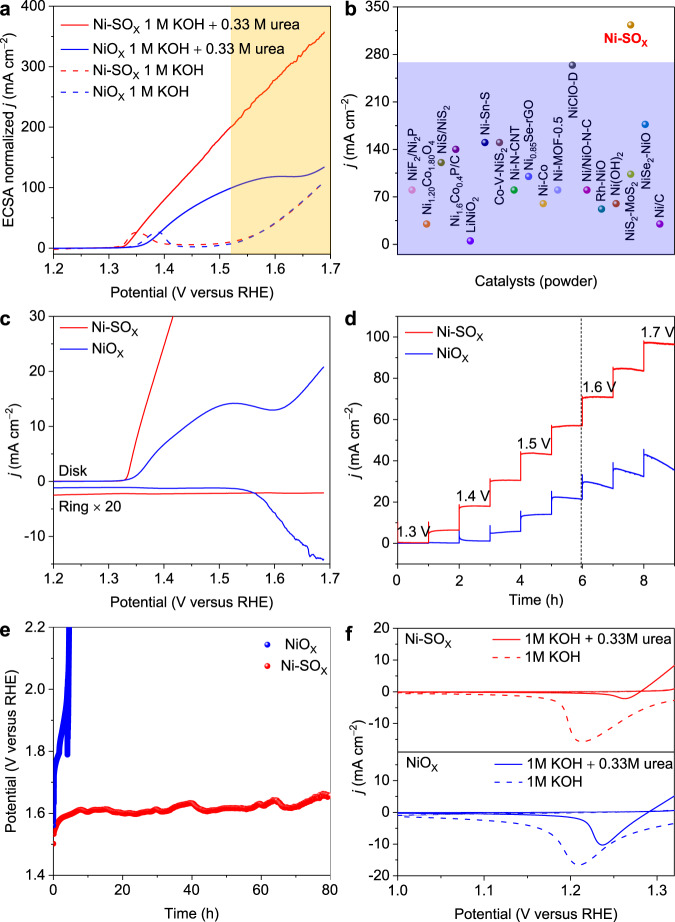
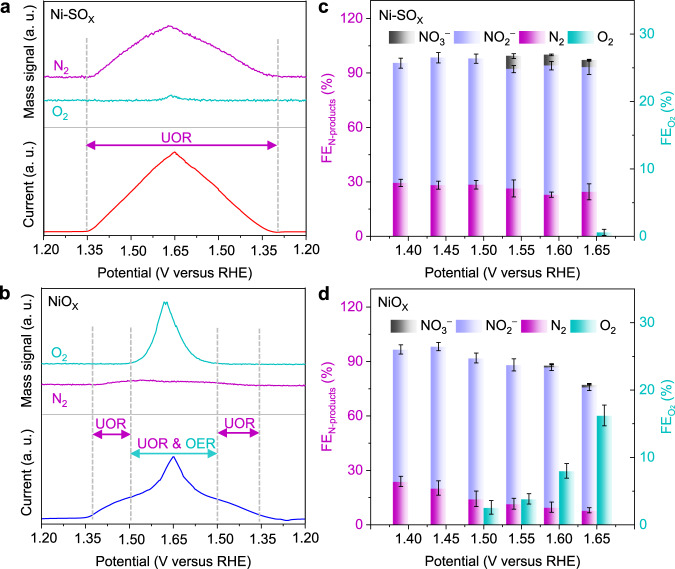
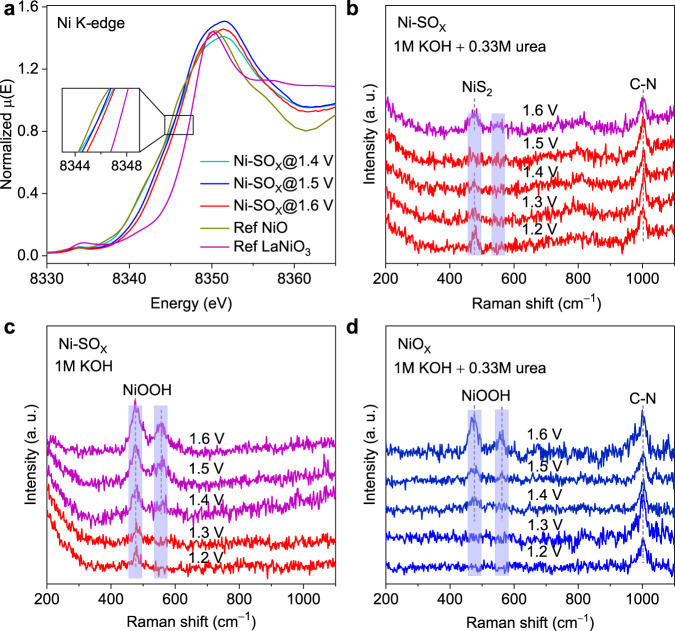
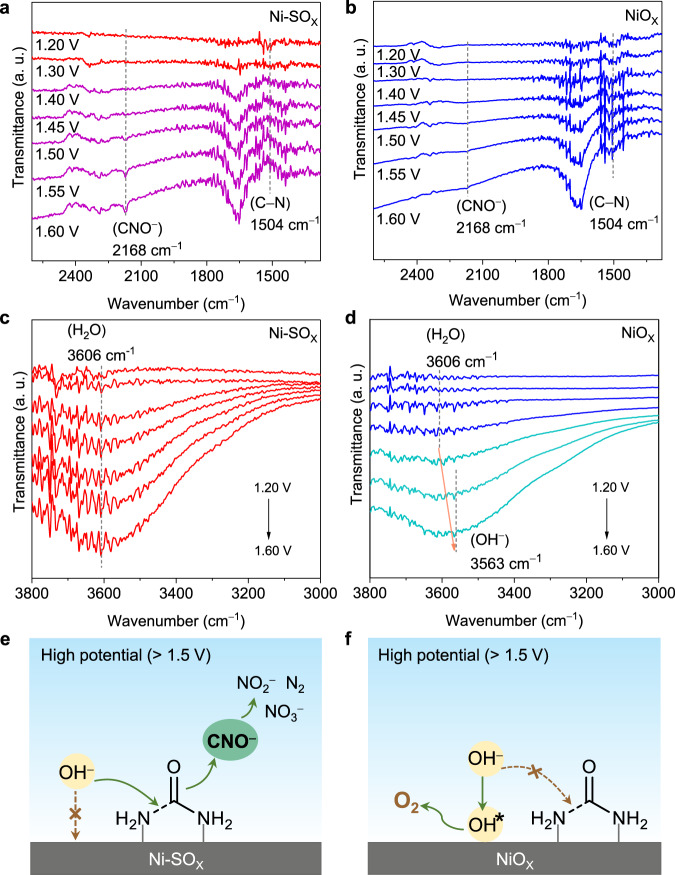
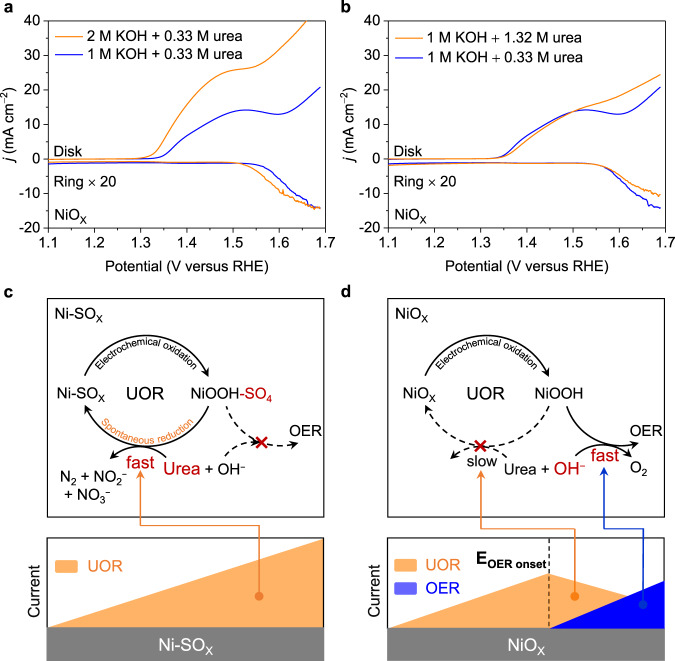
Renewable energy-based electrocatalytic oxidation of organic nucleophiles (e.g.methanol, urea, and amine) are more thermodynamically favourable and, economically attractive to replace conventional pure water electrooxidation in electrolyser to produce hydrogen. However, it is challenging due to the competitive oxygen evolution reaction under a high current density (e.g., >300 mA cm−2), which reduces the anode electrocatalyst’s activity and stability. Herein, taking lower energy cost urea electrooxidation reaction as the model reaction, we developed oxyanion-engineered Nickel catalysts to inhibit competing oxygen evolution reaction during urea oxidation reaction, achieving an ultrahigh 323.4 mA cm−2 current density at 1.65 V with 99.3 ± 0.4% selectivity of N-products. In situ spectra studies reveal that such in situ generated oxyanions not only inhibit OH− adsorption and guarantee high coverage of urea reactant on active sites to avoid oxygen evolution reaction, but also accelerate urea’s C − N bond cleavage to form CNO − intermediates for facilitating urea oxidation reaction. Accordingly, a comprehensive mechanism for competitive adsorption behaviour between OH− and urea to boost urea electrooxidation and dynamic change of Ni active sites during urea oxidation reaction was proposed. This work presents a feasible route for high-efficiency urea electrooxidation reaction and even various electrooxidation reactions in practical applications.
Overview
The claims and statistics of this paper haven’t been checked yet.
Run the check — free, no account needed. It reads the open-access text and checks the sources it cites.
Integrity signals
Registry
Cites
Statistics
Figures
Verification
Claims the paper makes
The claims and statistics of this paper haven’t been checked yet.
Run the check — free, no account needed. It reads the open-access text and checks the sources it cites.
Claims other papers make about this one
Each is checked against this paper’s own text: does it say what the citing paper says it does?
The cited source says what the claim attributes to it.
In the citing paper
“replacing OER with the urea oxidation reaction (UOR), which has a much lower theoretical potential (0.37 V) [3,6].”
Self-check
Percentages, sums and reported differences re-computed from the paper’s own numbers.
The self-check needs the paper’s full text.
Citations
Cites
A review on fundamentals for designing oxygen evolution electrocatalysts
Song, J., Wei, C., Huang, Z.-F., Liu, C., Zeng, L., Wang, X., & Xu, Z. J. (2020) · Chemical Society Reviews · doi:10.1039/c9cs00607a · Cited by 2,936
Metallic Nickel Nitride Nanosheets Realizing Enhanced Electrochemical Water Oxidation
Xu, K., Chen, P., Li, X., Tong, Y., Ding, H., Wu, X., Chu, W., Peng, Z., Wu, C., & Xie, Y. (2015) · Journal of the American Chemical Society · doi:10.1021/ja5119495 · Cited by 1,115
Urea electrolysis: direct hydrogen production from urine
Boggs, B. K., King, R. L., & Botte, G. G. (2009) · Chemical Communications · doi:10.1039/b905974a · Cited by 813
Nickel ferrocyanide as a high-performance urea oxidation electrocatalyst
Geng, S.-K., Zheng, Y., Li, S., Su, H. D., Zhao, X., Hu, J. X., Shu, H.-B., Jaroniec, M., Chen, P., Liu, Q., et al. (2021) · Nature Energy · doi:10.1038/s41560-021-00899-2 · Cited by 736
Self-citationHeterogeneous‐Interface‐Enhanced Adsorption of Organic and Hydroxyl for Biomass Electrooxidation
Zhou, P., Lv, X., Tao, S., Wu, J., Wang, H., Wei, X., Wang, T., Zhou, B., Lu, Y., Frauenheim, T., et al. (2022) · Advanced Materials · doi:10.1002/adma.202204089 · Cited by 570
Designing Advanced Catalysts for Energy Conversion Based on Urea Oxidation Reaction
Zhu, B., Liang, Z., & Zou, R. (2020) · Small · doi:10.1002/smll.201906133 · Cited by 550
Unveiling the Electrooxidation of Urea: Intramolecular Coupling of the N−N Bond
Chen, W., Xu, L., Zhu, X., Huang, Y., Wang, Z., Wang, D., Zhou, Y., Du, S., Li, Q., Xie, C. Y., et al. (2020) · Angewandte Chemie International Edition · doi:10.1002/anie.202015773 · Cited by 541
Vedharathinam, V., & Botte, G. G. (2012) · Electrochimica Acta · doi:10.1016/j.electacta.2012.07.007 · Cited by 518
Shi, Y., Du, W., Zhou, W., Wang, C., Lu, S., Lu, S., & Zhang, B. (2020) · Angewandte Chemie International Edition · doi:10.1002/anie.202011097 · Cited by 509
Qi, Y., Zhang, Y., Li, Y., Zhao, Y., Zhu, Y., Jiang, H., & Li, C. (2022) · Nature Communications · doi:10.1038/s41467-022-32443-5 · Cited by 507
Regulating the Local Charge Distribution of Ni Active Sites for the Urea Oxidation Reaction
Wang, L., Zhu, Y., Wen, Y., Li, S., Cui, C., Ni, F., Liu, Y., Lin, H., Li, Y., Peng, H., et al. (2021) · Angewandte Chemie International Edition · doi:10.1002/anie.202100610 · Cited by 445
Metallic Nickel Hydroxide Nanosheets Give Superior Electrocatalytic Oxidation of Urea for Fuel Cells
Zhu, X., Dou, X., Dai, J., An, X., Guo, Y., Zhang, L., Tao, S., Zhao, J., Chu, W., Zeng, X. C., et al. (2016) · Angewandte Chemie International Edition · doi:10.1002/anie.201606313 · Cited by 439
A direct urea fuel cell – power from fertiliser and waste
Lan, R., Tao, S., & Irvine, J. T. S. (2010) · Energy & Environmental Science · doi:10.1039/b924786f · Cited by 411
Zhu, S., Qin, X., Yao, Y., & Shao, M. (2020) · Journal of the American Chemical Society · doi:10.1021/jacs.0c01104 · Cited by 376
Dissociation Rates of Urea in the Presence of NiOOH Catalyst: A DFT Analysis
Daramola, D. A., Singh, D., & Botte, G. G. (2010) · The Journal of Physical Chemistry A · doi:10.1021/jp105159t · Cited by 352
Chen, S., Duan, J., Vasileff, A., & Qiao, S. (2016) · Angewandte Chemie International Edition · doi:10.1002/anie.201600387 · Cited by 348
Self-citationLi, S., Ma, R., Hu, J., Li, Z., Liu, L., Wang, X., Lu, Y., Sterbinsky, G. E., Liu, S., Zheng, L., et al. (2022) · Nature Communications · doi:10.1038/s41467-022-30670-4 · Cited by 343
A Lattice‐Oxygen‐Involved Reaction Pathway to Boost Urea Oxidation
Zhang, L., Wang, L., Lin, H., Liu, Y., Ye, J., Wen, Y., Chen, A., Wang, L., Ni, F., Zhou, Z., et al. (2019) · Angewandte Chemie International Edition · doi:10.1002/anie.201909832 · Cited by 340
Double-atom catalysts as a molecular platform for heterogeneous oxygen evolution electrocatalysis
Bai, L., Hsu, C., Alexander, D. T. L., Chen, H. M., & Hu, X. (2021) · Nature Energy · doi:10.1038/s41560-021-00925-3 · Cited by 332
Nanostructured LaNiO 3 Perovskite Electrocatalyst for Enhanced Urea Oxidation
Forslund, R. P., Mefford, J. T., Hardin, W. G., Alexander, C. T., Johnston, K. P., & Stevenson, K. J. (2016) · ACS Catalysis · doi:10.1021/acscatal.6b00487 · Cited by 264
Han, W., Wei, J., Xiao, K., Ouyang, T., Peng, X., Zhao, S., & Liu, Z. (2022) · Angewandte Chemie International Edition · doi:10.1002/anie.202206050 · Cited by 250
Spectroelectrochemical Analysis of the Water Oxidation Mechanism on Doped Nickel Oxides
Rao, R. R., Corby, S., Bucci, A., García‐Tecedor, M., Mesa, C. A., Rossmeisl, J., Giménez, S., Lloret‐Fillol, J., Stephens, I. E. L., & Durrant, J. R. (2022) · Journal of the American Chemical Society · doi:10.1021/jacs.1c08152 · Cited by 240
Ji, Z., Song, Y., Zhao, S., Li, Y. L., Liu, J., & Hu, W. (2021) · ACS Catalysis · doi:10.1021/acscatal.1c05190 · Cited by 239
Menezes, P. W., Yao, S., Beltrán‐Suito, R., Hausmann, J. N., Menezes, P. V., & Drieß, M. (2020) · Angewandte Chemie International Edition · doi:10.1002/anie.202014331 · Cited by 236
Nangan, S., kumar, G. G., & Manthiram, A. (2017) · Advanced Energy Materials · doi:10.1002/aenm.201702207 · Cited by 235
Sulfur: not a “silent” element any more
Jalilehvand, F. (2006) · Chemical Society Reviews · doi:10.1039/b417595f · Cited by 217
Deciphering and Suppressing Over‐Oxidized Nitrogen in Nickel‐Catalyzed Urea Electrolysis
Li, J., Li, J., Liu, T., Chen, L., Li, Y., Wang, H., Chen, X., Gong, M., Liu, Z., & Yang, X. (2021) · Angewandte Chemie International Edition · doi:10.1002/anie.202107886 · Cited by 215
Chang-xin, Z., Liu, J., Wang, C., Wang, J., Song, L., Li, B., & Zhang, Q. (2022) · Energy & Environmental Science · doi:10.1039/d2ee01036d · Cited by 191
Solar driven hydrogen releasing from urea and human urine
Wang, G., Ling, Y., Lu, X., Wang, H., Qian, F., Tong, Y., & Li, Y. (2012) · Energy & Environmental Science · doi:10.1039/c2ee22087c · Cited by 189
Kumar, A., Liu, X., Lee, J., Debnath, B., Jadhav, A. R., Shao, X., Bui, V. Q., Hwang, Y., Liu, Y., Kim, M. G., et al. (2021) · Energy & Environmental Science · doi:10.1039/d1ee02603h · Cited by 172
Cheng, W., Xi, S., Wu, Z., Luan, D., & Lou, X. W. (2021) · Science Advances · doi:10.1126/sciadv.abk0919 · Cited by 162
Nickel‐Catalyzed Urea Electrolysis: From Nitrite and Cyanate as Major Products to Nitrogen Evolution
Tatarchuk, S. W., Medvedev, J. J., Li, F., Tobolovskaya, Y., & Klinkova, A. (2022) · Angewandte Chemie International Edition · doi:10.1002/anie.202209839 · Cited by 158
Understanding the pH Dependence of Underpotential Deposited Hydrogen on Platinum
Yang, X., Nash, J., Oliveira, N. J., Yan, Y. S., & Xu, B. (2019) · Angewandte Chemie International Edition · doi:10.1002/anie.201909697 · Cited by 146
Wang, L., Zhu, S., Marinković, N., Kattel, S. P., Shao, M., Yang, B., & Chen, J. G. (2018) · Applied Catalysis B: Environmental · doi:10.1016/j.apcatb.2018.03.064 · Cited by 114
Pei, C., Chen, S., Zhao, T., Li, M., Cui, Z., Sun, B., Hu, S., Lan, S., Hahn, H., & Feng, T. (2022) · Advanced Materials · doi:10.1002/adma.202200850 · Cited by 99
Anodic Oxidation of Urea and an Electrochemical Approach to De-ureation
Yao, S. J., Wolfson, S. K., Ahn, B. K., & Liu, C. C. (1973) · Nature · doi:10.1038/241471a0 · Cited by 96
A Lattice‐Oxygen‐Involved Reaction Pathway to Boost Urea Oxidation
Zhang, L., Wang, L., Lin, H., Liu, Y., Ye, J., Wen, Y., Chen, A., Wang, L., Ni, F., Zhou, Z., et al. (2019) · Angewandte Chemie · doi:10.1002/ange.201909832 · Cited by 92
Patil, S. J., Chodankar, N. R., Hwang, S., Raju, G. S. R., Huh, Y. S., & Han, Y. (2021) · Small · doi:10.1002/smll.202103326 · Cited by 85
Yang, J., Yang, Z., Li, L. H., Cai, Q., Nie, H., Ge, M., Chen, X., Chen, Y. I., & Huang, S. (2017) · Nanoscale · doi:10.1039/c7nr01293d · Cited by 62
Urea adsorption on Pt(111) electrodes
Climent, V., Rodes, A., Orts, J. M., Aldaz, A., & Feliu, J. M. (1999) · Journal of Electroanalytical Chemistry · doi:10.1016/s0022-0728(98)00062-x · Cited by 55
Marini, C., Perucchi, A., Chermisi, D., Dore, P., Valentini, M., Topwal, D., Sarma, D. D., Lupi, S., & Postorino, P. (2011) · Physical Review B · doi:10.1103/physrevb.84.235134 · Cited by 40
Ye, N., Zhao, P., Qi, X., Sheng, W., Jiang, Z., & Fang, T. (2021) · Journal of Materials Chemistry A · doi:10.1039/d1ta07382f · Cited by 35
The Infrared Spectrum of Potassium Cyanate Solutions
Williams, D. (1940) · Journal of the American Chemical Society · doi:10.1021/ja01866a049 · Cited by 15
Cited by
Sorted by citations
Urea catalytic oxidation for energy and environmental applications
Gao, X., Zhang, S., Wang, P., Jaroniec, M., Zheng, Y., & Qiao, S. (2024) · Chemical Society Reviews · doi:10.1039/d3cs00963g · Cited by 353
Self-citationXu, S., Ruan, X., Ganesan, M., Wu, J., Ravi, S. K., & Cui, X. (2024) · Advanced Functional Materials · doi:10.1002/adfm.202313309 · Cited by 264
Lattice Oxygen Redox Mechanisms in the Alkaline Oxygen Evolution Reaction
Ren, X., Zhai, Y., Yang, N., Wang, B., & Liu, S. F. (2024) · Advanced Functional Materials · doi:10.1002/adfm.202401610 · Cited by 267
Microenvironment Engineering of Heterogeneous Catalysts for Liquid-Phase Environmental Catalysis
Zhu, Z., Zhong, S., Cheng, C., Zhou, H., Sun, H., Duan, X., & Wang, S. (2024) · Chemical Reviews · doi:10.1021/acs.chemrev.4c00276 · Cited by 200
Wang, P. G., Zheng, J., Xu, X., Zhang, Y., Shi, Q., Wan, Y., Ramakrishna, S., Zhang, J., Zhu, L., Yokoshima, T., et al. (2024) · Advanced Materials · doi:10.1002/adma.202404806 · Cited by 188
Self-citation
Metadata
- Authors
- Gao, X., Bai, X., Wang, P., Jiao, Y., Davey, K., Zheng, Y., & Qiao, S.-Z.
- Affiliations
- The University of Adelaide (AU)
- Corresponding author
- Zheng, Yao
- Qiao, Shi-Zhang
- Venue
- Nature Communications
- Published
- 2023-09-20
- Volume
- 14
- Issue
- 1
- Pages
- 5842-5842
- ISSN
- 2041-1723 (ISSN-L)
- PMC
- PMC10511637
- OpenAlex
- W4386887861
- Cited by
- 306
- References
- 43
- Citations by year
- 2026: 74 · 2025: 125 · 2024: 102 · 2023: 5
- FWCI
- 14.62
- Type
- journal article
- Language
- en
- Open access
- gold
- doi.org
- Locations
- Nature Communications (publishedVersion, cc-by)
- PubMed Central (publishedVersion, cc-by)
- PubMed (publishedVersion)
- RePEc: Research Papers in Economics (submittedVersion)
- Adelaide Research & Scholarship (AR&S) (University of Adelaide) (submittedVersion, cc-by)
- DOAJ (DOAJ: Directory of Open Access Journals) (submittedVersion, cc-by-sa)
- Funders
- Australian Nuclear Science and Technology Organisation
- Australian Synchrotron
- University of Adelaide
- China Scholarship Council
- Australian Research Council (FT200100062, DP190103472, DP220102596, LP210301397, FL170100154)
- Topics
- Physical Sciences › Energy › Renewable Energy, Sustainability and the Environment › Electrocatalysts for Energy Conversion
- Physical Sciences › Energy › Renewable Energy, Sustainability and the Environment › CO2 Reduction Techniques and Catalysts
- Physical Sciences › Engineering › Electrical and Electronic Engineering › Fuel Cells and Related Materials
- Keywords
- urea electrooxidation, nickel-based electrocatalysts, competitive adsorption, hydroxide adsorption, C–N bond cleavage, electrocatalytic hydrogen production, anode catalysts
About these checks
Registry, retraction, Cites and statistics results are computed, not judged, with one exception: a printed reference that no index lists is read once by a model before it counts as a citation error. Claims are extracted by a model and kept only when their quote appears verbatim in the text; each cited source is then checked, with a model’s help, for whether it says what the claim relies on. Those verdicts can be wrong — read the claim’s quote and the cited source before relying on one.
Statistics and arithmetic are recomputed, not judged.
Confidence bands are shown only for fields calibrated on our annotated test set. None is calibrated yet, so no band is shown.
What counts as a claim ›How we measure confidence ›How we check this ›
Are you an author, or do you see a problem with this page? Request a review
