

Seismic arrival-time picking on distributed acoustic sensing data using semi-supervised learning
Open accessPublished version of a preprint
The DOI matches its Crossref record; 80 of the 81 references it cites were found in a registry or an index.
Abstract
Distributed Acoustic Sensing (DAS) is an emerging technology for earthquake monitoring and subsurface imaging. However, its distinct characteristics, such as unknown ground coupling and high noise level, pose challenges to signal processing. Existing machine learning models optimized for conventional seismic data struggle with DAS data due to its ultra-dense spatial sampling and limited manual labels. We introduce a semi-supervised learning approach to address the phase-picking task of DAS data. We use the pre-trained PhaseNet model to generate noisy labels of P/S arrivals in DAS data and apply the Gaussian mixture model phase association (GaMMA) method to refine these noisy labels and build training datasets. We develop PhaseNet-DAS, a deep learning model designed to process 2D spatio-temporal DAS data to achieve accurate phase picking and efficient earthquake detection. Our study demonstrates a method to develop deep learning models for DAS data, unlocking the potential of integrating DAS in enhancing earthquake monitoring.
Overview
The claims and statistics of this paper haven’t been checked yet.
Free: it reads the open-access text and checks the first 5 claims that cite a source we can check. Create a free account to check every claim.
Integrity signals
Registry
Cites
Statistics
Figures
Verification
Claims the paper makes
The claims and statistics of this paper haven’t been checked yet.
Free: it reads the open-access text and checks the first 5 claims that cite a source we can check. Create a free account to check every claim.
Self-check
Percentages, sums and reported differences re-computed from the paper’s own numbers.
The self-check needs the paper’s full text.
Citations
Cites
Vaswani, A., Shazeer, N., Parmar, N., Uszkoreit, J., Jones, L., Gomez, A. N., Kaiser, L., & Polosukhin, I. (2017) · arXiv · doi:10.48550/arxiv.1706.03762 · Cited by 120,404 · cited 1×
“The exploration of the best neural network architectures, e.g., transformer (Vaswani et al., 2017; Mousavi & Beroza, 2022; Z. Liu et al., 2021), for DAS data can be done in future research.”
BackgroundU-Net: Convolutional Networks for Biomedical Image SegmentationPreprint
Ronneberger, O., Fischer, P., & Brox, T. (2015) · International Conference on Medical Image Computing and Computer-Assisted Intervention · doi:10.48550/arxiv.1505.04597 · Cited by 105,821 · cited 5×
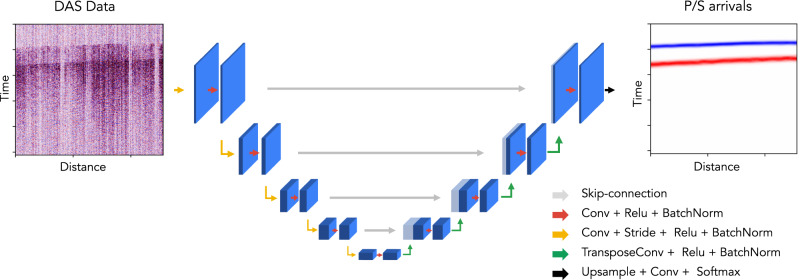
“Neural Network Model The pre-trained PhaseNet model is a modified U-Net architecture (Ronneberger et al., 2015) with 1D convolutional layers for processing 1D time series of seismic waveforms.”
MethodInfluentialAdam: A Method for Stochastic Optimization
Kingma, D. P., & Ba, J. (2014) · arXiv · doi:10.48550/arxiv.1412.6980 · Cited by 98,946
LeCun, Y., Bengio, Y., & Hinton, G. (2015) · Nature · doi:10.1038/nature14539 · Cited by 84,126
Swin Transformer: Hierarchical Vision Transformer using Shifted Windows
Liu, Z., Lin, Y., Cao, Y., Hu, H., Wei, Y., Zhang, Z., Lin, S., & Guo, B. (2021) · 2021 IEEE/CVF International Conference on Computer Vision (ICCV) · doi:10.1109/iccv48922.2021.00986 · Cited by 35,534 · cited 2×
“The exploration of the best neural network architectures, e.g., transformer (Vaswani et al., 2017; Mousavi & Beroza, 2022; Z. Liu et al., 2021), for DAS data can be done in future research.”
BackgroundMethodRethinking the Inception Architecture for Computer Vision
Szegedy, C., Vanhoucke, V., Ioffe, S., Shlens, J., & Wojna, Z. (2016) · 2016 IEEE Conference on Computer Vision and Pattern Recognition (CVPR) · doi:10.1109/cvpr.2016.308 · Cited by 32,138
A survey on Image Data Augmentation for Deep Learning
Shorten, C., & Khoshgoftaar, T. M. (2019) · Journal of Big Data · doi:10.1186/s40537-019-0197-0 · Cited by 13,203 · cited 1×
“Data augmentation, such as superposing noise onto seismic events, can synthesize new training samples with noisy waveforms, significantly expand the training dataset, and improve model generalization on noisy DAS data and weak earthquake signals (Shorten & Khoshgoftaar, 2019; W. Zhu et al., 2020a).”
BackgroundDecoupled Weight Decay Regularization
Loshchilov, I., & Hutter, F. (2017) · arXiv · doi:10.48550/arxiv.1711.05101 · Cited by 12,522
Rethinking Atrous Convolution for Semantic Image Segmentation
Chen, L.-C., Papandreou, G., Schroff, F., & Adam, H. (2017) · arXiv · doi:10.48550/arxiv.1706.05587 · Cited by 7,517 · cited 3×
“The semi-supervised approach does not require using the same neural network architecture as the pre-trained model, so that we can use other advanced architectures designed for the semantic segmentation task, such as DeepLab (Chen et al., 2017), deformable ConvNets (Dai et al.”
MethodLearning Deconvolution Network for Semantic Segmentation
Noh, H., Hong, S., & Han, B. (2015) · 2015 IEEE International Conference on Computer Vision (ICCV) · doi:10.1109/iccv.2015.178 · Cited by 4,422 · cited 2×
“We add the transposed convolutional layers for up-sampling (Noh et al., 2015), batch normalization layers (Ioffe & Szegedy, 2015), relu activation functions (Glorot et al., 2011), and skip connections to the model.”
BackgroundMethod
Research works printed but not linked: 12
- Li Z Zhan Z Pushing the limit of earthquake detection with distributed acoustic sensing and template matching: a case study at the brady geothermal field Geophys. J. Int. 2018 215 1583 1593 10.1093/gji/ggy359 · DOI
- Zhu W Beroza GC PhaseNet: a deep-neural-network-based seismic arrival-time picking method Geophys. J. Int. 2019 216 261 273
- Su J High resolution earthquake catalog building for the 21 May 2021 Yangbi, Yunnan, M S 6.4 earthquake sequence using deep-learning phase picker Chin. J. Geophys. 2021 64 2647 2656
- Wilding, John D., Zhu, Weiqiang, Ross, Zachary E. & Jackson, Jennifer M. The magmatic web beneath Hawai ‘i. Science379, 5755 (2022). 36548443 · DOI
- Hernández, Pablo D., Ramírez, Jaime A. & Soto, Marcelo A. Improving earthquake detection in fibre-optic distributed acoustic sensors using deep-learning and hybrid datasets. In 2022 European Conference on Optical Communication (ECOC) 1–4 (Optica Publishing Group, 2022).
- VanDecar JC Crosson RS Determination of teleseismic relative phase arrival times using multi-channel cross-correlation and least squares Bull. Seismol. Soc. Am. 1990 80 150 169
- Zhu, W., Mousavi, S. M. & Beroza, G. C. Seismic signal augmentation to improve generalization of deep neural networks. Adv. Geophys.61, 151–177 (2020). · DOI
- Luo, W., Li, Y., Urtasun, R. & Zemel, R. Understanding the effective receptive field in deep convolutional neural networks. In Advances in Neural Information Processing Systems (Curran Associates, Inc., 2016).
- Ioffe, S. & Szegedy, C. Batch normalization: accelerating deep network training by reducing internal covariate shift. In Proc. 32nd International Conference on Machine Learning 448–456 (PMLR, 2015).
- Glorot, X., Bordes, A. & Bengio, Y. Deep sparse rectifier neural networks. In Proc. 14h International Conference on Artificial Intelligence and Statistics 315–323 (JMLR Workshop and Conference Proceedings, 2011).
- Biondi E Wang X Williams EF Zhan Z Geolocalization of large-scale das channels using a GPS-tracked moving vehicle Seismol. Soc. Am. 2023 94 318 330
- Zhu, Weiqiang et al. Seismic arrival-time picking on distributed acoustic sensing data using semi-supervised learning. Zenodo10.5281/zenodo.10043122 (2023). PMC10713581 38081845 · doi:10.5281/zenodo.10043122
Cited by
Items 101–159 of 159
Feature-guided mixed multiscale BM4D denoising for Φ-OTDR vibration sensing
Chen, X., Liu, Z., Li, G., & Zhai, Y. (2025) · Optics Communications · doi:10.1016/j.optcom.2025.132689 · Cited by 1
Submarine seismicity monitoring with distributed acoustic sensing near Santorini and Kolumbo Volcano
Klaasen, S., Hudson, T., Sachdeva, S., Nomikou, P., & Fichtner, A. (2026) · Seismica · doi:10.26443/seismica.v5i1.1845 · Cited by 1
“However, existing ML approaches, such as PhaseNet-DAS (Zhu et al., 2023), also depend spatial coherence in the data.”
Wang, X., Liu, X., Zhu, S., Li, Z., & Gao, L. (2026) · IEEE Transactions on Geoscience and Remote Sensing · doi:10.1109/tgrs.2026.3691833 · Cited by 1
“For similar purposes, semi-supervised and self-supervised learning have been applied to denoising [33], [34] and arrival-time picking [35] to avoid complete labeling of the entire dataset.”
Near real-time channel selection for Distributed Acoustic Sensing technology
Bozzi, E., Pascucci, G., Rapagnani, G., Bocchini, G. M., Harrington, R. M., Ugalde, A., Saccorotti, G., & Grigoli, F. (2026) · Seismica · doi:10.26443/seismica.v5i1.2251 · Cited by 1
“At-tributes are computed over time windows defined by the event P-onset time, with onsets taken from previously-estimated picks (e.g., PhaseNet-DAS; Zhu et al., 2023).”
Transfer learning using DAS for blasting event identification
Wu, C.-S., Fratta, D., & Hampton, J. (2025) · Sensors and Smart Structures Technologies for Civil, Mechanical, and Aerospace Systems · doi:10.1117/12.3051072
Ming, L., Zhou, Y., Ya, X., & Yongqing, L. (2025) · Earth Science-Journal of China University of Geosciences · doi:10.3799/dqkx.2025.086
Ozawa, M. (2025) · BUTSURI-TANSA(Geophysical Exploration) · doi:10.3124/segj.78.sp47
Liu, C., Wang, H., Wang, R., Tang, J., Cheng, C., & Yang, M. (2025) · Journal of Lightwave Technology · doi:10.1109/jlt.2025.3631875
“and long sensing range [1], making it suitable for applications such as seismology, hydraulic-fracturing diagnostics and pipeline monitoring [2], [3], [4].”
Jiang, R., & Lyu, M. (2026) · IEEE Access · doi:10.1109/access.2025.3650708
“DVS measures the axial dynamic strain along the fiber, which is a scalar signal covering a wide frequency band, differing from the vector outputs of traditional point sensors like accelerometers [2], [3].”
Extending the Shot-to-Shot Measurement Range of CP-φOTDR
Lin, J., Xu, P., Yang, J., & Qin, Y. (2025) · Photonics Global Conference · doi:10.1109/pgc68487.2025.11319493
“These two technique characteristic enable its excellent detection for low-frequency signal, which has been widely applied in multiple fields such as earthquake monitoring [2], oil and gas exploration [3], and perimeter security [4].”
Hanson, L., Saunders, J. K., Husker, A. L., Zhan, Z., & Biondi, E. (2026) · doi:10.22541/essoar.176797715.58266789/v1
Self-citationBocchini, G. M., Bozzi, E., Roth, M. P., Gaviano, S., Pascucci, G., Grigoli, F., Biondi, E., Sokos, E. N., & Harrington, R. M. (2026) · doi:10.5194/essd-2025-715-supplement
Self-citationLi, Y., Xiao, Z., Li, C., Yang, H., & Xu, M. (2026) · Signal Processing · doi:10.1016/j.sigpro.2026.110544
Impact of machine-learning phase picking on seismic tomography at Popocatépetl Volcano, Mexico
Bernal-Manzanilla, K., & Calò, M. (2026) · Journal of South American Earth Sciences · doi:10.1016/j.jsames.2026.105996
Zhiyang, 顾. G., Linbo, 谢. X., & Fei, 程. C. (2026) · Laser & Optoelectronics Progress · doi:10.3788/lop251197
AI-oriented data generation via physics-based modeling from vibration excitation to sensing
Zhang, S. Y., Li, H., Fan, C., Hu, Y. H. Y., Yan, Z., Tang, M., Liu, D., & Sun, Q. (2026) · Advanced Engineering Informatics · doi:10.1016/j.aei.2026.105179
Chen, Y., de Ridder, S., Rost, S., Guo, Z., Chen, Y. J., & Gan, L. (2026) · Journal of Geophysical Research Solid Earth · doi:10.1029/2026jb034179
“For instance, DNNs have been widely used in seismic arrival time picking (Mousavi et al., 2020; Zhu & Beroza, 2019; Zhu et al., 2023), earthquake and noise classification (Maguire et al., 2024; Seydoux et al., 2020; Zhu et al., 2024) and earthquake location (Elsayed et al., 2023; Zhang et al.,…”
DAS-Based double-difference tomography of the NanAo offshore area: feasibility and initial result
Wang, J., Zhang, Q., Li, J., Li, S., Wu, M., & Shan, C. (2026) · Journal of Physics Conference Series · doi:10.1088/1742-6596/3178/1/012023
Self-citationPhysics-Aware Machine Learning for Seismic and Volcanic Signal InterpretationPreprint
Thorossian, W. (2026) · arXiv (Cornell University) · doi:10.48550/arxiv.2603.17855
EQAnomalyNet: Unsupervised Seismic Phase Picking via Transformer Autoencoder
Wang, H., Ma, Q., Wang, J., Tao, D., Xie, Q., & Zhu, H. (2026) · IEEE Transactions on Geoscience and Remote Sensing · doi:10.1109/tgrs.2026.3677697
“Recent advances in deep learning have produced highly e ff ective methods for seismic phase picking [10], [11], [12].”
A Lightweight Neural Network for Pipeline Flow Rate Measurement Using Distributed Acoustic Sensing
Tang, R., Shi, Y., Liu, F., Huang, X., Kamanga, I. A., Lv, H., Zhou, T., Tan, G., Zhu, G., Zeng, H., et al. (2026) · IEEE Transactions on Instrumentation and Measurement · doi:10.1109/tim.2026.3682837
“Owing to the aforementioned advantages, DAS has found widespread applications in the fields of oil and gas resource exploration [4], perimeter security [5], seismology [6], [7], and pipeline monitoring [8].”
3D Traveltime Tomography Using Ocean-bottom DAS Data
Illa, B., Fukushima, S., & Shinohara, M. (2026) · Geophysical Journal International · doi:10.1093/gji/ggag144
Optimizing deep-learning first-break picking
Heuel, J., Delsuc, A., Weiel, M., Coquelin, D., Götz, M., & Rietbrock, A. (2026) · RAS Techniques and Instruments · doi:10.1093/rasti/rzag027
Exploring wavefield-based location imaging in heterogeneous media: A borehole DAS example
Komeazi, A., Limberger, F., & Rümpker, G. (2026) · The Leading Edge · doi:10.1190/tle-2025-1020
Seismic reservoir prediction via enhanced semi-supervised regression with pseudo-labels
Li, L., Zhao, R., Zhang, Y., Xu, C., Xiong, W., & Kong, L. (2026) · Journal of Geophysics and Engineering · doi:10.1093/jge/gxag056
Pan, J., Tian, X., Chen, Y., Pan, Y., & Zhang, X. (2026) · Acta Geophysica · doi:10.1007/s11600-026-01898-1
“…have been proposed for this application, such as Convolutional Neural Networks (CNN), U-Net, and Fully Convolutional Networks (FCN) (Dong et al. 2023; Fan et al. 2022; Huang et al. 2021; Wang et al. 2025; Xu et al. 2022; Zhang et al. 2021b; Zhang et al. 2024a, b; Zhu et al. 2019, 2023).”
Abdykadyrov, A. A., Alipuly, Y., Mamadiyarov, M., Tashev, B., Yerkinova, A., & Tazhen, K. (2026) · Sensors · doi:10.3390/s26103269
A Predictive Dual-Stage Neural Framework for Phase-Coherent Auditory Synthesis on Edge Devices
Pairoch, S., Phasukkit, P., & Suteewong, T. (2026) · Sensors · doi:10.3390/s26113344
“Deep learning has substantially improved acoustic sensing, pitch estimation, audio enhancement, sound event detection, source separation, and neural synthesis [27–31].”
Submarine Communication Cable Networking for High-Precision Earthquake Location
Yue, B., Huang, W., Li, T., Xie, F., Huang, Z., Zhao, Y., Zheng, Y., chen, S., Wu, Y., & Li, Z. (2026) · Optical Fiber Communication Conference · doi:10.1364/ofc.2026.m1i.4
Sawi, T., McGuire, J. J., Barbour, A. J., Yoon, C. E., Karrenbach, M., & Stewart, C. (2026) · Nature Communications · doi:10.1038/s41467-026-72223-z
“1c), a deep-learning model trained to detect P - and S -wave arrivals on DAS data from Ridgecrest and Long Valley, California, as well as offshore Japan 63 .”
InfluentialShao, J., Ren, H., Wang, P., Lu, J. J., Yu, C., Cao, Q., Gu, G., & Xuan, Q. (2026) · IEEE Internet of Things Journal · doi:10.1109/jiot.2026.3699775
“Recent advancements in artificial intelligence (AI) have significantly impacted DAS signal detection [17], [18].”
Aguilar-Velázquez, M. J., Ide, S., Yoshimi, M., Hasegawa, A., & Iwata, S. (2026) · Soil Dynamics and Earthquake Engineering · doi:10.1016/j.soildyn.2026.110452
Zhang, T., Zhang, C.-C., Shi, B., Zhao, X., & Xu, X. (2026) · Construction and Building Materials · doi:10.1016/j.conbuildmat.2026.147067
Bird, E., Atterholt, J. W., Biondi, E., Yang, Y., & Zhan, Z. (2026) · Seismica · doi:10.26443/seismica.v5i1.1175
“The tech-1 nology has been utilized in wide-ranging contexts, with applications in the study of seismicity (Yin et al., 2023; Li et al., 2023), volcanic structures (Biondi et al., 2023; Klaasen et al., 2023; Bird et al., 2025), human activity (Wang et al., 2020), weather events (Roth et al., 2023;…”
Self-citationChen, G.-W., Li, Y., Zhang, S.-X., Wang, H., Shao-lei, S., & Huang, P.-C. (2026) · Applied Geophysics · doi:10.1007/s11770-026-1447-5
Guo, H., Zhao, Z., Li, C., Su, Y., Yang, H., & Nie, W. (2026) · IEEE Transactions on Multimedia · doi:10.1109/tmm.2026.3705143
Robust classification of blasts, collapses and natural earthquakes via Siamese neural network
Li, X., Kuang, W., Sun, L., & Ma, X. (2026) · Geophysical Journal International · doi:10.1093/gji/ggag247
Kurosawa, I. (2026) · arXiv (Cornell University) · doi:10.48550/arxiv.2606.29339
“Machine learning has been applied to DAS denoising and coherence enhancement (van den Ende et al., 2021) and to phase picking and event detection (Zhu et al., 2023), yet most studies treat all channels as available and clean.”
Distributed acoustic sensing data compression for seismological applications via compressive sensing
Ma, Y., Meng, L., & Lin, Y. (2026) · Geophysical Journal International · doi:10.1093/gji/ggag288
Morales, S., Oliva, S. J. C., & Ávila, A. I. (2026) · Research Square · doi:10.21203/rs.3.rs-10501619/v1
Sasi, D., Sabapathy, S., & Joseph, T. (2026) · International Conference on Signal Processing and Communications (SPCOM) · doi:10.1109/spcom71105.2026.11622987
“These properties reduce the performance of traditional trigger-based detection systems, due to which requirement for automated algorithms that can process large amount of continuous information in real-time contexts arise [7], [8].”
Sun, J., Xu, D., Zhang, J., Mu, Q., Shi, X., Zhang, P., Zhuo, Y., & Shao, L. (2026) · IEEE Sensors Journal · doi:10.1109/jsen.2026.3718907
“It has been widely investigated for perimeter security [1], [2], [3], [4], rail transit monitoring [5], [6], [7], oil and gas pipeline surveillance [8], [9], [10], and geophysical exploration [11], [12], [13].”
Almukhametov, I., Collet, O., Gurevich, B., Isaenkov, R., Shashkin, P., Tertyshnikov, K., Vorobev, M., Boitz, N., & Pevzner, R. (2026) · Sensors · doi:10.3390/s26165084
Current Status and Development Trends of Intelligent Seismic Exploration: A Review
Guanjun, W., Li, D., Guo, Y., Jiang, A., Jiang, Y., & Yu, P. (2026) · Applied Geophysics · doi:10.1007/s11770-026-1580-1 · Cited by 1
Xie, C., Wang, C., Liang, C., & Tang, J. (2026) · Geophysical Journal International · doi:10.1093/gji/ggag354
Chang, H., Nakata, N., Abercrombie, R. E., Dadi, S., & Titov, A. (2026) · Journal of Geophysical Research Solid Earth · doi:10.1029/2026jb034276
“…focusing on phase analysis, including detecting and locating earthquakes (e.g., Karrenbach et al., 2019; Lellouch et al., 2019; Zhang et al., 2023; Zhu et al., 2023), structure imaging (e.g., Chang & Nakata, 2024; Correa et al., 2019; Martuganova et al., 2024; Park, Jung, et al., 2025; Park,…”
SeisBench DAS: A machine learning framework for Distributed Acoustic SensingPreprint
Münchmeyer, J., Xiao, H., & Tilmann, F. J. (2026) · arXiv (Cornell University) · doi:10.48550/arxiv.2609.07558
“For DAS, deep learning models have been proposed for different tasks, such as seismic phase picking (Zhu et al., 2023; Xiao et al., 2026), denoising (van den Ende et al., 2023; Lapins et al., 2024; Zitt et al., 2025), and event classification of anthropogenic events (Tomasov et al., 2025).”
DAS-SPP: Transformer-based seismic phase picking on distributed acoustic sensing data
Corsaro, M., Cannavò, F., Currenti, G., Jousset, P., Prestifilippo, M., Allegra, M., Spampinato, C., & Palazzo, S. (2026) · Computers & Geosciences · doi:10.1016/j.cageo.2026.106264
Edge seismic phase picking: Model distillation for multimodal early-warning systems
Xiao, H., Walter, J. I., & Ogwari, P. O. (2026) · PNAS Nexus · doi:10.1093/pnasnexus/pgag322
DAS-based Earthquake Early Warning offshore ChilePreprint
Strumia, C., Elia, L., Baillet, M., Trabattoni, A., Barrientos, S., Colombelli, S., Rivet, D., Festa, G., & Strumia, C. (2026) · doi:10.22541/essoar.15009437/v1
Seismo-acoustic conflict monitoring using deep learningPreprint
Brissaud, Q., Dando, B., Turquet, A., Schutte, S., & Näsholm, S. P. (2026) · doi:10.22541/essoar.15009440/v1
SeisMamba: Selective state space models for DAS seismic denoising and phase picking
Shin, Y. (2026) · Journal of Applied Geophysics · doi:10.1016/j.jappgeo.2026.106562
Bamane, K. D., Bhujang, R. K., & Pareek, P. K. (2026) · Springer eBooks · doi:10.1007/978-981-95-6584-9_23
Kiel, A., Schlindwein, V., & Hammer, C. (2026) · doi:10.31223/x5qb9s
Ma, J., Luo, B., Guo, Z., Yuan, Y., & He, L. (2026) · Seismological Research Letters · doi:10.1785/0220260078
Li, J., & Sun, D. (2026) · Fibers · doi:10.3390/fib14110128
Self-citationDong, H., Bai, S., Wu, K., Xu, C. B., Sheng, S., Liang, J., Xiao, Z., Hu, J., & Huang, Y. (2026) · Natural Hazards Research · doi:10.1016/j.nhres.2026.10.013
Abnormal Event Monitoring of Drainage Pipelines Based on Distributed Optical Fiber Vibration Sensing
Xue, B., Cao, H. V., Wang, Z., Chen, R., Lu, S., & Zhou, X. (2026) · Environmental Science & Technology · doi:10.1021/acs.est.6c06501
Metadata
- Authors
- Zhu, W., Biondi, E., Li, J., Yin, J., Ross, Z. E., & Zhan, Z.
- Affiliations
- California Institute of Technology (US)
- Corresponding author
- Zhu, Weiqiang
- Venue
- Nature Communications
- Published
- 2023-12-11
- Volume
- 14
- Issue
- 1
- Pages
- 8192-8192
- ISSN
- 2041-1723 (ISSN-L)
- PMC
- PMC10713581
- OpenAlex
- W4389560491
- Semantic Scholar
- 7b31b15d90a8f92cf697bae7bc6c2eed19ea0f2c
- Cited by
- 130
- References
- 78
- Citations by year
- 2026: 53 · 2025: 44 · 2024: 30 · 2023: 3
- FWCI
- 12.25
- Type
- journal article
- Language
- en
- Open access
- gold
- doi.org
- Licence
- cc-by
- creativecommons.org/licenses/by/4.0 (tdm)
- creativecommons.org/licenses/by/4.0 (vor)
- Locations
- Nature Communications (publishedVersion, cc-by)
- PubMed Central (publishedVersion, cc-by)
- PubMed (publishedVersion)
- eScholarship (California Digital Library) (submittedVersion, cc-by)
- DOAJ (DOAJ: Directory of Open Access Journals) (submittedVersion, cc-by-sa)
- Funders
- National Science Foundation (1848166)
- Department of the Interior | United States Geological Survey | Wyoming-Montana Water Science Center (G22AP00067)
- Gordon and Betty Moore Foundation
- Topics
- Physical Sciences › Computer Science › Artificial Intelligence › Seismology and Earthquake Studies
- Physical Sciences › Earth and Planetary Sciences › Geophysics › Seismic Waves and Analysis
- Physical Sciences › Earth and Planetary Sciences › Geophysics › Seismic Imaging and Inversion Techniques
- Keywords
- distributed acoustic sensing, semi-supervised learning, PhaseNet, earthquake detection, seismic monitoring, ground coupling
About these checks
Registry, retraction, Cites and statistics results are computed, not judged, with one exception: a printed reference that no index lists is read once by a model before it counts as a citation error. Claims are extracted by a model and kept only when their quote appears verbatim in the text; each cited source is then checked, with a model’s help, for whether it says what the claim relies on. Those verdicts can be wrong — read the claim’s quote and the cited source before relying on one.
Statistics and arithmetic are recomputed, not judged.
Confidence bands are shown only for fields calibrated on our annotated test set. None is calibrated yet, so no band is shown.
What counts as a claim ›How we measure confidence ›How we check this ›
Are you an author, or do you see a problem with this page? Request a review
Data sources
Bibliographic data: Semantic Scholar, OpenAlex, Crossref.
Contains information from the Semantic Scholar Academic Graph Datasets, made available under the ODC Attribution License (ODC-BY 1.0).
Semantic Scholar’s data is described in: Kinney, R., et al. (2023). The Semantic Scholar Open Data Platform. arXiv:2301.10140.
