

The DOI matches its Crossref record; 53 of the 54 references it cites were found in a registry or an index.
UniKP: a unified framework for the prediction of enzyme kinetic parameters
Open accessPublished version of a preprint
Abstract
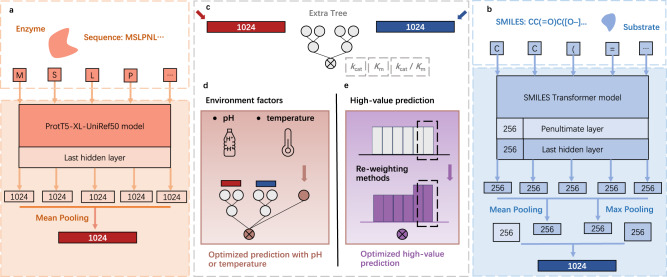
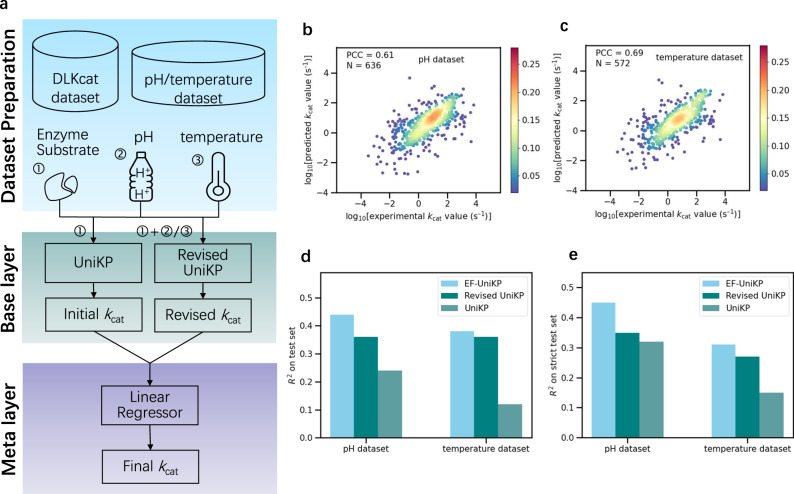
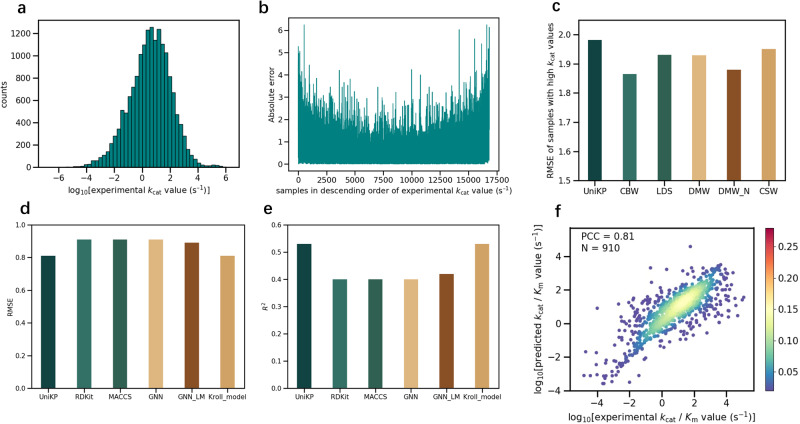
Prediction of enzyme kinetic parameters is essential for designing and optimizing enzymes for various biotechnological and industrial applications, but the limited performance of current prediction tools on diverse tasks hinders their practical applications. Here, we introduce UniKP, a unified framework based on pretrained language models for the prediction of enzyme kinetic parameters, including enzyme turnover number ( k cat ), Michaelis constant ( K m ), and catalytic efficiency ( k cat / K m ), from protein sequences and substrate structures. A two-layer framework derived from UniKP (EF-UniKP) has also been proposed to allow robust k cat prediction in considering environmental factors, including pH and temperature. In addition, four representative re-weighting methods are systematically explored to successfully reduce the prediction error in high-value prediction tasks. We have demonstrated the application of UniKP and EF-UniKP in several enzyme discovery and directed evolution tasks, leading to the identification of new enzymes and enzyme mutants with higher activity. UniKP is a valuable tool for deciphering the mechanisms of enzyme kinetics and enables novel insights into enzyme engineering and their industrial applications.
Overview
The claims and statistics of this paper haven’t been checked yet.
Run the check — free, no account needed. It reads the open-access text and checks the sources it cites.
Integrity signals
Registry
Cites
Statistics
Figures
Verification
Claims the paper makes
The claims and statistics of this paper haven’t been checked yet.
Run the check — free, no account needed. It reads the open-access text and checks the sources it cites.
Self-check
Percentages, sums and reported differences re-computed from the paper’s own numbers.
The self-check needs the paper’s full text.
Citations
Cites
Vaswani, A., Shazeer, N., Parmar, N., Uszkoreit, J., Jones, L., Gomez, A. N., Kaiser, L., & Polosukhin, I. (2017) · arXiv · doi:10.48550/arxiv.1706.03762 · Cited by 120,404
Basic local alignment search tool
Altschul, S. F., Gish, W., Miller, W., Myers, E. W., & Lipman, D. J. (1990) · Journal of Molecular Biology · doi:10.1006/jmbi.1990.9999 · Cited by 98,669
BERT: Pre-training of Deep Bidirectional Transformers for Language Understanding
Devlin, J., Chang, M.-W., Lee, K., & Toutanova, K. (2018) · arXiv · doi:10.48550/arxiv.1810.04805 · Cited by 73,173
ImageNet: A large-scale hierarchical image database
Deng, J., Dong, W., Socher, R., Li, L.-J., Li, K., & Fei-Fei, L. (2009) · 2009 IEEE Conference on Computer Vision and Pattern Recognition · doi:10.1109/cvpr.2009.5206848 · Cited by 65,333
SMOTE synthetic minority over-sampling technique
Chawla, N. V., Bowyer, K. W., Hall, L. O., & Kegelmeyer, W. P. (2002) · Journal of Artificial Intelligence Research · doi:10.1613/jair.953 · Cited by 32,865
UniProt: the Universal Protein Knowledgebase in 2023
The UniProt Consortium, Bateman, A., Martin, M.-J., Orchard, S., Magrane, M., Ahmad, S., Alpi, E., Bowler-Barnett, E. H., Britto, R., Bye-A-Jee, H., et al. (2023) · Nucleic Acids Research · doi:10.1093/nar/gkac1052 · Cited by 7,210
PubChem Substance and Compound databases
Kim, S., Thiessen, P. A., Bolton, E. E., Chen, J., Fu, G., Gindulyte, A., Han, L., He, J., He, S., Shoemaker, B. A., et al. (2016) · Nucleic Acids Research · doi:10.1093/nar/gkv951 · Cited by 5,436
Self-citationSupervised Machine Learning: A Review of Classification Techniques
Kotsiantis, S. B. (2007) · Informatica · Cited by 4,192
The class imbalance problem: A systematic study1
Japkowicz, N., & Stephen, S. (2002) · Intelligent Data Analysis · doi:10.3233/ida-2002-6504 · Cited by 3,295
Rives, A., Meier, J., Sercu, T., Goyal, S., Lin, Z., Liu, J., Guo, D., Ott, M., Zitnick, C. L., Ma, J., et al. (2021) · Proceedings of the National Academy of Sciences · doi:10.1073/pnas.2016239118 · Cited by 3,286
Rives, A., Meier, J., Sercu, T., Goyal, S., Lin, Z., Liu, J., Guo, D., Ott, M., Zitnick, C. L., Ma, J., et al. (2019) · doi:10.1101/622803 · Cited by 3,280
Sagi, O., & Rokach, L. (2018) · WIREs Data Mining and Knowledge Discovery · doi:10.1002/widm.1249 · Cited by 3,103
Class-Balanced Loss Based on Effective Number of Samples
Cui, Y., Jia, M., Lin, T.-Y., Song, Y., & Belongie, S. (2019) · 2019 IEEE/CVF Conference on Computer Vision and Pattern Recognition (CVPR) · doi:10.1109/cvpr.2019.00949 · Cited by 3,094
ProtTrans: Toward Understanding the Language of Life Through Self-Supervised Learning
Elnaggar, A., Heinzinger, M., Dallago, C., Rehawi, G., Wang, Y., Jones, L., Gibbs, T., Feher, T., Angerer, C., Steinegger, M., et al. (2022) · IEEE Transactions on Pattern Analysis and Machine Intelligence · doi:10.1109/tpami.2021.3095381 · Cited by 2,329 · cited 4×
“We speculated that pretrained models have greatly contributed to the performanceofUniKPbycreatinganeasilylearnablerepresentationof enzyme sequences and substrate structures using unsupervised information from the entire database 18 .”
InfluentialA Note on the Kinetics of Enzyme Action
Briggs, G. E., & Haldane, J. B. S. (1925) · Biochemical Journal · doi:10.1042/bj0190338 · Cited by 1,338
The Moderately Efficient Enzyme: Evolutionary and Physicochemical Trends Shaping Enzyme Parameters
Bar-Even, A., Noor, E., Savir, Y., Liebermeister, W., Davidi, D., Tawfik, D. S., & Milo, R. (2011) · Biochemistry · doi:10.1021/bi2002289 · Cited by 1,050
Tcherkez, G. G. B., Farquhar, G. D., & Andrews, T. J. (2006) · Proceedings of the National Academy of Sciences · doi:10.1073/pnas.0600605103 · Cited by 777
Deep learning improves antimicrobial peptide recognition
Veltri, D., Kamath, U., & Shehu, A. (2018) · Bioinformatics · doi:10.1093/bioinformatics/bty179 · Cited by 626
Deep learning-based kcat prediction enables improved enzyme-constrained model reconstruction
Li, F., Yuan, L., Lu, H., Li, G., Chen, Y., Engqvist, M. K. M., Kerkhoven, E. J., & Nielsen, J. (2022) · Nature Catalysis · doi:10.1038/s41929-022-00798-z · Cited by 466 · cited 8×
“” or k cat values less than or equal to 0, as per the DLKcat instruction 12 .”
InfluentialAn introduction to domain adaptation and transfer learningPreprint
Kouw, W. M., & Loog, M. (2018) · arXiv (Cornell University) · doi:10.13140/rg.2.2.33906.56004 · Cited by 416
BRENDA, the enzyme information system in 2011
Scheer, M., Grote, A., Chang, A., Schomburg, I., Munaretto, C., Rother, M., Sohngen, C., Stelzer, M., Thiele, J., & Schomburg, D. (2011) · Nucleic Acids Research · doi:10.1093/nar/gkq1089 · Cited by 409 · cited 2×
“For k cat / K m prediction, an additional dataset was collected from BRENDA, UniProt and PubChem 6,7,31 , containing 910 enzyme sequences,substratestructures,andtheircorresponding k cat / K m values.”
Currin, A., Swainston, N., Day, P. J., & Kell, D. B. (2014) · Chemical Society Reviews · doi:10.1039/c4cs00351a · Cited by 393
Directed evolution of enzyme catalysts
Kuchner, O., & Arnold, F. H. (1997) · Trends in biotechnology · doi:10.1016/s0167-7799(97)01138-4 · Cited by 373
Kuznetsova, E., Proudfoot, M., González, C. F., Brown, G., Omelchenko, M. V., Borozan, I., Carmel, L., Wolf, Y. I., Mori, H., Savchenko, A. V., et al. (2006) · Journal of Biological Chemistry · doi:10.1074/jbc.m605449200 · Cited by 310
Building a global alliance of biofoundries
Hillson, N., Caddick, M., Cai, Y.-Z., Carrasco, J., Chang, M., Curach, N., Bell, D. J., Lefeuvre, R., Friedman, D., Fu, X.-F., et al. (2019) · Nature Communications · doi:10.1038/s41467-019-10079-2 · Cited by 295
Self-citationAmiram, M., Haimovich, A. D., Fan, C., Wang, Y., Aerni, H. R., Ntai, I., Moonan, D. W., Ma, N. J., Rovner, A. J., Hong, S. H., et al. (2015) · Nature Biotechnology · doi:10.1038/nbt.3372 · Cited by 283
SABIO-RK--database for biochemical reaction kinetics
Wittig, U., Kania, R., Golebiewski, M., Rey, M., Shi, L., Jong, L. M., Algaa, E., Weidemann, A., Sauer‐Danzwith, H., Mir, S., et al. (2011) · Nucleic Acids Research · doi:10.1093/nar/gkr1046 · Cited by 260
Delving into deep imbalanced regression
Yang, Y., Zha, K., Chen, Y.-C., Wang, H., & Katabi, D. (2021) · arXiv · doi:10.48550/arxiv.2102.09554 · Cited by 229
The BRENDA enzyme information system–From a database to an expert system
Schomburg, I., Jeske, L., Ulbrich, M., Placzek, S., Chang, A., & Schomburg, D. (2017) · Journal of Biotechnology · doi:10.1016/j.jbiotec.2017.04.020 · Cited by 222
Heckmann, D., Lloyd, C. J., Mih, N., Ha, Y., Zielinski, D. C., Haiman, Z. B., Desouki, A. A., Lercher, M. J., & Palsson, B. O. (2018) · Nature Communications · doi:10.1038/s41467-018-07652-6 · Cited by 218
Jendresen, C. B., Stahlhut, S. G., Li, M., Gaspar, P., Siedler, S., Förster, J., Maury, J., Borodina, I., & Nielsen, A. T. (2015) · Applied and Environmental Microbiology · doi:10.1128/aem.00405-15 · Cited by 198
Adadi, R., Volkmer, B., Milo, R., Heinemann, M., & Shlomi, T. (2012) · PLoS Computational Biology · doi:10.1371/journal.pcbi.1002575 · Cited by 179
An approach for classification of highly imbalanced data using weighting and undersampling
Anand, A., Pugalenthi, G., Fogel, G. B., & Suganthan, P. N. (2010) · Amino Acids · doi:10.1007/s00726-010-0595-2 · Cited by 172
Vannelli, T., Qi, W., Sweigard, J. A., Gatenby, A. A., & Sariaslani, F. S. (2006) · Metabolic Engineering · doi:10.1016/j.ymben.2006.11.001 · Cited by 168
Anticancer peptides prediction with deep representation learning features
Lv, Z., Cui, F., Zou, Q., Zhang, L., & Xu, L. (2021) · Briefings in Bioinformatics · doi:10.1093/bib/bbab008 · Cited by 145
Bag of Tricks for Long-Tailed Visual Recognition with Deep Convolutional Neural Networks
Zhang, Y., Wei, X.-S., Zhou, B., & Wu, J. (2021) · Proceedings of the AAAI Conference on Artificial Intelligence · doi:10.1609/aaai.v35i4.16458 · Cited by 143
Deep learning allows genome-scale prediction of Michaelis constants from structural features
Kroll, A., Engqvist, M. K. M., Heckmann, D., & Lercher, M. J. (2021) · PLOS Biology · doi:10.1371/journal.pbio.3001402 · Cited by 132
Metabolic Models of Protein Allocation Call for the Kinetome
Nilsson, A., Nielsen, J., & Palsson, B. O. (2017) · Cell Systems · doi:10.1016/j.cels.2017.11.013 · Cited by 87
Identification of Protein Subcellular Localization With Network and Functional Embeddings
Pan, X., Li, H., Zeng, T., Li, Z., Chen, L., Huang, T., & Cai, Y. (2021) · Frontiers in Genetics · doi:10.3389/fgene.2020.626500 · Cited by 63
Underground metabolism: network-level perspective and biotechnological potential
Notebaart, R. A., Kintses, B., Feist, A. M., & Papp, B. (2017) · Current Opinion in Biotechnology · doi:10.1016/j.copbio.2017.07.015 · Cited by 62
Structural Flexibility Modulates the Activity of Human Glutathione Transferase P1-1
Caccuri, A. M., Ascenzi, P., Antonini, G., Parker, M. W., Oakley, A. J., Chiessi, E., Nuccetelli, M., Battistoni, A., Bellizia, A., & Ricci, G. (1996) · Journal of Biological Chemistry · doi:10.1074/jbc.271.27.16193 · Cited by 58
Plant uptake of NaCl in relation to enzyme kinetics and toxic effects
Trapp, S., Feifičová, D., Rasmussen, N. F., & Bauer‐Gottwein, P. (2008) · Environmental and Experimental Botany · doi:10.1016/j.envexpbot.2008.05.001 · Cited by 52
Vannelli, T., Xue, Z., Breinig, S., Qi, W. W., & Sariaslani, F. S. (2007) · Enzyme and Microbial Technology · doi:10.1016/j.enzmictec.2007.03.013 · Cited by 51
DLKcat cannot predict meaningful kcat values for mutants and unfamiliar enzymes
Kroll, A., & Lercher, M. J. (2024) · Biology Methods and Protocols · doi:10.1093/biomethods/bpae061 · Cited by 47
Characterization of mutants of a tyrosine ammonia-lyase from Rhodotorula glutinis
Zhou, S., Liu, P., Chen, J., Du, G., Li, H., & Zhou, J. (2016) · Applied Microbiology and Biotechnology · doi:10.1007/s00253-016-7672-8 · Cited by 45
Chen, T., Wang, X., Chu, Y., Wang, Y., Jiang, M., Wei, D., & Xiong, Y. (2020) · Frontiers in Microbiology · doi:10.3389/fmicb.2020.580382 · Cited by 42
Predicting plant Rubisco kinetics from RbcL sequence data using machine learning
Iqbal, W. A., Lisitsa, A., & Kapralov, M. V. (2022) · Journal of Experimental Botany · doi:10.1093/jxb/erac368 · Cited by 39
Discovery of Novel Tyrosine Ammonia Lyases for the Enzymatic Synthesis of p‐Coumaric Acid
Brack, Y., Sun, C., Yi, D., & Bornscheuer, U. T. (2022) · ChemBioChem · doi:10.1002/cbic.202200062 · Cited by 36
Prediction of enzyme kinetic parameters based on statistical learning.
Borger, S., Liebermeister, W., & Klipp, E. (2006) · PubMed · Cited by 31
Yu, H., & Luo, X. (2022) · Briefings in Bioinformatics · doi:10.1093/bib/bbac476 · Cited by 21
Self-citationA Unified Geolocation Channel Model--Part I (Path Loss)
Progri, I. F. (2017) · Journal of Geolocation Geo-information and Geo-intelligence · doi:10.18610/jg3.2017.071604 · Cited by 18
Exploiting spatial dimensions to enable parallelized continuous directed evolution
Wei, T., Lai, W., Chen, Q., Zhang, Y., Sun, C., He, X., Zhao, G., Fu, X., & Liu, C. (2022) · Molecular Systems Biology · doi:10.15252/msb.202210934 · Cited by 10
Luo-SynBioLab/UniKP: UniKP: v1
Luo-SynBioLab, & Yu, H. (2023) · Zenodo (CERN European Organization for Nuclear Research) · doi:10.5281/zenodo.10115497 · Cited by 1
Self-citation
Research works printed but not linked: 4
- Honda, S. et al. Smiles transformer: Pre-trained molecular fingerprint for low data drug discovery. arXiv preprint arXiv:1911.04738 (2019). · arXiv
- Van der Maaten, L. & Hinton, G. Visualizing data using t-SNE. J. Mach. Learning Res. 9, 11 (2008).
- Kroll, A. and Lercher, M. J. Machine learning models for the prediction of enzyme properties should be tested on proteins not used for model training. bioRxiv https://doi.org/10.1101/2023.02.06.526991 (2023). · DOI
- Li, Y. Deep reinforcement learning: An overview. arXiv preprint arXiv:1701.07274 (2017). · arXiv
Cited by
Sorted by citations
Relieving metabolic burden to improve robustness and bioproduction by industrial microorganisms
Mao, J., Zhang, H., Chen, Y., Wei, L., Liu, J., Nielsen, J., Chen, Y., & Xu, N. (2024) · Biotechnology Advances · doi:10.1016/j.biotechadv.2024.108401 · Cited by 163
Robust enzyme discovery and engineering with deep learning using CataPro
Wang, Z., Xie, D., Wu, D., Luo, X., Wang, S., Li, Y., Yang, Y., Li, W., & Zheng, L. (2025) · Nature Communications · doi:10.1038/s41467-025-58038-4 · Cited by 123
Self-citationCatPred: a comprehensive framework for deep learning in vitro enzyme kinetic parameters
Boorla, V. S., & Maranas, C. D. (2025) · Nature Communications · doi:10.1038/s41467-025-57215-9 · Cited by 122
Cell factory design with advanced metabolic modelling empowered by artificial intelligence
Lu, H., Xiao, L., Liao, W., Yan, X., & Nielsen, J. (2024) · Metabolic Engineering · doi:10.1016/j.ymben.2024.07.003 · Cited by 57
Wang, J., Yang, Z., Chen, C., Ge, Y., Wan, X., Bao, S., Ding, J., Wang, L., & Jiang, H. (2024) · Briefings in Bioinformatics · doi:10.1093/bib/bbae387 · Cited by 63
Metadata
- Authors
- Yu, H., Deng, H., He, J., Keasling, J. D., & Luo, X.
- Affiliations
- Chinese Academy of Sciences (CN)
- Lawrence Berkeley National Laboratory (US)
- Corresponding author
- Luo, Xiaozhou
- Venue
- Nature Communications
- Published
- 2023-12-11
- Volume
- 14
- Issue
- 1
- Pages
- 8211-8211
- ISSN
- 2041-1723 (ISSN-L)
- PMC
- PMC10713628
- OpenAlex
- W4389546039
- Cited by
- 226
- References
- 54
- Citations by year
- 2026: 96 · 2025: 88 · 2024: 39 · 2023: 3
- FWCI
- 20.23
- Type
- journal article
- Language
- en
- Open access
- gold
- doi.org
- Locations
- Nature Communications (publishedVersion, cc-by)
- Research Square (acceptedVersion, cc-by)
- PubMed Central (publishedVersion, cc-by)
- PubMed (publishedVersion)
- eScholarship (California Digital Library) (submittedVersion, cc-by)
- OSTI OAI (U.S. Department of Energy Office of Scientific and Technical Information) (submittedVersion, cc-by)
- Technical University of Denmark, DTU Orbit (Technical University of Denmark, DTU) (submittedVersion, other-oa)
- RePEc: Research Papers in Economics (submittedVersion)
- DOAJ (DOAJ: Directory of Open Access Journals) (submittedVersion, cc-by-sa)
- Funders
- National Natural Science Foundation of China (32071421)
- Topics
- Life Sciences › Biochemistry, Genetics and Molecular Biology › Molecular Biology › Machine Learning in Bioinformatics
- Life Sciences › Biochemistry, Genetics and Molecular Biology › Molecular Biology › Enzyme Catalysis and Immobilization
- Life Sciences › Biochemistry, Genetics and Molecular Biology › Molecular Biology › Protein Structure and Dynamics
- Keywords
- Michaelis constant, catalytic efficiency, protein sequences, substrate structure, pre-trained language models, environmental factors, pH and temperature effects, enzyme discovery, directed evolution, enzyme engineering
- MeSH terms
- Biotechnology, Catalysis, Kinetics, Temperature
About these checks
Registry, retraction, Cites and statistics results are computed, not judged, with one exception: a printed reference that no index lists is read once by a model before it counts as a citation error. Claims are extracted by a model and kept only when their quote appears verbatim in the text; each cited source is then checked, with a model’s help, for whether it says what the claim relies on. Those verdicts can be wrong — read the claim’s quote and the cited source before relying on one.
Statistics and arithmetic are recomputed, not judged.
Confidence bands are shown only for fields calibrated on our annotated test set. None is calibrated yet, so no band is shown.
What counts as a claim ›How we measure confidence ›How we check this ›
Are you an author, or do you see a problem with this page? Request a review
