

A reactive neural network framework for water-loaded acidic zeolites
Open accessThe DOI matches its Crossref record; 108 of the 112 references it cites were found in a registry or an index, and 1 are not checked yet; 27 of the 64 sources its claims cite were checked for support.
Abstract
Under operating conditions, the dynamics of water and ions confined within protonic aluminosilicate zeolite micropores are responsible for many of their properties, including hydrothermal stability, acidity and catalytic activity. However, due to high computational cost, operando studies of acidic zeolites are currently rare and limited to specific cases and simplified models. In this work, we have developed a reactive neural network potential (NNP) attempting to cover the entire class of acidic zeolites, including the full range of experimentally relevant water concentrations and Si/Al ratios. This NNP has the potential to dramatically improve sampling, retaining the (meta)GGA DFT level accuracy, with the capacity for discovery of new chemistry, such as collective defect formation mechanisms at the zeolite surface. Furthermore, we exemplify how the NNP can be used as a basis for further extensions/improvements which include data-efficient adoption of higher-level (hybrid) references via Δ-learning and the acceleration of rare event sampling via automatic construction of collective variables. These developments represent a significant step towards accurate simulations of realistic catalysts under operando conditions.
Verified 2026-11-22 · 1 reference not checked yet
Overview
CoChat Summary
## TL;DR
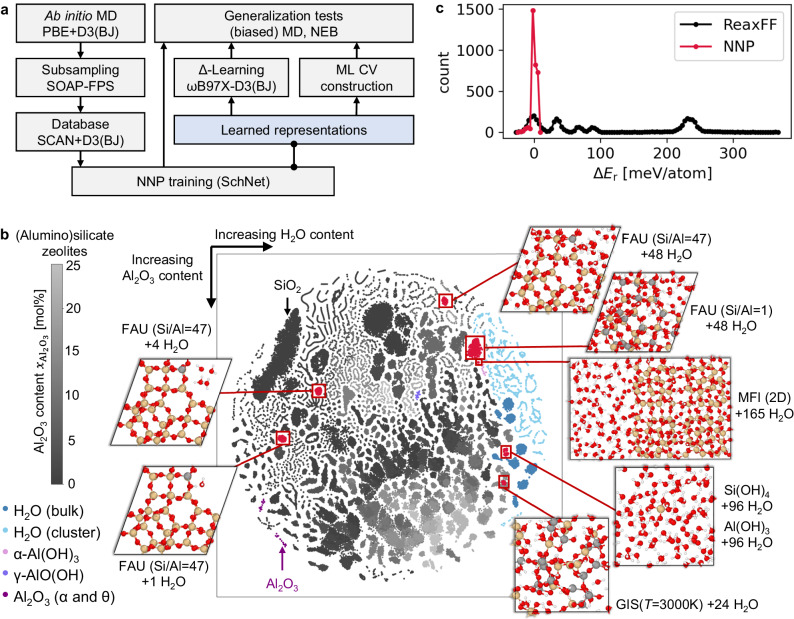
The paper develops a reactive neural network potential (NNP) for water-loaded Brønsted acidic zeolites (BAS) that aims to cover broad chemical and configurational space, including varied water loadings and Si/Al ratios. It reports that the model retains roughly meta-GGA DFT-level accuracy across diverse tests and can also support Δ-learning and machine-learned collective variables for rare-event sampling.
## Key findings
- The final SCAN+D3(BJ) training database contained 248,439 structures; an ensemble of six SchNet NNPs trained on it achieved average test RMSEs of 5.3 meV atom−1 for energies and 186 meV Å−1 for forces.
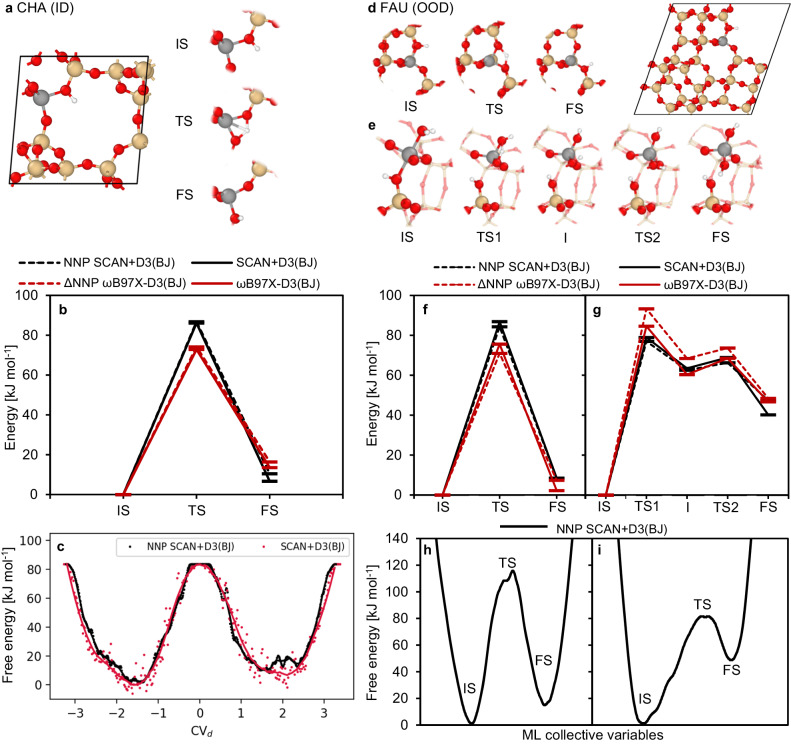
- Across 2700 test configurations, the NNP gave an average reaction-energy error of about 6 kJ mol−1 for FAU reaction-path tests, and the authors say this is within DFT accuracy.
- For the in-domain Δ-learning example (proton jump in CHA), 150 training structures were sufficient to reach test-set RMSEs of 1.3 meV atom−1 and 69 meV Å−1, with the ΔNNP deviating by less than 3 kJ/mol from the ωB97X-D3(BJ) reference.
- In out-of-domain tests, performance remained good but worsened modestly: proton jump in FAU showed about 5 kJ mol−1 relative-energy error, and Al–O(H) bond dissociation in FAU reached up to 8 kJ mol−1 error.
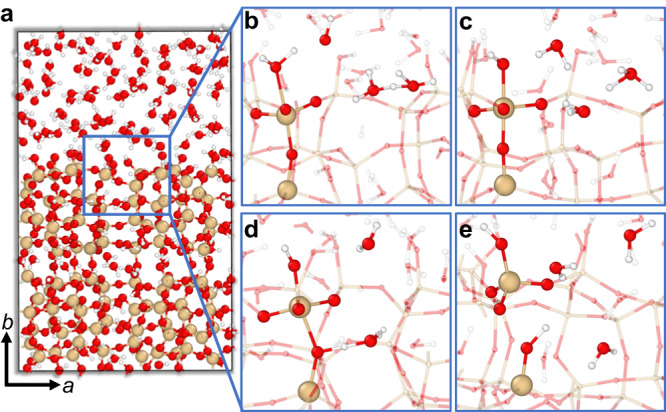
- The model captured multiple reactive behaviors not in the training set, including a collective hydrolysis mechanism at an external MFI surface and a high-temperature GIS liquid-state run with thousands of bond-breaking events.
## Methods
- The authors built a broad training set from 500 short (10 ps) AIMD trajectories plus lattice deformations, bulk-water simulations, water clusters, ice/alumina polymorphs, and prior CHA trajectories; the resulting reference dataset used SCAN+D3(BJ) single-point labels.
- Generalization was tested with MD and NEB on unseen systems, including FAU, MFI, GIS, bulk-water-solvated fragments (Si(OH)4 and Al(OH)3), and high-temperature simulations at 1600 K and 3000 K.
- They trained an ensemble of six SchNet-based NNPs and also built two extensions: Δ-learning to ωB97X-D3(BJ) and machine-learned collective variables via a variational autoencoder on NNP representations.
## Limitations
- The paper states that finite-size effects hinder the interpretation of confined-water dynamics in FAU because a small primitive cell was used primarily for benchmarking.
- The authors note that the very high-temperature conditions used in some tests (1600 K and 3000 K) are not applicable to standard applications of water-zeolite systems; this is an evident limitation of the stress tests, not the target use case.
- For the biased-dynamics free-energy calculations, the authors explicitly say their restraints may bias the reported free-energy profiles and that the goal was to demonstrate capability rather than maximal accuracy.
Model-written summary. Check it against the paper before relying on it.
Integrity signals
Registry
Cites
Statistics
Figures
Verification
Claims the paper makes
17 Valid · 2 Not valid · 15 Not checked · 66 Own results and interpretations
Some cited sources support this claim and some don’t — read each source’s verdict below.
In the paper
“As a result, the proper mechanistic understanding of BAS-water-zeolite interactions is still lacking, limited to either static calculations at ultra-high vacuum conditions13,14 or exploratory (ab initio) dynamical simulations of narrow scope15–18.”
§ A reactive neural network framework for water-loaded acidic zeolites > Introduction
What the sources say
- Not checked — no full text of the sourcecites [13] Silaghi M-C Regioselectivity of Al–O bond hydrolysis during zeolites dealumination unified by brønsted–evans–polanyi relationship ACS Catal. 2015 5 11 15 10.1021/cs501474u source
- Not checked — no full text of the sourcecites [14] Silaghi M-C Chizallet C Sauer J Raybaud P Dealumination mechanisms of zeolites and extra-framework aluminum confinement J. Catal. 2016 339 242 255 10.1016/j.jcat.2016.04.021 source
- Partly supportedcites [15] Heard CJ Fast room temperature lability of aluminosilicate zeolites Nat. Commun. 2019 10 1 7 10.1038/s41467-019-12752-y 31619677 PMC6795794 sourceExperimental — accuracy not yet measured
The Results (Computational studies) describe biased ab initio molecular dynamics of the initial hydrolysis of water-loaded chabazite, so this paper is an example of a dynamical study with a specific scope. It does not state that mechanistic understanding of Brønsted acid site–water–zeolite interactions is generally lacking or that prior work is limited to the two approaches named in the citing sentence. (LLM, conf=0.84)
- Partly supportedcites [16] Nielsen M Collective action of water molecules in zeolite dealumination Catal. Sci. Technol. 2019 9 3721 3725 10.1039/C9CY00624A sourceExperimental — accuracy not yet measured
The Introduction of Nielsen et al. (2019) supports the 'static calculations' half of the claim: 'so far all DFT studies of zeolite dealumination have employed a static approach, in which structures are located as minima in the potential energy landscape. Free energies were subsequently derived from nuclear vibrations in the harmonic approximation, which has obvious and severe limitations, in particular at the high temperatures employed in dealumination', and 'the static DFT approach in practice does not allow adequate sampling of all relevant states when taking the collective action of multiple water molecules into account'. However, our copy never describes those static studies as being at 'ultra-high vacuum conditions' (the limitation it names is the harmonic free-energy treatment and the gas-phase reference state for adsorbed water), and it does not characterise prior work as 'exploratory (ab initio) dynamical simulations of narrow scope' — it states the opposite, that all previous dealumination DFT studies were static, with its own DFT-MD/umbrella-sampling work presented as the first in situ dynamical investigation at realistic steaming conditions (Results and discussion; Conclusions). The claim's framing is also broader (BAS–water–zeolite interactions in general) than the dealumination-specific statements in the source. (LLM, conf=0.72)
- Disputedcites [17] Grifoni E Confinement effects and acid strength in zeolites Nat. Commun. 2021 12 2630 10.1038/s41467-021-22936-0 33976197 PMC8113345 sourceExperimental — accuracy not yet measured
The Introduction (page unavailable) describes full ab initio metadynamics across four zeolite frameworks and multiple water loadings, yielding thermodynamic and mechanistic information at atomistic detail—not a dynamical study of narrow scope. The Results and discussion report general findings about BAS solvation, contrary to the claim that mechanistic understanding remains limited to such studies. (LLM, conf=0.85)
Checked by a reasoning model — may be wrong.
- Not checked — no full text of the sourcecites [18] Jin M The role of water loading and germanium content in germanosilicate hydrolysis J. Phys. Chem. C 2021 125 23744 23757 10.1021/acs.jpcc.1c06873 source
plain- Asserted: passes — The authors put it forward as true.
- Checkable: passes — It can be checked against evidence.
- Load-bearing: passes — The paper’s conclusions depend on it.
- Based: passes — The paper gives a reason why it holds.
The cited sources support only part of this claim — read each source’s verdict below.
In the paper
“A standard tool for accelerating the reactive sampling in zeolite-water systems, and thus reaching experimentally relevant timescale or realistic levels of model complexity is the class of reactive analytical potentials, for example, ReaxFF19. However, due to their fixed functional form, these potentials have limited transferability to systems with different chemical composition20.”
§ A reactive neural network framework for water-loaded acidic zeolites > Introduction
What the sources say
- Partly supportedcites [19] Senftle TP The ReaxFF reactive force-field: development, applications and future directions npj Comput. Mater. 2016 2 1 14 10.1038/npjcompumats.2015.11 sourceExperimental — accuracy not yet measured
The section on ReaxFF parameterisations and development branches (page unavailable in our copy) says that parameter sets cannot be combined arbitrarily and that transferring them between branches requires extensive refitting. It does not attribute this limitation to a fixed functional form; it discusses the branches within a common functional form and points instead to ReaxFF’s lack of atom typing as a complication. (LLM, conf=0.86)
- Supportedcites [20] Vandermause J Xie Y Lim JS Owen CJ Kozinsky B Active learning of reactive Bayesian force fields applied to heterogeneous catalysis dynamics of H/Pt Nat. Commun. 2022 13 5183 10.1038/s41467-022-32294-0 36055982 PMC9440250 source
The Introduction says ReaxFF models require expert fine-tuning for each system and can deviate substantially from ab initio results because of their limited parametric functional form. That supports the citing sentence’s point that the potentials do not readily transfer between chemically different systems. (LLM, conf=0.86)
plainstates a cause- Asserted: passes — The authors put it forward as true.
- Checkable: passes — It can be checked against evidence.
- Load-bearing: passes — The paper’s conclusions depend on it.
- Based: passes — The paper gives a reason why it holds.
- Partly supported
The sources with a verdict support this claim; the rest weren’t checked yet, have no full text we could read, or their verdicts aren’t rated yet.
In the paper
“This relationship governs many features of BAS zeolites including (i) proton solvation, and thus acidity7,8”
§ A reactive neural network framework for water-loaded acidic zeolites > Introduction
What the sources say
- Not checked — no full text of the sourcecites [7] Pfriem N Role of the ionic environment in enhancing the activity of reacting molecules in zeolite pores Science 2021 372 952 957 10.1126/science.abh3418 33958482 source
- Supportedcites [8] Bates JS Bukowski BC Greeley J Gounder R Structure and solvation of confined water and water–ethanol clusters within microporous Brønsted acids and their effects on ethanol dehydration catalysis Chem. Sci. 2020 11 7102 7122 10.1039/D0SC02589E 33250979 PMC7690318 source
The Introduction (page not available in our copy) says water stabilizes solvated protons and that solvent polarity changes protonation equilibrium constants in zeolites. It also reports that solvent properties can change the strength of Brønsted acid sites, supporting the link between water interactions, proton solvation, and acidity. (LLM, conf=0.88)
plainstates a cause- Asserted: passes — The authors put it forward as true.
- Checkable: passes — It can be checked against evidence.
- Load-bearing: passes — The paper’s conclusions depend on it.
- Based: passes — The paper gives a reason why it holds.
The cited sources support only part of this claim — read each source’s verdict below.
In the paper
“(iii) water mobility and clustering in zeolite pores10”
§ A reactive neural network framework for water-loaded acidic zeolites > Introduction
What the sources say
- Partly supportedcites [10] Fasano M Interplay between hydrophilicity and surface barriers on water transport in zeolite membranes Nat. Commun. 2016 7 12762 10.1038/ncomms12762 27694935 PMC5477497 sourceExperimental — accuracy not yet measured
The Results section (‘Intracrystalline diffusion in zeolites’; page not specified) reports that water–zeolite interactions affect water mobility in MFI pores at low hydration, while water–water interactions predominate at higher hydration. It examines water–water hydrogen bonds but does not establish that Brønsted acid sites govern water clustering. (LLM, conf=0.86)
plainstates a cause- Asserted: passes — The authors put it forward as true.
- Checkable: passes — It can be checked against evidence.
- Load-bearing: passes — The paper’s conclusions depend on it.
- Based: passes — The paper gives a reason why it holds.
- Partly supported
The cited sources support only part of this claim — read each source’s verdict below.
In the paper
“Two paradigms dominate the MLP field currently: (i) training of universal MLP that cover large parts of the chemical space with dozens of elements, but with limited coverage of the configuration space, e.g., not considering all relevant chemical reactions with the associated transition states, e.g., OC22, CHGNet, and others25–29”
§ A reactive neural network framework for water-loaded acidic zeolites > Introduction
What the sources say
- Partly supportedcites [25] Takamoto S Towards universal neural network potential for material discovery applicable to arbitrary combination of 45 elements Nat. Commun. 2022 13 2991 10.1038/s41467-022-30687-9 35637178 PMC9151783 sourceExperimental — accuracy not yet measured
The Abstract and Methods describe a potential spanning 45 elements and a training dataset with no transition-state structures, supporting the claim about broad chemical coverage and a gap in training coverage. But the Results report that the model predicts transition-state energies and evaluates chemical-reaction pathways, so the paper does not support an unqualified claim that it does not consider reactions or their transition states. The indexed copy provides section labels but no page numbers. (LLM, conf=0.85)
- Partly supportedcites [26] Tran R The open catalyst 2022 (OC22) dataset and challenges for oxide electrocatalysts ACS Catal. 2023 13 3066 3084 10.1021/acscatal.2c05426 sourceExperimental — accuracy not yet measured
Our copy supports the chemical-space half of the characterization: the OC22 slabs are built from 51 elements (Chemical Diversity of Open Catalyst 2022, Fig. 11) and the work targets 'a general purpose potential, rather than separate models for each specific property' (Discussion), i.e. it is a legitimate instance of the universal-MLP paradigm. However, the source nowhere says its configuration-space coverage is limited by omitting relevant reactions or transition states; on the contrary it states the dataset 'spans the configurational complexity for oxide surfaces... varying surface terminations, adsorbate+slab configurations and coverage, and non-stoichiometric substitutions and vacancies' (Introduction) and only concedes that 'OC22 structures may not always be the most stable or pertinent for a particular reaction pathway of interest' (The OC22 Dataset). Searches for 'transition state', reaction-barrier coverage returned no such statement, so that qualifier of the claim is not attributable to this source. (LLM, conf=0.72)
- Partly supportedcites [27] Deng B CHGNet as a pretrained universal neural network potential for charge-informed atomistic modelling Nat. Mach. Intell. 2023 5 1031 1041 10.1038/s42256-023-00716-3 sourceExperimental — accuracy not yet measured
Our copy supports the first half of the attributed characterisation: CHGNet is presented as a pretrained universal MLIP trained on the Materials Project Trajectory (MPtrj) dataset, and the 'Materials Project Trajectory Dataset' section states the data cover '~146,000 inorganic materials composed of 89 elements', 'over 100,000 occurrences for 60 different elements' and 'comprehensive coverage of all chemistries, excluding only the noble gases and actinoids'. However, no passage states the second half — limited coverage of configuration space or the omission of chemical reactions and their transition states; the paper's own limitations discussion concerns magmom/charge inference and charge neutrality ('Discussion'), not reaction-pathway sampling (the closest content is the 'Data parsing' filtering of structures 'higher than 1 eV per atom ... relative to the relaxed structure', which is never framed as a transition-state coverage limitation). So only the chemical-space part of what this citation is offered for is in the source. (LLM, conf=0.72)
- Partly supportedcites [28] Zhang, D. et al. DPA-2: Towards a universal large atomic model for molecular and material simulation. Preprint at 10.48550/arXiv.2312.15492 (2023). sourceExperimental — accuracy not yet measured
The Introduction of DPA-2 supports the general shape of the claim: it describes 'universal'/'fundamental' large atomic models built on extensive DFT-labeled data covering dozens of elements (M3GNet across 89 chemical species, PFP on 45 elements, ALIGNN on 89 elements, CHGNet/MACE-MP-0 on 1.58M MPtrj inorganic crystal frames) and states such single-task models are only directly applicable 'in which the explored configurations are effectively covered by the training data', with DFT-labeled data 'expensive and sparse in the configurational and chemical spaces' and MLPs struggling to generalize beyond their training data. However, the specific exemplification attributed here — that these universal models do not cover relevant chemical reactions and their associated transition states — is not stated in our copy; the limitations it does name are inconsistent DFT labeling settings (e.g. MPtrj vs ANI-1x, restricting molecular generalizability) and GGA-vs-meta-GGA accuracy, and its own multi-task corpus actually includes reactive adsorbate/catalyst data (OC2M AIMD trajectories) and a Transition-1x dataset rather than a claim that reactions/transition states are absent from universal MLP training sets. (LLM, conf=0.72)
- Partly supportedcites [29] Batatia, I. et al. A foundation model for atomistic materials chemistry. Preprint at 10.48550/arXiv.2401.00096 (2024). sourceExperimental — accuracy not yet measured
Our copy supports the chemical-space half of the characterisation: Section 4 'Related work: general purpose MLIPs' lists the general-purpose models and their elemental reach (MEGNet/CHGNet/M3GNet on MP-based data covering most of the 89 elements, DPA-1 and DPA-2 with 56 and 73 elements, PFP with 45 then 72 elements, ALIGNN-FF with 89), and states they were 'created primarily for the purpose of "materials discovery", i.e. predicting thermodynamic stability of hypothetical inorganic crystals', trained on 'snapshots of DFT relaxations of MP structures' (Appendix Fig. S66, p. 141, confirms MPtrj is MP relaxation trajectories). What the source does not state is the specific configuration-space charge as worded — that these universal potentials do not include the relevant chemical reactions and their transition states; the nearest statements are about its own model, namely that Section 2.2 Catalysis shows it generalising 'to out-of-domain catalysis tasks from bulk training configurations' with barriers that are quantitatively wrong without fine-tuning, and that the field 'has yet to be a comprehensive demonstration that a single ML potential can describe solid, liquid, and gaseous systems ... well beyond the distribution of the underlying training set'. So the transition-state clause is inferred from the training-data description rather than asserted. (LLM, conf=0.70)
plain- Asserted: passes — The authors put it forward as true.
- Checkable: passes — It can be checked against evidence.
- Load-bearing: passes — The paper’s conclusions depend on it.
- Based: passes — The paper gives a reason why it holds.
- Partly supported
49 more claims · 4 with their cited sources checked
Create a free account to see all 100 claims and to verify the 19 references still open.
- Probably not a substantial claim. 14
- It may state two separate claims as one. 38
Citations
Cites
Generalized Gradient Approximation Made Simple
Perdew, J. P., Burke, K., & Ernzerhof, M. (1996) · Physical Review Letters · doi:10.1103/physrevlett.77.3865 · Cited by 215,824 · cited 2×
“All AIMD simulations and structure optimizations were performed at the computationally less demanding PBE+D3(BJ)[29] level employing the dispersion correction of Grimme et al.”
MethodEfficient iterative schemes for ab initio total-energy calculations using a plane-wave basis set
Kresse, G., & Furthmüller, J. (1996) · Physical Review B · doi:10.1103/physrevb.54.11169 · Cited by 123,652
Projector augmented-wave method
Blöchl, P. E. (1994) · Physical Review B · doi:10.1103/physrevb.50.17953 · Cited by 92,732
From ultrasoft pseudopotentials to the projector augmented-wave method
Kresse, G., & Joubert, D. (1999) · Physical Review B · doi:10.1103/physrevb.59.1758 · Cited by 85,307 · cited 1×
“4) along with standard versions of the Projector Augmented-Wave (PAW) potentials.[79, 80] Calculations at constant volume were performed with an energy cutoff of 400 eV.”
BackgroundKresse, G., & Furthmüller, J. (1996) · Computational Materials Science · doi:10.1016/0927-0256(96)00008-0 · Cited by 75,638
Grimme, S., Antony, J., Ehrlich, S., & Krieg, H. (2010) · The Journal of Chemical Physics · doi:10.1063/1.3382344 · Cited by 59,686
Ab initio molecular dynamics for liquid metals
Kresse, G., & Hafner, J. (1993) · Physical Review B · doi:10.1103/physrevb.47.558 · Cited by 45,727
Effect of the damping function in dispersion corrected density functional theory
Grimme, S., Ehrlich, S., & Goerigk, L. (2011) · Journal of Computational Chemistry · doi:10.1002/jcc.21759 · Cited by 28,221 · cited 2×
“The bulk of the data-base is derived from 500 short (10 ps) ab initio molecular dynamics (AIMD) trajectories (at PBE +D3(BJ) level) 35 – 37 using a set of BAS zeolite models.”
MethodCanonical dynamics: Equilibrium phase-space distributions
Hoover, W. G. (1985) · Physical Review A · doi:10.1103/physreva.31.1695 · Cited by 23,465 · cited 2×
“The AIMD equilibration used the canonical (NVT) ensemble along with a 1 fs time step, the Nosé–Hoover thermostat[70, 71] and with hydrogen being replaced by tritium.”
MethodKresse, G., & Hafner, J. (1994) · Physical Review B · doi:10.1103/physrevb.49.14251 · Cited by 23,019
Research works printed but not linked: 3
- Schütt, K., Unke, O. & Gastegger, M. Equivariant message passing for the prediction of tensorial properties and molecular spectra. In Proceedings of the 38th International Conference on Machine Learning 9377–9388 (PMLR, 2021).
- van der Maaten L Hinton G Visualizing Data using t-SNE J. Mach. Learn Res. 2008 9 2579 2605
- Kingma, D. P. & Ba, J. Adam: a method for stochastic optimization. In 3rd International Conference on Learning Representations, ICLR 2015, San Diego, CA, USA, May 7-9, 2015, Conference Track Proceedings (eds Bengio, Y. & LeCun, Y.) (ICLR, 2015).
Cited by
Application of machine learning interatomic potentials in heterogeneous catalysis
Olajide, G., Baral, K., Ezendu, S., Soyemi, A., & Szilvási, T. (2025) · Journal of Catalysis · doi:10.1016/j.jcat.2025.116202 · Cited by 34
Bocus, M., Vandenhaute, S., & Speybroeck, V. V. (2024) · Angewandte Chemie International Edition · doi:10.1002/anie.202413637 · Cited by 28
Wang, X., Wang, Q., Wang, C., Chu, Y., Hu, M., Deng, F., Yu, J., & Xu, J. (2025) · Journal of the American Chemical Society · doi:10.1021/jacs.5c01756 · Cited by 24
Learning a reactive potential for silica-water through uncertainty attribution
Roy, S., Dürholt, J. P., Asche, T. S., Zipoli, F., & Gómez‐Bombarelli, R. (2024) · Nature Communications · doi:10.1038/s41467-024-50407-9 · Cited by 29
“Several NNIP have been constructed for pure water 18 – 20 , amorphous and liquid silica 21,22 and water-fi lled aluminosilicate zeolites 23 .”
Zeolite–Water Chemistry: Characterization Methods to Unveil Zeolite Structure
Almeida, J. N., Song, L., Askarli, S., Chung, S., & Ruiz-Martínez, J. (2025) · Chemistry - Methods · doi:10.1002/cmtd.202400076 · Cited by 30
Zheng, M., & Bukowski, B. C. (2024) · The Journal of Physical Chemistry C · doi:10.1021/acs.jpcc.4c01087 · Cited by 18
Chen, L., Erlebach, A., Brivio, F., Grajciar, L., Tošner, Z., Heard, C. J., & Nachtigall, P. (2023) · Chemical Science · doi:10.1039/d3sc02492j · Cited by 18
“65,67,68 This will alleviate the sampling problem which currently hinders dynamical simulations, by extending the available timescales by several orders of magnitude.”
Self-citationChemically accurate predictions for water adsorption on Brønsted sites of zeolite H-MFI
Windeck, H., Berger, F., & Sauer, J. (2024) · Physical Chemistry Chemical Physics · doi:10.1039/d4cp02851a · Cited by 16
Toward Realistic Simulations of Zeolite Catalytic Processes: A Mini Review
Li, L., Xu, X., Ye, M., & Liu, Z. (2024) · The Journal of Physical Chemistry C · doi:10.1021/acs.jpcc.4c07342 · Cited by 13
Willimetz, D., Erlebach, A., Heard, C. J., & Grajciar, L. (2024) · Digital Discovery · doi:10.1039/d4dd00306c · Cited by 12
Self-citationMorton, K. S. C., Porter, A. J., Armstrong, J., & O’Malley, A. J. (2024) · Catalysis Science & Technology · doi:10.1039/d4cy00321g · Cited by 11
The role of defects in high-silica zeolite hydrolysis and framework healing
Liu, M., Grajciar, L., & Heard, C. J. (2024) · Microporous and Mesoporous Materials · doi:10.1016/j.micromeso.2024.113219 · Cited by 13
Self-citationAtmospheric water vapour as a potential water source and its impact on energy systems
Edström, F., & Dahlbäck, P. (2024) · Nature Reviews Materials · doi:10.1038/s41578-024-00727-5 · Cited by 9
“Newer methods, such as using solid desiccants like metal– organic frameworks 5 or zeolites 6 , offer potential solutions but also encounter thermodynamic limitations.”
Modelling silica using MACE-MP machine learnt interatomic potentials
Nasir, J. A., Guan, J., Jee, W. S. S., Woodley, S. M., Sokol, A. A., Catlow, C. R. A., & Elena, A. M. (2025) · Physical Chemistry Chemical Physics · doi:10.1039/d5cp01882j · Cited by 15
Chen, L., Bornes, C., Bengtsson, O., Erlebach, A., Slater, B., Grajciar, L., & Heard, C. J. (2024) · Faraday Discussions · doi:10.1039/d4fd00100a · Cited by 13
Self-citationKim, G., Tran, A. V., Keum, Y., Kim, T. Y., Song, C. K., Lee, H. J., Kim, J. M., Kim, Y. J., & Baek, J. (2025) · Chemical Engineering Journal · doi:10.1016/j.cej.2025.160472 · Cited by 9
Germanium distributions in zeolites derived from neural network potentials
Saha, I., Erlebach, A., Nachtigall, P., Heard, C. J., & Grajciar, L. (2024) · Catalysis Science & Technology · doi:10.1039/d4cy00763h · Cited by 7
Self-citationRen, G., Gong, G., Zhang, N., et al. (2025) · Journal of Membrane Science · doi:10.1016/j.memsci.2025.123779 · Cited by 6
Zheng, M., Orr, L., & Bukowski, B. C. (2025) · ACS Catalysis · doi:10.1021/acscatal.5c04133 · Cited by 5
Learning descriptors to predict organic structure-directing agent applicability in zeolite synthesis
Hoffman, A. J., Xie, M., & Gómez‐Bombarelli, R. (2025) · Microporous and Mesoporous Materials · doi:10.1016/j.micromeso.2024.113467 · Cited by 6
Jeschke, S., Wilson, K., & Lee, A. F. (2025) · The Journal of Physical Chemistry C · doi:10.1021/acs.jpcc.5c01790 · Cited by 5
Water Adsorption at Pairs of Proximate Brønsted Acid Sites in Zeolites
Windeck, H., Willimetz, D., Erlebach, A., Heard, C. J., Grajciar, L., Berger, F., & Sauer, J. (2026) · The Journal of Physical Chemistry Letters · doi:10.1021/acs.jpclett.5c03794 · Cited by 8
Self-citationPrecision, intelligence, and a new paradigm for chemical research
Feng, S., Jiang, J., & Li, Z. (2025) · The Journal of Chemical Physics · doi:10.1063/5.0262187 · Cited by 5
Feng, J., Lu, H., Hua, J., Sun, N., Jiang, J., Qian, K., Yu, Q., He, A., & Tian, H. (2026) · Environmental Science & Technology · doi:10.1021/acs.est.5c14654 · Cited by 3
Jarngal, P., Jackson, B. A., Yuk, S. F., Zhang, D., Lee, M.-S., Menziani, M. C., Glezakou, V., Rousseau, R. J., & Piccini, G. (2025) · Journal of Catalysis · doi:10.1016/j.jcat.2025.116658 · Cited by 3
Aluminium siting in zeolite RTH from a combined machine learning – NMR approach
Willimetz, D., Martínez-Ortigosa, J., Brako-Amoafo, D. A., Grajciar, L., Vidal‐Moya, A., Bornes, C., Sarou‐Kanian, V., Erlebach, A., Rey, F., Blasco, T., et al. (2026) · Journal of Materials Chemistry A · doi:10.1039/d5ta09253a · Cited by 3
Self-citationSpeybroeck, V. V., Temmerman, W., Bocus, M., & Vanduyfhuys, L. (2026) · Annual Review of Physical Chemistry · doi:10.1146/annurev-physchem-082624-014800 · Cited by 7
Rimer, J. D., Moliner, M., Grajciar, L., Navrotsky, A., Palmer, J. C., Schwalbe‐Koda, D., & Zones, S. I. (2026) · ACS Applied Materials & Interfaces · doi:10.1021/acsami.6c04953 · Cited by 2
Self-citationRecent Advances and Challenges in Modeling Catalytic Reactions in Zeolites
Verma, R., & Sahoo, S. K. (2025) · ChemistrySelect · doi:10.1002/slct.202501858 · Cited by 3
Bocus, M., Vandenhaute, S., & Speybroeck, V. V. (2024) · Angewandte Chemie · doi:10.1002/ange.202413637 · Cited by 1
Ma, K., Guan, Z., & Liang, X. (2025) · ChemistrySelect · doi:10.1002/slct.202502557 · Cited by 1
Moving in the right direction: Emerging ideas in fitting accurate potentials
Reinhart, W. F., & Sinnott, S. B. (2025) · MRS Bulletin · doi:10.1557/s43577-025-00950-7 · Cited by 4
Willimetz, D., & Grajciar, L. (2025) · The Journal of Physical Chemistry Letters · doi:10.1021/acs.jpclett.5c02595 · Cited by 1
“The correlation between the force uncertainties predicted by the NNP ensemble and those obtained with our atom-based KDE score is shown in Figure 4.”
Self-citationApplication of Machine Learning Interatomic Potentials in Heterogeneous CatalysisPreprint
Olajide, G., Baral, K., Ezendu, S., et al. (2025) · SSRN Electronic Journal · doi:10.2139/ssrn.5168152 · Cited by 1
Kim, G., Tran, A. V., Keum, Y., Lee, H. J., Kim, J. M., Kim, Y. J., & Baek, J. (2024) · SSRN Electronic Journal · doi:10.2139/ssrn.5055039
Computational Chemistry in Zeolite Catalysis
Kolganov, A. A., & Pidko, E. A. (2025) · Royal Society of Chemistry eBooks · doi:10.1039/9781837676859-00312
Jarngal, P., Jackson, B. A., Yuk, S. F., et al. (2025) · SSRN Electronic Journal · doi:10.2139/ssrn.5584118
Guan, Z., Ma, K., & Liang, X. (2025) · Energy Sources Part A Recovery Utilization and Environmental Effects · doi:10.1080/15567036.2025.2589361
“Solid acids, including zeolites (Erlebach et al. 2024), sulfonated metal oxides (Kour and Paul 2015), and ion-exchange resins (Han, Pyo, and Xu 2025), served as suitable replacements for liquid acids.”
Benchmarking Universal Interatomic Potentials on Zeolite
Ito, S., Muraoka, K., & Nakayama, A. (2026) · The Journal of Physical Chemistry C · doi:10.1021/acs.jpcc.5c06812 · Cited by 2
Guan, Z., Ma, K., & Liang, X. (2025) · Kinetics and Catalysis · doi:10.1134/s0023158425600737
Kayano, R., Delaye, J., Gin, S., Faijan, & Ohkubo, T. (2026) · ACS Applied Materials & Interfaces · doi:10.1021/acsami.6c09704
Wilson, W. N., Lane, J. M., Humphreys, W., Bharadwaj, V. S., & Rai, N. (2026) · The Journal of Physical Chemistry C · doi:10.1021/acs.jpcc.5c07956
CRISP : Enhancing ASE Workflows With Advanced Molecular Simulation Post‐Processing
Saha, I., Willimetz, D., & Grajciar, L. (2026) · Journal of Computational Chemistry · doi:10.1002/jcc.70384
Self-citationChizallet, C., Janik, M., Payard, P., & Rousseau, R. J. (2026) · Journal of Catalysis · doi:10.1016/j.jcat.2026.117001
Sireci, E., Hoffman, J.-A., Sharapa, D. I., Gambu, T. G., Steen, E. E. V., & Studt, F. (2026) · ACS Catalysis · doi:10.1021/acscatal.6c04886 · Cited by 1
Metadata
- Authors
- Erlebach, A., Šípka, M., Saha, I., Nachtigall, P., Heard, C. J., & Grajciar, L.
- Affiliations
- Charles University (CZ)
- Corresponding author
- Erlebach, Andreas
- Grajciar, Lukáš
- ORCID
- Venue
- Nature Communications
- Published
- 2024-05-17
- Volume
- 15
- Issue
- 1
- Pages
- 4215-4215
- ISSN
- 2041-1723 (ISSN-L)
- PMC
- PMC11101627
- OpenAlex
- W4396999021
- Cited by
- 47
- References
- 112
- Citations by year
- 2026: 13 · 2025: 20 · 2024: 13
- FWCI
- 4.47
- Type
- journal article
- Language
- en
- Open access
- gold
- doi.org
- Licence
- cc-by
- creativecommons.org/licenses/by/4.0 (tdm)
- creativecommons.org/licenses/by/4.0 (vor)
- Locations
- Nature Communications (publishedVersion, cc-by)
- PubMed Central (publishedVersion, cc-by-nc-sa)
- PubMed (publishedVersion)
- arXiv (Cornell University) (submittedVersion, cc-by-nc-sa)
- RePEc: Research Papers in Economics (submittedVersion)
- DOAJ (DOAJ: Directory of Open Access Journals) (submittedVersion)
- arXiv (Cornell University)
- Funders
- Univerzita Karlova v Praze (PRIMUS/20/SCI/004, UNCE/SCI/014)
- Ministerstvo Školství, Mládeže a Tělovýchovy (ID:90254, CZ.02.1.01/0.0/0.0/15 003/0000417)
- Grantová Agentura České Republiky (23-07616S)
- Topics
- Physical Sciences › Materials Science › Materials Chemistry › Machine Learning in Materials Science
- Physical Sciences › Chemistry › Inorganic Chemistry › Zeolite Catalysis and Synthesis
- Physical Sciences › Physics and Astronomy › Atomic and Molecular Physics, and Optics › Advanced Chemical Physics Studies
- Keywords
- acid zeolites, zeolite acidity, hydrothermal stability, Si/Al ratio, delta learning, rare event sampling, collective variables, machine learning interatomic potentials
About these checks
Registry, retraction, Cites and statistics results are computed, not judged, with one exception: a printed reference that no index lists is read once by a model before it counts as a citation error. Claims are extracted by a model and kept only when their quote appears verbatim in the text; each cited source is then checked, with a model’s help, for whether it says what the claim relies on. Those verdicts can be wrong — read the claim’s quote and the cited source before relying on one.
The claim verdicts this report counts are experimental: their accuracy is not yet measured.
A language model drew the claims from the paper on 2026-10-10, under version 3 of the claim definition (model deepseek-v4.1-flash, prompt extract-v3).
A second model labelled each claim on 2026-10-10 (model jev-1.13-20260917, definition revision gold-guideline-v0.2).
Cited sources are checked with a language model’s help (gpt-6-sol and qwen3.8-omni-flash).
Statistics and arithmetic are recomputed, not judged.
Confidence bands are shown only for fields calibrated on our annotated test set. None is calibrated yet, so no band is shown.
What counts as a claim ›How we measure confidence ›How we check this ›
Are you an author, or do you see a problem with this page? Request a review
Data sources
Bibliographic data: Semantic Scholar, OpenAlex, Crossref.
Contains information from the Semantic Scholar Academic Graph Datasets, made available under the ODC Attribution License (ODC-BY 1.0).
Semantic Scholar’s data is described in: Kinney, R., et al. (2023). The Semantic Scholar Open Data Platform. arXiv:2301.10140.
