

Pre-trained multimodal large language model enhances dermatological diagnosis using SkinGPT-4
Open accessPublished version of a preprint
The DOI matches its Crossref record; 81 of the 81 references it cites were found in a registry or an index.
Abstract
Large language models (LLMs) are seen to have tremendous potential in advancing medical diagnosis recently, particularly in dermatological diagnosis, which is a very important task as skin and subcutaneous diseases rank high among the leading contributors to the global burden of nonfatal diseases. Here we present SkinGPT-4, which is an interactive dermatology diagnostic system based on multimodal large language models. We have aligned a pre-trained vision transformer with an LLM named Llama-2-13b-chat by collecting an extensive collection of skin disease images (comprising 52,929 publicly available and proprietary images) along with clinical concepts and doctors’ notes, and designing a two-step training strategy. We have quantitatively evaluated SkinGPT-4 on 150 real-life cases with board-certified dermatologists. With SkinGPT-4, users could upload their own skin photos for diagnosis, and the system could autonomously evaluate the images, identify the characteristics and categories of the skin conditions, perform in-depth analysis, and provide interactive treatment recommendations.
Overview
The claims and statistics of this paper haven’t been checked yet.
Free: it reads the open-access text and checks the first 5 claims that cite a source we can check. Create a free account to check every claim.
Integrity signals
Registry
Cites
Statistics
Figures
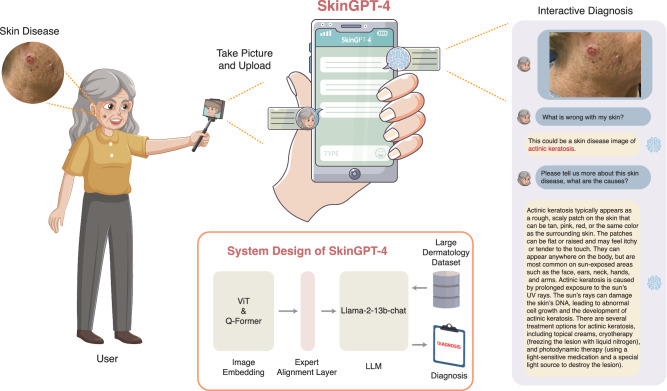
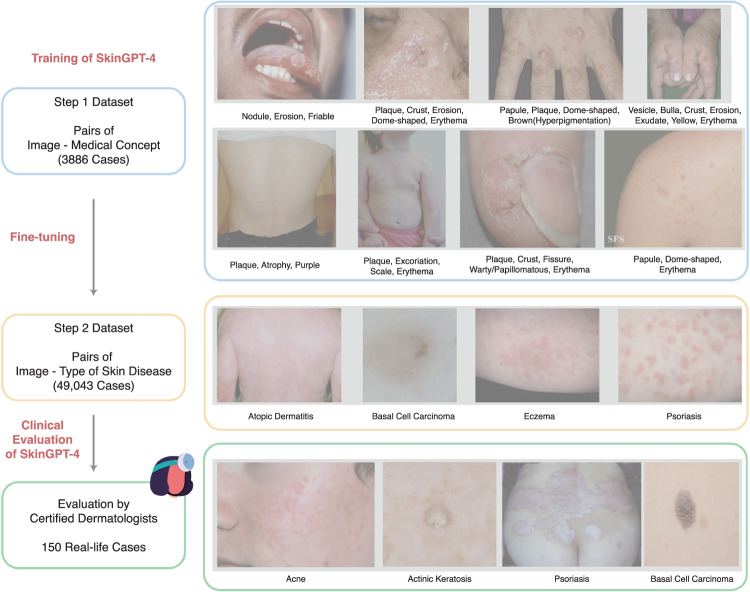
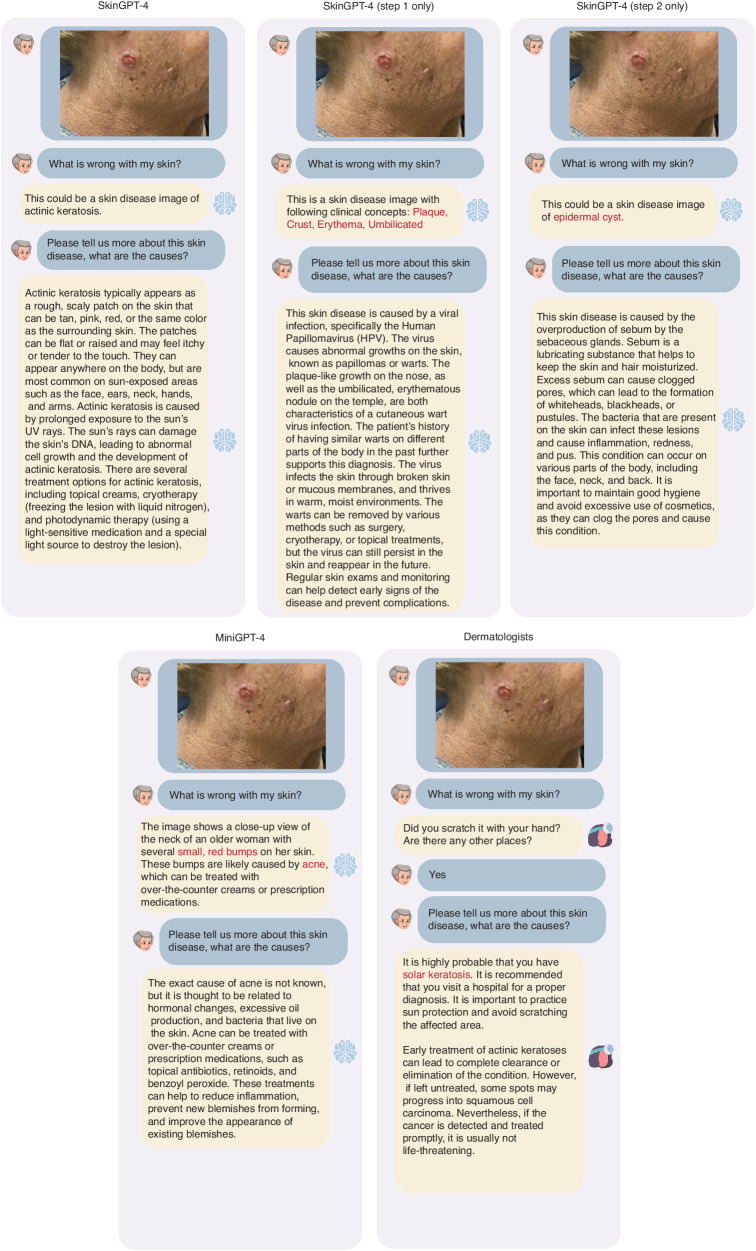
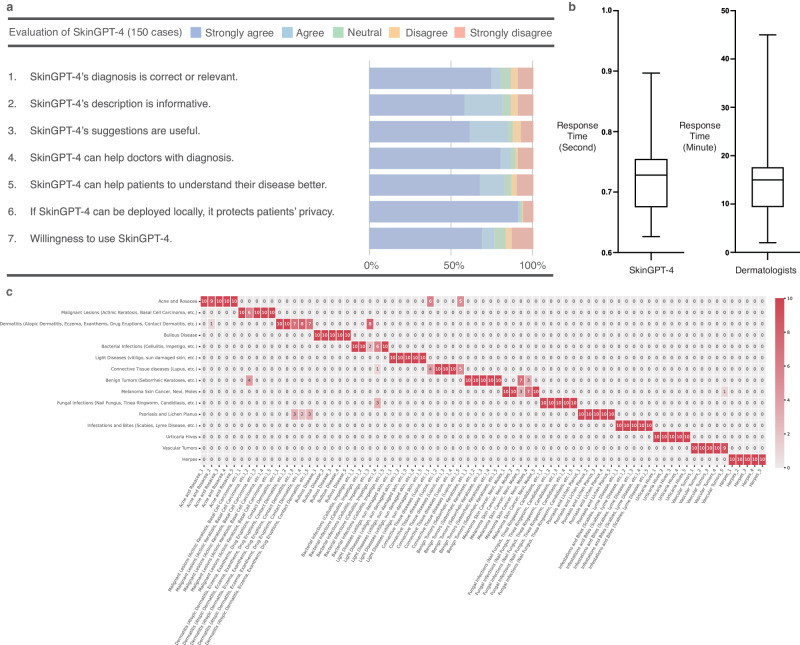
Verification
Claims the paper makes
The claims and statistics of this paper haven’t been checked yet.
Free: it reads the open-access text and checks the first 5 claims that cite a source we can check. Create a free account to check every claim.
Claims other papers make about this one
Each is checked against this paper’s own text: does it say what the citing paper says it does?
The source backs part of the claim, not all of it — or backs it for a different population, condition or comparison.
In the citing paper
“Large Language Models (LLMs) and emerging Large Multimodal Models (LMMs)—including GPT-4, SkinGPT-4, and Gemini—integrate image inputs with natural-language reasoning to produce diagnostic recommendations, clinical descriptions, or triage outputs (24).”
From Revolutionizing dermatopathology using AI in skin diagnostics: scoping review (2026) · cites this paper as [24]
Experimental — accuracy not yet measuredThe cited source says what the claim attributes to it.
In the citing paper
“The development of foundation models is also reshaping the dermatology domain, with multiple models such as SkinGPT4 2 , PanDerm 4 , Derm1M 3 , paving the way for an increased use of such models in the domain.”
From Synthesized clinical notes enable training robust multimodal AI models from unimodal dermatology datasets (2026) · cites this paper as [2]
Self-check
Percentages, sums and reported differences re-computed from the paper’s own numbers.
The self-check needs the paper’s full text.
Citations
Cites
Vaswani, A., Shazeer, N., Parmar, N., Uszkoreit, J., Jones, L., Gomez, A. N., Kaiser, L., & Polosukhin, I. (2017) · arXiv · doi:10.48550/arxiv.1706.03762 · Cited by 120,404
An Image is Worth 16x16 Words: Transformers for Image Recognition at Scale
Dosovitskiy, A., Beyer, L., Kolesnikov, A., Weissenborn, D., Zhai, X., Unterthiner, T., Dehghani, M., Minderer, M., Heigold, G., Gelly, S., et al. (2020) · arXiv · doi:10.48550/arxiv.2010.11929 · Cited by 47,472
Dermatologist-level classification of skin cancer with deep neural networks
Esteva, A., Kuprel, B., Novoa, R. A., Ko, J., Swetter, S. M., Blau, H. M., & Thrun, S. (2017) · Nature · doi:10.1038/nature21056 · Cited by 14,362
LLaMA: Open and Efficient Foundation Language Models
Touvron, H., Lavril, T., Izacard, G., Martinet, X., Lachaux, M.-A., Lacroix, T., Rozière, B., Goyal, N., Hambro, E., Azhar, F., et al. (2023) · arXiv · doi:10.48550/arxiv.2302.13971 · Cited by 4,602
Kung, T. H., Cheatham, M., Medenilla, A., Sillos, C., De Leon, L., Elepaño, C., Madriaga, M., Aggabao, R., Diaz-Candido, G., Maningo, J., et al. (2023) · PLOS Digital Health · doi:10.1371/journal.pdig.0000198 · Cited by 4,115 · cited 1×
“Over the past few months, the fi eld of large language models (LLMs) has seen signi fi cant advancements 40,41 , offering remarkable language comprehension abilities and the potential to perform complex linguistic tasks.”
Kung, T. H., Cheatham, M., ChatGPT, Medenilla, A., Sillos, C., De Leon, L., Elepaño, C., Madriaga, M., Aggabao, R., Diaz-Candido, G., et al. (2022) · doi:10.1101/2022.12.19.22283643 · Cited by 4,115
Large language models encode clinical knowledge
Singhal, K., Azizi, S., Tu, T., Mahdavi, S. S., Wei, J., Chung, H. W., Scales, N., Tanwani, A., Cole-Lewis, H., Pfohl, S., et al. (2023) · Nature · doi:10.1038/s41586-023-06291-2 · Cited by 4,083 · cited 1×
“Never-theless, the development of multimodal large language models for medical diagnosis is still in its early stages 51,52 , particularly considering the prevalence of image-based data in the fi eld of medical diagnosis, among which, dermatological diagnosis is a very important task but lacks…”
Large Language Models Encode Clinical Knowledge
Singhal, K., Azizi, S., Tu, T., Mahdavi, S. S., Wei, J., Chung, H. W., Scales, N., Tanwani, A., Cole-Lewis, H., Pfohl, S., et al. (2022) · arXiv · doi:10.48550/arxiv.2212.13138 · Cited by 4,083
Rajpurkar, P., Chen, E., Banerjee, O., & Topol, E. J. (2022) · Nature Medicine · doi:10.1038/s41591-021-01614-0 · Cited by 3,212 · cited 1×
“Meanwhile, for ChatCAD, users need to use ChatGPT ’ s API to upload text descriptions, which could raise data privacy issues 41,56,57 as both medical images and text descriptions contain patients ’ private information 58 – 61 .”
Conceptual Captions: A Cleaned, Hypernymed, Image Alt-text Dataset For Automatic Image Captioning
Sharma, P., Ding, N., Goodman, S., & Soricut, R. (2018) · Proceedings of the 56th Annual Meeting of the Association for Computational Linguistics (Volume 1: Long Papers) · doi:10.18653/v1/p18-1238 · Cited by 1,879 · cited 1×
“However, MiniGPT-4 is trained on the combined dataset of Conceptual Caption 67 , SBU 68 , and LAION 69 , which are irrelevant to medical images, especially dermatological images.”
Research works printed but not linked: 4
- Mijwil M Aljanabi M Ali AH Chatgpt: exploring the role of cybersecurity in the protection of medical information Mesop. J. Cybersecur. 2023 2023 18 21
- Lund B Agbaji D Teel ZA Information literacy, data literacy, privacy literacy, and ChatGPT: technology literacies align with perspectives on emerging technology adoption within communities Lund., B, Agbaji, D., Teel, ZA (2023) Inf. Lit., Data Lit., Priv. Lit., ChatGPT: Technol. Literacies Align Perspect. Emerg. Technol. Adoption Commun. Hum. Technol. 2023 19 163 177
- Ordonez, V., Kulkarni, G. & Berg, T. Im2text: describing images using 1 million captioned photographs. Adv. Neural Inf. Process. Syst.24 (2011).
- Daneshjou R Yuksekgonul M Cai ZR Novoa R Zou JY Skincon: a skin disease dataset densely annotated by domain experts for fine-grained debugging and analysis Adv. Neural Inf. Process. Syst. 2022 35 18157 18167
Cited by
Items 301–312 of 312
LLM を用いた胸部X 線画像および所見 データに対するラベル付与時のノイズ軽減 手法
有馬, 伊. (2026) · Institutional Repositories DataBase (IRDB) · doi:10.32149/0002000390
Sui, Z. (2026) · Theoretical and Natural Science · doi:10.54254/2753-8818/2026.36040
Applications and Development of Large Language Models in Dermatology
Yu, Q. (2026) · International Conference on Mechanics, Electronics Engineering and Automation (ICMEEA) · doi:10.4108/eai.24-4-2026.2364855
Savi, F. E. P. (2026) · DSpace (Federal University of Santa Catarina)
Zhang, M., Ma, Y., Chang, G., Jiuzuo, H., Yu, N., & Long, X. (2026) · Aesthetic Surgery Journal Open Forum · doi:10.1093/asjof/ojag189
SICAPS COMMUNITY-BASED AI PLATFORM FOR SCABIES SCREENING IN ISLAMIC BOARDING SCHOOLS: A CASE STUDY
Wijayanti, E., Rachmawati, U. A., Muhana, M. F., Utomo, C. P., Pratama, M. W., Insani, N., Inayatullah, S., Widjayanti, W., Fadilah, D. A., Widyastuti, E. A., et al. (2026) · F1000Research · doi:10.12688/f1000research.190191.1
Ketenci, B. M., & Acar, D. (2026) · Eurasian Journal of Emergency Medicine · doi:10.4274/eajem.galenos.2026.85451
Komparasi CNN dan VLM untuk Diagnosis Penyakit Kulit Tropis pada Subset Dataset Derm1M
Pradana, F. R., Nilogiri, A., & A’yun, Q. (2026) · REMIK (Riset dan E-Jurnal Manajemen Informatika Komputer) · doi:10.33395/remik.v10i3.16539
Bani, S. G., Nair, S., & Dadiyala, C. (2026) · International Conference on Sustainability, Innovation & Technology (ICSIT) · doi:10.1109/icsit70359.2026.11765279
Reifs, D., Casanova-Lozano, L., Hawke, F., Fellas, A., Eidels, A., Stevenson, E. M., Croft, E., Gironès, X., Alvarez, S. D., Santos, D., et al. (2026) · Experimental Dermatology · doi:10.1111/exd.70402
Yang, Q., Ren, Y., & 周云仙 (2026) · Qualitative Health Research · doi:10.1177/10497323261487317
Tayebi, I., Thaker, S., Nguyen, D., Thaker, K. N., & Varma, M. (2026) · doi:10.2196/preprints.115999
Metadata
- Authors
- Zhou, J., He, X., Sun, L., Xu, J., Chen, X., Chu, Y., Zhou, L., Liao, X., Zhang, B., Afvari, S., & Gao, X.
- Affiliations
- King Abdullah University of Science and Technology (SA)
- Capital Medical University (CN)
- Brigham and Women's Hospital (US)
- Corresponding author
- He, Xiaonan
- ORCID
- Venue
- Nature Communications
- Published
- 2024-07-05
- Volume
- 15
- Issue
- 1
- Pages
- 5649-5649
- ISSN
- 2041-1723 (ISSN-L)
- PMC
- PMC11226626
- OpenAlex
- W4400362569
- Semantic Scholar
- b283f9bcb85124593ad4fd20039eccb24d5d23c9
- Cited by
- 189
- References
- 72
- Citations by year
- 2026: 84 · 2025: 97 · 2024: 8
- FWCI
- 17.32
- Type
- journal article
- Language
- en
- Open access
- gold
- doi.org
- Licence
- cc-by
- creativecommons.org/licenses/by/4.0 (tdm)
- creativecommons.org/licenses/by/4.0 (vor)
- Locations
- Nature Communications (publishedVersion, cc-by)
- PubMed Central (publishedVersion, cc-by)
- PubMed (publishedVersion)
- Touro Scholar (Touro College) (submittedVersion)
- DOAJ (DOAJ: Directory of Open Access Journals) (submittedVersion)
- Funders
- King Abdullah University of Science and Technology (FCC/1/1976-44-01)
- Topics
- Health Sciences › Medicine › Health Informatics › Artificial Intelligence in Healthcare and Education
- Health Sciences › Medicine › Oncology › Cutaneous Melanoma Detection and Management
- Physical Sciences › Computer Science › Computer Vision and Pattern Recognition › Multimodal Machine Learning Applications
- Keywords
- dermatological diagnosis, multimodal large language models, clinical notes, treatment guidelines
- MeSH terms
- Machine Learning, Computer Simulation, Dermatology, Models, Biological, Skin Diseases, Mobile Applications
About these checks
Registry, retraction, Cites and statistics results are computed, not judged, with one exception: a printed reference that no index lists is read once by a model before it counts as a citation error. Claims are extracted by a model and kept only when their quote appears verbatim in the text; each cited source is then checked, with a model’s help, for whether it says what the claim relies on. Those verdicts can be wrong — read the claim’s quote and the cited source before relying on one.
Statistics and arithmetic are recomputed, not judged.
Confidence bands are shown only for fields calibrated on our annotated test set. None is calibrated yet, so no band is shown.
What counts as a claim ›How we measure confidence ›How we check this ›
Are you an author, or do you see a problem with this page? Request a review
Data sources
Bibliographic data: Semantic Scholar, OpenAlex, Crossref.
Contains information from the Semantic Scholar Academic Graph Datasets, made available under the ODC Attribution License (ODC-BY 1.0).
Semantic Scholar’s data is described in: Kinney, R., et al. (2023). The Semantic Scholar Open Data Platform. arXiv:2301.10140.
