

Pre-trained multimodal large language model enhances dermatological diagnosis using SkinGPT-4
Open accessPublished version of a preprint
The DOI matches its Crossref record; 81 of the 81 references it cites were found in a registry or an index.
Abstract
Large language models (LLMs) are seen to have tremendous potential in advancing medical diagnosis recently, particularly in dermatological diagnosis, which is a very important task as skin and subcutaneous diseases rank high among the leading contributors to the global burden of nonfatal diseases. Here we present SkinGPT-4, which is an interactive dermatology diagnostic system based on multimodal large language models. We have aligned a pre-trained vision transformer with an LLM named Llama-2-13b-chat by collecting an extensive collection of skin disease images (comprising 52,929 publicly available and proprietary images) along with clinical concepts and doctors’ notes, and designing a two-step training strategy. We have quantitatively evaluated SkinGPT-4 on 150 real-life cases with board-certified dermatologists. With SkinGPT-4, users could upload their own skin photos for diagnosis, and the system could autonomously evaluate the images, identify the characteristics and categories of the skin conditions, perform in-depth analysis, and provide interactive treatment recommendations.
Overview
The claims and statistics of this paper haven’t been checked yet.
Free: it reads the open-access text and checks the first 5 claims that cite a source we can check. Create a free account to check every claim.
Integrity signals
Registry
Cites
Statistics
Figures
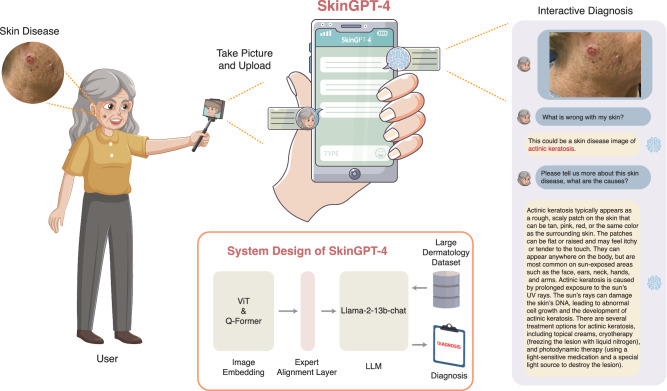
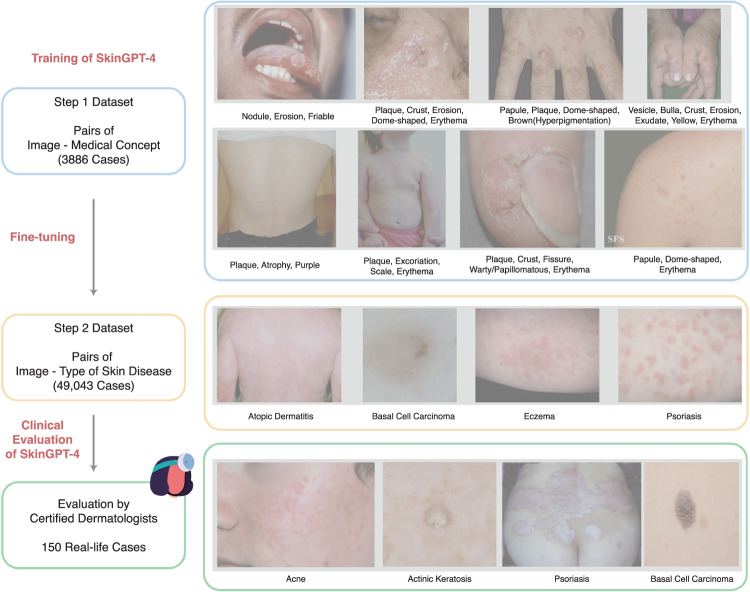
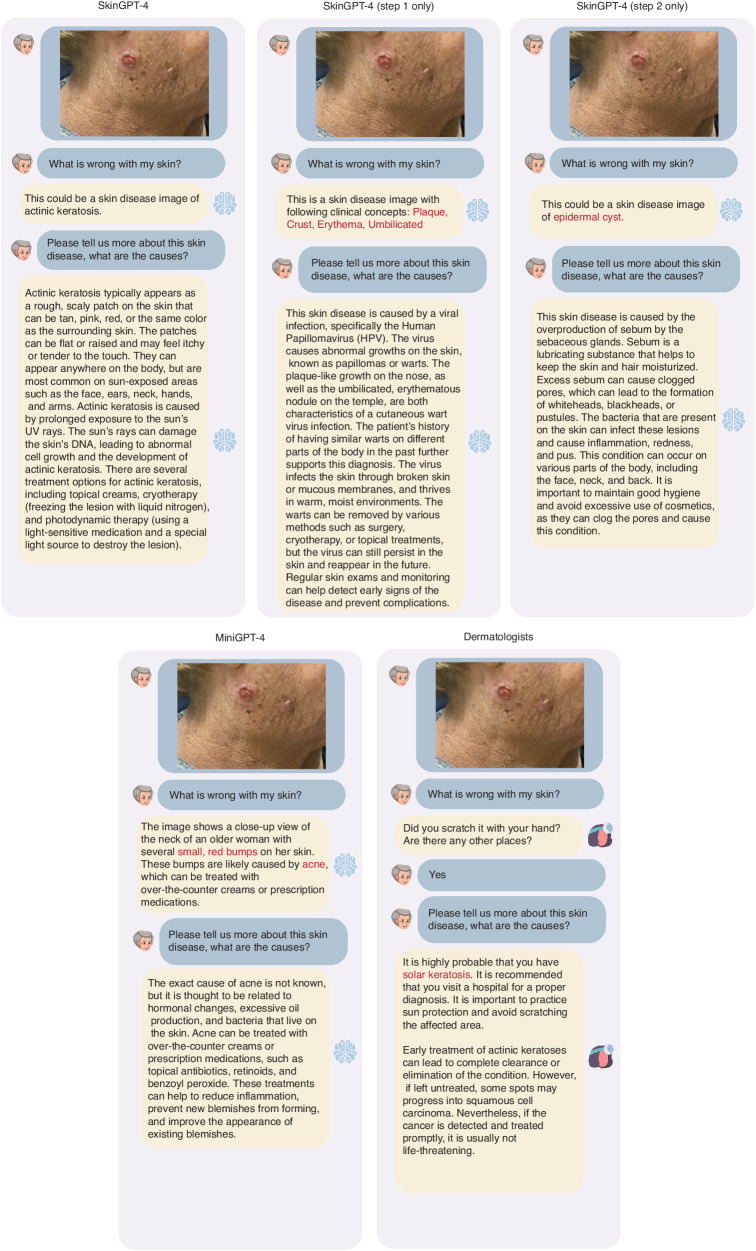
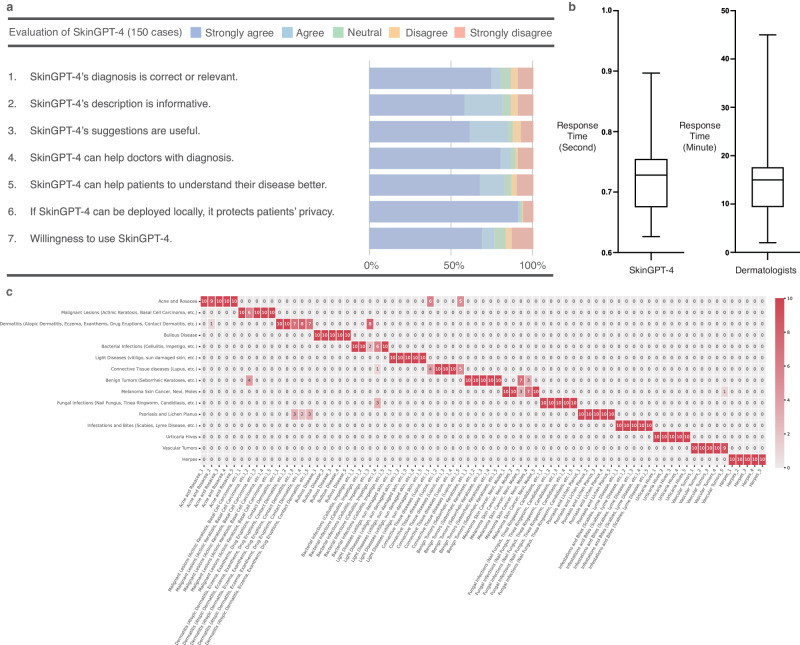
Verification
Claims the paper makes
The claims and statistics of this paper haven’t been checked yet.
Free: it reads the open-access text and checks the first 5 claims that cite a source we can check. Create a free account to check every claim.
Claims other papers make about this one
Each is checked against this paper’s own text: does it say what the citing paper says it does?
The source backs part of the claim, not all of it — or backs it for a different population, condition or comparison.
In the citing paper
“Large Language Models (LLMs) and emerging Large Multimodal Models (LMMs)—including GPT-4, SkinGPT-4, and Gemini—integrate image inputs with natural-language reasoning to produce diagnostic recommendations, clinical descriptions, or triage outputs (24).”
From Revolutionizing dermatopathology using AI in skin diagnostics: scoping review (2026) · cites this paper as [24]
Experimental — accuracy not yet measuredThe cited source says what the claim attributes to it.
In the citing paper
“The development of foundation models is also reshaping the dermatology domain, with multiple models such as SkinGPT4 2 , PanDerm 4 , Derm1M 3 , paving the way for an increased use of such models in the domain.”
From Synthesized clinical notes enable training robust multimodal AI models from unimodal dermatology datasets (2026) · cites this paper as [2]
Self-check
Percentages, sums and reported differences re-computed from the paper’s own numbers.
The self-check needs the paper’s full text.
Citations
Cites
Vaswani, A., Shazeer, N., Parmar, N., Uszkoreit, J., Jones, L., Gomez, A. N., Kaiser, L., & Polosukhin, I. (2017) · arXiv · doi:10.48550/arxiv.1706.03762 · Cited by 120,404
An Image is Worth 16x16 Words: Transformers for Image Recognition at Scale
Dosovitskiy, A., Beyer, L., Kolesnikov, A., Weissenborn, D., Zhai, X., Unterthiner, T., Dehghani, M., Minderer, M., Heigold, G., Gelly, S., et al. (2020) · arXiv · doi:10.48550/arxiv.2010.11929 · Cited by 47,472
Dermatologist-level classification of skin cancer with deep neural networks
Esteva, A., Kuprel, B., Novoa, R. A., Ko, J., Swetter, S. M., Blau, H. M., & Thrun, S. (2017) · Nature · doi:10.1038/nature21056 · Cited by 14,362
LLaMA: Open and Efficient Foundation Language Models
Touvron, H., Lavril, T., Izacard, G., Martinet, X., Lachaux, M.-A., Lacroix, T., Rozière, B., Goyal, N., Hambro, E., Azhar, F., et al. (2023) · arXiv · doi:10.48550/arxiv.2302.13971 · Cited by 4,602
Kung, T. H., Cheatham, M., Medenilla, A., Sillos, C., De Leon, L., Elepaño, C., Madriaga, M., Aggabao, R., Diaz-Candido, G., Maningo, J., et al. (2023) · PLOS Digital Health · doi:10.1371/journal.pdig.0000198 · Cited by 4,115 · cited 1×
“Over the past few months, the fi eld of large language models (LLMs) has seen signi fi cant advancements 40,41 , offering remarkable language comprehension abilities and the potential to perform complex linguistic tasks.”
Kung, T. H., Cheatham, M., ChatGPT, Medenilla, A., Sillos, C., De Leon, L., Elepaño, C., Madriaga, M., Aggabao, R., Diaz-Candido, G., et al. (2022) · doi:10.1101/2022.12.19.22283643 · Cited by 4,115
Large language models encode clinical knowledge
Singhal, K., Azizi, S., Tu, T., Mahdavi, S. S., Wei, J., Chung, H. W., Scales, N., Tanwani, A., Cole-Lewis, H., Pfohl, S., et al. (2023) · Nature · doi:10.1038/s41586-023-06291-2 · Cited by 4,083 · cited 1×
“Never-theless, the development of multimodal large language models for medical diagnosis is still in its early stages 51,52 , particularly considering the prevalence of image-based data in the fi eld of medical diagnosis, among which, dermatological diagnosis is a very important task but lacks…”
Large Language Models Encode Clinical Knowledge
Singhal, K., Azizi, S., Tu, T., Mahdavi, S. S., Wei, J., Chung, H. W., Scales, N., Tanwani, A., Cole-Lewis, H., Pfohl, S., et al. (2022) · arXiv · doi:10.48550/arxiv.2212.13138 · Cited by 4,083
Rajpurkar, P., Chen, E., Banerjee, O., & Topol, E. J. (2022) · Nature Medicine · doi:10.1038/s41591-021-01614-0 · Cited by 3,212 · cited 1×
“Meanwhile, for ChatCAD, users need to use ChatGPT ’ s API to upload text descriptions, which could raise data privacy issues 41,56,57 as both medical images and text descriptions contain patients ’ private information 58 – 61 .”
Conceptual Captions: A Cleaned, Hypernymed, Image Alt-text Dataset For Automatic Image Captioning
Sharma, P., Ding, N., Goodman, S., & Soricut, R. (2018) · Proceedings of the 56th Annual Meeting of the Association for Computational Linguistics (Volume 1: Long Papers) · doi:10.18653/v1/p18-1238 · Cited by 1,879 · cited 1×
“However, MiniGPT-4 is trained on the combined dataset of Conceptual Caption 67 , SBU 68 , and LAION 69 , which are irrelevant to medical images, especially dermatological images.”
Benefits, Limits, and Risks of GPT-4 as an AI Chatbot for Medicine
Lee, P., Bubeck, S., & Petro, J. (2023) · New England Journal of Medicine · doi:10.1056/nejmsr2214184 · Cited by 1,738
Hay, R. J., Johns, N. E., Williams, H. C., Bolliger, I. W., Dellavalle, R. P., Margolis, D. J., Marks, R., Naldi, L., Weinstock, M. A., Wulf, S. K., et al. (2014) · Journal of Investigative Dermatology · doi:10.1038/jid.2013.446 · Cited by 1,706 · cited 1×
“Skin and subcutaneous diseases rank as the fourth major cause of nonfatal disease burden worldwide, affecting a considerable proportion of individuals,with a prevalenceranging from 30 to 70% across all ages and regions 1 .”
Haenssle, H. A., Fink, C., Schneiderbauer, R., Toberer, F., Buhl, T., Blum, A., Kalloo, A., Hassen, A. B. H., Thomas, L., Enk, A., et al. (2018) · Annals of Oncology · doi:10.1093/annonc/mdy166 · Cited by 1,571
Sparks of Artificial General Intelligence: Early experiments with GPT-4
Bubeck, S., Chandrasekaran, V., Eldan, R., Gehrke, J., Horvitz, E., Kamar, E., Lee, P., Lee, Y. T., Li, Y., Lundberg, S., et al. (2023) · arXiv · doi:10.48550/arxiv.2303.12712 · Cited by 1,526
LLaVA-Med: Training a Large Language-and-Vision Assistant for Biomedicine in One Day
Li, C., Wong, C., Zhang, S., Usuyama, N., Liu, H., Yang, J., Naumann, T., Poon, H., & Gao, J. (2023) · Advances in Neural Information Processing Systems 36 · doi:10.52202/075280-1240 · Cited by 986
Li, J., Li, D., Savarese, S., & Hoi, S. (2023) · arXiv · doi:10.48550/arxiv.2301.12597 · Cited by 908 · cited 6×
“Each output image representation z , generated by ViT, is aligned with the text representation t that is produced by the text transformer and represents the output embedding of the [CLS] token with the pre-trained Q-Former 65 .”
InfluentialA deep learning system for differential diagnosis of skin diseases
Liu, Y., Jain, A., Eng, C., Way, D. H., Lee, K., Bui, P., Kanada, K., de Oliveira Marinho, G., Gallegos, J., Gabriele, S., et al. (2020) · Nature Medicine · doi:10.1038/s41591-020-0842-3 · Cited by 853
Han, S. S., Kim, M. S., Lim, W., Park, G. H., Park, I., & Chang, S. E. (2018) · Journal of Investigative Dermatology · doi:10.1016/j.jid.2018.01.028 · Cited by 713
Automatic skin lesion segmentation using deep fully convolutional networks with jaccard distance.
Yuan, Y., Chao, M., & Lo, Y.-C. (2017) · IEEE Transactions on Medical Imaging · doi:10.1109/tmi.2017.2695227 · Cited by 687
GPT detectors are biased against non-native English writers
Liang, W., Yuksekgonul, M., Mao, Y., Wu, E., & Zou, J. (2023) · Patterns · doi:10.1016/j.patter.2023.100779 · Cited by 673 · cited 1×
“This study employs a deep learning methodology developed through the utilization of publicly availableanonymized skin disease images, as well as anonymized in-house skin disease images sourced from hospitals.”
LLaVA-Med: Training a Large Language-and-Vision Assistant for Biomedicine in One Day
Li, C., Wong, C., Zhang, S., Usuyama, N., Liu, H., Yang, J., Naumann, T., Poon, H., & Gao, J. (2023) · arXiv · doi:10.48550/arxiv.2306.00890 · Cited by 590 · cited 1×
“Advancements in technology have led to the development of various tools and techniques to aid dermatologists in their diagnosis 13 – 15 .”
Tschandl, P., Codella, N., Akay, B. N., Argenziano, G., Braun, R. P., Cabo, H., Gutman, D., Halpern, A., Helba, B., Hofmann-Wellenhof, R., et al. (2019) · The Lancet Oncology · doi:10.1016/s1470-2045(19)30333-x · Cited by 555 · cited 1×
“Amongthese,moststudieshavepredominantly concentrated on identifying skin lesions through dermoscopic images 36 – 38 .”
Disparities in dermatology AI performance on a diverse, curated clinical image set
Daneshjou, R., Vodrahalli, K., Novoa, R. A., Jenkins, M., Liang, W., Rotemberg, V., Ko, J., Swetter, S. M., Bailey, E. E., Gevaert, O., et al. (2022) · Science Advances · doi:10.1126/sciadv.abq6147 · Cited by 544 · cited 3×
“…is still in its early stages 51,52 , particularly considering the prevalence of image-based data in the fi eld of medical diagnosis, among which, dermatological diagnosis is a very important task but lacks relevant research on enhanced diagnosis with multimodal large language models 53,54 .”
Multi-step Jailbreaking Privacy Attacks on ChatGPTPreprint
Li, H., Guo, D., Fan, W., Xu, M., Huang, J., & Song, Y.-Q. (2023) · Conference on Empirical Methods in Natural Language Processing · doi:10.48550/arxiv.2304.05197 · Cited by 514
EVA: Exploring the Limits of Masked Visual Representation Learning at Scale
Fang, Y., Wang, W., Xie, B., Sun, Q., Wu, L., Wang, X., Huang, T., Wang, X., & Cao, Y. (2023) · 2023 IEEE/CVF Conference on Computer Vision and Pattern Recognition (CVPR) · doi:10.1109/cvpr52729.2023.01855 · Cited by 506
MiniGPT-4: Enhancing Vision-Language Understanding with Advanced Large Language Models
Zhu, D., Chen, J., Shen, X., Li, X., & Elhoseiny, M. (2023) · arXiv · doi:10.48550/arxiv.2304.10592 · Cited by 469 · cited 12×
“MiniGPT-4 aims to combine the power of a large language model with visual information obtained from a pre-trained vision encoder.”
InfluentialCruz-Roa, A. A., Arevalo Ovalle, J. E., Madabhushi, A., & González Osorio, F. A. (2013) · Lecture Notes in Computer Science · doi:10.1007/978-3-642-40763-5_50 · Cited by 403 · cited 1×
“Amongthese,moststudieshavepredominantly concentrated on identifying skin lesions through dermoscopic images 36 – 38 .”
Agbai, O. N., Buster, K., Sanchez, M., Hernandez, C., Kundu, R. V., Chiu, M., Roberts, W. E., Draelos, Z. D., Bhushan, R., Taylor, S. C., et al. (2014) · Journal of the American Academy of Dermatology · doi:10.1016/j.jaad.2013.11.038 · Cited by 376
Global Burden of Skin Disease: Inequities and Innovations
Seth, D., Cheldize, K., Brown, D., & Freeman, E. E. (2017) · Current Dermatology Reports · doi:10.1007/s13671-017-0192-7 · Cited by 366 · cited 1×
“However, dermatologists are consistently in short supply, particularly in rural areas, and consultation costs are on the rise 2 – 4 .”
LAION-400M: Open Dataset of CLIP-Filtered 400 Million Image-Text Pairs
Schuhmann, C., Vencu, R., Beaumont, R., Kaczmarczyk, R., Mullis, C., Katta, A., Coombes, T., Jitsev, J., & Komatsuzaki, A. (2021) · arXiv · doi:10.48550/arxiv.2111.02114 · Cited by 358 · cited 1×
“However, MiniGPT-4 is trained on the combined dataset of Conceptual Caption 67 , SBU 68 , and LAION 69 , which are irrelevant to medical images, especially dermatological images.”
Sallam, M., Salim, N., Barakat, M., & Al-Tammemi, A. (2023) · Narra J · doi:10.52225/narra.v3i1.103 · Cited by 331
Marchetti, M. A., Codella, N. C. F., Dusza, S. W., Gutman, D. A., Helba, B., Kalloo, A., Mishra, N., Carrera, C., Celebi, M. E., DeFazio, J. L., et al. (2018) · Journal of the American Academy of Dermatology · doi:10.1016/j.jaad.2017.08.016 · Cited by 330
Expert-Level Diagnosis of Nonpigmented Skin Cancer by Combined Convolutional Neural Networks
Tschandl, P., Rosendahl, C., Akay, B. N., Argenziano, G., Blum, A., Braun, R. P., Cabo, H., Gourhant, J.-Y., Kreusch, J., Lallas, A., et al. (2019) · JAMA Dermatology · doi:10.1001/jamadermatol.2018.4378 · Cited by 328
Multimodal skin lesion classification using deep learning
Yap, J., Yolland, W., & Tschandl, P. (2018) · Experimental Dermatology · doi:10.1111/exd.13777 · Cited by 326
Health Insurance Portability and Accountability Act of 1996. Public Law 104-191.
(1996) · PubMed · Cited by 316
Han, S. S., Park, G. H., Lim, W., Kim, M. S., Na, J. I., Park, I., & Chang, S. E. (2018) · PLoS ONE · doi:10.1371/journal.pone.0191493 · Cited by 305 · cited 2×
“Some studies have explored the use of clinical photographs of skin cancer 18 , onychomycosis 33 , and skin lesions on educational websites 39 .”
ChatGPT: Is this version good for healthcare and research?
Vaishya, R., Misra, A., & Vaish, A. (2023) · Diabetes & Metabolic Syndrome: Clinical Research & Reviews · doi:10.1016/j.dsx.2023.102744 · Cited by 293 · cited 1×
“As an accessible alternative, ChatGPT, which is also developed by OpenAI, has demonstrated the potential to assist in disease diagnosis through conversation with patients 44 – 49 .”
Hekler, A., Utikal, J. S., Enk, A. H., Solass, W., Schmitt, M., Klode, J., Schadendorf, D., Sondermann, W., Franklin, C., Bestvater, F., et al. (2019) · European Journal of Cancer · doi:10.1016/j.ejca.2019.06.012 · Cited by 285 · cited 1×
“…made possible by recent advancements in deep learning (DL) 16,17 , such as skin cancer classi fi cation 18 – 27 , dermatopathology 28 – 30 , predicting novel risk factors or epidemiology 31,32 , identifying onychomycosis 33 , quantifying alopecia areata 34 , classify skin lesions from…”
Jones, O. T., Matin, R. N., van der Schaar, M., Prathivadi Bhayankaram, K., Ranmuthu, C. K. I., Islam, M. S., Behiyat, D., Boscott, R., Calanzani, N., Emery, J., et al. (2022) · The Lancet Digital Health · doi:10.1016/s2589-7500(22)00023-1 · Cited by 272
Han, S. S., Park, I., Eun Chang, S., Lim, W., Kim, M. S., Park, G. H., Chae, J. B., Huh, C. H., & Na, J.-I. (2020) · Journal of Investigative Dermatology · doi:10.1016/j.jid.2020.01.019 · Cited by 248 · cited 1×
“…of arti fi cial intelligence (AI)toolstoaidinthediagnosisofskindisordersfromimageshasbeen made possible by recent advancements in deep learning (DL) 16,17 , such as skin cancer classi fi cation 18 – 27 , dermatopathology 28 – 30 , predicting novel risk factors or epidemiology 31,32 , identifying…”
Pathologist-level classification of histopathological melanoma images with deep neural networks
Hekler, A., Utikal, J. S., Enk, A. H., Berking, C., Klode, J., Schadendorf, D., Jansen, P., Franklin, C., Holland-Letz, T., Krahl, D., et al. (2019) · European Journal of Cancer · doi:10.1016/j.ejca.2019.04.021 · Cited by 231
Groh, M., Harris, C., Soenksen, L., Lau, F., Han, R., Kim, A., Koochek, A., & Badri, O. (2021) · 2021 IEEE/CVF Conference on Computer Vision and Pattern Recognition Workshops (CVPRW) · doi:10.1109/cvprw53098.2021.00201 · Cited by 229
Comparison of Dermatologist Density Between Urban and Rural Counties in the United States
Feng, H., Berk-Krauss, J., Feng, P. W., & Stein, J. A. (2018) · JAMA Dermatology · doi:10.1001/jamadermatol.2018.3022 · Cited by 209
A Benchmark for Automatic Visual Classification of Clinical Skin Disease Images
Sun, X., Yang, J., Sun, M., & Wang, K. (2016) · Lecture Notes in Computer Science · doi:10.1007/978-3-319-46466-4_13 · Cited by 197
The Actinic (Solar) Keratosis: A 21st-Century Perspective
Fu, W., & Cockerell, C. J. (2003) · Archives of Dermatology · doi:10.1001/archderm.139.1.66 · Cited by 190
Applicability of ChatGPT in Assisting to Solve Higher Order Problems in Pathology
Sinha, R. K., Deb Roy, A., Kumar, N., & Mondal, H. (2023) · Cureus · doi:10.7759/cureus.35237 · Cited by 187
Multi-step Jailbreaking Privacy Attacks on ChatGPT
Li, H., Guo, D., Fan, W., Xu, M., Huang, J., Meng, F., & Song, Y. (2023) · Findings of the Association for Computational Linguistics: EMNLP 2023 · doi:10.18653/v1/2023.findings-emnlp.272 · Cited by 187
Brinker, T. J., Hekler, A., Hauschild, A., Berking, C., Schilling, B., Enk, A. H., Haferkamp, S., Karoglan, A., von Kalle, C., Weichenthal, M., et al. (2019) · European Journal of Cancer · doi:10.1016/j.ejca.2018.12.016 · Cited by 157
The dermatology workforce shortage
Resneck, J., & Kimball, A. B. (2004) · Journal of the American Academy of Dermatology · doi:10.1016/j.jaad.2003.07.001 · Cited by 153
Keratinocytic Skin Cancer Detection on the Face Using Region-Based Convolutional Neural Network
Han, S. S., Moon, I. J., Lim, W., Suh, I. S., Lee, S. Y., Na, J.-I., Kim, S. H., & Chang, S. E. (2020) · JAMA Dermatology · doi:10.1001/jamadermatol.2019.3807 · Cited by 148
Interactive computer-aided diagnosis on medical image using large language models
Wang, S., Zhao, Z., Ouyang, X., Liu, T., Wang, Q., & Shen, D. (2024) · Communications Engineering · doi:10.1038/s44172-024-00271-8 · Cited by 147
A deep-learning algorithm to classify skin lesions from mpox virus infection
Thieme, A. H., Zheng, Y., Machiraju, G., Sadée, C., Mittermaier, M., Gertler, M., Salinas, J. L., Srinivasan, K., Gyawali, P., Carrillo‐Pérez, F., et al. (2023) · Nature Medicine · doi:10.1038/s41591-023-02225-7 · Cited by 146
Federman, D. G. (1999) · Archives of Family Medicine · doi:10.1001/archfami.8.2.170 · Cited by 136
Deep learning in dermatology: a systematic review of current approaches, outcomes, and limitations
Jeong, H. K., Park, C., Henao, R., & Kheterpal, M. (2023) · JID Innovations · doi:10.1016/j.xjidi.2022.100150 · Cited by 134 · cited 1×
“…is still in its early stages 51,52 , particularly considering the prevalence of image-based data in the fi eld of medical diagnosis, among which, dermatological diagnosis is a very important task but lacks relevant research on enhanced diagnosis with multimodal large language models 53,54 .”
Deep Learning Approaches for Prognosis of Automated Skin Disease
Kshirsagar, P. R., Manoharan, H., Selvarajan, S., Alshareef, A. M., Albishry, N., & Balachandran, P. K. (2022) · Life · doi:10.3390/life12030426 · Cited by 112
Balas, M., & Ing, E. B. (2023) · JFO Open Ophthalmology · doi:10.1016/j.jfop.2023.100005 · Cited by 110
New Trends in Melanoma Detection Using Neural Networks: A Systematic Review
Popescu, D., El-Khatib, M., El-Khatib, H., & Ichim, L. (2022) · Sensors · doi:10.3390/s22020496 · Cited by 106
Predicting non-melanoma skin cancer via a multi-parameterized artificial neural network
Roffman, D., Hart, G., Girardi, M., Ko, C. J., & Deng, J. (2018) · Scientific Reports · doi:10.1038/s41598-018-19907-9 · Cited by 104 · cited 1×
“…advancements in deep learning (DL) 16,17 , such as skin cancer classi fi cation 18 – 27 , dermatopathology 28 – 30 , predicting novel risk factors or epidemiology 31,32 , identifying onychomycosis 33 , quantifying alopecia areata 34 , classify skin lesions from mpox virus infection 35 ,andsoon 4 .”
Teledermatology in the United States: An Update in a Dynamic Era
Yim, K. M., Florek, A. G., Oh, D. H., McKoy, K., & Armstrong, A. W. (2018) · Telemedicine and e-Health · doi:10.1089/tmj.2017.0253 · Cited by 81 · cited 1×
“As a result, the responsibility of diagnosis often falls on non-specialists such as primary care physicians, nurse practitioners, and physician assistants, which may have limited knowledge and training 5 and low accuracy on diagnosis 6,7 .”
Data augmentation in dermatology image recognition using machine learning
Aggarwal, S. L. P. (2019) · Skin Research and Technology · doi:10.1111/srt.12726 · Cited by 80
Ufuk, F. (2023) · Radiology · doi:10.1148/radiol.230276 · Cited by 76
Jiang, Y. Q., Xiong, J. H., Li, H. Y., Yang, X. H., Yu, W. T., Gao, M., Zhao, X., Ma, Y. P., Zhang, W., Guan, Y. F., et al. (2020) · British Journal of Dermatology · doi:10.1111/bjd.18026 · Cited by 75
Lott, J. P., Boudreau, D. M., Barnhill, R. L., Weinstock, M. A., Knopp, E. A., Piepkorn, M. W., Elder, D. E., Knezevich, S. R., Baer, A. B., Tosteson, A. N. A., et al. (2017) · JAMA Dermatology · doi:10.1001/jamadermatol.2017.4060 · Cited by 70
ChatCAD: Interactive Computer-Aided Diagnosis on Medical Image using Large Language Models
Wang, S., Zhao, Z., Ouyang, X., Wang, Q., & Shen, D. G. (2023) · arXiv (Cornell University) · doi:10.48550/arxiv.2302.07257 · Cited by 69
Deep learning for dermatologists: Part II. Current applications
Puri, P., Comfere, N., Drage, L. A., Shamim, H., Bezalel, S. A., Pittelkow, M. R., Davis, M. D. P., Wang, M., Mangold, A. R., Tollefson, M. M., et al. (2022) · Journal of the American Academy of Dermatology · doi:10.1016/j.jaad.2020.05.053 · Cited by 66
Zhou, J., Chen, S., Wu, Y., Li, H., Zhang, B., Zhou, L., Hu, Y., Xiang, Z., Li, Z., Chen, N., et al. (2024) · Science Advances · doi:10.1126/sciadv.adh8601 · Cited by 63
Self-citationPersonalized and privacy-preserving federated heterogeneous medical image analysis with PPPML-HMI
Zhou, J., Zhou, L., Wang, D., Xu, X., Li, H., Chu, Y., Han, W., & Gao, X. (2023) · Computers in Biology and Medicine · doi:10.1016/j.compbiomed.2023.107861 · Cited by 57
Self-citationMoreno, G., Tran, H., Chia, A. L., Lim, A., & Shumack, S. (2007) · Australasian Journal of Dermatology · doi:10.1111/j.1440-0960.2007.00340.x · Cited by 52 · cited 1×
“As a result, the responsibility of diagnosis often falls on non-specialists such as primary care physicians, nurse practitioners, and physician assistants, which may have limited knowledge and training 5 and low accuracy on diagnosis 6,7 .”
Consulting ChatGPT: Ethical dilemmas in language model artificial intelligence
Beltrami, E. J., & Grant-Kels, J. M. (2024) · Journal of the American Academy of Dermatology · doi:10.1016/j.jaad.2023.02.052 · Cited by 51 · cited 1×
“By leveraging its advanced natural language processing capabilities, ChatGPT could interpret symptoms and medical history provided by patients and make suggestions for potential diagnoses or referrals to appropriate dermatological specialists 50 .”
López-Liria, R., Valverde-Martínez, M. Á., López-Villegas, A., Bautista-Mesa, R. J., Vega-Ramírez, F. A., Peiró, S., & Leal-Costa, C. (2022) · International Journal of Environmental Research and Public Health · doi:10.3390/ijerph19052534 · Cited by 47 · cited 1×
“Then, the dermatologist reviews the case remotely and advises on diagnosis, workup, treat-ment, and follow-up recommendations 10,11 .”
Quantifying Alopecia Areata via Texture Analysis to Automate the SALT Score Computation
Bernardis, E., & Castelo‐Soccio, L. A. (2017) · Journal of Investigative Dermatology Symposium Proceedings · doi:10.1016/j.jisp.2017.10.010 · Cited by 46
Chinese Guidelines for the Management of Acne Vulgaris: 2019 Update #
Acne Group, C. O. T. A. W. M. D., Acne Group, C. S. O. D., Acne Group, C. D. A., & Acne group, D. C. (2019) · International Journal of Dermatology and Venereology · doi:10.1097/jd9.0000000000000043 · Cited by 44
Zhou, J., Li, H., Liao, X., Zhang, B., He, W., Li, Z., Zhou, L., & Gao, X. (2023) · Nature Communications · doi:10.1038/s41467-023-41703-x · Cited by 39
Self-citationChatGPT is not the solution to physicians’ documentation burden
Preiksaitis, C. M., Sinsky, C. A., & Rose, C. C. (2023) · Nature Medicine · doi:10.1038/s41591-023-02341-4 · Cited by 36
Advancing Medical Imaging with Language Models: A Journey from N-grams to ChatGPTPreprint
Hu, M., Pan, S., Li, Y., & Yang, X. (2023) · arXiv (Cornell University) · doi:10.48550/arxiv.2304.04920 · Cited by 24
Sierro, T. J., Blumenthal, L. Y., Hekmatjah, J., Chat, V. S., Kassardjian, A., Read, C., & Armstrong, A. W. (2021) · Journal of the American Academy of Dermatology · doi:10.1016/j.jaad.2021.07.005 · Cited by 12
A Review on Early Diagnosis of Skin Cancer Detection Using Deep Learning Techniques
Pious, I. K., & Srinivasan, R. (2022) · International Conference on Computer, Power and Communications (ICCPC) · doi:10.1109/iccpc55978.2022.10072274 · Cited by 9
Martora, F., Ruggiero, A., Fabbrocini, G., & Villani, A. (2022) · Clinical and Experimental Dermatology · doi:10.1111/ced.15326 · Cited by 7
Workforce characteristics of nonphysician clinicians in dermatology in the United States
Lakdawala, N., Gronbeck, C., & Feng, H. (2022) · Journal of the American Academy of Dermatology · doi:10.1016/j.jaad.2022.01.019 · Cited by 6
A Review of Computer Assistance in Dermatology
Reshma, S., & Reeja, S. R. (2023) · International Conference on Intelligent and Innovative Technologies in Computing, Electrical and Electronics (IITCEE) · doi:10.1109/iitcee57236.2023.10090919 · Cited by 6
The Twenty Factors that Made Teledermatology Consultation a Matured Application: A Systematic Review
Kanthraj, G. R. (2023) · Clinical Dermatology Review · doi:10.4103/cdr.cdr_19_22 · Cited by 4
Research works printed but not linked: 4
- Mijwil M Aljanabi M Ali AH Chatgpt: exploring the role of cybersecurity in the protection of medical information Mesop. J. Cybersecur. 2023 2023 18 21
- Lund B Agbaji D Teel ZA Information literacy, data literacy, privacy literacy, and ChatGPT: technology literacies align with perspectives on emerging technology adoption within communities Lund., B, Agbaji, D., Teel, ZA (2023) Inf. Lit., Data Lit., Priv. Lit., ChatGPT: Technol. Literacies Align Perspect. Emerg. Technol. Adoption Commun. Hum. Technol. 2023 19 163 177
- Ordonez, V., Kulkarni, G. & Berg, T. Im2text: describing images using 1 million captioned photographs. Adv. Neural Inf. Process. Syst.24 (2011).
- Daneshjou R Yuksekgonul M Cai ZR Novoa R Zou JY Skincon: a skin disease dataset densely annotated by domain experts for fine-grained debugging and analysis Adv. Neural Inf. Process. Syst. 2022 35 18157 18167
Cited by
Large Language Models in Medicine: The Potentials and Pitfalls: A Narrative Review
Omiye, J. A., Gui, H., Rezaei, S. J., Zou, J., & Daneshjou, R. (2024) · Annals of Internal Medicine · doi:10.7326/m23-2772 · Cited by 361
Multimodal generative AI for medical image interpretation
Rao, V. M., Hla, M., Moor, M., Adithan, S., Kwak, S., Topol, E. J., & Rajpurkar, P. (2025) · Nature · doi:10.1038/s41586-025-08675-y · Cited by 182
Schouten, D., Nicoletti, G., Dille, B., Chia, C., Vendittelli, P., Schuurmans, M., Litjens, G., & Khalili, N. (2025) · Medical Image Analysis · doi:10.1016/j.media.2025.103621 · Cited by 162
Roles and potential of Large language models in healthcare: A comprehensive review
Lin, C., & Kuo, C. (2025) · Biomedical Journal · doi:10.1016/j.bj.2025.100868 · Cited by 143
An AI Agent for Fully Automated Multi‐Omic Analyses
Zhou, J., Zhang, B., Li, G., Chen, X., Li, H., Xu, X., Chen, S., He, W., Xu, C., Liu, L., et al. (2024) · Advanced Science · doi:10.1002/advs.202407094 · Cited by 138
Self-citation
Metadata
- Authors
- Zhou, J., He, X., Sun, L., Xu, J., Chen, X., Chu, Y., Zhou, L., Liao, X., Zhang, B., Afvari, S., & Gao, X.
- Affiliations
- King Abdullah University of Science and Technology (SA)
- Capital Medical University (CN)
- Brigham and Women's Hospital (US)
- Corresponding author
- He, Xiaonan
- ORCID
- Venue
- Nature Communications
- Published
- 2024-07-05
- Volume
- 15
- Issue
- 1
- Pages
- 5649-5649
- ISSN
- 2041-1723 (ISSN-L)
- PMC
- PMC11226626
- OpenAlex
- W4400362569
- Semantic Scholar
- b283f9bcb85124593ad4fd20039eccb24d5d23c9
- Cited by
- 189
- References
- 72
- Citations by year
- 2026: 84 · 2025: 97 · 2024: 8
- FWCI
- 17.32
- Type
- journal article
- Language
- en
- Open access
- gold
- doi.org
- Licence
- cc-by
- creativecommons.org/licenses/by/4.0 (tdm)
- creativecommons.org/licenses/by/4.0 (vor)
- Locations
- Nature Communications (publishedVersion, cc-by)
- PubMed Central (publishedVersion, cc-by)
- PubMed (publishedVersion)
- Touro Scholar (Touro College) (submittedVersion)
- DOAJ (DOAJ: Directory of Open Access Journals) (submittedVersion)
- Funders
- King Abdullah University of Science and Technology (FCC/1/1976-44-01)
- Topics
- Health Sciences › Medicine › Health Informatics › Artificial Intelligence in Healthcare and Education
- Health Sciences › Medicine › Oncology › Cutaneous Melanoma Detection and Management
- Physical Sciences › Computer Science › Computer Vision and Pattern Recognition › Multimodal Machine Learning Applications
- Keywords
- dermatological diagnosis, multimodal large language models, clinical notes, treatment guidelines
- MeSH terms
- Machine Learning, Computer Simulation, Dermatology, Models, Biological, Skin Diseases, Mobile Applications
About these checks
Registry, retraction, Cites and statistics results are computed, not judged, with one exception: a printed reference that no index lists is read once by a model before it counts as a citation error. Claims are extracted by a model and kept only when their quote appears verbatim in the text; each cited source is then checked, with a model’s help, for whether it says what the claim relies on. Those verdicts can be wrong — read the claim’s quote and the cited source before relying on one.
Statistics and arithmetic are recomputed, not judged.
Confidence bands are shown only for fields calibrated on our annotated test set. None is calibrated yet, so no band is shown.
What counts as a claim ›How we measure confidence ›How we check this ›
Are you an author, or do you see a problem with this page? Request a review
Data sources
Bibliographic data: Semantic Scholar, OpenAlex, Crossref.
Contains information from the Semantic Scholar Academic Graph Datasets, made available under the ODC Attribution License (ODC-BY 1.0).
Semantic Scholar’s data is described in: Kinney, R., et al. (2023). The Semantic Scholar Open Data Platform. arXiv:2301.10140.
