

The DOI matches its Crossref record; 56 of the 56 references it cites were found in a registry or an index.
Matching patients to clinical trials with large language models
Open accessAbstract
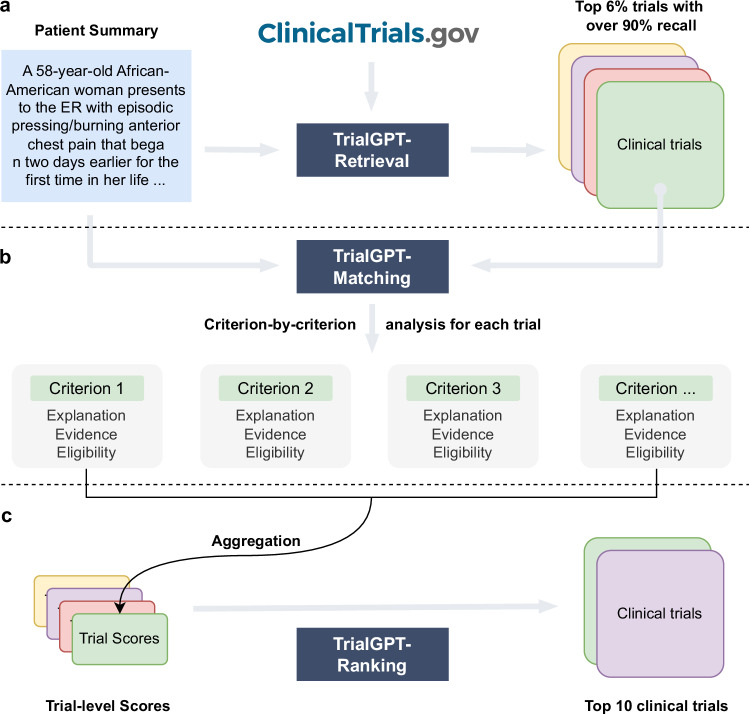
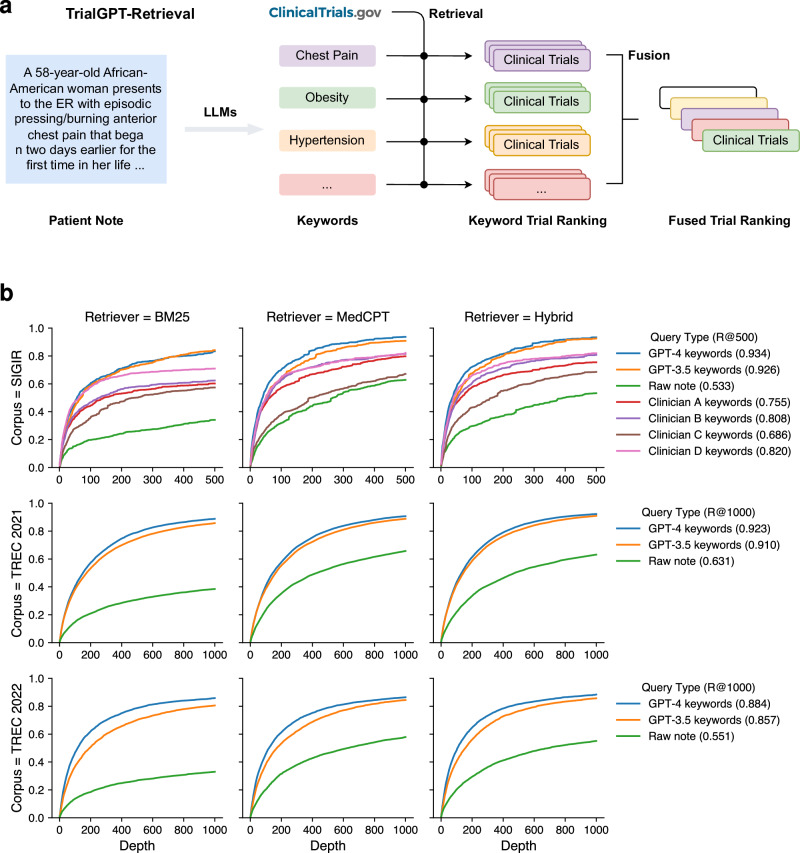
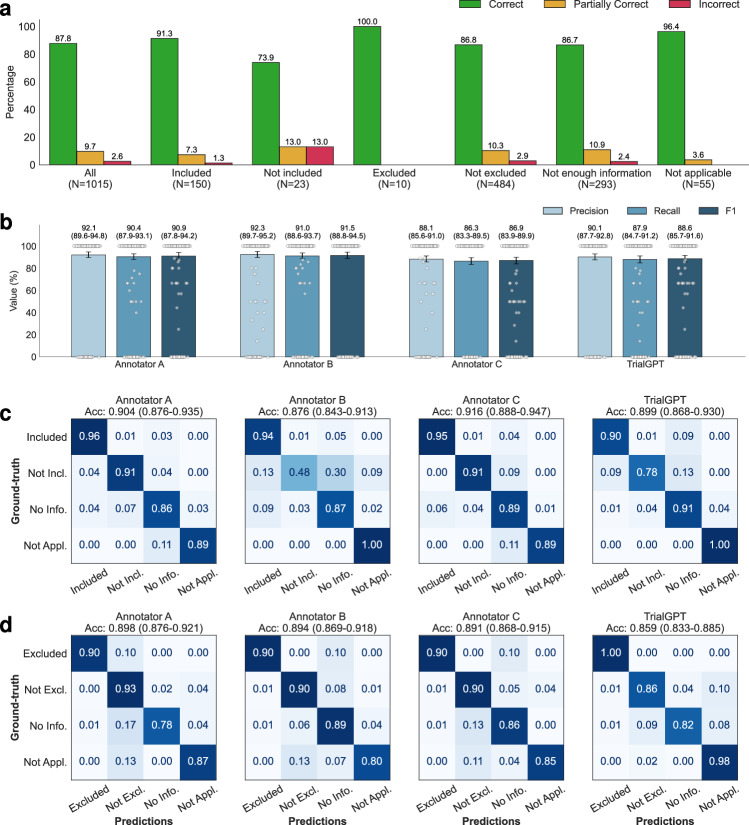
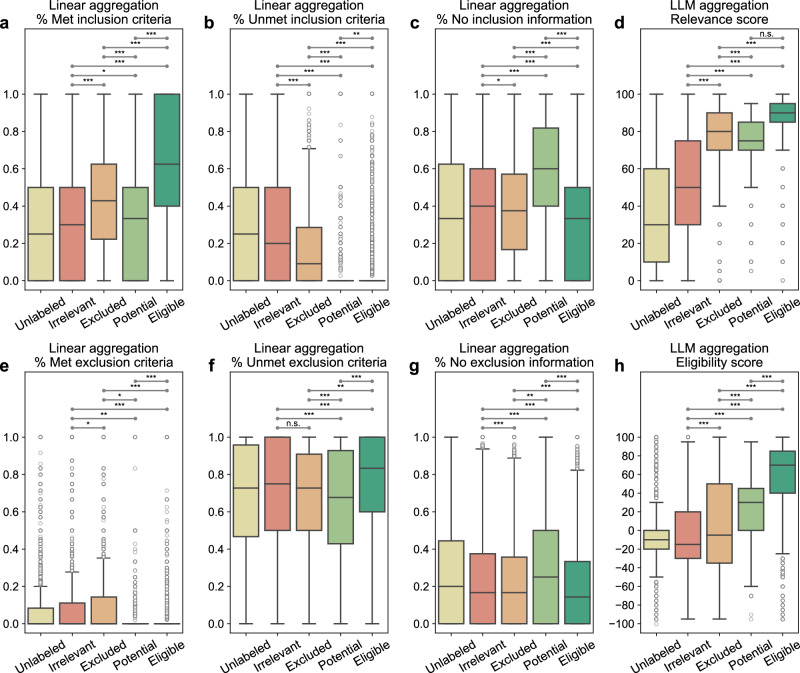
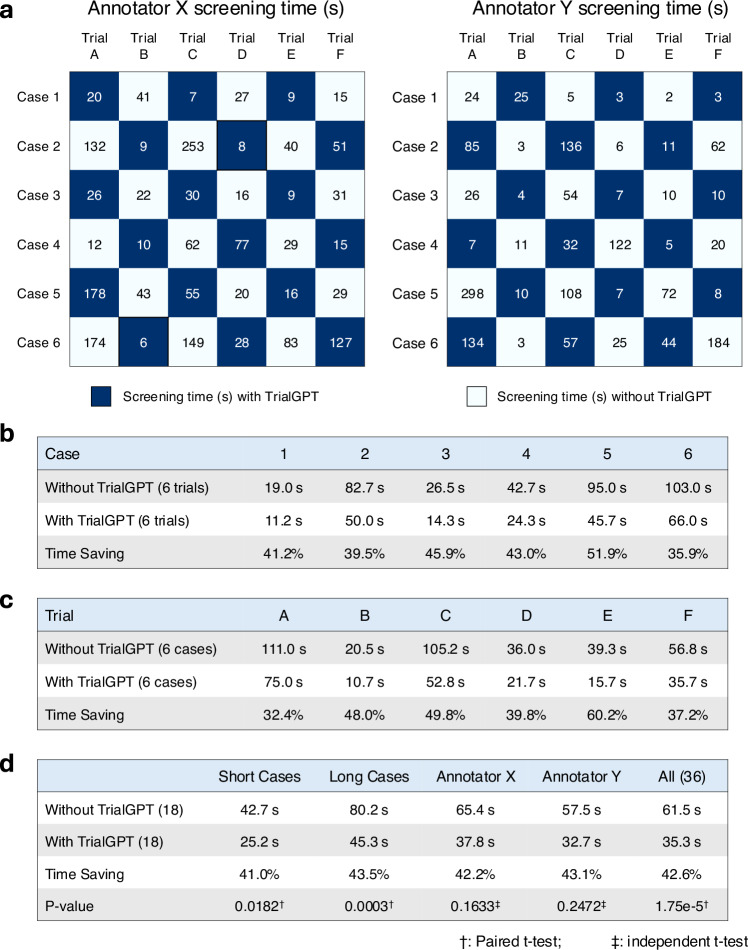
Patient recruitment is challenging for clinical trials. We introduce TrialGPT, an end-to-end framework for zero-shot patient-to-trial matching with large language models. TrialGPT comprises three modules: it first performs large-scale filtering to retrieve candidate trials (TrialGPT-Retrieval); then predicts criterion-level patient eligibility (TrialGPT-Matching); and finally generates trial-level scores (TrialGPT-Ranking). We evaluate TrialGPT on three cohorts of 183 synthetic patients with over 75,000 trial annotations. TrialGPT-Retrieval can recall over 90% of relevant trials using less than 6% of the initial collection. Manual evaluations on 1015 patient-criterion pairs show that TrialGPT-Matching achieves an accuracy of 87.3% with faithful explanations, close to the expert performance. The TrialGPT-Ranking scores are highly correlated with human judgments and outperform the best-competing models by 43.8% in ranking and excluding trials. Furthermore, our user study reveals that TrialGPT can reduce the screening time by 42.6% in patient recruitment. Overall, these results have demonstrated promising opportunities for patient-to-trial matching with TrialGPT.
Overview
The claims and statistics of this paper haven’t been checked yet.
Run the check — free, no account needed. It reads the open-access text and checks the sources it cites.
Integrity signals
Registry
Cites
Statistics
Figures
Verification
Claims the paper makes
The claims and statistics of this paper haven’t been checked yet.
Run the check — free, no account needed. It reads the open-access text and checks the sources it cites.
Claims other papers make about this one
Each is checked against this paper’s own text: does it say what the citing paper says it does?
The source backs part of the claim, not all of it — or backs it for a different population, condition or comparison.
In the citing paper
“many published approaches remain retrospective, disease-limited, or optimized for text similarity and retrieval rather than auditable patient–trial execution over longitudinal records.”
From Transforming oncology clinical trial matching through neuro-symbolic, multi-agent AI and an oncology-specific knowledge graph: a prospective evaluation in 3804 patients (2026) · cites this paper as [4]
Experimental — accuracy not yet measuredThe source backs part of the claim, not all of it — or backs it for a different population, condition or comparison.
In the citing paper
“A pioneering system in this realm is TrialGPT, which uses a trio of agents to match patients to clinical trials [36].”
From A Review of Multi-Agent AI Systems for Biological and Clinical Data Analysis (2026) · cites this paper as [36]
Experimental — accuracy not yet measuredThe source backs part of the claim, not all of it — or backs it for a different population, condition or comparison.
In the citing paper
“clinicians assisted by TrialGPT were able to complete trial screening tasks 42.6% faster than those working without AI assistance (35.3 s vs. 61.5 s; p < 0.001)”
From A Review of Multi-Agent AI Systems for Biological and Clinical Data Analysis (2026) · cites this paper as [36]
Experimental — accuracy not yet measuredThe source backs part of the claim, not all of it — or backs it for a different population, condition or comparison.
In the citing paper
“the high correlation between TrialGPT’s ranking scores and human judgment suggests that MAS has the potential to serve as a reliable cognitive assistant for complex, zero-shot patient-to-trial matching”
From A Review of Multi-Agent AI Systems for Biological and Clinical Data Analysis (2026) · cites this paper as [36]
Experimental — accuracy not yet measuredThe source backs part of the claim, not all of it — or backs it for a different population, condition or comparison.
In the citing paper
“representing a 43.8% improvement over state-of-the-art baselines like the cross-encoder BioLinkBERT (AUROC: 0.6176)”
From A Review of Multi-Agent AI Systems for Biological and Clinical Data Analysis (2026) · cites this paper as [36]
Experimental — accuracy not yet measured
The cited source says what the claim attributes to it.
In the citing paper
“TrialGPT-Retrieval, first conducts a large-scale search to retrieve candidate trials from databases based on a patient’s profile”
From A Review of Multi-Agent AI Systems for Biological and Clinical Data Analysis (2026) · cites this paper as [36]
The cited source says what the claim attributes to it.
In the citing paper
“the system achieved a precision of 90.1% and a recall of 87.9% in locating relevant supporting sentences in clinical notes”
From A Review of Multi-Agent AI Systems for Biological and Clinical Data Analysis (2026) · cites this paper as [36]
The cited source says what the claim attributes to it.
In the citing paper
“TrialGPT-Ranking, assigns scores to rank the trials by suitability”
From A Review of Multi-Agent AI Systems for Biological and Clinical Data Analysis (2026) · cites this paper as [36]
The cited source says what the claim attributes to it.
In the citing paper
“the system achieved a precision of 90.1% and a recall of 87.9% in locating relevant supporting sentences in clinical notes”
From A Review of Multi-Agent AI Systems for Biological and Clinical Data Analysis (2026) · cites this paper as [36]
The cited source says what the claim attributes to it.
In the citing paper
“In the trial exclusion task, TrialGPT attained an AUROC of 0.7979”
From A Review of Multi-Agent AI Systems for Biological and Clinical Data Analysis (2026) · cites this paper as [36]
The cited source says what the claim attributes to it.
In the citing paper
“as these evaluations were conducted on synthetic patient records”
From A Review of Multi-Agent AI Systems for Biological and Clinical Data Analysis (2026) · cites this paper as [36]
The cited source says what the claim attributes to it.
In the citing paper
“manual evaluations of 1015 patient-criterion pairs demonstrated that the matching agent achieved an accuracy of 87.3%”
From A Review of Multi-Agent AI Systems for Biological and Clinical Data Analysis (2026) · cites this paper as [36]
The cited source says what the claim attributes to it.
In the citing paper
“TrialGPT-Retrieval successfully recalled over 90% of relevant trials while filtering out most irrelevant ones, requiring less than 6% of the total collection to maintain this high recall”
From A Review of Multi-Agent AI Systems for Biological and Clinical Data Analysis (2026) · cites this paper as [36]
The cited source says what the claim attributes to it.
In the citing paper
“TrialGPT-Matching, then evaluates the patient’s eligibility against each trial’s criteria using LLM-based reading and annotation of inclusion/exclusion criteria”
From A Review of Multi-Agent AI Systems for Biological and Clinical Data Analysis (2026) · cites this paper as [36]
The cited source says what the claim attributes to it.
In the citing paper
“The system was then evaluated on three cohorts comprising 183 synthetic patients with over 75,000 trial eligibility annotations.”
From A Review of Multi-Agent AI Systems for Biological and Clinical Data Analysis (2026) · cites this paper as [36]
Self-check
Percentages, sums and reported differences re-computed from the paper’s own numbers.
The self-check needs the paper’s full text.
Citations
Cites
Vaswani, A., Shazeer, N., Parmar, N., Uszkoreit, J., Jones, L., Gomez, A. N., Kaiser, L., & Polosukhin, I. (2017) · arXiv · doi:10.48550/arxiv.1706.03762 · Cited by 120,404
BERT: Pre-training of Deep Bidirectional Transformers for Language Understanding
Devlin, J., Chang, M.-W., Lee, K., & Toutanova, K. (2019) · Proceedings of the 2019 Conference of the North American Chapter of the Association for Computational Linguistics: Human Language Technologies, Volume 1 (Long and Short Papers) · doi:10.18653/v1/n19-1423 · Cited by 54,325
BioBERT: a pre-trained biomedical language representation model for biomedical text mining
Lee, J., Yoon, W., Kim, S., Kim, D., Kim, S., So, C. H., & Kang, J. (2020) · Bioinformatics · doi:10.1093/bioinformatics/btz682 · Cited by 7,218
Chain-Of-Thought Prompting Elicits Reasoning in Large Language Models
Wei, J., Wang, X., Schuurmans, D., Bosma, M., Ichter, B., Xia, F., Chi, E., Le, Q. V., & Zhou, D. (2022) · Advances in Neural Information Processing Systems 35 · doi:10.52202/068431-1800 · Cited by 4,505
Chain-of-Thought Prompting Elicits Reasoning in Large Language Models
Wei, J., Wang, X., Schuurmans, D., Bosma, M., Ichter, B., Xia, F., Chi, E., Le, Q., & Zhou, D. (2022) · arXiv · doi:10.48550/arxiv.2201.11903 · Cited by 4,263
Large language models encode clinical knowledge
Singhal, K., Azizi, S., Tu, T., Mahdavi, S. S., Wei, J., Chung, H. W., Scales, N., Tanwani, A., Cole-Lewis, H., Pfohl, S., et al. (2023) · Nature · doi:10.1038/s41586-023-06291-2 · Cited by 4,083
Large Language Models Encode Clinical Knowledge
Singhal, K., Azizi, S., Tu, T., Mahdavi, S. S., Wei, J., Chung, H. W., Scales, N., Tanwani, A., Cole-Lewis, H., Pfohl, S., et al. (2022) · arXiv · doi:10.48550/arxiv.2212.13138 · Cited by 4,083
A large annotated corpus for learning natural language inference
Bowman, S. R., Angeli, G., Potts, C., & Manning, C. D. (2015) · Proceedings of the 2015 Conference on Empirical Methods in Natural Language Processing · doi:10.18653/v1/d15-1075 · Cited by 3,377
The probabilistic relevance framework: BM25 and beyond
Robertson, S., & Zaragoza, H. (2009) · Foundations and Trends® in Information Retrieval · doi:10.1561/1500000019 · Cited by 3,374
A Broad-Coverage Challenge Corpus for Sentence Understanding through Inference
Williams, A., Nangia, N., & Bowman, S. (2018) · Proceedings of the 2018 Conference of the North American Chapter of the Association for Computational Linguistics: Human Language Technologies, Volume 1 (Long Papers) · doi:10.18653/v1/n18-1101 · Cited by 3,342
Research works printed but not linked: 2
- Roberts, K., Demner-Fushman, D., Voorhees, E. M., Bedrick, S. & Hersh, W. R. Overview of the TREC 2021 Clinical Trials Track. In Proc. Thirtieth Text REtrieval Conference (TREC 2021) (2021). · DOI
- Roberts, K., Simpson, M. S., Voorhees, E. M. & Hersh, W. R. Overview of the TREC 2015 Clinical Decision Support Track. In Proc. Twenty-Fourth Text REtrieval Conference (TREC 2015) (2015). · DOI
Cited by
Sorted by citations
Items 201–300 of 309
ClinAgent: AI-assisted methodology for clinical trial data processing and statistical programming
Yan, J. (2026) · Biology Methods and Protocols · doi:10.1093/biomethods/bpag032 · Cited by 1
AI in variant analysis: fast track to genetic diagnoses
Wilk, E. J., Taluri, S., Howton, T. C., Crumley, A. B., Mrug, M. M., & Lasseigne, B. N. (2026) · Human Genetics · doi:10.1007/s00439-026-02847-0 · Cited by 1
CT CL : A Cross-Language Benchmark for Matching Patients to Clinical Trials
Rybiński, M., Kusa, W., Bölücü, N., Peikos, G., Joshi, A., Karimi, S., Atutxa, A., Ser, J. D., Bölücü, A., Chierichetti, M., et al. (2026) · International ACM SIGIR Conference on Research and Development in Information Retrieval (SIGIR) · doi:10.1145/3805712.3808620 · Cited by 1
Windisch, P. Y., Koechli, C., Dennstädt, F., Aebersold, D. M., Zwahlen, D. R., Foerster, R., & Schröder, C. (2026) · JMIR AI · doi:10.2196/95565 · Cited by 1
Buhr, C. R., Müller, L., dos Santos, D. P., Thiem, D. G. E., Ponciano, J.-J., Krüger, M., O’Brien, K., Kaufmann, J., Nolte, H., Gartenschläger, M., et al. (2026) · JMIR AI · doi:10.2196/95081 · Cited by 1
From Invisible to Enrolled: How Artificial Intelligence Is Reshaping Clinical Trial Recruitment
Ahn, S. (2026) · Pharmaceutical Medicine · doi:10.1007/s40290-026-00635-9 · Cited by 1
Raynaud, M., Trayanova, N. A., Mannon, R. B., André, F., Doraiswamy, P. M., & Loupy, A. (2026) · Nature Reviews Bioengineering · doi:10.1038/s44222-026-00487-7 · Cited by 1
Abidi, N. Y., Abidi, Z., Hanrahan, B., Kaur, M. P., Kerego, Y., Pellegrino, A. N., & Thulasi, V. (2024) · Artificial intelligence · doi:10.5772/intechopen.115279 · Cited by 1
Gómez, E., Cuesta, H., Gkiokas, A., Gómez-Cañón, J. S., Porcaro, L., & Yesiler, F. (2024) · ACM eBooks · doi:10.1145/3674127.3702959 · Cited by 1
Baeza-Yates, R. A., Murgai, L., & Dudy, S. (2024) · ACM eBooks · doi:10.1145/3674127.3674138 · Cited by 1
Konduru, K. K., Natalia, F., Sudirman, S., & Al‐Jumeily, D. (2024) · International Conference on Developments in eSystems Engineering (DeSE) · doi:10.1109/dese63988.2024.10911889 · Cited by 1
Challenges in Pursuing AI Transparency
Ellertson, M. F., & Sharp, R. R. (2025) · The American Journal of Bioethics · doi:10.1080/15265161.2025.2458425 · Cited by 1
Tang, T., Li, A. K. C., Tan, X., Ji, Q., Si, L., & Bao, L. (2025) · medRxiv · doi:10.1101/2025.04.07.25325243 · Cited by 1
LLM4TOP: An End-to-End framework based on Large Language Model for trial outcome predictionPreprint
Qian, L., Lu, X., Haris, P. I., Shuo, L., Zhu, J., & Yang, Y. (2025) · medRxiv · doi:10.1101/2025.07.06.25330956 · Cited by 1
Self-citationTransforming Cardio-Oncology Care Through AI-Driven Large Language Model Systems
Agar, A., Shah, V., Kunhiraman, H. H., Nahle, T., Madabhushi, A., Riaz, I. B., Bandaru, M., Okwuosa, T., Fillmore, N. R., & Guha, A. (2025) · JACC Advances · doi:10.1016/j.jacadv.2025.102117 · Cited by 1
Evidence-Graded Decision Authorization for Safe Clinical AI: A Constrained Reasoning FrameworkPreprint
Lin, C., Lin, J., & Lin, Y.-S. (2026) · medRxiv · doi:10.64898/2026.05.19.26353565 · Cited by 2
Narang, K., Devisetti, L., Addo, N., Singh, C., Feng, J., Holmes, J. F., Kuppermann, N., & Kornblith, A. E. (2026) · doi:10.2196/preprints.109370 · Cited by 1
A Curated Dataset for Question Answering on Laboratory Test Reference Ranges and Interpretation
Bhasuran, B., Jin, Q., Deville, A., Wu, Y., Hanna, K., Lu, Z., & He, Z. (2026) · Scientific Data · doi:10.1038/s41597-026-07554-z
Self-citationKantor, K., & Morzy, M. (2024) · Proceedings of the International Conference on Information Systems Development · doi:10.62036/isd.2024.53
Augmenting Large Language Models via Vector Embeddings to Improve Domain-specific Responsiveness
Wolfrath, N., Verhagen, N. B., Crotty, B. H., Somai, M. M., & Kothari, A. N. (2024) · Journal of Visualized Experiments · doi:10.3791/66796 · Cited by 1
Alonso, O., & Baeza-Yates, R. (2024) · ACM eBooks · doi:10.1145/3674127.3674128
Searching Personal Collections
Bendersky, M., Metzler, D., Najork, M., & Wang, X. (2024) · ACM eBooks · doi:10.1145/3674127.3674142
Query-driven Search Functionality
Li, L. (2024) · ACM eBooks · doi:10.1145/3674127.3674133
Alonso, O., & Baeza-Yates, R. (2024) · ACM eBooks · doi:10.1145/3674127.3702962
Alonso, O., & Baeza-Yates, R. (2024) · ACM eBooks · doi:10.1145/3674127.3674129
Alonso, O., & Baeza-Yates, R. (2024) · ACM eBooks · doi:10.1145/3674127.3702961
Hersh, W., & Roberts, K. E. (2024) · ACM eBooks · doi:10.1145/3674127.3702960
Bast, H., Kalmbach, J., Klumpp, T., & Korzen, C. (2024) · ACM eBooks · doi:10.1145/3674127.3674134
Precision Medicine and Opportunities with Artificial Intelligence
Dhar, S. (2024) · Premier Journal of Artificial Intelligence · doi:10.70389/pjai.100001
Ruan, P., Villanueva-Miranda, I., Liu, J., Yang, D. M., Zhou, Q., Xiao, G., & Xie, Y. (2025) · bioRxiv (Cold Spring Harbor Laboratory) · doi:10.1101/2025.02.06.636776
Kouzy, R., Kai, M., Le‐Petross, H. T., Saleem, S., MDACC Inflammatory Breast Cancer Team, Layman, R. M., Lim, B., Nasrazadani, A., Saleem, S., Valero, V., et al. (2025) · JNCI Cancer Spectrum · doi:10.1093/jncics/pkaf058
Development and Implementation
Zanders, E. D. (2025) · Springer eBooks · doi:10.1007/978-3-031-93949-5_7
SROTAS IQ: An AI-Based Clinical Trial Matching Platform: A Validation Study in Breast CancerPreprint
McInerney, S., Gurku, H., Balasubramanian, R., Parimi, V., Bhaskaran, S., & Sekaran, K. (2025) · medRxiv · doi:10.1101/2025.08.13.25333342
Bouman, J. A., Moser, A., Wohlfender, M., Leichtle, A., Beldi, G., Endrich, O., Riou, J., & Althaus, C. L. (2025) · AJE Advances Research in Epidemiology · doi:10.1093/ajeadv/uuaf010
Foundation models in clinical trials: The advances and nuances
John, C., & Sahoo, J. (2025) · International Conference on Biomedical Engineering and Sustainable Healthcare (ICBMESH) · doi:10.1109/icbmesh66209.2025.11182222
Generative AI for Advances in Biomedicine
Sun, Y. (2025) · Journal of Medicine and Life Sciences · doi:10.71222/7dmwdj95
Koller, P., Prenosil, G. A., Shi, K., & Cavinato, L. (2025) · PET Clinics · doi:10.1016/j.cpet.2025.09.009
Yu, M., Huang, S., Li, M., Zhang, L., Zhang, H., Xu, Q., Wang, Z., & Gao, J. (2025) · Research Square · doi:10.21203/rs.3.rs-7864505/v1
Self-citationDemo: A Framework for Ranking The Clinical Trials with Large Language Model Prompting
Arif, S. A., Gopeekrishnan, A., Liu, H., & Varde, A. S. (2025) · IEEE/ACM Conference on Connected Health: Applications, Systems and Engineering Technologies · doi:10.1145/3721201.3725511
Research Discussion, Tools, and Use Cases
Pratap, D. A., Yadav, D. R. N., Patel, D. Y. S., Yadav, D. A. K., & Ahmadian, D. A. (2025) · Wiley eBooks · doi:10.1002/9781394297061.app01
Unlocking Clinical Narrative Text for Secondary Clinical Usage
AlMutair, L., Atwell, E., & Ravikumar, N. (2025) · Lecture notes in networks and systems · doi:10.1007/978-981-96-9242-2_28
Current Limitations of Automated Reflection Consolidation in LLMs for Clinical Note Extraction
Lui, L. T., Hung, T., Che, F., Wang, H., Ip, B. Y. M., & Chan, R. H. M. (2025) · IEEE-EMBS International Conference on Biomedical and Health Informatics (BHI ...) · doi:10.1109/bhi67747.2025.11269565
Log in, lie down: ethics and the digital turn in psychotherapy
Branford, J., & Conrad, J. A. (2025) · Philosophical Psychology · doi:10.1080/09515089.2025.2599894
Expert interviews and use cases
Kumar, R. (2025) · Elsevier eBooks · doi:10.1016/b978-0-443-33362-0.00013-8
AI in the discovery and development of antibody therapeutics
Peckner, R., Visweswaraiah, J., & Higginson-Scott, N. (2025) · Elsevier eBooks · doi:10.1016/b978-0-443-29808-0.00034-0
AI for clinical trials in oncology
Cerami, E., Riaz, I. B., & Kehl, K. L. (2025) · ESMO Real World Data and Digital Oncology · doi:10.1016/j.esmorw.2025.100658
Fuentes-Martín, Á., Mayol, J., Mendez, B. S., & Ramos, Á. C. (2025) · Open Respiratory Archives · doi:10.1016/j.opresp.2025.100533
BioTrouble: A Multi-Agent Workflow for Troubleshooting Molecular Biology TechniquesPreprint
Ameri, M., Yousefabadi, H., & Ramezani, A. (2026) · bioRxiv (Cold Spring Harbor Laboratory) · doi:10.64898/2025.12.30.697016
Kim, S., Won, J., Lee, D., Luo, R., Wu, L., Qin, T., & Lee, H. (2024) · Findings of the Association for Computational Linguistics: EACL · doi:10.18653/v1/2024.findings-eacl.149
Kennedy, V. E., & Muffly, L. S. (2026) · The Hematologist · doi:10.1182/hem.v23.1.202619
Windisch, P. Y., Koechli, C., Dennstädt, F., Aebersold, D. M., Zwahlen, D. R., Förster, R., & Schröder, C. (2026) · medRxiv · doi:10.64898/2026.02.02.26345347
Kallam, A. R. (2025) · Journal of Population Therapeutics and Clinical Pharmacology · doi:10.53555/c723b744
Large Language Models for Bioinformatics: Applications and Challenges
Zhu, W., Gan, W., Qi, Z., & Yu, P. S. (2025) · IEEE International Conference on Big Data (BigData) · doi:10.1109/bigdata66926.2025.11402046
Kakkar, R., & Byrne, M. F. (2026) · Inflammatory Bowel Diseases · doi:10.1093/ibd/izag036
Dohopolski, M. J., Esselink, K., Desai, N. B., Grones, B., Patel, T., Jiang, S. B., Peterson, E. D., & Navar, A. M. (2026) · medRxiv · doi:10.64898/2026.03.20.26348890
吉川, 和., Yoshikawa, H., 岡崎, 直., & Okazaki, N. (2022) · Institutional Repositories DataBase (IRDB)
Embracing AI for precision healthcare
McCormick, K. (2026) · Elsevier eBooks · doi:10.1016/b978-0-443-44073-1.00029-8
Dey, S. K., Qureshi, A. I., & Shyu, C. (2026) · medRxiv · doi:10.64898/2026.04.09.26350523
Combining Non-numerical Text and Numerical Sequences in LLM-Based Survival Prediction
Zhou, Z., Qian, G., Jiang, X., Wang, G., Lu, R., Xiao, L., & Tang, S. (2026) · Lecture notes in computer science · doi:10.1007/978-981-95-7078-2_17
Enhancing Clinical Trial Participant Selection with Artificial Intelligence
Espaillat, A. (2026) · Springer eBooks · doi:10.1007/978-3-032-19336-0_16
Harnessing Artificial Intelligence for the Management of Patients With GI Cancers
Goyal, L., Chung, C. D., Mori, Y., Hall, W. A., Kehl, K. L., & Feng, M. (2026) · American Society of Clinical Oncology Educational Book · doi:10.1200/edbk-26-515754
Patient Records Interpretation with Clinical Trial Matching Using LLMs
Deenathayalan, A., A, J. P. P., Rahav, R., & Keerthika, R. (2026) · International Conference on Machine Learning and Autonomous Systems (ICMLAS) · doi:10.1109/icmlas67792.2026.11483918
Windisch, P., Weyrich, J., Dennstädt, F., Zwahlen, D. R., Förster, R., & Schröder, C. (2026) · Cureus · doi:10.7759/cureus.108666
Sarin, A., Seffren, C. M., Shwaib, H., Matos, M. C., Eisenstein, S., Ferrara, M., Patel, N. M., & Langenfeld, S. J. (2026) · Diseases of the Colon & Rectum · doi:10.1097/dcr.0000000000004178
Xie, J., Parikh, J., Liu, J., Pandya, S., & Gong, G. (2026) · JMIR Research Protocols · doi:10.2196/86425
Cardiovascular Regulatory Science: Accelerating the Path from Bench to Bedside
Korjian, S., Gibson, C. M., Seltzer, J. H., Mahaffey, K. W., Stockbridge, N., Lawler, P. R., Pundi, K. N., Bergmark, B. A., Petrie, M. C., deFilippi, C. R., et al. (2026) · American Heart Journal · doi:10.1016/j.ahj.2026.107487
Gupta, D., Gupta, M. K., Parveen, F., & Agarwal, A. (2026) · Human Nutrition & Metabolism · doi:10.1016/j.hnm.2026.200369
Pescol, F., Buonocore, T. M., Tibollo, V., Failla, G., Traversi, E., Rovere, M. T. L., Sacchi, L., Ricciardi, W., & Bellazzi, R. (2026) · International Journal of Medical Informatics · doi:10.1016/j.ijmedinf.2026.106509
Rudra, P., Balke, W., Kacprowski, T., Ursin, F., & Salloch, S. (2026) · Research Ethics · doi:10.1177/17470161261451591
A Large Language Model-based System for Automatic Medical NLP Code Generation
Xu, J., Li, S., Kang, B., & Yan, J. (2026) · Communications in computer and information science · doi:10.1007/978-981-95-7299-1_35
Mohajerani, S., Leb, I., Gruendner, J., Overton, P., & Ganslandt, T. (2026) · JMIR Human Factors · doi:10.2196/preprints.103570
Quantifying Cancer Clinical Trial Eligibility Using Artificial Intelligence-Based MatchingPreprint
Goel, K. P., Myall, N. J., Dickerson, J. C., Caswell-Jin, J. L., Johnson, T. P., Worth, J. E., & Gensheimer, M. F. (2026) · medRxiv · doi:10.64898/2026.06.03.26354859
Beyond event-rate enrichment: proteomic risk scores for mechanism-aware prevention trial designPreprint
Fieggen, J., Simond, G., Segal, B., Noori, A., Thakurta, A., Butler, C., Clifton, D. A., & Clifton, L. (2026) · medRxiv · doi:10.64898/2026.06.09.26355266
He, L., Do, D., Shet, V. G., Farghaly, O., Deshpande, P., Madiraju, P., Ye, J., & Beestrum, M. (2026) · Journal of the American Medical Informatics Association · doi:10.1093/jamia/ocag089
Ethics of AI in Patient Recruitment and Diversity
Kholiya, N. S., Ojha, A., Singh, A. K., & Bhatt, V. (2026) · Journal of Drug Delivery and Therapeutics · doi:10.22270/jddt.v16i6.7815
Patients similaires : quand le raisonnement de l’interniste rencontre l’intelligence artificielle
Faure, G., Tannier, X., & Gérardin, C. (2026) · La Revue de Médecine Interne · doi:10.1016/j.revmed.2026.05.011
The Impact and Integration of AI
Bidarkund, N., Das, D., & Khanna, S. (2026) · IGI Global eBooks · doi:10.4018/979-8-3373-1509-6.ch009
Large language models in oncology: promise, pitfalls, and the path to real-world adoption
McInerney, S., Hall, P. S., & Cresswell, K. M. (2026) · ESMO Real World Data and Digital Oncology · doi:10.1016/j.esmorw.2026.100723
From matching to facilitation: Reframing AI’s role in clinical trial enrollment
Yaacov, A., Levi, E., & Peled, N. (2026) · Patterns · doi:10.1016/j.patter.2026.101591
AI-Driven Innovations in Cancer Care: A Comprehensive Overview
Li, J., Yeang, H. A., & Perera, R. (2026) · Springer eBooks · doi:10.1007/978-3-032-11023-7_6
Idriss, J., Kalash, S., Faraj, J. A., Nolan, L., Bechnak, K., & Rouphael, N. (2026) · Clinical Infectious Diseases · doi:10.1093/cid/ciag445
Automatic prediction of patients early discontinuation in oncology clinical trials
Olgiati, L., Filori, Q., Toueress, S., Brutti-Mairesse, C., Zidane, L., Ikhlef, N., Gueguen, L., & Verlingue, L. (2026) · ESMO Real World Data and Digital Oncology · doi:10.1016/j.esmorw.2026.100728
Cao, H., Hu, F., Xu, L., Guo, K., Xue, B., Zhang, N., Sun, J., Gong, W., & Ouyang, X. (2026) · Scientific Reports · doi:10.1038/s41598-026-63557-1
Self-citationUsing Artificial Intelligence to Standardize Naming Conventions in Radiation Therapy
Dennstädt, F. (2026) · JCO Clinical Cancer Informatics · doi:10.1200/cci-26-00169
Khan, S., Samuelsson, J. G., Cai, X., Natarajan, K., & Madhavan, S. (2026) · Drug Discovery Today · doi:10.1016/j.drudis.2026.104754
Putting the I in AML: Artificial Intelligence and Machine Learning in Acute Myeloid Leukemia
Marchi, F. D., Ciotti, G., Atanasio, A., Pascarella, G., Sperotto, A. A., & Gottardi, M. (2026) · Cells · doi:10.3390/cells15171539
RECITE: Revising Eligibility Criteria Incorporating Textual Evidence
Ro, R., & Abbasi-Asl, R. (2026) · ACM SIGKDD Conference on Knowledge Discovery and Data Mining (KDD) · doi:10.1145/3770855.3819027
Musa, S. A. (2026) · International Journal of Epidemiology and Health Sciences · doi:10.51757/ijehs.7.2026.734980
Holmes, J., Mastroleo, F., Borras-Osorio, M., Seetamsetty, S., Shiraishi, S., Fatyga, M., Boughey, J. C., Thiels, C. A., Breen, W. G., Ma, D. J., et al. (2026) · Clinical and Translational Radiation Oncology · doi:10.1016/j.ctro.2026.101261
Li, X., Chowdhury, S., Wi, C.-I., Vassilaki, M. E., Liu, X., Sio, T. T., Garrick, O., Juhn, Y. J., Cerhan, J. R., Tao, C., et al. (2026) · IEEE International Conference on Healthcare Informatics (ICHI) · doi:10.1109/ichi69079.2026.00033
Lequeux, B., Gardent, C., & Girerd, N. (2026) · Archives of cardiovascular diseases · doi:10.1016/j.acvd.2026.07.002
AI-powered medicinal chemistry and translational drug development
Kaicheng, U., Zhang, S. M., Yu, Z., Zhang, Z., Zhang, J., He, C., Liu, A., Chen, R., Wang, S., Yan, L., et al. (2026) · Chemical Society Reviews · doi:10.1039/d5cs01469g
The Five-Decade Journey of Small Cell Lung Cancer
Chen, R., Xue, C., Zhong, Y., Huang, Q., Fan, Q., Li, Y., Wu, J., Dong, S., Li, X., Xiao, T., et al. (2026) · 癌症:英文版 · doi:10.34133/cancomm.0052
AI-Enabled Real-World Evidence in Oncology: A Statistical Perspective for Regulatory Decisions
Gao, L., Feng, D., & Yu, B. (2026) · Therapeutic Innovation & Regulatory Science · doi:10.1007/s43441-026-01036-5
Kırca, Ö., Çakır, M. O., Kaya, M. S., Kurt, B., Yilmaz, B., Bilge, U., & Ozdogan, M. (2026) · Biomedicines · doi:10.20944/preprints202609.0010.v1
Shao, J., Liu, X., Zhang, Z., Liao, S., Wu, J., Yang, H., Zhao, Z., Wang, L., Liang, S.-F., Wang, X., et al. (2026) · Cell Reports Medicine · doi:10.1016/j.xcrm.2026.102926
Expert Matching System for Power Grid Technology Project Evaluation
Cai, W., Cai, X., Li, Y., Wang, S., & Wang, J. (2026) · Journal of Systems Science and Systems Engineering · doi:10.1007/s11518-026-5775-z
Artificial intelligence and target trial emulation: toward scalable and credible real-world evidence
Liu, T., & Wang, Y. (2026) · Journal of Clinical Epidemiology · doi:10.1016/j.jclinepi.2026.112501
Hamilton, S., Fiuzat, M., Starling, R. C., Shalowitz, E. L., Psotka, M. A., O'Connor, C., Kao, D. P., Sharma, A., Cowie, M., Bhatt, A. S., et al. (2026) · JACC Heart Failure · doi:10.1016/j.jchf.2026.103354
Digitally enabled patient-centred survivorship care: from hype to implementation-aware impact
Franzoi, M. A., Mussault, E., & Vaz-Luís, I. (2026) · The Lancet Digital Health · doi:10.1016/j.landig.2026.101071
Metadata
- Authors
- Jin, Q., Wang, Z., Floudas, C. S., Chen, F., Gong, C., Bracken-Clarke, D., Xue, E., Yang, Y., Sun, J., & Lu, Z.
- Affiliations
- National Institutes of Health (US)
- University of Illinois Urbana-Champaign (US)
- University of Pittsburgh (US)
- Albert Einstein College of Medicine (US)
- Corresponding author
- Lu, Zhiyong
- ORCID
- Venue
- Nature Communications
- Published
- 2024-11-18
- Volume
- 15
- Issue
- 1
- Pages
- 9074-9074
- ISSN
- 2041-1723 (ISSN-L)
- PMC
- PMC11574183
- OpenAlex
- W4404486407
- Cited by
- 287
- References
- 43
- Citations by year
- 2026: 119 · 2025: 117 · 2024: 50
- FWCI
- 26.74
- Type
- journal article
- Language
- en
- Open access
- gold
- doi.org
- Locations
- Nature Communications (publishedVersion, cc-by)
- PubMed Central (publishedVersion, cc-by)
- PubMed (publishedVersion)
- arXiv (Cornell University) (submittedVersion, cc-by)
- PubMed Central (submittedVersion, cc-by)
- RePEc: Research Papers in Economics (submittedVersion)
- DOAJ (DOAJ: Directory of Open Access Journals) (submittedVersion, cc-by-sa)
- arXiv (Cornell University) (cc-by)
- Funders
- U.S. Department of Health & Human Services | National Institutes of Health
- Topics
- Health Sciences › Medicine › Health Informatics › Artificial Intelligence in Healthcare and Education
- Physical Sciences › Computer Science › Artificial Intelligence › Machine Learning in Healthcare
- Physical Sciences › Computer Science › Information Systems › Information Retrieval and Search Behavior
- Keywords
- clinical trial recruitment, large language models, explainable AI, synthetic patient data, user study
About these checks
Registry, retraction, Cites and statistics results are computed, not judged, with one exception: a printed reference that no index lists is read once by a model before it counts as a citation error. Claims are extracted by a model and kept only when their quote appears verbatim in the text; each cited source is then checked, with a model’s help, for whether it says what the claim relies on. Those verdicts can be wrong — read the claim’s quote and the cited source before relying on one.
Statistics and arithmetic are recomputed, not judged.
Confidence bands are shown only for fields calibrated on our annotated test set. None is calibrated yet, so no band is shown.
What counts as a claim ›How we measure confidence ›How we check this ›
Are you an author, or do you see a problem with this page? Request a review
