

The DOI matches its Crossref record; 56 of the 56 references it cites were found in a registry or an index.
Matching patients to clinical trials with large language models
Open accessAbstract
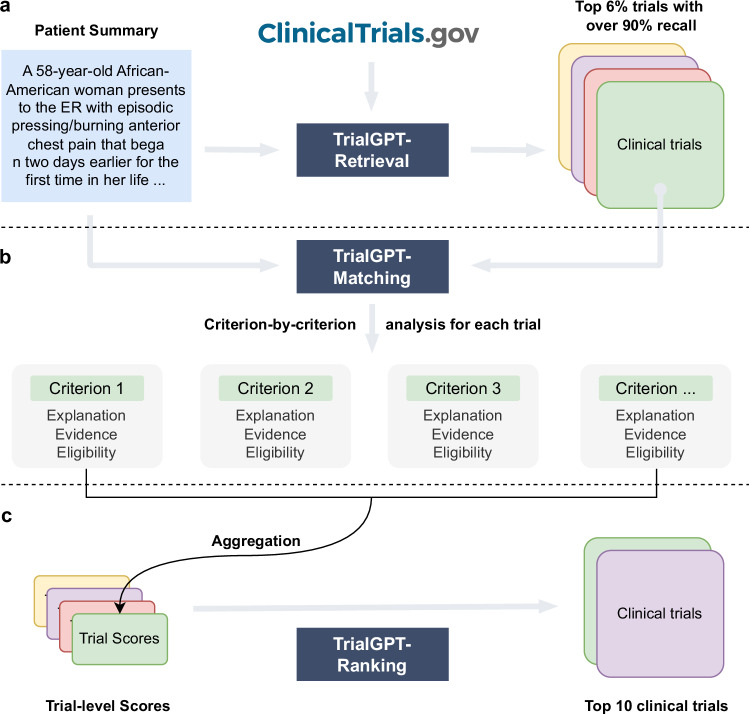
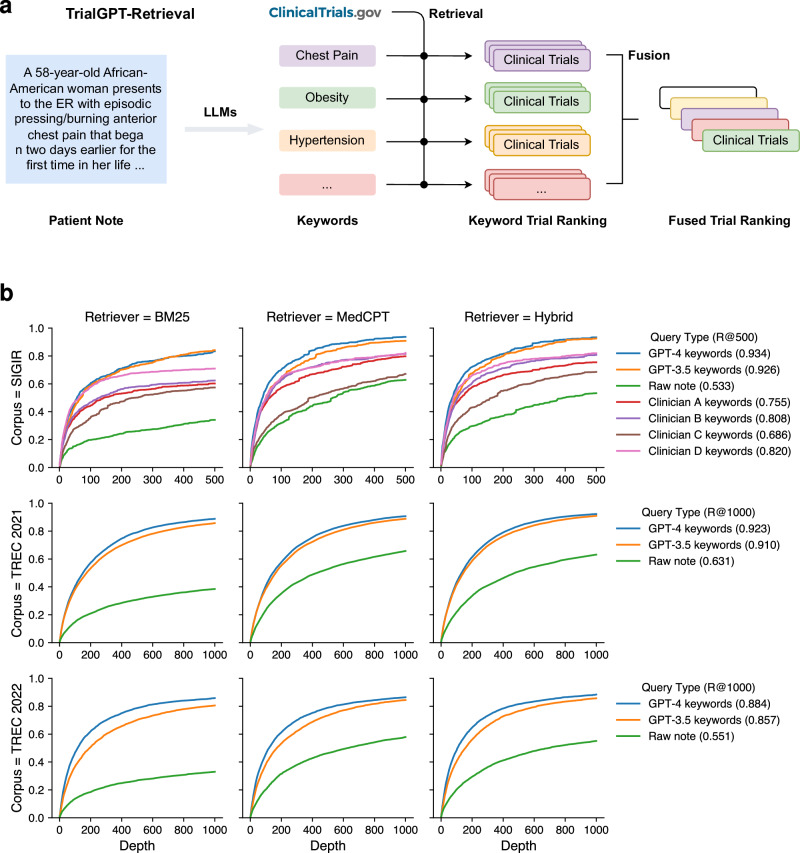
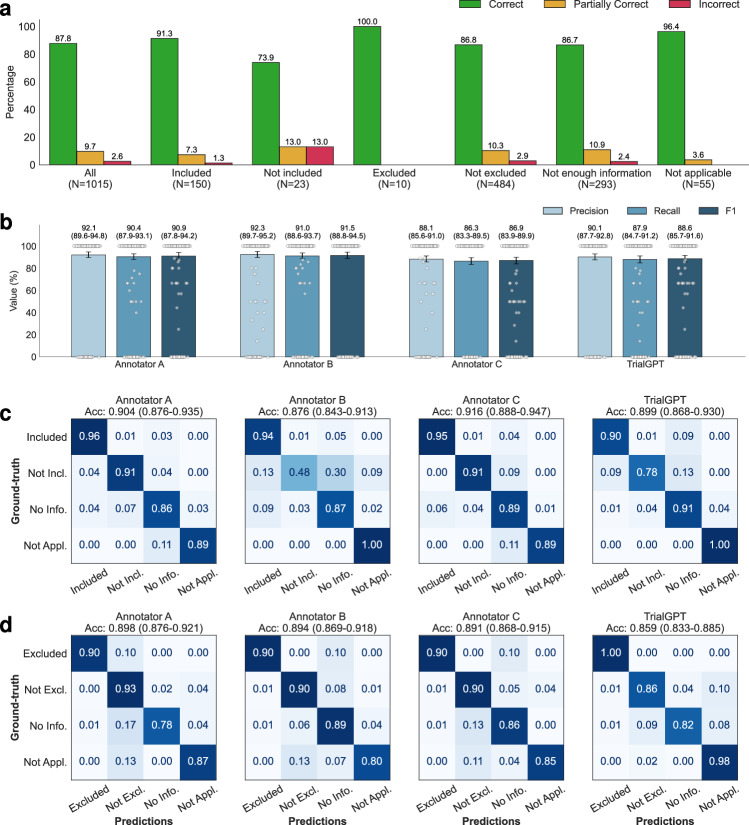
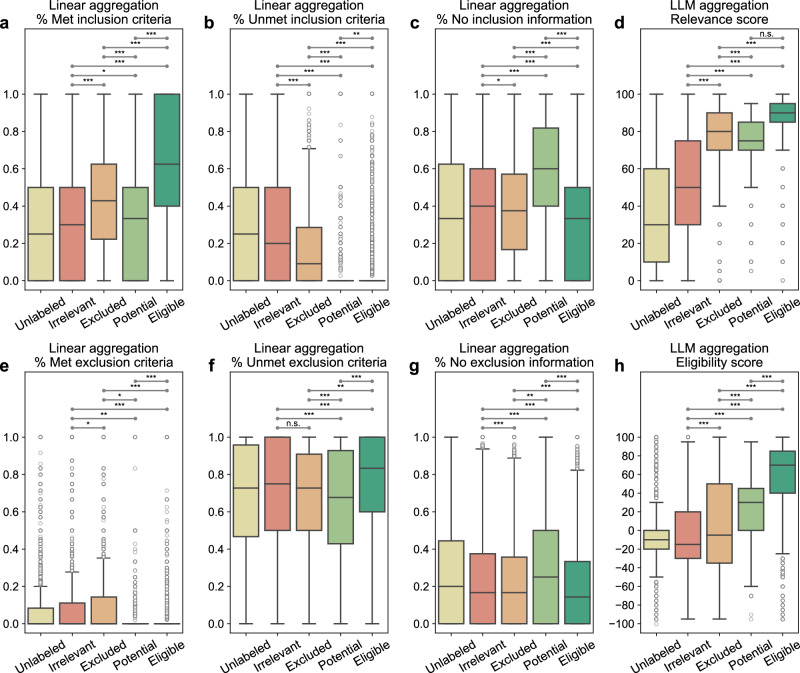
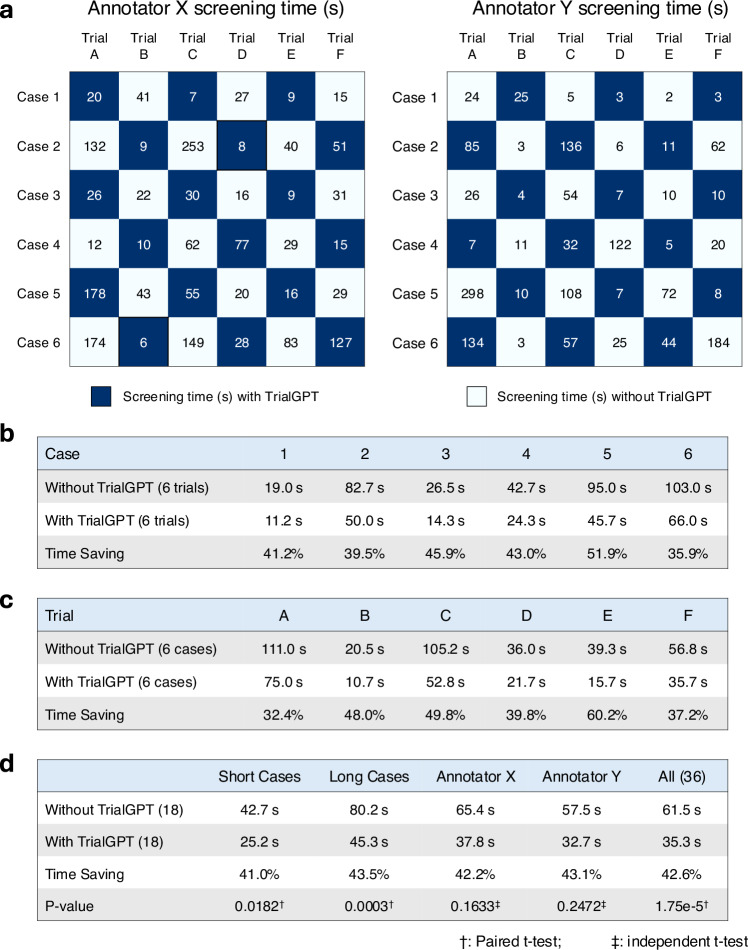
Patient recruitment is challenging for clinical trials. We introduce TrialGPT, an end-to-end framework for zero-shot patient-to-trial matching with large language models. TrialGPT comprises three modules: it first performs large-scale filtering to retrieve candidate trials (TrialGPT-Retrieval); then predicts criterion-level patient eligibility (TrialGPT-Matching); and finally generates trial-level scores (TrialGPT-Ranking). We evaluate TrialGPT on three cohorts of 183 synthetic patients with over 75,000 trial annotations. TrialGPT-Retrieval can recall over 90% of relevant trials using less than 6% of the initial collection. Manual evaluations on 1015 patient-criterion pairs show that TrialGPT-Matching achieves an accuracy of 87.3% with faithful explanations, close to the expert performance. The TrialGPT-Ranking scores are highly correlated with human judgments and outperform the best-competing models by 43.8% in ranking and excluding trials. Furthermore, our user study reveals that TrialGPT can reduce the screening time by 42.6% in patient recruitment. Overall, these results have demonstrated promising opportunities for patient-to-trial matching with TrialGPT.
Overview
The claims and statistics of this paper haven’t been checked yet.
Run the check — free, no account needed. It reads the open-access text and checks the sources it cites.
Integrity signals
Registry
Cites
Statistics
Figures
Verification
Claims the paper makes
The claims and statistics of this paper haven’t been checked yet.
Run the check — free, no account needed. It reads the open-access text and checks the sources it cites.
Claims other papers make about this one
Each is checked against this paper’s own text: does it say what the citing paper says it does?
The source backs part of the claim, not all of it — or backs it for a different population, condition or comparison.
In the citing paper
“many published approaches remain retrospective, disease-limited, or optimized for text similarity and retrieval rather than auditable patient–trial execution over longitudinal records.”
From Transforming oncology clinical trial matching through neuro-symbolic, multi-agent AI and an oncology-specific knowledge graph: a prospective evaluation in 3804 patients (2026) · cites this paper as [4]
Experimental — accuracy not yet measuredThe source backs part of the claim, not all of it — or backs it for a different population, condition or comparison.
In the citing paper
“A pioneering system in this realm is TrialGPT, which uses a trio of agents to match patients to clinical trials [36].”
From A Review of Multi-Agent AI Systems for Biological and Clinical Data Analysis (2026) · cites this paper as [36]
Experimental — accuracy not yet measuredThe source backs part of the claim, not all of it — or backs it for a different population, condition or comparison.
In the citing paper
“clinicians assisted by TrialGPT were able to complete trial screening tasks 42.6% faster than those working without AI assistance (35.3 s vs. 61.5 s; p < 0.001)”
From A Review of Multi-Agent AI Systems for Biological and Clinical Data Analysis (2026) · cites this paper as [36]
Experimental — accuracy not yet measuredThe source backs part of the claim, not all of it — or backs it for a different population, condition or comparison.
In the citing paper
“the high correlation between TrialGPT’s ranking scores and human judgment suggests that MAS has the potential to serve as a reliable cognitive assistant for complex, zero-shot patient-to-trial matching”
From A Review of Multi-Agent AI Systems for Biological and Clinical Data Analysis (2026) · cites this paper as [36]
Experimental — accuracy not yet measuredThe source backs part of the claim, not all of it — or backs it for a different population, condition or comparison.
In the citing paper
“representing a 43.8% improvement over state-of-the-art baselines like the cross-encoder BioLinkBERT (AUROC: 0.6176)”
From A Review of Multi-Agent AI Systems for Biological and Clinical Data Analysis (2026) · cites this paper as [36]
Experimental — accuracy not yet measured
The cited source says what the claim attributes to it.
In the citing paper
“TrialGPT-Retrieval, first conducts a large-scale search to retrieve candidate trials from databases based on a patient’s profile”
From A Review of Multi-Agent AI Systems for Biological and Clinical Data Analysis (2026) · cites this paper as [36]
The cited source says what the claim attributes to it.
In the citing paper
“the system achieved a precision of 90.1% and a recall of 87.9% in locating relevant supporting sentences in clinical notes”
From A Review of Multi-Agent AI Systems for Biological and Clinical Data Analysis (2026) · cites this paper as [36]
The cited source says what the claim attributes to it.
In the citing paper
“TrialGPT-Ranking, assigns scores to rank the trials by suitability”
From A Review of Multi-Agent AI Systems for Biological and Clinical Data Analysis (2026) · cites this paper as [36]
The cited source says what the claim attributes to it.
In the citing paper
“the system achieved a precision of 90.1% and a recall of 87.9% in locating relevant supporting sentences in clinical notes”
From A Review of Multi-Agent AI Systems for Biological and Clinical Data Analysis (2026) · cites this paper as [36]
The cited source says what the claim attributes to it.
In the citing paper
“In the trial exclusion task, TrialGPT attained an AUROC of 0.7979”
From A Review of Multi-Agent AI Systems for Biological and Clinical Data Analysis (2026) · cites this paper as [36]
The cited source says what the claim attributes to it.
In the citing paper
“as these evaluations were conducted on synthetic patient records”
From A Review of Multi-Agent AI Systems for Biological and Clinical Data Analysis (2026) · cites this paper as [36]
The cited source says what the claim attributes to it.
In the citing paper
“manual evaluations of 1015 patient-criterion pairs demonstrated that the matching agent achieved an accuracy of 87.3%”
From A Review of Multi-Agent AI Systems for Biological and Clinical Data Analysis (2026) · cites this paper as [36]
The cited source says what the claim attributes to it.
In the citing paper
“TrialGPT-Retrieval successfully recalled over 90% of relevant trials while filtering out most irrelevant ones, requiring less than 6% of the total collection to maintain this high recall”
From A Review of Multi-Agent AI Systems for Biological and Clinical Data Analysis (2026) · cites this paper as [36]
The cited source says what the claim attributes to it.
In the citing paper
“TrialGPT-Matching, then evaluates the patient’s eligibility against each trial’s criteria using LLM-based reading and annotation of inclusion/exclusion criteria”
From A Review of Multi-Agent AI Systems for Biological and Clinical Data Analysis (2026) · cites this paper as [36]
The cited source says what the claim attributes to it.
In the citing paper
“The system was then evaluated on three cohorts comprising 183 synthetic patients with over 75,000 trial eligibility annotations.”
From A Review of Multi-Agent AI Systems for Biological and Clinical Data Analysis (2026) · cites this paper as [36]
Self-check
Percentages, sums and reported differences re-computed from the paper’s own numbers.
The self-check needs the paper’s full text.
Citations
Cites
Vaswani, A., Shazeer, N., Parmar, N., Uszkoreit, J., Jones, L., Gomez, A. N., Kaiser, L., & Polosukhin, I. (2017) · arXiv · doi:10.48550/arxiv.1706.03762 · Cited by 120,404
BERT: Pre-training of Deep Bidirectional Transformers for Language Understanding
Devlin, J., Chang, M.-W., Lee, K., & Toutanova, K. (2019) · Proceedings of the 2019 Conference of the North American Chapter of the Association for Computational Linguistics: Human Language Technologies, Volume 1 (Long and Short Papers) · doi:10.18653/v1/n19-1423 · Cited by 54,325
BioBERT: a pre-trained biomedical language representation model for biomedical text mining
Lee, J., Yoon, W., Kim, S., Kim, D., Kim, S., So, C. H., & Kang, J. (2020) · Bioinformatics · doi:10.1093/bioinformatics/btz682 · Cited by 7,218
Chain-Of-Thought Prompting Elicits Reasoning in Large Language Models
Wei, J., Wang, X., Schuurmans, D., Bosma, M., Ichter, B., Xia, F., Chi, E., Le, Q. V., & Zhou, D. (2022) · Advances in Neural Information Processing Systems 35 · doi:10.52202/068431-1800 · Cited by 4,505
Chain-of-Thought Prompting Elicits Reasoning in Large Language Models
Wei, J., Wang, X., Schuurmans, D., Bosma, M., Ichter, B., Xia, F., Chi, E., Le, Q., & Zhou, D. (2022) · arXiv · doi:10.48550/arxiv.2201.11903 · Cited by 4,263
Large language models encode clinical knowledge
Singhal, K., Azizi, S., Tu, T., Mahdavi, S. S., Wei, J., Chung, H. W., Scales, N., Tanwani, A., Cole-Lewis, H., Pfohl, S., et al. (2023) · Nature · doi:10.1038/s41586-023-06291-2 · Cited by 4,083
Large Language Models Encode Clinical Knowledge
Singhal, K., Azizi, S., Tu, T., Mahdavi, S. S., Wei, J., Chung, H. W., Scales, N., Tanwani, A., Cole-Lewis, H., Pfohl, S., et al. (2022) · arXiv · doi:10.48550/arxiv.2212.13138 · Cited by 4,083
A large annotated corpus for learning natural language inference
Bowman, S. R., Angeli, G., Potts, C., & Manning, C. D. (2015) · Proceedings of the 2015 Conference on Empirical Methods in Natural Language Processing · doi:10.18653/v1/d15-1075 · Cited by 3,377
The probabilistic relevance framework: BM25 and beyond
Robertson, S., & Zaragoza, H. (2009) · Foundations and Trends® in Information Retrieval · doi:10.1561/1500000019 · Cited by 3,374
A Broad-Coverage Challenge Corpus for Sentence Understanding through Inference
Williams, A., Nangia, N., & Bowman, S. (2018) · Proceedings of the 2018 Conference of the North American Chapter of the Association for Computational Linguistics: Human Language Technologies, Volume 1 (Long Papers) · doi:10.18653/v1/n18-1101 · Cited by 3,342
Domain-specific language model pretraining for biomedical natural language processing
Gu, Y., Tinn, R., Cheng, H., Lucas, M., Usuyama, N., Liu, X., Naumann, T., Gao, J., & Poon, H. (2022) · ACM Transactions on Computing for Healthcare · doi:10.1145/3458754 · Cited by 2,170
SemEval-2017 Task 1: Semantic Textual Similarity Multilingual and Crosslingual Focused Evaluation
Cer, D., Diab, M., Agirre, E., Lopez-Gazpio, I., & Specia, L. (2017) · Proceedings of the 11th International Workshop on Semantic Evaluation (SemEval-2017) · doi:10.18653/v1/s17-2001 · Cited by 1,562
Anil, R., Dai, A. M., Firat, O., Johnson, M., Lepikhin, D., Passos, A., Shakeri, S., Taropa, E., Bailey, P., Chen, Z., et al. (2023) · arXiv · doi:10.48550/arxiv.2305.10403 · Cited by 834
Self-citationReciprocal rank fusion outperforms condorcet and individual rank learning methods
Cormack, G. V., Clarke, C. L. A., & Buettcher, S. (2009) · Proceedings of the 32nd international ACM SIGIR conference on Research and development in information retrieval · doi:10.1145/1571941.1572114 · Cited by 797
Capabilities of GPT-4 on Medical Challenge Problems
Nori, H., King, N., McKinney, S. M., Carignan, D., & Horvitz, E. (2023) · arXiv · doi:10.48550/arxiv.2303.13375 · Cited by 509
Self-Alignment Pretraining for Biomedical Entity Representations
Liu, F., Shareghi, E., Meng, Z., Basaldella, M., & Collier, N. (2021) · Conference of the North American Chapter of the Association for Computational Linguistics: Human Language Technologies (NAACL-HLT) · doi:10.18653/v1/2021.naacl-main.334 · Cited by 479
LinkBERT: Pretraining Language Models with Document Links
Yasunaga, M., Leskovec, J., & Liang, P. (2022) · Proceedings of the conference - Association for Computational Linguistics. Meeting · doi:10.18653/v1/2022.acl-long.551 · Cited by 474
SciTaiL: A Textual Entailment Dataset from Science Question Answering
Khot, T., Sabharwal, A., & Clark, P. E. (2018) · Proceedings of the AAAI Conference on Artificial Intelligence · doi:10.1609/aaai.v32i1.12022 · Cited by 419
Opportunities and Challenges for ChatGPT and Large Language Models in Biomedicine and Health
Tian, S., Jin, Q., Yeganova, L., Lai, P.-T., Zhu, Q., Chen, X., Yang, Y., Chen, Q., Kim, W., Comeau, D. C., et al. (2023) · Briefings in Bioinformatics · doi:10.1093/bib/bbad493 · Cited by 359
Self-citationCan large language models reason about medical questions?
Liévin, V., Hother, C. E., Motzfeldt, A. G., & Winther, O. (2024) · Patterns · doi:10.1016/j.patter.2024.100943 · Cited by 343
Lessons from Natural Language Inference in the Clinical Domain
Romanov, A., & Shivade, C. (2018) · Conference on Empirical Methods in Natural Language Processing (EMNLP) · doi:10.18653/v1/d18-1187 · Cited by 249
Modeling Semantic Containment and Exclusion in Natural Language Inference
MacCartney, B., & Manning, C. D. (2008) · International Conference on Computational Linguistics · doi:10.3115/1599081.1599147 · Cited by 228
SciFive: a text-to-text transformer model for biomedical literaturePreprint
Phan, L., Anibal, J., Tran, H., Chanana, S., Bahadroglu, E., Peltekian, A., & Altan-Bonnet, G. Y. (2021) · arXiv (Cornell University) · doi:10.48550/arxiv.2106.03598 · Cited by 204
Challenges in recruitment and retention of clinical trial subjects
Kadam, R., Borde, S., Madas, S., Salvi, S., & Limaye, S. (2016) · Perspectives in Clinical Research · doi:10.4103/2229-3485.184820 · Cited by 179
Can Generalist Foundation Models Outcompete Special-Purpose Tuning? Case Study in Medicine
Nori, H., Lee, Y. T., Zhang, S., Carignan, D., Edgar, R., Fusi, N., King, N., Larson, J., Li, Y., Liu, W., et al. (2023) · arXiv · doi:10.48550/arxiv.2311.16452 · Cited by 178
Jin, Q., Yang, Y., Chen, Q., & Lu, Z. (2024) · Bioinformatics · doi:10.1093/bioinformatics/btae075 · Cited by 176
Self-citationJin, Q., Kim, W., Chen, Q., Comeau, D. C., Yeganova, L., Wilbur, W. J., & Lu, Z. (2023) · Bioinformatics · doi:10.1093/bioinformatics/btad651 · Cited by 175
Self-citationCriteria2Query: a natural language interface to clinical databases for cohort definition
Yuan, C., Ryan, P. B., Ta, C., Guo, Y., Li, Z., Hardin, J., Makadia, R., Jin, P., Shang, N., Kang, T., et al. (2019) · Journal of the American Medical Informatics Association · doi:10.1093/jamia/ocy178 · Cited by 170
Biomedical Question Answering: A Survey of Approaches and Challenges
Jin, Q., Yuan, Z. P., Xiong, G., Yu, Q., Ying, H., Tan, C., Chen, M., Huang, S., Liu, X., & Yu, S. (2022) · ACM Computing Surveys · doi:10.1145/3490238 · Cited by 145
Self-citationAn AI boost for clinical trials
Woo, M. (2019) · Nature · doi:10.1038/d41586-019-02871-3 · Cited by 131
How AI is being used to accelerate clinical trials
Hutson, M. (2024) · Nature · doi:10.1038/d41586-024-00753-x · Cited by 130
Predicting Low Accrual in the National Cancer Institute’s Cooperative Group Clinical Trials
Bennette, C. S., Ramsey, S. D., McDermott, C. L., Carlson, J. J., Basu, A., & Veenstra, D. L. (2016) · Journal of the National Cancer Institute · doi:10.1093/jnci/djv324 · Cited by 108
Cohort selection for clinical trials: n2c2 2018 shared task track 1
Stubbs, A., Filannino, M., Soysal, E., Henry, S., & Uzuner, Ö. (2019) · Journal of the American Medical Informatics Association · doi:10.1093/jamia/ocz163 · Cited by 79
DeepEnroll: Patient-Trial Matching with Deep Embedding and Entailment Prediction
Zhang, X., Xiao, C., Glass, L. M., & Sun, J. (2020) · International World Wide Web Conference (WWW) · doi:10.1145/3366423.3380181 · Cited by 75
Self-citationDistilling large language models for matching patients to clinical trials
Nievas, M., Basu, A., Wang, Y., & Singh, H. (2024) · Journal of the American Medical Informatics Association · doi:10.1093/jamia/ocae073 · Cited by 67
COMPOSE: Cross-Modal Pseudo-Siamese Network for Patient Trial Matching
Gao, J., Xiao, C., Glass, L. M., & Sun, J. (2020) · ACM SIGKDD Conference on Knowledge Discovery and Data Mining (KDD) · doi:10.1145/3394486.3403123 · Cited by 62
Self-citationDatta, S., Lee, K., Paek, H., Manion, F. J., Ofoegbu, N., Du, J., Li, Y., Huang, L., Wang, J., Lin, B., et al. (2023) · Journal of the American Medical Informatics Association · doi:10.1093/jamia/ocad218 · Cited by 55
Large Language Models for Healthcare Data Augmentation: An Example on Patient-Trial Matching
Yuan, J., Tang, R., Jiang, X., & Xia, H. (2023) · PubMed Central · doi:10.48550/arxiv.2303.16756 · Cited by 46
A Test Collection for Matching Patients to Clinical Trials
Koopman, B., & Zuccon, G. (2016) · International ACM SIGIR Conference on Research and Development in Information Retrieval (SIGIR) · doi:10.1145/2911451.2914672 · Cited by 34
Impact of a cognitive computing clinical trial matching system in an ambulatory oncology practice.
Haddad, T. C., Helgeson, J. M., Pomerleau, K., Makey, M., Lombardo, P., Coverdill, S., Urman, A., Rammage, M., Goetz, M. P., & LaRusso, N. (2018) · Journal of Clinical Oncology · doi:10.1200/jco.2018.36.15_suppl.6550 · Cited by 32
Cohort selection for clinical trials using deep learning models
Segura-Bédmar, I., & Raez, P. (2019) · Journal of the American Medical Informatics Association · doi:10.1093/jamia/ocz139 · Cited by 31
AutoTrial: Prompting Language Models for Clinical Trial Design
Wang, Z., Xiao, C., & Sun, J. (2023) · Conference on Empirical Methods in Natural Language Processing (EMNLP) · doi:10.18653/v1/2023.emnlp-main.766 · Cited by 31
Self-citationScaling Clinical Trial Matching Using Large Language Models: A Case Study in Oncology
Wong, C., Zhang, S., Gu, Y., Moung, C., Abel, J., Usuyama, N., Weerasinghe, R., Piening, B., Naumann, T., Bifulco, C., et al. (2023) · arXiv · doi:10.48550/arxiv.2308.02180 · Cited by 28
Overview of the TREC 2012 Medical Records Track
Voorhees, E. M., & Hersh, W. R. (2012) · doi:10.6028/nist.sp.500-298.medical-overview · Cited by 28
Overview of the TREC 2015 Clinical Decision Support Track
Roberts, K., Simpson, M. S., Voorhees, E. M., & Hersh, W. R. (2015) · doi:10.6028/nist.sp.500-319.clinical-overview · Cited by 28
SciNLI: A Corpus for Natural Language Inference on Scientific Text
Sadat, M., & Caragea, C. (2022) · Proceedings of the conference - Association for Computational Linguistics. Meeting · doi:10.18653/v1/2022.acl-long.511 · Cited by 27
Evidence Extraction to Validate Medical Claims in Fake News Detection
Deka, P., Jurek, A., & Deepak, P. (2022) · Lecture notes in computer science · doi:10.1007/978-3-031-20627-6_1 · Cited by 26
Utilizing ChatGPT to Enhance Clinical Trial EnrollmentPreprint
Peikos, G., Symeonidis, S., Kasela, P., & Pasi, G. (2023) · SSRN Electronic Journal · doi:10.2139/ssrn.4492872 · Cited by 21
Utilizing ChatGPT to Enhance Clinical Trial EnrollmentPreprint
Peikos, G., Symeonidis, S., Kasela, P., & Pasi, G. (2023) · arXiv.org · doi:10.48550/arxiv.2306.02077 · Cited by 20
Neural Query Synthesis and Domain-Specific Ranking Templates for Multi-Stage Clinical Trial Matching
Pradeep, R., Li, Y., Wang, Y., & Lin, J. (2022) · International ACM SIGIR Conference on Research and Development in Information Retrieval (SIGIR) · doi:10.1145/3477495.3531853 · Cited by 19
Overview of the TREC 2022 Clinical Trials Track
Roberts, K., Demner-Fushman, D., Voorhees, E. M., et al. (2022) · doi:10.6028/nist.sp.500-338.trials-overview · Cited by 18
Predicting Clinical Trial Results by Implicit Evidence Integration
Jin, Q., Tan, C., Chen, M., Liu, X., & Huang, S. (2020) · Conference on Empirical Methods in Natural Language Processing (EMNLP) · doi:10.18653/v1/2020.emnlp-main.114 · Cited by 6
Self-citationZhuang, S., Koopman, B., & Zuccon, G. (2024) · arXiv (Cornell University) · doi:10.48550/arxiv.2401.01566 · Cited by 2
Jin, Q., Tan, C., Zhao, Z., Yuan, Z., & Huang, S. (2021) · doi:10.6028/nist.sp.500-335.trials-alibaba · Cited by 1
Self-citationncbi-nlp/TrialGPT: TrialGPT: Matching Patients to Clinical Trials with Large Language Models
Jin, Q. (2024) · Zenodo · doi:10.5281/zenodo.13270780
Self-citationOpenAI, Achiam, J., Adler, S., Agarwal, S., Ahmad, L., Akkaya, I., Aleman, F. L., Almeida, D., Altenschmidt, J., Altman, S., et al. (2023) · arXiv · doi:10.48550/arxiv.2303.08774
Research works printed but not linked: 2
- Roberts, K., Demner-Fushman, D., Voorhees, E. M., Bedrick, S. & Hersh, W. R. Overview of the TREC 2021 Clinical Trials Track. In Proc. Thirtieth Text REtrieval Conference (TREC 2021) (2021). · DOI
- Roberts, K., Simpson, M. S., Voorhees, E. M. & Hersh, W. R. Overview of the TREC 2015 Clinical Decision Support Track. In Proc. Twenty-Fourth Text REtrieval Conference (TREC 2015) (2015). · DOI
Cited by
Sorted by citations
Opportunities and Challenges for ChatGPT and Large Language Models in Biomedicine and Health
Tian, S., Jin, Q., Yeganova, L., Lai, P.-T., Zhu, Q., Chen, X., Yang, Y., Chen, Q., Kim, W., Comeau, D. C., et al. (2023) · Briefings in Bioinformatics · doi:10.1093/bib/bbad493 · Cited by 359
Self-citationRetrieval augmented generation for large language models in healthcare: A systematic review
Amugongo, L. M., Mascheroni, P., Brooks, S., Doering, S., & Seidel, J. (2025) · PLOS Digital Health · doi:10.1371/journal.pdig.0000877 · Cited by 267
Moulaei, K., Yadegari, A., Baharestani, M., Farzanbakhsh, S., Sabet, B., & Reza Afrash, M. (2024) · International Journal of Medical Informatics · doi:10.1016/j.ijmedinf.2024.105474 · Cited by 244
Ocaña, A., Pandiella, A., Privat, C., Bravo, I., Luengo-Oroz, M. A., Amir, E., & Győrffy, B. (2025) · Biomarker Research · doi:10.1186/s40364-025-00758-2 · Cited by 248
Mirakhori, F., & Niazi, S. K. (2025) · Pharmaceuticals · doi:10.3390/ph18010047 · Cited by 176
Metadata
- Authors
- Jin, Q., Wang, Z., Floudas, C. S., Chen, F., Gong, C., Bracken-Clarke, D., Xue, E., Yang, Y., Sun, J., & Lu, Z.
- Affiliations
- National Institutes of Health (US)
- University of Illinois Urbana-Champaign (US)
- University of Pittsburgh (US)
- Albert Einstein College of Medicine (US)
- Corresponding author
- Lu, Zhiyong
- ORCID
- Venue
- Nature Communications
- Published
- 2024-11-18
- Volume
- 15
- Issue
- 1
- Pages
- 9074-9074
- ISSN
- 2041-1723 (ISSN-L)
- PMC
- PMC11574183
- OpenAlex
- W4404486407
- Cited by
- 287
- References
- 43
- Citations by year
- 2026: 119 · 2025: 117 · 2024: 50
- FWCI
- 26.74
- Type
- journal article
- Language
- en
- Open access
- gold
- doi.org
- Locations
- Nature Communications (publishedVersion, cc-by)
- PubMed Central (publishedVersion, cc-by)
- PubMed (publishedVersion)
- arXiv (Cornell University) (submittedVersion, cc-by)
- PubMed Central (submittedVersion, cc-by)
- RePEc: Research Papers in Economics (submittedVersion)
- DOAJ (DOAJ: Directory of Open Access Journals) (submittedVersion, cc-by-sa)
- arXiv (Cornell University) (cc-by)
- Funders
- U.S. Department of Health & Human Services | National Institutes of Health
- Topics
- Health Sciences › Medicine › Health Informatics › Artificial Intelligence in Healthcare and Education
- Physical Sciences › Computer Science › Artificial Intelligence › Machine Learning in Healthcare
- Physical Sciences › Computer Science › Information Systems › Information Retrieval and Search Behavior
- Keywords
- clinical trial recruitment, large language models, explainable AI, synthetic patient data, user study
About these checks
Registry, retraction, Cites and statistics results are computed, not judged, with one exception: a printed reference that no index lists is read once by a model before it counts as a citation error. Claims are extracted by a model and kept only when their quote appears verbatim in the text; each cited source is then checked, with a model’s help, for whether it says what the claim relies on. Those verdicts can be wrong — read the claim’s quote and the cited source before relying on one.
Statistics and arithmetic are recomputed, not judged.
Confidence bands are shown only for fields calibrated on our annotated test set. None is calibrated yet, so no band is shown.
What counts as a claim ›How we measure confidence ›How we check this ›
Are you an author, or do you see a problem with this page? Request a review
