

A large-scale examination of inductive biases shaping high-level visual representation in brains and machines
Open accessThe DOI matches its Crossref record; 113 of the 113 references it cites were found in a registry or an index.
Abstract
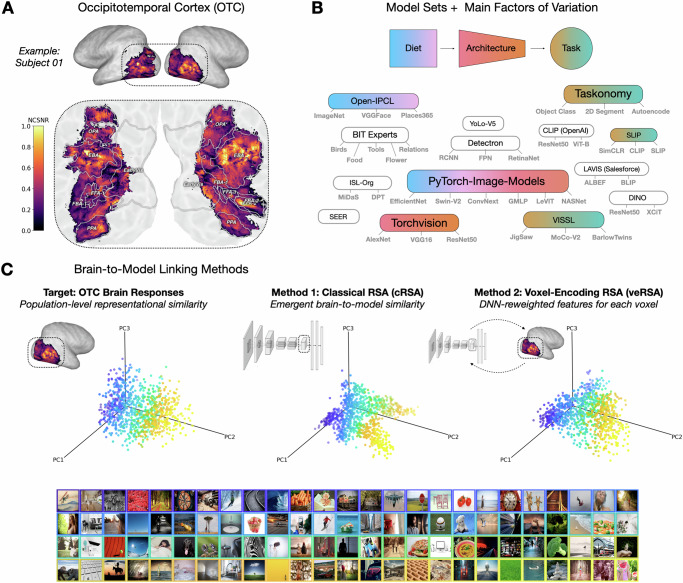
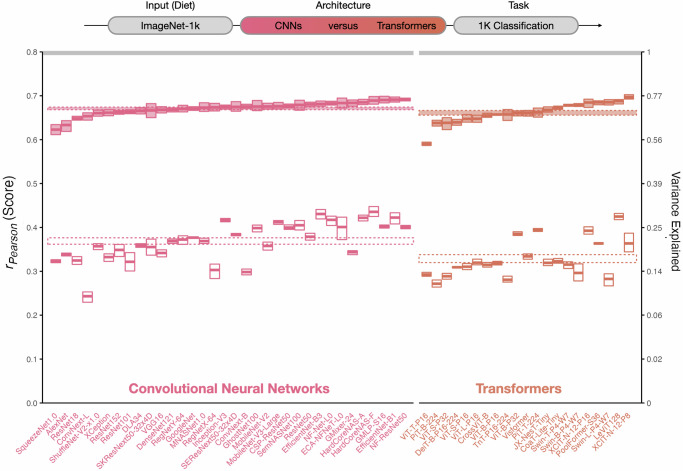
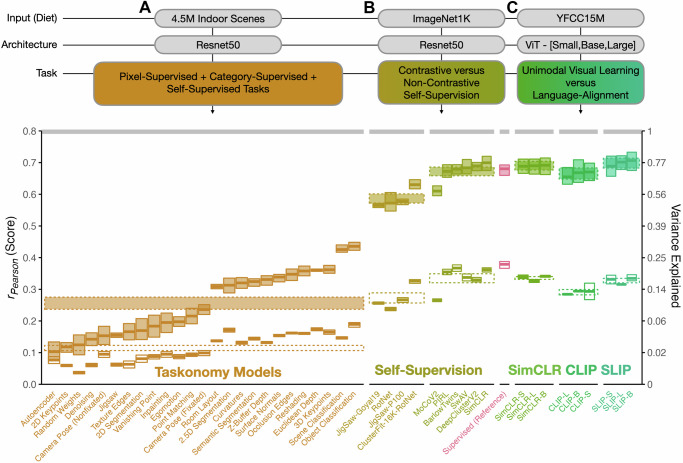
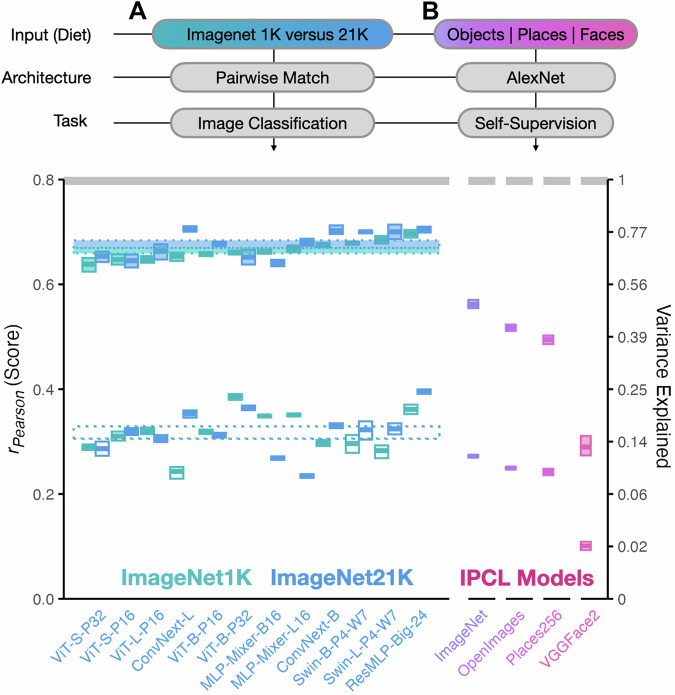
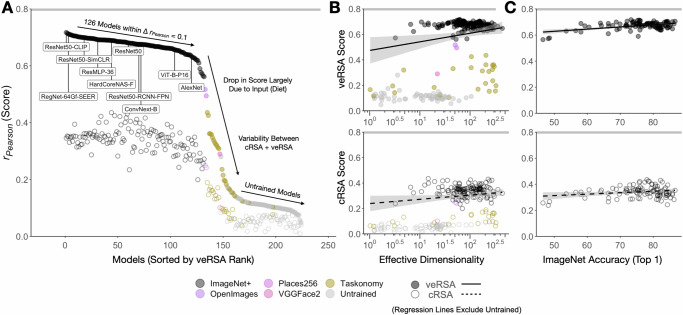
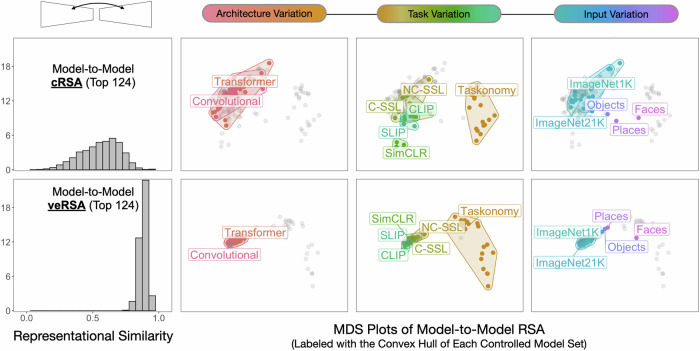
The rapid release of high-performing computer vision models offers new potential to study the impact of different inductive biases on the emergent brain alignment of learned representations. Here, we perform controlled comparisons among a curated set of 224 diverse models to test the impact of specific model properties on visual brain predictivity - a process requiring over 1.8 billion regressions and 50.3 thousand representational similarity analyses. We find that models with qualitatively different architectures (e.g. CNNs versus Transformers) and task objectives (e.g. purely visual contrastive learning versus vision- language alignment) achieve near equivalent brain predictivity, when other factors are held constant. Instead, variation across visual training diets yields the largest, most consistent effect on brain predictivity. Many models achieve similarly high brain predictivity, despite clear variation in their underlying representations - suggesting that standard methods used to link models to brains may be too flexible. Broadly, these findings challenge common assumptions about the factors underlying emergent brain alignment, and outline how we can leverage controlled model comparison to probe the common computational principles underlying biological and artificial visual systems.
Overview
The claims and statistics of this paper haven’t been checked yet.
Free: it reads the open-access text and checks the first 5 claims that cite a source we can check. Create a free account to check every claim.
Integrity signals
Registry
Cites
Statistics
Figures
Verification
Claims the paper makes
The claims and statistics of this paper haven’t been checked yet.
Free: it reads the open-access text and checks the first 5 claims that cite a source we can check. Create a free account to check every claim.
Claims other papers make about this one
Each is checked against this paper’s own text: does it say what the citing paper says it does?
The source backs part of the claim, not all of it — or backs it for a different population, condition or comparison.
In the citing paper
“However, recent results suggest that contrasting different ANNs with neural data may start to yield diminishing returns: models with drastically different architectures and training regimes all match neural data with similar accuracy, especially when parametric flexibility is allowed in the model–brain mapping [6,12–14]”
From The Umwelt Representation Hypothesis: rethinking Universality (2026) · cites this paper as [6]
Experimental — accuracy not yet measuredThe cited source says what the claim attributes to it.
In the citing paper
“Using this approach, known as neuroconnectionism, numerous studies have identified shared representational structure across brains and ANN models, as well as factors influencing this alignment [5–11]”
From The Umwelt Representation Hypothesis: rethinking Universality (2026) · cites this paper as [6]
Self-check
Percentages, sums and reported differences re-computed from the paper’s own numbers.
The self-check needs the paper’s full text.
Citations
Cites
Fitting Linear Mixed-Effects Models Using lme4
Bates, D., Mächler, M., Bolker, B., & Walker, S. (2015) · Journal of Statistical Software · doi:10.18637/jss.v067.i01 · Cited by 86,835
LeCun, Y., Bengio, Y., & Hinton, G. (2015) · Nature · doi:10.1038/nature14539 · Cited by 84,126
Scikit-learn: Machine Learning in Python
Pedregosa, F., Varoquaux, G., Gramfort, A., Michel, V., Thirion, B., Grisel, O., Blondel, M., Müller, A., Nothman, J., Louppe, G., et al. (2012) · arXiv · doi:10.48550/arxiv.1201.0490 · Cited by 71,016
Image quality assessment: from error visibility to structural similarity
Wang, Z., Bovik, A. C., Sheikh, H. R., & Simoncelli, E. P. (2004) · IEEE Transactions on Image Processing · doi:10.1109/tip.2003.819861 · Cited by 57,892
Microsoft COCO: Common Objects in Context
Lin, T.-Y., Maire, M., Belongie, S., Hays, J., Perona, P., Ramanan, D., Dollár, P., & Zitnick, C. L. (2014) · Lecture Notes in Computer Science · doi:10.1007/978-3-319-10602-1_48 · Cited by 45,460
PyTorch: An Imperative Style, High-Performance Deep Learning Library
Paszke, A., Gross, S., Massa, F., Lerer, A., Bradbury, J., Chanan, G., Killeen, T., Lin, Z., Gimelshein, N., Antiga, L., et al. (2019) · arXiv · doi:10.48550/arxiv.1912.01703 · Cited by 31,473
Advances in neural information processing systems 7
Cios, K., & Shields, M. (1997) · Neurocomputing · doi:10.1016/s0925-2312(97)90018-7 · Cited by 22,059
Learning Transferable Visual Models From Natural Language Supervision
Radford, A., Kim, J. W., Hallacy, C., Ramesh, A., Goh, G., Agarwal, S., Sastry, G., Askell, A., Mishkin, P., Clark, J., et al. (2021) · arXiv · doi:10.48550/arxiv.2103.00020 · Cited by 15,293
A simple framework for contrastive learning of visual representations
Chen, T., Kornblith, S., Norouzi, M., & Hinton, G. (2020) · arXiv · doi:10.48550/arxiv.2002.05709 · Cited by 10,857
Scaling Laws for Neural Language Models
Kaplan, J., McCandlish, S., Henighan, T., Brown, T. B., Chess, B., Child, R., Gray, S., Radford, A., Wu, J., & Amodei, D. (2020) · arXiv · doi:10.48550/arxiv.2001.08361 · Cited by 9,550
Research works printed but not linked: 24
- 20. Güçlü, U. & van Gerven, M. A. Deep neural networks reveal a gradient in the complexity of neural representations across the ventral stream. J. Neurosci.35, 10005–10014 (2015). · DOI · Paper page
- 28. Radoslaw, M. C. et al. The algonauts project: A platform for communication between the sciences of biological and artificial intelligence. arXiv Prepr. arXiv1905, 05675 (2019).
- 29. K. F. Willeke et al. The Sensorium competition on predicting large-scale mouse primary visual cortex activity. arXiv preprint arXiv:2206.08666, 2022. · arXiv
- 37. McGreivy, N. & Hakim A. Convolutional layers are not translation equivariant. arXiv preprint arXiv:2206.04979, 2022. · arXiv
- 38. Maithra, R., Thomas, U., Simon, K., Chiyuan, Z. & Alexey, D. Do vision transformers see like convolutional neural networks? Adv. Neural Inf. Process. Syst.34, 12116–12128 (2021).
- 44. Sax, A. et al. Learning to Navigate Using Mid-Level Visual Priors. arXiv:1912.11121 [cs], URL http://arxiv.org/abs/1912.11121. arXiv: 1912.11121 (2019). · arXiv
- 47. Conwell, C., Mayo, D., Barbu, A., Buice, M., Alvarez, G. & Katz, B. Neural regression, representational similarity, model zoology & neural taskonomy at scale in rodent visual cortex. Adv. Neural Inf. Process. Syst.34, 5590–5607 (2021).
- 48. Nayebi, A. et al. Unsupervised Models of Mouse Visual Cortex. bioRxiv. (Cold Spring Harbor Laboratory, 2021).
- 52. Wang, A. Y., Kay, K., Naselaris, T., Tarr, M. J., & Wehbe, L. Incorporating natural language into vision models improves prediction and understanding of higher visual cortex. BioRxiv, 2022–09 (Cold Spring Harbor Laboratory, 2022).
- 54. Goyal, P. et al. Vision models are more robust and fair when pretrained on uncurated images without supervision. arXiv preprint arXiv, (2022). 2202.08360.
- 55. Puigcerver, J. et al. Scalable transfer learning with expert models. arXiv preprint arXiv, (2020). 2009.13239.
- 56. Ridnik, T., Ben-Baruch, E., Noy, A. & Zelnik-Manor, L. Imagenet-21k pretraining for the masses. arXiv preprint arXiv, (2021). 2104.10972.
- 59. Cadena, S. A. et al. How well do deep neural networks trained on object recognition characterize the mouse visual system? In NeurIPS Neuro AI Workshop, (2019).
- 60. Hermann, K. & Lampinen, A. What shapes feature representations? exploring datasets, architectures, and training. Adv. Neural Inf. Process. Syst.33, 9995–10006 (2020).
- 67. Garrido, Q., Balestriero, R., Najman, L. & Lecun, Y. Rankme: Assessing the downstream performance of pretrained self-supervised representations by their rank. In International conference on machine learning 10929–10974 (PMLR, 2023).
- 68. Yerxa, T., Kuang, Y., Simoncelli, E. & Chung, S. Learning efficient coding of natural images with maximum manifold capacity representations. Advances in Neural Information Processing Systems, 36, 24103–24128 (2023).
- 71. Muttenthaler, L., Dippel, J., Linhardt, L., Vandermeulen, R. A. & Kornblith, S. Human alignment of neural network representations. In: Proceedings of the 11th International Conference on Learning Representations (ICLR), (2023).
- 82. Abbas, A., Tirumala, K., Simig, D., Ganguli, S. & Morcos, A. S. Semdedup: Data-efficient learning at web-scale through semantic deduplication. In: Proceedings of the ICLR 2023: Multimodal Representation Learning Workshop (2023).
- 85. Wightman, R., Touvron, H. & Jégou, H. Resnet strikes back: An improved training procedure in timm. arxiv 2021. arXiv preprint arXiv:2110.00476, 2021. · arXiv
- 90. Han, Y., Poggio, T. A. & Cheung, B. System Identification of Neural Systems: If We Got It Right, Would We Know? In: Proceedings of the 40th International Conference on Machine Learning, PMLR, vol. 202, 12430–12444 (2023).
- 92. Khosla, M. & Williams, A. H. Soft Matching Distance: A metric on neural representations that captures single-neuron tuning. Proceedings of UniReps: the First Workshop on Unifying Representations in Neural Models, (PMLR, 2024).
- 106. Golan, T., Guo, W., Schütt, H. H. & Kriegeskorte, N. Distinguishing representational geometries with controversial stimuli: Bayesian experimental design and its application to face dissimilarity judgments. Proceedings of the SVRHM 2022 Workshop @ NeurIPS (2022).
- 108. Prasad A., Manor U. & Pereira T. Exploring the role of image domain in self-supervised dnn models of rodent brains. In SVRHM 2022 Workshop@ NeurIPS, 2022.
- 113. Tang, J., Du, M., Vo, V., Lal, V. & Huth, A. Brain encoding models based on multimodal transformers can transfer across language and vision. Adv. Neural Inf. Process. Syst.36 (2024).
Cited by
Wang, A. Y., Kay, K., Naselaris, T., Tarr, M. J., & Wehbe, L. (2023) · Nature Machine Intelligence · doi:10.1038/s42256-023-00753-y · Cited by 189
Self-citationHigh-level visual representations in the human brain are aligned with large language models
Doerig, A., Kietzmann, T. C., Allen, E., Wu, Y., Naselaris, T., Kay, K., & Charest, I. (2025) · Nature Machine Intelligence · doi:10.1038/s42256-025-01072-0 · Cited by 175
Self-citationTuckute, G., Feather, J., Boebinger, D., & McDermott, J. H. (2023) · PLoS Biology · doi:10.1371/journal.pbio.3002366 · Cited by 126
Language in Brains, Minds, and Machines
Tuckute, G., Kanwisher, N., & Fedorenko, E. G. (2024) · Annual Review of Neuroscience · doi:10.1146/annurev-neuro-120623-101142 · Cited by 117
A unifying framework for functional organization in early and higher ventral visual cortex
Margalit, E., Lee, H., Finzi, D., DiCarlo, J. J., Grill-Spector, K., & Yamins, D. L. K. (2024) · Neuron · doi:10.1016/j.neuron.2024.04.018 · Cited by 116
Distributed representations of behaviour-derived object dimensions in the human visual system
Contier, O., Baker, C. I., & Hebart, M. N. (2024) · Nature Human Behaviour · doi:10.1038/s41562-024-01980-y · Cited by 98
Human-like object concept representations emerge naturally in multimodal large language models
Du, C., Fu, K., Wen, B., Sun, Y., Peng, J., Wei, W., Gao, Y., Wang, S., Zhang, C., Li, J., et al. (2025) · Nature Machine Intelligence · doi:10.1038/s42256-025-01049-z · Cited by 83
Driving and suppressing the human language network using large language models
Tuckute, G., Sathe, A., Srikant, S., Taliaferro, M., Wang, M., Schrimpf, M., Kay, K., & Fedorenko, E. (2024) · Nature Human Behaviour · doi:10.1038/s41562-023-01783-7 · Cited by 69
Self-citationDimensions underlying the representational alignment of deep neural networks with humans
Mahner, F. P., Muttenthaler, L., Güçlü, U., & Hebart, M. N. (2025) · Nature Machine Intelligence · doi:10.1038/s42256-025-01041-7 · Cited by 70
Explanatory models in neuroscience, Part 1: Taking mechanistic abstraction seriously
Cao, R., & Yamins, D. (2024) · Cognitive Systems Research · doi:10.1016/j.cogsys.2024.101244 · Cited by 64
Contrastive learning explains the emergence and function of visual category-selective regions
Prince, J. S., Alvarez, G. A., & Konkle, T. (2024) · Science Advances · doi:10.1126/sciadv.adl1776 · Cited by 65
Self-citationLong, B., Fan, J. E., Huey, H., Chai, Z., & Frank, M. C. (2024) · Nature Communications · doi:10.1038/s41467-023-44529-9 · Cited by 63
Modeling naturalistic face processing in humans with deep convolutional neural networks
Jiahui, G., Feilong, M., Castello, M. V. D. O., Nastase, S. A., Haxby, J. V., & Gobbini, M. I. (2023) · Proceedings of the National Academy of Sciences · doi:10.1073/pnas.2304085120 · Cited by 55
High-performing neural network models of visual cortex benefit from high latent dimensionality
Elmoznino, E., & Bonner, M. F. (2024) · PLOS Computational Biology · doi:10.1371/journal.pcbi.1011792 · Cited by 49
Long, B., Sparks, R. Z., Xiang, V., Stojanov, S., Yinzi, Keene, G., Tan, A. W. M., Feng, S. Y., Nag, A., Zhuang, C., et al. (2025) · Conference on Cognitive Computational Neuroscience (CCN) · doi:10.32470/vbbjtb0 · Cited by 45
Spurious reconstruction from brain activity
Shirakawa, K., Nagano, Y., Tanaka, M., Aoki, S., Muraki, Y., Majima, K., & Kamitani, Y. (2025) · Neural Networks · doi:10.1016/j.neunet.2025.107515 · Cited by 44
Deep Neural Networks and Brain Alignment: Brain Encoding and Decoding (Survey)
Oota, S. R., Chen, Z., Gupta, M., Bapi, R. S., Jobard, G., Alexandre, F., & Hinaut, X. (2025) · Transactions on machine learning research · doi:10.48550/arxiv.2307.10246 · Cited by 43
Learning Efficient Coding of Natural Images with Maximum Manifold Capacity Representations
Yerxa, T. E., Kuang, Y., Simoncelli, E. P., & Chung, S. (2023) · neural information processing systems · doi:10.52202/075280-1047 · Cited by 43
Conwell, C., Graham, D., Boccagno, C. E., & Vessel, E. A. (2025) · Proceedings of the National Academy of Sciences · doi:10.1073/pnas.2306025121 · Cited by 41
Self-citationMemorability shapes perceived time (and vice versa)
Ma, A. C., Cameron, A., & Wiener, M. (2024) · Nature Human Behaviour · doi:10.1038/s41562-024-01863-2 · Cited by 38
Yang, H., Gee, J. C., & Shi, J. (2024) · IEEE Computer Society Conference on Computer Vision and Pattern Recognition/Proceedings - IEEE Computer Society Conference on Computer Vision and Pattern Recognition/Proceedings · doi:10.1109/cvpr52733.2024.02173 · Cited by 38
Maintenance and transformation of representational formats during working memory prioritization
Pacheco, D., Fellner, M.-C., Kunz, L., Zhang, H., Reinacher, P. C., Roy, C., Brandt, A., Schulze‐Bonhage, A., Yang, L., Wang, S., et al. (2024) · Nature Communications · doi:10.1038/s41467-024-52541-w · Cited by 32
BrainSCUBA: Fine-Grained Natural Language Captions of Visual Cortex Selectivity
Luo, A. F., Henderson, M. M., Tarr, M. J., & Wehbe, L. (2024) · International Conference on Learning Representations · doi:10.48550/arxiv.2310.04420 · Cited by 33
Hadidi, N., Feghhi, E., Song, B. H., Blank, I., & Kao, J. C. (2026) · Nature Communications · doi:10.1038/s41467-026-72253-7 · Cited by 30
Takeda, K., Sasaki, M., Abe, K., & Oizumi, M. (2025) · Journal of Neuroscience Methods · doi:10.1016/j.jneumeth.2025.110443 · Cited by 28
Soni, A. K., Srivastava, S., Maechler, M. R., Kording, K. P., & Khosla, M. (2024) · bioRxiv (Cold Spring Harbor Laboratory) · doi:10.1101/2024.08.07.607035 · Cited by 28
NeuroAI for AI SafetyPreprint
Mineault, P., Zanichelli, N., Peng, J. Z., Arkhipov, A., Bingham, E., Jara‐Ettinger, J., Mackevicius, E. L., Marblestone, A. H., Mattar, M. G., Payne, A. C., et al. (2024) · arXiv (Cornell University) · doi:10.48550/arxiv.2411.18526 · Cited by 27
Parallels Between VLA Model Post-Training and Human Motor Learning: Progress, Challenges, and TrendsPreprint
Xiang, T., Jin, A.-Q., Zhou, X.-H., Gui, M.-J., Xie, X., Liu, S.-Q., Wang, S.-Y., Duan, S.-B., Xie, F.-C., Wang, W.-K., et al. (2025) · arXiv (Cornell University) · doi:10.48550/arxiv.2506.20966 · Cited by 25
Convolutional architectures are cortex-aligned de novo
Kazemian, A., Elmoznino, E., & Bonner, M. (2025) · Nature Machine Intelligence · doi:10.1038/s42256-025-01142-3 · Cited by 24
On the importance of severely testing deep learning models of cognition
Bowers, J. S., Malhotra, G., Adolfi, F., Dujmović, M., Montero, M. L., Biscione, V., Puebla, G., Hummel, J. H., & Heaton, R. F. (2023) · Cognitive Systems Research · doi:10.1016/j.cogsys.2023.101158 · Cited by 26
Reanimating Images using Neural Representations of Dynamic Stimuli
Yeung, J., Luo, A. F., Sarch, G. H., Henderson, M. M., Ramanan, D., & Tarr, M. J. (2025) · IEEE Computer Society Conference on Computer Vision and Pattern Recognition/Proceedings - IEEE Computer Society Conference on Computer Vision and Pattern Recognition/Proceedings · doi:10.1109/cvpr52734.2025.00502 · Cited by 20
Ferrante, M., Boccato, T., Rashkov, G., & Toschi, N. (2025) · Information Fusion · doi:10.1016/j.inffus.2025.103650 · Cited by 20
Dynamic Representation of Multidimensional Object Properties in the Human Brain
Teichmann, L., Hebart, M. N., & Baker, C. I. (2026) · Journal of Neuroscience · doi:10.1523/jneurosci.1057-25.2026 · Cited by 20
Beyond Boundaries: A Comprehensive Survey of Transferable Attacks on AI SystemsPreprint
Wang, G., Ce, Z., Wang, Y., Chen, B., Guo, H., & Yan, Q. (2023) · arXiv (Cornell University) · doi:10.48550/arxiv.2311.11796 · Cited by 19
Sievers, B., & Thornton, M. A. (2024) · Social Cognitive and Affective Neuroscience · doi:10.1093/scan/nsae014 · Cited by 21
Scaling Laws for Task-Optimized Models of the Primate Visual Ventral StreamPreprint
Gökce, A., & Schrimpf, M. (2024) · arXiv (Cornell University) · doi:10.48550/arxiv.2411.05712 · Cited by 19
A single computational objective can produce specialization of streams in visual cortex
Finzi, D., Margalit, E., Kay, K., Yamins, D. L. K., & Grill-Spector, K. (2026) · Nature Communications · doi:10.1038/s41467-026-76098-y · Cited by 18
Self-citationUniversal dimensions of visual representation
Chen, Z., & Bonner, M. F. (2025) · Science Advances · doi:10.1126/sciadv.adw7697 · Cited by 16
Privileged representational axes in biological and artificial neural networks
Khosla, M., Williams, A. H., McDermott, J. H., & Kanwisher, N. (2023) · Conference on Cognitive Computational Neuroscience (CCN) · doi:10.32470/ccn.2023.1664-0 · Cited by 18
Factorized visual representations in the primate visual system and deep neural networks
Lindsey, J. W., & Issa, E. B. (2024) · eLife · doi:10.7554/elife.91685 · Cited by 16
Visual Image Reconstruction from Brain Activity via Latent Representation
Kamitani, Y., Tanaka, M., & Shirakawa, K. (2025) · Annual Review of Vision Science · doi:10.1146/annurev-vision-110423-023616 · Cited by 18
Representation of locomotive action affordances in human behavior, brains, and deep neural networks
Bartnik, C. G., Sartzetaki, C., Sanchez, A. P., Molenkamp, E., Bommer, S., Vukšić, N., & Groen, I. I. A. (2025) · Proceedings of the National Academy of Sciences · doi:10.1073/pnas.2414005122 · Cited by 15
Park, J.-Y., Tsukamoto, M., Tanaka, M., & Kamitani, Y. (2025) · PLoS Biology · doi:10.1371/journal.pbio.3003293 · Cited by 16
Material perception connects vision, cognition and action
Xiao, B., & Liao, C. (2025) · Nature Reviews Psychology · doi:10.1038/s44159-025-00489-z · Cited by 14
Chen, H., Liu, B., Wang, S., Wang, X., Han, W., Wang, X., Zhu, Y., & Bi, Y. (2025) · Nature Human Behaviour · doi:10.1038/s41562-025-02357-5 · Cited by 14
Hierarchical VAEs provide a normative account of motion processing in the primate brain
Vafaii, H., Yates, J. L., & Butts, D. (2023) · neural information processing systems · doi:10.52202/075280-2002 · Cited by 14
Aligning brains into a shared space improves their alignment with large language models
Bhattacharjee, A., Zada, Z., Wang, H., Aubrey, B., Doyle, W., Dugan, P. C., Friedman, D. J., Devinsky, O., Flinker, A., Ramadge, P. J., et al. (2025) · Nature Computational Science · doi:10.1038/s43588-025-00900-y · Cited by 14
Takeda, K., Abe, K., Kitazono, J., & Oizumi, M. (2025) · iScience · doi:10.1016/j.isci.2025.112427 · Cited by 13
Golan, T., Guo, W., Schütt, H. H., & Kriegeskorte, N. (2022) · arXiv (Cornell University) · doi:10.48550/arxiv.2211.15053 · Cited by 13
Conwell, C., McMahon, E., Jagadeesh, A. V., Vinken, K., Sharma, S., Prince, J. S., Alvarez, G. A., Konkle, T., Livingstone, M. S., & Işık, L. (2025) · bioRxiv (Cold Spring Harbor Laboratory) · doi:10.1101/2025.03.05.641284 · Cited by 13
Self-citationContrastive-Equivariant Self-Supervised Learning Improves Alignment with Primate Visual Area IT
Yerxa, T. E., Feather, J., Simoncelli, E. P., & Chung, S. (2024) · neural information processing systems · doi:10.52202/079017-3043 · Cited by 12
Achieving more human brain-like vision via human EEG representational alignment
Lu, Z., Wang, Y., & Golomb, J. D. (2026) · Communications Biology · doi:10.1038/s42003-026-09685-w · Cited by 12
Qian, X., Dehghani, A., Farahani, A., & Bashivan, P. (2026) · Nature Communications · doi:10.1038/s41467-026-70065-3 · Cited by 13
Quantifying Differences in Neural Population Activity With Shape MetricsPreprint
Barbosa, J., Nejatbakhsh, A., Duong, L., Harvey, S. E., Brincat, S. L., Siegel, M., Miller, E. K., & Williams, A. H. (2025) · bioRxiv (Cold Spring Harbor Laboratory) · doi:10.1101/2025.01.10.632411 · Cited by 12
Language models align with brain regions that represent concepts across modalitiesPreprint
Ryskina, M., Tuckute, G., Fung, A., Malkin, A., & Fedorenko, E. G. (2025) · arXiv (Cornell University) · doi:10.48550/arxiv.2508.11536 · Cited by 12
Reverse predictivity for bidirectional comparison of neural networks and biological brains
Muzellec, S., & Kar, K. (2026) · Nature Machine Intelligence · doi:10.1038/s42256-026-01204-0 · Cited by 11
Evaluating alignment between humans and neural network representations in image-based learning tasks
Demircan, C., Saanum, T., Pettini, L., Binz, M., Bączkowski, B. M., Doeller, C. F., Garvert, M. M., & Schulz, E. (2024) · neural information processing systems · doi:10.52202/079017-3890 · Cited by 11
Universality of representation in biological and artificial neural networks
Hosseini, E., Casto, C., Zaslavsky, N., Conwell, C., Richardson, M., & Fedorenko, E. (2024) · doi:10.1101/2024.12.26.629294 · Cited by 10
Self-citationModeling Visual Impairments with Artificial Neural Networks: a Review
Schiatti, L., Gori, M., Schrimpf, M., Cappagli, G., Morelli, F., Signorini, S. G., Katz, B., & Barbu, A. (2023) · IEEE International Conference on Computer Vision Workshops · doi:10.1109/iccvw60793.2023.00213 · Cited by 10
A simplified minimodel of visual cortical neurons
Du, F., Núñez-Ochoa, M. A., Pachitariu, M., & Stringer, C. (2025) · Nature Communications · doi:10.1038/s41467-025-61171-9 · Cited by 10
Kapoor, C., Srivastava, S., & Khosla, M. (2025) · neural information processing systems · doi:10.52202/085713-4690 · Cited by 9
Li, Y., Liu, X., Li, W., Yang, J., Gong, B., Jin, W., Gong, Z., Wang, K., Luo, J., Zhao, Z., et al. (2026) · Nature Neuroscience · doi:10.1038/s41593-026-02322-z · Cited by 9
Net2Brain: a toolbox to compare artificial vision models with human brain responses
Bersch, D., Vilas, M. G., Saba-Sadiya, S., Schaumlöffel, T., Dwivedi, K., Sartzetaki, C., Cichy, R. M., & Roig, G. (2025) · Frontiers in Neuroinformatics · doi:10.3389/fninf.2025.1515873 · Cited by 9
Disentangling signal and noise in neural responses through generative modeling
Kay, K., Prince, J. S., Gebhart, T., Tuckute, G., Zhou, J., Naselaris, T., & Schütt, H. H. (2025) · PLoS Computational Biology · doi:10.1371/journal.pcbi.1012092 · Cited by 9
Self-citationTakahashi, S., Sasaki, M., Takeda, K., & Oizumi, M. (2025) · Neural Networks · doi:10.1016/j.neunet.2025.108222 · Cited by 9
One Hundred Neural Networks and Brains Watching Videos: Lessons from AlignmentPreprint
Sartzetaki, C., Roig, G., Snoek, C. G. M., & Groen, I. I. A. (2024) · bioRxiv (Cold Spring Harbor Laboratory) · doi:10.1101/2024.12.05.626975 · Cited by 10
A Python Toolbox for Representational Similarity AnalysisPreprint
van den Bosch, J. J. F., Golan, T., Peters, B., Taylor, J., Shahbazi, M., Lin, B., Charest, I., Diedrichsen, J., Kriegeskorte, N., Mur, M., et al. (2025) · eLife · doi:10.7554/elife.107828.1 · Cited by 9
Deep learning in fetal, infant, and toddler neuroimaging research
Chin, J., Wyburd, M. K., Ayzenberg, V., Bayet, L., Bilgiç, B., Chen, E. M., Chen, Y., Dineen, Á. T., Fujita, S., Liu, J., et al. (2026) · Developmental Cognitive Neuroscience · doi:10.1016/j.dcn.2026.101680 · Cited by 8
Neuronal tuning aligns dynamically with object and texture manifolds across the visual hierarchy
Wang, B., & Ponce, C. R. (2026) · Nature Neuroscience · doi:10.1038/s41593-026-02207-1 · Cited by 8
Artificial neural networks for magnetoencephalography: a review of an emerging field
Dehgan, A., Abdelhedi, H., Hadid, V., Rish, I., & Jerbi, K. (2025) · Journal of Neural Engineering · doi:10.1088/1741-2552/addd4a · Cited by 8
A high-throughput approach for the efficient prediction of perceived similarity of natural objectsPreprint
Kaniuth, P., Mahner, F. P., Perkuhn, J., & Hebart, M. N. (2024) · bioRxiv (Cold Spring Harbor Laboratory) · doi:10.1101/2024.06.28.601184 · Cited by 8
Better artificial intelligence does not mean better models of biology
Linsley, D., Feng, P., & Serre, T. (2026) · Trends in Cognitive Sciences · doi:10.1016/j.tics.2025.11.016 · Cited by 7
Attention, not scale, drives human-AI alignment in multimodal language prediction
Kewenig, V. N., Lampinen, A. K., Nastase, S. A., Edwards, C., D’Elascombe, Q., Rechardt, A., Skipper, J. I., & Vigliocco, G. (2026) · npj Artificial Intelligence · doi:10.1038/s44387-026-00086-2 · Cited by 7
Approximating Human-Level 3D Visual Inferences With Deep Neural Networks
O’Connell, T. P., Bonnen, T., Friedman, Y., Tewari, A., Sitzmann, V., Tenenbaum, J. B., & Kanwisher, N. (2025) · Open Mind · doi:10.1162/opmi_a_00189 · Cited by 7
Zhou, Y., Tarr, M. J., & Yurovsky, D. (2025) · PLoS ONE · doi:10.1371/journal.pone.0321973 · Cited by 7
Factorized visual representations in the primate visual system and deep neural networksPreprint
Lindsey, J. W., & Issa, E. B. (2024) · eLife · doi:10.7554/elife.91685.1 · Cited by 7
What comparing deep neural networks can teach us about human vision
Seeliger, K., & Hebart, M. N. (2024) · Nature Machine Intelligence · doi:10.1038/s42256-024-00789-8 · Cited by 7
A 7T fMRI dataset of synthetic images for out-of-distribution modeling of vision
Gifford, A. T., Cichy, R. M., Naselaris, T., & Kay, K. (2026) · Nature Communications · doi:10.1038/s41467-026-69345-9 · Cited by 6
Self-citationMeta-Learning an In-Context Transformer Model of Human Higher Visual Cortex
Yu, M.-L., Nan, M., Adeli, H., Prince, J. S., Pyles, J. A., Wehbe, L., Henderson, M. M., Tarr, M. J., & Luo, A. F. (2025) · neural information processing systems · doi:10.52202/085713-5606 · Cited by 7
Self-citationGoig, G. A., Loiseau, C., Maghradze, N., Mchedlishvili, K., Avaliani, T., Tsutsunava, A., Brites, D., Kalkan, S., Borrell, S., Aspindzelashvili, R., et al. (2025) · Genome Medicine · doi:10.1186/s13073-025-01555-0 · Cited by 6
Computational origins of shape perception
Pandey, L., Wood, S. M. W., & Wood, J. N. (2025) · PLoS Computational Biology · doi:10.1371/journal.pcbi.1013674 · Cited by 6
Anchor objects drive realism while diagnostic objects drive categorization in GAN generated scenes
Kallmayer, A., & Võ, M. L. ‐. (2024) · Communications Psychology · doi:10.1038/s44271-024-00119-z · Cited by 6
Kewenig, V. N., Lampinen, A. K., Nastase, S. A., Edwards, C., D'Elascombe, Q., Rechardt, A., Skipper, J. I., & Vigliocco, G. (2024) · Research Square · doi:10.21203/rs.3.rs-3913308/v1 · Cited by 6
A Python Toolbox for Representational Similarity AnalysisPreprint
van den Bosch, J. J. F., Golan, T., Peters, B., Taylor, J., Shahbazi, M., Lin, B., Charest, I., Diedrichsen, J., Kriegeskorte, N., Mur, M., et al. (2025) · bioRxiv (Cold Spring Harbor Laboratory) · doi:10.1101/2025.05.22.655542 · Cited by 7
Telomeric SUMO level influences the choices of APB formation pathways and ALT efficiency
Zhao, R., Yu, X., Chigumira, T., Xu, M., Wivagg, A., Lackner, R. M., Salsman, J., Dellaire, G., Matunis, M. J., Chenoweth, D. M., et al. (2025) · The Journal of Cell Biology · doi:10.1083/jcb.202410073 · Cited by 5
Only Brains Align with Brains: Cross-Region Alignment Patterns Expose Limits of Normative Models
Höfling, L., Tangemann, M., Piefke, L., Keller, S., Franke, K., & Bethge, M. (2026) · International Conference on Learning Representations · doi:10.48550/arxiv.2604.21780 · Cited by 5
Neirz, P., Allende, H., & Saavedra, C. (2026) · Scientific Reports · doi:10.1038/s41598-026-52883-z · Cited by 5
Principal distortions for discrimination of image representations
Feather, J., Lipshutz, D., Harvey, S. E., Williams, A. H., & Simoncelli, E. P. (2025) · Journal of Vision · doi:10.1167/jov.25.9.2246 · Cited by 5
Saha, S., Chadha, I., & Khosla, M. (2025) · Conference on Cognitive Computational Neuroscience (CCN) · doi:10.32470/0438nhad · Cited by 5
Sörensen, L. K. A., DiCarlo, J. J., & Kar, K. (2026) · Nature Communications · doi:10.1038/s41467-026-74816-0 · Cited by 5
Lu, Z., & Golomb, J. D. (2025) · eLife · doi:10.1101/2023.08.19.553999 · Cited by 5
Disentangled deep generative models reveal coding principles of the human face processing network
Soulos, P., & Işık, L. (2024) · PLoS Computational Biology · doi:10.1371/journal.pcbi.1011887 · Cited by 5
Meta-learning: Data, architecture, and both
Binz, M., Dasgupta, I., Jagadish, A. K., Botvinick, M., Wang, J. X., & Schulz, E. (2024) · Behavioral and Brain Sciences · doi:10.1017/s0140525x24000311 · Cited by 5
Lu, Z., & Golomb, J. D. (2025) · eLife · doi:10.7554/elife.98117 · Cited by 5
A high-throughput approach for the efficient prediction of perceived similarity of natural objectsPreprint
Kaniuth, P., Mahner, F. P., Perkuhn, J., & Hebart, M. N. (2025) · eLife · doi:10.7554/elife.105394 · Cited by 5
A Python Toolbox for Representational Similarity AnalysisPreprint
van den Bosch, J. J. F., Golan, T., Peters, B., Taylor, J., Shahbazi, M., Lin, B., Charest, I., Diedrichsen, J., Kriegeskorte, N., Mur, M., et al. (2025) · eLife · doi:10.7554/elife.107828 · Cited by 5
Chao, X., Jiang, J., Ma, W., Li, Y., Nie, J., Erċışlı, S., & Muhammad, G. (2025) · IEEE Internet of Things Journal · doi:10.1109/jiot.2025.3641637 · Cited by 4
Drawings of THINGS: A large-scale drawing dataset of 1854 object concepts
Mukherjee, K., Huey, H., Stoinski, L. M., Hebart, M. N., Fan, J. E., & Bainbridge, W. A. (2026) · Behavior Research Methods · doi:10.3758/s13428-025-02887-w · Cited by 4
Representation Biases: Variance Is Not Always a Good Proxy for Importance
Lampinen, A. K., Chan, S. C. Y., Li, Y., & Hermann, K. L. (2026) · eNeuro · doi:10.1523/eneuro.0461-25.2026 · Cited by 4
Predictive coding algorithms induce brain-like responses in artificial neural networks
Gütlin, D., & Auksztulewicz, R. (2025) · PLOS complex systems. · doi:10.1371/journal.pcsy.0000076 · Cited by 4
Metadata
- Authors
- Conwell, C., Prince, J. S., Kay, K. N., Alvarez, G. A., & Konkle, T.
- Affiliations
- Harvard University (US)
- University of Minnesota (US)
- Corresponding author
- Conwell, Colin
- Konkle, Talia
- Venue
- Nature Communications
- Published
- 2024-10-30
- Volume
- 15
- Issue
- 1
- Pages
- 9383-9383
- ISSN
- 2041-1723 (ISSN-L)
- PMC
- PMC11526138
- OpenAlex
- W4403924340
- Cited by
- 100
- References
- 98
- Citations by year
- 2026: 48 · 2025: 50 · 2024: 2
- FWCI
- 24.24
- Type
- journal article
- Language
- en
- Open access
- gold
- doi.org
- Licence
- cc-by-nc-nd
- creativecommons.org/licenses/by-nc-nd/4.0 (tdm)
- creativecommons.org/licenses/by-nc-nd/4.0 (vor)
- Locations
- Nature Communications (publishedVersion, cc-by-nc-nd)
- PubMed Central (publishedVersion, cc-by-nc-nd)
- PubMed (publishedVersion)
- RePEc: Research Papers in Economics (submittedVersion)
- DOAJ (DOAJ: Directory of Open Access Journals) (submittedVersion)
- Funders
- National Science Foundation (NSF-CAREER BCS-1942438)
- Topics
- Life Sciences › Neuroscience › Cognitive Neuroscience › Visual perception and processing mechanisms
- Physical Sciences › Computer Science › Artificial Intelligence › Domain Adaptation and Few-Shot Learning
- Life Sciences › Neuroscience › Cognitive Neuroscience › Face Recognition and Perception
- Keywords
- inductive bias, representational similarity analysis, vision models, convolutional neural networks, vision transformer, contrastive learning, vision-language alignment, model architecture
- MeSH terms
- Brain, Humans, Models, Neurological, Visual Perception, Neural Networks, Computer
About these checks
Registry, retraction, Cites and statistics results are computed, not judged, with one exception: a printed reference that no index lists is read once by a model before it counts as a citation error. Claims are extracted by a model and kept only when their quote appears verbatim in the text; each cited source is then checked, with a model’s help, for whether it says what the claim relies on. Those verdicts can be wrong — read the claim’s quote and the cited source before relying on one.
Statistics and arithmetic are recomputed, not judged.
Confidence bands are shown only for fields calibrated on our annotated test set. None is calibrated yet, so no band is shown.
What counts as a claim ›How we measure confidence ›How we check this ›
Are you an author, or do you see a problem with this page? Request a review
Data sources
Bibliographic data: Semantic Scholar, OpenAlex, Crossref.
Contains information from the Semantic Scholar Academic Graph Datasets, made available under the ODC Attribution License (ODC-BY 1.0).
Semantic Scholar’s data is described in: Kinney, R., et al. (2023). The Semantic Scholar Open Data Platform. arXiv:2301.10140.
