

A large-scale examination of inductive biases shaping high-level visual representation in brains and machines
Open accessThe DOI matches its Crossref record; 117 of the 117 references it cites were found in a registry or an index.
Abstract
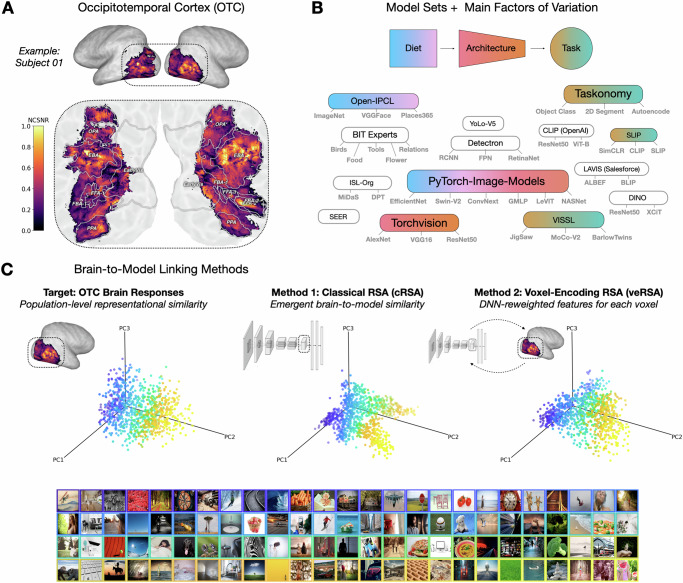
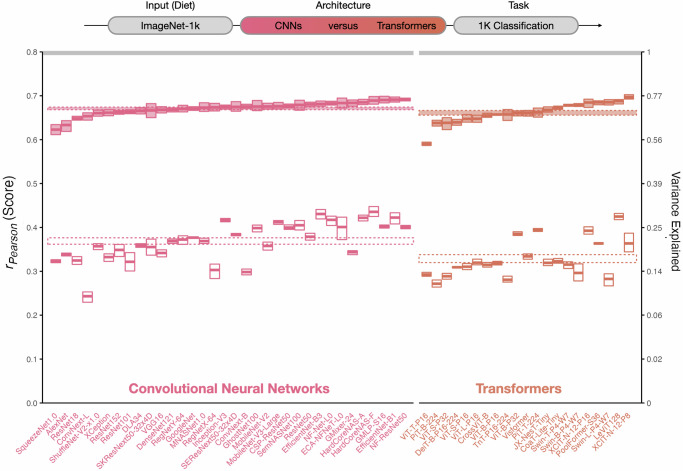
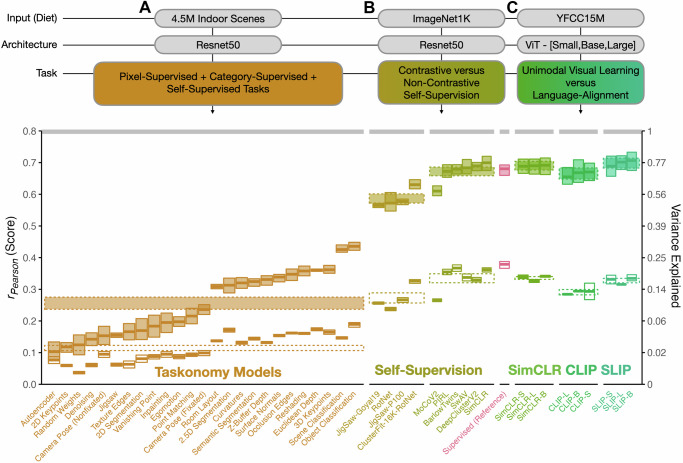
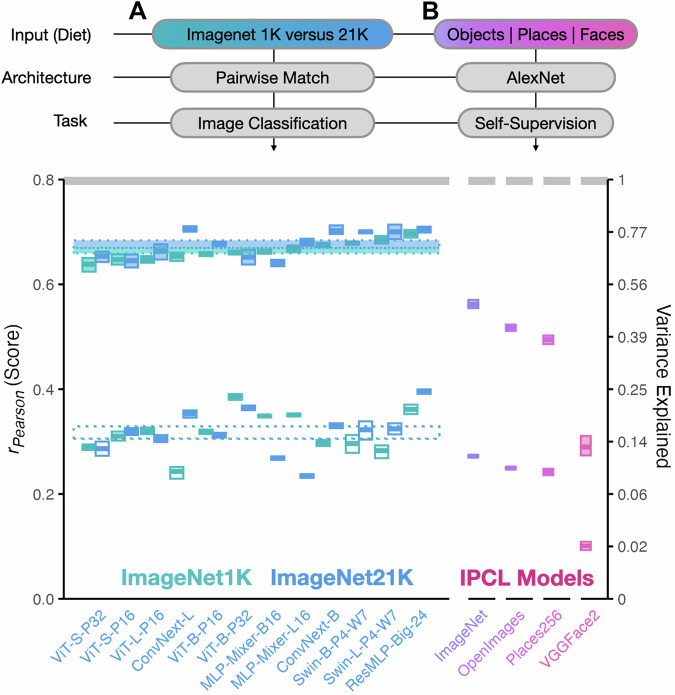
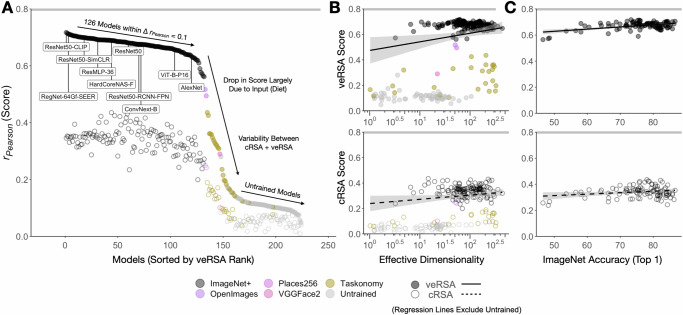
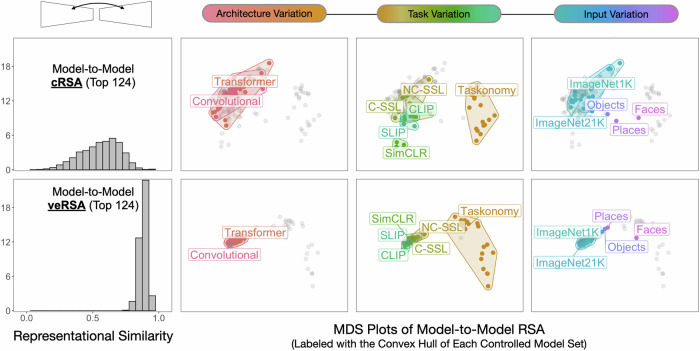
The rapid release of high-performing computer vision models offers new potential to study the impact of different inductive biases on the emergent brain alignment of learned representations. Here, we perform controlled comparisons among a curated set of 224 diverse models to test the impact of specific model properties on visual brain predictivity - a process requiring over 1.8 billion regressions and 50.3 thousand representational similarity analyses. We find that models with qualitatively different architectures (e.g. CNNs versus Transformers) and task objectives (e.g. purely visual contrastive learning versus vision- language alignment) achieve near equivalent brain predictivity, when other factors are held constant. Instead, variation across visual training diets yields the largest, most consistent effect on brain predictivity. Many models achieve similarly high brain predictivity, despite clear variation in their underlying representations - suggesting that standard methods used to link models to brains may be too flexible. Broadly, these findings challenge common assumptions about the factors underlying emergent brain alignment, and outline how we can leverage controlled model comparison to probe the common computational principles underlying biological and artificial visual systems.
Overview
The claims and statistics of this paper haven’t been checked yet.
Free: it reads the open-access text and checks the first 5 claims that cite a source we can check. Create a free account to check every claim.
Integrity signals
Registry
Cites
Statistics
Figures
Verification
Claims the paper makes
The claims and statistics of this paper haven’t been checked yet.
Free: it reads the open-access text and checks the first 5 claims that cite a source we can check. Create a free account to check every claim.
Claims other papers make about this one
Each is checked against this paper’s own text: does it say what the citing paper says it does?
The source backs part of the claim, not all of it — or backs it for a different population, condition or comparison.
In the citing paper
“However, recent results suggest that contrasting different ANNs with neural data may start to yield diminishing returns: models with drastically different architectures and training regimes all match neural data with similar accuracy, especially when parametric flexibility is allowed in the model–brain mapping [6,12–14]”
From The Umwelt Representation Hypothesis: rethinking Universality (2026) · cites this paper as [6]
Experimental — accuracy not yet measuredThe cited source says what the claim attributes to it.
In the citing paper
“Using this approach, known as neuroconnectionism, numerous studies have identified shared representational structure across brains and ANN models, as well as factors influencing this alignment [5–11]”
From The Umwelt Representation Hypothesis: rethinking Universality (2026) · cites this paper as [6]
Self-check
Percentages, sums and reported differences re-computed from the paper’s own numbers.
The self-check needs the paper’s full text.
Citations
Cites
Fitting Linear Mixed-Effects Models Using lme4
Bates, D., Mächler, M., Bolker, B., & Walker, S. (2015) · Journal of Statistical Software · doi:10.18637/jss.v067.i01 · Cited by 86,835
LeCun, Y., Bengio, Y., & Hinton, G. (2015) · Nature · doi:10.1038/nature14539 · Cited by 84,126
Scikit-learn: Machine Learning in Python
Pedregosa, F., Varoquaux, G., Gramfort, A., Michel, V., Thirion, B., Grisel, O., Blondel, M., Müller, A., Nothman, J., Louppe, G., et al. (2012) · arXiv · doi:10.48550/arxiv.1201.0490 · Cited by 71,016
Image quality assessment: from error visibility to structural similarity
Wang, Z., Bovik, A. C., Sheikh, H. R., & Simoncelli, E. P. (2004) · IEEE Transactions on Image Processing · doi:10.1109/tip.2003.819861 · Cited by 57,892
Microsoft COCO: Common Objects in Context
Lin, T.-Y., Maire, M., Belongie, S., Hays, J., Perona, P., Ramanan, D., Dollár, P., & Zitnick, C. L. (2014) · Lecture Notes in Computer Science · doi:10.1007/978-3-319-10602-1_48 · Cited by 45,460
PyTorch: An Imperative Style, High-Performance Deep Learning Library
Paszke, A., Gross, S., Massa, F., Lerer, A., Bradbury, J., Chanan, G., Killeen, T., Lin, Z., Gimelshein, N., Antiga, L., et al. (2019) · arXiv · doi:10.48550/arxiv.1912.01703 · Cited by 31,473
Advances in neural information processing systems 7
Cios, K., & Shields, M. (1997) · Neurocomputing · doi:10.1016/s0925-2312(97)90018-7 · Cited by 22,059
Learning Transferable Visual Models From Natural Language Supervision
Radford, A., Kim, J. W., Hallacy, C., Ramesh, A., Goh, G., Agarwal, S., Sastry, G., Askell, A., Mishkin, P., Clark, J., et al. (2021) · arXiv · doi:10.48550/arxiv.2103.00020 · Cited by 15,293
A simple framework for contrastive learning of visual representations
Chen, T., Kornblith, S., Norouzi, M., & Hinton, G. (2020) · arXiv · doi:10.48550/arxiv.2002.05709 · Cited by 10,857
Scaling Laws for Neural Language Models
Kaplan, J., McCandlish, S., Henighan, T., Brown, T. B., Chess, B., Child, R., Gray, S., Radford, A., Wu, J., & Amodei, D. (2020) · arXiv · doi:10.48550/arxiv.2001.08361 · Cited by 9,550
Research works printed but not linked: 20
- 20. Güçlü, U. & van Gerven, M. A. Deep neural networks reveal a gradient in the complexity of neural representations across the ventral stream. J. Neurosci.35, 10005–10014 (2015). · DOI · Paper page
- 28. Radoslaw, M. C. et al. The algonauts project: A platform for communication between the sciences of biological and artificial intelligence. arXiv Prepr. arXiv1905, 05675 (2019).
- 38. Maithra, R., Thomas, U., Simon, K., Chiyuan, Z. & Alexey, D. Do vision transformers see like convolutional neural networks? Adv. Neural Inf. Process. Syst.34, 12116–12128 (2021).
- 47. Conwell, C., Mayo, D., Barbu, A., Buice, M., Alvarez, G. & Katz, B. Neural regression, representational similarity, model zoology & neural taskonomy at scale in rodent visual cortex. Adv. Neural Inf. Process. Syst.34, 5590–5607 (2021).
- 48. Nayebi, A. et al. Unsupervised Models of Mouse Visual Cortex. bioRxiv. (Cold Spring Harbor Laboratory, 2021).
- 52. Wang, A. Y., Kay, K., Naselaris, T., Tarr, M. J., & Wehbe, L. Incorporating natural language into vision models improves prediction and understanding of higher visual cortex. BioRxiv, 2022–09 (Cold Spring Harbor Laboratory, 2022).
- 54. Goyal, P. et al. Vision models are more robust and fair when pretrained on uncurated images without supervision. arXiv preprint arXiv, (2022). 2202.08360.
- 55. Puigcerver, J. et al. Scalable transfer learning with expert models. arXiv preprint arXiv, (2020). 2009.13239.
- 56. Ridnik, T., Ben-Baruch, E., Noy, A. & Zelnik-Manor, L. Imagenet-21k pretraining for the masses. arXiv preprint arXiv, (2021). 2104.10972.
- 59. Cadena, S. A. et al. How well do deep neural networks trained on object recognition characterize the mouse visual system? In NeurIPS Neuro AI Workshop, (2019).
- 60. Hermann, K. & Lampinen, A. What shapes feature representations? exploring datasets, architectures, and training. Adv. Neural Inf. Process. Syst.33, 9995–10006 (2020).
- 67. Garrido, Q., Balestriero, R., Najman, L. & Lecun, Y. Rankme: Assessing the downstream performance of pretrained self-supervised representations by their rank. In International conference on machine learning 10929–10974 (PMLR, 2023).
- 68. Yerxa, T., Kuang, Y., Simoncelli, E. & Chung, S. Learning efficient coding of natural images with maximum manifold capacity representations. Advances in Neural Information Processing Systems, 36, 24103–24128 (2023).
- 71. Muttenthaler, L., Dippel, J., Linhardt, L., Vandermeulen, R. A. & Kornblith, S. Human alignment of neural network representations. In: Proceedings of the 11th International Conference on Learning Representations (ICLR), (2023).
- 82. Abbas, A., Tirumala, K., Simig, D., Ganguli, S. & Morcos, A. S. Semdedup: Data-efficient learning at web-scale through semantic deduplication. In: Proceedings of the ICLR 2023: Multimodal Representation Learning Workshop (2023).
- 90. Han, Y., Poggio, T. A. & Cheung, B. System Identification of Neural Systems: If We Got It Right, Would We Know? In: Proceedings of the 40th International Conference on Machine Learning, PMLR, vol. 202, 12430–12444 (2023).
- 92. Khosla, M. & Williams, A. H. Soft Matching Distance: A metric on neural representations that captures single-neuron tuning. Proceedings of UniReps: the First Workshop on Unifying Representations in Neural Models, (PMLR, 2024).
- 106. Golan, T., Guo, W., Schütt, H. H. & Kriegeskorte, N. Distinguishing representational geometries with controversial stimuli: Bayesian experimental design and its application to face dissimilarity judgments. Proceedings of the SVRHM 2022 Workshop @ NeurIPS (2022).
- 108. Prasad A., Manor U. & Pereira T. Exploring the role of image domain in self-supervised dnn models of rodent brains. In SVRHM 2022 Workshop@ NeurIPS, 2022.
- 113. Tang, J., Du, M., Vo, V., Lal, V. & Huth, A. Brain encoding models based on multimodal transformers can transfer across language and vision. Adv. Neural Inf. Process. Syst.36 (2024).
Cited by
Items 101–200 of 259
Marcos-Manchón, P., & Fuentemilla, L. (2026) · Communications Biology · doi:10.1038/s42003-026-10169-0 · Cited by 4
Thorat, S., Doerig, A., Kroner, A., Amme, C., & Kietzmann, T. C. (2026) · Science Advances · doi:10.1126/sciadv.aee1955 · Cited by 4
Rajaei, K., Cichy, R. M., & Soltanian-Zadeh, H. (2026) · Array · doi:10.1016/j.array.2026.100731 · Cited by 4
Loke, J., Sörensen, L. K. A., Groen, I. I. A., Cappaert, N. L. M., & Scholte, H. S. (2026) · Current Biology · doi:10.1016/j.cub.2026.08.008 · Cited by 5
Advancing NeuroAI through developmental alignment
Ayzenberg, V., Bonner, M., & Bayet, L. (2026) · Neuron · doi:10.1016/j.neuron.2026.07.003 · Cited by 4
Action features dominate cortical representation during natural vision
Jung, H., Jain, H., Han, X., Feilong, M., Han, J., Shokeen, D., Uden, C. V., Hanson, I., Connolly, A. C., Wager, T. D., et al. (2026) · Proceedings of the National Academy of Sciences · doi:10.1073/pnas.2625018123 · Cited by 4
Grosbard, I. D., & Yovel, G. (2025) · bioRxiv (Cold Spring Harbor Laboratory) · doi:10.1101/2025.01.09.632216 · Cited by 3
Representations in the hippocampal-entorhinal system emerge from learning sensory predictionsPreprint
Gomez, D., Bowling, M., Lee, J. Q., & Machado, M. C. (2025) · bioRxiv (Cold Spring Harbor Laboratory) · doi:10.1101/2025.10.03.680189 · Cited by 4
Superposition disentanglement of neural representations reveals hidden alignmentPreprint
Longon, A., Klindt, D. A., & Khosla, M. (2025) · arXiv (Cornell University) · doi:10.48550/arxiv.2510.03186 · Cited by 4
Mouse vs. AI: A Neuroethological Benchmark for Visual Robustness and Neural AlignmentPreprint
Schneider, M., Canzano, J., Peng, J., Hou, Y., Smith, S. L., & Beyeler, M. (2025) · PubMed Central · doi:10.48550/arxiv.2509.14446 · Cited by 4
Vanilla Group Equivariant Vision Transformer: Simple and EffectivePreprint
Fu, J., Xie, Q., Meng, D., & Xu, Z. (2026) · arXiv (Cornell University) · doi:10.48550/arxiv.2602.08047 · Cited by 4
Conceptual priorities shape individual gaze patterns during naturalistic visual attention
Haskins, A. J., Packard, K. O., & Robertson, C. E. (2026) · Proceedings of the National Academy of Sciences · doi:10.1073/pnas.2604369123 · Cited by 3
Wang, Y., Brunner, P., Willie, J. T., Cao, R., & Wang, S. (2026) · PLoS Biology · doi:10.1371/journal.pbio.3003614 · Cited by 3
Chirichella, M., Ratcliff, M., Gu, S., Miragaia, R. J., Sammito, M. D., Cutano, V., Cohen, S. E., Angeletti, D., Ros, X. R., & Schofield, D. J. (2026) · Cell Systems · doi:10.1016/j.cels.2025.101483 · Cited by 3
Ecological Visual Processing in the Mouse
Niell, C. M., Beyeler, M., Goard, M. J., & Smith, S. L. (2026) · Annual Review of Neuroscience · doi:10.1146/annurev-neuro-112723-040446 · Cited by 3
Sun, H., Lu, Q., Yang, F., Zhang, X., Dong, X., Chen, J., Zhang, X., Chen, J., Zhao, Y., & Li, Y. A. (2026) · Advanced Functional Materials · doi:10.1002/adfm.75808 · Cited by 3
MAPLE: Self-Supervised Learning-Enhanced Nonlinear Dimensionality Reduction for Visual Analysis
Huang, Z., Fujiwara, T., Chatzimparmpas, A., Duchemin, W., & Kerren, A. (2026) · IEEE Transactions on Visualization and Computer Graphics · doi:10.1109/tvcg.2026.3694000 · Cited by 3
A decade of comparing brains to DNNs: Progress and perspectives
Schmitt, L., Dong, D. T., Çelik, E., de Lange, F. P., & Toneva, M. (2026) · Trends in Cognitive Sciences · doi:10.1016/j.tics.2026.06.011 · Cited by 3
Systematic image perturbations reveal persistent gaps between human and machine vision
Mugihiko, K., & He, B. J. (2026) · iScience · doi:10.1016/j.isci.2026.117370 · Cited by 3
Task-dependent color representation in convolutional neural networks
Bosten, J. M., & Diyalagoda, S. A. (2025) · Journal of the Optical Society of America A · doi:10.1364/josaa.546067 · Cited by 3
Yilmaz, H., Shah, A. D., Letrou, A., Kumar, S., Vogels, R., & Yildirim, I. (2025) · Proceedings of the National Academy of Sciences · doi:10.1073/pnas.2420287122 · Cited by 3
Generic fitting models learn edge representations from prenatal retinal waves
Pandey, L., Wood, S. M. W., Cappell, B., & Wood, J. N. (2026) · Cognition · doi:10.1016/j.cognition.2025.106415 · Cited by 3
Natural scenes reveal diverse representations of 2D and 3D body pose in the human brain
Zhu, H., Ge, Y., Bratch, A., Yuille, A., Kay, K., & Kersten, D. (2024) · Proceedings of the National Academy of Sciences · doi:10.1073/pnas.2317707121 · Cited by 3
Self-citationEvaluating alignment between humans and neural network representations in image-based learning tasksPreprint
Demircan, C., Saanum, T., Pettini, L., Binz, M., Bączkowski, B. M., Doeller, C. F., Garvert, M. M., & Schulz, E. (2023) · arXiv (Cornell University) · doi:10.48550/arxiv.2306.09377 · Cited by 3
Rajesh, N., Jacob, G., & Arun, S. P. (2024) · arXiv (Cornell University) · doi:10.48550/arxiv.2411.16326 · Cited by 3
Holm, E. L., Marraffini, G., Slezak, D. F., & Tagliazucchi, E. (2025) · bioRxiv (Cold Spring Harbor Laboratory) · doi:10.1101/2025.05.19.655003 · Cited by 3
Sparse Autoencoders Bridge The Deep Learning Model and The BrainPreprint
Mao, Z., Xu, J., Zheng, Z., Zheng, H., Sheng, D., Jin, Y., & Yang, G. (2025) · arXiv (Cornell University) · doi:10.48550/arxiv.2506.11123 · Cited by 3
Are neural network representations universal or idiosyncratic?
(2025) · Nature Machine Intelligence · doi:10.1038/s42256-025-01139-y · Cited by 3
The Human Brain as a Dynamic Mixture of Expert Models in Video UnderstandingPreprint
Sartzetaki, C., Zonneveld, A. W., Oyarzo, P., Gifford, A. T., Cichy, R. M., Mettes, P., & Groen, I. I. A. (2025) · bioRxiv (Cold Spring Harbor Laboratory) · doi:10.1101/2025.10.27.684803 · Cited by 3
Rong, B., Gifford, A. T., Düzel, E., & Cichy, R. M. (2025) · eLife · doi:10.7554/elife.108915 · Cited by 3
MOSAIC: A scalable framework for fMRI dataset aggregation and modeling of human visionPreprint
Lahner, B., Deb, M., Murty, N. A. R., & Oliva, A. (2025) · bioRxiv (Cold Spring Harbor Laboratory) · doi:10.64898/2025.11.28.690060 · Cited by 3
Wu, J., Saha, S., Bo, Y., & Khosla, M. (2025) · arXiv (Cornell University) · doi:10.48550/arxiv.2509.04622 · Cited by 3
Model-Behavior Alignment under Flexible Evaluation: When the Best-Fitting Model Isn't the Right OnePreprint
Avitan, I., & Golan, T. (2025) · arXiv (Cornell University) · doi:10.48550/arxiv.2510.23321 · Cited by 3
Similarity of Neural Network Representations in SuperpositionPreprint
Liu, S., Issa, H. A., Longon, A., Gorton, L., Khosla, M., Williams, A., & Klindt, D. A. (2026) · arXiv (Cornell University) · doi:10.48550/arxiv.2604.00208 · Cited by 3
Characterizing universal object representations across vision modelsPreprint
Mahner, F. P., Roth, J., Lam, K. C., Bonner, M., Pereira, F., & Hebart, M. N. (2026) · PubMed Central · doi:10.48550/arxiv.2605.13675 · Cited by 3
Platonic Representations in the Human Brain: Unsupervised Recovery of Universal GeometryPreprint
Marcos-Manchón, P., Jha, R., & Fuentemilla, L. (2026) · arXiv (Cornell University) · doi:10.48550/arxiv.2605.20496 · Cited by 3
Skrill, D., Feather, J., & Norman-Haignere, S. (2026) · bioRxiv (Cold Spring Harbor Laboratory) · doi:10.64898/2026.08.05.743059 · Cited by 3
The Umwelt Representation Hypothesis: rethinking Universality
Bosch, V., Sommers, R. P., Doerig, A., & Kietzmann, T. C. (2026) · Trends in Cognitive Sciences · doi:10.1016/j.tics.2026.07.004 · Cited by 2
Simkova, K. M., Doerig, A., Hickey, C., & Charest, I. (2026) · Journal of Vision · doi:10.1167/jov.26.5.7 · Cited by 2
Ecological Vision Hypothesis: Training Deep Neural Networks for Robustness and Human Alignment
Tong, F., & Jang, H. (2026) · Annual Review of Vision Science · doi:10.1146/annurev-vision-110323-112649 · Cited by 2
Müller, N., Chen, H., Wahlberg, S., Scholte, H. S., & Groen, I. I. A. (2026) · PLoS Computational Biology · doi:10.1371/journal.pcbi.1014371 · Cited by 2
Generative AI as a transformational logic for cognitive neuroscience
Beste, C., & Safavi, S. (2026) · Communications Biology · doi:10.1038/s42003-026-10642-w · Cited by 2
Making models disagree to learn how brains compute
Golan, T., Schütt, H. H., & Kriegeskorte, N. (2026) · Nature reviews. Neuroscience · doi:10.1038/s41583-026-01070-0 · Cited by 2
The Problem of Determinism in Machine Learning: Ashʻarite and Muʻtazilite Free Will Perspectives
Siregar, F. H., Harahap, I., Ashani, S., & Hasabalh, H. M. A. (2026) · Al-Qarawiyyin Jurnal Ilmu Ushuluddin · doi:10.64691/swkng003 · Cited by 2
Beyond Sight: Probing Alignment Between Image Models and Blind V1Preprint
Granley, J., Pogoncheff, G., Rodil, A., Soo, L., Turkstra, L. M., Nadolskis, L., Saez, A. A., Soto‐Sánchez, C., Jover, E. F., & Beyeler, M. (2024) · arXiv (Cornell University) · doi:10.48550/arxiv.2403.12990 · Cited by 3
Linking faces to social cognition: The temporal pole as a potential social switch
Dipani, A., McNeal, N., & Murty, N. A. R. (2024) · Proceedings of the National Academy of Sciences · doi:10.1073/pnas.2411735121 · Cited by 2
Farahat, A., & Vinck, M. A. (2025) · bioRxiv (Cold Spring Harbor Laboratory) · doi:10.1101/2025.02.05.636721 · Cited by 2
A spatiotemporal hierarchy for social interaction perception in the lateral visual streamPreprint
McMahon, E., Im, E. J., Bonner, M., & Işık, L. (2025) · PsyArXiv (OSF Preprints) · doi:10.31234/osf.io/mdt4u_v5 · Cited by 2
A high-throughput approach for the efficient prediction of perceived similarity of natural objectsPreprint
Kaniuth, P., Mahner, F. P., Perkuhn, J., & Hebart, M. N. (2025) · eLife · doi:10.7554/elife.105394.1 · Cited by 2
A 7T fMRI dataset of synthetic images for out-of-distribution modeling of vision.Preprint
Gifford, A. T., Cichy, R. M., Naselaris, T., & Kay, K. (2025) · PubMed Central · Cited by 2
Self-citationBehavioral Geometric Supervision Aligns Video Foundation Models with Human Social PerceptionPreprint
Garcia, K., & Işık, L. (2025) · arXiv (Cornell University) · doi:10.48550/arxiv.2510.01502 · Cited by 2
Ziaee, S., Ahuja, R., Muzellec, S., Fide, E., Rosenbaum, R. S., & Kar, K. (2025) · bioRxiv (Cold Spring Harbor Laboratory) · doi:10.1101/2025.10.06.680822 · Cited by 2
Rong, B., Gifford, A. T., Düzel, E., & Cichy, R. M. (2025) · eLife · doi:10.7554/elife.108915.1 · Cited by 2
Yu, J., Ma, W., Wei, C., Zhang, J., Deng, H., Deng, Z., & Liu, Q. (2026) · arXiv (Cornell University) · doi:10.48550/arxiv.2601.22722 · Cited by 2
Fung, H., Murty, N. A. R., & Rahnev, D. (2026) · bioRxiv (Cold Spring Harbor Laboratory) · doi:10.64898/2026.02.10.705061 · Cited by 2
Extremely coarse learning objectives induce human-aligned representations in AI vision modelsPreprint
Mehta, Y., & Bonner, M. (2026) · Research Square · doi:10.21203/rs.3.rs-11089803/v1 · Cited by 2
Attention Alignment Between Humans and Vision-Language ModelsPreprint
Christian, I. R., Haputhanthrige, U., Hornfeld, H., Campbell, D., Nastase, S., Webb, T., & Graziano, M. S. A. (2026) · arXiv (Cornell University) · doi:10.48550/arxiv.2606.17410 · Cited by 2
Bavaresco, A., Klaric, I., Fernández, R., & Moens, M. (2026) · arXiv (Cornell University) · doi:10.48550/arxiv.2607.16214 · Cited by 2
Parametric neural control differentiates top neural network models of primate visual cortexPreprint
Prince, J. S., Wang, B., Fel, T., Jagadeesh, A. V., Vaziri, P. A., Alvarez, G. A., Livingstone, M. S., & Konkle, T. (2026) · bioRxiv (Cold Spring Harbor Laboratory) · doi:10.64898/2026.08.16.745063 · Cited by 2
Self-citationParameter Symmetries Determine Representational Geometry in Overparameterized Nonlinear NetworksPreprint
Theiss, M., Braun, L., Saxe, A., & Grant, E. (2026) · arXiv (Cornell University) · doi:10.48550/arxiv.2609.39078 · Cited by 2
Triple-N Dataset: Non-human Primate Neural Responses to Natural Scenes
Li, Y., Jin, W., Yang, J., Li, W., Gong, B., Liu, X., Gong, Z., Wang, K., Zhao, Z., Luo, J., et al. (2025) · Journal of Vision · doi:10.1167/jov.25.9.2859 · Cited by 1
Probing the content of semantic representations in body-selective regions
Yashiro, R., Sawayama, M., Yamashita, A., & Amano, K. (2026) · Imaging Neuroscience · doi:10.1162/imag.a.1309 · Cited by 2
Visual input statistics and behavioral relevance jointly constrain higher visual cortex organization
Henderson, M. M. (2025) · Cognitive Neuroscience · doi:10.1080/17588928.2025.2591254 · Cited by 1
A Rigorous Behavior Assessment of CNNs Using a Data-Domain Sampling Regime
Jiang, S., Chao, W., Haehn, D., Pfister, H., & Chen, J. (2025) · IEEE Transactions on Visualization and Computer Graphics · doi:10.1109/tvcg.2025.3633829 · Cited by 1
The recipe for intelligence in natural and artificial systems
Summerfield, C., & Stachenfeld, K. (2026) · Neuron · doi:10.1016/j.neuron.2026.08.013 · Cited by 1
Privileged representational axes in biological and artificial neural networks
Khosla, M., Srivastava, S., Williams, A. H., McDermott, J. H., & Kanwisher, N. (2026) · Nature Human Behaviour · doi:10.1038/s41562-026-02515-3 · Cited by 1
Qian, P., & Ullman, T. D. (2025) · Open Mind · doi:10.1162/opmi.a.277 · Cited by 1
Saliency Suppressed, Semantics Surfaced: Visual Transformations in Neural Networks and the BrainPreprint
Opiełka, G., Loke, J., & Scholte, H. S. (2024) · arXiv (Cornell University) · doi:10.48550/arxiv.2404.18772 · Cited by 1
Factorized visual representations in the primate visual system and deep neural networksPreprint
Lindsey, J. W., & Issa, E. B. (2024) · eLife · doi:10.7554/elife.91685.2 · Cited by 1
Image retrieval based on closed-loop visual–semantic neural decodingPreprint
Fukuma, R., Yanagisawa, T., Sugano, H., Tamura, K., Oshino, S., Tani, N., Iimura, Y., Khoo, H. M., Suzuki, H., Yang, H., et al. (2024) · bioRxiv (Cold Spring Harbor Laboratory) · doi:10.1101/2024.08.05.606113 · Cited by 1
Ferdous, S., Gupta, P., Teoh, Y. C., Sajeevan, K. A., Vaishnavey, S. R., Hainlin, K., Reuel, N. F., Qamhiyah, A. Z., Aluru, N. R., Kumar, M., et al. (2025) · bioRxiv (Cold Spring Harbor Laboratory) · doi:10.1101/2025.01.09.632218 · Cited by 1
Rong, B., Gifford, A. T., Düzel, E., & Cichy, R. M. (2025) · arXiv (Cornell University) · doi:10.48550/arxiv.2506.19497 · Cited by 1
McNeal, N., & Murty, N. A. R. (2025) · arXiv (Cornell University) · doi:10.48550/arxiv.2509.23333 · Cited by 1
Simple 3D Pose Features Support Human and Machine Social Scene UnderstandingPreprint
Qin, W., & Işık, L. (2025) · PubMed Central · doi:10.48550/arxiv.2511.03988 · Cited by 1
Training neural networks from scratch in a videogame leads to brittle brain encodingPreprint
Paugam, F., Pinsard, B., St‐Laurent, M., Lajoie, G., & Bellec, P. (2025) · eLife · doi:10.1101/2025.11.28.691119 · Cited by 1
Structure as an inductive bias for brain–model alignment
Wang, B., & Ponce, C. R. (2025) · Nature Machine Intelligence · doi:10.1038/s42256-025-01155-y · Cited by 1
Credit Assignment via Neural Manifold Noise CorrelationPreprint
Kang, B., Richards, M., & Sabatini, B. L. (2026) · arXiv (Cornell University) · doi:10.48550/arxiv.2601.02636 · Cited by 1
Self-supervised learning yields representational signatures of category-selective cortexPreprint
Janini, D., & Cichy, R. M. (2026) · bioRxiv (Cold Spring Harbor Laboratory) · doi:10.64898/2026.02.09.704031 · Cited by 1
Daube, C., Groß, J., & Ince, R. A. A. (2026) · bioRxiv (Cold Spring Harbor Laboratory) · doi:10.64898/2026.03.18.712602 · Cited by 1
Generative Adversarial Perturbations with Cross-paradigm Transferability on Localized Crowd CountingPreprint
Anisha, A. M., Wang, G., & Chellappan, S. (2026) · arXiv (Cornell University) · doi:10.48550/arxiv.2603.24821 · Cited by 1
Meta-learning In-Context Enables Training-Free Cross Subject Brain DecodingPreprint
Nan, M., Yu, M., Mai, W., Prince, J. S., Adeli, H., Zhang, R., Cao, J., Becker, B., Pyles, J. A., Henderson, M. M., et al. (2026) · arXiv (Cornell University) · doi:10.48550/arxiv.2604.08537 · Cited by 2
Self-citationCoggan, D. D., & Tong, F. (2026) · bioRxiv (Cold Spring Harbor Laboratory) · doi:10.64898/2026.04.23.720370 · Cited by 1
Characterizing the visual representation of objects from the child's viewPreprint
Yang, J., Sepuri, T., Tan, A. W. M., Aw, K. L., Frank, M. C., & Long, B. (2026) · arXiv (Cornell University) · doi:10.48550/arxiv.2605.14990 · Cited by 1
Beyond Neural Activity Prediction: Probing Latent Representations in Mouse V1 Digital TwinsPreprint
Lima, A., Hou, Y., Beyeler, M., & Schneider, M. (2026) · arXiv (Cornell University) · doi:10.48550/arxiv.2605.23122 · Cited by 1
Dipani, A., & Murty, N. A. R. (2026) · bioRxiv (Cold Spring Harbor Laboratory) · doi:10.64898/2026.05.29.728609 · Cited by 2
Brain alignment in deep neural networks emerges early and independently of object classificationPreprint
Scholte, H. S., Müller, N., Smidi, J., Groen, I. I. A., & van Gerven, M. A. J. (2026) · bioRxiv (Cold Spring Harbor Laboratory) · doi:10.64898/2026.08.18.745511 · Cited by 1
Zero-shot evaluations expose structured generalization limits in predictive models of the brainPreprint
Wang, R., Deb, M., Abate, A., Dipani, A., Dudipala, K. R., Chillarege, S., Ravikanti, K., Li, Y., Al-Tahan, H., Koushik, R., et al. (2026) · bioRxiv (Cold Spring Harbor Laboratory) · doi:10.64898/2026.09.15.751562 · Cited by 1
Predictive coding networks capture human neural representations missing in supervised DNNsPreprint
Gütlin, D., Kittelmann, D., & Auksztulewicz, R. (2026) · bioRxiv (Cold Spring Harbor Laboratory) · doi:10.64898/2026.09.18.752626 · Cited by 1
Lindsey, J. W., & Issa, E. B. (2024) · eLife · doi:10.7554/elife.91685.1.sa1
Zhang, H., Zheng, Z., Hu, J. S., Wang, Q., Xu, M., Zhou, Z., Li, Z., & Okazawa, G. (2025) · bioRxiv (Cold Spring Harbor Laboratory) · doi:10.1101/2025.04.02.646407
A Spatiotemporal Hierarchy for Social Interaction Perception in the Lateral Visual StreamPreprint
McMahon, E., Im, E. J., Bonner, M., & Işık, L. (2025) · eLife · doi:10.7554/elife.112352
Skaza, J., Murlidaran, S., Varshney, A., Wen, Z., Eckstein, M. P., & Beyeler, M. (2025) · Journal of Vision · doi:10.1167/jov.25.9.2829
Semantic Concept in Brain fMRI Spatio-Temporal Voxel PatternsPreprint
Zheng, N., Ma, Y., & Jing, H. (2025) · Research Square · doi:10.21203/rs.3.rs-6674875/v1
McPherson, M. J., & Brady, T. F. (2025) · PsyArXiv (OSF Preprints) · doi:10.31234/osf.io/vqdt5_v1
How Robust Are fMRI- and EEG-Based Representational Similarity Analysis?
Sarma, S. S., Boruah, G., & Srivastava, N. (2025) · Computational Brain & Behavior · doi:10.1007/s42113-025-00257-5
He, H., Du, C., Lu, Y., Huang, Z., Sun, Y., Zhou, Z., & Qin, S. (2025) · Research Square · doi:10.21203/rs.3.rs-7545984/v1
Khodabandehloo, B., & Rajimehr, R. (2025) · arXiv (Cornell University) · doi:10.48550/arxiv.2509.16973
Metadata
- Authors
- Conwell, C., Prince, J. S., Kay, K. N., Alvarez, G. A., & Konkle, T.
- Affiliations
- Harvard University (US)
- University of Minnesota (US)
- Corresponding author
- Conwell, Colin
- Konkle, Talia
- Venue
- Nature Communications
- Published
- 2024-10-30
- Volume
- 15
- Issue
- 1
- Pages
- 9383-9383
- ISSN
- 2041-1723 (ISSN-L)
- PMC
- PMC11526138
- OpenAlex
- W4403924340
- Cited by
- 100
- References
- 98
- Citations by year
- 2026: 48 · 2025: 50 · 2024: 2
- FWCI
- 24.24
- Type
- journal article
- Language
- en
- Open access
- gold
- doi.org
- Licence
- cc-by-nc-nd
- creativecommons.org/licenses/by-nc-nd/4.0 (tdm)
- creativecommons.org/licenses/by-nc-nd/4.0 (vor)
- Locations
- Nature Communications (publishedVersion, cc-by-nc-nd)
- PubMed Central (publishedVersion, cc-by-nc-nd)
- PubMed (publishedVersion)
- RePEc: Research Papers in Economics (submittedVersion)
- DOAJ (DOAJ: Directory of Open Access Journals) (submittedVersion)
- Funders
- National Science Foundation (NSF-CAREER BCS-1942438)
- Topics
- Life Sciences › Neuroscience › Cognitive Neuroscience › Visual perception and processing mechanisms
- Physical Sciences › Computer Science › Artificial Intelligence › Domain Adaptation and Few-Shot Learning
- Life Sciences › Neuroscience › Cognitive Neuroscience › Face Recognition and Perception
- Keywords
- inductive bias, representational similarity analysis, vision models, convolutional neural networks, vision transformer, contrastive learning, vision-language alignment, model architecture
- MeSH terms
- Brain, Humans, Models, Neurological, Visual Perception, Neural Networks, Computer
About these checks
Registry, retraction, Cites and statistics results are computed, not judged, with one exception: a printed reference that no index lists is read once by a model before it counts as a citation error. Claims are extracted by a model and kept only when their quote appears verbatim in the text; each cited source is then checked, with a model’s help, for whether it says what the claim relies on. Those verdicts can be wrong — read the claim’s quote and the cited source before relying on one.
Statistics and arithmetic are recomputed, not judged.
Confidence bands are shown only for fields calibrated on our annotated test set. None is calibrated yet, so no band is shown.
What counts as a claim ›How we measure confidence ›How we check this ›
Are you an author, or do you see a problem with this page? Request a review
Data sources
Bibliographic data: Semantic Scholar, OpenAlex, Crossref.
Contains information from the Semantic Scholar Academic Graph Datasets, made available under the ODC Attribution License (ODC-BY 1.0).
Semantic Scholar’s data is described in: Kinney, R., et al. (2023). The Semantic Scholar Open Data Platform. arXiv:2301.10140.
