

A large-scale examination of inductive biases shaping high-level visual representation in brains and machines
Open accessThe DOI matches its Crossref record; 113 of the 113 references it cites were found in a registry or an index.
Abstract
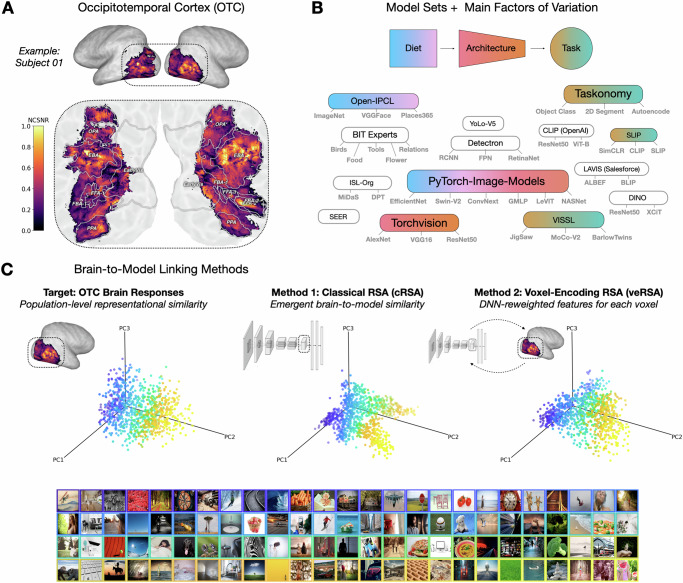
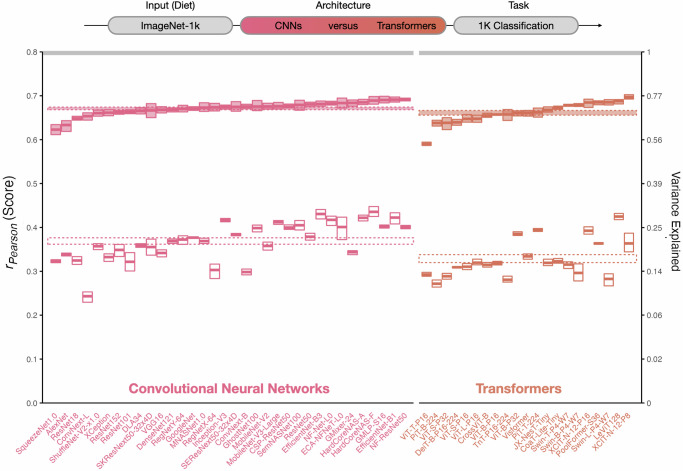
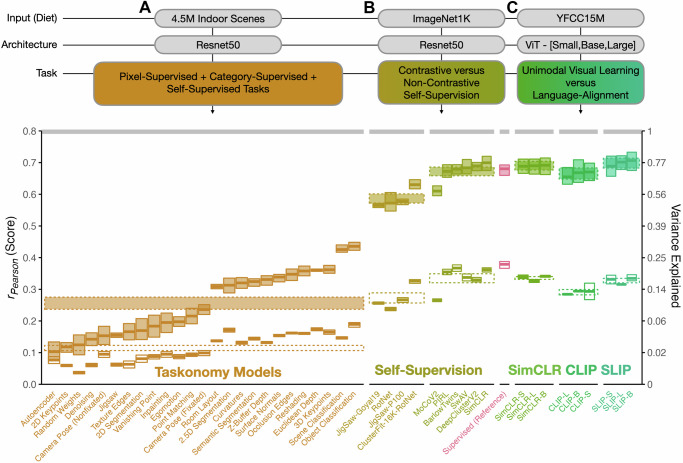
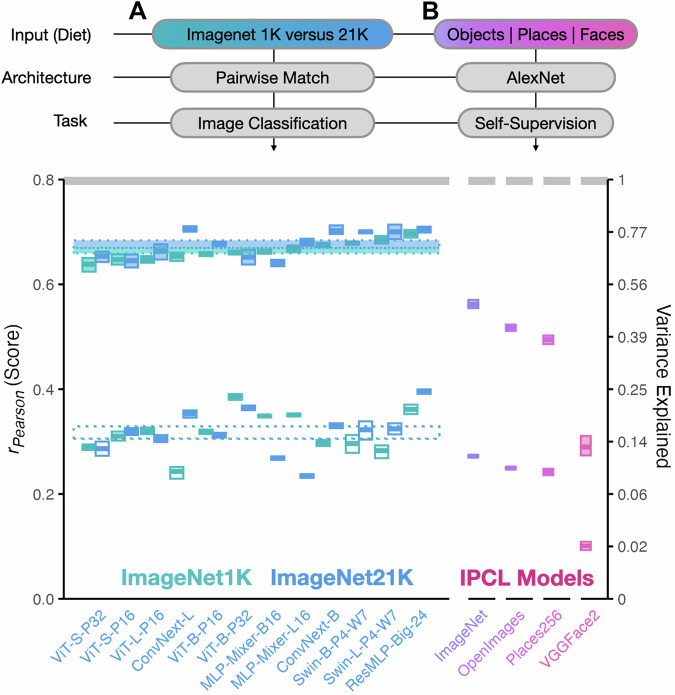
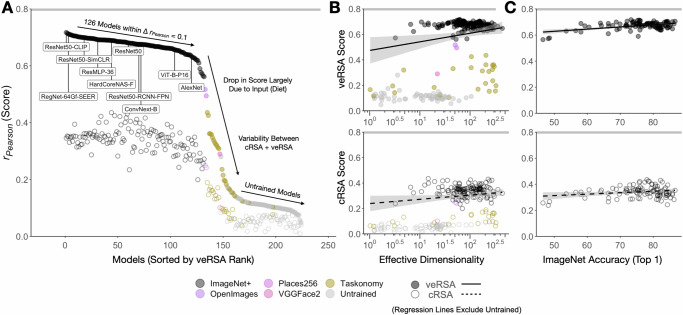
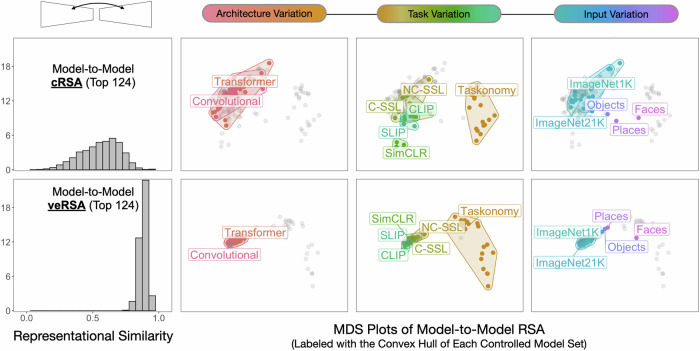
The rapid release of high-performing computer vision models offers new potential to study the impact of different inductive biases on the emergent brain alignment of learned representations. Here, we perform controlled comparisons among a curated set of 224 diverse models to test the impact of specific model properties on visual brain predictivity - a process requiring over 1.8 billion regressions and 50.3 thousand representational similarity analyses. We find that models with qualitatively different architectures (e.g. CNNs versus Transformers) and task objectives (e.g. purely visual contrastive learning versus vision- language alignment) achieve near equivalent brain predictivity, when other factors are held constant. Instead, variation across visual training diets yields the largest, most consistent effect on brain predictivity. Many models achieve similarly high brain predictivity, despite clear variation in their underlying representations - suggesting that standard methods used to link models to brains may be too flexible. Broadly, these findings challenge common assumptions about the factors underlying emergent brain alignment, and outline how we can leverage controlled model comparison to probe the common computational principles underlying biological and artificial visual systems.
Overview
The claims and statistics of this paper haven’t been checked yet.
Free: it reads the open-access text and checks the first 5 claims that cite a source we can check. Create a free account to check every claim.
Integrity signals
Registry
Cites
Statistics
Figures
Verification
Claims the paper makes
The claims and statistics of this paper haven’t been checked yet.
Free: it reads the open-access text and checks the first 5 claims that cite a source we can check. Create a free account to check every claim.
Claims other papers make about this one
Each is checked against this paper’s own text: does it say what the citing paper says it does?
The source backs part of the claim, not all of it — or backs it for a different population, condition or comparison.
In the citing paper
“However, recent results suggest that contrasting different ANNs with neural data may start to yield diminishing returns: models with drastically different architectures and training regimes all match neural data with similar accuracy, especially when parametric flexibility is allowed in the model–brain mapping [6,12–14]”
From The Umwelt Representation Hypothesis: rethinking Universality (2026) · cites this paper as [6]
Experimental — accuracy not yet measuredThe cited source says what the claim attributes to it.
In the citing paper
“Using this approach, known as neuroconnectionism, numerous studies have identified shared representational structure across brains and ANN models, as well as factors influencing this alignment [5–11]”
From The Umwelt Representation Hypothesis: rethinking Universality (2026) · cites this paper as [6]
Self-check
Percentages, sums and reported differences re-computed from the paper’s own numbers.
The self-check needs the paper’s full text.
Citations
Cites
Fitting Linear Mixed-Effects Models Using lme4
Bates, D., Mächler, M., Bolker, B., & Walker, S. (2015) · Journal of Statistical Software · doi:10.18637/jss.v067.i01 · Cited by 86,835
LeCun, Y., Bengio, Y., & Hinton, G. (2015) · Nature · doi:10.1038/nature14539 · Cited by 84,126
Scikit-learn: Machine Learning in Python
Pedregosa, F., Varoquaux, G., Gramfort, A., Michel, V., Thirion, B., Grisel, O., Blondel, M., Müller, A., Nothman, J., Louppe, G., et al. (2012) · arXiv · doi:10.48550/arxiv.1201.0490 · Cited by 71,016
Image quality assessment: from error visibility to structural similarity
Wang, Z., Bovik, A. C., Sheikh, H. R., & Simoncelli, E. P. (2004) · IEEE Transactions on Image Processing · doi:10.1109/tip.2003.819861 · Cited by 57,892
Microsoft COCO: Common Objects in Context
Lin, T.-Y., Maire, M., Belongie, S., Hays, J., Perona, P., Ramanan, D., Dollár, P., & Zitnick, C. L. (2014) · Lecture Notes in Computer Science · doi:10.1007/978-3-319-10602-1_48 · Cited by 45,460
PyTorch: An Imperative Style, High-Performance Deep Learning Library
Paszke, A., Gross, S., Massa, F., Lerer, A., Bradbury, J., Chanan, G., Killeen, T., Lin, Z., Gimelshein, N., Antiga, L., et al. (2019) · arXiv · doi:10.48550/arxiv.1912.01703 · Cited by 31,473
Advances in neural information processing systems 7
Cios, K., & Shields, M. (1997) · Neurocomputing · doi:10.1016/s0925-2312(97)90018-7 · Cited by 22,059
Learning Transferable Visual Models From Natural Language Supervision
Radford, A., Kim, J. W., Hallacy, C., Ramesh, A., Goh, G., Agarwal, S., Sastry, G., Askell, A., Mishkin, P., Clark, J., et al. (2021) · arXiv · doi:10.48550/arxiv.2103.00020 · Cited by 15,293
A simple framework for contrastive learning of visual representations
Chen, T., Kornblith, S., Norouzi, M., & Hinton, G. (2020) · arXiv · doi:10.48550/arxiv.2002.05709 · Cited by 10,857
Scaling Laws for Neural Language Models
Kaplan, J., McCandlish, S., Henighan, T., Brown, T. B., Chess, B., Child, R., Gray, S., Radford, A., Wu, J., & Amodei, D. (2020) · arXiv · doi:10.48550/arxiv.2001.08361 · Cited by 9,550
Liu, Z., Mao, H., Wu, C.-Y., Feichtenhofer, C., Darrell, T., & Xie, S. (2022) · 2022 IEEE/CVF Conference on Computer Vision and Pattern Recognition (CVPR) · doi:10.1109/cvpr52688.2022.01167 · Cited by 8,494
Receptive fields and functional architecture of monkey striate cortex
Hubel, D. H., & Wiesel, T. N. (1968) · The Journal of Physiology · doi:10.1113/jphysiol.1968.sp008455 · Cited by 6,568
mixup: Beyond Empirical Risk Minimization
Zhang, H., Cisse, M., Dauphin, Y. N., & Lopez-Paz, D. (2017) · arXiv · doi:10.48550/arxiv.1710.09412 · Cited by 5,831
CutMix: Regularization Strategy to Train Strong Classifiers with Localizable Features
Yun, S., Han, D., Oh, S. J., Chun, S., Choe, J., & Yoo, Y. (2019) · arXiv · doi:10.48550/arxiv.1905.04899 · Cited by 5,439
CutMix: Regularization Strategy to Train Strong Classifiers With Localizable Features
Yun, S., Han, D., Chun, S., Oh, S. J., Yoo, Y., & Choe, J. (2019) · 2019 IEEE/CVF International Conference on Computer Vision (ICCV) · doi:10.1109/iccv.2019.00612 · Cited by 5,400
Some distance properties of latent root and vector methods used in multivariate analysis
GOWER, J. C. (1966) · Biometrika · doi:10.1093/biomet/53.3-4.325 · Cited by 4,293
Representational similarity analysis-connecting the branches of systems neuroscience
Kriegeskorte, N. (2008) · Frontiers in Systems Neuroscience · doi:10.3389/neuro.06.004.2008 · Cited by 3,355
Estimating regression models with unknown break‐points
Muggeo, V. M. R. (2003) · Statistics in Medicine · doi:10.1002/sim.1545 · Cited by 2,371
Confidence Intervals from Normalized Data: A correction to Cousineau (2005)
Morey, R. D. (2008) · Tutorials in Quantitative Methods for Psychology · doi:10.20982/tqmp.04.2.p061 · Cited by 1,997
Performance-optimized hierarchical models predict neural responses in higher visual cortex
Yamins, D. L. K., Hong, H., Cadieu, C. F., Solomon, E. A., Seibert, D., & DiCarlo, J. J. (2014) · Proceedings of the National Academy of Sciences · doi:10.1073/pnas.1403112111 · Cited by 1,924
How does the brain solve visual object recognition?
DiCarlo, J. J., Zoccolan, D., & Rust, N. C. (2012) · Neuron · doi:10.1016/j.neuron.2012.01.010 · Cited by 1,790 · cited 1×
“The authors should discuss other studies that observe that untrained models sometimes produce similar RSA scores.”
Using goal-driven deep learning models to understand sensory cortex
Yamins, D. L. K., & DiCarlo, J. J. (2016) · Nature Neuroscience · doi:10.1038/nn.4244 · Cited by 1,621
Geirhos, R., Rubisch, P., Michaelis, C., Bethge, M., Wichmann, F. A., & Brendel, W. (2018) · arXiv · doi:10.48550/arxiv.1811.12231 · Cited by 1,490
Scanning the horizon: towards transparent and reproducible neuroimaging research
Poldrack, R. A., Baker, C. I., Durnez, J., Gorgolewski, K. J., Matthews, P. M., Munafò, M. R., Nichols, T. E., Poline, J.-B., Vul, E., & Yarkoni, T. (2017) · Nature Reviews Neuroscience · doi:10.1038/nrn.2016.167 · Cited by 1,410
Neuroscience Needs Behavior: Correcting a Reductionist Bias
Krakauer, J. W., Ghazanfar, A. A., Gomez-Marin, A., MacIver, M. A., & Poeppel, D. (2017) · Neuron · doi:10.1016/j.neuron.2016.12.041 · Cited by 1,358
Matching Categorical Object Representations in Inferior Temporal Cortex of Man and Monkey
Kriegeskorte, N., Mur, M., Ruff, D. A., Kiani, R., Bodurka, J., Esteky, H., Tanaka, K., & Bandettini, P. A. (2008) · Neuron · doi:10.1016/j.neuron.2008.10.043 · Cited by 1,344
Deep supervised, but not unsupervised, models may explain IT cortical representation
Khaligh-Razavi, S.-M., & Kriegeskorte, N. (2014) · PLoS Computational Biology · doi:10.1371/journal.pcbi.1003915 · Cited by 1,204
Taskonomy: Disentangling Task Transfer Learning
Zamir, A. R., Sax, A., Shen, W., Guibas, L., Malik, J., & Savarese, S. (2018) · 2018 IEEE/CVF Conference on Computer Vision and Pattern Recognition · doi:10.1109/cvpr.2018.00391 · Cited by 1,128
Kriegeskorte, N. (2015) · Annual Review of Vision Science · doi:10.1146/annurev-vision-082114-035447 · Cited by 1,093
A deep learning framework for neuroscience
Richards, B. A., Lillicrap, T. P., Beaudoin, P., Bengio, Y., Bogacz, R., Christensen, A., Clopath, C., Costa, R. P., de Berker, A., Ganguli, S., et al. (2019) · Nature Neuroscience · doi:10.1038/s41593-019-0520-2 · Cited by 1,027
Guclu, U., & van Gerven, M. A. J. (2015) · Journal of Neuroscience · doi:10.1523/jneurosci.5023-14.2015 · Cited by 961 · cited 1×
“For example, in Figure 1, could untrained models be included for all models and the results included in the Figure?”
Neural Style Transfer: A Review
Jing, Y., Yang, Y., Feng, Z., Ye, J., Yu, Y., & Song, M. (2020) · IEEE Transactions on Visualization and Computer Graphics · doi:10.1109/tvcg.2019.2921336 · Cited by 856
Cadieu, C. F., Hong, H., Yamins, D. L. K., Pinto, N., Ardila, D., Solomon, E. A., Majaj, N. J., & DiCarlo, J. J. (2014) · PLoS Computational Biology · doi:10.1371/journal.pcbi.1003963 · Cited by 824
DataComp: In search of the next generation of multimodal datasetsPreprint
Gadre, S., Ilharco, G., Fang, A., et al. (2023) · Neural Information Processing Systems · doi:10.48550/arxiv.2304.14108 · Cited by 781
Cichy, R. M., Khosla, A., Pantazis, D., Torralba, A., & Oliva, A. (2016) · Scientific Reports · doi:10.1038/srep27755 · Cited by 716
Database-friendly random projections
Achlioptas, D. (2001) · Proceedings of the twentieth ACM SIGMOD-SIGACT-SIGART symposium on Principles of database systems · doi:10.1145/375551.375608 · Cited by 699
Eccentricity bias as an organizing principle for human high-order object areas
Hasson, U., Levy, I., Behrmann, M., Hendler, T., & Malach, R. (2002) · Neuron · doi:10.1016/s0896-6273(02)00662-1 · Cited by 578
A massive 7T fMRI dataset to bridge cognitive neuroscience and artificial intelligence
Allen, E. J., St-Yves, G., Wu, Y., Breedlove, J. L., Prince, J. S., Dowdle, L. T., Nau, M., Caron, B., Pestilli, F., Charest, I., et al. (2022) · Nature Neuroscience · doi:10.1038/s41593-021-00962-x · Cited by 577
Self-citationExtracting, Computing and Exploring the Parameters of Statistical Models using R
Lüdecke, D., Ben-Shachar, M., Patil, I., & Makowski, D. (2020) · Journal of Open Source Software · doi:10.21105/joss.02445 · Cited by 518
Controlling Perceptual Factors in Neural Style Transfer
Gatys, L. A., Ecker, A. S., Bethge, M., Hertzmann, A., & Shechtman, E. (2017) · 2017 IEEE Conference on Computer Vision and Pattern Recognition (CVPR) · doi:10.1109/cvpr.2017.397 · Cited by 486
Brain-Score: Which Artificial Neural Network for Object Recognition is most Brain-Like?
Schrimpf, M., Kubilius, J., Hong, H., Majaj, N. J., Rajalingham, R., Issa, E. B., Kar, K., Bashivan, P., Prescott-Roy, J., Geiger, F., et al. (2018) · bioRxiv (Cold Spring Harbor Laboratory) · doi:10.1101/407007 · Cited by 458
Neural population control via deep image synthesis
Bashivan, P., Kar, K., & DiCarlo, J. J. (2019) · Science · doi:10.1126/science.aav9436 · Cited by 434
Intriguing Properties of Vision Transformers
Naseer, M., Ranasinghe, K., Khan, S., Hayat, M., Khan, F. S., & Yang, M.-H. (2021) · arXiv · doi:10.48550/arxiv.2105.10497 · Cited by 431 · cited 1×
“Rather than pitching the work as fundamentally an alternative to leaderboard type comparisons, it would be helpful to spell out exactly what information is missing from current leaderboards that would allow one to do this sort of analysis.”
Robust fine-tuning of zero-shot models
Wortsman, M., Ilharco, G., Kim, J. W., Li, M., Kornblith, S., Roelofs, R., Lopes, R. G., Hajishirzi, H., Farhadi, A., Namkoong, H., et al. (2022) · 2022 IEEE/CVF Conference on Computer Vision and Pattern Recognition (CVPR) · doi:10.1109/cvpr52688.2022.00780 · Cited by 428
Seeing it all: Convolutional network layers map the function of the human visual system
Eickenberg, M., Gramfort, A., Varoquaux, G., & Thirion, B. (2017) · NeuroImage · doi:10.1016/j.neuroimage.2016.10.001 · Cited by 338 · cited 1×
“For example, in Figure 1, could untrained models be included for all models and the results included in the Figure?”
Unsupervised neural network models of the ventral visual stream
Zhuang, C., Yan, S., Nayebi, A., Schrimpf, M., Frank, M. C., DiCarlo, J. J., & Yamins, D. L. K. (2021) · Proceedings of the National Academy of Sciences · doi:10.1073/pnas.2014196118 · Cited by 337
Interval estimation for the breakpoint in segmented regression: a smoothed score‐based approach
Muggeo, V. M. R. (2017) · Australian & New Zealand Journal of Statistics · doi:10.1111/anzs.12200 · Cited by 332
A comprehensive assessment of the structural similarity index
Dosselmann, R., & Yang, X. D. (2011) · Signal, Image and Video Processing · doi:10.1007/s11760-009-0144-1 · Cited by 275
Deep Learning: The Good, the Bad, and the Ugly
Serre, T. (2019) · Annual Review of Vision Science · doi:10.1146/annurev-vision-091718-014951 · Cited by 267
SLIP: Self-supervision Meets Language-Image Pre-training
Mu, N., Kirillov, A., Wagner, D., & Xie, S. (2022) · Lecture Notes in Computer Science · doi:10.1007/978-3-031-19809-0_30 · Cited by 258
Mid-level visual features underlie the high-level categorical organization of the ventral stream
Long, B., Yu, C.-P., & Konkle, T. (2018) · Proceedings of the National Academy of Sciences · doi:10.1073/pnas.1719616115 · Cited by 243
Self-citationRust, N. C., & Movshon, J. A. (2005) · Nature Neuroscience · doi:10.1038/nn1606 · Cited by 240
Integrative benchmarking to advance neurally mechanistic models of human intelligence
Schrimpf, M., Kubilius, J., Lee, M. J., Ratan Murty, N. A., Ajemian, R., & DiCarlo, J. J. (2020) · Neuron · doi:10.1016/j.neuron.2020.07.040 · Cited by 233
The neuroconnectionist research programme
Doerig, A., Sommers, R. P., Seeliger, K., Richards, B., Ismael, J., Lindsay, G. W., Kording, K. P., Konkle, T., van Gerven, M. A. J., Kriegeskorte, N., et al. (2023) · Nature Reviews Neuroscience · doi:10.1038/s41583-023-00705-w · Cited by 233
Self-citationDeep problems with neural network models of human vision
Bowers, J. S., Malhotra, G., Dujmović, M., Llera Montero, M., Tsvetkov, C., Biscione, V., Puebla, G., Adolfi, F., Hummel, J. E., Heaton, R. F., et al. (2023) · Behavioral and Brain Sciences · doi:10.1017/s0140525x22002813 · Cited by 204
Generalized Shape Metrics on Neural Representations
Williams, A. H., Kunz, E. M., Kornblith, S., & Linderman, S. W. (2021) · PubMed · doi:10.48550/arxiv.2110.14739 · Cited by 194
Wang, A. Y., Kay, K., Naselaris, T., Tarr, M. J., & Wehbe, L. (2023) · Nature Machine Intelligence · doi:10.1038/s42256-023-00753-y · Cited by 189
Self-citationSeparability and geometry of object manifolds in deep neural networks
Cohen, U., Chung, S., Lee, D. D., & Sompolinsky, H. (2020) · Nature Communications · doi:10.1038/s41467-020-14578-5 · Cited by 188
Deep neural networks in computational neuroscience
Kietzmann, T. C., McClure, P., & Kriegeskorte, N. (2019) · Oxford Research Encyclopedia of Neuroscience · doi:10.1093/acrefore/9780190264086.013.46 · Cited by 186
Using artificial neural networks to ask ‘why’ questions of minds and brains
Kanwisher, N., Khosla, M., & Dobs, K. (2023) · Trends in Neurosciences · doi:10.1016/j.tins.2022.12.008 · Cited by 182
Visual and linguistic semantic representations are aligned at the border of human visual cortex
Popham, S. F., Huth, A. G., Bilenko, N. Y., Deniz, F., Gao, J. S., Nunez-Elizalde, A. O., & Gallant, J. L. (2021) · Nature Neuroscience · doi:10.1038/s41593-021-00921-6 · Cited by 179
Improving the accuracy of single-trial fMRI response estimates using GLMsingle
Prince, J. S., Charest, I., Kurzawski, J. W., Pyles, J. A., Tarr, M. J., & Kay, K. N. (2022) · eLife · doi:10.7554/elife.77599 · Cited by 174
Self-citationXu, Y., & Vaziri-Pashkam, M. (2021) · Nature Communications · doi:10.1038/s41467-021-22244-7 · Cited by 153
Extensive sampling for complete models of individual brains
Naselaris, T., Allen, E., & Kay, K. (2021) · Current Opinion in Behavioral Sciences · doi:10.1016/j.cobeha.2020.12.008 · Cited by 145
Self-citationBeyond Neural Scaling Laws: Beating Power Law Scaling Via Data Pruning
Sorscher, B., Geirhos, R., Shekhar, S., Ganguli, S., & Morcos, A. (2022) · Advances in Neural Information Processing Systems 35 · doi:10.52202/068431-1419 · Cited by 142
An ecologically motivated image dataset for deep learning yields better models of human vision
Mehrer, J., Spoerer, C. J., Jones, E. C., Kriegeskorte, N., & Kietzmann, T. C. (2021) · Proceedings of the National Academy of Sciences · doi:10.1073/pnas.2011417118 · Cited by 140
A self-supervised domain-general learning framework for human ventral stream representation
Konkle, T., & Alvarez, G. A. (2022) · Nature Communications · doi:10.1038/s41467-022-28091-4 · Cited by 133
Self-citationPartial success in closing the gap between human and machine vision
Geirhos, R., Narayanappa, K., Mitzkus, B., Thieringer, T., Bethge, M., Wichmann, F. A., & Brendel, W. (2021) · arXiv · doi:10.48550/arxiv.2106.07411 · Cited by 129
DataComp: In search of the next generation of multimodal datasets
Gadre, S. Y., Ilharco, G., Fang, A., Hayase, J., Smyrnis, G., Nguyen, T., Marten, R., Wortsman, M., Ghosh, D., Zhang, J., et al. (2023) · Advances in Neural Information Processing Systems 36 · doi:10.52202/075280-1179 · Cited by 120
Computational models of category-selective brain regions enable high-throughput tests of selectivity
Ratan Murty, N. A., Bashivan, P., Abate, A., DiCarlo, J. J., & Kanwisher, N. (2021) · Nature Communications · doi:10.1038/s41467-021-25409-6 · Cited by 112
Scaling vision transformers to 22 billion parameters
Dehghani, M., Djolonga, J., Mustafa, B., Padlewski, P., Heek, J., Gilmer, J., Steiner, A., Caron, M., Geirhos, R., Alabdulmohsin, I., et al. (2023) · arXiv · doi:10.48550/arxiv.2302.05442 · Cited by 112
FFCV: Accelerating Training by Removing Data Bottlenecks
Leclerc, G., Ilyas, A., Engstrom, L., Park, S. M., Salman, H., & Mądry, A. (2023) · IEEE Computer Society Conference on Computer Vision and Pattern Recognition/Proceedings - IEEE Computer Society Conference on Computer Vision and Pattern Recognition/Proceedings · doi:10.1109/cvpr52729.2023.01156 · Cited by 111
Controversial stimuli: Pitting neural networks against each other as models of human cognition
Golan, T., Raju, P. C., & Kriegeskorte, N. (2020) · Proceedings of the National Academy of Sciences · doi:10.1073/pnas.1912334117 · Cited by 106
Grounded language acquisition through the eyes and ears of a single child
Vong, W. K., Wang, W., Orhan, A. E., & Lake, B. M. (2024) · Science · doi:10.1126/science.adi1374 · Cited by 104
Deep Randomized Neural Networks
Gallicchio, C., & Scardapane, S. (2020) · Studies in computational intelligence · doi:10.1007/978-3-030-43883-8_3 · Cited by 103
ConvNets vs. Transformers: Whose Visual Representations are More Transferable?
Zhou, H.-Y., Lu, C., Yang, S., & Yu, Y. (2021) · IEEE International Conference on Computer Vision Workshops · doi:10.1109/iccvw54120.2021.00252 · Cited by 95
Wen, H., Shi, J., Chen, W., & Liu, Z. (2018) · Scientific Reports · doi:10.1038/s41598-018-22160-9 · Cited by 91
Brain hierarchy score: Which deep neural networks are hierarchically brain-like?
Nonaka, S., Majima, K., Aoki, S. C., & Kamitani, Y. (2021) · iScience · doi:10.1016/j.isci.2021.103013 · Cited by 89
Principles for models of neural information processing
Kay, K. N. (2018) · NeuroImage · doi:10.1016/j.neuroimage.2017.08.016 · Cited by 88
Self-citation(2021) · doi:10.1162/jocn_a_01755 · Cited by 85
The feature-weighted receptive field: an interpretable encoding model for complex feature spaces
St-Yves, G., & Naselaris, T. (2018) · NeuroImage · doi:10.1016/j.neuroimage.2017.06.035 · Cited by 82
Neural representational geometry underlies few-shot concept learning
Sorscher, B., Ganguli, S., & Sompolinsky, H. (2022) · Proceedings of the National Academy of Sciences · doi:10.1073/pnas.2200800119 · Cited by 78
Blauch, N. M., Behrmann, M., & Plaut, D. C. (2022) · Proceedings of the National Academy of Sciences · doi:10.1073/pnas.2112566119 · Cited by 74
Khaligh-Razavi, S.-M., Henriksson, L., Kay, K., & Kriegeskorte, N. (2017) · Journal of Mathematical Psychology · doi:10.1016/j.jmp.2016.10.007 · Cited by 70
Self-citationEffective Dimensionality: A Tutorial
Del Giudice, M. (2021) · Multivariate Behavioral Research · doi:10.1080/00273171.2020.1743631 · Cited by 70
Face detection in untrained deep neural networks
Baek, S., Song, M., Jang, J., Kim, G., & Paik, S.-B. (2021) · Nature Communications · doi:10.1038/s41467-021-27606-9 · Cited by 69
Cortical topographic motifs emerge in a self-organized map of object space
Doshi, F. R., & Konkle, T. (2023) · Science Advances · doi:10.1126/sciadv.ade8187 · Cited by 66
Self-citationHigh-performing neural network models of visual cortex benefit from high latent dimensionalityPreprint
Elmoznino, E., & Bonner, M. F. (2023) · bioRxiv · doi:10.1101/2022.07.13.499969 · Cited by 65
Contrastive learning explains the emergence and function of visual category-selective regions
Prince, J. S., Alvarez, G. A., & Konkle, T. (2024) · Science Advances · doi:10.1126/sciadv.adl1776 · Cited by 65
Self-citationExplanatory models in neuroscience, Part 1: Taking mechanistic abstraction seriously
Cao, R., & Yamins, D. (2024) · Cognitive Systems Research · doi:10.1016/j.cogsys.2024.101244 · Cited by 64
Model metamers reveal divergent invariances between biological and artificial neural networks
Feather, J., Leclerc, G., Mądry, A., & McDermott, J. H. (2023) · Nature Neuroscience · doi:10.1038/s41593-023-01442-0 · Cited by 59
Reliability-based voxel selection
Tarhan, L., & Konkle, T. (2020) · NeuroImage · doi:10.1016/j.neuroimage.2019.116350 · Cited by 53
Self-citationUnveiling functions of the visual cortex using task-specific deep neural networks
Dwivedi, K., Bonner, M. F., Cichy, R. M., & Roig, G. (2021) · PLOS Computational Biology · doi:10.1371/journal.pcbi.1009267 · Cited by 52
Lee, H., Margalit, E., Jozwik, K. M., Cohen, M. A., Kanwisher, N., Yamins, D. L. K., & DiCarlo, J. J. (2020) · bioRxiv (Cold Spring Harbor Laboratory) · doi:10.1101/2020.07.09.185116 · Cited by 50
High-performing neural network models of visual cortex benefit from high latent dimensionality
Elmoznino, E., & Bonner, M. F. (2024) · PLOS Computational Biology · doi:10.1371/journal.pcbi.1011792 · Cited by 49
(Sasha), A. S., Emi, B., Zamir, A., Guibas, L. J., Savarese, S., & Malik, J. (2018) · arXiv (Cornell University) · doi:10.48550/arxiv.1812.11971 · Cited by 44
Kaniuth, P., & Hebart, M. N. (2022) · NeuroImage · doi:10.1016/j.neuroimage.2022.119294 · Cited by 43
Getting aligned on representational alignment
Sucholutsky, I., Muttenthaler, L., Weller, A., Peng, A., Bobu, A., Kim, B., Love, B. C., Cueva, C. J., Grant, E., Groen, I., et al. (2023) · arXiv · doi:10.48550/arxiv.2310.13018 · Cited by 36
Self-citationXiao, W., & Kreiman, G. (2020) · PLoS Computational Biology · doi:10.1371/journal.pcbi.1007973 · Cited by 32
Neural Taskonomy: Inferring the Similarity of Task-Derived Representations from Brain Activity
Wang, A. Y., Wehbe, L., & Tarr, M. J. (2019) · bioRxiv (Cold Spring Harbor Laboratory) · doi:10.1101/708016 · Cited by 27
Linsley, D. A., Rodríguez, I., Fel, T., Arcaro, M. J., Sharma, S., Livingstone, M. S., & Serre, T. (2023) · arXiv (Cornell University) · doi:10.48550/arxiv.2306.03779 · Cited by 26
Diverse deep neural networks all predict human IT well, after training and fitting
Storrs, K. R., Kietzmann, T. C., Walther, A., Mehrer, J., & Kriegeskorte, N. (2020) · bioRxiv (Cold Spring Harbor Laboratory) · doi:10.1101/2020.05.07.082743 · Cited by 25
On the surprising similarities between supervised and self-supervised models
Geirhos, R., Narayanappa, K., Mitzkus, B., Bethge, M., Wichmann, F. A., & Brendel, W. (2020) · arXiv (Cornell University) · doi:10.48550/arxiv.2010.08377 · Cited by 20
Arend, L., Han, Y., Schrimpf, M., Bashivan, P., Kar, K., Poggio, T., DiCarlo, J. J., & Boix, X. (2018) · DSpace@MIT (Massachusetts Institute of Technology) · Cited by 15
How well do models of visual cortex generalize to out of distribution samples?
Ren, Y., & Bashivan, P. (2024) · PLoS Computational Biology · doi:10.1371/journal.pcbi.1011145 · Cited by 13
Diverse task-driven modeling of macaque V4 reveals functional specialization towards semantic tasksPreprint
Cadena, S. A., Willeke, K. F., Restivo, K., Denfield, G. H., Sinz, F. H., Bethge, M., Tolias, A. S., & Ecker, A. S. (2022) · bioRxiv (Cold Spring Harbor Laboratory) · doi:10.1101/2022.05.18.492503 · Cited by 12
A Unifying Principle for the Functional Organization of Visual CortexPreprint
Margalit, E., Lee, H., Finzi, D., DiCarlo, J. J., Kalanit Grill-spector, A., & Yamins, D. L. K. (2023) · bioRxiv (Cold Spring Harbor Laboratory) · doi:10.1101/2023.05.18.541361 · Cited by 12
Disentangling signal and noise in neural responses through generative modeling
Kay, K., Prince, J. S., Gebhart, T., Tuckute, G., Zhou, J., Naselaris, T., & Schütt, H. H. (2025) · PLoS Computational Biology · doi:10.1371/journal.pcbi.1012092 · Cited by 9
Self-citationDisentangling signal and noise in neural responses through generative modelingPreprint
Kay, K., Prince, J. S., Gebhart, T., et al. (2024) · bioRxiv (Cold Spring Harbor Laboratory) · doi:10.1101/2024.04.22.590510 · Cited by 5
Self-citationPrince, J. S., & Konkle, T. (2020) · Journal of Vision · doi:10.1167/jov.20.11.1577 · Cited by 4
Self-citationHow well do models of visual cortex generalize to out of distribution samples?Preprint
Ren, Y., & Bashivan, P. (2023) · bioRxiv (Cold Spring Harbor Laboratory) · doi:10.1101/2023.05.03.539191 · Cited by 3
Probing Biological and Artificial Neural Networks with Task-dependent Neural ManifoldsPreprint
Kuoch, M., Chou, C.-N., Parthasarathy, N., Dapello, J., DiCarlo, J. J., Sompolinsky, H., & Chung, S. (2023) · arXiv (Cornell University) · doi:10.48550/arxiv.2312.14285 · Cited by 3
FFCV: Accelerating Training by Removing Data BottlenecksPreprint
Leclerc, G., Ilyas, A., Engstrom, L., et al. (2023) · arXiv (Cornell University) · doi:10.48550/arxiv.2306.12517 · Cited by 2
Research works printed but not linked: 24
- 20. Güçlü, U. & van Gerven, M. A. Deep neural networks reveal a gradient in the complexity of neural representations across the ventral stream. J. Neurosci.35, 10005–10014 (2015). · DOI · Paper page
- 28. Radoslaw, M. C. et al. The algonauts project: A platform for communication between the sciences of biological and artificial intelligence. arXiv Prepr. arXiv1905, 05675 (2019).
- 29. K. F. Willeke et al. The Sensorium competition on predicting large-scale mouse primary visual cortex activity. arXiv preprint arXiv:2206.08666, 2022. · arXiv
- 37. McGreivy, N. & Hakim A. Convolutional layers are not translation equivariant. arXiv preprint arXiv:2206.04979, 2022. · arXiv
- 38. Maithra, R., Thomas, U., Simon, K., Chiyuan, Z. & Alexey, D. Do vision transformers see like convolutional neural networks? Adv. Neural Inf. Process. Syst.34, 12116–12128 (2021).
- 44. Sax, A. et al. Learning to Navigate Using Mid-Level Visual Priors. arXiv:1912.11121 [cs], URL http://arxiv.org/abs/1912.11121. arXiv: 1912.11121 (2019). · arXiv
- 47. Conwell, C., Mayo, D., Barbu, A., Buice, M., Alvarez, G. & Katz, B. Neural regression, representational similarity, model zoology & neural taskonomy at scale in rodent visual cortex. Adv. Neural Inf. Process. Syst.34, 5590–5607 (2021).
- 48. Nayebi, A. et al. Unsupervised Models of Mouse Visual Cortex. bioRxiv. (Cold Spring Harbor Laboratory, 2021).
- 52. Wang, A. Y., Kay, K., Naselaris, T., Tarr, M. J., & Wehbe, L. Incorporating natural language into vision models improves prediction and understanding of higher visual cortex. BioRxiv, 2022–09 (Cold Spring Harbor Laboratory, 2022).
- 54. Goyal, P. et al. Vision models are more robust and fair when pretrained on uncurated images without supervision. arXiv preprint arXiv, (2022). 2202.08360.
- 55. Puigcerver, J. et al. Scalable transfer learning with expert models. arXiv preprint arXiv, (2020). 2009.13239.
- 56. Ridnik, T., Ben-Baruch, E., Noy, A. & Zelnik-Manor, L. Imagenet-21k pretraining for the masses. arXiv preprint arXiv, (2021). 2104.10972.
- 59. Cadena, S. A. et al. How well do deep neural networks trained on object recognition characterize the mouse visual system? In NeurIPS Neuro AI Workshop, (2019).
- 60. Hermann, K. & Lampinen, A. What shapes feature representations? exploring datasets, architectures, and training. Adv. Neural Inf. Process. Syst.33, 9995–10006 (2020).
- 67. Garrido, Q., Balestriero, R., Najman, L. & Lecun, Y. Rankme: Assessing the downstream performance of pretrained self-supervised representations by their rank. In International conference on machine learning 10929–10974 (PMLR, 2023).
- 68. Yerxa, T., Kuang, Y., Simoncelli, E. & Chung, S. Learning efficient coding of natural images with maximum manifold capacity representations. Advances in Neural Information Processing Systems, 36, 24103–24128 (2023).
- 71. Muttenthaler, L., Dippel, J., Linhardt, L., Vandermeulen, R. A. & Kornblith, S. Human alignment of neural network representations. In: Proceedings of the 11th International Conference on Learning Representations (ICLR), (2023).
- 82. Abbas, A., Tirumala, K., Simig, D., Ganguli, S. & Morcos, A. S. Semdedup: Data-efficient learning at web-scale through semantic deduplication. In: Proceedings of the ICLR 2023: Multimodal Representation Learning Workshop (2023).
- 85. Wightman, R., Touvron, H. & Jégou, H. Resnet strikes back: An improved training procedure in timm. arxiv 2021. arXiv preprint arXiv:2110.00476, 2021. · arXiv
- 90. Han, Y., Poggio, T. A. & Cheung, B. System Identification of Neural Systems: If We Got It Right, Would We Know? In: Proceedings of the 40th International Conference on Machine Learning, PMLR, vol. 202, 12430–12444 (2023).
- 92. Khosla, M. & Williams, A. H. Soft Matching Distance: A metric on neural representations that captures single-neuron tuning. Proceedings of UniReps: the First Workshop on Unifying Representations in Neural Models, (PMLR, 2024).
- 106. Golan, T., Guo, W., Schütt, H. H. & Kriegeskorte, N. Distinguishing representational geometries with controversial stimuli: Bayesian experimental design and its application to face dissimilarity judgments. Proceedings of the SVRHM 2022 Workshop @ NeurIPS (2022).
- 108. Prasad A., Manor U. & Pereira T. Exploring the role of image domain in self-supervised dnn models of rodent brains. In SVRHM 2022 Workshop@ NeurIPS, 2022.
- 113. Tang, J., Du, M., Vo, V., Lal, V. & Huth, A. Brain encoding models based on multimodal transformers can transfer across language and vision. Adv. Neural Inf. Process. Syst.36 (2024).
Cited by
Wang, A. Y., Kay, K., Naselaris, T., Tarr, M. J., & Wehbe, L. (2023) · Nature Machine Intelligence · doi:10.1038/s42256-023-00753-y · Cited by 189
Self-citationHigh-level visual representations in the human brain are aligned with large language models
Doerig, A., Kietzmann, T. C., Allen, E., Wu, Y., Naselaris, T., Kay, K., & Charest, I. (2025) · Nature Machine Intelligence · doi:10.1038/s42256-025-01072-0 · Cited by 175
Self-citationTuckute, G., Feather, J., Boebinger, D., & McDermott, J. H. (2023) · PLoS Biology · doi:10.1371/journal.pbio.3002366 · Cited by 123
Language in Brains, Minds, and Machines
Tuckute, G., Kanwisher, N., & Fedorenko, E. G. (2024) · Annual Review of Neuroscience · doi:10.1146/annurev-neuro-120623-101142 · Cited by 117
A unifying framework for functional organization in early and higher ventral visual cortex
Margalit, E., Lee, H., Finzi, D., DiCarlo, J. J., Grill-Spector, K., & Yamins, D. L. K. (2024) · Neuron · doi:10.1016/j.neuron.2024.04.018 · Cited by 116
Metadata
- Authors
- Conwell, C., Prince, J. S., Kay, K. N., Alvarez, G. A., & Konkle, T.
- Affiliations
- Harvard University (US)
- University of Minnesota (US)
- Corresponding author
- Conwell, Colin
- Konkle, Talia
- Venue
- Nature Communications
- Published
- 2024-10-30
- Volume
- 15
- Issue
- 1
- Pages
- 9383-9383
- ISSN
- 2041-1723 (ISSN-L)
- PMC
- PMC11526138
- OpenAlex
- W4403924340
- Cited by
- 100
- References
- 98
- Citations by year
- 2026: 48 · 2025: 50 · 2024: 2
- FWCI
- 24.24
- Type
- journal article
- Language
- en
- Open access
- gold
- doi.org
- Licence
- cc-by-nc-nd
- creativecommons.org/licenses/by-nc-nd/4.0 (tdm)
- creativecommons.org/licenses/by-nc-nd/4.0 (vor)
- Locations
- Nature Communications (publishedVersion, cc-by-nc-nd)
- PubMed Central (publishedVersion, cc-by-nc-nd)
- PubMed (publishedVersion)
- RePEc: Research Papers in Economics (submittedVersion)
- DOAJ (DOAJ: Directory of Open Access Journals) (submittedVersion)
- Funders
- National Science Foundation (NSF-CAREER BCS-1942438)
- Topics
- Life Sciences › Neuroscience › Cognitive Neuroscience › Visual perception and processing mechanisms
- Physical Sciences › Computer Science › Artificial Intelligence › Domain Adaptation and Few-Shot Learning
- Life Sciences › Neuroscience › Cognitive Neuroscience › Face Recognition and Perception
- Keywords
- inductive bias, representational similarity analysis, vision models, convolutional neural networks, vision transformer, contrastive learning, vision-language alignment, model architecture
- MeSH terms
- Brain, Humans, Models, Neurological, Visual Perception, Neural Networks, Computer
About these checks
Registry, retraction, Cites and statistics results are computed, not judged, with one exception: a printed reference that no index lists is read once by a model before it counts as a citation error. Claims are extracted by a model and kept only when their quote appears verbatim in the text; each cited source is then checked, with a model’s help, for whether it says what the claim relies on. Those verdicts can be wrong — read the claim’s quote and the cited source before relying on one.
Statistics and arithmetic are recomputed, not judged.
Confidence bands are shown only for fields calibrated on our annotated test set. None is calibrated yet, so no band is shown.
What counts as a claim ›How we measure confidence ›How we check this ›
Are you an author, or do you see a problem with this page? Request a review
Data sources
Bibliographic data: Semantic Scholar, OpenAlex, Crossref.
Contains information from the Semantic Scholar Academic Graph Datasets, made available under the ODC Attribution License (ODC-BY 1.0).
Semantic Scholar’s data is described in: Kinney, R., et al. (2023). The Semantic Scholar Open Data Platform. arXiv:2301.10140.
