

The DOI matches its Crossref record; 44 of the 44 references it cites were found in a registry or an index.
Structural insights into epitope-paratope interactions of a monoclonal antibody targeting CEACAM5-expressing tumors
Open accessPublished version of a preprint
Abstract
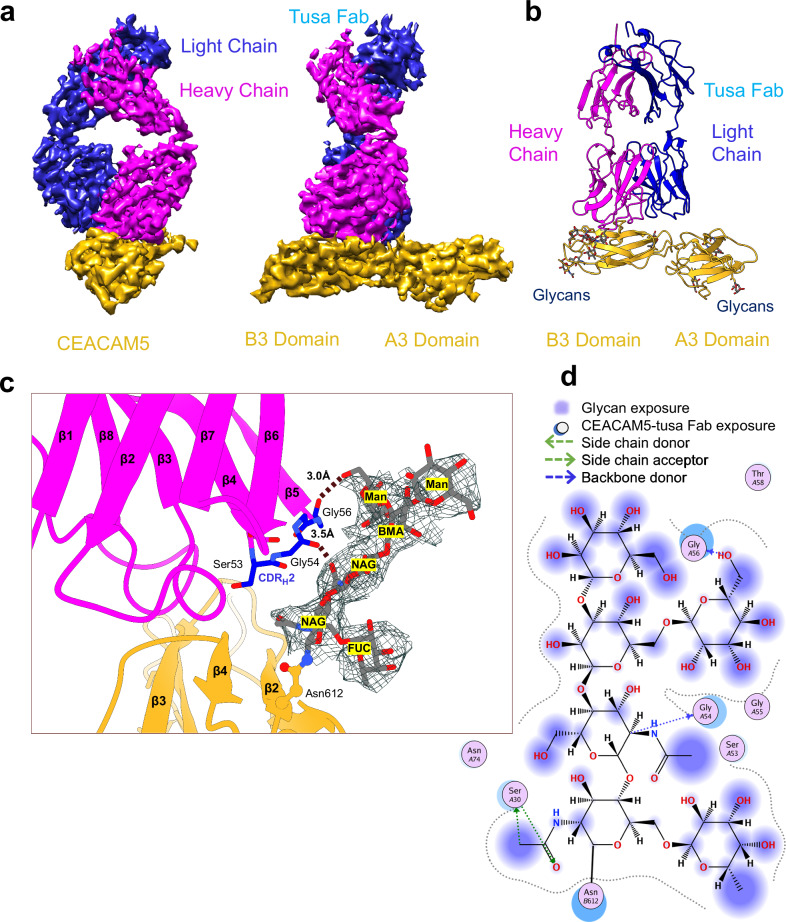
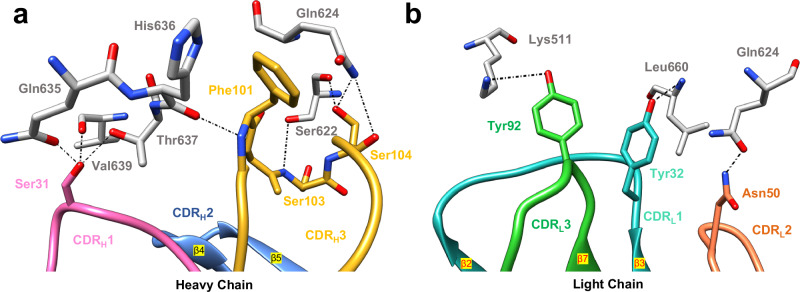
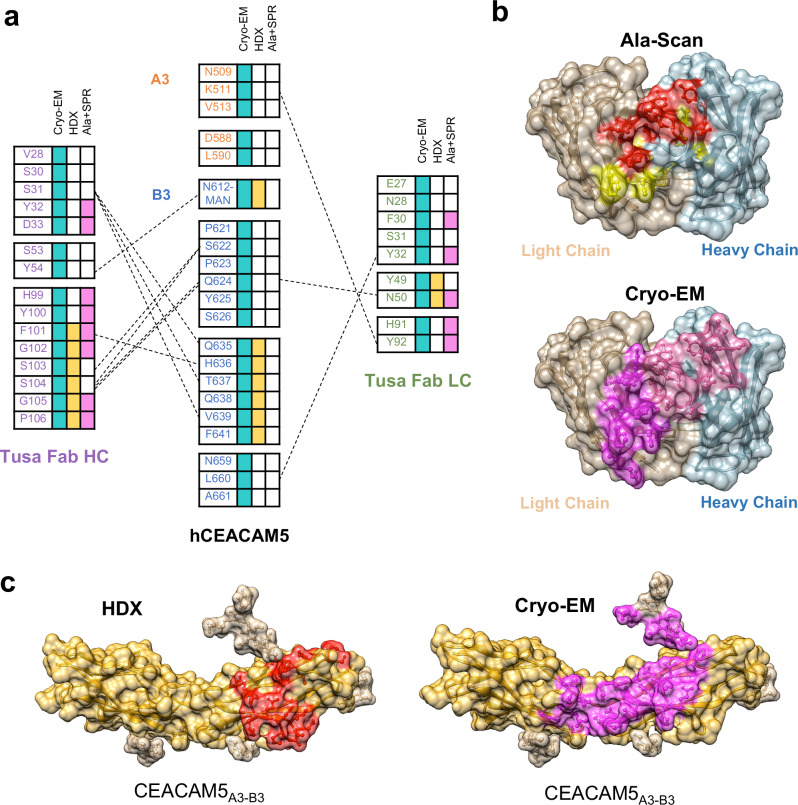
Abstract Carcinoembryonic antigen-related cell adhesion molecules (CEACAMs) are overexpressed in some tumor types. The antibody-drug conjugate, tusamitamab ravtansine, specifically recognizes the A3-B3 domains of human CEACAM5 (hCEACAM5). To understand this specificity, we mapped the epitope-paratope interface between the A3-B3 domains of hCEACAM5 (hCEACAM5A3 − B3) and the antigen-binding fragment of tusamitamab (tusa Fab). Hydrogen/deuterium exchange mass spectrometry identified the tusa Fab paratope, which involves heavy chain (HC) residues 101–109 and light chain residues 48–54 and 88–104. Surface plasmon resonance demonstrated that alanine variants of HC residues 96–108 abolish binding to hCEACAM5, suggesting that these residues are critical for the Fab-antigen complex formation. Cryogenic electron microscopy structure of the tusa Fab-hCEACAM5A3 − B3 complex (3.11 Å overall resolution) revealed a discontinuous epitope involving residues in the A3-B3 domains and an N-linked mannose at residue 612. Conformational constraints on the epitope-paratope interface enable tusamitamab to target hCEACAM5A3 − B3 and differentiate it from other CEACAMs.
Overview
The claims and statistics of this paper haven’t been checked yet.
Run the check — free, no account needed. It reads the open-access text and checks the sources it cites.
Integrity signals
Registry
Cites
Statistics
Figures
Verification
Claims the paper makes
The claims and statistics of this paper haven’t been checked yet.
Run the check — free, no account needed. It reads the open-access text and checks the sources it cites.
Self-check
Percentages, sums and reported differences re-computed from the paper’s own numbers.
The self-check needs the paper’s full text.
Citations
Cites
UCSF Chimera—A visualization system for exploratory research and analysis
Pettersen, E. F., Goddard, T. D., Huang, C. C., Couch, G. S., Greenblatt, D. M., Meng, E. C., & Ferrin, T. E. (2004) · Journal of Computational Chemistry · doi:10.1002/jcc.20084 · Cited by 45,828
Highly accurate protein structure prediction with AlphaFold
Jumper, J., Evans, R., Pritzel, A., Green, T., Figurnov, M., Ronneberger, O., Tunyasuvunakool, K., Bates, R., Žídek, A., Potapenko, A., et al. (2021) · Nature · doi:10.1038/s41586-021-03819-2 · Cited by 43,764
Coot : model-building tools for molecular graphics
Emsley, P., & Cowtan, K. (2004) · Acta Crystallographica Section D Biological Crystallography · doi:10.1107/s0907444904019158 · Cited by 30,571
PHENIX : a comprehensive Python-based system for macromolecular structure solution
Adams, P. D., Afonine, P. V., Bunkóczi, G., Chen, V. B., Davis, I. W., Echols, N., Headd, J. J., Hung, L.-W., Kapral, G. J., Grosse-Kunstleve, R. W., et al. (2010) · Acta Crystallographica Section D Biological Crystallography · doi:10.1107/s0907444909052925 · Cited by 23,716
Fast, scalable generation of high‐quality protein multiple sequence alignments using Clustal Omega
Sievers, F., Wilm, A., Dineen, D., Gibson, T. J., Karplus, K., Li, W., Lopez, R., McWilliam, H., Remmert, M., Söding, J., et al. (2011) · Molecular Systems Biology · doi:10.1038/msb.2011.75 · Cited by 15,355
MolProbity : all-atom structure validation for macromolecular crystallography
Chen, V. B., Arendall, W. B., Headd, J. J., Keedy, D. A., Immormino, R. M., Kapral, G. J., Murray, L. W., Richardson, J. S., & Richardson, D. C. (2010) · Acta Crystallographica Section D Biological Crystallography · doi:10.1107/s0907444909042073 · Cited by 14,115
Inference of Macromolecular Assemblies from Crystalline State
Krissinel, E., & Henrick, K. (2007) · Journal of Molecular Biology · doi:10.1016/j.jmb.2007.05.022 · Cited by 9,984
UniProt: the universal protein knowledgebase in 2021
The UniProt Consortium, Bateman, A., Martin, M.-J., Orchard, S., Magrane, M., Agivetova, R., Ahmad, S., Alpi, E., Bowler-Barnett, E. H., Britto, R., et al. (2021) · Nucleic Acids Research · doi:10.1093/nar/gkaa1100 · Cited by 6,372
The InterPro protein families and domains database: 20 years on
Blum, M., Chang, H.-Y., Chuguransky, S., Grego, T., Kandasaamy, S., Mitchell, A., Nuka, G., Paysan-Lafosse, T., Qureshi, M., Raj, S., et al. (2021) · Nucleic Acids Research · doi:10.1093/nar/gkaa977 · Cited by 2,231
Surface Plasmon Resonance: A Versatile Technique for Biosensor Applications
Nguyen, H., Park, J., Kang, S., & Kim, M. (2015) · Sensors · doi:10.3390/s150510481 · Cited by 1,357
Metadata
- Authors
- Kumar, A., Duffieux, F., Gagnaire, M., Rapisarda, C., Bertrand, T., & Rak, A.
- Affiliations
- Sanofi (France) (FR)
- Corresponding author
- Rak, Alexey
- Venue
- Nature Communications
- Published
- 2024-10-30
- Volume
- 15
- Issue
- 1
- Pages
- 9377-9377
- ISSN
- 2041-1723 (ISSN-L)
- PMC
- PMC11525548
- OpenAlex
- W4403890164
- Cited by
- 11
- References
- 44
- Citations by year
- 2026: 7 · 2025: 4
- FWCI
- 2.80
- Type
- journal article
- Language
- en
- Open access
- gold
- doi.org
- Licence
- cc-by-nc-nd
- creativecommons.org/licenses/by-nc-nd/4.0 (tdm)
- creativecommons.org/licenses/by-nc-nd/4.0 (vor)
- Locations
- Nature Communications (publishedVersion, cc-by-nc-nd)
- Research Square (acceptedVersion, cc-by)
- PubMed Central (publishedVersion, cc-by-nc-nd)
- PubMed (publishedVersion)
- RePEc: Research Papers in Economics (submittedVersion)
- DOAJ (DOAJ: Directory of Open Access Journals) (submittedVersion, cc-by-sa)
- Funders
- Sanofi
- Topics
- Life Sciences › Immunology and Microbiology › Immunology › Monoclonal and Polyclonal Antibodies Research
- Life Sciences › Biochemistry, Genetics and Molecular Biology › Structural Biology › Enzyme Structure and Function
- Life Sciences › Biochemistry, Genetics and Molecular Biology › Molecular Biology › vaccines and immunoinformatics approaches
- Keywords
- CEACAM5, monoclonal antibodies, antibody-drug conjugates, antigen-binding fragments, hydrogen-deuterium exchange, alanine scanning, cryo-EM structure, tumor targeting
- MeSH terms
- Protein Domains, Antibodies, Monoclonal, Epitopes, Carcinoembryonic Antigen, Humans, Immunoglobulin Fab Fragments, Models, Molecular, Neoplasms, Protein Binding, Cell Adhesion Molecules, Immunoconjugates, Cryoelectron Microscopy, Surface Plasmon Resonance, GPI-Linked Proteins
About these checks
Registry, retraction, Cites and statistics results are computed, not judged, with one exception: a printed reference that no index lists is read once by a model before it counts as a citation error. Claims are extracted by a model and kept only when their quote appears verbatim in the text; each cited source is then checked, with a model’s help, for whether it says what the claim relies on. Those verdicts can be wrong — read the claim’s quote and the cited source before relying on one.
Statistics and arithmetic are recomputed, not judged.
Confidence bands are shown only for fields calibrated on our annotated test set. None is calibrated yet, so no band is shown.
What counts as a claim ›How we measure confidence ›How we check this ›
Are you an author, or do you see a problem with this page? Request a review
How to cite
Cite CoChat for the checks on this page, and the paper for its own findings.
- This page
- CoChat. (2026). Citation check: Structural insights into epitope-paratope interactions of a monoclonal antibody targeting CEACAM5-expressing tumors. https://app.cochat.ai/papers/10.1038/s41467-024-53746-9
- The paper
- Kumar, A., Duffieux, F., Gagnaire, M., Rapisarda, C., Bertrand, T., & Rak, A. (2024). Structural insights into epitope-paratope interactions of a monoclonal antibody targeting CEACAM5-expressing tumors. Nature Communications. https://doi.org/10.1038/s41467-024-53746-9
Data sources
Bibliographic data: Semantic Scholar, OpenAlex, Crossref.
Contains information from the Semantic Scholar Academic Graph Datasets, made available under the ODC Attribution License (ODC-BY 1.0).
Semantic Scholar’s data is described in: Kinney, R., et al. (2023). The Semantic Scholar Open Data Platform. arXiv:2301.10140.
