

Label-free single-cell RNA multiplexing leveraging genetic variability
Open accessThe DOI matches its Crossref record; 10 of the 10 references it cites were found in a registry or an index.
Abstract
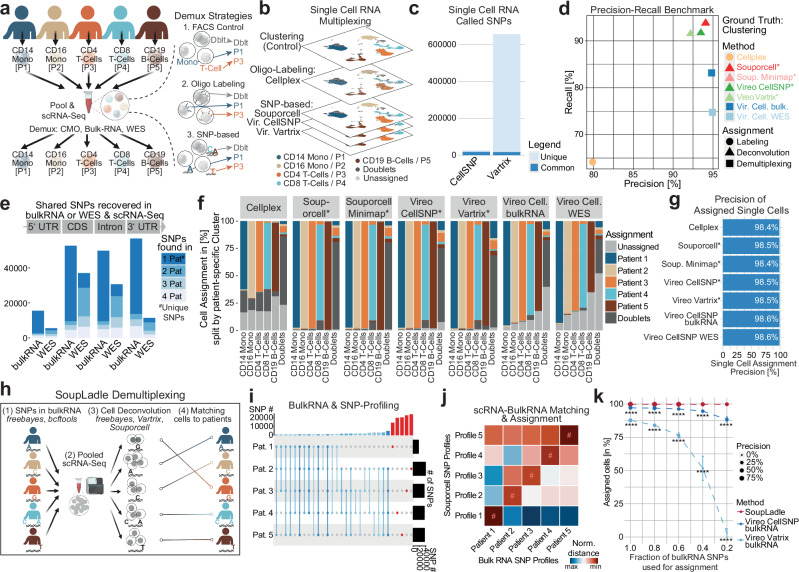
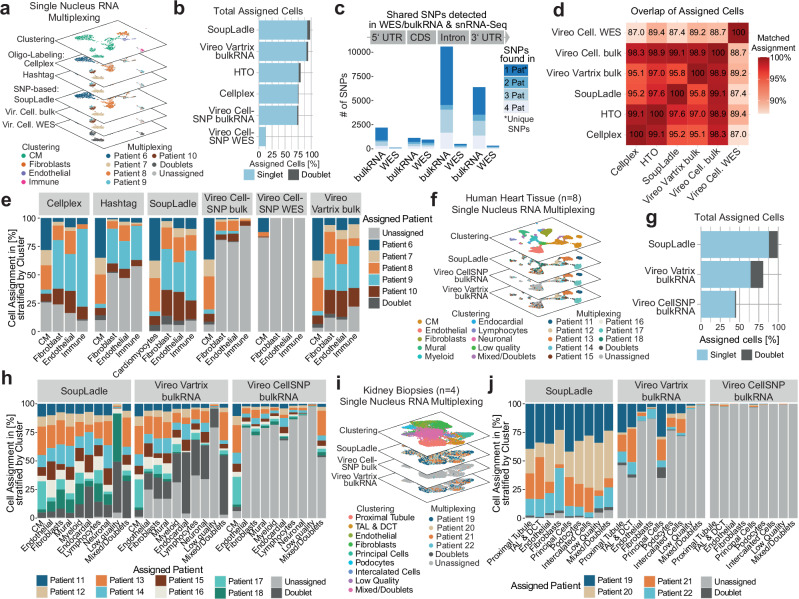
Single cell RNA sequencing has provided unprecedented insights into the molecular cues and cellular heterogeneity underlying human disease. However, the high costs and complexity of single cell methods remain a major obstacle for generating large-scale human cohorts. Here, we compare current state-of-the-art single cell multiplexing technologies, and provide a widely applicable demultiplexing method, SoupLadle, that enables simple, yet robust high-throughput multiplexing leveraging genetic variability of patients.
Overview
The claims and statistics of this paper haven’t been checked yet.
Free: it reads the open-access text and checks the first 5 claims that cite a source we can check. Create a free account to check every claim.
Integrity signals
Registry
Cites
Statistics
Figures
Verification
Claims the paper makes
The claims and statistics of this paper haven’t been checked yet.
Free: it reads the open-access text and checks the first 5 claims that cite a source we can check. Create a free account to check every claim.
Claims other papers make about this one
Each is checked against this paper’s own text: does it say what the citing paper says it does?
The source backs part of the claim, not all of it — or backs it for a different population, condition or comparison.
In the citing paper
“although when applied to live cells these methods can achieve >90% demultiplexing accuracy (defined as the number of all matching singlets plus the number of matching non-singlets divided by the total number of cells), accuracy is lower on nuclei isolated from archived/frozen samples (snRNA-Seq) [15, 19, 20].”
From Benchmarking of computational demultiplexing methods for single-nucleus RNA sequencing data (2025) · cites this paper as [20]
Experimental — accuracy not yet measuredThe source backs part of the claim, not all of it — or backs it for a different population, condition or comparison.
In the citing paper
“accuracy is lower on nuclei isolated from archived/frozen samples (snRNA-Seq) [15, 19, 20].”
From Benchmarking of computational demultiplexing methods for single-nucleus RNA sequencing data (2025) · cites this paper as [20]
Experimental — accuracy not yet measured
Self-check
Percentages, sums and reported differences re-computed from the paper’s own numbers.
The self-check needs the paper’s full text.
Citations
Cites
Multiplexed droplet single-cell RNA-sequencing using natural genetic variation
Kang, H. M., Subramaniam, M., Targ, S., Nguyen, M., Maliskova, L., McCarthy, E., Wan, E., Wong, S., Byrnes, L., Lanata, C. M., et al. (2018) · Nature Biotechnology · doi:10.1038/nbt.4042 · Cited by 1,101
Stoeckius, M., Zheng, S., Houck-Loomis, B., Hao, S., Yeung, B. Z., Mauck, W. M., Smibert, P., & Satija, R. (2018) · Genome Biology · doi:10.1186/s13059-018-1603-1 · Cited by 1,046 · cited 1×
“Among the most common multiplexing-methods used are cell-labeling approaches ( CellPlex or Hashtagging ), where cells are tag-ged with a sample-speci fi c oligonucleotide prior to pooling 3 .”
Genetic Heterogeneity in Human Disease
McClellan, J., & King, M.-C. (2010) · Cell · doi:10.1016/j.cell.2010.03.032 · Cited by 981
Doublet identification in single-cell sequencing data using scDblFinder
Germain, P.-L., Lun, A., Garcia Meixide, C., Macnair, W., & Robinson, M. D. (2022) · F1000Research · doi:10.12688/f1000research.73600.2 · Cited by 684 · cited 1×
“…assess doublet identi fi cation of multiplexing methods in more detail we next assessed the shared doublet assignment for each method including manually and computationally assigned doublets (scDblFinder 9 ) using computationally identi fi ed doublets by scDblFinder as a reference (Supplementary Fig.”
Souporcell: robust clustering of single-cell RNA-seq data by genotype without reference genotypes
Heaton, H., Talman, A. M., Knights, A., Imaz, M., Gaffney, D. J., Durbin, R., Hemberg, M., & Lawniczak, M. K. N. (2020) · Nature Methods · doi:10.1038/s41592-020-0820-1 · Cited by 533
Single-cell transcriptomics reveals cell-type-specific diversification in human heart failure
Koenig, A. L., Shchukina, I., Amrute, J., Andhey, P. S., Zaitsev, K., Lai, L., Bajpai, G., Bredemeyer, A., Smith, G., Jones, C., et al. (2022) · Nature Cardiovascular Research · doi:10.1038/s44161-022-00028-6 · Cited by 482
Vireo: Bayesian demultiplexing of pooled single-cell RNA-seq data without genotype reference
Huang, Y., McCarthy, D. J., & Stegle, O. (2019) · Genome Biology · doi:10.1186/s13059-019-1865-2 · Cited by 348 · cited 1×
“Alter-natively, cells can be multiplexed by calling patient-speci fi c SNPs from scRNA-seq data ( Vireo , Souporcell or Demuxlet ) 4 – 8 .”
Impact of the Human Cell Atlas on medicine
Rood, J. E., Maartens, A., Hupalowska, A., Teichmann, S. A., & Regev, A. (2022) · Nature Medicine · doi:10.1038/s41591-022-02104-7 · Cited by 222
Cellsnp-lite: an efficient tool for genotyping single cells
Huang, X., & Huang, Y. (2021) · Bioinformatics · doi:10.1093/bioinformatics/btab358 · Cited by 214
Ernst, K., Okonechnikov, K., Bageritz, J., Mallm, J., Wittmann, A., Maaß, K. K., Leible, S., Boutros, M., Pfister, S. M., Zuckermann, M., et al. (2020) · bioRxiv (Cold Spring Harbor Laboratory) · doi:10.1101/2020.10.23.351809 · Cited by 11
Research works printed but not linked: 1
- Garrison, E. & Marth, G. Haplotype-based variant detection from short-read sequencing. arXiv [q-bio.GN] (2012).
Cited by
Methodologies for Sample Multiplexing and Computational Deconvolution in Single‐Cell Sequencing
Gao, Y., Yin, W., Hu, W., & Chen, W. (2025) · Advanced Science · doi:10.1002/advs.202513396 · Cited by 6
Benchmarking of computational demultiplexing methods for single-nucleus RNA sequencing data
Fu, Y., Youness, M., Virzì, A., Song, X., Tubeeckx, M. R. L., De Keulenaer, G. W., Heidbuchel, H., Segers, V. F. M., Sipido, K. R., Thienpont, B., et al. (2025) · Briefings in Bioinformatics · doi:10.1093/bib/bbaf371 · Cited by 5
“…applied to live cells these methods can achieve > 90% demultiplexing accuracy (defined as the number of all matching singlets plus the number of matching non-singlets divided by the total number of cells), accuracy is lower on nuclei isolated from archived/frozen samples (snRNA-Seq) [15, 19, 20].”
Single-cell transcriptomics of human brain disorders
Arbabi, K., Carito, G., Luquez, T., & Wainberg, M. (2026) · Molecular Psychiatry · doi:10.1038/s41380-026-03573-9 · Cited by 2
“Suspensions from multiple donors can be pooled for higher throughput and reduced batch effects; donor identity is assigned computationally after sequencing by leveraging natural genetic variation or pre-labeling cells with antibody-based tags [89, 90].”
Metadata
- Authors
- Hoeft, K., Bleckwehl, T., Schumacher, D., Kim, H., Meyer, R., Long, Q., Zhang, L., Möller, C., Clahsen-van Groningen, M. C., Babler, A., Saritas, T., Kurth, I., Milting, H., Hayat, S., & Kramann, R.
- Affiliations
- Erasmus MC (NL)
- RWTH Aachen University (DE)
- Heart and Diabetes Center North Rhine-Westphalia (DE)
- Corresponding author
- Hayat, Sikander
- Kramann, Rafael
- ORCID
- Venue
- Nature Communications
- Published
- 2024-12-05
- Volume
- 15
- Issue
- 1
- Pages
- 10612-10612
- ISSN
- 2041-1723 (ISSN-L)
- PMC
- PMC11621319
- OpenAlex
- W4405078072
- Semantic Scholar
- 4762be08500b9733f0b355b64d7035f1d28314a1
- Cited by
- 3
- References
- 10
- Citations by year
- 2026: 1 · 2025: 2
- FWCI
- 0.41
- Type
- journal article
- Language
- en
- Open access
- gold
- doi.org
- Licence
- cc-by
- creativecommons.org/licenses/by/4.0 (tdm)
- creativecommons.org/licenses/by/4.0 (vor)
- Locations
- Nature Communications (publishedVersion, cc-by)
- PubMed Central (publishedVersion, cc-by)
- PubMed (publishedVersion)
- EUR Research Repository (Erasmus University Rotterdam) (publishedVersion, cc-by)
- RePEc: Research Papers in Economics (submittedVersion)
- DOAJ (DOAJ: Directory of Open Access Journals) (submittedVersion)
- RWTH Publications (RWTH Aachen) (submittedVersion, other-oa)
- RWTH Publications (RWTH Aachen)
- Funders
- Deutsche Forschungsgemeinschaft (SFBTRR219, CRU344-428857885785, 445703531, CRU344, CRU5011, 322900939)
- Bundesministerium für Bildung und Forschung (322900939, 01KL1907)
- Nierstichting (TASKFORCE EP1805)
- Else Kröner-Fresenius-Stiftung (01KL1907)
- Nederlandse Organisatie voor Wetenschappelijk Onderzoek (VIDI 09150172010072)
- RWTH Aachen University (139/21, 445703531, SFBTRR219)
- European Research Area Network on Cardiovascular Diseases
- HORIZON EUROPE European Research Council (101043403)
- Topics
- Life Sciences › Biochemistry, Genetics and Molecular Biology › Molecular Biology › Single-cell and spatial transcriptomics
- Life Sciences › Biochemistry, Genetics and Molecular Biology › Molecular Biology › Genomics and Phylogenetic Studies
- Life Sciences › Biochemistry, Genetics and Molecular Biology › Molecular Biology › Molecular Biology Techniques and Applications
- Keywords
- single-cell RNA sequencing, demultiplexing, genetic variation, patient cohort, cellular heterogeneity
- MeSH terms
- Humans, RNA, Genetic Variation, Sequence Analysis, RNA, Single-Cell Analysis, High-Throughput Nucleotide Sequencing
About these checks
Registry, retraction, Cites and statistics results are computed, not judged, with one exception: a printed reference that no index lists is read once by a model before it counts as a citation error. Claims are extracted by a model and kept only when their quote appears verbatim in the text; each cited source is then checked, with a model’s help, for whether it says what the claim relies on. Those verdicts can be wrong — read the claim’s quote and the cited source before relying on one.
Statistics and arithmetic are recomputed, not judged.
Confidence bands are shown only for fields calibrated on our annotated test set. None is calibrated yet, so no band is shown.
What counts as a claim ›How we measure confidence ›How we check this ›
Are you an author, or do you see a problem with this page? Request a review
Data sources
Bibliographic data: Semantic Scholar, OpenAlex, Crossref.
Contains information from the Semantic Scholar Academic Graph Datasets, made available under the ODC Attribution License (ODC-BY 1.0).
Semantic Scholar’s data is described in: Kinney, R., et al. (2023). The Semantic Scholar Open Data Platform. arXiv:2301.10140.
