

Sensing flow gradients is necessary for learning autonomous underwater navigation
Open accessThe DOI matches its Crossref record; 119 of the 119 references it cites were found in a registry or an index; 24 of the 51 sources its claims cite were checked for support.
Abstract
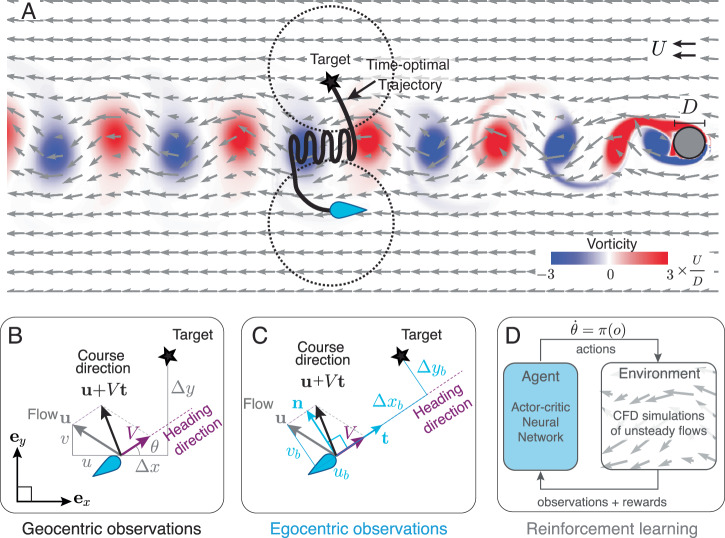
Aquatic animals are much better at underwater navigation than robotic vehicles. Robots face major challenges in deep water because of their limited access to global positioning signals and flow maps. These limitations, and the changing nature of water currents, support the use of reinforcement learning approaches, where the navigator learns through trial-and-error interactions with the flow environment. But is it feasible to learn underwater navigation in the agent's Umwelt, without any land references? Here, we tasked an artificial swimmer with learning to reach a specific destination in unsteady flows by relying solely on egocentric observations, collected through on-board flow sensors in the agent's body frame, with no reference to a geocentric inertial frame. We found that while sensing local flow velocities is sufficient for geocentric navigation, successful egocentric navigation requires additional information of local flow gradients. Importantly, egocentric navigation strategies obey rotational symmetry and are more robust in unfamiliar conditions and flows not experienced during training. Our work expands underwater robot-centric learning, helps explain why aquatic organisms have arrays of flow sensors that detect gradients, and provides physics-based guidelines for transfer learning of learned policies to unfamiliar and diverse flow environments.
Overview
CoChat Summary
TL;DR
Egocentric reinforcement learning can navigate an artificial swimmer across an unsteady wake without any inertial or geocentric reference, but only if the agent senses local flow gradients in addition to local flow velocity. These egocentric policies are rotationally invariant and transfer more robustly than geocentric policies to unfamiliar flow conditions, though both degrade when flow physics changes substantially.
Key findings
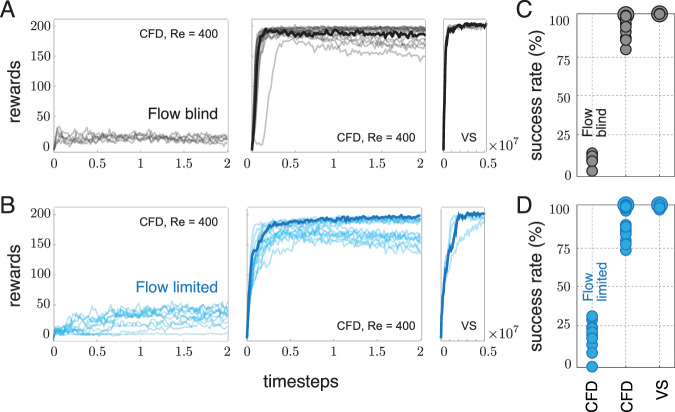
- Egocentric RL using only body-frame flow velocity and target position `(Δx_b, Δy_b, u_b, v_b)` failed in all 10 CFD training instances; adding transverse flow gradients `(n·∇u_b, n·∇v_b)` succeeded in all 16 CFD and 4 vortex-street training instances, reaching equally high reward as geocentric policies. Longitudinal gradients `(t·∇u_b, t·∇v_b)` also enabled success.
- Geocentric RL required explicit heading orientation: with `(Δx, Δy, θ, u, v)` it converged in all 17 CFD sessions and 4 vortex-street sessions, while a flow-blind agent failed.
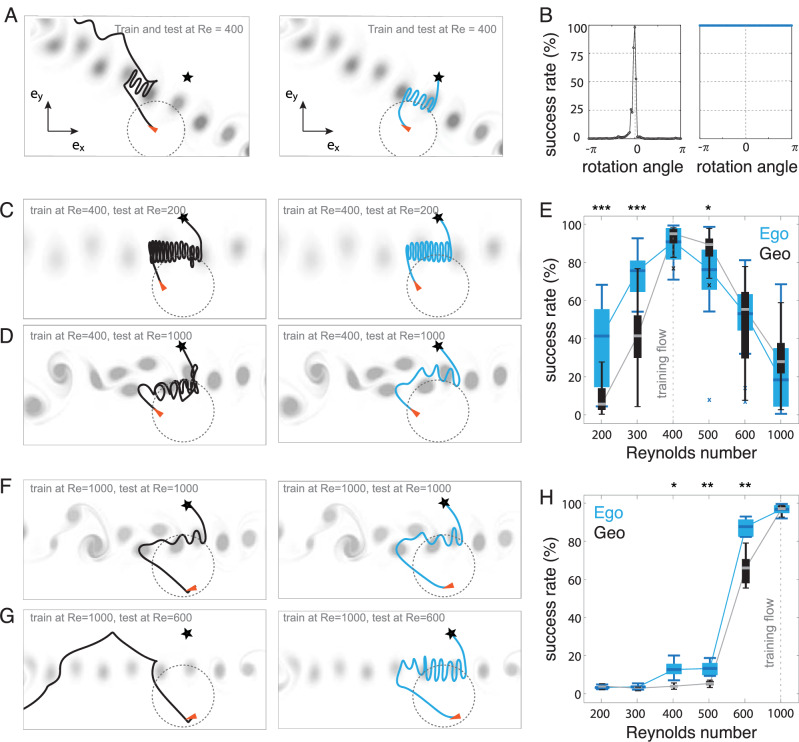
- Egocentric policies were rotationally invariant: as the CFD wake was rotated relative to the inertial frame, geocentric success dropped to nearly zero, whereas egocentric performance remained high.
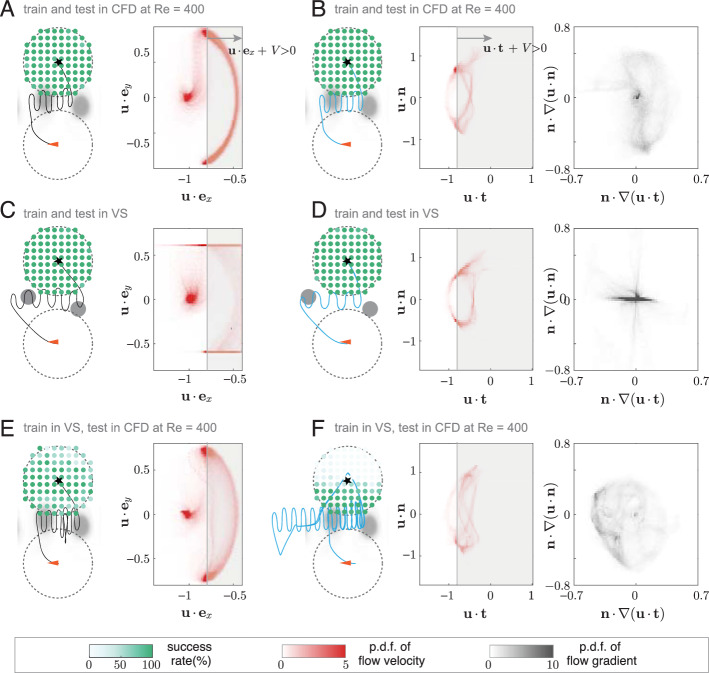
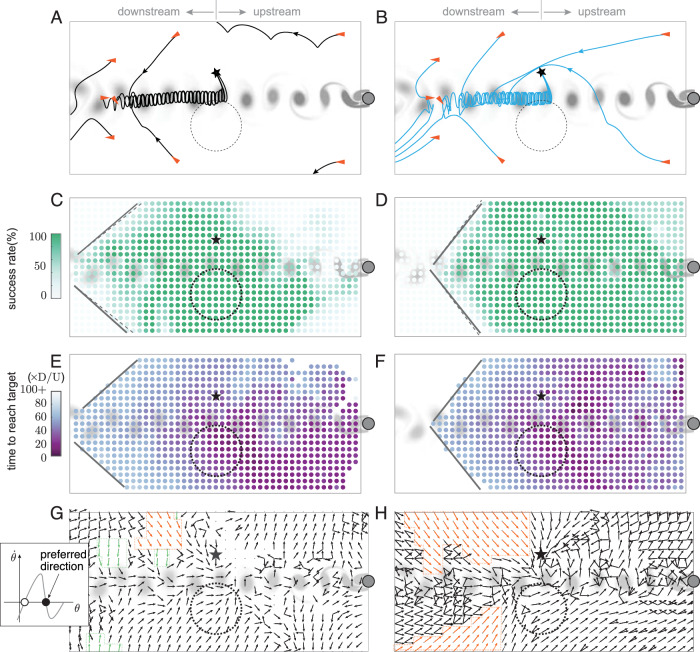
- Transfer tests showed egocentric policies generalized better at lower Reynolds numbers and at Re = 600 when trained at Re = 1000; both policies declined at higher Re or when Re changes altered wake stability. In grid tests, egocentric success was 90% vs 55% geocentric upstream of the training domain, while geocentric was 63% vs 47% downstream.
Methods
- The swimmer moved at constant speed `V = 0.8U` through a cylinder wake simulated with CFD at Re = 400 and Re = 200–1000, or through a reduced-order inviscid von Kármán vortex-street model with `λ = 4D`, `A = 0.2D`, `Γ = 3UD`. The action controlled heading rate, not heading directly.
- Deep RL used V-RACER with a 128 × 128 feedforward network; reward combined a sparse 200D bonus for reaching within 0.15D of the target and a dense per-timestep distance-change reward. Training episodes randomized target and agent positions in circular regions of radius 2D on opposite sides of the wake, plus random orientation and flow phase.
- Evaluation used 1000 random test cases per policy; 105 policies were tested for 105,000 total tests. Additional sweeps included 198,000 tests for Re = 400-trained policies, 60,000 for Re = 1000-trained policies, and 34,020 tests per policy over a grid of initial positions and 36 orientations. Two-sample t-tests compared egocentric and geocentric success rates.
Limitations
- Stated: both policies struggle when changes in Re substantially alter the nature of the wake; transfer is asymmetric and depends on the training flow. At higher Re, wake instability introduces novel physical challenges, and at lower Re both policies eventually fail. Egocentric policies fail downstream because flow gradients weaken and preferred directions become ambiguous; geocentric policies fail upstream because they confidently choose a single wrong preferred direction. Training over the entire flow domain performed worse than training over the limited domain, apparently due to a local optimum.
- Stated: egocentric policy with only angular target information performed worse inside the training domain but generalized better outside it, with 56.54% success for full target position versus 79.30% for angular-only outside the training domain.
- Evident from the text: results are simulation-only, with no physical robot or animal validation; the swimmer has constant speed, no memory or prediction, and senses flow gradients only locally rather than through distributed arrays.
Model-written summary. Check it against the paper before relying on it.
Integrity signals
Registry
Cites
Statistics
Figures
Verification
Claims the paper makes
14 Valid · 3 Not valid · 9 Not checked · 96 Own results and interpretations
The cited sources support only part of this claim — read each source’s verdict below.
In the paper
“The problem of navigating across unsteady wakes in strong currents is thus controllable and solvable with either full or partial observations of the flow field, as long as observations are provided in an inertial frame of reference.”
§ Sensing flow gradients is necessary for learning autonomous underwater navigation > Results
What the sources say
- Partly supportedcites [38] Gunnarson, P., Mandralis, I., Novati, G., Koumoutsakos, P. & Dabiri, J. O. Learning efficient navigation in vortical flow fields. Nat. Commun. 12, 7143 (2021). 34880221 PMC8654940 sourceExperimental — accuracy not yet measured
The Abstract (page not given) reports near-100% target-reaching success for a swimmer sensing local flow velocity, while the Simulated navigation problem section describes optimal path planning when the entire flow field is known. But that section also reports failures with some partial flow observations. Our copy does not establish that an inertial frame of reference is a condition for success, or that navigation is solvable with any partial observation. (LLM, conf=0.86)
plainstates a cause- Asserted: passes — The authors put it forward as true.
- Checkable: passes — It can be checked against evidence.
- Load-bearing: passes — The paper’s conclusions depend on it.
- Based: passes — The paper gives a reason why it holds.
- Partly supported
The cited sources support only part of this claim — read each source’s verdict below.
In the paper
“At this scale, the flow environment is characterized by long-lived coherent vortex structures56–58, distinct from the uniform turbulence experienced at smaller scales59,60.”
§ Sensing flow gradients is necessary for learning autonomous underwater navigation > Introduction
What the sources say
- Partly supportedcites [56] Spedding, G. R. Wake signature detection. Annu. Rev. Fluid Mech. 46, 273–302 (2014). sourceExperimental — accuracy not yet measured
Section 2.2, Basic Phenomenology (page unavailable), describes larger vortices persisting as small-scale fluctuations dissipate, and Section 2.4, Practical Consequences (page unavailable), discusses the persistence of coherent wake patterns. These passages support the long-lived vortex structures attributed to this source, but concern particular wakes rather than establishing that the flow environment generally has this character at the meter scale. The separate comparison with uniform turbulence carries different citations in the citing sentence. (LLM, conf=0.82)
- Partly supportedcites [57] Colvert, B., Alsalman, M. & Kanso, E. Classifying vortex wakes using neural networks. Bioinspir. Biomim. 13, 025003 (2018). 29334075 sourceExperimental — accuracy not yet measured
The Introduction (page unavailable) describes long-lived vortical flows left by moving objects and organized vortex wakes, supporting the coherent-vortex portion of the claim. It does not establish that this characterizes the environment specifically at the meter scale. The smaller-scale turbulence comparison is attached to different citations in the citing sentence. (LLM, conf=0.84)
- Not checked — no full text of the sourcecites [58] Colvert, B., Liu, G., Dong, H. & Kanso, E. Flowtaxis in the wakes of oscillating airfoils. Theor. Comput. Fluid Dyn. 34, 545–556 (2020). source
- Partly supportedcites [59] Alageshan, J. K., Verma, A. K., Bec, J. & Pandit, R. Machine learning strategies for path-planning microswimmers in turbulent flows. Phys. Rev. E 101, 043110 (2020). 32422741 sourceExperimental — accuracy not yet measured
Section II (p. 1) describes the simulated flow as statistically steady, homogeneous, and isotropic turbulence, which supports the cited description of turbulence. It does not place that flow at a smaller physical scale or contrast it with meter-scale, long-lived coherent vortices; Appendix B (p. 8) likewise describes a simulated turbulent flow without that scale comparison. (LLM, conf=0.82)
- Partly supportedcites [60] Monthiller, R., Loisy, A., Koehl, M. A., Favier, B. & Eloy, C. Surfing on turbulence: a strategy for planktonic navigation. Phys. Rev. Lett. 129, 064502 (2022). 36018657 sourceExperimental — accuracy not yet measured
The main text (pp. 1–2) models a small plankter in homogeneous, isotropic turbulence and describes the smallest turbulent flow features. That supports the smaller-scale turbulence portion associated with this citation, but the paper does not establish that real flow at smaller scales is uniformly turbulent or contrast it with meter-scale coherent vortices. The meter-scale vortex clause has a separate citation group. (LLM, conf=0.82)
plain- Asserted: passes — The authors put it forward as true.
- Checkable: passes — It can be checked against evidence.
- Load-bearing: passes — The paper’s conclusions depend on it.
- Based: passes — The paper gives a reason why it holds.
- Partly supported
The sources with a verdict support this claim; the rest weren’t checked yet, have no full text we could read, or their verdicts aren’t rated yet.
In the paper
“Fish also possess an elaborate lateral line system that allows them to determine the direction and rate of water movement48,49.”
§ Sensing flow gradients is necessary for learning autonomous underwater navigation > Introduction
What the sources say
- Not checked — no full text of the sourcecites [48] Engelmann, J., Hanke, W., Mogdans, J. & Bleckmann, H. Hydrodynamic stimuli and the fish lateral line. Nature 408, 51–52 (2000). 11081502 source
- Supportedcites [49] Ristroph, L., Liao, J. C. & Zhang, J. Lateral line layout correlates with the differential hydrodynamic pressure on swimming fish. Phys. Rev. Lett. 114, 018102 (2015). 25615505 PMC6324575 source
The paper describes the lateral line as a flow-responsive sensory system. It says superficial neuromasts respond to local flow velocity, while its discussion of rheotaxis and pressure differences explains how fish can sense their orientation relative to a current (Abstract and discussion of Fig. 3; page not provided). (LLM, conf=0.88)
plainstates a cause- Asserted: passes — The authors put it forward as true.
- Checkable: passes — It can be checked against evidence.
- Load-bearing: passes — The paper’s conclusions depend on it.
- Based: passes — The paper gives a reason why it holds.
Every source the paper cites for this claim was checked and supports it.
In the paper
“Starting from the same set of geocentric observations o = (Δx, Δy, u, v) employed in ref. 38, the swimmer failed to learn the navigation task.”
§ Sensing flow gradients is necessary for learning autonomous underwater navigation > Results > Egocentric learning requires sensing flow gradients
What the sources say
- Supportedcites [38] Gunnarson, P., Mandralis, I., Novati, G., Koumoutsakos, P. & Dabiri, J. O. Learning efficient navigation in vortical flow fields. Nat. Commun. 12, 7143 (2021). 34880221 PMC8654940 source
The Simulated navigation problem section identifies a velocity swimmer whose observations are its position relative to the target and both components of local flow velocity: {Δx, Δy, u, v}. The citation supports the identification of that observation set; the failure to learn is a result reported by the citing authors, not a result attributed to this source. (LLM, conf=0.93)
plainSingle case- Asserted: passes — The authors put it forward as true.
- Checkable: passes — It can be checked against evidence.
- Load-bearing: passes — The paper’s conclusions depend on it.
- Based: passes — The paper gives a reason why it holds.
- Supported
Every source the paper cites for this claim was checked and supports it.
In the paper
“In ref. 38, the swimmer learned successfully because it had direct control over its heading angle θ.”
§ Sensing flow gradients is necessary for learning autonomous underwater navigation > Results > Egocentric learning requires sensing flow gradients
What the sources say
- Supportedcites [38] Gunnarson, P., Mandralis, I., Novati, G., Koumoutsakos, P. & Dabiri, J. O. Learning efficient navigation in vortical flow fields. Nat. Commun. 12, 7143 (2021). 34880221 PMC8654940 source
The Simulated navigation problem section states that the swimmer could directly control its swimming direction θ. The Discussion’s Fig. 3 description says that adjusting this direction in response to the flow enabled time-efficient navigation, supporting the attributed explanation without implying it was the only factor. (LLM, conf=0.88)
plainstates a causeSingle case- Asserted: passes — The authors put it forward as true.
- Checkable: passes — It can be checked against evidence.
- Load-bearing: passes — The paper’s conclusions depend on it.
- Based: passes — The paper gives a reason why it holds.
- Supported
45 more claims · 1 with their cited sources checked
Create a free account to see all 122 claims and to verify the 3 references still open.
- It may state two separate claims as one. 58
- Probably not a substantial claim. 19
- The quote only partly states this claim. 2
Self-check
Percentages, sums and reported differences re-computed from the paper’s own numbers.
Each contradiction between two passages listed here was confirmed by an independent check.
Rated minor: it would not touch a result — a value no result rests on, a p-value that stays on the same side of the significance level, or a conflict that is clerical, resolved elsewhere in the paper, or outside its own findings.
In the paper
§ Sensing flow gradients is necessary for learning autonomous underwater navigation > Results > Transfer of RL policies to unfamiliar flow environments
“H Success rates of geocentric and egocentric agents trained in CFD wake at Re = 1000 and tested across a range of Reynolds numbers are summarized using the same box plot convention as in (C).”
§ Sensing flow gradients is necessary for learning autonomous underwater navigation > Results > Transfer of RL policies to unfamiliar flow environments
“E Success rates of geocentric and egocentric agents trained in CFD wake at Re = 400 and tested across a range of Reynolds numbers are summarized using box plots, where the median, lower, and upper quartiles are indicated with horizontal bars, and outliers are marked by “×”.”
Rated minor: it would not touch a result — a value no result rests on, a p-value that stays on the same side of the significance level, or a conflict that is clerical, resolved elsewhere in the paper, or outside its own findings.
In the paper
§ Sensing flow gradients is necessary for learning autonomous underwater navigation > Results > Transfer of RL policies to unfamiliar flow environments
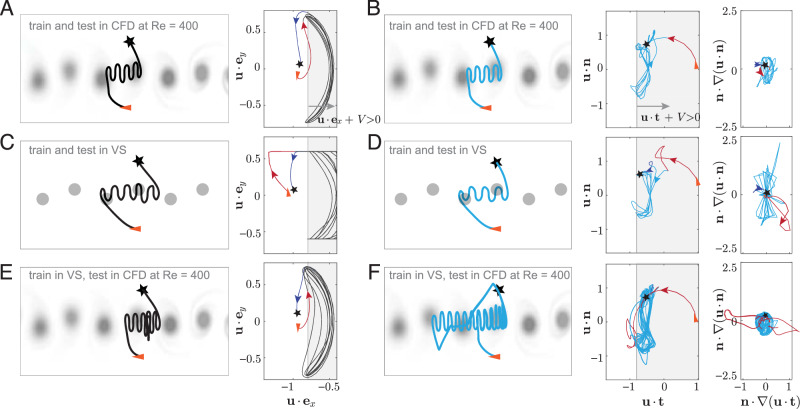
“In Fig. 3C, we tested the RL policies trained in VS wake when placed in the CFD wake.”
§ Sensing flow gradients is necessary for learning autonomous underwater navigation > Results > Egocentric learning requires sensing flow gradients
“Agents trained in the reduced VS flow representation succeed when tested in (C, D) VS wake and (E, F) CFD wake”
Rated minor: it would not touch a result — a value no result rests on, a p-value that stays on the same side of the significance level, or a conflict that is clerical, resolved elsewhere in the paper, or outside its own findings.
In the paper
§ Sensing flow gradients is necessary for learning autonomous underwater navigation > Results > Transfer of RL policies to unfamiliar flow environments
“we tested the VS-trained policy in the CFD wake using all 1000 test cases (Fig. 4C).”
§ Sensing flow gradients is necessary for learning autonomous underwater navigation > Results > Egocentric learning requires sensing flow gradients
“Geocentric and egocentric agents trained and tested in (A, B) CFD wake at Re = 400, (C, D) VS wake, and (E, F) trained in VS and tested in CFD wake.”
Citations
Cites
Human-level control through deep reinforcement learning
Mnih, V., Kavukcuoglu, K., Silver, D., Rusu, A. A., Veness, J., Bellemare, M. G., Graves, A., Riedmiller, M., Fidjeland, A. K., Ostrovski, G., et al. (2015) · Nature · doi:10.1038/nature14236 · Cited by 30,357
Pan, S. J., & Yang, Q. (2010) · IEEE Transactions on Knowledge and Data Engineering · doi:10.1109/tkde.2009.191 · Cited by 23,387
U1 snRNP regulates cancer cell migration and invasion in vitro
Oh, J.-M., Venters, C. C., Di, C., Pinto, A. M., Wan, L., Younis, I., Cai, Z., Arai, C., So, B. R., Duan, J., et al. (2020) · Nature Communications · doi:10.1038/s41467-019-13993-7 · Cited by 7,157
Bengio, Y., Louradour, J., Collobert, R., & Weston, J. (2009) · Proceedings of the 26th Annual International Conference on Machine Learning · doi:10.1145/1553374.1553380 · Cited by 5,366
Learning to predict by the methods of temporal differences
Sutton, R. S. (1988) · Machine Learning · doi:10.1007/bf00115009 · Cited by 5,148
Biodiversity and ecosystem functioning: Current knowledge and future challenges
Loreau, M., Naeem, S., Inchausti, P., Bengtsson, J., Grime, J. P., Hector, A., Hooper, D. U., Huston, M. A., Raffaelli, D., Schmid, B., et al. (2001) · Science · doi:10.1126/science.1064088 · Cited by 4,649
Simultaneous localization and mapping: part I
Durrant-Whyte, H., & Bailey, T. (2006) · IEEE Robotics & Automation Magazine · doi:10.1109/mra.2006.1638022 · Cited by 4,199
Mittal, R., & Iaccarino, G. (2005) · Annual Review of Fluid Mechanics · doi:10.1146/annurev.fluid.37.061903.175743 · Cited by 3,472
Reinforcement learning in robotics: A survey
Kober, J., Bagnell, J. A., & Peters, J. (2013) · The International Journal of Robotics Research · doi:10.1177/0278364913495721 · Cited by 3,160
Continual lifelong learning with neural networks: A review
Parisi, G. I., Kemker, R., Part, J. L., Kanan, C., & Wermter, S. (2019) · Neural Networks · doi:10.1016/j.neunet.2019.01.012 · Cited by 3,117
Numerical analysis of blood flow in the heart
Peskin, C. S. (1977) · Journal of Computational Physics · doi:10.1016/0021-9991(77)90100-0 · Cited by 3,084
Dubins, L. E. (1957) · American Journal of Mathematics · doi:10.2307/2372560 · Cited by 3,045
On the Interpretation of χ 2 from Contingency Tables, and the Calculation of P
Fisher, R. A. (1922) · Journal of the Royal Statistical Society · doi:10.2307/2340521 · Cited by 2,953
Simultaneous localization and mapping (SLAM): part II
Bailey, T., & Durrant-Whyte, H. (2006) · IEEE Robotics & Automation Magazine · doi:10.1109/mra.2006.1678144 · Cited by 2,554
Model predictive control: past, present and future
Morari, M., & H. Lee, J. (1999) · Computers & Chemical Engineering · doi:10.1016/s0098-1354(98)00301-9 · Cited by 2,335
Global patterns and predictors of marine biodiversity across taxa
Tittensor, D. P., Mora, C., Jetz, W., Lotze, H. K., Ricard, D., Berghe, E. V., & Worm, B. (2010) · Nature · doi:10.1038/nature09329 · Cited by 1,524
Student (1908) · Biometrika · doi:10.1093/biomet/6.1.1 · Cited by 1,363
Robots that can adapt like animals
Cully, A., Clune, J., Tarapore, D., & Mouret, J.-B. (2015) · Nature · doi:10.1038/nature14422 · Cited by 979
Collective Motion, Sensor Networks, and Ocean Sampling
Leonard, N. E., Paley, D. A., Lekien, F., Sepulchre, R., Fratantoni, D. M., & Davis, R. E. (2007) · Proceedings of the IEEE · doi:10.1109/jproc.2006.887295 · Cited by 946
Fish Exploiting Vortices Decrease Muscle Activity
Liao, J. C., Beal, D. N., Lauder, G. V., & Triantafyllou, M. S. (2003) · Science · doi:10.1126/science.1088295 · Cited by 921
‘Infotaxis’ as a strategy for searching without gradients
Vergassola, M., Villermaux, E., & Shraiman, B. I. (2007) · Nature · doi:10.1038/nature05464 · Cited by 890
Exploration of underwater life with an acoustically controlled soft robotic fish
Katzschmann, R. K., DelPreto, J., MacCurdy, R., & Rus, D. (2018) · Science Robotics · doi:10.1126/scirobotics.aar3449 · Cited by 865
Emergence of Locomotion Behaviours in Rich Environments
Heess, N., TB, D., Sriram, S., Lemmon, J., Merel, J., Wayne, G., Tassa, Y., Erez, T., Wang, Z., Eslami, S. M. A., et al. (2017) · arXiv · doi:10.48550/arxiv.1707.02286 · Cited by 657
Self-citationHoming in Pacific Salmon: Mechanisms and Ecological Basis
Dittman, A. H., & Quinn, T. P. (1996) · Journal of Experimental Biology · doi:10.1242/jeb.199.1.83 · Cited by 651
Spatial representation in the hippocampal formation: a history
Moser, E. I., Moser, M.-B., & McNaughton, B. L. (2017) · Nature Neuroscience · doi:10.1038/nn.4653 · Cited by 560
The lateral line can mediate rheotaxis in fish
Montgomery, J. C., Baker, C. F., & Carton, A. G. (1997) · Nature · doi:10.1038/40135 · Cited by 553
The Kármán gait: novel body kinematics of rainbow trout swimming in a vortex street
Liao, J. C., Beal, D. N., Lauder, G. V., & Triantafyllou, M. S. (2003) · Journal of Experimental Biology · doi:10.1242/jeb.00209 · Cited by 509
Path Planning for Autonomous Underwater Vehicles
Petres, C., Pailhas, Y., Patron, P., Petillot, Y., Evans, J., & Lane, D. (2007) · IEEE Transactions on Robotics · doi:10.1109/tro.2007.895057 · Cited by 433
Passive propulsion in vortex wakes
BEAL, D. N., HOVER, F. S., TRIANTAFYLLOU, M. S., LIAO, J. C., & LAUDER, G. V. (2006) · Journal of Fluid Mechanics · doi:10.1017/s0022112005007925 · Cited by 421
Hydrodynamic Trail-Following in Harbor Seals ( Phoca vitulina )
Dehnhardt, G., Mauck, B., Hanke, W., & Bleckmann, H. (2001) · Science · doi:10.1126/science.1060514 · Cited by 384
An adaptive, formally second order accurate version of the immersed boundary method
Griffith, B. E., Hornung, R. D., McQueen, D. M., & Peskin, C. S. (2007) · Journal of Computational Physics · doi:10.1016/j.jcp.2006.08.019 · Cited by 363
The mechanism of rapid starting of slender fish1
Weihs, D. (1973) · Biorheology · doi:10.3233/bir-1973-10308 · Cited by 349
A visual pathway for looming-evoked escape in larval zebrafish
Temizer, I., Donovan, J. C., Baier, H., & Semmelhack, J. L. (2015) · Current Biology · doi:10.1016/j.cub.2015.06.002 · Cited by 292
Autonomous navigation of stratospheric balloons using reinforcement learning
Bellemare, M. G., Candido, S., Castro, P. S., Gong, J., Machado, M. C., Moitra, S., Ponda, S. S., & Wang, Z. (2020) · Nature · doi:10.1038/s41586-020-2939-8 · Cited by 286
Hydrodynamic stimuli and the fish lateral line
Engelmann, J., Hanke, W., Mogdans, J., & Bleckmann, H. (2000) · Nature · doi:10.1038/35040706 · Cited by 271
Model-Based and Model-Free Mechanisms of Human Motor Learning
Haith, A. M., & Krakauer, J. W. (2013) · Advances in Experimental Medicine and Biology · doi:10.1007/978-1-4614-5465-6_1 · Cited by 263
Über das Navigationsproblem bei ruhender oder veränderlicher Windverteilung
Zermelo, E. (1931) · ZAMM - Journal of Applied Mathematics and Mechanics / Zeitschrift für Angewandte Mathematik und Mechanik · doi:10.1002/zamm.19310110205 · Cited by 258
Landau, I. D., Lozano, R., & M’Saad, M. (1998) · Communications and Control Engineering · doi:10.1007/978-0-85729-343-5 · Cited by 253
Model-Free reinforcement learning with continuous action in practice
Degris, T., Pilarski, P. M., & Sutton, R. S. (2012) · 2012 American Control Conference (ACC) · doi:10.1109/acc.2012.6315022 · Cited by 239
The sensory nature of mnemonic representation in the primate prefrontal cortex
Constantinidis, C., Franowicz, M. N., & Goldman-Rakic, P. S. (2001) · Nature Neuroscience · doi:10.1038/85179 · Cited by 233
Vortex phase matching as a strategy for schooling in robots and in fish
Li, L., Nagy, M., Graving, J. M., Bak-Coleman, J., Xie, G., & Couzin, I. D. (2020) · Nature Communications · doi:10.1038/s41467-020-19086-0 · Cited by 223
Bechlioulis, C. P., Karras, G. C., Heshmati-Alamdari, S., & Kyriakopoulos, K. J. (2017) · IEEE Transactions on Control Systems Technology · doi:10.1109/tcst.2016.2555247 · Cited by 217
Hydrodynamic signal perception in the copepod Acartia tonsa
Kiørboe, T., Saiz, E., & Visser, A. (1999) · Marine Ecology Progress Series · doi:10.3354/meps179097 · Cited by 210
Reinforcement Learning in Robotics: A Survey
Kober, J., & Peters, J. (2014) · Springer Tracts in Advanced Robotics · doi:10.1007/978-3-319-03194-1_2 · Cited by 202
Velocity- and acceleration-sensitive units in the trunk lateral line of the trout
Kroese, A. B., & Schellart, N. A. (1992) · Journal of Neurophysiology · doi:10.1152/jn.1992.68.6.2212 · Cited by 200
A novel mechanism for mechanosensory-based rheotaxis in larval zebrafish
Oteiza, P., Odstrcil, I., Lauder, G., Portugues, R., & Engert, F. (2017) · Nature · doi:10.1038/nature23014 · Cited by 199
Bhalla, A. P. S., Bale, R., Griffith, B. E., & Patankar, N. A. (2013) · Journal of Computational Physics · doi:10.1016/j.jcp.2013.04.033 · Cited by 194
Mechanoreception in marine copepods: electrophysiological studies on the first antennae
Yen, J., Lenz, P. H., Gassie, D. V., & Hartline, D. K. (1992) · Journal of Plankton Research · doi:10.1093/plankt/14.4.495 · Cited by 189
Zebrafish larvae evade predators by sensing water flow
Stewart, W. J., Cardenas, G. S., & McHenry, M. J. (2013) · Journal of Experimental Biology · doi:10.1242/jeb.072751 · Cited by 186
Glider soaring via reinforcement learning in the field
Reddy, G., Wong-Ng, J., Celani, A., Sejnowski, T. J., & Vergassola, M. (2018) · Nature · doi:10.1038/s41586-018-0533-0 · Cited by 177
Algorithms for Olfactory Search across Species
Baker, K. L., Dickinson, M., Findley, T. M., Gire, D. H., Louis, M., Suver, M. P., Verhagen, J. V., Nagel, K. I., & Smear, M. C. (2018) · The Journal of Neuroscience · doi:10.1523/jneurosci.1668-18.2018 · Cited by 177
Learning to soar in turbulent environments
Reddy, G., Celani, A., Sejnowski, T. J., & Vergassola, M. (2016) · Proceedings of the National Academy of Sciences · doi:10.1073/pnas.1606075113 · Cited by 170
Morphological Computation – Connecting Brain, Body, and Environment
Pfeifer, R., & Gómez, G. (2009) · Lecture Notes in Computer Science · doi:10.1007/978-3-642-00616-6_5 · Cited by 157
Synchronisation through learning for two self-propelled swimmers
Novati, G., Verma, S., Alexeev, D., Rossinelli, D., van Rees, W. M., & Koumoutsakos, P. (2017) · Bioinspiration & Biomimetics · doi:10.1088/1748-3190/aa6311 · Cited by 157
Marine biodiversity and climate change
Worm, B., & Lotze, H. K. (2021) · Elsevier eBooks · doi:10.1016/b978-0-12-821575-3.00021-9 · Cited by 154
Transferring policy of deep reinforcement learning from simulation to reality for robotics
Ju, H., Juan, R., Gomez, R., Nakamura, K., & Li, G. (2022) · Nature Machine Intelligence · doi:10.1038/s42256-022-00573-6 · Cited by 147
Contraction theory for nonlinear stability analysis and learning-based control: A tutorial overview
Tsukamoto, H., Chung, S.-J., & Slotine, J.-J. E. (2021) · Annual Reviews in Control · doi:10.1016/j.arcontrol.2021.10.001 · Cited by 145
Fang, Y., Huang, Z., Jin-yun, P., & Zhang, J. (2021) · Ocean Engineering · doi:10.1016/j.oceaneng.2021.110452 · Cited by 144
Not Just Going with the Flow: The Effects of Fluid Flow on Bacteria and Plankton
Wheeler, J. D., Secchi, E., Rusconi, R., & Stocker, R. (2019) · Annual Review of Cell and Developmental Biology · doi:10.1146/annurev-cellbio-100818-125119 · Cited by 139
Learning to school in the presence of hydrodynamic interactions
Gazzola, M., Tchieu, A. A., Alexeev, D., de Brauer, A., & Koumoutsakos, P. (2016) · Journal of Fluid Mechanics · doi:10.1017/jfm.2015.686 · Cited by 137
Smith, K. L., Ruhl, H. A., Huffard, C. L., Messié, M., & Kahru, M. (2018) · Proceedings of the National Academy of Sciences · doi:10.1073/pnas.1814559115 · Cited by 126
Biferale, L., Bonaccorso, F., Buzzicotti, M., Clark Di Leoni, P., & Gustavsson, K. (2019) · Chaos: An Interdisciplinary Journal of Nonlinear Science · doi:10.1063/1.5120370 · Cited by 121
Learning to school in the presence of hydrodynamic interactions
Gazzola, M., Tchieu, A., Alexeev, D., Brauer, A. D., & Koumoutsakos, P. (2016) · Repository for Publications and Research Data (ETH Zurich) · doi:10.3929/ethz-b-000113533 · Cited by 117
Ashmos, D. P., Duchon, D., & McDaniel, R. R. (1998) · Decision Sciences · doi:10.1111/j.1540-5915.1998.tb01343.x · Cited by 112
Learning efficient navigation in vortical flow fields
Gunnarson, P., Mandralis, I., Novati, G., Koumoutsakos, P., & Dabiri, J. O. (2021) · Nature Communications · doi:10.1038/s41467-021-27015-y · Cited by 108
Divide-and-Conquer Reinforcement LearningPreprint
Ghosh, D., Singh, A., Rajeswaran, A., Kumar, V., & Levine, S. (2017) · arXiv (Cornell University) · doi:10.48550/arxiv.1711.09874 · Cited by 103
Umwelt und Innenwelt der Tiere [microform] / von J. von Uexküll.
von Uexküll, J. (1909) · Biodiversity Heritage Library (Smithsonian Institution) · doi:10.5962/bhl.title.1150 · Cited by 102
Feature Selection for Transfer Learning
Uguroglu, S., & Carbonell, J. (2011) · Lecture notes in computer science · doi:10.1007/978-3-642-23808-6_28 · Cited by 97
Dynamic robotic tracking of underwater targets using reinforcement learning
Masmitja, I., Martin, M., O’Reilly, T., Kieft, B., Palomeras, N., Navarro, J., & Katija, K. (2023) · Science Robotics · doi:10.1126/scirobotics.ade7811 · Cited by 96
Classifying vortex wakes using neural networks
Colvert, B., Alsalman, M., & Kanso, E. (2018) · Bioinspiration & Biomimetics · doi:10.1088/1748-3190/aaa787 · Cited by 95
Self-citationPassive locomotion of a simple articulated fish-like system in the wake of an obstacle
ELDREDGE, J. D., & PISANI, D. (2008) · Journal of Fluid Mechanics · doi:10.1017/s0022112008002218 · Cited by 93
Reinforcement Learning: An OverviewPreprint
Murphy, K. (2024) · arXiv (Cornell University) · doi:10.48550/arxiv.2412.05265 · Cited by 92
Spedding, G. R. (2014) · Annual Review of Fluid Mechanics · doi:10.1146/annurev-fluid-011212-140747 · Cited by 91
Target Tracking Control of a Biomimetic Underwater Vehicle Through Deep Reinforcement Learning
Wang, Y., Tang, C., Wang, S., Cheng, L., Wang, R., Tan, M. H., & Hou, Z. (2021) · IEEE Transactions on Neural Networks and Learning Systems · doi:10.1109/tnnls.2021.3054402 · Cited by 90
Machine learning strategies for path-planning microswimmers in turbulent flows
Alageshan, J. K., Verma, A. K., Bec, J., & Pandit, R. (2020) · Physical Review E · doi:10.1103/physreve.101.043110 · Cited by 88
Lateral Line Layout Correlates with the Differential Hydrodynamic Pressure on Swimming Fish
Ristroph, L., Liao, J. C., & Zhang, J. (2015) · Physical Review Letters · doi:10.1103/physrevlett.114.018102 · Cited by 82
Cade, D. E., Carey, N., Domenici, P., POTVIN, J., & Goldbogen, J. A. (2019) · Proceedings of the National Academy of Sciences · doi:10.1073/pnas.1911099116 · Cited by 73
Deep Reinforcement Learning Framework for Underwater Locomotion of Soft Robot
Li, G., Shintake, J., & Hayashibe, M. (2021) · Proceedings - IEEE International Conference on Robotics and Automation/Proceedings · doi:10.1109/icra48506.2021.9561145 · Cited by 71
Transfer in Reinforcement Learning Domains
Taylor, M. E. (2009) · Studies in computational intelligence · doi:10.1007/978-3-642-01882-4 · Cited by 69
Emergent behaviour and neural dynamics in artificial agents tracking odour plumes
Singh, S. H., van Breugel, F., Rao, R. P. N., & Brunton, B. W. (2023) · Nature Machine Intelligence · doi:10.1038/s42256-022-00599-w · Cited by 61
Abyssal Benthic Rover, an autonomous vehicle for long-term monitoring of deep-ocean processes
Smith, K. L., Sherman, A. D., McGill, P., Henthorn, R., Ferreira, J. G., Connolly, T., & Huffard, C. L. (2021) · Science Robotics · doi:10.1126/scirobotics.abl4925 · Cited by 56
Optimal Synthesis of the Zermelo–Markov–Dubins Problem in a Constant Drift Field
Bakolas, E., & Tsiotras, P. (2013) · Journal of Optimization Theory and Applications · doi:10.1007/s10957-012-0128-0 · Cited by 53
Moe, S., Pettersen, K. Y., Fossen, T. I., & Gravdahl, J. T. (2016) · 2016 24th Mediterranean Conference on Control and Automation (MED) · doi:10.1109/med.2016.7536018 · Cited by 52
Optimal trajectory generation for a glider in time-varying 2D ocean flows B-spline model
Zhang, W., Inanc, T., Ober-Blobaum, S., & Marsden, J. E. (2008) · 2008 IEEE International Conference on Robotics and Automation · doi:10.1109/robot.2008.4543348 · Cited by 50
Learning to swim in potential flow
Jiao, Y., Ling, F., Heydari, S., Heess, N., Merel, J., & Kanso, E. (2021) · Physical Review Fluids · doi:10.1103/physrevfluids.6.050505 · Cited by 47
Self-citationPursuit and Evasion Strategies in the Predator–Prey Interactions of Fishes
Peterson, A. N., Soto, A. P., & McHenry, M. J. (2021) · Integrative and Comparative Biology · doi:10.1093/icb/icab116 · Cited by 46
Stability of a coupled body–vortex system
KANSO, E., & OSKOUEI, B. G. (2008) · Journal of Fluid Mechanics · doi:10.1017/s0022112008000359 · Cited by 44
Self-citationDeep neuroethology of a virtual rodent
Merel, J., Aldarondo, D., Marshall, J., Tassa, Y., Wayne, G., & Ölveczky, B. (2019) · arXiv · doi:10.48550/arxiv.1911.09451 · Cited by 44
Self-citationMcKee, A., Soto, A. P., Chen, P., & McHenry, M. J. (2020) · Proceedings of the Royal Society B: Biological Sciences · doi:10.1098/rspb.2020.0568 · Cited by 42
Optimal sensor placement for artificial swimmers
Verma, S., Papadimitriou, C., Lüthen, N., Arampatzis, G., & Koumoutsakos, P. (2020) · Journal of Fluid Mechanics · doi:10.1017/jfm.2019.940 · Cited by 41
Du, P., Yang, W., Chen, Y., & Huang, S. H. (2023) · Ocean Engineering · doi:10.1016/j.oceaneng.2023.114729 · Cited by 40
From fish out of water to new insights on navigation mechanisms in animals
Givon, S., Samina, M., Ben-Shahar, O., & Segev, R. (2022) · Behavioural Brain Research · doi:10.1016/j.bbr.2021.113711 · Cited by 38
Optimal navigation in planar time-varying flow: Zermelo’s problem revisited
Techy, L. (2011) · Intelligent Service Robotics · doi:10.1007/s11370-011-0092-9 · Cited by 36
Surfing on Turbulence: A Strategy for Planktonic Navigation
Monthiller, R., Loisy, A., Koehl, M. A. R., Favier, B., & Eloy, C. (2022) · Physical Review Letters · doi:10.1103/physrevlett.129.064502 · Cited by 36
On the linear stability of the inviscid Kármán vortex street
Jimenez, J. (1987) · Journal of Fluid Mechanics · doi:10.1017/s0022112087001174 · Cited by 31
Reinforcement Learning Background
Taylor, M. E. (2009) · Studies in Computational Intelligence · doi:10.1007/978-3-642-01882-4_2 · Cited by 30
Kuhnz, L. A., Ruhl, H. A., Huffard, C. L., & Smith, K. L. (2020) · Deep Sea Research Part II Topical Studies in Oceanography · doi:10.1016/j.dsr2.2020.104761 · Cited by 29
Colvert, B., & Kanso, E. (2016) · Journal of Fluid Mechanics · doi:10.1017/jfm.2016.141 · Cited by 26
Self-citationRoss, I. M., Proulx, R., & Karpenko, M. (2014) · AIAA/AAS Astrodynamics Specialist Conference · doi:10.2514/6.2014-4423 · Cited by 22
Mapping spatial patterns to energetic benefits in groups of flow-coupled swimmersPreprint
Heydari, S., Hang, H., & Kanso, E. A. (2024) · eLife · doi:10.7554/elife.96129 · Cited by 22
Self-citationThe Representation of Three-Dimensional Space in Fish
Burt de Perera, T., Holbrook, R. I., & Davis, V. (2016) · Frontiers in Behavioral Neuroscience · doi:10.3389/fnbeh.2016.00040 · Cited by 20
Underwater map-based localization using flow features
Muhammad, N., Toming, G., Tuhtan, J. A., Musall, M., & Kruusmaa, M. (2016) · Autonomous Robots · doi:10.1007/s10514-016-9558-0 · Cited by 16
Local flow characterization using bioinspired sensory information
Colvert, B., Chen, K., & Kanso, E. (2017) · Journal of Fluid Mechanics · doi:10.1017/jfm.2017.137 · Cited by 15
Self-citationFlow currents support simple and versatile trail-tracking strategies
Hang, H., Jiao, Y., Merel, J., & Kanso, E. A. (2026) · Physical Review Research · doi:10.1103/qj9q-p7rg · Cited by 15
Self-citationMuhammad, N., Fuentes‐Pérez, J. F., Tuhtan, J. A., Toming, G., Musall, M., & Kruusmaa, M. (2018) · Autonomous Robots · doi:10.1007/s10514-018-9797-3 · Cited by 14
McKee, A., & McHenry, M. J. (2020) · Integrative Organismal Biology · doi:10.1093/iob/obaa023 · Cited by 12
Finite Time Lyapunov Exponent Analysis of Model Predictive Control and Reinforcement Learning
Krishna, K., Brunton, S. L., & Song, Z. (2023) · IEEE Access · doi:10.1109/access.2023.3326424 · Cited by 12
Fish-inspired tracking of underwater turbulent plumes
Gunnarson, P., & Dabiri, J. O. (2024) · Bioinspiration & Biomimetics · doi:10.1088/1748-3190/ad7181 · Cited by 11
Efficient collective swimming by harnessing vortices through deep reinforcement learning
Verma, S., Novati, G., & Koumoutsakos, P. (2018) · Proceedings of the National Academy of Sciences · doi:10.1073/pnas.1800923115 · Cited by 10
Zhang, T., Wang, R., Wang, Y., & Wang, S. (2021) · IEEE International Conference on Real-time Computing and Robotics (RCAR) · doi:10.1109/rcar52367.2021.9517392 · Cited by 8
Flow Currents Support Simple and Versatile Trail-Tracking StrategiesPreprint
Hang, H., Jiao, Y., Merel, J., et al. (2023) · bioRxiv (Cold Spring Harbor Laboratory) · doi:10.1101/2023.12.15.571932 · Cited by 8
Self-citationFlowtaxis in the wakes of oscillating airfoils
Colvert, B., Liu, G., Dong, H., & Kanso, E. (2020) · Theoretical and Computational Fluid Dynamics · doi:10.1007/s00162-020-00546-8 · Cited by 6
Self-citation(2016) · Proceedings of the National Academy of Sciences · doi:10.1073/iti1816113 · Cited by 6
Surfing vortex rings for energy-efficient propulsion
Gunnarson, P. J., & Dabiri, J. O. (2025) · PNAS Nexus · doi:10.1093/pnasnexus/pgaf031 · Cited by 6
Parameter Adaptation Algorithms — Deterministic Environment
Landau, I. D., Lozano, R., & M’Saad, M. (1998) · Communications and Control Engineering · doi:10.1007/978-0-85729-343-5_3 · Cited by 5
Stability of passive locomotion in inviscid wakes
Oskouei, B. G., & Kanso, E. (2013) · Physics of Fluids · doi:10.1063/1.4789901 · Cited by 3
Self-citationJiao, Y., Ling, F., Heydari, S., Heess, N., Merel, J., & Kanso, E. (2024) · arXiv.org · doi:10.48550/arxiv.2405.11457 · Cited by 3
Self-citationMapping Spatial Patterns to Energetic Benefits in Groups of Flow-coupled Swimmers
Heydari, S., Hang, H., & Kanso, E. (2024) · doi:10.7554/elife.96129.2 · Cited by 3
Self-citation
Research works printed but not linked: 7
- Hájek, P. Metamathematics of Fuzzy Logic, vol. 4 (Springer Science & Business Media, 2013).
- Sutton, R. S. & Barto, A. G. Reinforcement Learning: An Introduction (MIT Press, 2018).
- Saffman, P. G. Vortex Dynamics (Cambridge University Press, 1995).
- Kolmogoroff, A. Interpolation und extrapolation von stationaren zufalligen folgen. Izvestiya Rossiiskoi Akademii Nauk. Seriya Matematicheskaya 5, 3–14 (1941).
- Arnold, V. I. Ordinary Differential Equations (Springer Science & Business Media, 1992).
- Lienhard, J. H. et al. Synopsis of Lift, Drag, and Vortex Frequency Data for Rigid Circular Cylinders, vol. 300 (Technical Extension Service, Washington State University, 1966).
- Novati, G. & Koumoutsakos, P. Remember and forget for experience replay. In Proc.International Conference on Machine Learning, 4851–4860 (PMLR, 2019).
Cited by
Flow currents support simple and versatile trail-tracking strategies
Hang, H., Jiao, Y., Merel, J., & Kanso, E. A. (2026) · Physical Review Research · doi:10.1103/qj9q-p7rg · Cited by 15
Self-citationSuper-resolution reconstruction of turbulent flows from a single Lagrangian trajectory
Wu, H.-L., Xu, A., & Xi, H.-D. (2026) · Journal of Fluid Mechanics · doi:10.1017/jfm.2025.11033 · Cited by 9
“Inspired by previous studies on navigation in fluid environments, which highlight the importance of velocity (Gunnarson et al. 2021; Jiao et al. 2025) and temperature fields (Xu et al. 2022, 2023), we focus on reconstructing the horizontal and vertical velocity components u x , u y and the…”
A critical assessment of reinforcement learning methods for microswimmer navigation in complex flows
Mecanna, S., Loisy, A., & Eloy, C. (2025) · The European Physical Journal E · doi:10.1140/epje/s10189-025-00522-2 · Cited by 12
“In the last ten years, navigation in partially observable flows has attracted considerable attention in the fluid mechanics community [8–26], who adopted reinforcement learning techniques to develop ”smart” navigation strategies.”
Data-driven Mori–Zwanzig modeling of Lagrangian particle dynamics in turbulent flows
de Wit, X., Gabbana, A., Woodward, M., et al. (2026) · Proceedings of the National Academy of Sciences · doi:10.1073/pnas.2525390123 · Cited by 3
“One particularly relevant scenario involves the real-time control of active particles in turbulent environments (38, 39).”
A High-Sensitive Bio-Inspired Differential Pressure Sensor for Vortex Source Localization
Yang, X., Cao, Y., Gong, Z., Zhou, W., Ye, H., Ma, Z., & Jiang, Y. (2025) · IEEE Sensors Journal · doi:10.1109/jsen.2025.3641566 · Cited by 1
“H YDRODYNAMIC perception plays a pivotal role in providing essential environmental sensing abilities for underwater robotics, carrying profound implications for marine exploration [1], [2], [3], environmental surveillance [4], [5], subaquatic operations [6], [7], [8], and beyond.”
Metadata
- Authors
- Jiao, Y., Hang, H., Merel, J., & Kanso, E.
- Affiliations
- University of Southern California (US)
- Corresponding author
- Kanso, Eva
- Venue
- Nature Communications
- Published
- 2025-03-28
- Volume
- 16
- Issue
- 1
- Pages
- 3044-3044
- ISSN
- 2041-1723 (ISSN-L)
- PMC
- PMC11953274
- OpenAlex
- W4408953897
- Cited by
- 23
- References
- 116
- Citations by year
- 2026: 19 · 2025: 4
- FWCI
- 8.80
- Type
- journal article
- Language
- en
- Open access
- gold
- doi.org
- Licence
- cc-by-nc-nd
- creativecommons.org/licenses/by-nc-nd/4.0 (tdm)
- creativecommons.org/licenses/by-nc-nd/4.0 (vor)
- Locations
- Nature Communications (publishedVersion, cc-by-nc-nd)
- Europe PMC (PubMed Central) (publishedVersion, cc-by-nc-nd)
- PubMed Central (publishedVersion, cc-by-nc-nd)
- PubMed (publishedVersion)
- RePEc: Research Papers in Economics (submittedVersion)
- DOAJ (DOAJ: Directory of Open Access Journals) (submittedVersion, cc-by-sa)
- Funders
- United States Department of Defense | United States Navy | Office of Naval Research (N00014-22-1-2655)
- National Science Foundation (IOS 2034043, CBET 210020)
- Topics
- Physical Sciences › Engineering › Ocean Engineering › Underwater Vehicles and Communication Systems
- Physical Sciences › Computer Science › Artificial Intelligence › Reinforcement Learning in Robotics
- Physical Sciences › Engineering › Aerospace Engineering › Biomimetic flight and propulsion mechanisms
- Keywords
- underwater navigation, flow gradients, egocentric navigation, unsteady flow, artificial swimmers, reinforcement learning, flow sensors, rotational symmetry, policy transfer, deep-sea robotics, flow velocity sensing
About these checks
Registry, retraction, Cites and statistics results are computed, not judged, with one exception: a printed reference that no index lists is read once by a model before it counts as a citation error. Claims are extracted by a model and kept only when their quote appears verbatim in the text; each cited source is then checked, with a model’s help, for whether it says what the claim relies on. Those verdicts can be wrong — read the claim’s quote and the cited source before relying on one.
The claim verdicts this report counts are experimental: their accuracy is not yet measured.
A language model drew the claims from the paper on 2026-10-10, under version 3 of the claim definition (model deepseek-v4.1-flash, prompt extract-v3).
A second model labelled each claim on 2026-10-10 (model jev-1.13-20260917, definition revision gold-guideline-v0.2).
Cited sources are checked with a language model’s help (gpt-6-sol).
Statistics and arithmetic are recomputed, not judged.
Confidence bands are shown only for fields calibrated on our annotated test set. None is calibrated yet, so no band is shown.
What counts as a claim ›How we measure confidence ›How we check this ›
Are you an author, or do you see a problem with this page? Request a review
Data sources
Bibliographic data: Semantic Scholar, OpenAlex, Crossref.
Contains information from the Semantic Scholar Academic Graph Datasets, made available under the ODC Attribution License (ODC-BY 1.0).
Semantic Scholar’s data is described in: Kinney, R., et al. (2023). The Semantic Scholar Open Data Platform. arXiv:2301.10140.
