

The gender gap in scholarly self-promotion on social media
Open accessThe DOI matches its Crossref record; 102 of the 102 references it cites were found in a registry or an index.
Abstract
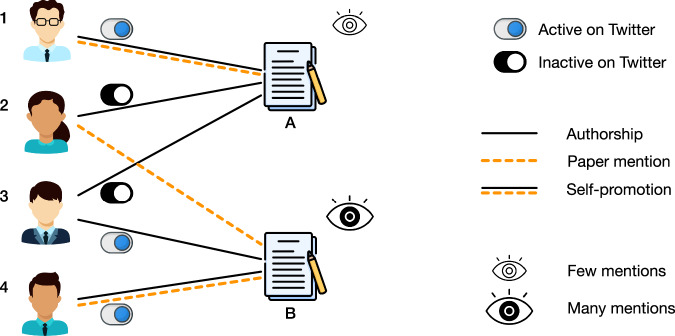
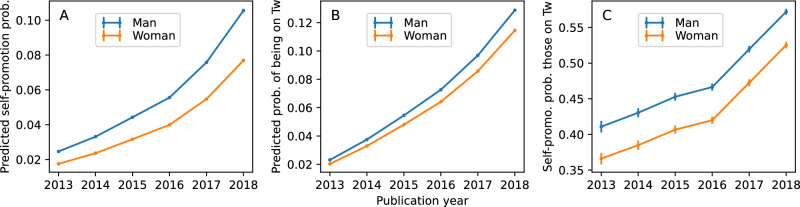
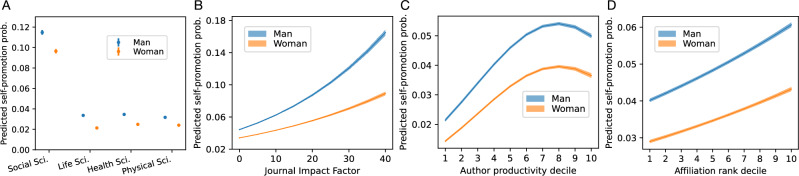
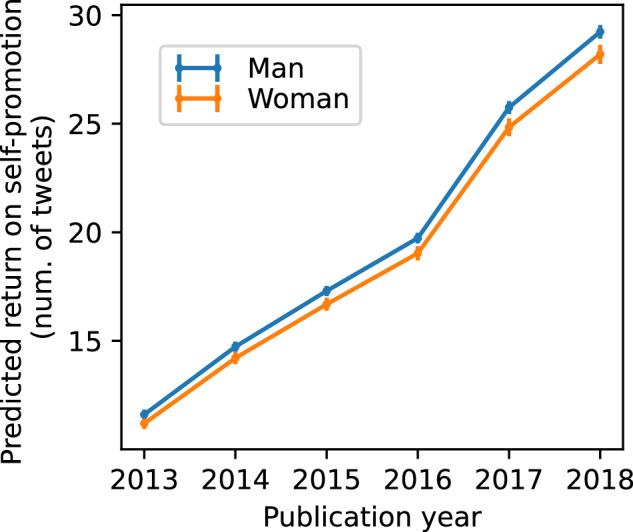
Self-promotion in science is ubiquitous but may not be exercised equally by everyone. Research on self-promotion in other domains suggests that, partly due to adverse reactions to non-gender-conforming career-enhancing behaviors, women tend to self-promote less often than men. We test whether this pattern extends to online spaces by examining scholarly self-promotion over six years using 23M tweets about 2.8M research papers authored by 3.5M scientists. We find that, overall, women are about 28% less likely than men to self-promote their papers on Twitter (now X) despite accounting for important confounds. The differential adoption of Twitter does not fully explain the gender gap in self-promotion, which is large even in relatively gender-balanced research areas, where adversity is expected to be smaller. Moreover, we find that the gender gap increases with higher performance and academic status, being most pronounced for research-prolific women from top-ranked institutions who publish papers in high-impact journals. We also find differential returns with respect to gender: while self-promotion is associated with increased tweets of papers compared to no self-promotion, the increase is slightly smaller for women than for men. Our findings reveal that scholarly self-promotion online varies meaningfully by gender and can contribute to a measurable gender gap in the visibility of scientific ideas. The study shows a significant gender gap in scholarly self-promotion on Twitter, finding that women are about 28% less likely to promote their own academic papers compared to men, a disparity which is even more pronounced among highly productive women at prestigious institutions. Women’s self-promotion efforts tend to yield fewer overall mentions and visibility online compared to men, highlighting systematic gender biases in digital scholarly communication.
Overview
The claims and statistics of this paper haven’t been checked yet.
Free: it reads the open-access text and checks the first 5 claims that cite a source we can check. Create a free account to check every claim.
Integrity signals
Registry
Cites
Statistics
Figures
Verification
Claims the paper makes
The claims and statistics of this paper haven’t been checked yet.
Free: it reads the open-access text and checks the first 5 claims that cite a source we can check. Create a free account to check every claim.
Claims other papers make about this one
Each is checked against this paper’s own text: does it say what the citing paper says it does?
The source backs part of the claim, not all of it — or backs it for a different population, condition or comparison.
In the citing paper
“Finally, one recent study has compared the consequences of self-promotion on social media for female and male academics showing that Twitter posts written by female (vs. male) scientsts receive less user engagement40.”
From Scientific publications that use promotional language in the abstract receive more citations and public attention (2025) · cites this paper as [40]
Experimental — accuracy not yet measuredThe cited source says what the claim attributes to it.
In the citing paper
“For example, female academics tend to use more modest language in presenting their work in paper abstracts compared to men25,28, engage less in self-citation behavior39 and are less likely to promote their papers on social media40.”
From Scientific publications that use promotional language in the abstract receive more citations and public attention (2025) · cites this paper as [40]
Self-check
Percentages, sums and reported differences re-computed from the paper’s own numbers.
The self-check needs the paper’s full text.
Citations
Cites
Hilbe, J. M. (2011) · doi:10.1017/cbo9780511973420 · Cited by 2,342
Prescriptive Gender Stereotypes and Backlash Toward Agentic Women
Rudman, L. A., & Glick, P. (2001) · Journal of Social Issues · doi:10.1111/0022-4537.00239 · Cited by 1,855
Rudman, L. A. (1998) · Journal of Personality and Social Psychology · doi:10.1037/0022-3514.74.3.629 · Cited by 1,511
Gender and the Career Choice Process: The Role of Biased Self‐Assessments
Correll, S. J. (2001) · American Journal of Sociology · doi:10.1086/321299 · Cited by 1,320 · cited 1×
“A number of studies fi nd differences in self-assessment, with women often undervaluing their performance in stereotypically male-dominated domains, including science and business, and men over-valuing theirs 45 – 48 .”
Women in Academic Science: A Changing Landscape
Ceci, S. J., Ginther, D. K., Kahn, S., & Williams, W. M. (2014) · Psychological Science in the Public Interest · doi:10.1177/1529100614541236 · Cited by 1,019
Costas, R., Zahedi, Z., & Wouters, P. (2015) · Journal of the Association for Information Science and Technology · doi:10.1002/asi.23309 · Cited by 711 · cited 2×
“Moreover, papers tend to receive more and more tweet mentions over our studied time period ( p 0.001 for year coef fi cients in Table 4), suggesting the growing online attention to scienti fi c papers.”
InfluentialAge and gender differences in self-esteem—A cross-cultural window.
(2015) · doi:10.1037/pspp0000078 · Cited by 684
Online collaboration: Scientists and the social network
Van Noorden, R. (2014) · Nature · doi:10.1038/512126a · Cited by 654
Josephs, R. A., Markus, H. R., & Tafarodi, R. W. (1992) · Journal of Personality and Social Psychology · doi:10.1037//0022-3514.63.3.391 · Cited by 605 · cited 1×
“Fourth, the result also holds when we consider mentions of the paper by only scientists or non-scientists ( p < 0.001; Supplementary Table S19, S20), indicating that neither of these groups alone can account for the gender difference in return on self-promotion.”
InfluentialScholarly use of social media and altmetrics: A review of the literature
Sugimoto, C. R., Work, S., Larivière, V., & Haustein, S. (2017) · Journal of the Association for Information Science and Technology · doi:10.1002/asi.23833 · Cited by 569
Research works printed but not linked: 3
- John, L. K. Savvy self-promotion. Harv. Bus. Rev. 99, 145–148 (2021).
- Rudman, L. A. & Phelan, J. E. Backlash effects for disconfirming gender stereotypes in organizations. Res. Organ. Behav. 28, 61–79 (2008).
- Costas, R., Mongeon, P., Ferreira, M. R., van Honk, J. & Franssen, T. Large-scale identification and characterization of scholars on Twitter. Quant. Sci. Stud. 1, 771–791 (2020).
Cited by
Stavrova, O., Kleinberg, B., Evans, A. M., & Ivanović, M. (2025) · Communications Psychology · doi:10.1038/s44271-025-00293-8 · Cited by 8
Emerging technologies for STEM education: global evidence on learning, equity, and SDG4
Nedungadi, P., Thushara, M. G., Veena, G., Tang, K., & Raman, R. (2026) · Humanities and Social Sciences Communications · doi:10.1057/s41599-026-06565-w · Cited by 9
Schluchter, H., Andel, D., Bettignies, A. D., Andel, H. L., & Schaden, E. (2025) · Journal of Clinical Medicine · doi:10.3390/jcm14165891 · Cited by 4
“This disparity extends to social media, where men scholars are more likely to share their own research [38,39], whereas women face disproportionate backlash and harassment online, further discouraging self-promotion and public engagement in high-profile research topics [40].”
Professors in the media: dynamics of cumulative advantage, reputation, and gender
Heiberger, R. H., Hofstra, B., & Unger, S. (2025) · European Sociological Review · doi:10.1093/esr/jcaf037 · Cited by 2
Social media promotion improves job market outcomes
Qiu, J., Chen, Y., Cohn, A., & Roth, A. E. (2026) · Proceedings of the National Academy of Sciences · doi:10.1073/pnas.2528289123 · Cited by 3
Metadata
- Authors
- Peng, H., Teplitskiy, M., Romero, D. M., & Horvát, E.-Á.
- Affiliations
- Northwestern University (US)
- Harvard University (US)
- University of Michigan (US)
- Corresponding author
- Peng, Hao
- Horvát, Emőke-Ágnes
- Venue
- Nature Communications
- Published
- 2025-07-01
- Volume
- 16
- Issue
- 1
- Pages
- 5552-5552
- ISSN
- 2041-1723 (ISSN-L)
- PMC
- PMC12215391
- OpenAlex
- W4411887000
- Cited by
- 17
- References
- 102
- Citations by year
- 2026: 10 · 2025: 6
- FWCI
- 10.23
- Type
- journal article
- Language
- en
- Open access
- gold
- doi.org
- Licence
- cc-by-nc-nd
- creativecommons.org/licenses/by-nc-nd/4.0 (tdm)
- creativecommons.org/licenses/by-nc-nd/4.0 (vor)
- Locations
- Nature Communications (publishedVersion, cc-by-nc-nd)
- PubMed Central (publishedVersion, cc-by-nc-nd)
- PubMed (publishedVersion)
- DOAJ (DOAJ: Directory of Open Access Journals) (submittedVersion, cc-by-sa)
- CityU Scholars (submittedVersion, cc-by-nc-nd)
- Funders
- City University of Hong Kong (9610703)
- United States Department of Defense | United States Air Force | AFMC | Air Force Office of Scientific Research (FA9550-19-1-0029)
- National Science Foundation (IIS-1943506)
- Topics
- Social Sciences › Library and Information Sciences › scientometrics and bibliometrics research
- Social Sciences › Library and Information Sciences › Academic Publishing and Open Access
- Social Sciences › Psychology › Applied Psychology › Career Development and Diversity
- Keywords
- gender gap, Twitter, X, women in science, research visibility, digital scholarly communication, gender bias, research productivity, academic institutions, high-impact journals
- MeSH terms
- Scholarly Communication, Female, Humans, Male, Research Personnel, Sex Factors, Social Media, Sexism
About these checks
Registry, retraction, Cites and statistics results are computed, not judged, with one exception: a printed reference that no index lists is read once by a model before it counts as a citation error. Claims are extracted by a model and kept only when their quote appears verbatim in the text; each cited source is then checked, with a model’s help, for whether it says what the claim relies on. Those verdicts can be wrong — read the claim’s quote and the cited source before relying on one.
Statistics and arithmetic are recomputed, not judged.
Confidence bands are shown only for fields calibrated on our annotated test set. None is calibrated yet, so no band is shown.
What counts as a claim ›How we measure confidence ›How we check this ›
Are you an author, or do you see a problem with this page? Request a review
How to cite
Cite CoChat for the checks on this page, and the paper for its own findings.
- This page
- CoChat. (2026). Citation check: The gender gap in scholarly self-promotion on social media. https://app.cochat.ai/papers/10.1038/s41467-025-60590-y
- The paper
- Peng, H., Teplitskiy, M., Romero, D. M., & Horvát, E.-Á. (2025). The gender gap in scholarly self-promotion on social media. Nature Communications. https://doi.org/10.1038/s41467-025-60590-y
Data sources
Bibliographic data: Semantic Scholar, OpenAlex, Crossref.
Contains information from the Semantic Scholar Academic Graph Datasets, made available under the ODC Attribution License (ODC-BY 1.0).
Semantic Scholar’s data is described in: Kinney, R., et al. (2023). The Semantic Scholar Open Data Platform. arXiv:2301.10140.
