

The gender gap in scholarly self-promotion on social media
Open accessThe DOI matches its Crossref record; 102 of the 102 references it cites were found in a registry or an index.
Abstract
Self-promotion in science is ubiquitous but may not be exercised equally by everyone. Research on self-promotion in other domains suggests that, partly due to adverse reactions to non-gender-conforming career-enhancing behaviors, women tend to self-promote less often than men. We test whether this pattern extends to online spaces by examining scholarly self-promotion over six years using 23M tweets about 2.8M research papers authored by 3.5M scientists. We find that, overall, women are about 28% less likely than men to self-promote their papers on Twitter (now X) despite accounting for important confounds. The differential adoption of Twitter does not fully explain the gender gap in self-promotion, which is large even in relatively gender-balanced research areas, where adversity is expected to be smaller. Moreover, we find that the gender gap increases with higher performance and academic status, being most pronounced for research-prolific women from top-ranked institutions who publish papers in high-impact journals. We also find differential returns with respect to gender: while self-promotion is associated with increased tweets of papers compared to no self-promotion, the increase is slightly smaller for women than for men. Our findings reveal that scholarly self-promotion online varies meaningfully by gender and can contribute to a measurable gender gap in the visibility of scientific ideas. The study shows a significant gender gap in scholarly self-promotion on Twitter, finding that women are about 28% less likely to promote their own academic papers compared to men, a disparity which is even more pronounced among highly productive women at prestigious institutions. Women’s self-promotion efforts tend to yield fewer overall mentions and visibility online compared to men, highlighting systematic gender biases in digital scholarly communication.
Overview
The claims and statistics of this paper haven’t been checked yet.
Free: it reads the open-access text and checks the first 5 claims that cite a source we can check. Create a free account to check every claim.
Integrity signals
Registry
Cites
Statistics
Figures
Verification
Claims the paper makes
The claims and statistics of this paper haven’t been checked yet.
Free: it reads the open-access text and checks the first 5 claims that cite a source we can check. Create a free account to check every claim.
Claims other papers make about this one
Each is checked against this paper’s own text: does it say what the citing paper says it does?
The source backs part of the claim, not all of it — or backs it for a different population, condition or comparison.
In the citing paper
“Finally, one recent study has compared the consequences of self-promotion on social media for female and male academics showing that Twitter posts written by female (vs. male) scientsts receive less user engagement40.”
From Scientific publications that use promotional language in the abstract receive more citations and public attention (2025) · cites this paper as [40]
Experimental — accuracy not yet measuredThe cited source says what the claim attributes to it.
In the citing paper
“For example, female academics tend to use more modest language in presenting their work in paper abstracts compared to men25,28, engage less in self-citation behavior39 and are less likely to promote their papers on social media40.”
From Scientific publications that use promotional language in the abstract receive more citations and public attention (2025) · cites this paper as [40]
Self-check
Percentages, sums and reported differences re-computed from the paper’s own numbers.
The self-check needs the paper’s full text.
Citations
Cites
Hilbe, J. M. (2011) · doi:10.1017/cbo9780511973420 · Cited by 2,342
Prescriptive Gender Stereotypes and Backlash Toward Agentic Women
Rudman, L. A., & Glick, P. (2001) · Journal of Social Issues · doi:10.1111/0022-4537.00239 · Cited by 1,855
Rudman, L. A. (1998) · Journal of Personality and Social Psychology · doi:10.1037/0022-3514.74.3.629 · Cited by 1,511
Gender and the Career Choice Process: The Role of Biased Self‐Assessments
Correll, S. J. (2001) · American Journal of Sociology · doi:10.1086/321299 · Cited by 1,320 · cited 1×
“A number of studies fi nd differences in self-assessment, with women often undervaluing their performance in stereotypically male-dominated domains, including science and business, and men over-valuing theirs 45 – 48 .”
Women in Academic Science: A Changing Landscape
Ceci, S. J., Ginther, D. K., Kahn, S., & Williams, W. M. (2014) · Psychological Science in the Public Interest · doi:10.1177/1529100614541236 · Cited by 1,019
Costas, R., Zahedi, Z., & Wouters, P. (2015) · Journal of the Association for Information Science and Technology · doi:10.1002/asi.23309 · Cited by 711 · cited 2×
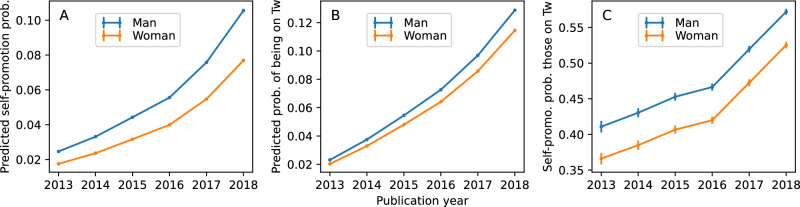
“Moreover, papers tend to receive more and more tweet mentions over our studied time period ( p 0.001 for year coef fi cients in Table 4), suggesting the growing online attention to scienti fi c papers.”
InfluentialAge and gender differences in self-esteem—A cross-cultural window.
(2015) · doi:10.1037/pspp0000078 · Cited by 684
Online collaboration: Scientists and the social network
Van Noorden, R. (2014) · Nature · doi:10.1038/512126a · Cited by 654
Josephs, R. A., Markus, H. R., & Tafarodi, R. W. (1992) · Journal of Personality and Social Psychology · doi:10.1037//0022-3514.63.3.391 · Cited by 605 · cited 1×
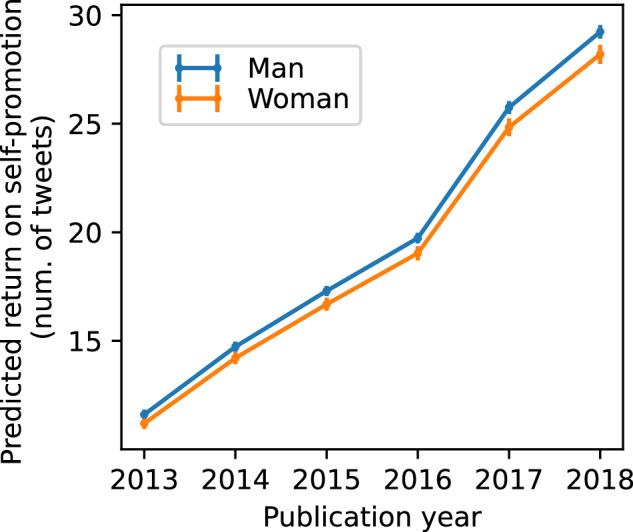
“Fourth, the result also holds when we consider mentions of the paper by only scientists or non-scientists ( p < 0.001; Supplementary Table S19, S20), indicating that neither of these groups alone can account for the gender difference in return on self-promotion.”
InfluentialScholarly use of social media and altmetrics: A review of the literature
Sugimoto, C. R., Work, S., Larivière, V., & Haustein, S. (2017) · Journal of the Association for Information Science and Technology · doi:10.1002/asi.23833 · Cited by 569
Amanatullah, E. T., & Morris, M. W. (2010) · Journal of Personality and Social Psychology · doi:10.1037/a0017094 · Cited by 527 · cited 1×
“Additionally, researchers of any gender could engage in peer promotion, as this is less likely to trigger backlash 36,106 .”
Gender Differences in Accepting and Receiving Requests for Tasks with Low Promotability
Babcock, L., Recalde, M. P., Vesterlund, L., & Weingart, L. (2017) · American Economic Review · doi:10.1257/aer.20141734 · Cited by 507 · cited 1×
“A growing literature fi nds that men spend less time than women on non-promotable tasks that are crucial to the sustainability of the academic ecosystem, such as emotional support towards trainees 63,64 and academic services 65 .”
Investors prefer entrepreneurial ventures pitched by attractive men
Brooks, A. W., Huang, L., Kearney, S. W., & Murray, F. E. (2014) · Proceedings of the National Academy of Sciences · doi:10.1073/pnas.1321202111 · Cited by 493 · cited 1×
“Supporting this view on double standards, empirical research across many settings fi nds that women whoself-promoteare often seenasmore arrogant andlesslikable than self-promoting men 57 – 62 .”
Tweeting biomedicine: An analysis of tweets and citations in the biomedical literature
Haustein, S., Peters, I., Sugimoto, C. R., Thelwall, M., & Larivière, V. (2014) · Journal of the Association for Information Science and Technology · doi:10.1002/asi.23101 · Cited by 434
Science, New Media, and the Public
Brossard, D., & Scheufele, D. A. (2013) · Science · doi:10.1126/science.1232329 · Cited by 414
Misinformation in and about science
West, J. D., & Bergstrom, C. T. (2021) · Proceedings of the National Academy of Sciences · doi:10.1073/pnas.1912444117 · Cited by 391
Zahedi, Z., Costas, R., & Wouters, P. (2014) · Scientometrics · doi:10.1007/s11192-014-1264-0 · Cited by 384
Gap between science and media revisited: Scientists as public communicators
Peters, H. P. (2013) · Proceedings of the National Academy of Sciences · doi:10.1073/pnas.1212745110 · Cited by 351 · cited 2×
“One possible interpretation of the difference between the gender gap documented in our study and the less robust one in self-citation is that the latter is a subtle, “ quiet ” way to self-promote in academia.”
Men Set Their Own Cites High: Gender and Self-citation across Fields and over TimePreprint
King, M. M., Bergstrom, C. T., Correll, S. J., Jacquet, J., & West, J. D. (n.d.) · OSF Preprints (OSF Preprints) · Cited by 348
Evidence on Self-Stereotyping and the Contribution of Ideas *
Coffman, K. B. (2014) · The Quarterly Journal of Economics · doi:10.1093/qje/qju023 · Cited by 321 · cited 1×
“A number of studies fi nd differences in self-assessment, with women often undervaluing their performance in stereotypically male-dominated domains, including science and business, and men over-valuing theirs 45 – 48 .”
Oliveira, D. F. M., Ma, Y., Woodruff, T. K., & Uzzi, B. (2019) · JAMA · doi:10.1001/jama.2018.21944 · Cited by 282 · cited 1×
“These results suggest that women ’ s concerns about pushback in response to their self-promotion may dominate the likely high self-assessment associated with being an established scholar and assurance that the contribution is worth promoting 31,56 .”
Men Set Their Own Cites High: Gender and Self-citation across Fields and over Time
King, M. M., Bergstrom, C. T., Correll, S. J., Jacquet, J., & West, J. D. (2017) · Socius: Sociological Research for a Dynamic World · doi:10.1177/2378023117738903 · Cited by 275
Disruptions in Women's Self-Promotion: The Backlash Avoidance Model
Moss-Racusin, C. A., & Rudman, L. A. (2010) · Psychology of Women Quarterly · doi:10.1111/j.1471-6402.2010.01561.x · Cited by 257
The Gender Gap in Self-Promotion
Exley, C. L., & Kessler, J. B. (2022) · The Quarterly Journal of Economics · doi:10.1093/qje/qjac003 · Cited by 250 · cited 2×
“For example, a recent study by Exley and Kessler shows that men and boys self-assess the same performance on math tasks much higher than women and girls, and the gap arises as early as sixth grade 49 .”
Exposure to rising inequality shapes Americans' opportunity beliefs and policy support
McCall, L., Burk, D., Laperrière, M., & Richeson, J. A. (2017) · Proceedings of the National Academy of Sciences · doi:10.1073/pnas.1706253114 · Cited by 226 · cited 2×
“Second, simply informing individuals about the gender gap may affect collective behavior and judgment 38 – 41 .”
Gender differences in how scientists present the importance of their research: observational study
Lerchenmueller, M. J., Sorenson, O., & Jena, A. B. (2019) · BMJ · doi:10.1136/bmj.l6573 · Cited by 211
Does Tweeting Improve Citations? One-Year Results From the TSSMN Prospective Randomized Trial
Luc, J. G. Y., Archer, M. A., Arora, R. C., Bender, E. M., Blitz, A., Cooke, D. T., Hlci, T. N., Kidane, B., Ouzounian, M., Varghese, T. K., et al. (2021) · The Annals of Thoracic Surgery · doi:10.1016/j.athoracsur.2020.04.065 · Cited by 211 · cited 1×
“…would be valuable because algorithms on online platforms may amplify small initial differences in online attention, as produced via differential self-promotion practice, into large disparities in ultimate academic recognition 70,108 and conventional markers of scienti fi c excellence 15,17,20 .”
Social influence and unfollowing accelerate the emergence of echo chambers
Sasahara, K., Chen, W., Peng, H., Ciampaglia, G. L., Flammini, A., & Menczer, F. (2021) · Journal of Computational Social Science · doi:10.1007/s42001-020-00084-7 · Cited by 211 · cited 2×
“…would be valuable because algorithms on online platforms may amplify small initial differences in online attention, as produced via differential self-promotion practice, into large disparities in ultimate academic recognition 70,108 and conventional markers of scienti fi c excellence 15,17,20 .”
Self-citationCommittees with implicit biases promote fewer women when they do not believe gender bias exists
Régner, I., Thinus‐Blanc, C., Netter, A., Schmader, T., & Huguet, P. (2019) · Nature Human Behaviour · doi:10.1038/s41562-019-0686-3 · Cited by 209
How algorithmic popularity bias hinders or promotes quality
Ciampaglia, G. L., Nematzadeh, A., Menczer, F., & Flammini, A. (2018) · Scientific Reports · doi:10.1038/s41598-018-34203-2 · Cited by 204 · cited 1×
“…would be valuable because algorithms on online platforms may amplify small initial differences in online attention, as produced via differential self-promotion practice, into large disparities in ultimate academic recognition 70,108 and conventional markers of scienti fi c excellence 15,17,20 .”
Wren, J. D., Kozak, K. Z., Johnson, K. R., Deakyne, S. J., Schilling, L. M., & Dellavalle, R. P. (2007) · EMBO reports · doi:10.1038/sj.embor.7401095 · Cited by 202
Unprofessional peer reviews disproportionately harm underrepresented groups in STEM
Silbiger, N. J., & Stubler, A. D. (2019) · PeerJ · doi:10.7717/peerj.8247 · Cited by 189 · cited 1×
“The literature shows that intersectional categories develop bias in self-assessment regardless of actual performance 98 , have a heightened sensitivity to unprofessional feedback 99 , and receive worse treatment and fewer rewards 100,101 .”
Mitigating gender bias in student evaluations of teaching
Peterson, D. A. M., Biederman, L., Andersen, D. J., Ditonto, T., & Roe, K. J. (2019) · PLoS ONE · doi:10.1371/journal.pone.0216241 · Cited by 173 · cited 1×
“Morebroadly,informingpeopleabout gender gaps in self-promotion can affect their subsequent opinions and behavior 38 – 41 and contribute to targeted interventions that promote gender equity in science 42 – 44 .”
Baugh, S. G., & Graen, G. B. (1997) · Group & Organization Management · doi:10.1177/1059601197223004 · Cited by 165 · cited 1×
“The literature shows that intersectional categories develop bias in self-assessment regardless of actual performance 98 , have a heightened sensitivity to unprofessional feedback 99 , and receive worse treatment and fewer rewards 100,101 .”
Citation inequity and gendered citation practices in contemporary physics
Teich, E. G., Kim, J. Z., Lynn, C. W., Simon, S. C., Klishin, A. A., Szymula, K. P., Srivastava, P., Bassett, L. C., Zurn, P., Dworkin, J. D., et al. (2022) · Nature Physics · doi:10.1038/s41567-022-01770-1 · Cited by 164
The intersectional privilege of white able-bodied heterosexual men in STEM
Cech, E. A. (2022) · Science Advances · doi:10.1126/sciadv.abo1558 · Cited by 159 · cited 1×
“The literature shows that intersectional categories develop bias in self-assessment regardless of actual performance 98 , have a heightened sensitivity to unprofessional feedback 99 , and receive worse treatment and fewer rewards 100,101 .”
Weisgram, E. S., & Bigler, R. S. (2007) · Psychology of Women Quarterly · doi:10.1111/j.1471-6402.2007.00369.x · Cited by 157 · cited 3×
“Second, simply informing individuals about the gender gap may affect collective behavior and judgment 38 – 41 .”
Klar, S., Krupnikov, Y., Ryan, J. B., Searles, K., & Shmargad, Y. (2020) · PLoS ONE · doi:10.1371/journal.pone.0229446 · Cited by 157
A Review of Microsoft Academic Services for Science of Science Studies
Wang, K., Shen, Z., Huang, C., Wu, C.-H., Eide, D., Dong, Y., Qian, J., Kanakia, A., Chen, A., & Rogahn, R. (2019) · Frontiers in Big Data · doi:10.3389/fdata.2019.00045 · Cited by 144
Two investigations of ?female modesty? in achievement situations
Heatherington, L., Daubman, K. A., Bates, C., Ahn, A., Brown, H. A., & Preston, C. (1993) · Sex Roles · doi:10.1007/bf00289215 · Cited by 142
Name-based demographic inference and the unequal distribution of misrecognition
Lockhart, J. W., King, M. M., & Munsch, C. L. (2023) · Nature Human Behaviour · doi:10.1038/s41562-023-01587-9 · Cited by 134 · cited 3×
“Relatedly,ourvalidationresultismoreapplicabletoWestern names because many East Asian names do not have a distinctively predicted gender label and are thus excluded from our evaluation 23,97 .”
The Use of Social Media to Increase the Impact of Health Research: Systematic Review
Bardus, M., Rassi, R. E., Chahrour, M. A., Akl, E. W., Raslan, A. S., Meho, L. I., & Akl, E. A. (2020) · Journal of Medical Internet Research · doi:10.2196/15607 · Cited by 131 · cited 1×
“First, our work informs the way we interpret online visibility metrics and traditional performance indicators shown to correlate with them such as citations 15,17,104,105 .”
The chaperone effect in scientific publishing
Sekara, V., Deville, P., Ahnert, S. E., Barabási, A.-L., Sinatra, R., & Lehmann, S. (2018) · Proceedings of the National Academy of Sciences · doi:10.1073/pnas.1800471115 · Cited by 127 · cited 1×
“This suggests that the gender gap in self-promotion is consistently large, even in the presence of substantial variation in an area ’ s gender representation 85 .”
Coevolution of policy and science during the pandemic
Yin, Y., Gao, J., Jones, B. F., & Wang, D. (2021) · Science · doi:10.1126/science.abe3084 · Cited by 127
Self-citation is the hallmark of productive authors, of any gender
Mishra, S., Fegley, B. D., Diesner, J., & Torvik, V. I. (2018) · PLOS ONE · doi:10.1371/journal.pone.0195773 · Cited by 126 · cited 1×
“Some large-scale bibliometric studies argue that women self-cite less than men 30,91,92 , whereas others dispute this result and fi nd no gender differences 93,94 .”
Research impact: Altmetrics make their mark
Kwok, R. (2013) · Nature · doi:10.1038/nj7463-491a · Cited by 125 · cited 2×
“Raising awareness of such gender gaps is a prerequisite for improving research policy through properly accounting for biases that appear in the public ’ s opinion about who is driving scienti fi c progress and innovation 23 , which can affect young people ’ s career choices 38 and shape…”
Prejudice Toward Female Leaders: Backlash Effects and Women’s Impression Management Dilemma
Phelan, J. E., & Rudman, L. A. (2010) · Social and Personality Psychology Compass · doi:10.1111/j.1751-9004.2010.00306.x · Cited by 120
Gender and the self-presentation of academic achievement
Daubman, K. A., Heatherington, L., & Ahn, A. (1992) · Sex Roles · doi:10.1007/bf00290017 · Cited by 115
Gender differences in performance of top cited scientists by field and country
Chan, H. F., & Torgler, B. (2020) · Scientometrics · doi:10.1007/s11192-020-03733-w · Cited by 110 · cited 1×
“This suggests that the gender gap in self-promotion is consistently large, even in the presence of substantial variation in an area ’ s gender representation 85 .”
Discrimination Against Competent Women1
Hagen, R. L., & Kahn, A. (1975) · Journal of Applied Social Psychology · doi:10.1111/j.1559-1816.1975.tb00688.x · Cited by 109
Untangling the network effects of productivity and prominence among scientists
Li, W., Zhang, S., Zheng, Z., Cranmer, S., & Clauset, A. J. (2022) · Nature Communications · doi:10.1038/s41467-022-32604-6 · Cited by 103 · cited 1×
“This association may be produced by various mechanisms, such as different language styles used by men and women 89 , or the unobserved network effects from of fl ine contexts 95 .”
Self-Presentation: Impression Management and Interpersonal Behavior
Leary, M. R. (2019) · Routledge eBooks · doi:10.4324/9780429497384 · Cited by 100
Someone like me: How does peer parity influence participation of women on stack overflow?
Ford, D., Harkins, A., & Parnin, C. (2017) · 2017 IEEE Symposium on Visual Languages and Human-Centric Computing (VL/HCC) · doi:10.1109/vlhcc.2017.8103473 · Cited by 99 · cited 2×
“We use Ford’s algorithm [12] to infer the gender of an author based on their first name.”
The role of Twitter in the life cycle of a scientific publication
Darling, E., Shiffman, D., Cȏté, I., & Drew, J. (2013) · Ideas in Ecology and Evolution · doi:10.4033/iee.2013.6.6.f · Cited by 97
Andersen, J. P., Schneider, J. W., Jagsi, R., & Nielsen, M. W. (2019) · eLife · doi:10.7554/elife.45374 · Cited by 96 · cited 1×
“The gender gap in self-promotion is consistent with gender gaps observed offline, such as in self-citation 56,57 and embellished presentation of results 58 .”
A “Scientific Diversity” Intervention to Reduce Gender Bias in a Sample of Life Scientists
Moss-Racusin, C. A., van der Toorn, J., Dovidio, J. F., Brescoll, V. L., Graham, M. J., & Handelsman, J. (2016) · CBE—Life Sciences Education · doi:10.1187/cbe.15-09-0187 · Cited by 90 · cited 1×
“Morebroadly,informingpeopleabout gender gaps in self-promotion can affect their subsequent opinions and behavior 38 – 41 and contribute to targeted interventions that promote gender equity in science 42 – 44 .”
Ortega, J. L. (2016) · Scientometrics · doi:10.1007/s11192-016-2113-0 · Cited by 85 · cited 1×
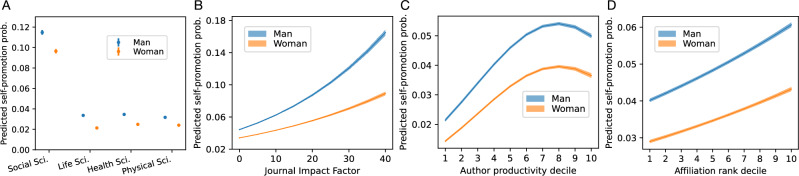
“D Thelikelihoodofself-promotion as a function of journal impact factor, author productivity, and af fi liation rank, predicted based on our most comprehensive model that also adds an interaction term between gender and the corresponding variable (Supplementary Table 12 – 14).”
Validated names for experimental studies on race and ethnicity
Crabtree, C. D., Kim, J. Y., Gaddis, S. M., Holbein, J. B., Guage, C., & Marx, W. W. (2023) · Scientific Data · doi:10.1038/s41597-023-01947-0 · Cited by 81 · cited 1×
“Since authors from certain countries such as China are more likely to have gender-neutral names 97,102 , the lower self-promotion rate of authors with gender-neutral names may be driven by racially and ethnically differentiated cultural norms around self-marketing on social media.”
Balancing Research and Service in Academia: Gender, Race, and Laboratory Tasks
Miller, C. N., & Roksa, J. (2019) · Gender & Society · doi:10.1177/0891243219867917 · Cited by 79 · cited 1×
“A growing literature fi nds that men spend less time than women on non-promotable tasks that are crucial to the sustainability of the academic ecosystem, such as emotional support towards trainees 63,64 and academic services 65 .”
Now, Women Do Ask: A Call to Update Beliefs about the Gender Pay Gap
Kray, L. J., Kennedy, J. A., & Lee, M. (2023) · Academy of Management Discoveries · doi:10.5465/amd.2022.0021 · Cited by 69
Gender inequities in the online dissemination of scholars’ work
Vásárhelyi, O., Zakhlebin, I., Milojević, S., & Horvát, E.-Á. (2021) · Proceedings of the National Academy of Sciences · doi:10.1073/pnas.2102945118 · Cited by 68 · cited 2×
“[25] Orsolya Vásárhelyi, Igor Zakhlebin, Staša Milojević, and EÁ Horvát.”
Self-citationGender Differences in Negotiation: Can Interventions Reduce the Gap?
Recalde, M. P., & Vesterlund, L. (2023) · Annual Review of Economics · doi:10.1146/annurev-economics-092022-115353 · Cited by 63 · cited 2×
“Third,scholarlypracticesandpoliciesaimedatclosingthegender gap in visibility could rely on interventions that aim to “ fi x the institutions ” not “ fi x the women ” by placing additional burdens on them 69 , especially given that women ’ s self-promotion is not as effective as men ’ s.”
Neural embeddings of scholarly periodicals reveal complex disciplinary organizations
Peng, H., Ke, Q., Budak, C., Romero, D. M., & Ahn, Y.-Y. (2021) · Science Advances · doi:10.1126/sciadv.abb9004 · Cited by 61
Self-citationGender Differences in Twitter Use and Influence Among Health Policy and Health Services Researchers
Zhu, J. M., Pelullo, A., Hassan, S., Siderowf, L., Merchant, R. M., & Werner, R. M. (2019) · JAMA Internal Medicine · doi:10.1001/jamainternmed.2019.4027 · Cited by 60 · cited 1×
“Social scientists are, on average, about three times as likely to promote their research as scientists in the other three areas (Fig.”
Envisioning the scientific paper of the future
Sopinka, N., Coristine, L. E., DeRosa, M. C., Rochman, C. M., Owens, B. L., & Cooke, S. J. (2020) · FACETS · doi:10.1139/facets-2019-0012 · Cited by 59
Viewpoint: The Dilemma of Self-Advocacy for Women: Another Case of Blaming the Victim?
Janoff‐Bulman, R., & Wade, M. B. (1996) · Journal of Social and Clinical Psychology · doi:10.1521/jscp.1996.15.2.143 · Cited by 58
Dynamics of cross-platform attention to retracted papers
Peng, H., Romero, D. M., & Horvát, E.-Á. (2022) · Proceedings of the National Academy of Sciences · doi:10.1073/pnas.2119086119 · Cited by 57
Self-citationKang, H. Y. (2022) · Technovation · doi:10.1016/j.technovation.2022.102522 · Cited by 55 · cited 1×
“Theoretically, online environments should feature less barriers for women than conventional of fl ine settings 71,72 .”
Why Public Dissemination of Science Matters: A Manifesto
Eagleman, D. M. (2013) · Journal of Neuroscience · doi:10.1523/jneurosci.2556-13.2013 · Cited by 49 · cited 1×
“For example, an established line of literature suggests that the online visibility of scholarly papers amplifies their impact in the academy through citations 3–6 but also beyond academic audiences 7,8 , contributing to prevalent alternative measures for scholarly evaluation 9 .”
Cross‐cultural differences in self‐promotion: A study of self‐citations in management journals
Deschacht, N., & Maes, B. (2016) · Journal of Occupational and Organizational Psychology · doi:10.1111/joop.12162 · Cited by 45 · cited 1×
“For example, regardless of gender, self-promotion may be considered more acceptable in Western than East Asian cultures 103 .”
Social media and hyper‐masculine work cultures
Maaranen, A., & Tienari, J. (2020) · Gender Work and Organization · doi:10.1111/gwao.12450 · Cited by 45 · cited 1×
“However, some social media platforms such as Twitter promote self-importance, combative behavior, and masculinity 73 .”
Is novel research worth doing? Evidence from peer review at 49 journals
Teplitskiy, M., Peng, H., Blasco, A., & Lakhani, K. R. (2022) · Proceedings of the National Academy of Sciences · doi:10.1073/pnas.2118046119 · Cited by 44 · cited 1×
“…– the Altmetric database of papers ’ online mentions and the Microsoft Academic Graph (MAG) database that contains metadata about papers and their authors such as publication venues, af fi liations, productivity metrics, and research fi elds 78 – 80 (See details in Methods and Supplementary Note A).”
Self-citationWhat Makes Tweetorials Tick: How Experts Communicate Complex Topics on Twitter
Gero, K. I., Liu, V., Huang, S. X. L., Lee, J., & Chilton, L. B. (2021) · Proceedings of the ACM on Human-Computer Interaction · doi:10.1145/3479566 · Cited by 43
Cundiff, J. L., Danube, C. L., Zawadzki, M. J., & Shields, S. A. (2018) · The Journal of Higher Education · doi:10.1080/00221546.2018.1437665 · Cited by 42
(2018) · Nature Cell Biology · doi:10.1038/s41556-018-0253-6 · Cited by 41
Self-Citation, Cumulative Advantage, and Gender Inequality in Science
Azoulay, P., & Lynn, F. B. (2020) · Sociological Science · doi:10.15195/v7.a7 · Cited by 40
Altenburger, K., De, R., Frazier, K., Avteniev, N., & Hamilton, J. (2017) · Proceedings of the International AAAI Conference on Web and Social Media · doi:10.1609/icwsm.v11i1.14929 · Cited by 35
Going viral: how to boost the spread of coronavirus science on social media
Yammine, S. Z. (2020) · Nature · doi:10.1038/d41586-020-01356-y · Cited by 34
Sugimoto, C. R., & Larivière, V. (2023) · Harvard University Press eBooks · doi:10.4159/9780674292918 · Cited by 33
Taking the Time: The Implications of Workplace Assessment for Organizational Gender Inequality
Nelson, L. K., Brewer, A. E., Mueller, A. S., O’Connor, D. M., Dayal, A., & Arora, V. M. (2023) · American Sociological Review · doi:10.1177/00031224231184264 · Cited by 33 · cited 1×
“A growing literature fi nds that men spend less time than women on non-promotable tasks that are crucial to the sustainability of the academic ecosystem, such as emotional support towards trainees 63,64 and academic services 65 .”
Effect of Altmetric score on manuscript citations: A randomized-controlled trial
Peres, M. F. P., Braschinsky, M., & May, A. (2022) · Cephalalgia · doi:10.1177/03331024221107385 · Cited by 28 · cited 2×
“…would be valuable because algorithms on online platforms may amplify small initial differences in online attention, as produced via differential self-promotion practice, into large disparities in ultimate academic recognition 70,108 and conventional markers of scienti fi c excellence 15,17,20 .”
Durbin, S., Lopes, A. C., & Warren, S. (2020) · New Technology Work and Employment · doi:10.1111/ntwe.12166 · Cited by 27 · cited 1×
“Theoretically, online environments should feature less barriers for women than conventional of fl ine settings 71,72 .”
Author mentions in science news reveal widespread disparities across name-inferred ethnicities
Peng, H., Teplitskiy, M., & Jurgens, D. (2024) · Quantitative Science Studies · doi:10.1162/qss_a_00297 · Cited by 27 · cited 4×
“Altmetric ’ s coverage favors more prominent papers that have received some online attention 23,81 .”
InfluentialSelf-citationAn open data set of scholars on Twitter
Mongeon, P., Bowman, T. D., & Costas, R. (2023) · Quantitative Science Studies · doi:10.1162/qss_a_00250 · Cited by 26 · cited 3×
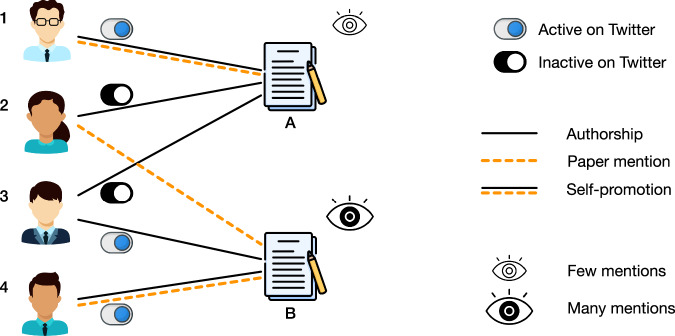
“Specifically, a (paper, author) pair is coded as active on Twitter if two conditions are met: (1) the author is identified as having an active Twitter account in the external dataset [18], and (2) the paper’s publication date is after the author’s earliest tweet time in our Altmetric dataset.”
Promotional language and the adoption of innovative ideas in science
Peng, H., Qiu, H. S., Fosse, H. B., & Uzzi, B. (2024) · Proceedings of the National Academy of Sciences · doi:10.1073/pnas.2320066121 · Cited by 26 · cited 1×
“As an initial exploration, our linguistic analysis of self-promotional tweets shows that men use more promotional words 90,96 such as “ novel, ” “ excellent, ” “ robust, ” “ remarkable, ” and “ unprecedented ” than women, while women use more supportive words such as “ amazing, ” “ supportive, ”…”
Self-citationEmpowering women facing gender-based violence amid COVID-19 through media campaigns
Christia, F., Larreguy, H., Parker-Magyar, E., & Quintero, M. (2023) · Nature Human Behaviour · doi:10.1038/s41562-023-01665-y · Cited by 24 · cited 1×
“At the same time, women may now engage more in self-promotion as a result of their increased awareness of gender gaps and dedicated efforts to counter them 66,67 .”
Effects of gender harassment on science popularization behaviors
McDonald, L., Barriault, C. L., & Merritt, T. J. S. (2020) · Public Understanding of Science · doi:10.1177/0963662520946667 · Cited by 22 · cited 1×
“For example, recent research on labor economics shows that women negotiate pay at least as much as men, indicating a closing of the gender gap in speaking up for oneself in professional contexts, albeit one that has yet to translate to the closing of the pay gap itself 68,69 .”
How to use Twitter to further your research career
Lee, J. M. (2019) · Nature · doi:10.1038/d41586-019-00535-w · Cited by 21 · cited 1×
“speaking directly about one ’ s strengths and achievements as a career-enhancing practice 34,35 , is an early mechanism that could contribute to substantial differences in online visibility 8,10,36,37 .”
Stephen, D. M., & Stahlschmidt, S. (2024) · Scientometrics · doi:10.1007/s11192-024-05006-2 · Cited by 17 · cited 1×
“First, our work informs the way we interpret online visibility metrics and traditional performance indicators shown to correlate with them such as citations 15,17,104,105 .”
Science and sexism: In the eye of the Twitterstorm
Morello, L. (2015) · Nature · doi:10.1038/527148a · Cited by 16
Women Who Break the Glass Ceiling Get a “Paper Cut”: Gender, Fame, and Media Sentiment
Shor, E., van de Rijt, A., & Kulkarni, V. (2022) · Social Problems · doi:10.1093/socpro/spac020 · Cited by 16 · cited 3×
“The second literature concerns the “ backlash effect, ” whereby audiences differentially penalize women for self-promotion because it is incongruent with stereotypes of modesty and pro-sociality 51 – 56 .”
Dehdarirad, T. (2020) · PLoS ONE · doi:10.1371/journal.pone.0241723 · Cited by 15 · cited 1×
“D Thelikelihoodofself-promotion as a function of journal impact factor, author productivity, and af fi liation rank, predicted based on our most comprehensive model that also adds an interaction term between gender and the corresponding variable (Supplementary Table 12 – 14).”
Song, Y., Wang, X., & Li, G. (2023) · Journal of Computer-Mediated Communication · doi:10.1093/jcmc/zmad050 · Cited by 15
Acceptance in Top Journals Shows Large Disparities across Name-inferred EthnicitiesPreprint
Peng, H. M., Lakhani, K. R., & Teplitskiy, M. (2021) · SocArXiv (OSF Preprints) · doi:10.31235/osf.io/mjbxg · Cited by 14 · cited 1×
“The literature shows that intersectional categories develop bias in self-assessment regardless of actual performance 98 , have a heightened sensitivity to unprofessional feedback 99 , and receive worse treatment and fewer rewards 100,101 .”
Self-citationLiu, C., & Huang, M. (2022) · Scientometrics · doi:10.1007/s11192-022-04456-w · Cited by 14
Social media (SoMe) enhances exposure of dermatology articles
Liakos, W., Burrall, B. A., Hsu, D. K., & Cohen, P. R. (2021) · Dermatology Online Journal · doi:10.5070/d327754361 · Cited by 13
Chan, H. F., Önder, A. S., Schweitzer, S., & Torgler, B. (2023) · Economics Letters · doi:10.1016/j.econlet.2023.111270 · Cited by 13
How scientists are making the most of Reddit
Docter-Loeb, H. (2024) · Nature · doi:10.1038/d41586-024-00906-y · Cited by 9 · cited 1×
“speaking directly about one ’ s strengths and achievements as a career-enhancing practice 34,35 , is an early mechanism that could contribute to substantial differences in online visibility 8,10,36,37 .”
Use of Promotional Language in Grant Applications and Grant Success
Qiu, H. S., Peng, H., Fosse, H. B., Woodruff, T. K., & Uzzi, B. (2024) · JAMA Network Open · doi:10.1001/jamanetworkopen.2024.48696 · Cited by 5 · cited 2×
“The gender gap in self-promotion is consistent with gender differences in the tendency for embellished presentation of results 89,90 and invites interesting connections with the practice of self-citation.”
Self-citationWhen Finnish researchers took on the Twitter trolls
Thornton, J. (2021) · Nature · doi:10.1038/d41586-021-03407-4 · Cited by 2
Peng, H. (2025) · Zenodo (CERN European Organization for Nuclear Research) · doi:10.5281/zenodo.15054467 · Cited by 1
Self-citation
Research works printed but not linked: 3
- John, L. K. Savvy self-promotion. Harv. Bus. Rev. 99, 145–148 (2021).
- Rudman, L. A. & Phelan, J. E. Backlash effects for disconfirming gender stereotypes in organizations. Res. Organ. Behav. 28, 61–79 (2008).
- Costas, R., Mongeon, P., Ferreira, M. R., van Honk, J. & Franssen, T. Large-scale identification and characterization of scholars on Twitter. Quant. Sci. Stud. 1, 771–791 (2020).
Cited by
Stavrova, O., Kleinberg, B., Evans, A. M., & Ivanović, M. (2025) · Communications Psychology · doi:10.1038/s44271-025-00293-8 · Cited by 8
Emerging technologies for STEM education: global evidence on learning, equity, and SDG4
Nedungadi, P., Thushara, M. G., Veena, G., Tang, K., & Raman, R. (2026) · Humanities and Social Sciences Communications · doi:10.1057/s41599-026-06565-w · Cited by 9
Schluchter, H., Andel, D., Bettignies, A. D., Andel, H. L., & Schaden, E. (2025) · Journal of Clinical Medicine · doi:10.3390/jcm14165891 · Cited by 4
“This disparity extends to social media, where men scholars are more likely to share their own research [38,39], whereas women face disproportionate backlash and harassment online, further discouraging self-promotion and public engagement in high-profile research topics [40].”
Professors in the media: dynamics of cumulative advantage, reputation, and gender
Heiberger, R. H., Hofstra, B., & Unger, S. (2025) · European Sociological Review · doi:10.1093/esr/jcaf037 · Cited by 2
Social media promotion improves job market outcomes
Qiu, J., Chen, Y., Cohn, A., & Roth, A. E. (2026) · Proceedings of the National Academy of Sciences · doi:10.1073/pnas.2528289123 · Cited by 3
Metadata
- Authors
- Peng, H., Teplitskiy, M., Romero, D. M., & Horvát, E.-Á.
- Affiliations
- Northwestern University (US)
- Harvard University (US)
- University of Michigan (US)
- Corresponding author
- Peng, Hao
- Horvát, Emőke-Ágnes
- Venue
- Nature Communications
- Published
- 2025-07-01
- Volume
- 16
- Issue
- 1
- Pages
- 5552-5552
- ISSN
- 2041-1723 (ISSN-L)
- PMC
- PMC12215391
- OpenAlex
- W4411887000
- Semantic Scholar
- fe5c38e1f961290bf8fc1de6c22122ffa6f9415f
- Cited by
- 17
- References
- 102
- Citations by year
- 2026: 10 · 2025: 6
- FWCI
- 10.23
- Type
- journal article
- Language
- en
- Open access
- gold
- doi.org
- Licence
- cc-by-nc-nd
- creativecommons.org/licenses/by-nc-nd/4.0 (tdm)
- creativecommons.org/licenses/by-nc-nd/4.0 (vor)
- Locations
- Nature Communications (publishedVersion, cc-by-nc-nd)
- PubMed Central (publishedVersion, cc-by-nc-nd)
- PubMed (publishedVersion)
- DOAJ (DOAJ: Directory of Open Access Journals) (submittedVersion, cc-by-sa)
- CityU Scholars (submittedVersion, cc-by-nc-nd)
- Funders
- City University of Hong Kong (9610703)
- United States Department of Defense | United States Air Force | AFMC | Air Force Office of Scientific Research (FA9550-19-1-0029)
- National Science Foundation (IIS-1943506)
- Topics
- Social Sciences › Library and Information Sciences › scientometrics and bibliometrics research
- Social Sciences › Library and Information Sciences › Academic Publishing and Open Access
- Social Sciences › Psychology › Applied Psychology › Career Development and Diversity
- Keywords
- gender gap, Twitter, X, women in science, research visibility, digital scholarly communication, gender bias, research productivity, academic institutions, high-impact journals
- MeSH terms
- Scholarly Communication, Female, Humans, Male, Research Personnel, Sex Factors, Social Media, Sexism
About these checks
Registry, retraction, Cites and statistics results are computed, not judged, with one exception: a printed reference that no index lists is read once by a model before it counts as a citation error. Claims are extracted by a model and kept only when their quote appears verbatim in the text; each cited source is then checked, with a model’s help, for whether it says what the claim relies on. Those verdicts can be wrong — read the claim’s quote and the cited source before relying on one.
Statistics and arithmetic are recomputed, not judged.
Confidence bands are shown only for fields calibrated on our annotated test set. None is calibrated yet, so no band is shown.
What counts as a claim ›How we measure confidence ›How we check this ›
Are you an author, or do you see a problem with this page? Request a review
Data sources
Bibliographic data: Semantic Scholar, OpenAlex, Crossref.
Contains information from the Semantic Scholar Academic Graph Datasets, made available under the ODC Attribution License (ODC-BY 1.0).
Semantic Scholar’s data is described in: Kinney, R., et al. (2023). The Semantic Scholar Open Data Platform. arXiv:2301.10140.
