

Structural insights into context-specific inhibition of bacterial translation by macrolides
Open accessThe DOI matches its Crossref record; 55 of the 55 references it cites were found in a registry or an index.
Abstract
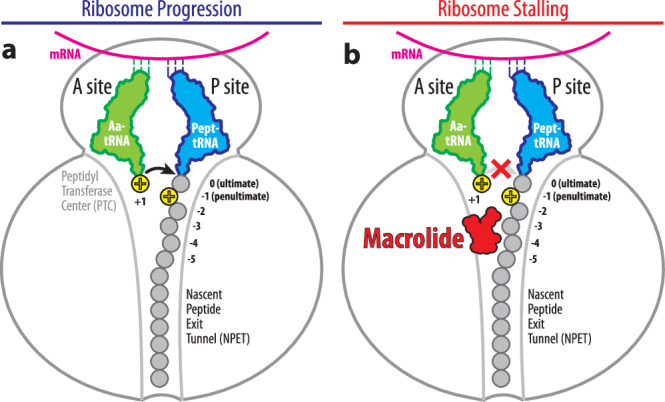
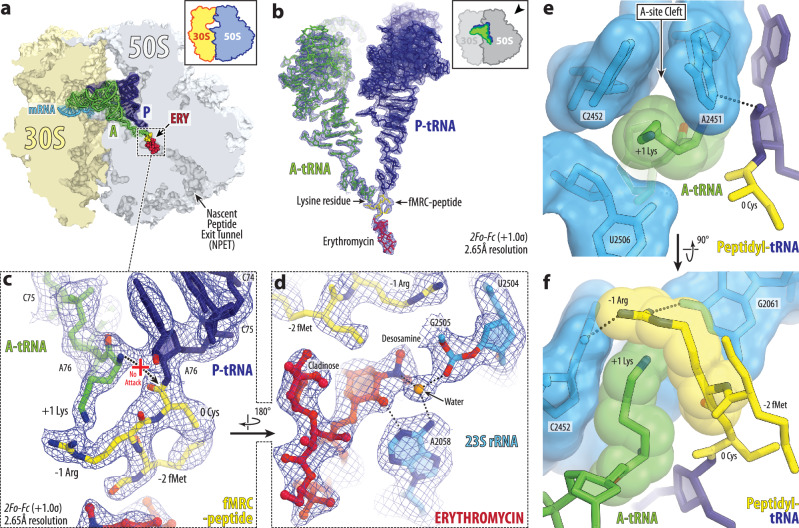
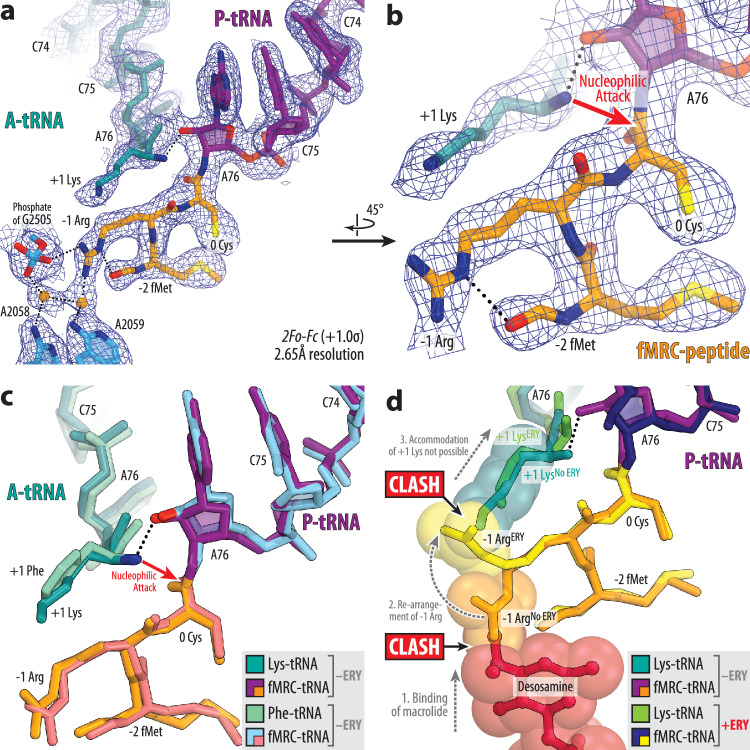
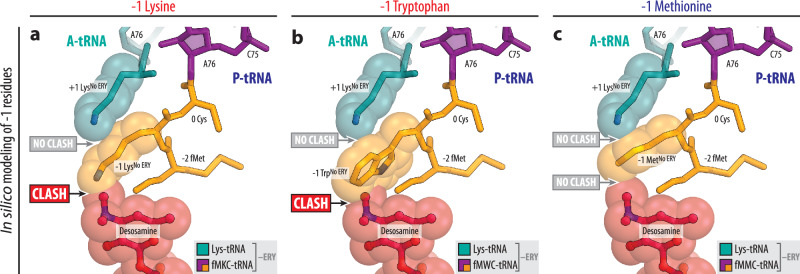
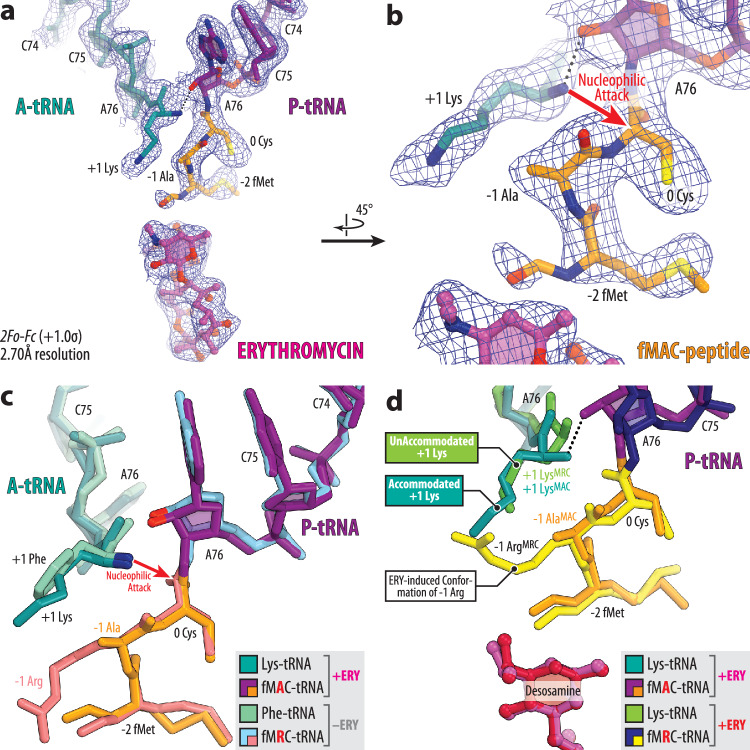
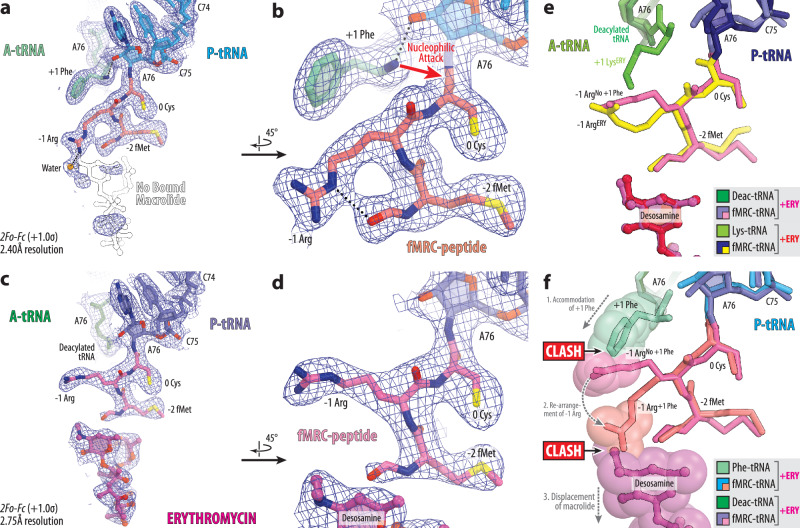
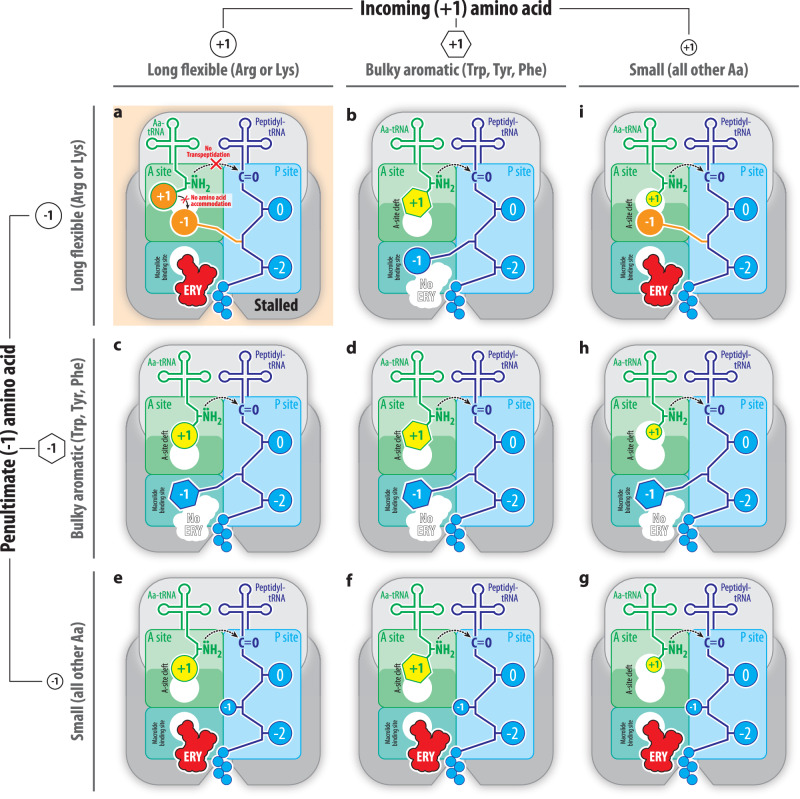
The ribosome's peptidyl transferase center (PTC) catalyzes peptide bond formation during protein synthesis and is targeted by many antibiotic classes. Remarkably, macrolides that bind in the peptide exit tunnel some ~10 Å away from the PTC also remotely inhibit PTC and cause translational arrest depending on the synthesized polypeptide sequence. The Arg/Lys-X-Arg/Lys (also known as +X+) motif is particularly susceptible to this inhibition, as peptidyl-tRNA carrying nascent peptide with penultimate arginine or lysine residue fails to react with aminoacyl-tRNA carrying the same amino acids in the presence of macrolides. While structural studies of macrolide-bound ribosomes have shed light on the context-specific nature of this inhibition, the precise roles of the drug, ribosome, and tRNA in modulating PTC activity remain unclear. In this study, we present a detailed structural analysis of ribosome-nascent chain complexes (RNCs) that represent either arrested or non-arrested states, containing various combinations of peptidyl- and aminoacyl-tRNAs, with or without macrolides. Our findings reveal a dynamic interaction between the ribosome-bound drug, the nascent peptide, and the incoming amino acid, which collectively modulates PTC function. This lays the foundation for designing antibiotics that can overcome drug resistance by preventing the induction of inducible erm genes in pathogens.
Overview
The claims and statistics of this paper haven’t been checked yet.
Free: it reads the open-access text and checks the first 5 claims that cite a source we can check. Create a free account to check every claim.
Integrity signals
Registry
Cites
Statistics
Figures
Verification
Claims the paper makes
The claims and statistics of this paper haven’t been checked yet.
Free: it reads the open-access text and checks the first 5 claims that cite a source we can check. Create a free account to check every claim.
Claims other papers make about this one
Each is checked against this paper’s own text: does it say what the citing paper says it does?
The source backs part of the claim, not all of it — or backs it for a different population, condition or comparison.
In the citing paper
“Recent studies on NPET binding translation inhibitors like macrolides and Tetracenomycin X have established that the sequence of the nascent peptide plays a crucial role in the binding affinity and efficacy of these inhibitors14,26,27.”
From Dual site targeting of the bacterial 70S ribosome by tetracyclines (2026) · cites this paper as [27]
Experimental — accuracy not yet measuredThe cited source says what the claim attributes to it.
In the citing paper
“The polypeptide sequence has been shown to be central to the mechanism of action of NPET binding inhibitors like linezolid30, Tetracenomycin X14, and macrolides27.”
From Dual site targeting of the bacterial 70S ribosome by tetracyclines (2026) · cites this paper as [27]
Self-check
Percentages, sums and reported differences re-computed from the paper’s own numbers.
The self-check needs the paper’s full text.
Citations
Cites
Coot : model-building tools for molecular graphics
Emsley, P., & Cowtan, K. (2004) · Acta Crystallographica Section D Biological Crystallography · doi:10.1107/s0907444904019158 · Cited by 30,571
PHENIX : a comprehensive Python-based system for macromolecular structure solution
Adams, P. D., Afonine, P. V., Bunkóczi, G., Chen, V. B., Davis, I. W., Echols, N., Headd, J. J., Hung, L.-W., Kapral, G. J., Grosse-Kunstleve, R. W., et al. (2010) · Acta Crystallographica Section D Biological Crystallography · doi:10.1107/s0907444909052925 · Cited by 23,716
Kabsch, W. (2010) · Acta Crystallographica Section D Biological Crystallography · doi:10.1107/s0907444909047337 · Cited by 16,463
Structure of the 70 S Ribosome Complexed with mRNA and tRNA
Selmer, M., Dunham, C. M., Murphy, F. V., Weixlbaumer, A., Petry, S., Kelley, A. C., Weir, J. R., & Ramakrishnan, V. (2006) · Science · doi:10.1126/science.1131127 · Cited by 1,283 · cited 1×
“Wild-type 70S ribosomes from T. thermophilus (strain HB8) were prepared as described previously 29,31,36,49,50 .”
Schlünzen, F., Zarivach, R., Harms, J., Bashan, A., Tocilj, A., Albrecht, R., Yonath, A., & Franceschi, F. (2001) · Nature · doi:10.1038/35101544 · Cited by 1,059
The Galaxy platform for accessible, reproducible, and collaborative data analyses: 2024 update
Community, T. G., Abueg, L. A. L., Afgan, E., Allart, O., Awan, A. H., Bacon, W. A., Baker, D., Bassetti, M., Batut, B., Bernt, M., et al. (2024) · Nucleic Acids Research · doi:10.1093/nar/gkae410 · Cited by 936
Tenson, T., Lovmar, M., & Ehrenberg, M. (2003) · Journal of Molecular Biology · doi:10.1016/s0022-2836(03)00662-4 · Cited by 461 · cited 3×
“1, lane 10) or other aromatic residues 32 completely abolishes macrolide-dependent ribosome stal-ling, indicating that these residues accommodate into the A site, overcome the occlusion imposed by the − 1 Arg, and react with the P-site peptidyl-tRNA just normally.”
IMP Dehydrogenase: Structure, Mechanism, and Inhibition
Hedstrom, L. (2009) · Chemical Reviews · doi:10.1021/cr900021w · Cited by 428 · cited 1×
“…macrolides at +X+ motifs most closely resembles uncom-petitive inhibition, a relatively rare but well-de fi ned model in enzy-mology where an inhibitor binds adjacent to the active site but only afterthesubstrateisbound(e.g.,inhibitionofinosine-monophosphate dehydrogenase by mycophenolic acid 40 ).”
How Macrolide Antibiotics Work
Vázquez-Laslop, N., & Mankin, A. S. (2018) · Trends in Biochemical Sciences · doi:10.1016/j.tibs.2018.06.011 · Cited by 410
Rodnina, M. V. (2018) · Cold Spring Harbor Perspectives in Biology · doi:10.1101/cshperspect.a032664 · Cited by 278 · cited 1×
“Remarkably, the PTC effectively catalyzes transpeptidation reactions between a wide variety of peptidyl-and aminoacyl-tRNAs, with only a few “ problematic ” substrate combinations that require the assistance of auxiliary translation factors 1,2 .”
Structural insights into peptide bond formation
Hansen, J. L., Schmeing, T. M., Moore, P. B., & Steitz, T. A. (2002) · Proceedings of the National Academy of Sciences · doi:10.1073/pnas.172404099 · Cited by 273 · cited 1×
“At the same time, the CCA-end of the A-site lysyl-tRNA Lys forms canonical interactions with the A-loop (Helix 92) of the 23S rRNA 37 , indi-catingthatthepresenceofascrunchedlysineresidueintheAsitedoes not impede recognition of the CCA-end by the ribosome (Supplementary Fig.”
Structural insights into the role of rRNA modifications in protein synthesis and ribosome assembly
Polikanov, Y. S., Melnikov, S. V., Söll, D., & Steitz, T. A. (2015) · Nature Structural & Molecular Biology · doi:10.1038/nsmb.2992 · Cited by 272 · cited 1×
“Wild-type 70S ribosomes from T. thermophilus (strain HB8) were prepared as described previously 29,31,36,49,50 .”
Self-citationMolecular Mechanism of Drug-Dependent Ribosome Stalling
Vazquez-Laslop, N., Thum, C., & Mankin, A. S. (2008) · Molecular Cell · doi:10.1016/j.molcel.2008.02.026 · Cited by 260 · cited 2×
“Therefore, MAMs cause problems not because the growing peptide is trapped in the drug-obstructed tunnel but because the macrolide-bound ribosome is unable to catalyze peptide bond formation between the last two residues of a MAM, such as +X+ motif 5,13,15,16,20,23 .”
A proton wire to couple aminoacyl-tRNA accommodation and peptide-bond formation on the ribosome
Polikanov, Y. S., Steitz, T. A., & Innis, C. A. (2014) · Nature Structural & Molecular Biology · doi:10.1038/nsmb.2871 · Cited by 231 · cited 5×
“%) until reaching the fi nal concentration of 40% (v/v) MPD as described previously 29 – 31, 36, Collection and processing of the X-ray diffraction data, model building,andstructurere fi nement wereperformedasdescribedinour recent reports 29 – 31 , 51 .”
InfluentialSelf-citationRetapamulin-Assisted Ribosome Profiling Reveals the Alternative Bacterial Proteome
Meydan, S., Marks, J., Klepacki, D., Sharma, V., Baranov, P. V., Firth, A. E., Margus, T., Kefi, A., Vázquez-Laslop, N., & Mankin, A. S. (2019) · Molecular Cell · doi:10.1016/j.molcel.2019.02.017 · Cited by 184
Selective Protein Synthesis by Ribosomes with a Drug-Obstructed Exit Tunnel
Kannan, K., Vázquez‐Laslop, N., & Mankin, A. S. (2012) · Cell · doi:10.1016/j.cell.2012.09.018 · Cited by 179 · cited 4×
“Since the discovery of selective protein synthesis inhibition 11 , the concept of modulating the selectivity of existing inhibitors — or designing new molecules to target speci fi c proteins — has gained signi fi cant attention.”
InfluentialThe general mode of translation inhibition by macrolide antibiotics
Kannan, K., Kanabar, P., Schryer, D., Florin, T., Oh, E., Bahroos, N., Tenson, T., Weissman, J. S., & Mankin, A. S. (2014) · Proceedings of the National Academy of Sciences · doi:10.1073/pnas.1417334111 · Cited by 175 · cited 4×
“1, lanes 8, 10, and 12, red arrowhead), which is fully consistent with the reported context speci fi city of ERY action 18 – 20 .”
InfluentialProgrammed drug‐dependent ribosome stalling
Ramu, H., Mankin, A., & Vazquez‐Laslop, N. (2009) · Molecular Microbiology · doi:10.1111/j.1365-2958.2008.06576.x · Cited by 164 · cited 2×
“Importantly, MAMs, such as the +X+, are found in many regulatory leader upstream ORFs (uORFs) that control the expression of clinically important macrolide-resistance genes, such as erm 20,24,25 , mef 24,26 ,or msr 24,26 .”
Marks, J., Kannan, K., Roncase, E. J., Klepacki, D., Kefi, A., Orelle, C., Vázquez-Laslop, N., & Mankin, A. S. (2016) · Proceedings of the National Academy of Sciences · doi:10.1073/pnas.1613055113 · Cited by 159 · cited 1×
“This uncompetitive-like mode of inhibition by macrolides strikingly resembles the context-speci fi c action of CHL 38 , which was shown to stall ribosomes only when alanine, serine, or threonine occupy the penultimate position of the growing polypeptide chain 41 .”
Bacterial Protein Synthesis as a Target for Antibiotic Inhibition
Arenz, S., & Wilson, D. N. (2016) · Cold Spring Harbor Perspectives in Medicine · doi:10.1101/cshperspect.a025361 · Cited by 156 · cited 1×
“The ribosome is one of the major targets in bacterial cells for antimicrobial drugs that are indispensable as therapeutic agents and tools for basic research 3,4 .”
Ramu, H., Vázquez‐Laslop, N., Klepacki, D., Dai, Q., Piccirilli, J. A., Micura, R., & Mankin, A. S. (2011) · Molecular Cell · doi:10.1016/j.molcel.2010.12.031 · Cited by 155 · cited 1×
“Therefore, MAMs cause problems not because the growing peptide is trapped in the drug-obstructed tunnel but because the macrolide-bound ribosome is unable to catalyze peptide bond formation between the last two residues of a MAM, such as +X+ motif 5,13,15,16,20,23 .”
Arenz, S., Ramu, H., Gupta, P., Berninghausen, O., Beckmann, R., Vázquez-Laslop, N., Mankin, A. S., & Wilson, D. N. (2014) · Nature Communications · doi:10.1038/ncomms4501 · Cited by 142 · cited 2×
“Therefore, MAMs cause problems not because the growing peptide is trapped in the drug-obstructed tunnel but because the macrolide-bound ribosome is unable to catalyze peptide bond formation between the last two residues of a MAM, such as +X+ motif 5,13,15,16,20,23 .”
Structure of Erm-modified 70S ribosome reveals the mechanism of macrolide resistance
Svetlov, M. S., Syroegin, E. A., Aleksandrova, E. V., Atkinson, G. C., Gregory, S. T., Mankin, A. S., & Polikanov, Y. S. (2021) · Nature Chemical Biology · doi:10.1038/s41589-020-00715-0 · Cited by 141
Self-citationThe Mechanisms of Action of Ribosome-Targeting Peptide Antibiotics
Polikanov, Y. S., Aleksashin, N. A., Beckert, B., & Wilson, D. N. (2018) · Frontiers in Molecular Biosciences · doi:10.3389/fmolb.2018.00048 · Cited by 126 · cited 1×
“The ribosome is one of the major targets in bacterial cells for antimicrobial drugs that are indispensable as therapeutic agents and tools for basic research 3,4 .”
Self-citationTools for Characterizing Bacterial Protein Synthesis Inhibitors
Orelle, C., Carlson, S., Kaushal, B., Almutairi, M. M., Liu, H., Ochabowicz, A., Quan, S., Pham, V. C., Squires, C. L., Murphy, B. T., et al. (2013) · Antimicrobial Agents and Chemotherapy · doi:10.1128/aac.01673-13 · Cited by 124 · cited 2×
“1) was carried out as previously described 13,33,44 – 47 with minor modi fi cations.”
Sequence selectivity of macrolide-induced translational attenuation
Davis, A. R., Gohara, D. W., & Yap, M.-N. F. (2014) · Proceedings of the National Academy of Sciences · doi:10.1073/pnas.1410356111 · Cited by 123 · cited 2×
“Importantly, macrolide-induced stalling is not strictly limited to +X+ motifs and can also occur at other sequence contexts, such as the previously described xRx motifs, which are characterized by arrest at C-terminal arginine residues 19 .”
Cooperative and Antagonistic Interactions of Peptidyl‐tRNA and Antibiotics with Bacterial Ribosomes
CONTRERAS, A., & VAZQUEZ, D. (1977) · European Journal of Biochemistry · doi:10.1111/j.1432-1033.1977.tb11422.x · Cited by 115 · cited 3×
“6, red), whereas ERY-or TEL-speci fi c arrestsitesareconsiderablylessfrequent(SupplementaryFig.6,green andblue).”
Arenz, S., Bock, L. V., Graf, M., Innis, C. A., Beckmann, R., Grubmüller, H., Vaiana, A. C., & Wilson, D. N. (2016) · Nature Communications · doi:10.1038/ncomms12026 · Cited by 113 · cited 1×
“…translation-based approach used in previous structural studies relies on ribosome stalling in the presence of a macrolide and an arrest peptide 15 – 17, 21 , making it unsuitable for To ensure that the peptide sequences of the peptidyl-tRNAs and their combinations with various aa-tRNAs indeed…”
Macrolide antibiotics allosterically predispose the ribosome for translation arrest
Sothiselvam, S., Liu, B., Han, W., Ramu, H., Klepacki, D., Atkinson, G. C., Brauer, A., Remm, M., Tenson, T., Schulten, K., et al. (2014) · Proceedings of the National Academy of Sciences · doi:10.1073/pnas.1403586111 · Cited by 110 · cited 9×
“To investigate previously proposed allosteric inactivation of the PTC by macrolides, which was suggested to occur through the reorientation of nucleotides A2602 and U2585 20 , we compared the conformations of these key nucleotides in our macrolide-containing complexes with a previous ribosome structure representing ac…”
InfluentialDrug Sensing by the Ribosome Induces Translational Arrest via Active Site Perturbation
Arenz, S., Meydan, S., Starosta, A. L., Berninghausen, O., Beckmann, R., Vázquez-Laslop, N., & Wilson, D. N. (2014) · Molecular Cell · doi:10.1016/j.molcel.2014.09.014 · Cited by 109 · cited 1×
“Therefore, MAMs cause problems not because the growing peptide is trapped in the drug-obstructed tunnel but because the macrolide-bound ribosome is unable to catalyze peptide bond formation between the last two residues of a MAM, such as +X+ motif 5,13,15,16,20,23 .”
Structural and mechanistic basis for translation inhibition by macrolide and ketolide antibiotics
Beckert, B., Leroy, E. C., Sothiselvam, S., Bock, L. V., Svetlov, M. S., Graf, M., Arenz, S., Abdelshahid, M., Seip, B., Grubmüller, H., et al. (2021) · Nature Communications · doi:10.1038/s41467-021-24674-9 · Cited by 93 · cited 10×
“In silico modeling and molecular dynamics simulations 21 suggested that macrolide-induced conformation of − 1 Arg should interfere not only with the accommodation of the incoming +1 Arg/Lys residue but also with the equally large aromatic side chains, such as Phe, Tyr, or Trp. Never-theless,…”
InfluentialSelf-citationSyroegin, E. A., Flemmich, L., Klepacki, D., Vazquez-Laslop, N., Micura, R., & Polikanov, Y. S. (2022) · Nature Structural & Molecular Biology · doi:10.1038/s41594-022-00720-y · Cited by 87 · cited 4×
“Thus, rather than being simple tunnel plugs, macrolide antibiotics emerge as context-speci fi c inhibitors of peptide bond formation — afeaturethatunitesthemwithPTC-targetingantibiotics,such as chloramphenicol (CHL).”
InfluentialSelf-citationRole of antibiotic ligand in nascent peptide-dependent ribosome stalling
Vázquez-Laslop, N., Klepacki, D., Mulhearn, D. C., Ramu, H., Krasnykh, O., Franzblau, S., & Mankin, A. S. (2011) · Proceedings of the National Academy of Sciences · doi:10.1073/pnas.1103474108 · Cited by 61 · cited 2×
“Fractions containing tRNA Lys were identi fi ed by aminoacylation with [ 14 C]-lysine, pooled together, precipitated with ethanol, resus-pended in buffer C (20 mM NH 4 CH 3 COO pH 5.5, 400mM NaCl, 10 mM MgCl 2 , 1 mM EDTA, 1% methanol), and subjected to reversed-phase chromatography on 20-ml C5…”
InfluentialABC‐F translation factors: from antibiotic resistance to immune response
Fostier, C. R., Monlezun, L., Ousalem, F., Singh, S., Hunt, J. F., & Boël, G. (2020) · FEBS Letters · doi:10.1002/1873-3468.13984 · Cited by 54 · cited 1×
“Remarkably, the PTC effectively catalyzes transpeptidation reactions between a wide variety of peptidyl-and aminoacyl-tRNAs, with only a few “ problematic ” substrate combinations that require the assistance of auxiliary translation factors 1,2 .”
Protein components of the erythromycin binding site in bacterial ribosomes.
Arévalo, M. A., Tejedor, F., Polo, F., & Ballesta, J. P. (1988) · Journal of Biological Chemistry · doi:10.1016/s0021-9258(19)57355-0 · Cited by 53 · cited 1×
“1, lanes 8, 10, and 12, red arrowhead), which is fully consistent with the reported context speci fi city of ERY action 18 – 20 .”
Selective inhibition of human translation termination by a drug-like compound
Li, W., Chang, S. T.-L., Ward, F. R., & Cate, J. H. D. (2020) · Nature Communications · doi:10.1038/s41467-020-18765-2 · Cited by 49 · cited 1×
“While some progress has been made 42,43 , the limited understanding of the context-speci fi city of current inhibitors in both bacteria and eukaryotes presents a signi fi cant barrier to further advancements.”
Syroegin, E. A., Aleksandrova, E. V., & Polikanov, Y. S. (2022) · Nature Chemistry · doi:10.1038/s41557-022-01073-1 · Cited by 49 · cited 7×
“%) until reaching the fi nal concentration of 40% (v/v) MPD as described previously 29 – 31, 36, Collection and processing of the X-ray diffraction data, model building,andstructurere fi nement wereperformedasdescribedinour recent reports 29 – 31 , 51 .”
InfluentialSelf-citationAlmutairi, M. M., Svetlov, M. S., Hansen, D. A., Khabibullina, N. F., Klepacki, D., Kang, H., Sherman, D. H., Vázquez‐Laslop, N., Polikanov, Y. S., & Mankin, A. S. (2017) · Nucleic Acids Research · doi:10.1093/nar/gkx673 · Cited by 48 · cited 1×
“1, lanes 8, 10, and 12, red arrowhead), which is fully consistent with the reported context speci fi city of ERY action 18 – 20 .”
Self-citationSothiselvam, S., Neuner, S., Rigger, L., Klepacki, D., Micura, R., Vázquez-Laslop, N., & Mankin, A. S. (2016) · Cell Reports · doi:10.1016/j.celrep.2016.07.018 · Cited by 47 · cited 4×
“1, lane 12) or other relatively small residues 32 that are not expected to clash with the macrolide-induced conformation of − 1 Lys/Arg residue.”
InfluentialChancey, S. T., Bai, X., Kumar, N., Drábek, E. F., Daugherty, S. C., Colon, T., Ott, S. H., Sengamalay, N. A., Sadzewicz, L., Tallon, L. J., et al. (2015) · PLoS ONE · doi:10.1371/journal.pone.0116254 · Cited by 46 · cited 1×
“Importantly, MAMs, such as the +X+, are found in many regulatory leader upstream ORFs (uORFs) that control the expression of clinically important macrolide-resistance genes, such as erm 20,24,25 , mef 24,26 ,or msr 24,26 .”
Context-specific action of macrolide antibiotics on the eukaryotic ribosome
Svetlov, M. S., Koller, T. O., Meydan, S., Shankar, V. G., Klepacki, D., Polacek, N., Guydosh, N. R., Vázquez‐Laslop, N., Wilson, D. N., & Mankin, A. S. (2021) · Nature Communications · doi:10.1038/s41467-021-23068-1 · Cited by 43 · cited 1×
“Importantly, recent studies on macrolide-sensitized Saccharomyces cerevisiae have illuminated +X+ as the main drug-arrest motif in eukaryotes as well 22 .”
Self-citationWatson, Z. L., Knudson, I. J., Ward, F. R., Miller, S. J., Cate, J. H. D., Schepartz, A., & Abramyan, A. M. (2023) · Nature Chemistry · doi:10.1038/s41557-023-01226-w · Cited by 43 · cited 1×
“Asaresult,the lysine ’ s α -amino group is positioned at least 4.2 Å away from the carbonylcarbon of the peptidyl-tRNA in the Psite, whichistoofar 35 for the nucleophilic attack and the peptide bond formation to occur ef fi - ciently (Fig.”
InfluentialChen, C., Leimer, N., Syroegin, E. A., Dunand, C. F., Bulman, Z. P., Lewis, K., Polikanov, Y. S., & Svetlov, M. S. (2023) · Nature Communications · doi:10.1038/s41467-023-39653-5 · Cited by 42
Self-citationMacrolones target bacterial ribosomes and DNA gyrase and can evade resistance mechanisms
Aleksandrova, E. V., Ma, C.-X., Klepacki, D., Alizadeh, F., Vázquez‐Laslop, N., Liang, J., Polikanov, Y. S., & Mankin, A. S. (2024) · Nature Chemical Biology · doi:10.1038/s41589-024-01685-3 · Cited by 38
Self-citationAlmutairi, M. M., Park, S. R., Rose, S., Hansen, D. A., Vázquez‐Laslop, N., Douthwaite, S. R., Sherman, D. H., & Mankin, A. S. (2015) · Proceedings of the National Academy of Sciences · doi:10.1073/pnas.1512090112 · Cited by 36 · cited 1×
“Importantly, MAMs, such as the +X+, are found in many regulatory leader upstream ORFs (uORFs) that control the expression of clinically important macrolide-resistance genes, such as erm 20,24,25 , mef 24,26 ,or msr 24,26 .”
Effect of Erythromycin Analogues on Binding of [ 14 C]Erythromycin to Escherichia coli Ribosomes
Pestka, S., & LeMahieu, R. A. (1974) · Antimicrobial Agents and Chemotherapy · doi:10.1128/aac.6.4.479 · Cited by 34 · cited 1×
“Importantly, in this work, we show that the macrolide desosamine group — and, more speci fi cally, its dimethyl-amino moiety — is crucial not only for drug binding to the ribosome 34,39 but also for mediating the macrolide-induced repositioning of the − 1 Arg/Lys residues in the peptidyl-tRNA.”
The synthesis of polyphenylalanine on ribosomes to which erythromycin is bound
ODOM, O. W., Picking, W. D., Tsalkova, T. N., & HARDESTY, B. (1991) · European Journal of Biochemistry · doi:10.1111/j.1432-1033.1991.tb16071.x · Cited by 32
tRNA 3′-amino-tailing for stable amino acid attachment
Gamper, H., & Hou, Y. (2018) · RNA · doi:10.1261/rna.068015.118 · Cited by 30 · cited 1×
“OH group with the one carrying 3 ’ -NH 2 ) was performed as described previously with minor modi fi cations for other tRNAs 29,30,48 .”
Syroegin, E. A., Aleksandrova, E. V., & Polikanov, Y. S. (2022) · Nucleic Acids Research · doi:10.1093/nar/gkac548 · Cited by 30 · cited 2×
“Stable amide-linked peptidyl-tRNAs, fMRC-tRNA i Met and fMAC-tRNA i Met , were prepared as described previously 29,30 .”
Self-citationRegulation of the macrolide-lincosamide-streptogramin B resistance gene ermD
Hue, K. K., & Bechhofer, D. H. (1992) · Journal of Bacteriology · doi:10.1128/jb.174.18.5860-5868.1992 · Cited by 29 · cited 1×
“A well-known example of a leader uORF containing the +X+ motif is ErmDL (MTHSMRLRIFPTL), a peptide that regulates the expression of the ErmD methyltransferase, which confers resistance to macrolides 28 .”
Structural basis of Cfr-mediated antimicrobial resistance and mechanisms to evade it
Aleksandrova, E. V., Wu, K. J. Y., Tresco, B. I. C., Syroegin, E. A., Killeavy, E. E., Balasanyants, S. M., Svetlov, M. S., Gregory, S. T., Atkinson, G. C., Myers, A. G., et al. (2024) · Nature Chemical Biology · doi:10.1038/s41589-023-01525-w · Cited by 27
Self-citationermK leader peptide: Amino acid sequence critical for induction by erythromycin
Kwon, A., Min, Y.-H., Yoon, E.-J., Kim, J.-A., Shim, M.-J., & Choi, E. (2006) · Archives of Pharmacal Research · doi:10.1007/bf02969307 · Cited by 26 · cited 1×
“In the absence of the drug, ribosomes effectively synthesize leader peptide from a bicistronic mRNA, but the translationofthedownstreamresistancegeneissuppressedduetothe mRNA secondary structure hindering its ribosome-binding site 24,27 .”
Paranjpe, M. N., Marina, V. I., Grachev, A. A., Maviza, T. P., Tolicheva, O. A., Paleskava, A., Osterman, I. А., Владимирович, С. П., Konevega, A. L., Polikanov, Y. S., et al. (2022) · Nucleic Acids Research · doi:10.1093/nar/gkac1189 · Cited by 13
Self-citationMechanism of release factor–mediated peptidyl-tRNA hydrolysis on the ribosome
Aleksandrova, E. V., Syroegin, E. A., Basu, R. S., Vassilevski, A. A., Gagnon, M. G., & Polikanov, Y. S. (2025) · Science · doi:10.1126/science.ads9030 · Cited by 12 · cited 1×
“%) until reaching the fi nal concentration of 40% (v/v) MPD as described previously 29 – 31, 36, Collection and processing of the X-ray diffraction data, model building,andstructurere fi nement wereperformedasdescribedinour recent reports 29 – 31 , 51 .”
Self-citationContext-dependent translation inhibition as a novel oncology therapeutic modalityPreprint
Diamond, P. D., Sauer, P. V., Holm, M., Swanson-Swett, C. J., Ferguson, L., Bratset, N. M., Wienker, G. W., Sim, J. S., Adams, H. K., Kenner, L., et al. (2025) · bioRxiv (Cold Spring Harbor Laboratory) · doi:10.1101/2025.01.09.632223 · Cited by 3 · cited 1×
“While some progress has been made 42,43 , the limited understanding of the context-speci fi city of current inhibitors in both bacteria and eukaryotes presents a signi fi cant barrier to further advancements.”
Cited by
Klebsiella pneumoniae in the global AMR: resistance mechanisms and genomic adaptation
Harini, A. C., Sundaresan, A. K., & Ramakrishnan, J. (2026) · World Journal of Microbiology and Biotechnology · doi:10.1007/s11274-026-04951-9 · Cited by 6
“They inhibit protein synthesis by binding to domain V of the 23 S rRNA in the 50 S ribosomal sub - unit, blocking the peptide exit tunnel (Syroegin et al. 2025; Gupta et al. 2020; Chen et al. 2023).”
Dual site targeting of the bacterial 70S ribosome by tetracyclines
Devarkar, S. C., Lomakin, I. B., Wang, J., Grada, A., & Bunick, C. G. (2026) · Nature Communications · doi:10.1038/s41467-026-72788-9 · Cited by 2
Li, M., Teng, F., Ren, Y. X., Slaveykova, V. I., & Tao, Y. (2025) · Journal of Hazardous Materials · doi:10.1016/j.jhazmat.2025.141001 · Cited by 3
Collided ribosomes are rescued by the endonuclease Rae1 and trans- translationPreprint
Tetreault, D. D., Callan, K., Prince, C. R., & Feaga, H. A. (2026) · bioRxiv (Cold Spring Harbor Laboratory) · doi:10.64898/2026.09.23.753862 · Cited by 1
Kleinman, J. I., Raskar, T., Klepacki, D., Szal, T., Vázquez‐Laslop, N., Mankin, A. S., Fraser, J. S., & Fujimori, D. G. (2026) · bioRxiv (Cold Spring Harbor Laboratory) · doi:10.64898/2026.02.16.706219
Metadata
- Authors
- Syroegin, E. A., Aleksandrova, E. V., Kruglov, A. A., Paranjpe, M. N., Svetlov, M. S., & Polikanov, Y. S.
- Affiliations
- University of Illinois Chicago (US)
- Corresponding author
- Svetlov, Maxim S.
- Polikanov, Yury S.
- Venue
- Nature Communications
- Published
- 2025-11-03
- Volume
- 16
- Issue
- 1
- Pages
- 9685-9685
- ISSN
- 2041-1723 (ISSN-L)
- PMC
- PMC12583479
- OpenAlex
- W4415807405
- Cited by
- 8
- References
- 55
- Citations by year
- 2026: 7 · 2025: 1
- FWCI
- 2.40
- Type
- journal article
- Language
- en
- Open access
- gold
- doi.org
- Licence
- cc-by-nc-nd
- creativecommons.org/licenses/by-nc-nd/4.0 (tdm)
- creativecommons.org/licenses/by-nc-nd/4.0 (vor)
- Locations
- Nature Communications (publishedVersion, cc-by-nc-nd)
- bioRxiv (Cold Spring Harbor Laboratory) (acceptedVersion, cc-by-nc-nd)
- Europe PMC (PubMed Central) (publishedVersion, cc-by-nc-nd)
- PubMed (publishedVersion)
- PubMed Central (submittedVersion, cc-by-nc-nd)
- DOAJ (DOAJ: Directory of Open Access Journals) (submittedVersion, cc-by-sa)
- Funders
- U.S. Department of Health & Human Services | NIH | National Institute of General Medical Sciences (R01-GM132302, R35-GM151957)
- National Science Foundation (MCB-2345351)
- Topics
- Life Sciences › Biochemistry, Genetics and Molecular Biology › Molecular Biology › RNA and protein synthesis mechanisms
- Life Sciences › Biochemistry, Genetics and Molecular Biology › Molecular Biology › RNA modifications and cancer
- Life Sciences › Immunology and Microbiology › Applied Microbiology and Biotechnology › Microbial Natural Products and Biosynthesis
- Keywords
- macrolides, peptidyl transferase center, ribosome-nascent chain complex, translational arrest, nascent polypeptide chains, peptidyl-tRNA, aminoacyl-tRNA, antibiotic resistance, ribosome structure
About these checks
Registry, retraction, Cites and statistics results are computed, not judged, with one exception: a printed reference that no index lists is read once by a model before it counts as a citation error. Claims are extracted by a model and kept only when their quote appears verbatim in the text; each cited source is then checked, with a model’s help, for whether it says what the claim relies on. Those verdicts can be wrong — read the claim’s quote and the cited source before relying on one.
Statistics and arithmetic are recomputed, not judged.
Confidence bands are shown only for fields calibrated on our annotated test set. None is calibrated yet, so no band is shown.
What counts as a claim ›How we measure confidence ›How we check this ›
Are you an author, or do you see a problem with this page? Request a review
Data sources
Bibliographic data: Semantic Scholar, OpenAlex, Crossref.
Contains information from the Semantic Scholar Academic Graph Datasets, made available under the ODC Attribution License (ODC-BY 1.0).
Semantic Scholar’s data is described in: Kinney, R., et al. (2023). The Semantic Scholar Open Data Platform. arXiv:2301.10140.
