

A 7T fMRI dataset of synthetic images for out-of-distribution modeling of vision
Open accessThe DOI matches its Crossref record; 78 of the 80 references it cites were found in a registry or an index, and 2 are not checked yet.
Abstract
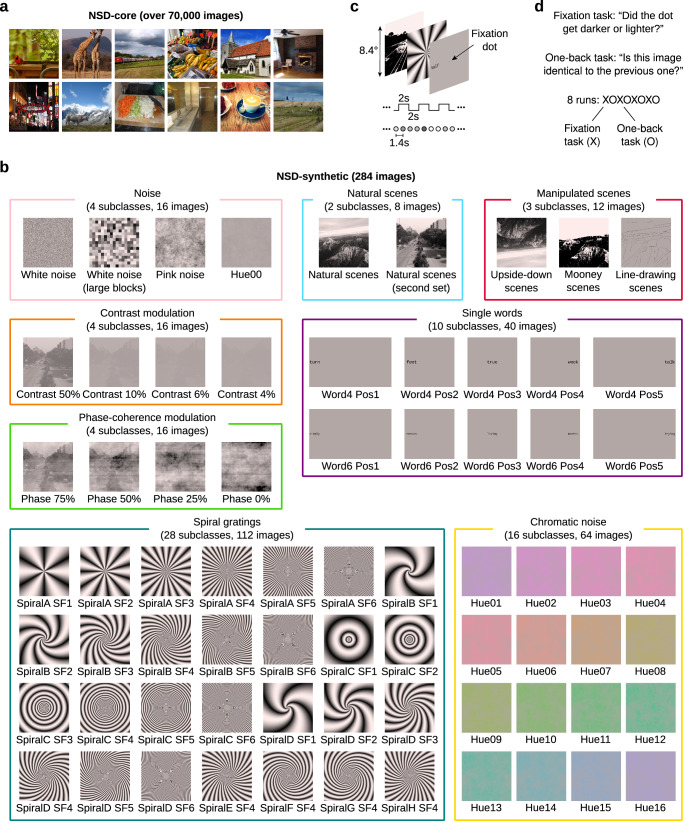
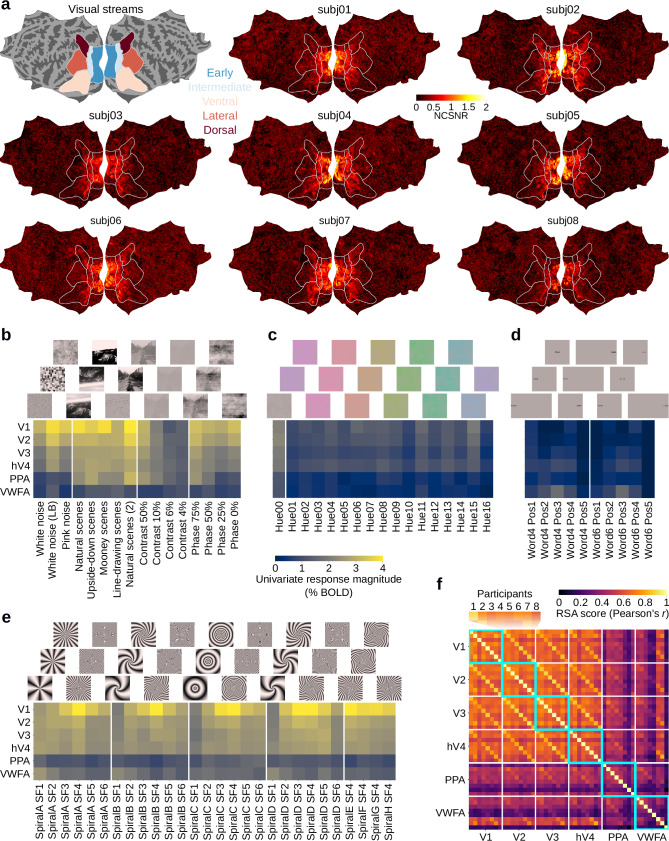
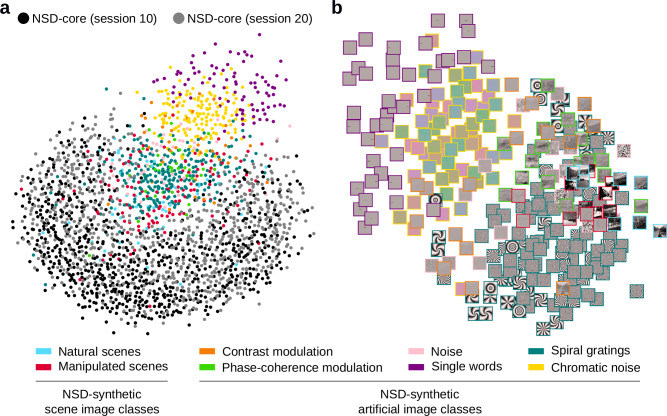
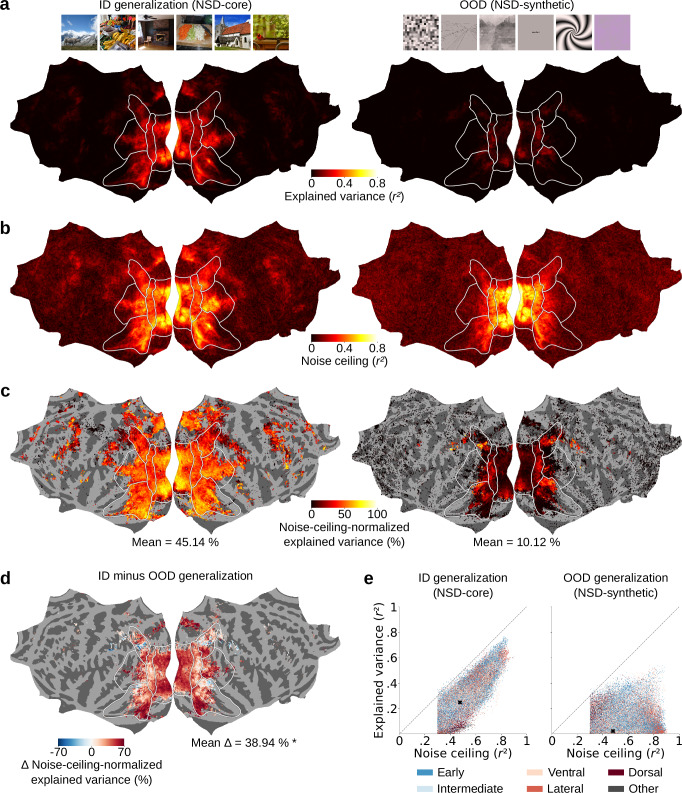
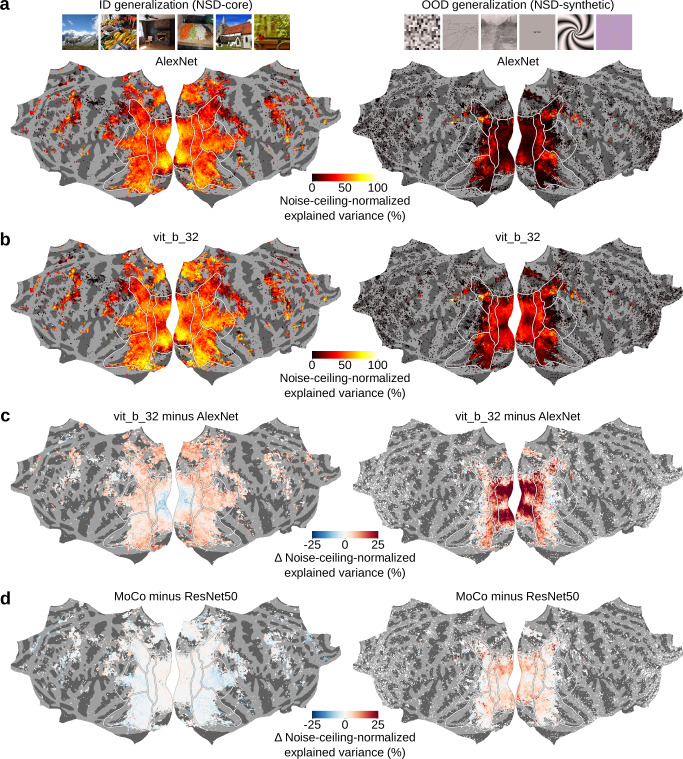
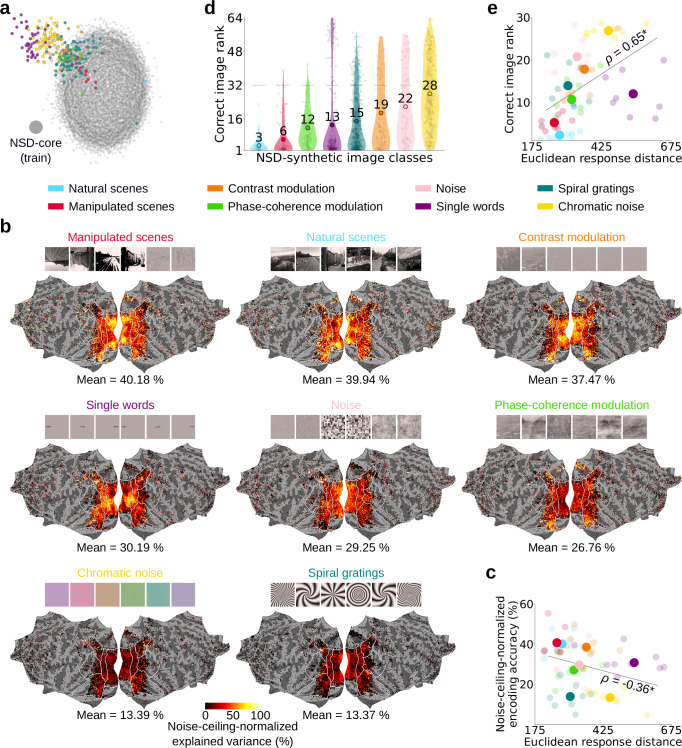
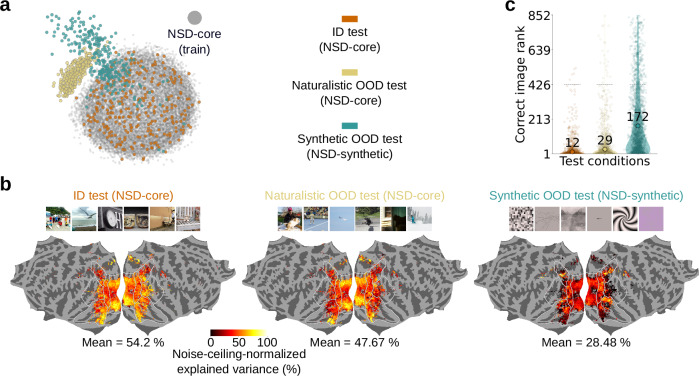
Large-scale visual neural datasets such as the Natural Scenes Dataset (NSD) are enabling models of the brain with performances beyond what was possible just a decade ago. However, because the stimuli of these datasets typically live within a common naturalistic visual distribution, they make it challenging to implement out-of-distribution (OOD) generalization tests crucial for the development of robust brain models. Here, we address this by releasing NSD-synthetic, a dataset of 7T fMRI responses from the same eight NSD participants for 284 synthetic images. We show that NSD-synthetic’s fMRI responses reliably encode stimulus-related information and are OOD with respect to NSD; that OOD generalization tests on NSD-synthetic reveal differences between brain models that are not detected in-distribution; and that the degree of OOD (quantified as the test data distance from the training data) is predictive of the magnitude of model failures. Together, NSD-synthetic enables OOD generalization tests that facilitate the development of more robust models of visual processing.
Overview
The claims and statistics of this paper haven’t been checked yet.
Free: it reads the open-access text and checks the first 5 claims that cite a source we can check. Create a free account to check every claim.
Integrity signals
Registry
Cites
Statistics
Figures
Verification
Claims the paper makes
The claims and statistics of this paper haven’t been checked yet.
Free: it reads the open-access text and checks the first 5 claims that cite a source we can check. Create a free account to check every claim.
Claims other papers make about this one
Each is checked against this paper’s own text: does it say what the citing paper says it does?
The source backs part of the claim, not all of it — or backs it for a different population, condition or comparison.
In the citing paper
“This possibility is supported by recent work showing that ANNs achieving high neural prediction scores on natural scenes fail on out-of-distribution synthetic images [95]”
From The Umwelt Representation Hypothesis: rethinking Universality (2026) · cites this paper as [95]
Experimental — accuracy not yet measured
Self-check
Percentages, sums and reported differences re-computed from the paper’s own numbers.
The self-check needs the paper’s full text.
Citations
Cites
Deep Residual Learning for Image Recognition
He, K., Zhang, X., Ren, S., & Sun, J. (2016) · 2016 IEEE Conference on Computer Vision and Pattern Recognition (CVPR) · doi:10.1109/cvpr.2016.90 · Cited by 235,474
An Image is Worth 16x16 Words: Transformers for Image Recognition at Scale
Dosovitskiy, A., Beyer, L., Kolesnikov, A., Weissenborn, D., Zhai, X., Unterthiner, T., Dehghani, M., Minderer, M., Heigold, G., Gelly, S., et al. (2020) · arXiv · doi:10.48550/arxiv.2010.11929 · Cited by 47,472
ImageNet Large Scale Visual Recognition Challenge
Russakovsky, O., Deng, J., Su, H., Krause, J., Satheesh, S., Ma, S., Huang, Z., Karpathy, A., Khosla, A., Bernstein, M., et al. (2015) · International Journal of Computer Vision · doi:10.1007/s11263-015-0816-y · Cited by 39,380
Momentum Contrast for Unsupervised Visual Representation Learning
He, K., Fan, H., Wu, Y., Xie, S., & Girshick, R. (2020) · 2020 IEEE/CVF Conference on Computer Vision and Pattern Recognition (CVPR) · doi:10.1109/cvpr42600.2020.00975 · Cited by 13,347
The fusiform face area: a module in human extrastriate cortex specialized for face perception
Kanwisher, N., McDermott, J., & Chun, M. M. (1997) · The Journal of Neuroscience · doi:10.1523/jneurosci.17-11-04302.1997 · Cited by 7,738 · cited 3×
“The second deep neural network was vit_b_32, a vision transformer pretrained on image classi fi cation 50 , for which we used the activations from the output of the lastsublayer of eachofthe twelve model layers.”
Receptive fields and functional architecture of monkey striate cortex
Hubel, D. H., & Wiesel, T. N. (1968) · The Journal of Physiology · doi:10.1113/jphysiol.1968.sp008455 · Cited by 6,568
Representational similarity analysis-connecting the branches of systems neuroscience
Kriegeskorte, N. (2008) · Frontiers in Systems Neuroscience · doi:10.3389/neuro.06.004.2008 · Cited by 3,355
A cortical representation of the local visual environment
Epstein, R., & Kanwisher, N. (1998) · Nature · doi:10.1038/33402 · Cited by 2,984
A cortical area selective for visual processing of the human body
Downing, P. E., Jiang, Y., Shuman, M., & Kanwisher, N. (2001) · Science · doi:10.1126/science.1063414 · Cited by 2,043
How does the brain solve visual object recognition?
DiCarlo, J. J., Zoccolan, D., & Rust, N. C. (2012) · Neuron · doi:10.1016/j.neuron.2012.01.010 · Cited by 1,790 · cited 3×
“We believe this re fl ects the limited visualand semantic complexity of NSD-synthetic ’ s stimuli,which leads to reduced signals in higher visual areas that preferentially respond to more complex visual features 27 – 32 .”
Research works printed but not linked: 4
- 42. Davison, M. L. & Sireci, S. G. Multidimensional Scaling. Handb. Appl. Multivar. Stat. Math. Modeling 323, 352 (2000).
- 53. Zbontar, J., Jing, L., Misra, I., LeCun, Y. & Deny, S. Barlow twins: Self-supervised learning via redundancy reduction. in Proceedings of the 38th international conference on machine learning (eds Meila, M. & Zhang, T.) vol. 139, 12310–12320 (PMLR, 2021).
- 59. Schaeffer, R. et al. Does maximizing neural regression scores teach us about the brain? in UniReps: 2nd edition of the workshop on unifying representations in neural models (2024).
- 70. Singer, J. J. D., Cichy, R. M. & Hebart, M. N. The spatiotemporal neural dynamics of object recognition for natural images and line drawings. J. Neurosci. 43, 484–500 (2023). 36535769 10.1523/JNEUROSCI.1546-22.2022 PMC9864561 · doi:10.1523/jneurosci.1546-22.2022
Cited by
In silico discovery of representational relationships across visual cortex
Gifford, A. T., Jastrzębowska, M. A., Singer, J., & Cichy, R. M. (2025) · Nature Human Behaviour · doi:10.1038/s41562-025-02252-z · Cited by 12
Self-citationLi, Y., Liu, X., Li, W., Yang, J., Gong, B., Jin, W., Gong, Z., Wang, K., Luo, J., Zhao, Z., et al. (2026) · Nature Neuroscience · doi:10.1038/s41593-026-02322-z · Cited by 9
Spatial Frequency Maps in Human Visual Cortex: A Replication and Extension
Ha, J., Broderick, W. F., Kay, K., & Winawer, J. A. (2023) · Journal of Vision · doi:10.1167/jov.23.9.5624 · Cited by 6
Self-citationSpatial frequency maps in human visual cortex: A replication and extension
Ha, J., Broderick, W. F., Kay, K., & Winawer, J. A. (2026) · Journal of Vision · doi:10.1167/jov.26.11.4 · Cited by 3
Self-citationMOSAIC: A scalable framework for fMRI dataset aggregation and modeling of human visionPreprint
Lahner, B., Deb, M., Murty, N. A. R., & Oliva, A. (2025) · bioRxiv (Cold Spring Harbor Laboratory) · doi:10.64898/2025.11.28.690060 · Cited by 3
The Umwelt Representation Hypothesis: rethinking Universality
Bosch, V., Sommers, R. P., Doerig, A., & Kietzmann, T. C. (2026) · Trends in Cognitive Sciences · doi:10.1016/j.tics.2026.07.004 · Cited by 2
BrainRiem: Riemannian Prototype Learning for Source-Free Cross-Site Brain Network Diagnosis
Zhang, K., & Xu, T. (2026) · Lecture notes in computer science · doi:10.1007/978-3-032-37174-4_18 · Cited by 3
Gifford, A. T., Oyarzo, P., Zonneveld, A. W., Sartzetaki, C., Groen, I. I. A., & Cichy, R. M. (2026) · arXiv (Cornell University) · doi:10.48550/arxiv.2608.28768 · Cited by 1
Self-citationZero-shot evaluations expose structured generalization limits in predictive models of the brainPreprint
Wang, R., Deb, M., Abate, A., Dipani, A., Dudipala, K. R., Chillarege, S., Ravikanti, K., Li, Y., Al-Tahan, H., Koushik, R., et al. (2026) · bioRxiv (Cold Spring Harbor Laboratory) · doi:10.64898/2026.09.15.751562 · Cited by 1
Wang, R., Li, Y., Deb, M., Dudipala, K. R., Ravikanti, K., Chillarege, S., Bhanushali, A., Koushik, R., Katiyar, A., & Murty, N. A. R. (2026) · CHI Conference Extended Abstracts on Human Factors in Computing Systems (CHI EA) · doi:10.1145/3772363.3798548
Yanez-Ramos, M. G., Valencia, G. O., Huang, H., Gregg, N. M., Bilderbeek, J. A., Montoya, M., Kay, K., Worrell, G. A., Miller, K. J., & Hermes, D. (2026) · bioRxiv (Cold Spring Harbor Laboratory) · doi:10.64898/2026.04.14.718565
Self-citationHow Much is Brain Data Worth for Machine Learning?Preprint
Lewis, L., Wang, Z., Schwab, D. J., & Pitkow, X. (2026) · arXiv (Cornell University) · doi:10.48550/arxiv.2605.09243
Beyond Prediction Accuracy: Target-Space Recovery Profiles for Evaluating Model-Brain AlignmentPreprint
Nakamura, K., Nakai, T., Yashiro, R., Yamashita, A., & Amano, K. (2026) · arXiv (Cornell University) · doi:10.48550/arxiv.2605.20127
Naturalistic stimulus reconstruction from fMRI: A primer in the Natural Scenes Dataset
Yıldız, U., & Ürgen, B. A. (2026) · Aperture Neuro · doi:10.52294/001c.162412
When minds become data: brain–computer interfaces and the future of mental privacy
Seymour, K., Ienca, M., & Koenig‐Robert, R. (2026) · Trends in Neurosciences · doi:10.1016/j.tins.2026.09.003
Jin, J., Wang, W., Han, J., Wu, J., Yang, Q., Chen, L., Cai, S., 高红昌, Cai, C., & Chen, Z. (2026) · Magnetic Resonance Letters · doi:10.1016/j.mrl.2026.200315
Metadata
- Authors
- Gifford, A. T., Cichy, R. M., Naselaris, T., & Kay, K.
- Affiliations
- Humboldt-Universität zu Berlin (DE)
- University of Minnesota (US)
- Corresponding author
- Gifford, Alessandro T.
- Kay, Kendrick
- Venue
- Nature Communications
- Published
- 2026-02-09
- Volume
- 17
- Issue
- 1
- Pages
- 1589-1589
- ISSN
- 2041-1723 (ISSN-L)
- PMC
- PMC12901131
- OpenAlex
- W7128426427
- Cited by
- 6
- References
- 73
- Citations by year
- 2026: 6
- FWCI
- 24.71
- Type
- journal article
- Language
- en
- Open access
- gold
- doi.org
- Licence
- cc-by
- creativecommons.org/licenses/by/4.0 (tdm)
- creativecommons.org/licenses/by/4.0 (vor, 3 d)
- Locations
- Nature Communications (publishedVersion, cc-by)
- Europe PMC (PubMed Central) (publishedVersion, cc-by)
- PubMed (publishedVersion)
- PubMed Central (publishedVersion, cc-by)
- arXiv (Cornell University) (submittedVersion)
- DOAJ (DOAJ: Directory of Open Access Journals) (submittedVersion, cc-by-sa)
- arXiv (Cornell University)
- Funders
- National Eye Institute (R01EY034118)
- Topics
- Life Sciences › Neuroscience › Cognitive Neuroscience › Visual perception and processing mechanisms
- Health Sciences › Medicine › Radiology, Nuclear Medicine and Imaging › Advanced MRI Techniques and Applications
- Physical Sciences › Computer Science › Computer Vision and Pattern Recognition › Visual Attention and Saliency Detection
- Keywords
- out-of-distribution generalization, naturalistic visual stimuli, 7T fMRI, synthetic images, visual cortex responses, stimulus encoding
- MeSH terms
- Brain, Brain Mapping, Humans, Magnetic Resonance Imaging, Models, Neurological, Photic Stimulation, Vision, Ocular, Visual Cortex, Visual Perception
About these checks
Registry, retraction, Cites and statistics results are computed, not judged, with one exception: a printed reference that no index lists is read once by a model before it counts as a citation error. Claims are extracted by a model and kept only when their quote appears verbatim in the text; each cited source is then checked, with a model’s help, for whether it says what the claim relies on. Those verdicts can be wrong — read the claim’s quote and the cited source before relying on one.
Statistics and arithmetic are recomputed, not judged.
Confidence bands are shown only for fields calibrated on our annotated test set. None is calibrated yet, so no band is shown.
What counts as a claim ›How we measure confidence ›How we check this ›
Are you an author, or do you see a problem with this page? Request a review
Data sources
Bibliographic data: Semantic Scholar, OpenAlex, Crossref.
Contains information from the Semantic Scholar Academic Graph Datasets, made available under the ODC Attribution License (ODC-BY 1.0).
Semantic Scholar’s data is described in: Kinney, R., et al. (2023). The Semantic Scholar Open Data Platform. arXiv:2301.10140.
