

The DOI matches its Crossref record; 2 of the 2 references it cites were found in a registry or an index.
Establishment and characterization of immortalized human breast cancer cell lines from breast cancer patient-derived xenografts (PDX)
Abstract
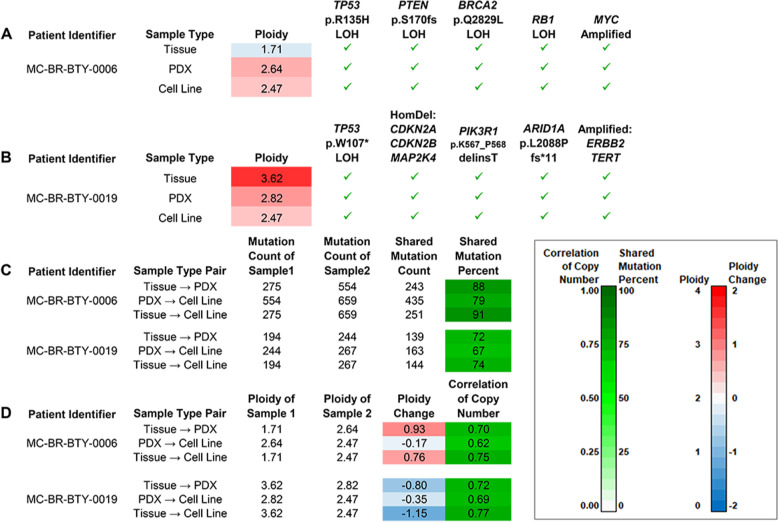
The application of patient-derived xenografts (PDX) in drug screening and testing is a costly and time-consuming endeavor. While cell lines permit extensive mechanistic studies, many human breast cancer cell lines lack patient characteristics and clinical treatment information. Establishing cell lines that retain patient’s genetic and drug response information would enable greater drug screening and mechanistic studies. Therefore, we utilized breast cancer PDX from the Mayo Breast Cancer Genome Guided Therapy Study (BEAUTY) to establish two immortalized, genomically unique breast cancer cell lines. Through extensive genetic and therapeutic testing, the cell lines were found to retain the same clinical subtype, major somatic alterations, and drug response phenotypes as their corresponding PDX and patient tumor. Our findings demonstrate PDX can be utilized to develop immortalized breast cancer cell lines and provide a valuable tool for understanding the molecular mechanism of drug resistance and exploring novel treatment strategies.
Overview
The claims and statistics of this paper haven’t been checked yet.
Run the check — free, no account needed. It reads the open-access text and checks the sources it cites.
Integrity signals
Registry
Cites
Statistics
Figures
Verification
Claims the paper makes
The claims and statistics of this paper haven’t been checked yet.
Run the check — free, no account needed. It reads the open-access text and checks the sources it cites.
Claims other papers make about this one
Each is checked against this paper’s own text: does it say what the citing paper says it does?
In the citing paper
“Additionally, creating cell lines that preserve genetic information and drug responses can enable more drug screening and mechanistic studies [35].”
From Cell Immortality: In Vitro Effective Techniques to Achieve and Investigate Its Applications and Challenges (2024) · cites this paper as [35]
Self-check
Percentages, sums and reported differences re-computed from the paper’s own numbers.
The self-check needs the paper’s full text.
Citations
Cites
The COSMIC Cancer Gene Census: describing genetic dysfunction across all human cancers
Sondka, Z., Bamford, S., Cole, C. G., Ward, S. A., Dunham, I., & Forbes, S. A. (2018) · Nature Reviews Cancer · doi:10.1038/s41568-018-0060-1 · Cited by 1,597
Luca, A. C., Mersch, S., Deenen, R., Schmidt, S., Messner, I., Schäfer, K.-L., Baldus, S. E., Huckenbeck, W., Piekorz, R. P., Knoefel, W. T., et al. (2013) · PLoS ONE · doi:10.1371/journal.pone.0059689 · Cited by 341
Research works printed but not linked: 39
- Mirabelli, P., Coppola, L. & Salvatore, M. Cancer cell lines are useful model systems for medical research. Cancers 11, https://doi.org/10.3390/cancers11081098 (2019). · DOI
- Paul, J. The cancer cell in vitro: a review. Cancer Res. 22, 431–440 (1962).
- Lasfargues, E. Y. & Ozzello, L. Cultivation of human breast carcinomas. J. Natl Cancer Inst. 21, 1131–1147 (1958).
- Miserocchi, G. et al. Management and potentialities of primary cancer cultures in preclinical and translational studies. J. Transl. Med. 15, 229 (2017). · DOI
- Yu, J. et al. Establishing and characterizing patient-derived xenografts using pre-chemotherapy percutaneous biopsy and post-chemotherapy surgical samples from a prospective neoadjuvant breast cancer study. Breast Cancer Res. 19, 130 (2017). · DOI
- Goetz, M. P. et al. Tumor sequencing and patient-derived xenografts in the neoadjuvant treatment of breast cancer. J. Natl Cancer Inst. 109, https://doi.org/10.1093/jnci/djw306 (2017). · DOI
- Yu, J. et al. DNA methyltransferase expression in triple-negative breast cancer predicts sensitivity to decitabine. J. Clin. Investig. 128, 2376–2388 (2018). · DOI
- Smith, H. S., Wolman, S. R. & Hackett, A. J. The biology of breast cancer at the cellular level. Biochim. Biophys. Acta 738, 103–123 (1984).
- Smith, H. S. et al. Immortalization in culture: occurrence at a late stage in the progression of breast cancer. J. Natl Cancer Inst. 78, 611–615 (1987).
- Dai, X., Cheng, H., Bai, Z. & Li, J. Breast cancer cell line classification and its relevance with breast tumor subtyping. J. Cancer 8, 3131–3141 (2017). · DOI
- Kodack, D. P. et al. Primary patient-derived cancer cells and their potential for personalized cancer patient care. Cell Rep. 21, 3298–3309 (2017). · DOI
- Dangles-Marie, V. et al. Establishment of human colon cancer cell lines from fresh tumors versus xenografts: comparison of success rate and cell line features. Cancer Res. 67, 398–407 (2007). · DOI
- Cavalloni, G. et al. Establishment and characterization of a human intrahepatic cholangiocarcinoma cell line derived from an Italian patient. Tumour Biol. 37, 4041–4052 (2016). · DOI
- Matossian, M. D. et al. Drug resistance profiling of a new triple negative breast cancer patient-derived xenograft model. BMC Cancer 19, 205 (2019). · DOI
- Casey, S. C. et al. The effect of environmental chemicals on the tumor microenvironment. Carcinogenesis 36, S160–S183 (2015). · DOI
- Mota, A. L. et al. Molecular characterization of breast cancer cell lines by clinical immunohistochemical markers. Oncol. Lett. 13, 4708–4712 (2017).
- Voigtlaender, M., Schneider-Merck, T. & Trepel, M. Lapatinib. Recent Results Cancer Res. 211, 19–44 (2018). · DOI
- Abu Samaan, T. M., Samec, M., Liskova, A., Kubatka, P. & Busselberg, D. Paclitaxel’s mechanistic and clinical effects on breast cancer. Biomolecules 9, (2019). https://doi.org/10.3390/biom9120789. · DOI
- Hajitou, A. et al. A preclinical model for predicting drug response in soft-tissue sarcoma with targeted AAVP molecular imaging. Proc. Natl Acad. Sci. USA 105, 4471–4476 (2008). · DOI
- Holliday, D. L. & Speirs, V. Choosing the right cell line for breast cancer research. Breast Cancer Res. 13, 215 (2011). · DOI
- Negrini, S., Gorgoulis, V. G. & Halazonetis, T. D. Genomic instability—an evolving hallmark of cancer. Nat. Rev. Mol. Cell Biol. 11, 220–228 (2010). · DOI · Paper page
- Zhao, B. et al. ARID1A promotes genomic stability through protecting telomere cohesion. Nat. Commun. 10, 4067 (2019). · DOI
- ICGA-TCGA-Pan-Cancer-Analysis-of-Whole-Genomes-Consortium. Pan-cancer analysis of whole genomes. Nature 578, 82–93 (2020). · DOI · Paper page
- Sweeney, K. J., Swarbrick, A., Sutherland, R. L. & Musgrove, E. A. Lack of relationship between CDK activity and G1 cyclin expression in breast cancer cells. Oncogene 16, 2865–2878 (1998). · DOI
- Cowley, G. S. et al. Parallel genome-scale loss of function screens in 216 cancer cell lines for the identification of context-specific genetic dependencies. Sci. Data 1, 140035 (2014). · DOI
- Jacobi, N. et al. Organotypic three-dimensional cancer cell cultures mirror drug responses in vivo: lessons learned from the inhibition of EGFR signaling. Oncotarget 8, 107423–107440 (2017). · DOI · Paper page
- Ekert, J. E. et al. Three-dimensional lung tumor microenvironment modulates therapeutic compound responsiveness in vitro-implication for drug development. PLoS ONE 9, e92248 (2014). · DOI
- Khaled, W. T. & Liu, P. Cancer mouse models: past, present and future. Semin. Cell Dev. Biol. 27, 54–60 (2014). · DOI
- Zhang, D. et al. Activity of lapatinib is independent of EGFR expression level in HER2-overexpressing breast cancer cells. Mol. Cancer Ther. 7, 1846–1850 (2008). · DOI
- Burdall, S. E., Hanby, A. M., Lansdown, M. R. & Speirs, V. Breast cancer cell lines: friend or foe? Breast Cancer Res. 5, 89–95 (2003). · DOI
- Merlo, L. M., Wang, L. S., Pepper, J. W., Rabinovitch, P. S. & Maley, C. C. Polyploidy, aneuploidy and the evolution of cancer. Adv. Exp. Med. Biol. 676, 1–13 (2010). · DOI
- Ellingson, M. S. et al. Exome sequencing reveals frequent deleterious germline variants in cancer susceptibility genes in women with invasive breast cancer undergoing neoadjuvant chemotherapy. Breast Cancer Res. Treat. 153, 435–443 (2015). · DOI
- McKenna, A. et al. The Genome Analysis Toolkit: a MapReduce framework for analyzing next-generation DNA sequencing data. Genome Res. 20, 1297–1303 (2010). · DOI · Paper page
- McLaren, W. et al. The ensembl variant effect predictor. Genome Biol. 17, 122 (2016). · DOI · Paper page
- Haider, S. et al. A bedr way of genomic interval processing. Source Code Biol. Med. 11, 14 (2016). · DOI
- Cheng, D. T. et al. Memorial Sloan Kettering-Integrated Mutation Profiling of Actionable Cancer Targets (MSK-IMPACT): a hybridization capture-based next-generation sequencing clinical assay for solid tumor molecular oncology. J. Mol. Diagn. 17, 251–264 (2015). · DOI · Paper page
- Vogelstein, B. et al. Cancer-genome-landscapes. Science 339, 1546–1558 (2013). · DOI · Paper page
- Tate, J. G. et al. COSMIC: the catalogue of somatic mutations in cancer. Nucleic Acids Res. 47, D941–D947 (2019). · DOI · Paper page
- Herschkowitz, J. I., He, X., Fan, C. & Perou, C. M. The functional loss of the retinoblastoma tumour suppressor is a common event in basal-like and luminal B breast carcinomas. Breast Cancer Res. 10, R75 (2008). · DOI
Cited by
Chalak, M., Hesaraki, M., Mirbahari, S. N., Yeganeh, M., Abdi, S., Rajabi, S., & Hemmatzadeh, F. (2024) · Life · doi:10.3390/life14030417 · Cited by 66
Metadata
- Authors
- Zhuang, Y., Grainger, J. M., Vedell, P. T., Yu, J., Moyer, A. M., Gao, H., Fan, X.-Y., Qin, S., Liu, D., Kalari, K. R., Goetz, M. P., Boughey, J. C., Weinshilboum, R. M., & Wang, L.
- Venue
- npj Breast Cancer
- Published
- 2021-06-18
- Volume
- 7
- Issue
- 1
- ISSN
- 2374-4677
- PMC
- PMC8213738
- Cited by
- 11
- References
- 2
- Language
- en
About these checks
Registry, retraction, Cites and statistics results are computed, not judged, with one exception: a printed reference that no index lists is read once by a model before it counts as a citation error. Claims are extracted by a model and kept only when their quote appears verbatim in the text; each cited source is then checked, with a model’s help, for whether it says what the claim relies on. Those verdicts can be wrong — read the claim’s quote and the cited source before relying on one.
Statistics and arithmetic are recomputed, not judged.
Confidence bands are shown only for fields calibrated on our annotated test set. None is calibrated yet, so no band is shown.
What counts as a claim ›How we measure confidence ›How we check this ›
Are you an author, or do you see a problem with this page? Request a review
How to cite
Cite CoChat for the checks on this page, and the paper for its own findings.
- This page
- CoChat. (2026). Citation check: Establishment and characterization of immortalized human breast cancer cell lines from breast cancer patient-derived xenografts (PDX). https://app.cochat.ai/papers/10.1038/s41523-021-00285-x
- The paper
- Zhuang, Y., Grainger, J. M., Vedell, P. T., Yu, J., Moyer, A. M., Gao, H., Fan, X.-Y., Qin, S., Liu, D., Kalari, K. R., Goetz, M. P., Boughey, J. C., Weinshilboum, R. M., & Wang, L. (2021). Establishment and characterization of immortalized human breast cancer cell lines from breast cancer patient-derived xenografts (PDX). npj Breast Cancer. https://doi.org/10.1038/s41523-021-00285-x
