

GRHL2 motif is associated with intratumor heterogeneity of cis-regulatory elements in luminal breast cancer
Open accessThe DOI matches its Crossref record; 46 of the 46 references it cites were found in a registry or an index.
Abstract
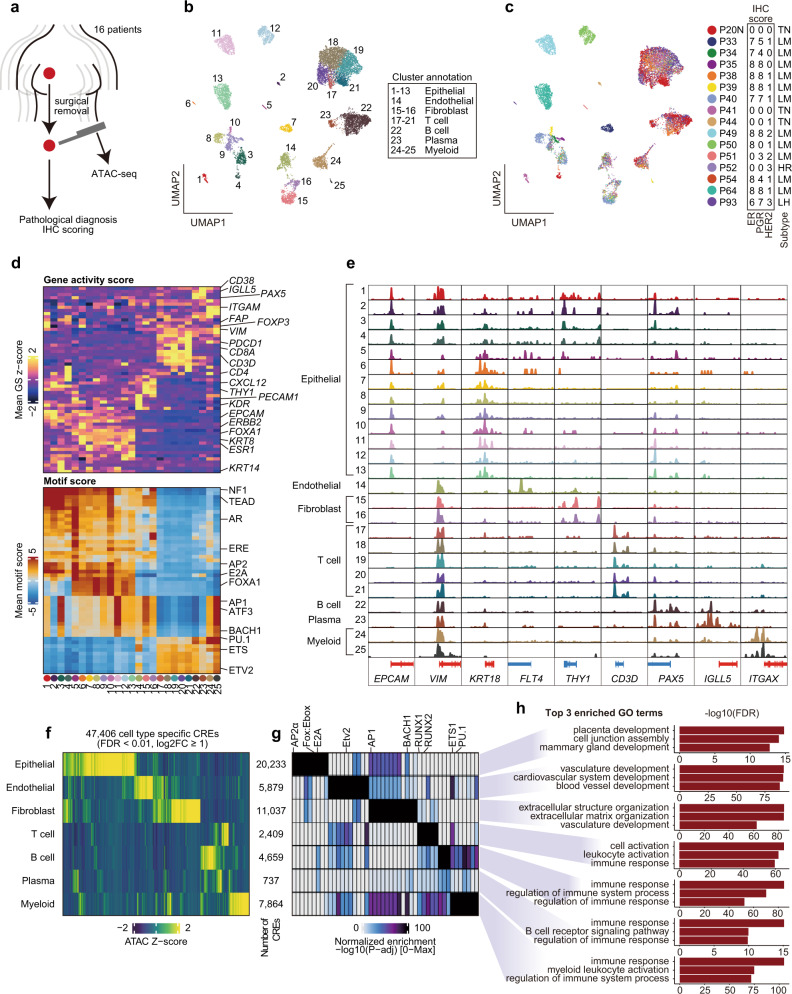
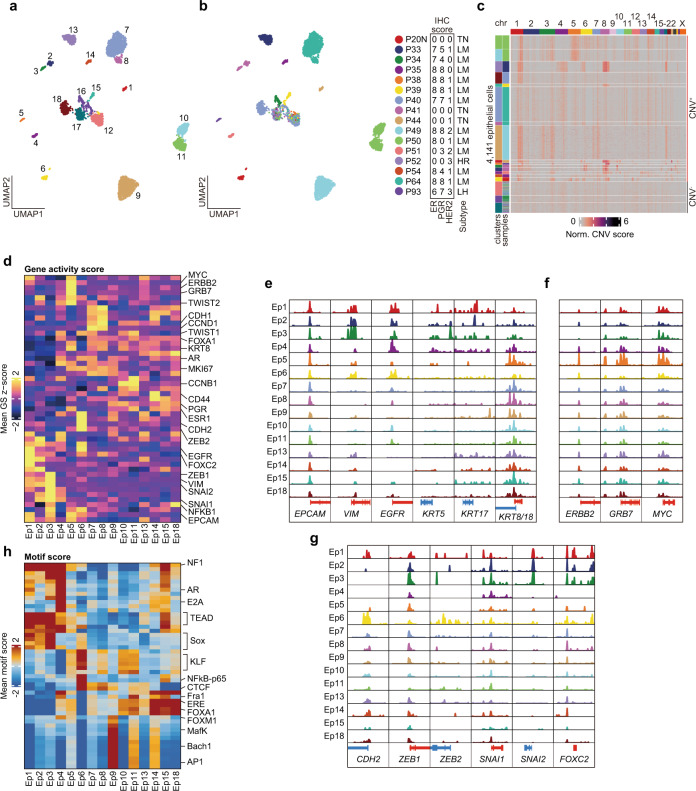
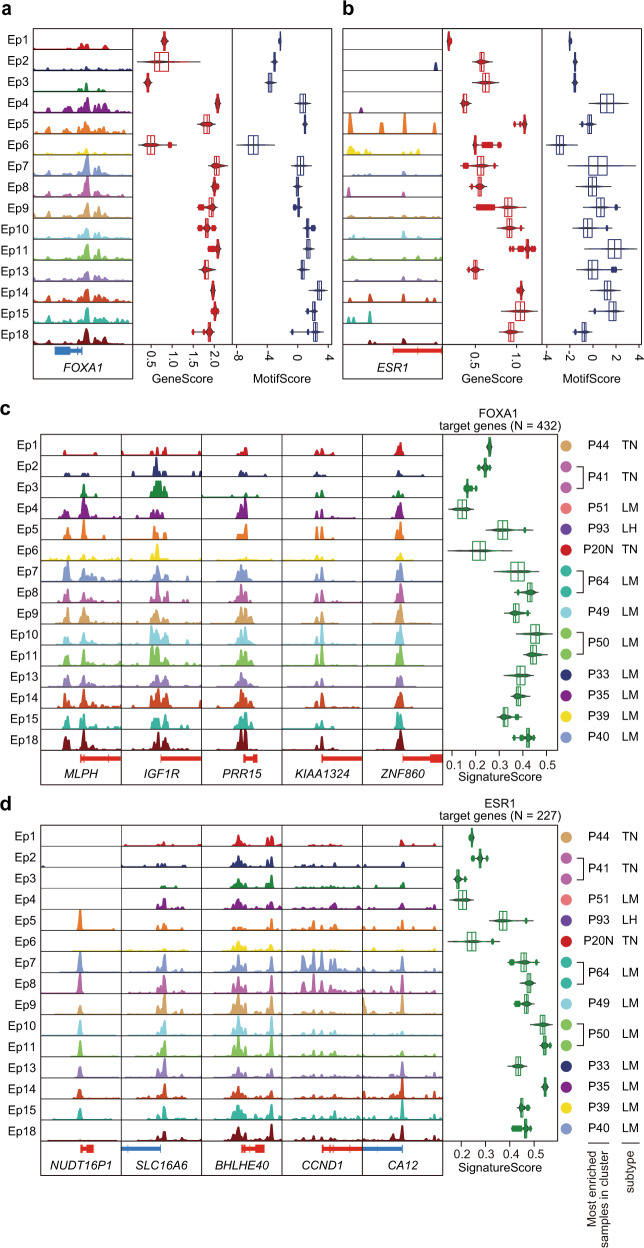
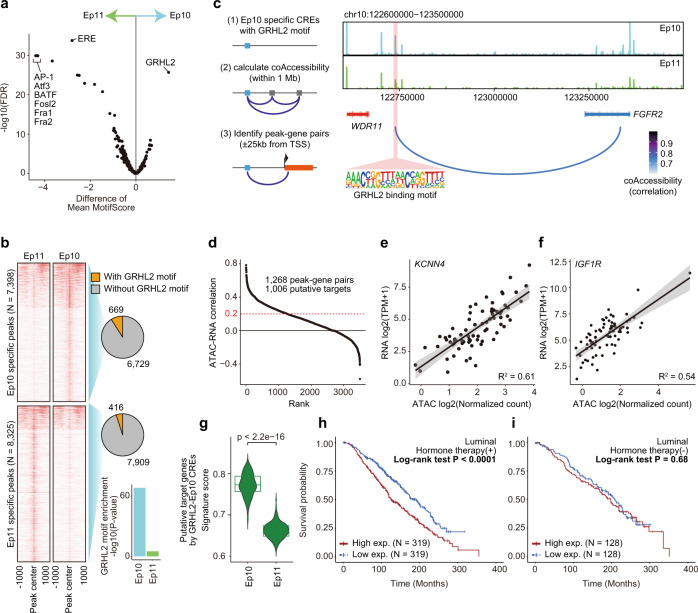
In breast cancer patients, tumor heterogeneity is associated with prognosis and therapeutic response; however, the epigenetic diversity that exists in primary tumors remains unknown. Using a single-cell sequencing assay for transposase-accessible chromatin (scATAC-seq), we obtained the chromatin accessibility profiles of 12,452 cells from 16 breast cancer patients including 11 luminal, 1 luminal-HER2, 1 HER2+, and 3 triple-negative subtypes. Via this profiling process, tumors were classified into cancer cells and the tumor microenvironment, highlighting the heterogeneity of disease-related pathways including estrogen receptor (ER) signaling. Furthermore, the coexistence of cancer cell clusters with different ER binding motif enrichments was identified in a single ER+ tumor. In a cluster with reduced ER motif enrichment, we identified GRHL2, a transcription factor, as the most enriched motif, and it cooperated with FOXA1 to initiate endocrine resistance. Coaccessibility analysis revealed that GRHL2 binding elements potentially regulate genes associated with endocrine resistance, metastasis, and poor prognosis in patients that received hormonal therapy. Overall, our study suggests that epigenetic heterogeneity could lead to endocrine resistance and poor prognosis in breast cancer patients and it offers a large-scale resource for further cancer research.
Overview
The claims and statistics of this paper haven’t been checked yet.
Free: it reads the open-access text and checks the first 5 claims that cite a source we can check. Create a free account to check every claim.
Integrity signals
Registry
Cites
Statistics
Figures
Verification
Claims the paper makes
The claims and statistics of this paper haven’t been checked yet.
Free: it reads the open-access text and checks the first 5 claims that cite a source we can check. Create a free account to check every claim.
Self-check
Percentages, sums and reported differences re-computed from the paper’s own numbers.
The self-check needs the paper’s full text.
Citations
Cites
PD-1 and PD-L1 Immune Checkpoint Blockade to Treat Breast Cancer
Hartkopf, A. D., Taran, F.-A., Wallwiener, M., Walter, C. B., Krämer, B., Grischke, E.-M., & Brucker, S. Y. (2016) · Breast Care · doi:10.1159/000453569 · Cited by 30,845
Integrated analysis of multimodal single-cell data
Hao, Y., Hao, S., Andersen-Nissen, E., Mauck, W. M., Zheng, S., Butler, A., Lee, M. J., Wilk, A. J., Darby, C., Zagar, M., et al. (2020) · doi:10.1101/2020.10.12.335331 · Cited by 15,508
Heinz, S., Benner, C., Spann, N., Bertolino, E., Lin, Y. C., Laslo, P., Cheng, J. X., Murre, C., Singh, H., & Glass, C. K. (2010) · Molecular Cell · doi:10.1016/j.molcel.2010.05.004 · Cited by 13,382
Nishimura, R., Osako, T., Nishiyama, Y., Tashima, R., Nakano, M., Fujisue, M., Toyozumi, Y., & Arima, N. (2013) · Oncology · doi:10.1159/000353099 · Cited by 13,166
Self-citationComprehensive molecular portraits of human breast tumours
The Cancer Genome Atlas Network (2012) · Nature · doi:10.1038/nature11412 · Cited by 12,129
The genomic and transcriptomic architecture of 2,000 breast tumours reveals novel subgroups
METABRIC Group, Curtis, C., Shah, S. P., Chin, S.-F., Turashvili, G., Rueda, O. M., Dunning, M. J., Speed, D., Lynch, A. G., Samarajiwa, S., et al. (2012) · Nature · doi:10.1038/nature10983 · Cited by 6,097
Lehmann, B. D., Bauer, J. A., Chen, X., Sanders, M. E., Chakravarthy, A. B., Shyr, Y., & Pietenpol, J. A. (2011) · Journal of Clinical Investigation · doi:10.1172/jci45014 · Cited by 5,592
Dissecting the multicellular ecosystem of metastatic melanoma by single-cell RNA-seq
Tirosh, I., Izar, B., Prakadan, S. M., Wadsworth, M. H., Treacy, D., Trombetta, J. J., Rotem, A., Rodman, C., Lian, C., Murphy, G., et al. (2016) · Science · doi:10.1126/science.aad0501 · Cited by 4,944
GREAT improves functional interpretation of cis-regulatory regions
McLean, C. Y., Bristor, D., Hiller, M., Clarke, S. L., Schaar, B. T., Lowe, C. B., Wenger, A. M., & Bejerano, G. (2010) · Nature Biotechnology · doi:10.1038/nbt.1630 · Cited by 4,502
TCGAbiolinks: an R/Bioconductor package for integrative analysis of TCGA data
Colaprico, A., Silva, T. C., Olsen, C., Garofano, L., Cava, C., Garolini, D., Sabedot, T. S., Malta, T. M., Pagnotta, S. M., Castiglioni, I., et al. (2016) · Nucleic Acids Research · doi:10.1093/nar/gkv1507 · Cited by 4,183
Cited by
Epigenetic regulation during cancer transitions across 11 tumour types
Terekhanova, N. V., Karpova, A., Liang, W.-W., Strzalkowski, A., Chen, S., Li, Y., Southard-Smith, A. N., Iglesia, M. D., Wendl, M. C., Jayasinghe, R. G., et al. (2023) · Nature · doi:10.1038/s41586-023-06682-5 · Cited by 207
Single-cell sequencing technology applied to epigenetics for the study of tumor heterogeneity
Hu, Y., Shen, F., Yang, X., Han, T., Long, Z., Wen, J., Huang, J., Shen, J., & Guo, Q. (2023) · Clinical Epigenetics · doi:10.1186/s13148-023-01574-x · Cited by 108
“Another study, by scATAC-seq of 12 breast cancer patients, found that the transcription factor GRHL2 cooperates with FOXA1 to initiate endocrine resistance and that epigenetic heterogeneity may contribute to endocrine resistance in breast cancer patients [70].”
BackgroundEpigenomic heterogeneity as a source of tumour evolution
Laisné, M., Lupien, M., & Vallot, C. (2024) · Nature reviews. Cancer · doi:10.1038/s41568-024-00757-9 · Cited by 113
Subbalakshmi, A. R., Sahoo, S., Manjunatha, P., Goyal, S., Kasiviswanathan, V. A., Mahesh, Y., Ramu, S., McMullen, I., Somarelli, J. A., & Jolly, M. K. (2023) · Journal of Biological Engineering · doi:10.1186/s13036-023-00333-z · Cited by 50
“GRHL2 has also been reported to be lineage-specific driver of reprogrammed estrogen signaling and an enabler of endocrine resistance in ER+ breast cancer (Cocce et al., 2019; Kumegawa et al., 2022).”
BackgroundFang, K., Ohihoin, A. G., Liu, T., Choppavarapu, L., Nosirov, B., Wang, Q., Yu, X., Kamaraju, S., Leone, G. W., & Jin, V. X. (2024) · Genome Medicine · doi:10.1186/s13073-024-01407-3 · Cited by 38
Regner, M. J., García‐Recio, S., Thennavan, A., Wiśniewska, K., Méndez-Giráldez, R., Felsheim, B., Spanheimer, P. M., Parker, J. S., Perou, C. M., & Franco, H. L. (2025) · Cell Genomics · doi:10.1016/j.xgen.2025.100765 · Cited by 28
Lewis, M. W., King, C. M., Wiśniewska, K., Regner, M. J., Coffey, A. R., Kelly, M. R., Méndez-Giráldez, R., Davis, E. S., Phanstiel, D. H., & Franco, H. L. (2024) · Cancer Research · doi:10.1158/0008-5472.can-23-3995 · Cited by 18
Miyata, K., Zhou, X., Nishio, M., Hanyu, A., Chiba, M., Kawasaki, H., Osako, T., Takeuchi, K., Ohno, S., Ueno, T., et al. (2023) · Proceedings of the National Academy of Sciences · doi:10.1073/pnas.2305046120 · Cited by 14
“As previously reported (39), we also obtained a gene score matrix using “getMa-trixFromProject()” to get a preimputed matrix, “imputeMatrix()” for matrix imputation with MAGIC, and log2 (Imputed gene score + 1) for normalization.”
Self-citationKumegawa, K., Saeki, S., Takahashi, Y., Yang, L., Osako, T., Nakadai, T., Amino, S., Maeda, T., Takahata, C., Mori, S., et al. (2023) · British Journal of Cancer · doi:10.1038/s41416-023-02178-1 · Cited by 14
“We categorised distal cancer CREs using a set of TME-derived CREs previously reported in our scATAC profile of primary breast tumours [28] identifying a subset of ER-positive tumours with sustained ER expression (at both the RNA and protein levels).”
MethodSelf-citationZhou, Y., Tian, L., Choppavarapu, L., Fang, K., Lin, S., & Jin, V. X. (2024) · Nature Communications · doi:10.1038/s41467-024-52440-0 · Cited by 13
“Among them, CEBPB, COX7A2L, NELFA, SRSF1, TXNRD1, UBE2I had epithelial cell-speci fi c cis -regulatory elements at their distal regions in luminal breast cancer patient tissue 49 .”
EpiCHAOS: a metric to quantify epigenomic heterogeneity in single-cell data
Kelly, K., Scherer, M., Braun, M. M., Lutsik, P., & Plass, C. (2024) · Genome biology · doi:10.1186/s13059-024-03446-w · Cited by 10
“Using technologies such as the Assay for Transposase Accessible Chromatin with sequencing (scATAC-seq), the presence of epigenetically distinct clusters within tumors – the simplest layer of epigenetic heterogeneity – has been demonstrated across a broad range of cancer types 13,14,15,16 .”
Sabit, H., Yadav, A. K., Salimy, S., Sakr, A., Abdel-Ghany, S. E., Wadan, A. S., Alqosaibi, A. I., Rashwan, R., Algosaibi, S., Alnamshan, M. M., et al. (2026) · Cancer Letters · doi:10.1016/j.canlet.2026.218468 · Cited by 13
Yang, L., Kumegawa, K., Saeki, S., Nakadai, T., & Maruyama, R. (2024) · Cancer Gene Therapy · doi:10.1038/s41417-024-00745-z · Cited by 10
“Cells were cultured according to recommended guidelines, with speci fi c details outlined in Supplementary Table 1.”
Self-citationRobust estimation of cancer and immune cell-type proportions from bulk tumor ATAC-Seq data
Gabriel, A. A., Racle, J., Falquet, M., Jandus, C., & Gfeller, D. (2024) · eLife · doi:10.7554/elife.94833.4 · Cited by 8
cfDNA UniFlow: a unified preprocessing pipeline for cell-free DNA data from liquid biopsies
Röner, S., Burkard, L., Speicher, M. R., & Kircher, M. (2024) · GigaScience · doi:10.1093/gigascience/giae102 · Cited by 5
“As user-181 defined regions of interest, we selected 10,000 binding sites of LYL1, a transcription factor (TF) associated with hematopoietic cells [33], and GRHL2, an important pioneer TF for epithelial cells [34 – 36] playing a role in a wide variety of cancer types [37 – 41].”
Elevated GRHL2 Imparts Plasticity in ER-Positive Breast Cancer Cells
Zheng, C., Allen, K. O., Liu, T., Solodin, N. M., Meyer, M. B., Salem, K., Tsourkas, P. K., McIlwain, S. J., Vera, J. M., Cromwell, E. R., et al. (2024) · Cancers · doi:10.3390/cancers16162906 · Cited by 4
“Together, these findings indicate that elevated levels of GRHL2 in ER-positive breast cancer cells can alter its DNA binding activity to promote the expression of genes implicated in a plastic, hybrid state that is associated with increased metastatic potential.”
BackgroundCutting‑edge advances in endocrine therapy for breast cancer (Review)
Yumei, D. O. N. G., Shao, L., Li, Q., Qi, Y., Liu, T., Wei, S., & Qi, H. (2026) · Oncology Letters · doi:10.3892/ol.2026.15569 · Cited by 4
HyGAnno: hybrid graph neural network–based cell type annotation for single-cell ATAC sequencing data
Zhang, W., Cui, Y., Liu, B., Loza, M., Park, S., & Nakai, K. (2024) · Briefings in Bioinformatics · doi:10.1093/bib/bbae152 · Cited by 6
“Based on previous works [27, 29], we inferred the DNA copy number variation (CNV) signals by calculating the normalized CNV scores of the scATAC-seq data (Fig.”
MethodMeng, Y., Zhou, D., Luo, Y., Chen, J., & Li, H. (2024) · Cancer Cell International · doi:10.1186/s12935-024-03245-0 · Cited by 4
“However, the rationale behind the lack of upregulation of GRHL2 expression upon ERα overexpression has not been investigated [22, 31].”
BackgroundDelineating highly transcribed noncoding elements landscape in breast cancer
Zhu, W., Huang, H., Ming, W., Zhang, R., Gu, Y., Bai, Y., Liu, X., Liu, H., Liu, Y., Gu, W., et al. (2023) · Computational and Structural Biotechnology Journal · doi:10.1016/j.csbj.2023.09.009 · Cited by 3
“GRHL2-HTNE, one of the HTNEs, was distinctly marked as an active enhancer and has been demonstrated to be over-expressed in breast cancer and correlated with metastasis and poor prognosis in patients [69].”
BackgroundGRHL and PGR control WNT4 expression via 3D looping of conserved and species-specific enhancers
van de Grift, Y. B. C., Aarts, M. T., Wiese, K. E., Heijmans, N., Hooijkaas, I. B., Pritchard, C. E. J., Henneman, L., Krimpenfort, P., van Boxtel, A. L., & van Amerongen, R. (2026) · Cell Reports · doi:10.1016/j.celrep.2026.117575 · Cited by 2
Miyata, K., Yang, L., Yang, Y., Kumegawa, K., & Maruyama, R. (2026) · Science Advances · doi:10.1126/sciadv.aed7880 · Cited by 1
“0.2) ( 61 ) with modifications based on previously described workflows ( 46 , 62 ).”
InfluentialSelf-citationRobust estimation of cancer and immune cell-type proportions from bulk tumor ATAC-Seq data.
Gabriel, A. A., Racle, J., Falquet, M., Jandus, C., & Gfeller, D. (2024) · Archive ouverte UNIGE (University of Geneva) · doi:10.5281/zenodo.13132868 · Cited by 1
A universal molecular mechanism driving agingPreprint
Jin, W., Zheng, J., Xiao, Y., Ju, L., Chen, F., Fu, J., Jiang, H., & Zhang, Y. (2024) · bioRxiv (Cold Spring Harbor Laboratory) · doi:10.1101/2024.01.06.574476 · Cited by 1
Robust estimation of cancer and immune cell-type proportions from bulk tumor ATAC-Seq dataPreprint
Gabriel, A. A., Racle, J., Falquet, M., Jandus, C., & Gfeller, D. (2024) · eLife · doi:10.7554/elife.94833.2
Robust estimation of cancer and immune cell-type proportions from bulk tumor ATAC-Seq dataPreprint
Gabriel, A. A., Racle, J., Falquet, M., Jandus, C., & Gfeller, D. (2024) · eLife · doi:10.7554/elife.94833.3
Gabriel, A. A., Racle, J., Falquet, M., Jandus, C., & Gfeller, D. (2024) · eLife · doi:10.7554/elife.94833.4.sa3
Shimizu, H., Wang, L., Tsuda, M., Maruyama, R., Saito, Y., Kumegawa, K., Takahashi, M., Horii, R., Suzuki, H., Watanabe, K., et al. (2025) · bioRxiv (Cold Spring Harbor Laboratory) · doi:10.1101/2025.03.18.643632
Self-citationEditorial: Advances in tumor microenvironment, immunology and immunotherapy of breast cancer
Zhang, Y., Cui, J., Zheng, S., Kawaguchi, K., & Lin, Y. (2025) · Frontiers in Oncology · doi:10.3389/fonc.2025.1664563
Atlas of Breast Cancer in Chinese Young Women Revealed by Single-cell RNA and ATAC SequencingPreprint
Ruan, Z., Li, L., Xiang, W., Zhang, J., Liu, Y., Huang, Z., Wang, Y., Han, X. M., Yan, C., Ou, Y., et al. (2025) · bioRxiv (Cold Spring Harbor Laboratory) · doi:10.1101/2025.10.16.682857
“Like existing single-cell RNA atlases, the results derived from scATAC-seq lacked YBC patients [29].”
Hori, C., Kumegawa, K., Saeki, S., Takahashi, Y. K., Yang, L., Nakadai, T., Otsuji, K., Takahata, C., Ozaki, Y., Uehiro, N., et al. (2025) · Genome Medicine · doi:10.1186/s13073-025-01562-1
“We generated scATAC-seq data for 38 prospectively collected BC samples: 16 samples from our previous report [29] and 22 new samples (Additional file 1: Table S1).”
InfluentialSelf-citationMeng, Y., Zhou, D., Luo, Y., Chen, J., & Li, H. (2024) · Figshare · doi:10.6084/m9.figshare.26674769
Subbalakshmi, A. R., Sahoo, S., Manjunatha, P., Goyal, S., Kasiviswanathan, V. A., Mahesh, Y., Ramu, S., McMullen, I., Somarelli, J. A., & Jolly, M. K. (2024) · Figshare · doi:10.6084/m9.figshare.26572519
Meng, Y., Zhou, D., Luo, Y., Chen, J., & Li, H. (2024) · Figshare · doi:10.6084/m9.figshare.26674766
Subbalakshmi, A. R., Sahoo, S., Manjunatha, P., Goyal, S., Kasiviswanathan, V. A., Mahesh, Y., Ramu, S., McMullen, I., Somarelli, J. A., & Jolly, M. K. (2024) · Figshare · doi:10.6084/m9.figshare.26572516
Saitou, M. (2025) · bioRxiv (Cold Spring Harbor Laboratory) · doi:10.64898/2025.12.19.695381
Saitou, M., & Sandvik, G. K. (2025) · Research Square · doi:10.21203/rs.3.rs-8403790/v1
Pouramirarsalani, S., Makouei, S., & Abbasian, K. (2026) · Network Modeling Analysis in Health Informatics and Bioinformatics · doi:10.1007/s13721-025-00715-x
eTRex Reveals Oncogenic Transcriptional Regulatory Programs Across Human CancersPreprint
Lu, Z., Yang, Y., Zheng, Q., Gao, F., Xu, L., & Wang, X. (2026) · bioRxiv (Cold Spring Harbor Laboratory) · doi:10.64898/2026.01.16.699950
Furukawa, T., Kumegawa, K., Miyata, K., Takamatsu, M., Iesato, A., Saeki, S., Yang, L., Shibata, C., Takahara, T., Masuda, K., et al. (2026) · Journal of Experimental & Clinical Cancer Research · doi:10.1186/s13046-026-03668-9
Self-citationA unique malignant cell type per patient tumor encoded in each cancer cell transcriptome
Saurty-Seerunghen, M. S., El-Habr, E. A., Eliaz, Y., Bellenger, L., Antoniewski, C., Chneiweiss, H., & Junier, M. (2026) · iScience · doi:10.1016/j.isci.2026.115139 · Cited by 1
“53,54 Ongoing development of single-cell chromatin conformation capture (scHi-C) 55 should offer another avenue for capturing essential molecular markers of malignant cell types.”
Saitou, M. (2026) · Genome Biology and Evolution · doi:10.1093/gbe/evag130
Zhao, J., Li, D., Yang, S., & Ma, X. (2026) · Cancer Management and Research · doi:10.2147/cmar.s622575
Mezawa, Y., Kumegawa, K., Morita, K., Yang, L., Hirakuri, K., Yamashita, K., Shirakihara, T., Sasaki, R., Onagi, H., Kutomi, G., et al. (2026) · bioRxiv (Cold Spring Harbor Laboratory) · doi:10.64898/2026.08.30.745418
Self-citationWu, J., Liu, X., & Wu, G. (2026) · Journal of Holistic Integrative Pharmacy · doi:10.1016/j.jhip.2026.09.001
Same-cell mapping of epigenetic regulatory state to functional proteomic outputPreprint
Wang, X., Islam, M. N., Deroy, C., Overton, M. M., Martinez, A. E. G., Lam, T., Khartchenko, A. F., McClure, R. A., Lennon, A. C., Goldhammer, N., et al. (2026) · bioRxiv (Cold Spring Harbor Laboratory) · doi:10.64898/2026.10.15.759447
Role of clustered regularly interspaced short palindromic repeat in triple-negative breast cancer
Barik, B., & Satapathy, B. S. (2026) · Elsevier eBooks · doi:10.1016/b978-0-443-49074-3.00016-9
Metadata
- Authors
- Kumegawa, K., Takahashi, Y., Saeki, S., Yang, L., Nakadai, T., Osako, T., Mori, S., Noda, T., Ohno, S., Ueno, T., & Maruyama, R.
- Affiliations
- Japanese Foundation For Cancer Research (JP)
- The Cancer Institute Hospital (JP)
- Corresponding author
- Maruyama, Reo
- ORCID
- Venue
- npj Breast Cancer
- Published
- 2022-06-08
- Volume
- 8
- Issue
- 1
- Pages
- 70-70
- ISSN
- 2374-4677 (ISSN-L)
- PMC
- PMC9177858
- OpenAlex
- W4281754371
- Cited by
- 45
- References
- 46
- Citations by year
- 2026: 12 · 2025: 8 · 2024: 19 · 2023: 6
- FWCI
- 2.78
- Type
- journal article
- Language
- en
- Open access
- gold
- doi.org
- Licence
- cc-by
- creativecommons.org/licenses/by/4.0 (tdm)
- creativecommons.org/licenses/by/4.0 (vor)
- Locations
- npj Breast Cancer (publishedVersion, cc-by)
- PubMed Central (publishedVersion, cc-by)
- PubMed (publishedVersion)
- DOAJ (DOAJ: Directory of Open Access Journals) (submittedVersion, cc-by-sa)
- Funders
- Japan Agency for Medical Research and Development (21fk0210054h0003, JP21fk0210092)
- Japan Society for the Promotion of Science (22K07161, 17K18336, 17K10568, 21H02793, 21K06898, 20K07708)
- Topics
- Life Sciences › Biochemistry, Genetics and Molecular Biology › Molecular Biology › Genomics and Chromatin Dynamics
- Life Sciences › Biochemistry, Genetics and Molecular Biology › Molecular Biology › Single-cell and spatial transcriptomics
- Life Sciences › Biochemistry, Genetics and Molecular Biology › Molecular Biology › Epigenetics and DNA Methylation
- Keywords
- GRHL2, luminal breast cancer, intratumoral heterogeneity, cis-regulatory elements, chromatin accessibility, estrogen receptor signaling, endocrine therapy resistance, FOXA1, tumor microenvironment, single-cell ATAC-seq, HER2-positive breast cancer, triple-negative breast cancer, metastasis, prognosis, hormone therapy
About these checks
Registry, retraction, Cites and statistics results are computed, not judged, with one exception: a printed reference that no index lists is read once by a model before it counts as a citation error. Claims are extracted by a model and kept only when their quote appears verbatim in the text; each cited source is then checked, with a model’s help, for whether it says what the claim relies on. Those verdicts can be wrong — read the claim’s quote and the cited source before relying on one.
Statistics and arithmetic are recomputed, not judged.
Confidence bands are shown only for fields calibrated on our annotated test set. None is calibrated yet, so no band is shown.
What counts as a claim ›How we measure confidence ›How we check this ›
Are you an author, or do you see a problem with this page? Request a review
Data sources
Bibliographic data: Semantic Scholar, OpenAlex, Crossref.
Contains information from the Semantic Scholar Academic Graph Datasets, made available under the ODC Attribution License (ODC-BY 1.0).
Semantic Scholar’s data is described in: Kinney, R., et al. (2023). The Semantic Scholar Open Data Platform. arXiv:2301.10140.
