

Machine-learning structural and electronic properties of metal halide perovskites using a hierarchical convolutional neural network
Open accessThe DOI matches its Crossref record; 49 of the 49 references it cites were found in a registry or an index.
Abstract
The development of statistical tools based on machine learning (ML) and deep networks is actively sought for materials design problems. While structure-property relationships can be accurately determined using quantum mechanical methods, these first-principles calculations are computationally demanding, limiting their use in screening a large set of candidate structures. Herein, we use convolutional neural networks to develop a predictive model for the electronic properties of metal halide perovskites (MHPs) that have a billions-range materials design space. We show that a well-designed hierarchical ML approach has a higher fidelity in predicting properties of the MHPs compared to straight-forward methods. In this architecture, each neural network element has a designated role in the estimation process from predicting complex features of the perovskites such as lattice constant and octahedral till angle to narrowing down possible ranges for the values of interest. Using the hierarchical ML scheme, the obtained root-mean-square errors for the lattice constants, octahedral angle and bandgap for the MHPs are 0.01 Å, 5°, and 0.02 eV, respectively. Our study underscores the importance of a careful network design and a hierarchical approach to alleviate issues associated with imbalanced dataset distributions, which is invariably common in materials datasets.
Overview
The claims and statistics of this paper haven’t been checked yet.
Free: it reads the open-access text and checks the first 5 claims that cite a source we can check. Create a free account to check every claim.
Integrity signals
Registry
Cites
Statistics
Figures

Verification
Claims the paper makes
The claims and statistics of this paper haven’t been checked yet.
Free: it reads the open-access text and checks the first 5 claims that cite a source we can check. Create a free account to check every claim.
Self-check
Percentages, sums and reported differences re-computed from the paper’s own numbers.
The self-check needs the paper’s full text.
Citations
Cites
Projector augmented-wave method
Blöchl, P. E. (1994) · Physical Review B · doi:10.1103/physrevb.50.17953 · Cited by 92,732 · cited 1×
“…optimization of the MHPs is carried out using DFT calculations employing the Perdew-Burke-Ehrenzhof exchange-correlation functional revised for solids (PBEsol) 43 and projector augmented wave (PAW) pseudopotentials 44,45 as implemented in the Vienna Ab initio Simulation Package (VASP) package.”
MethodFrom ultrasoft pseudopotentials to the projector augmented-wave method
Kresse, G., & Joubert, D. (1999) · Physical Review B · doi:10.1103/physrevb.59.1758 · Cited by 85,307 · cited 1×
“…optimization of the MHPs is carried out using DFT calculations employing the Perdew-Burke-Ehrenzhof exchange-correlation functional revised for solids (PBEsol) 43 and projector augmented wave (PAW) pseudopotentials 44,45 as implemented in the Vienna Ab initio Simulation Package (VASP) package.”
MethodRestoring the Density-Gradient Expansion for Exchange in Solids and Surfaces
Perdew, J. P., Ruzsinszky, A., Csonka, G. I., Vydrov, O. A., Scuseria, G. E., Constantin, L. A., Zhou, X., & Burke, K. (2008) · Physical Review Letters · doi:10.1103/physrevlett.100.136406 · Cited by 11,970
Stranks, S. D., Eperon, G. E., Grancini, G., Menelaou, C., Alcocer, M. J. P., Leijtens, T., Herz, L. M., Petrozza, A., & Snaith, H. J. (2013) · Science · doi:10.1126/science.1243982 · Cited by 10,413 · cited 1×
“…of features: large absorption coef fi cient > 3.0 × 10 4 cm − 1 in the visible light region 3 , low exciton binding energy resulting in high quantum yield of free electrons and holes 4 , long electron – hole diffusion lengths 5,6 , and electronically benign point 7,8 and grain-boundary defects 9 .”
BackgroundInfluentialThe emergence of perovskite solar cells
Green, M. A., Ho-Baillie, A., & Snaith, H. J. (2014) · Nature Photonics · doi:10.1038/nphoton.2014.134 · Cited by 7,432 · cited 1×
“, some range parts of a target value may have too many samples while other parts may have few or none; and (3) use simple ML approaches that are computationally not demanding, and are relatively simple to understand and control.”
BackgroundLong-Range Balanced Electron- and Hole-Transport Lengths in Organic-Inorganic CH 3 NH 3 PbI 3
Xing, G., Mathews, N., Sun, S., Lim, S. S., Lam, Y. M., Grätzel, M., Mhaisalkar, S., & Sum, T. C. (2013) · Science · doi:10.1126/science.1243167 · Cited by 6,909
Die Gesetze der Krystallochemie
Goldschmidt, V. M. (1926) · Die Naturwissenschaften · doi:10.1007/bf01507527 · Cited by 4,012 · cited 1×
“Additionally, the atomic size of the constituent elements of the perovskites is particularly important since this relates to their stability according to the Goldschmidt tolerance factor 27 .”
BackgroundHalide Perovskite Photovoltaics: Background, Status, and Future Prospects
Jena, A. K., Kulkarni, A., & Miyasaka, T. (2019) · Chemical Reviews · doi:10.1021/acs.chemrev.8b00539 · Cited by 3,087 · cited 1×
“However, in comparison to traditional solar absorbers, the main advantage of MHPs is their facile large-scale synthesis with relatively low cost 2 .”
BackgroundA mixed-cation lead mixed-halide perovskite absorber for tandem solar cells
McMeekin, D. P., Sadoughi, G., Rehman, W., Eperon, G. E., Saliba, M., Hörantner, M. T., Haghighirad, A., Sakai, N., Korte, L., Rech, B., et al. (2016) · Science · doi:10.1126/science.aad5845 · Cited by 3,067 · cited 3×
“The importance of some of these features for the bandgap in the MHPs has been reported before 10,28,29,39 .”
BackgroundMethodInfluentialEnkovaara, J., Rostgaard, C., Mortensen, J. J., Chen, J., Dułak, M., Ferrighi, L., Gavnholt, J., Glinsvad, C., Haikola, V, Hansen, H. A., et al. (2010) · Journal of Physics: Condensed Matter · doi:10.1088/0953-8984/22/25/253202 · Cited by 2,208 · cited 1×
“The band structure calculations are performed using GPAW 46 with spin-orbit coupling (SOC) corrections.”
Method
Cited by
Items 101–170 of 170
Machine learning in the era of smart automation for renewable energy materials
Hemavathi, B., Vidya, G., Vaibhav, Anantharaju, K. S., & Pai, R. K. (2024) · e-Prime - Advances in Electrical Engineering Electronics and Energy · doi:10.1016/j.prime.2024.100458 · Cited by 21
Emerging opportunities for hybrid perovskite solar cells using machine learning
Hering, A. R., Dubey, M., & Leite, M. S. (2023) · APL Energy · doi:10.1063/5.0146828 · Cited by 10
Quantitative prediction of surface energy of high-entropy-alloys based on intrinsic descriptors
Yang, Z. K., Li, X., & Gao, W. (2023) · Surfaces and Interfaces · doi:10.1016/j.surfin.2023.103442 · Cited by 10
Su, Y., Wang, K., Guan, X., Wu, Y., Zhang, H., Xie, F., & Chu, J. (2025) · Advanced Energy Materials · doi:10.1002/aenm.202505294 · Cited by 11
Tsuji, Y., Yoshioka, Y., Okazawa, K., & Yoshizawa, K. (2023) · ACS Omega · doi:10.1021/acsomega.3c03456 · Cited by 10
Manzhos, S., Chen, Q., Lee, W., Yoon, H., Ihara, M., & Chueh, C. (2024) · The Journal of Physical Chemistry Letters · doi:10.1021/acs.jpclett.4c01413 · Cited by 10
Balagowtham, N., Acchutharaman, K. R., Pandian, M. S., Kumar, M., Chang, J.-H., & Ramasamy, P. (2025) · Solar Energy · doi:10.1016/j.solener.2025.113892 · Cited by 9
Deshsorn, K., Chavalekvirat, P., Deepaisarn, S., Chuang, H.-C., & Iamprasertkun, P. (2025) · ACS Materials Au · doi:10.1021/acsmaterialsau.5c00030 · Cited by 9
Machine Learning Approach for Predicting the Hole Mobility of the Perovskite Solar Cells
Rashid, M. A. M., Lee, S., Kim, K. H., Kim, J., & Jeong, K. (2024) · Advanced Theory and Simulations · doi:10.1002/adts.202300978 · Cited by 9
Chen, T.-C., Elveny, M., Surendar, A., Lawal, A. I., Zekiy, A. O., & Anzum, R. (2021) · Modelling and Simulation in Materials Science and Engineering · doi:10.1088/1361-651x/ac1774 · Cited by 12
Aristizabal-Ferreira, V. A., Guevara-Vela, J. M., Sauza-de la Vega, A., Pendás, Á. M., Fuentes-Pineda, G., & Rocha-Rinza, T. (2022) · Theoretical Chemistry Accounts · doi:10.1007/s00214-022-02875-9 · Cited by 7
Xu, T. N., Bai, J., Gong, X., Lei, R., & Yan, Y. J. (2025) · Computational Materials Science · doi:10.1016/j.commatsci.2025.114164 · Cited by 7
Gebhardt, J., Gassmann, A., Wei, W., Weidenkaff, A., & Elsässer, C. (2023) · Materials & Design · doi:10.1016/j.matdes.2023.112324 · Cited by 7
Elza, V. B., Babu, V. S., & Abraham, N. (2023) · Materials Today Proceedings · doi:10.1016/j.matpr.2023.04.640 · Cited by 7
Fatima, Q., Zhang, H., Ahmad, U., & Haidry, A. A. (2026) · Journal of Power Sources · doi:10.1016/j.jpowsour.2026.240165 · Cited by 6
Kumar, J., Nath, B., Bhattacharjee, T., & Ramamurthy, P. C. (2025) · Scientific Reports · doi:10.1038/s41598-025-93004-6 · Cited by 6
Alidoust, S., Jamalinabijan, F., & Tekin, A. (2024) · ACS Applied Energy Materials · doi:10.1021/acsaem.3c02934 · Cited by 6
Shao, S., Yan, L., Li, J., Zhang, Y., Zhang, J., Kim, H. W., & Kim, S. S. (2025) · ACS Sensors · doi:10.1021/acssensors.4c03085 · Cited by 6
Zhou, W., Tang, H., Li, D., Zhang, D., Zhang, H., Yang, A., & Liang, C. (2020) · Journal of Alloys and Compounds · doi:10.1016/j.jallcom.2020.157391 · Cited by 5
Crystal-Site-Based Artificial Neural Networks for Material Classification
Gómez-Peralta, J. I., García-Peña, N. G., & Bokhimi, X. (2021) · Crystals · doi:10.3390/cryst11091039 · Cited by 5
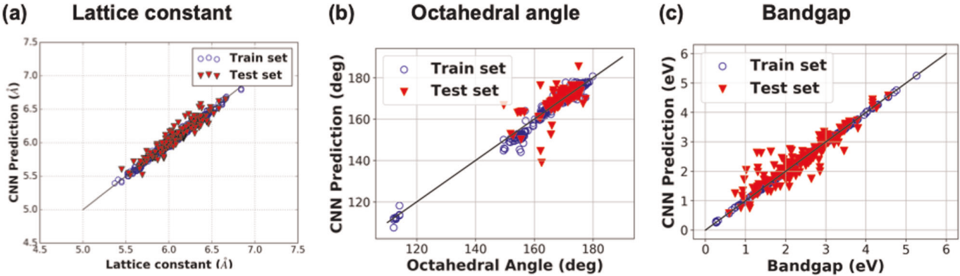
“Saidi and coworkers [34] concatenated properties of the atoms and molecules forming ABX3 perovskites to estimate the lattice constant, octahedral tilt angle, and even band gap energies using convolutional neural networks (CNNs); with these CNNs, hidden information was extracted from the 1D-input data.”
MethodHung, S.-H., Ye, Z.-R., Cheng, C.-F., Yang, A.-C., Chen, B., & Tsai, M. (2025) · Journal of Chemical Theory and Computation · doi:10.1021/acs.jctc.5c00085 · Cited by 5
Recent advances of theoretical investigation on lead-free metal halide perovskites
Wu, L., Huang, H., Zhang, X., Zhang, G., Liu, W., Ge, Z., & Wu, T. (2025) · Coordination Chemistry Reviews · doi:10.1016/j.ccr.2025.217182 · Cited by 5
Ouali, M. A., Bennacer, H., Ladjal, M., & Bouzateur, I. (2025) · Computational Materials Science · doi:10.1016/j.commatsci.2025.114397 · Cited by 4
Linton, N., Singh, P., & Aidhy, D. S. (2026) · npj Computational Materials · doi:10.1038/s41524-026-02037-6 · Cited by 6
Wang, B., & Wang, J. (2026) · Molecules · doi:10.3390/molecules31061032 · Cited by 4
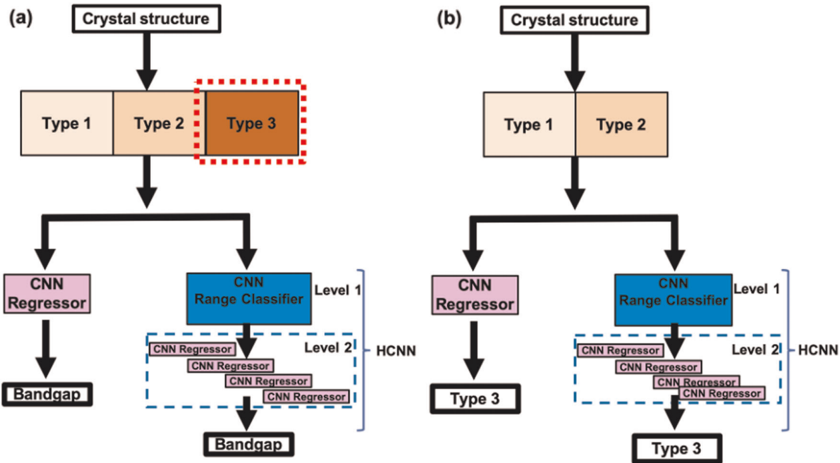
“Saidi [16] employed a hierarchical convolutional neural network (HCNN) to predict the structure and electronic properties of metal halide perovskites (MHPs).”
Topological Properties on Neural Networks Using Graph Properties
Chandrashekar, K. K., Srirangan, J., & Dhivviyanandam, I. (2024) · Circuits Systems and Signal Processing · doi:10.1007/s00034-024-02898-6 · Cited by 4
“Saidi et al. [31] studied the structural and electronic properties of metal halide perovskites using CVNNs. Petersen et al. [26] studied the topological properties of the set of functions generated by fixed-sized neural networks.”
Hybrid metal halide perovskite magic-sized clusters, what’s next?
Xu, K., Chen, K., & Xue, D. (2023) · Next Materials · doi:10.1016/j.nxmate.2023.100030 · Cited by 4
Feature Fusion Deep Learning Model for Defects Prediction in Crystal Structures
AlArfaj, A. A., & Mahmoud, H. A. H. (2022) · Crystals · doi:10.3390/cryst12091324 · Cited by 4
Advances and prospects of lead-free metal halide perovskites for solar hydrogen fuel generation
Boretti, A. A. (2026) · Transition Metal Chemistry · doi:10.1007/s11243-025-00712-z · Cited by 3
Kim, M., Lee, J., Chun, H. W., Shin, E. S., Choi, H., Kang, D.-W., Kim, J. H., Huang, S., & Kim, J. (2026) · Energy and AI · doi:10.1016/j.egyai.2026.100856 · Cited by 5
Yang, X., Yang, Y., Meng, H., Li, Y., & Hu, Q. (2024) · The Journal of Physical Chemistry C · doi:10.1021/acs.jpcc.4c01715 · Cited by 4
Machine Learning Accelerated Insights of Perovskite Materials
Lu, S., Wu, Y., Ju, M., & Wang, J. (2021) · Springer series in materials science · doi:10.1007/978-3-030-68310-8_8 · Cited by 3
Text Mining for Energy Materials
(2022) · Journal of Research in Science and Engineering · doi:10.53469/jrse.2022.04(03).24 · Cited by 3
Luo, W., Guan, J., & Yan, Z. (2024) · Canadian Journal of Chemistry · doi:10.1139/cjc-2023-0156 · Cited by 4
Ruiying, 孔. K., Yijun, 韦. W., Jiacheng, 陈. C., Tianshu, 马. M., Yaohui, 詹. Z., & Li, X. (2024) · Laser & Optoelectronics Progress · doi:10.3788/lop232375 · Cited by 3
Deep-learning neural network potentials for titanate perovskites
Wisesa, P., Tadano, T., & Saidi, W. A. (2025) · Computational Materials Science · doi:10.1016/j.commatsci.2025.113719 · Cited by 3
Self-citationEfficient Discovery of Lead-Free A 3 BX 6 Halide Perovskites via Machine Learning
Xian, X., Wang, D., Xu, G., Luo, W., Yuan, S., Chen, F., Pu, Y., Qi, F., Zhang, N., Tang, X., et al. (2026) · ACS Sustainable Chemistry & Engineering · doi:10.1021/acssuschemeng.5c09606 · Cited by 2
Octahedral-motif-guided design of optoelectronic semiconductors via interpretable machine learning
Yang, X., Zhao, W., He, X., Fei, W., Sun, Y., Zhao, Y., & Zhang, L. (2026) · Nature Communications · doi:10.1038/s41467-026-75216-0 · Cited by 5
“The ionic radius-based analog χ B = R (cid:2) 6× χ X = R and octahedral factor O f , although successful within single perovskite families 31,34,36 , contribute little to stability prediction in a chemically heterogeneous octahedral space.”
Exploring the absolute yield curve of secondary electrons using machine learning methods
Mehnaz, Da, B., & Ding, Z. (2023) · Physical Chemistry Chemical Physics · doi:10.1039/d3cp01443f · Cited by 4
Kaleemullah, N. S., Mohamed, S. B., Ramakrishnan, P., Ashwin, V., & Sirajuddeen, M. M. S. (2024) · Computational Condensed Matter · doi:10.1016/j.cocom.2024.e00939 · Cited by 2
Pattern Recognition for the Electronic Phase of Bismuth Antimony Thin Films
Tang, S., Dow, L., & Ojukwu, E. (2022) · ES Materials & Manufacturing · doi:10.30919/esmm5f661 · Cited by 2
pySIMsalabim: a Python package to extend drift-diffusion modelling with SIMsalabim
Heester, S., Elhorst, F. D., Fernandez, P. M., Corre, V. M. L., Koopmans, M., & Koster, L. J. A. (2026) · Computer Physics Communications · doi:10.1016/j.cpc.2026.110096 · Cited by 2
Mahd, Z. N., Kokabi, A., Fallahzadeh, M., & Naghibi, Z. (2024) · Nanotechnology · doi:10.1088/1361-6528/ad892c · Cited by 1
“CNNs have also been employed to design predictive models for the electronic properties of metal halide perovskites [18].”
Yousfi, A., Saidani, O., & Zaidi, E. (2025) · Sustainable Energy Technologies and Assessments · doi:10.1016/j.seta.2025.104745 · Cited by 1
A Novel Transformer Architecture for Scalable Perovskite Thin-Film Detection
Li, M., Li, H., Shi, Y., & Meng, Y. (2026) · Micromachines · doi:10.3390/mi17030314 · Cited by 1
“A hierarchical CNN was employed to predict the lattice constant and octahedral tilt angle for ABX 3 perovskites and consequently made features as the input for a second CNN to predict the material bandgap [18].”
Abrego‐Martínez, P. G., Corpus-Mendoza, A. N., Arias‐Ramos, C. F., Cancino‐Gordillo, F. E., Hu, Q., Qu, Z., & Hu, H. (2026) · physica status solidi (RRL) - Rapid Research Letters · doi:10.1002/pssr.70177 · Cited by 1
Generalizable machine-learned interatomic potential for all-inorganic halide double perovskites
Bare, Z. J. L., Karimitari, N., Barber, J. T., Musgrave, C. B., & Sutton, C. (2026) · Physical Review Materials · doi:10.1103/n6dj-hlzm · Cited by 1
Fatima, Q., Haidry, A. A., Ahmad, U., & Zhang, H. (2026) · Advanced Theory and Simulations · doi:10.1002/adts.70513 · Cited by 1
Peng, J. J., Duan, M., Li, M., He, Y., Hao, H., Li, M., Zhang, C., Chen, Z., Yu, Q., Yan, Q., et al. (2026) · Journal of Materials Chemistry A · doi:10.1039/d6ta04986a · Cited by 1
Current Methods of Power Conversion Efficiency Optimization for Perovskite Solar Cells
Workman, M., Chen, Z. D., & Musa, S. M. (2021) · IEEE SoutheastCon · doi:10.1109/southeastcon45413.2021.9401870 · Cited by 1
“In a simulated environment, the quantity of organic or inorganic elements can be varied to study how the device behavior changes [12].”
BackgroundMethodInfluentialSukmas, W., Ektarawong, A., Tsuppayakorn‐aek, P., Alling, B., Pinsook, U., & Bovornratanaraks, T. (2021) · Materials Advances · doi:10.1039/d1ma00076d
Deep Learning for Materials Recognition from FTIR Images
(2022) · Journal of Research in Science and Engineering · doi:10.53469/jrse.2022.04(07).12
Lin, Z., Sun, J., Shiring, S. B., Dou, L., & Savoie, B. M. (2023) · Angewandte Chemie · doi:10.1002/ange.202305298
From Structure Mining to Unsupervised Exploration of Atomic Octahedral Networks
Xian, R. P., Morelock, R. J., Hadar, I., Musgrave, C. B., & Sutton, C. A. (2026) · Chemistry of Materials · doi:10.1021/acs.chemmater.6c00038
Ab initio calculations on superconducting metal-hydride and perovskites for energy applications
Sukmas, W., Bovornratanaraks, T., & Pinsook, U. (2021) · Chula Digiverse · doi:10.58837/chula.the.2021.325
AI-driven inorganic materials by design
Zhu, R. (2024) · DR-NTU (Nanyang Technological University) · doi:10.32657/10356/183779
Chin, S. (2025) · European Journal of Energy Research · doi:10.24018/ejenergy.2025.5.3.154
Kavitha, K. C., Jagatheswari, S., Dhivviyanandam, I., & Prashitha, J. R. (2025) · Circuits Systems and Signal Processing · doi:10.1007/s00034-025-03201-x
“The neural network has applications in image recognition, time series forecasting, chemistry, computer science, and natural language processing, etc. Saidi et al. [1] computed the structural and electronic properties of metal-halide pervoskites using a hierarchical convolutional neural network.”
THAKUR, A. K., & THAKUR, A. K. (2023) · UA Campus Repository (The University of Arizona)
Bykov, A. V., & Shevelkov, А. V. (2026) · Chemistry of Materials · doi:10.1021/acs.chemmater.6c00619
Bouzateur, I., Guenou, S., Djoudi, L., Bennacer, H., Ouali, M. A., HADJI, A., Romano, P., & Benghia, A. (2026) · Optical and Quantum Electronics · doi:10.1007/s11082-026-08887-0
“Although ab initio methods can accurately predict material properties using only atomic numbers and ionic positions as input, whereas their substantial computational cost restricts their applicability to large datasets containing millions of possible material combinations (Saidi et al. 2020 ).”
Saidani, O., Yousfi, A., Belhadad, Y., Chenouf, A., Chouya, A., & Sahoo, G. S. (2026) · Journal of Optics · doi:10.1007/s12596-026-03200-4
Parvizi, P., Zangeneh, M. R., Amidi, A. M., & Jalilian, M. (2026) · Next Energy · doi:10.1016/j.nxener.2026.100817
Functional machine learning modeling of electronic bandgap
Baninajarian, S., Hashemifar, S. J., Abedi, S., Haghighi, M. S., & Levchenko, S. V. (2026) · The Journal of Chemical Physics · doi:10.1063/5.0325183
El-Muraikhi, M. D., Yasin, E. S., & Ayesh, A. I. (2026) · Chemical Physics · doi:10.1016/j.chemphys.2026.113471
(2021) · Illinois Digital Environment for Access to Learning and Scholarship (University of Illinois at Urbana-Champaign)
Vega, C., & Hernandez, M. (2024) · Journal of Computational and Data-Driven Materials Engineering · doi:10.68159/b688694306
Kim, Y. L., Yue, T., & Li, Y. (2026) · Digital Discovery · doi:10.1039/d6dd00303f
Kumar, D., Pandey, S. C., & Kour, P. (2026) · Digest Journal of Nanomaterials and Biostructures · doi:10.31083/djnb57746
Martina, E., Tripathy, A., & Sahoo, G. S. (2026) · Energy Reports · doi:10.1016/j.egyr.2026.109878
Metadata
- Authors
- Saidi, W. A., Shadid, W., & Castelli, I. E.
- Affiliations
- University of Pittsburgh (US)
- University of North Carolina at Charlotte (US)
- Technical University of Denmark (DK)
- Corresponding author
- Saidi, Wissam A.
- Venue
- npj Computational Materials
- Published
- 2020-04-14
- Volume
- 6
- Issue
- 1
- ISSN
- 2057-3960 (ISSN-L)
- OpenAlex
- W3016987575
- Semantic Scholar
- 3f7bf2f0e5a17596d914f7698b0f657721e7aebd
- Cited by
- 164
- References
- 49
- Citations by year
- 2026: 19 · 2025: 27 · 2024: 26 · 2023: 30 · 2022: 31 · 2021: 23 · 2020: 8
- FWCI
- 8.95
- Type
- journal article
- Language
- en
- Open access
- gold
- doi.org
- Licence
- cc-by
- creativecommons.org/licenses/by/4.0 (tdm)
- creativecommons.org/licenses/by/4.0 (vor)
- Locations
- npj Computational Materials (publishedVersion, cc-by)
- Technical University of Denmark, DTU Orbit (Technical University of Denmark, DTU) (submittedVersion, other-oa)
- Funders
- National Science Foundation (1809085, DE-AC02–06CH11357)
- U.S. Department of Energy (DE‐ AC02‐06CH11357, AC02‐06CH11357, 06CH11357, DE-AC02-)
- University of Pittsburgh
- Danmarks Tekniske Universitet
- Office of Science (AC02‐06CH11357, DE-AC02, 06CH11357, DE-AC02-06CH11357)
- Center for Research Computing, University of Pittsburgh
- Division of Materials Research (DE-AC02-06CH11357, DMR-1809085, 1809085)
- Argonne National Laboratory (DE- AC02-06-CH11357, DE-AC02, AC02–06CH11357, Contract DE-AC02-06CH11357, 06CH11357)
- Topics
- Physical Sciences › Materials Science › Materials Chemistry › Machine Learning in Materials Science
- Physical Sciences › Engineering › Electrical and Electronic Engineering › Perovskite Materials and Applications
- Physical Sciences › Physics and Astronomy › Atomic and Molecular Physics, and Optics › Advanced Chemical Physics Studies
- Keywords
- halide perovskites, convolutional neural networks, hierarchical neural networks, band gap prediction, structure-property relationships, materials design, class imbalance, network architecture design
About these checks
Registry, retraction, Cites and statistics results are computed, not judged, with one exception: a printed reference that no index lists is read once by a model before it counts as a citation error. Claims are extracted by a model and kept only when their quote appears verbatim in the text; each cited source is then checked, with a model’s help, for whether it says what the claim relies on. Those verdicts can be wrong — read the claim’s quote and the cited source before relying on one.
Statistics and arithmetic are recomputed, not judged.
Confidence bands are shown only for fields calibrated on our annotated test set. None is calibrated yet, so no band is shown.
What counts as a claim ›How we measure confidence ›How we check this ›
Are you an author, or do you see a problem with this page? Request a review
Data sources
Bibliographic data: Semantic Scholar, OpenAlex, Crossref.
Contains information from the Semantic Scholar Academic Graph Datasets, made available under the ODC Attribution License (ODC-BY 1.0).
Semantic Scholar’s data is described in: Kinney, R., et al. (2023). The Semantic Scholar Open Data Platform. arXiv:2301.10140.
