

Machine-learning structural and electronic properties of metal halide perovskites using a hierarchical convolutional neural network
Open accessThe DOI matches its Crossref record; 49 of the 49 references it cites were found in a registry or an index.
Abstract
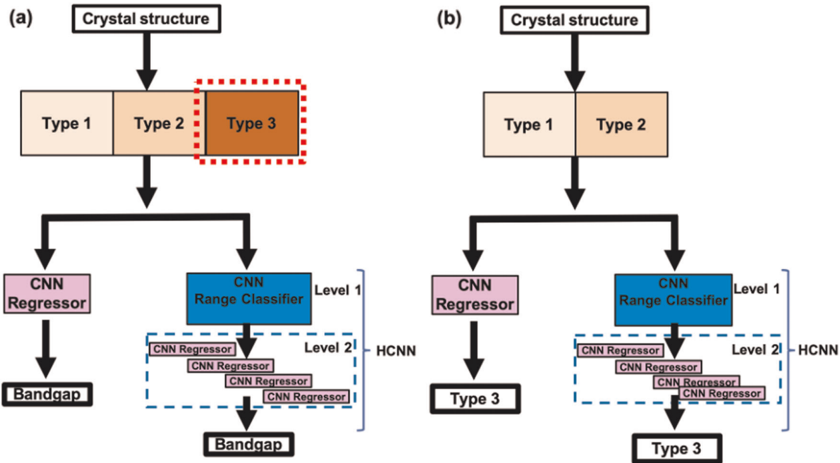
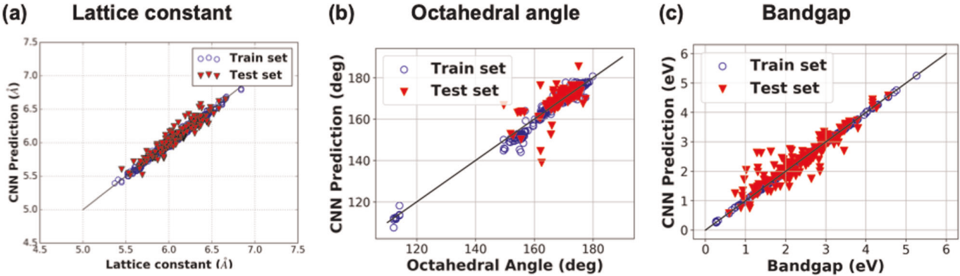
The development of statistical tools based on machine learning (ML) and deep networks is actively sought for materials design problems. While structure-property relationships can be accurately determined using quantum mechanical methods, these first-principles calculations are computationally demanding, limiting their use in screening a large set of candidate structures. Herein, we use convolutional neural networks to develop a predictive model for the electronic properties of metal halide perovskites (MHPs) that have a billions-range materials design space. We show that a well-designed hierarchical ML approach has a higher fidelity in predicting properties of the MHPs compared to straight-forward methods. In this architecture, each neural network element has a designated role in the estimation process from predicting complex features of the perovskites such as lattice constant and octahedral till angle to narrowing down possible ranges for the values of interest. Using the hierarchical ML scheme, the obtained root-mean-square errors for the lattice constants, octahedral angle and bandgap for the MHPs are 0.01 Å, 5°, and 0.02 eV, respectively. Our study underscores the importance of a careful network design and a hierarchical approach to alleviate issues associated with imbalanced dataset distributions, which is invariably common in materials datasets.
Overview
The claims and statistics of this paper haven’t been checked yet.
Free: it reads the open-access text and checks the first 5 claims that cite a source we can check. Create a free account to check every claim.
Integrity signals
Registry
Cites
Statistics
Figures

Verification
Claims the paper makes
The claims and statistics of this paper haven’t been checked yet.
Free: it reads the open-access text and checks the first 5 claims that cite a source we can check. Create a free account to check every claim.
Self-check
Percentages, sums and reported differences re-computed from the paper’s own numbers.
The self-check needs the paper’s full text.
Citations
Cites
Projector augmented-wave method
Blöchl, P. E. (1994) · Physical Review B · doi:10.1103/physrevb.50.17953 · Cited by 92,732 · cited 1×
“…optimization of the MHPs is carried out using DFT calculations employing the Perdew-Burke-Ehrenzhof exchange-correlation functional revised for solids (PBEsol) 43 and projector augmented wave (PAW) pseudopotentials 44,45 as implemented in the Vienna Ab initio Simulation Package (VASP) package.”
MethodFrom ultrasoft pseudopotentials to the projector augmented-wave method
Kresse, G., & Joubert, D. (1999) · Physical Review B · doi:10.1103/physrevb.59.1758 · Cited by 85,307 · cited 1×
“…optimization of the MHPs is carried out using DFT calculations employing the Perdew-Burke-Ehrenzhof exchange-correlation functional revised for solids (PBEsol) 43 and projector augmented wave (PAW) pseudopotentials 44,45 as implemented in the Vienna Ab initio Simulation Package (VASP) package.”
MethodRestoring the Density-Gradient Expansion for Exchange in Solids and Surfaces
Perdew, J. P., Ruzsinszky, A., Csonka, G. I., Vydrov, O. A., Scuseria, G. E., Constantin, L. A., Zhou, X., & Burke, K. (2008) · Physical Review Letters · doi:10.1103/physrevlett.100.136406 · Cited by 11,970
Stranks, S. D., Eperon, G. E., Grancini, G., Menelaou, C., Alcocer, M. J. P., Leijtens, T., Herz, L. M., Petrozza, A., & Snaith, H. J. (2013) · Science · doi:10.1126/science.1243982 · Cited by 10,413 · cited 1×
“…of features: large absorption coef fi cient > 3.0 × 10 4 cm − 1 in the visible light region 3 , low exciton binding energy resulting in high quantum yield of free electrons and holes 4 , long electron – hole diffusion lengths 5,6 , and electronically benign point 7,8 and grain-boundary defects 9 .”
BackgroundInfluentialThe emergence of perovskite solar cells
Green, M. A., Ho-Baillie, A., & Snaith, H. J. (2014) · Nature Photonics · doi:10.1038/nphoton.2014.134 · Cited by 7,432 · cited 1×
“, some range parts of a target value may have too many samples while other parts may have few or none; and (3) use simple ML approaches that are computationally not demanding, and are relatively simple to understand and control.”
BackgroundLong-Range Balanced Electron- and Hole-Transport Lengths in Organic-Inorganic CH 3 NH 3 PbI 3
Xing, G., Mathews, N., Sun, S., Lim, S. S., Lam, Y. M., Grätzel, M., Mhaisalkar, S., & Sum, T. C. (2013) · Science · doi:10.1126/science.1243167 · Cited by 6,909
Die Gesetze der Krystallochemie
Goldschmidt, V. M. (1926) · Die Naturwissenschaften · doi:10.1007/bf01507527 · Cited by 4,012 · cited 1×
“Additionally, the atomic size of the constituent elements of the perovskites is particularly important since this relates to their stability according to the Goldschmidt tolerance factor 27 .”
BackgroundHalide Perovskite Photovoltaics: Background, Status, and Future Prospects
Jena, A. K., Kulkarni, A., & Miyasaka, T. (2019) · Chemical Reviews · doi:10.1021/acs.chemrev.8b00539 · Cited by 3,087 · cited 1×
“However, in comparison to traditional solar absorbers, the main advantage of MHPs is their facile large-scale synthesis with relatively low cost 2 .”
BackgroundA mixed-cation lead mixed-halide perovskite absorber for tandem solar cells
McMeekin, D. P., Sadoughi, G., Rehman, W., Eperon, G. E., Saliba, M., Hörantner, M. T., Haghighirad, A., Sakai, N., Korte, L., Rech, B., et al. (2016) · Science · doi:10.1126/science.aad5845 · Cited by 3,067 · cited 3×
“The importance of some of these features for the bandgap in the MHPs has been reported before 10,28,29,39 .”
BackgroundMethodInfluentialEnkovaara, J., Rostgaard, C., Mortensen, J. J., Chen, J., Dułak, M., Ferrighi, L., Gavnholt, J., Glinsvad, C., Haikola, V, Hansen, H. A., et al. (2010) · Journal of Physics: Condensed Matter · doi:10.1088/0953-8984/22/25/253202 · Cited by 2,208 · cited 1×
“The band structure calculations are performed using GPAW 46 with spin-orbit coupling (SOC) corrections.”
MethodMiyata, A., Mitioglu, A., Plochocka, P., Portugall, O., Wang, J. T.-W., Stranks, S. D., Snaith, H. J., & Nicholas, R. J. (2015) · Nature Physics · doi:10.1038/nphys3357 · Cited by 2,085 · cited 1×
“…of features: large absorption coef fi cient > 3.0 × 10 4 cm − 1 in the visible light region 3 , low exciton binding energy resulting in high quantum yield of free electrons and holes 4 , long electron – hole diffusion lengths 5,6 , and electronically benign point 7,8 and grain-boundary defects 9 .”
BackgroundInfluentialThe high-throughput highway to computational materials design
Curtarolo, S., Hart, G. L. W., Nardelli, M. B., Mingo, N., Sanvito, S., & Levy, O. (2013) · Nature Materials · doi:10.1038/nmat3568 · Cited by 2,053 · cited 2×
“As an example, Li and Yang quite recently screened over 4500 hybrid compounds including those beyond the perovskite crystal structure, identifying 13 and 23 materials for solar energy conversion and light emitting diodes, respectively 12 .”
BackgroundNew tolerance factor to predict the stability of perovskite oxides and halides
Bartel, C. J., Sutton, C., Goldsmith, B. R., Ouyang, R., Musgrave, C. B., Ghiringhelli, L. M., & Scheffler, M. (2019) · Science Advances · doi:10.1126/sciadv.aav0693 · Cited by 1,838 · cited 1×
“…the Goldschmidt tolerance factor, often used to assess the stability of the perovskite structure and the recently introduced tolerance factor 38 , We also identi fi ed six-precursor-based features derived from optimum structures of AX and BX 2 including lattice volumes, formation energies…”
BackgroundA general-purpose machine learning framework for predicting properties of inorganic materials
Ward, L., Agrawal, A., Choudhary, A., & Wolverton, C. (2016) · npj Computational Materials · doi:10.1038/npjcompumats.2016.28 · Cited by 1,831 · cited 1×
“As an example, Li and Yang quite recently screened over 4500 hybrid compounds including those beyond the perovskite crystal structure, identifying 13 and 23 materials for solar energy conversion and light emitting diodes, respectively 12 .”
BackgroundRelativistic GW calculations on CH3NH3PbI3 and CH3NH3SnI3 Perovskites for Solar Cell Applications
Umari, P., Mosconi, E., & De Angelis, F. (2014) · Scientific Reports · doi:10.1038/srep04467 · Cited by 1,325
Toward Lead-Free Perovskite Solar Cells
Giustino, F., & Snaith, H. J. (2016) · ACS Energy Letters · doi:10.1021/acsenergylett.6b00499 · Cited by 1,141 · cited 1×
“Current research focuses on fi nding optimum MHPs materials for either a single absorber or tandem solar cells that are cost-effective, stable and lead free 11 .”
BackgroundSteric engineering of metal-halide perovskites with tunable optical band gaps
Filip, M. R., Eperon, G. E., Snaith, H. J., & Giustino, F. (2014) · Nature Communications · doi:10.1038/ncomms6757 · Cited by 1,081
The Role of Intrinsic Defects in Methylammonium Lead Iodide Perovskite
Kim, J., Lee, S.-H., Lee, J. H., & Hong, K.-H. (2014) · The Journal of Physical Chemistry Letters · doi:10.1021/jz500370k · Cited by 906
Brandt, R. E., Stevanović, V., Ginley, D. S., & Buonassisi, T. (2015) · MRS Communications · doi:10.1557/mrc.2015.26 · Cited by 817
Yu, L., & Zunger, A. (2012) · Physical Review Letters · doi:10.1103/physrevlett.108.068701 · Cited by 816
Reymond, J.-L. (2015) · Accounts of Chemical Research · doi:10.1021/ar500432k · Cited by 720
Machine learning bandgaps of double perovskites
Pilania, G., Mannodi-Kanakkithodi, A., Uberuaga, B. P., Ramprasad, R., Gubernatis, J. E., & Lookman, T. (2016) · Scientific Reports · doi:10.1038/srep19375 · Cited by 518 · cited 4×
“But simple features such as the Shannon radii for atomic size are not easily generalized to the molecular case 22 – 25 .”
BackgroundMethodInfluentialJANAF Thermochemical Tables, 1982 Supplement
Chase, M. W., Curnutt, J. L., Downey, J. R., McDonald, R. A., Syverud, A. N., & Valenzuela, E. A. (1982) · Journal of Physical and Chemical Reference Data · doi:10.1063/1.555666 · Cited by 488 · cited 1×
“Even limiting the chemical space to ~10,000 experimentally measured molecules 20,21 , the number of potential candidates is still huge, precluding traditional screening methods.”
BackgroundEfficient carrier transport in halide perovskites: theoretical perspectives
Du, M. H. (2014) · Journal of Materials Chemistry A · doi:10.1039/c4ta01198h · Cited by 487
A Guide to Convolutional Neural Networks for Computer Vision
Khan, S. H., Rahmani, H., Shah, S. A. A., & Bennamoun, M. (2018) · Synthesis lectures on computer vision · doi:10.2200/s00822ed1v01y201712cov015 · Cited by 443
Computational screening of perovskite metal oxides for optimal solar light capture
Castelli, I. E., Olsen, T., Datta, S., Landis, D. D., Dahl, S., Thygesen, K. S., & Jacobsen, K. W. (2012) · Energy Environ. Sci. · doi:10.1039/c1ee02717d · Cited by 432 · cited 2×
“For example, Castelli et al. examined the performance of 19,000 oxide and oxynitride perovskite materials as solar water light splitters, fi nding only 20 interesting compounds for experimental follow-up 14,17 .”
BackgroundMethodSelf-citationKohn-Sham potential with discontinuity for band gap materials
Kuisma, M., Ojanen, J., Enkovaara, J., & Rantala, T. T. (2010) · Physical Review B · doi:10.1103/physrevb.82.115106 · Cited by 308 · cited 1×
“To obtain accurate bandgaps at a reasonable computational cost, we employed the GLLB-SC functional 47 that can predict the bandgaps within an absolute accuracy of 0.5 eV 48 .”
MethodInfluentialBandgap calculations and trends of organometal halide perovskites
Castelli, I. E., García-Lastra, J. M., Thygesen, K. S., & Jacobsen, K. W. (2014) · APL Materials · doi:10.1063/1.4893495 · Cited by 293 · cited 8×
“The GLLB-SC functional has been used in several studies to screen layered perovskites 49 , perovskite oxides 14 , and also organic perovskites 29 .”
BackgroundMethodResultInfluentialSelf-citationComputational Screening of Homovalent Lead Substitution in Organic–Inorganic Halide Perovskites
Filip, M. R., & Giustino, F. (2016) · The Journal of Physical Chemistry C · doi:10.1021/acs.jpcc.5b11845 · Cited by 283
Castelli, I. E., Landis, D. D., Thygesen, K. S., Dahl, S., Chorkendorff, I., Jaramillo, T. F., & Jacobsen, K. W. (2012) · Energy & Environmental Science · doi:10.1039/c2ee22341d · Cited by 266 · cited 1×
“For example, Castelli et al. examined the performance of 19,000 oxide and oxynitride perovskite materials as solar water light splitters, fi nding only 20 interesting compounds for experimental follow-up 14,17 .”
BackgroundSelf-citationIdentifying Pb-free perovskites for solar cells by machine learning
Im, J., Lee, S., Ko, T.-W., Kim, H. W., Hyon, Y., & Chang, H. (2019) · npj Computational Materials · doi:10.1038/s41524-019-0177-0 · Cited by 232 · cited 4×
“But simple features such as the Shannon radii for atomic size are not easily generalized to the molecular case 22 – 25 .”
BackgroundMethodInfluentialTemperature dependent energy levels of methylammonium lead iodide perovskite
Foley, B. J., Marlowe, D. L., Sun, K., Saidi, W. A., Scudiero, L., Gupta, M. C., & Choi, J. J. (2015) · Applied Physics Letters · doi:10.1063/1.4922804 · Cited by 195 · cited 1×
“We ingored electron-phonon coupling effects that can affect the bandgasp as these are relatively small 35 – 37 .”
MethodSelf-citationFilip, M. R., Verdi, C., & Giustino, F. (2015) · The Journal of Physical Chemistry C · doi:10.1021/acs.jpcc.5b07891 · Cited by 172
Materials 4.0: Materials big data enabled materials discovery
Jose, R., & Ramakrishna, S. (2018) · Applied Materials Today · doi:10.1016/j.apmt.2017.12.015 · Cited by 170 · cited 1×
“…the materials search by orders of magnitude compared to traditional fi rst-principles methods without signi fi cantly compromising their accuracy 22 – 25 , contributing to a paradigm shift in materials design where big data, arti fi cial intelligence and materials modeling are deeply entangled 26 .”
MethodYang, D., Lv, J., Zhao, X., Xu, Q., Fu, Y., Zhan, Y., Zunger, A., & Zhang, L. (2017) · Chemistry of Materials · doi:10.1021/acs.chemmater.6b03221 · Cited by 155 · cited 1×
“Previous searches investigated a small portion of these compounds 28 – 32 .”
BackgroundNew Light‐Harvesting Materials Using Accurate and Efficient Bandgap Calculations
Castelli, I. E., Hüser, F., Pandey, M., Li, H., Thygesen, K. S., Seger, B., Jain, A., Persson, K. A., Ceder, G., & Jacobsen, K. W. (2015) · Advanced Energy Materials · doi:10.1002/aenm.201400915 · Cited by 150
Self-citationSaidi, W. A., Poncé, S., & Monserrat, B. (2016) · The Journal of Physical Chemistry Letters · doi:10.1021/acs.jpclett.6b02560 · Cited by 143
Self-citationLi, Y., & Yang, K. (2019) · Energy & Environmental Science · doi:10.1039/c9ee01371g · Cited by 103 · cited 1×
“As an example, Li and Yang quite recently screened over 4500 hybrid compounds including those beyond the perovskite crystal structure, identifying 13 and 23 materials for solar energy conversion and light emitting diodes, respectively 12 .”
BackgroundHummelshøj, J. S., Landis, D. D., Voss, J., Jiang, T., Tekin, A., Bork, N., Dułak, M., Mortensen, J. J., Adamska, L., Andersin, J., et al. (2009) · The Journal of Chemical Physics · doi:10.1063/1.3148892 · Cited by 87
Visini, R., Awale, M., & Reymond, J. (2017) · Journal of Chemical Information and Modeling · doi:10.1021/acs.jcim.7b00020 · Cited by 77 · cited 1×
“The GDB-17 database 18 contains 166.4 billion molecules composed of 17 atoms including H, C, N, O, S, and the halogens, and there are ~10 million in the FDB-17 database, which evenly covers a broad range of molecular sizes, polarities, and stereo-chemistries 19 .”
BackgroundInfluentialSegregation of Native Defects to the Grain Boundaries in Methylammonium Lead Iodide Perovskite
Shan, W., & Saidi, W. A. (2017) · The Journal of Physical Chemistry Letters · doi:10.1021/acs.jpclett.7b02727 · Cited by 70 · cited 1×
“…of features: large absorption coef fi cient > 3.0 × 10 4 cm − 1 in the visible light region 3 , low exciton binding energy resulting in high quantum yield of free electrons and holes 4 , long electron – hole diffusion lengths 5,6 , and electronically benign point 7,8 and grain-boundary defects 9 .”
BackgroundInfluentialSelf-citationNature of the cubic to tetragonal phase transition in methylammonium lead iodide perovskite
Saidi, W. A., & Choi, J. J. (2016) · The Journal of Chemical Physics · doi:10.1063/1.4964094 · Cited by 64 · cited 1×
“MHPs are known to have a complex potential energy surface with many local minima 28,34 .”
BackgroundSelf-citationWeston, L., & Stampfl, C. (2018) · Physical Review Materials · doi:10.1103/physrevmaterials.2.085407 · Cited by 63
Stability and bandgaps of layered perovskites for one- and two-photon water splitting
Castelli, I. E., García-Lastra, J. M., Hüser, F., Thygesen, K. S., & Jacobsen, K. W. (2013) · New Journal of Physics · doi:10.1088/1367-2630/15/10/105026 · Cited by 61
Self-citationSaidi, W. A., & Kachmar, A. (2018) · The Journal of Physical Chemistry Letters · doi:10.1021/acs.jpclett.8b03164 · Cited by 57 · cited 1×
“We ingored electron-phonon coupling effects that can affect the bandgasp as these are relatively small 35 – 37 .”
MethodSelf-citationDeep learning illustrated : a visual, interactive guide to artificial intelligence
Krohn, J. P., Beyleveld, G., & Bassens, A. (2020) · CERN Document Server (European Organization for Nuclear Research) · Cited by 31
Electron affinity of lead: An ab initio four-component relativistic study
Tatewaki, H., Yamamoto, S., Moriyama, H., & Watanabe, Y. (2009) · Chemical Physics Letters · doi:10.1016/j.cplett.2009.01.079 · Cited by 9
Computational High-Throughput Screening for Solar Energy Materials
Castelli, I. E., Thygesen, K. S., & Jacobsen, K. W. (2017) · CRC Press eBooks · doi:10.4324/9781315152424-6 · Cited by 6
Self-citationComputational High-Throughput Screening for Solar Energy Materials
Castelli, I. E., Thygesen, K. S., & Jacobsen, K. W. (2017) · Routledge eBooks · doi:10.1201/9781315152424-7 · Cited by 3 · cited 1×
“Previous studies show the orientation of the organic molecule has relatively small effect on electronic properties of the system and, on average, the bandgap changes less than 0.1 eV 33 .”
BackgroundInfluentialSelf-citation
Cited by
Machine learning for perovskite materials design and discovery
Tao, Q., Xu, P., Li, M., & Lu, W. (2021) · npj Computational Materials · doi:10.1038/s41524-021-00495-8 · Cited by 542
Advanced Organic–Inorganic Hybrid Materials for Optoelectronic Applications
Zhou, K., Qi, B., Liu, Z., Wang, X., Sun, Y., & Zhang, L. (2024) · Advanced Functional Materials · doi:10.1002/adfm.202411671 · Cited by 228
Machine learning for advanced energy materials
Liu, Y., Esan, O. C., Pan, Z., & An, L. (2021) · Energy and AI · doi:10.1016/j.egyai.2021.100049 · Cited by 208
Roadmap on organic–inorganic hybrid perovskite semiconductors and devices
Schmidt-Mende, L., Dyakonov, V., Olthof, S., Ünlü, F., Lê, K. M. T., Mathur, S., Karabanov, A. D., Lupascu, D. C., Herz, L. M., Hinderhofer, A., et al. (2021) · APL Materials · doi:10.1063/5.0047616 · Cited by 201
Machine Learning for Perovskite Solar Cells and Component Materials: Key Technologies and Prospects
Liu, Y., Tan, X., Liang, J., Han, H., Xiang, P., & Yan, W. (2023) · Advanced Functional Materials · doi:10.1002/adfm.202214271 · Cited by 174
Metadata
- Authors
- Saidi, W. A., Shadid, W., & Castelli, I. E.
- Affiliations
- University of Pittsburgh (US)
- University of North Carolina at Charlotte (US)
- Technical University of Denmark (DK)
- Corresponding author
- Saidi, Wissam A.
- Venue
- npj Computational Materials
- Published
- 2020-04-14
- Volume
- 6
- Issue
- 1
- ISSN
- 2057-3960 (ISSN-L)
- OpenAlex
- W3016987575
- Cited by
- 164
- References
- 49
- Citations by year
- 2026: 19 · 2025: 27 · 2024: 26 · 2023: 30 · 2022: 31 · 2021: 23 · 2020: 8
- FWCI
- 8.95
- Type
- journal article
- Language
- en
- Open access
- gold
- doi.org
- Licence
- cc-by
- creativecommons.org/licenses/by/4.0 (tdm)
- creativecommons.org/licenses/by/4.0 (vor)
- Locations
- npj Computational Materials (publishedVersion, cc-by)
- Technical University of Denmark, DTU Orbit (Technical University of Denmark, DTU) (submittedVersion, other-oa)
- Funders
- National Science Foundation (1809085, DE-AC02–06CH11357)
- U.S. Department of Energy (DE‐ AC02‐06CH11357, AC02‐06CH11357, 06CH11357, DE-AC02-)
- University of Pittsburgh
- Danmarks Tekniske Universitet
- Office of Science (AC02‐06CH11357, DE-AC02, 06CH11357, DE-AC02-06CH11357)
- Center for Research Computing, University of Pittsburgh
- Division of Materials Research (DE-AC02-06CH11357, DMR-1809085, 1809085)
- Argonne National Laboratory (DE- AC02-06-CH11357, DE-AC02, AC02–06CH11357, Contract DE-AC02-06CH11357, 06CH11357)
- Topics
- Physical Sciences › Materials Science › Materials Chemistry › Machine Learning in Materials Science
- Physical Sciences › Engineering › Electrical and Electronic Engineering › Perovskite Materials and Applications
- Physical Sciences › Physics and Astronomy › Atomic and Molecular Physics, and Optics › Advanced Chemical Physics Studies
- Keywords
- halide perovskites, convolutional neural networks, hierarchical neural networks, band gap prediction, structure-property relationships, materials design, class imbalance, network architecture design
About these checks
Registry, retraction, Cites and statistics results are computed, not judged, with one exception: a printed reference that no index lists is read once by a model before it counts as a citation error. Claims are extracted by a model and kept only when their quote appears verbatim in the text; each cited source is then checked, with a model’s help, for whether it says what the claim relies on. Those verdicts can be wrong — read the claim’s quote and the cited source before relying on one.
Statistics and arithmetic are recomputed, not judged.
Confidence bands are shown only for fields calibrated on our annotated test set. None is calibrated yet, so no band is shown.
What counts as a claim ›How we measure confidence ›How we check this ›
Are you an author, or do you see a problem with this page? Request a review
Data sources
Bibliographic data: Semantic Scholar, OpenAlex, Crossref.
Contains information from the Semantic Scholar Academic Graph Datasets, made available under the ODC Attribution License (ODC-BY 1.0).
Semantic Scholar’s data is described in: Kinney, R., et al. (2023). The Semantic Scholar Open Data Platform. arXiv:2301.10140.
