

Machine-learning structural and electronic properties of metal halide perovskites using a hierarchical convolutional neural network
Open accessThe DOI matches its Crossref record; 49 of the 49 references it cites were found in a registry or an index.
Abstract
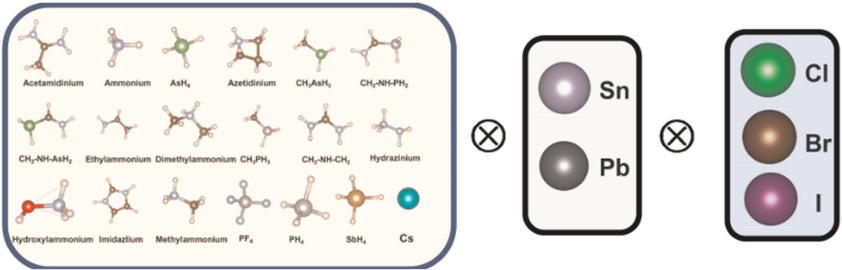
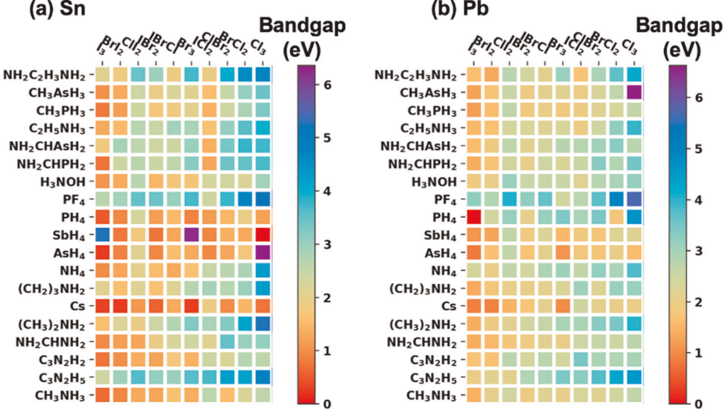
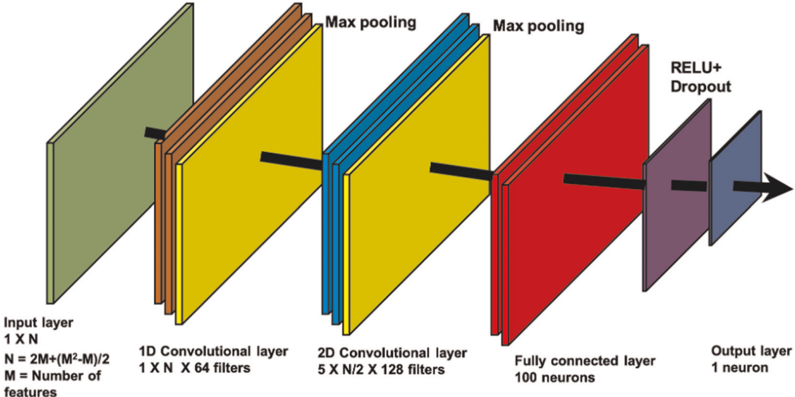
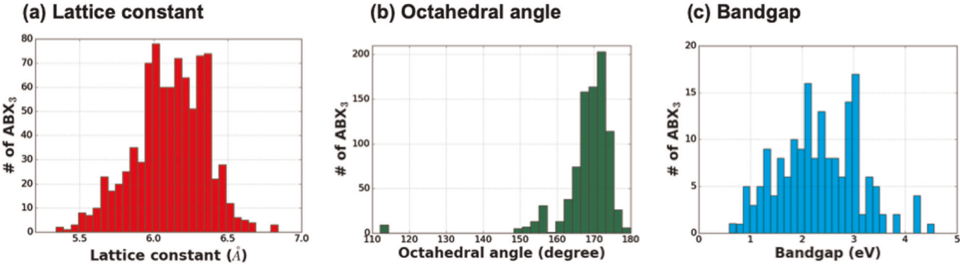
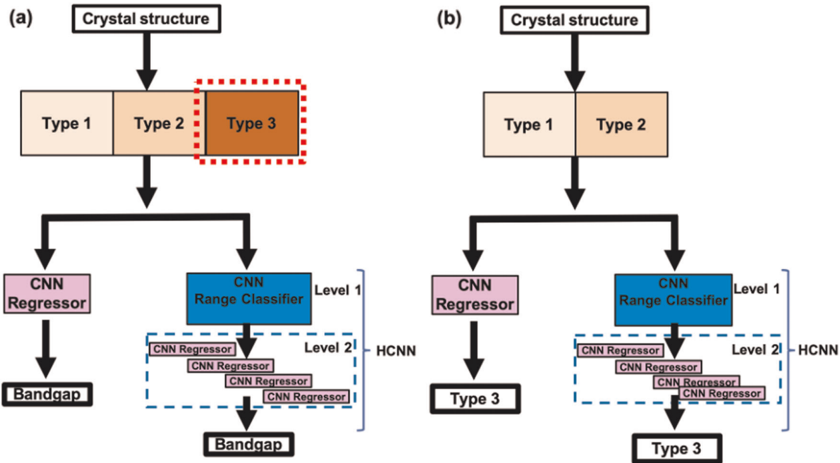
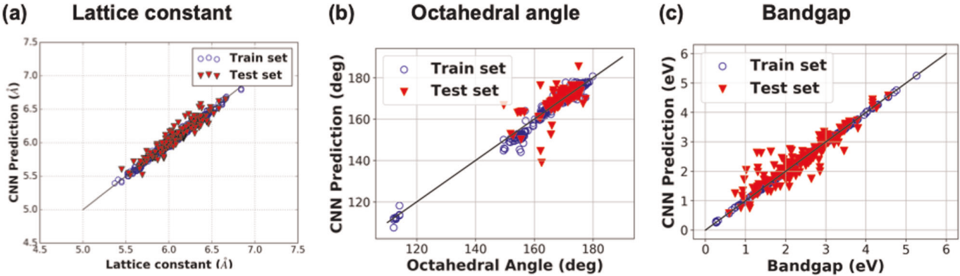
The development of statistical tools based on machine learning (ML) and deep networks is actively sought for materials design problems. While structure-property relationships can be accurately determined using quantum mechanical methods, these first-principles calculations are computationally demanding, limiting their use in screening a large set of candidate structures. Herein, we use convolutional neural networks to develop a predictive model for the electronic properties of metal halide perovskites (MHPs) that have a billions-range materials design space. We show that a well-designed hierarchical ML approach has a higher fidelity in predicting properties of the MHPs compared to straight-forward methods. In this architecture, each neural network element has a designated role in the estimation process from predicting complex features of the perovskites such as lattice constant and octahedral till angle to narrowing down possible ranges for the values of interest. Using the hierarchical ML scheme, the obtained root-mean-square errors for the lattice constants, octahedral angle and bandgap for the MHPs are 0.01 Å, 5°, and 0.02 eV, respectively. Our study underscores the importance of a careful network design and a hierarchical approach to alleviate issues associated with imbalanced dataset distributions, which is invariably common in materials datasets.
Overview
The claims and statistics of this paper haven’t been checked yet.
Free: it reads the open-access text and checks the first 5 claims that cite a source we can check. Create a free account to check every claim.
Integrity signals
Registry
Cites
Statistics
Figures

Verification
Claims the paper makes
The claims and statistics of this paper haven’t been checked yet.
Free: it reads the open-access text and checks the first 5 claims that cite a source we can check. Create a free account to check every claim.
Self-check
Percentages, sums and reported differences re-computed from the paper’s own numbers.
The self-check needs the paper’s full text.
Citations
Cites
Projector augmented-wave method
Blöchl, P. E. (1994) · Physical Review B · doi:10.1103/physrevb.50.17953 · Cited by 92,732 · cited 1×
“…optimization of the MHPs is carried out using DFT calculations employing the Perdew-Burke-Ehrenzhof exchange-correlation functional revised for solids (PBEsol) 43 and projector augmented wave (PAW) pseudopotentials 44,45 as implemented in the Vienna Ab initio Simulation Package (VASP) package.”
MethodFrom ultrasoft pseudopotentials to the projector augmented-wave method
Kresse, G., & Joubert, D. (1999) · Physical Review B · doi:10.1103/physrevb.59.1758 · Cited by 85,307 · cited 1×
“…optimization of the MHPs is carried out using DFT calculations employing the Perdew-Burke-Ehrenzhof exchange-correlation functional revised for solids (PBEsol) 43 and projector augmented wave (PAW) pseudopotentials 44,45 as implemented in the Vienna Ab initio Simulation Package (VASP) package.”
MethodRestoring the Density-Gradient Expansion for Exchange in Solids and Surfaces
Perdew, J. P., Ruzsinszky, A., Csonka, G. I., Vydrov, O. A., Scuseria, G. E., Constantin, L. A., Zhou, X., & Burke, K. (2008) · Physical Review Letters · doi:10.1103/physrevlett.100.136406 · Cited by 11,970
Stranks, S. D., Eperon, G. E., Grancini, G., Menelaou, C., Alcocer, M. J. P., Leijtens, T., Herz, L. M., Petrozza, A., & Snaith, H. J. (2013) · Science · doi:10.1126/science.1243982 · Cited by 10,413 · cited 1×
“…of features: large absorption coef fi cient > 3.0 × 10 4 cm − 1 in the visible light region 3 , low exciton binding energy resulting in high quantum yield of free electrons and holes 4 , long electron – hole diffusion lengths 5,6 , and electronically benign point 7,8 and grain-boundary defects 9 .”
BackgroundInfluentialThe emergence of perovskite solar cells
Green, M. A., Ho-Baillie, A., & Snaith, H. J. (2014) · Nature Photonics · doi:10.1038/nphoton.2014.134 · Cited by 7,432 · cited 1×
“, some range parts of a target value may have too many samples while other parts may have few or none; and (3) use simple ML approaches that are computationally not demanding, and are relatively simple to understand and control.”
BackgroundLong-Range Balanced Electron- and Hole-Transport Lengths in Organic-Inorganic CH 3 NH 3 PbI 3
Xing, G., Mathews, N., Sun, S., Lim, S. S., Lam, Y. M., Grätzel, M., Mhaisalkar, S., & Sum, T. C. (2013) · Science · doi:10.1126/science.1243167 · Cited by 6,909
Die Gesetze der Krystallochemie
Goldschmidt, V. M. (1926) · Die Naturwissenschaften · doi:10.1007/bf01507527 · Cited by 4,012 · cited 1×
“Additionally, the atomic size of the constituent elements of the perovskites is particularly important since this relates to their stability according to the Goldschmidt tolerance factor 27 .”
BackgroundHalide Perovskite Photovoltaics: Background, Status, and Future Prospects
Jena, A. K., Kulkarni, A., & Miyasaka, T. (2019) · Chemical Reviews · doi:10.1021/acs.chemrev.8b00539 · Cited by 3,087 · cited 1×
“However, in comparison to traditional solar absorbers, the main advantage of MHPs is their facile large-scale synthesis with relatively low cost 2 .”
BackgroundA mixed-cation lead mixed-halide perovskite absorber for tandem solar cells
McMeekin, D. P., Sadoughi, G., Rehman, W., Eperon, G. E., Saliba, M., Hörantner, M. T., Haghighirad, A., Sakai, N., Korte, L., Rech, B., et al. (2016) · Science · doi:10.1126/science.aad5845 · Cited by 3,067 · cited 3×
“The importance of some of these features for the bandgap in the MHPs has been reported before 10,28,29,39 .”
BackgroundMethodInfluentialEnkovaara, J., Rostgaard, C., Mortensen, J. J., Chen, J., Dułak, M., Ferrighi, L., Gavnholt, J., Glinsvad, C., Haikola, V, Hansen, H. A., et al. (2010) · Journal of Physics: Condensed Matter · doi:10.1088/0953-8984/22/25/253202 · Cited by 2,208 · cited 1×
“The band structure calculations are performed using GPAW 46 with spin-orbit coupling (SOC) corrections.”
Method
Cited by
Machine learning for perovskite materials design and discovery
Tao, Q., Xu, P., Li, M., & Lu, W. (2021) · npj Computational Materials · doi:10.1038/s41524-021-00495-8 · Cited by 542
Advanced Organic–Inorganic Hybrid Materials for Optoelectronic Applications
Zhou, K., Qi, B., Liu, Z., Wang, X., Sun, Y., & Zhang, L. (2024) · Advanced Functional Materials · doi:10.1002/adfm.202411671 · Cited by 228
Machine learning for advanced energy materials
Liu, Y., Esan, O. C., Pan, Z., & An, L. (2021) · Energy and AI · doi:10.1016/j.egyai.2021.100049 · Cited by 208
Roadmap on organic–inorganic hybrid perovskite semiconductors and devices
Schmidt-Mende, L., Dyakonov, V., Olthof, S., Ünlü, F., Lê, K. M. T., Mathur, S., Karabanov, A. D., Lupascu, D. C., Herz, L. M., Hinderhofer, A., et al. (2021) · APL Materials · doi:10.1063/5.0047616 · Cited by 201
Machine Learning for Perovskite Solar Cells and Component Materials: Key Technologies and Prospects
Liu, Y., Tan, X., Liang, J., Han, H., Xiang, P., & Yan, W. (2023) · Advanced Functional Materials · doi:10.1002/adfm.202214271 · Cited by 174
Plasmonic–perovskite solar cells, light emitters, and sensors
Ai, B., Fan, Z., & Wong, Z. J. (2022) · Microsystems & Nanoengineering · doi:10.1038/s41378-021-00334-2 · Cited by 172
AI methods in materials design, discovery and manufacturing: A review
Papadimitriou, I., Gialampoukidis, I., Vrochidis, S., & Kompatsiaris, I. Y. (2024) · Computational Materials Science · doi:10.1016/j.commatsci.2024.112793 · Cited by 176
Adsorbate chemical environment-based machine learning framework for heterogeneous catalysis
Ghanekar, P. G., Deshpande, S., & Greeley, J. (2022) · Nature Communications · doi:10.1038/s41467-022-33256-2 · Cited by 158
“…computational modeling algorithms, some based on machine learning, which have made screening of diverse materials classes, including oxides, perovskites, zeolites, and metal-organic frameworks (MOFs), possible through the facile generation of diverse materials-speci fi c structural motifs 5 – 10 .”
BackgroundCritical review of machine learning applications in perovskite solar research
Yılmaz, B., & Yıldırım, R. (2021) · Nano Energy · doi:10.1016/j.nanoen.2020.105546 · Cited by 139
Machine learning for halide perovskite materials
Zhang, L., He, M., & Shao, S. (2020) · Nano Energy · doi:10.1016/j.nanoen.2020.105380 · Cited by 130
Optimization of High-Entropy Alloy Catalyst for Ammonia Decomposition and Ammonia Synthesis
Saidi, W. A., Shadid, W., & Veser, G. (2021) · The Journal of Physical Chemistry Letters · doi:10.1021/acs.jpclett.1c01242 · Cited by 131
Self-citationMachine learning for high-throughput experimental exploration of metal halide perovskites
Ahmadi, M., Ziatdinov, M., Zhou, Y., Lass, E. A., & Kalinin, S. V. (2021) · Joule · doi:10.1016/j.joule.2021.10.001 · Cited by 117
Lyu, R., Moore, C. E., Liu, T., Yu, Y., & Wu, Y. (2021) · Journal of the American Chemical Society · doi:10.1021/jacs.1c05441 · Cited by 114
Sun, J., Wang, K., Ma, K., Park, J. Y., Lin, Z., Savoie, B. M., & Dou, L. (2023) · Journal of the American Chemical Society · doi:10.1021/jacs.3c02143 · Cited by 108
Guo, Z., Yuan, M., Chen, G., Liu, F., Lu, R., & Yin, W. (2024) · Advanced Science · doi:10.1002/advs.202305799 · Cited by 96
Machine Learning Roadmap for Perovskite Photovoltaics
Srivastava, M., Howard, J. M., Gong, T., Rebello Sousa Dias, M., & Leite, M. S. (2021) · The Journal of Physical Chemistry Letters · doi:10.1021/acs.jpclett.1c01961 · Cited by 85
How Machine Learning Predicts and Explains the Performance of Perovskite Solar Cells
Liu, Y., Yan, W., Han, S., Zhu, H., Tu, Y., Guan, L., & Tan, X. (2022) · Solar RRL · doi:10.1002/solr.202101100 · Cited by 87
Machine Learning in Perovskite Solar Cells: Recent Developments and Future Perspectives
Bansal, N., Mishra, S., Dixit, H., Porwal, S., Singh, P., & Singh, T. (2023) · Energy Technology · doi:10.1002/ente.202300735 · Cited by 94
Solar Materials Find Their Band Gap
Sutherland, B. R. (2020) · Joule · doi:10.1016/j.joule.2020.05.001 · Cited by 84
MatGPT: A Vane of Materials Informatics from Past, Present, to Future
Wang, Z., Chen, A., Tao, K., Han, Y., & Li, J. (2023) · Advanced Materials · doi:10.1002/adma.202306733 · Cited by 94
Gómez-Peralta, J. I., & Bokhimi, X. (2021) · Materials Chemistry and Physics · doi:10.1016/j.matchemphys.2021.124710 · Cited by 77
Data-driven design of novel halide perovskite alloys
Mannodi-Kanakkithodi, A., & Chan, M. K. Y. (2022) · Energy & Environmental Science · doi:10.1039/d1ee02971a · Cited by 73
Marchenko, E. I., Korolev, V., Fateev, S. A., Mitrofanov, A. A., Eremin, N. N., Goodilin, E. A., & Tarasov, A. B. (2021) · Chemistry of Materials · doi:10.1021/acs.chemmater.1c02467 · Cited by 74
Sustainable development of perovskite solar cells: keeping a balance between toxicity and efficiency
Ding, G., Zheng, Y., Xiao, X., Cheng, H., Zhang, G., Shi, Y., & Shao, Y. (2022) · Journal of Materials Chemistry A · doi:10.1039/d2ta00248e · Cited by 73
Liang, J., Wu2, T., Wang, Z., Yu, Y., Hu, L., Li, H., Zhang, X., Zhu, X., & Zhao, Y. (2022) · Energy Materials · doi:10.20517/energymater.2022.14 · Cited by 67
Emergence of local scaling relations in adsorption energies on high-entropy alloys
Saidi, W. A. (2022) · npj Computational Materials · doi:10.1038/s41524-022-00766-y · Cited by 65
Self-citationMultiscopic Microenvironment Engineering in Nitrate Electrocatalytic Reduction
Gu, L., Cong, Y., Wu, Z., Xie, F., Hua, Y., Xu, H. L., & Yang, J. (2025) · Advanced Functional Materials · doi:10.1002/adfm.202500316 · Cited by 69
Shang, Y., Xiong, Z., An, K., Hauch, J., Brabec, C. J., & Li, N. (2024) · Materials Genome Engineering Advances · doi:10.1002/mgea.28 · Cited by 69
Is machine learning redefining the perovskite solar cells?
Parikh, N., Karamta, M. R., Yadav, N., Tavakoli, M. M., Prochowicz, D., Akın, S., Kalam, A., Satapathi, S., & Yadav, P. (2021) · Journal of Energy Chemistry · doi:10.1016/j.jechem.2021.07.020 · Cited by 64
Bandgap prediction of metal halide perovskites using regression machine learning models
Vakharia, V., Castelli, I. E., Bhavsar, K., & Solanki, A. (2021) · Physics Letters A · doi:10.1016/j.physleta.2021.127800 · Cited by 62
Self-citationMachine Learning Lattice Constants for Cubic Perovskite Compounds
Zhang, Y., & Xu, X. (2020) · ChemistrySelect · doi:10.1002/slct.202002532 · Cited by 59
Rafique, H., Abbas, G., Mendes, M. J., Barquinha, P. M. C., Martins, R., Fortunato, E. M. C., Águas, H., & Jana, S. (2025) · Nano-Micro Letters · doi:10.1007/s40820-025-01823-z · Cited by 58
Predicting Perovskite Bandgap and Solar Cell Performance with Machine Learning
Gök, E. C., Yildirim, M. O., Haris, M. P. U., Eren, E., Pegu, M., Hemasiri, N. H., Huang, P., Kazim, S., Öksüz, A. U., & Ahmad, S. (2021) · Solar RRL · doi:10.1002/solr.202100927 · Cited by 51
Machine learning-enhanced band gaps prediction for low-symmetry double and layered perovskites
Moeini, A. S., Tehrani, F. S., & Sadigh, A. N. (2024) · Scientific Reports · doi:10.1038/s41598-024-77081-7 · Cited by 52
Recent progress in the data-driven discovery of novel photovoltaic materials
Tian, L., Li, M., Lu, W., & Zhang, T. (2022) · Journal of Materials Informatics · doi:10.20517/jmi.2022.07 · Cited by 49
XU, S. L., Chen, Z., Qin, M., Cai, B., Li, W., Zhu, R., Xu, C. G., & Xiang, X. ‐. (2024) · npj Computational Materials · doi:10.1038/s41524-024-01386-4 · Cited by 48
Computational and topological properties of neural networks by means of graph-theoretic parameters
Khan, A., Hayat, S., Zhong, Y., Arif, A., Zada, L., & Fang, M. (2022) · Alexandria Engineering Journal · doi:10.1016/j.aej.2022.11.001 · Cited by 45
Jo, B., Chen, W., & Jung, H. S. (2024) · Journal of Energy Chemistry · doi:10.1016/j.jechem.2024.09.043 · Cited by 46
Vakharia, V., Shah, M., Suthar, V., Patel, V. K., & Solanki, A. (2022) · Physica Scripta · doi:10.1088/1402-4896/acae49 · Cited by 44
Deep learning for augmented process monitoring of scalable perovskite thin-film fabrication
Laufer, F., Götz, M., & Paetzold, U. W. (2025) · Energy & Environmental Science · doi:10.1039/d4ee03445g · Cited by 48
Huang, Z., Wang, Z., Chen, X., Yang, L., Huang, T., He, X., Huang, W., Chen, J., Yang, X., Chen, L., et al. (2025) · Advanced Materials · doi:10.1002/adma.202504186 · Cited by 44
Lu, T., Li, H., Li, M., Wang, S., & Lu, W. (2022) · ACS Omega · doi:10.1021/acsomega.2c01380 · Cited by 44
High-throughput computations and machine learning for halide perovskite discovery
Yang, J., & Mannodi‐Kanakkithodi, A. (2022) · MRS Bulletin · doi:10.1557/s43577-022-00414-2 · Cited by 45
Machine learning–assisted colloidal synthesis: A review
Gulevich, D., Nabiev, I. R., & Samokhvalov, P. S. (2023) · Materials Today Chemistry · doi:10.1016/j.mtchem.2023.101837 · Cited by 48
Wang, H., Ouyang, R., Chen, W., & Pasquarello, A. (2024) · Journal of the American Chemical Society · doi:10.1021/jacs.4c03507 · Cited by 42
Kaleemullah, N. S., Hussain, M. S., Ashwin, V., Ajay, G., & Sirajuddeen, M. M. S. (2024) · Chemical Physics Impact · doi:10.1016/j.chphi.2024.100545 · Cited by 38
Bhatti, S., Manzoor, H. U., Michel, B., Bonilla, R. S., Abrams, R., Zoha, A., Hussain, S., & Ghannam, R. (2023) · Advanced Energy and Sustainability Research · doi:10.1002/aesr.202300004 · Cited by 40
Predicting Synthesizability using Machine Learning on Databases of Existing Inorganic Materials
Zhu, R., Tian, S. I. P., Ren, Z., Li, J., Buonassisi, T., & Hippalgaonkar, K. (2023) · ACS Omega · doi:10.1021/acsomega.2c04856 · Cited by 47
Howard, J. M., Wang, Q., Srivastava, M., Gong, T., Lee, E., Abate, A., & Leite, M. S. (2022) · The Journal of Physical Chemistry Letters · doi:10.1021/acs.jpclett.2c00131 · Cited by 36
Beniwal, D., Singh, P., Gupta, S., Kramer, M. J., Johnson, D. D., & Ray, P. K. (2022) · npj Computational Materials · doi:10.1038/s41524-022-00842-3 · Cited by 36
Graph representational learning for bandgap prediction in varied perovskite crystals
Omprakash, P., Manikandan, B., Sandeep, A., Shrivastava, R., Viswesh, P., & Panemangalore, D. B. (2021) · Computational Materials Science · doi:10.1016/j.commatsci.2021.110530 · Cited by 39
Nations, S. M., Nandi, T., Ramazani, A., Wang, S., & Duan, Y. (2023) · Journal of Energy Storage · doi:10.1016/j.est.2023.107980 · Cited by 38
Dimensional Control over Metal Halide Perovskite Crystallization Guided by Active Learning
Li, Z., Nega, P. W., Najeeb, M. A., Dun, C., Zeller, M., Urban, J. J., Saidi, W. A., Schrier, J., Norquist, A. J., & Chan, E. M. (2022) · Chemistry of Materials · doi:10.1021/acs.chemmater.1c03564 · Cited by 36
Self-citationMachine learning in energy chemistry: introduction, challenges and perspectives
Xu, Y., Ge, J., & Ju, C. (2023) · Energy Advances · doi:10.1039/d3ya00057e · Cited by 36
Li, C., Hao, H., Xu, B., Shen, Z., Zhou, E., Jiang, D., & Liu, H. (2021) · Computational Materials Science · doi:10.1016/j.commatsci.2021.110714 · Cited by 32
Zhang, Z., Guo, T., Li, Z.-G., Gao, F., Li, W., Wei, F., & Bu, X. (2022) · Acta Materialia · doi:10.1016/j.actamat.2022.118638 · Cited by 33
Optimizing the Catalytic Activity of Pd-Based Multinary Alloys toward Oxygen Reduction Reaction
Saidi, W. A. (2022) · The Journal of Physical Chemistry Letters · doi:10.1021/acs.jpclett.1c04128 · Cited by 31
Self-citationYousfi, A., Saidani, O., Belhadad, Y., Zouache, R., Brahimi, A., Bhattarai, S., & Sahoo, G. S. (2025) · Materials Science and Engineering B · doi:10.1016/j.mseb.2025.118697 · Cited by 30
Machine Learning and Optoelectronic Materials Discovery: A Growing Synergy
Mayr, F., Harth, M., Kouroudis, I., Rinderle, M., & Gagliardi, A. (2022) · The Journal of Physical Chemistry Letters · doi:10.1021/acs.jpclett.1c04223 · Cited by 33
Accelerated Design of High-Efficiency Lead-Free Tin Perovskite Solar Cells via Machine Learning
Bak, T., Kim, K., Seo, E., Han, J., Sung, H., Jeon, I., & Jung, I. D. (2022) · International Journal of Precision Engineering and Manufacturing-Green Technology · doi:10.1007/s40684-022-00417-z · Cited by 30
Laufer, F., Ziegler, S., Schackmar, F., Viteri, E. A. M., Götz, M., Debus, C., Isensee, F., & Paetzold, U. W. (2023) · Solar RRL · doi:10.1002/solr.202201114 · Cited by 30
High‐throughput computational design of halide perovskites and beyond for optoelectronics
Li, Y., & Yang, K. (2020) · Wiley Interdisciplinary Reviews Computational Molecular Science · doi:10.1002/wcms.1500 · Cited by 30
“developed a hierarchical ML model to predict the electronic properties of metal halide perovskites using convolutional neural networks (CNN).(127) Each neural network element is designated with a role from predicting features to narrowing down value ranges.”
MethodDesigning multinary noble metal‐free catalyst for hydrogen evolution reaction
Saidi, W. A., Nandi, T., & Yang, T. T. (2022) · Electrochemical Science Advances · doi:10.1002/elsa.202100224 · Cited by 30
Self-citationAccelerating Li-based battery design by computationally engineering materials
Maiti, S., Curnan, M. T., Maiti, K., Choung, S., & Han, J. W. (2023) · Chem · doi:10.1016/j.chempr.2023.09.007 · Cited by 27
Predicting Experimental Formability of Hybrid Organic–Inorganic Perovskites via Imbalanced Learning
Lu, T., Li, H., Li, M., Wang, S., & Lu, W. (2022) · The Journal of Physical Chemistry Letters · doi:10.1021/acs.jpclett.2c00603 · Cited by 26
Yang, X., Zhou, K., He, X., & Zhang, L. (2024) · Science China Materials · doi:10.1007/s40843-024-2851-9 · Cited by 24
“Most ML endeavors scrutinize the distribution of chemical compositions, space groups, feature values, and target values to underscore the absence of significant noise in the dataset [58,63,84,87,92,153,169,291].”
Machine Learning Approaches in Advancing Perovskite Solar Cells Research
Subba, S., Rai, P., & Chatterjee, S. (2024) · Advanced Theory and Simulations · doi:10.1002/adts.202400652 · Cited by 24
Machine Learning Accelerated Study of Defect Energy Levels in Perovskites
Wu, X., Chen, H., Wang, J., & Niu, X. (2023) · The Journal of Physical Chemistry C · doi:10.1021/acs.jpcc.3c02493 · Cited by 25
Perovskite solar cells empowered by machine learning
Li, Z., Huang, C. X., Chao, L., Chen, Y., Huang, W., & Chen, G. (2025) · Journal of Energy Chemistry · doi:10.1016/j.jechem.2025.05.029 · Cited by 23
Yildirim, M. O., Gök, E. C., Hemasiri, N. H., Eren, E., Kazim, S., Öksüz, A. U., & Ahmad, S. (2021) · ChemPlusChem · doi:10.1002/cplu.202100132 · Cited by 23
Kumar, A., Singh, S., Mohammed, M. K. A., & Sharma, D. K. (2022) · International Journal of Modern Physics B · doi:10.1142/s0217979223500674 · Cited by 56
Metal halide perovskite photocatalysts: recent progress, challenges, and future directions
Malevu, T. D., Ocaya, R. O., Soonmin, H., & Nhlapo, T. A. (2023) · Critical reviews in solid state and materials sciences/CRC critical reviews in solid state and materials sciences · doi:10.1080/10408436.2023.2225238 · Cited by 19
“MHPPs generally have high photocatalytic performance [10 – 12] owing to their ability to achieve high photocurrents and power conversion efficiencies due to their high absorption efficiencies, tunable bandgap, and long carrier lifetimes.”
High-entropy alloy screening for halide perovskites
Muzzillo, C. P., Ciobanu, C. V., & Moore, D. T. (2024) · Materials Horizons · doi:10.1039/d4mh00464g · Cited by 19
Adapting Explainable Machine Learning to Study Mechanical Properties of 2D Hybrid Halide Perovskites
Yao, Y., Han, D., Spooner, K. B., Jia, X., Ebert, H., Scanlon, D. O., & Oberhofer, H. (2024) · Advanced Functional Materials · doi:10.1002/adfm.202411652 · Cited by 22
Machine Learning for Photocatalytic Materials Design and Discovery
Obada, D. O., Akinpelu, S. B., Abolade, S. A., Kekung, M. O., Okafor, E., Syam Kumar, R., Ukpong, A. M., & Akande, A. (2025) · Crystals · doi:10.3390/cryst15121034 · Cited by 19
“In materials science, neural networks have been employed for tasks such as predicting mechanical properties [81], electronic band gaps [82,83], and optical behaviour [84].”
Ye, Z.-R., Hung, S.-H., Chen, B., & Tsai, M. (2022) · ACS Engineering Au · doi:10.1021/acsengineeringau.2c00011 · Cited by 21
Machine Learning for Predicting Perovskite Solar Cell Opto-Electronic Properties
Workman, M., Chen, Z. D., & Musa, S. M. (2020) · International Conference on Data Analytics for Business and Industry (ICDABI) · doi:10.1109/icdabi51230.2020.9325629 · Cited by 21
“ML structural and electronic properties of metal halide perovskites using a hierarchical convolutional neural network were studied in [3].”
BackgroundMethodInfluentialInvestigation of Singlet Fission–Halide Perovskite Interfaces
Bowman, A. R., Stranks, S. D., & Monserrat, B. (2022) · Chemistry of Materials · doi:10.1021/acs.chemmater.1c04310 · Cited by 17
Bandgap Prediction of Hybrid Organic–Inorganic Perovskite Solar Cell Using Machine Learning
Sadhu, D., De, D., Dattatreya, D., Deo, A., & Gupta, S. (2023) · Journal of The Institution of Engineers (India) Series D · doi:10.1007/s40033-023-00553-z · Cited by 16
Chen, J., Zhang, Y., Luan, J. P., Fan, Y., Yu, Z., Liu, B., & Chou, K. (2025) · Journal of Materials Informatics · doi:10.20517/jmi.2024.89 · Cited by 16
Global Property Prediction: A Benchmark Study on Open-Source, Perovskite-like Datasets
Mayr, F., & Gagliardi, A. (2021) · ACS Omega · doi:10.1021/acsomega.1c00991 · Cited by 16
Cai, X., Li, Y., Liu, J., Zhang, H., Pan, J., & Zhan, Y. (2023) · Materials Horizons · doi:10.1039/d3mh00967j · Cited by 14
Unlocking a self-driving research workflow for perovskite photovoltaics
Xie, L., Zhang, Y., Peterkes, N., Li, X., Guo, Y., & Zhou, Y. (2025) · Matter · doi:10.1016/j.matt.2025.102097 · Cited by 16
Machine‐Learning Accelerating the Development of Perovskite Photovoltaics
Liu, T., Wang, S., Shi, Y., Wu, L., Zhu, R., Wang, Y., Zhou, J., & Choy, W. C. H. (2023) · Solar RRL · doi:10.1002/solr.202300650 · Cited by 16
Machine learning-driven prediction of band-alignment types in 2D hybrid perovskites
Mahal, E., Roy, D., Manna, S. S., & Pathak, B. (2023) · Journal of Materials Chemistry A · doi:10.1039/d3ta05186b · Cited by 13
Theoretical Studies on the Electronic Structures of Halide Perovskites: A Critical Review
Hwang, S.-Y., Kim, W.-Y., Kim, K., & Ko, M. J. (2024) · Korean Journal of Chemical Engineering · doi:10.1007/s11814-024-00336-6 · Cited by 13
Tang, Y., Xiao, B., Ihara, M., Manzhos, S., & Liu, Y. (2025) · Journal of Materials Informatics · doi:10.20517/jmi.2025.05 · Cited by 14
Yousfi, A., Saidani, O., Zerrougui, R., Assassi, T., Bhattarai, S., Rahman, M. F., & Sahoo, G. S. (2025) · Materials Research Bulletin · doi:10.1016/j.materresbull.2025.113731 · Cited by 26
Polaron mobility modulation by bandgap engineering in black phase α-FAPbI3
Wang, C., Zhang, Z., Xiong, Z., Yue, X., Zhang, B., Jia, T., Liu, Z., Du, J., Leng, Y., Sun, K., et al. (2022) · Journal of Energy Chemistry · doi:10.1016/j.jechem.2022.08.039 · Cited by 13
Lin, Z., Sun, J., Shiring, S. B., Dou, L., & Savoie, B. M. (2023) · Angewandte Chemie International Edition · doi:10.1002/anie.202305298 · Cited by 13
Bandgap prediction of ABX3-type perovskites using Broad Learning System
Tian, T., Li, T., Li, G., Hao, F., Tang, R., Yuan, Z., & Liu, X. (2023) · Materials Today Communications · doi:10.1016/j.mtcomm.2023.107026 · Cited by 16
Optical Optimization of Tandem Solar Cells: A Systematic Review for Enhanced Power Conversion
Razi, A., Safdar, A., & Irfan, R. (2023) · Nanomaterials · doi:10.3390/nano13232985 · Cited by 12
Shao, S., Yan, L., Li, J., Zhang, Y., Zhang, J., Kim, H. W., & Kim, S. S. (2025) · Chemical Engineering Journal · doi:10.1016/j.cej.2025.162154 · Cited by 13
Perovskite solar cells towards industrialization: overcoming challenges with data-driven strategies
Pan, Q., Zhong, Q., Pu, J., Yu, G., Chen, J., Cao, M., & Feng, B. (2026) · Nanoscale · doi:10.1039/d5nr05360a · Cited by 16
Halide Pb-Free Double–Perovskites: Ternary vs. Quaternary Stoichiometry
Palummo, M., Varsano, D., Berríos, E., Yamashita, K., & Giorgi, G. (2020) · Energies · doi:10.3390/en13143516 · Cited by 12
An atlas of room-temperature stability and vibrational anharmonicity of cubic perovskites
Yang, J., & Li, S. (2022) · Materials Horizons · doi:10.1039/d2mh00272h · Cited by 13
Tamur, C., Li, S., & Zeng, D. (2023) · Polymers · doi:10.3390/polym15214254 · Cited by 13
“…approach is to use features based on the material composition to obtain structure and electronic properties, such as predicting the band gap of semiconductor materials using convolutional neural networks [7] and predicting adsorption energies of high-entropy alloys through deep neural networks [8].”
MethodLean CNNs for Mapping Electron Charge Density Fields to Material Properties
Ray, P., Choudhary, K. K., & Kalidindi, S. R. (2025) · Integrating materials and manufacturing innovation · doi:10.1007/s40192-024-00389-9 · Cited by 13
“CNNs have already been successfully applied to various materials science problems at the mesoscale [35, 55, 70, 75–80] and the molecular scale [32, 50, 81].”
Zhou, H., Wang, K., Nie, C., Deng, J., Chen, Z., Zhang, K., Zhao, X., Liang, J., Huang, D., Zhao, L., et al. (2025) · Small · doi:10.1002/smll.202408528 · Cited by 16
Artificial Intelligence-Based Applications in Perovskite Photovoltaic Cells
Saidu, U., Srivastava, M. K., Umar, A. S., Savilov, S. V., & Diantoro, M. (2025) · Chemical Physics Impact · doi:10.1016/j.chphi.2025.100988 · Cited by 13
Metadata
- Authors
- Saidi, W. A., Shadid, W., & Castelli, I. E.
- Affiliations
- University of Pittsburgh (US)
- University of North Carolina at Charlotte (US)
- Technical University of Denmark (DK)
- Corresponding author
- Saidi, Wissam A.
- Venue
- npj Computational Materials
- Published
- 2020-04-14
- Volume
- 6
- Issue
- 1
- ISSN
- 2057-3960 (ISSN-L)
- OpenAlex
- W3016987575
- Cited by
- 164
- References
- 49
- Citations by year
- 2026: 19 · 2025: 27 · 2024: 26 · 2023: 30 · 2022: 31 · 2021: 23 · 2020: 8
- FWCI
- 8.95
- Type
- journal article
- Language
- en
- Open access
- gold
- doi.org
- Licence
- cc-by
- creativecommons.org/licenses/by/4.0 (tdm)
- creativecommons.org/licenses/by/4.0 (vor)
- Locations
- npj Computational Materials (publishedVersion, cc-by)
- Technical University of Denmark, DTU Orbit (Technical University of Denmark, DTU) (submittedVersion, other-oa)
- Funders
- National Science Foundation (1809085, DE-AC02–06CH11357)
- U.S. Department of Energy (DE‐ AC02‐06CH11357, AC02‐06CH11357, 06CH11357, DE-AC02-)
- University of Pittsburgh
- Danmarks Tekniske Universitet
- Office of Science (AC02‐06CH11357, DE-AC02, 06CH11357, DE-AC02-06CH11357)
- Center for Research Computing, University of Pittsburgh
- Division of Materials Research (DE-AC02-06CH11357, DMR-1809085, 1809085)
- Argonne National Laboratory (DE- AC02-06-CH11357, DE-AC02, AC02–06CH11357, Contract DE-AC02-06CH11357, 06CH11357)
- Topics
- Physical Sciences › Materials Science › Materials Chemistry › Machine Learning in Materials Science
- Physical Sciences › Engineering › Electrical and Electronic Engineering › Perovskite Materials and Applications
- Physical Sciences › Physics and Astronomy › Atomic and Molecular Physics, and Optics › Advanced Chemical Physics Studies
- Keywords
- halide perovskites, convolutional neural networks, hierarchical neural networks, band gap prediction, structure-property relationships, materials design, class imbalance, network architecture design
About these checks
Registry, retraction, Cites and statistics results are computed, not judged, with one exception: a printed reference that no index lists is read once by a model before it counts as a citation error. Claims are extracted by a model and kept only when their quote appears verbatim in the text; each cited source is then checked, with a model’s help, for whether it says what the claim relies on. Those verdicts can be wrong — read the claim’s quote and the cited source before relying on one.
Statistics and arithmetic are recomputed, not judged.
Confidence bands are shown only for fields calibrated on our annotated test set. None is calibrated yet, so no band is shown.
What counts as a claim ›How we measure confidence ›How we check this ›
Are you an author, or do you see a problem with this page? Request a review
Data sources
Bibliographic data: Semantic Scholar, OpenAlex, Crossref.
Contains information from the Semantic Scholar Academic Graph Datasets, made available under the ODC Attribution License (ODC-BY 1.0).
Semantic Scholar’s data is described in: Kinney, R., et al. (2023). The Semantic Scholar Open Data Platform. arXiv:2301.10140.
