

Restricted truncal sagittal movements of rapid eye movement behaviour disorder
Open accessThe DOI matches its Crossref record; 36 of the 36 references it cites were found in a registry or an index.
Abstract
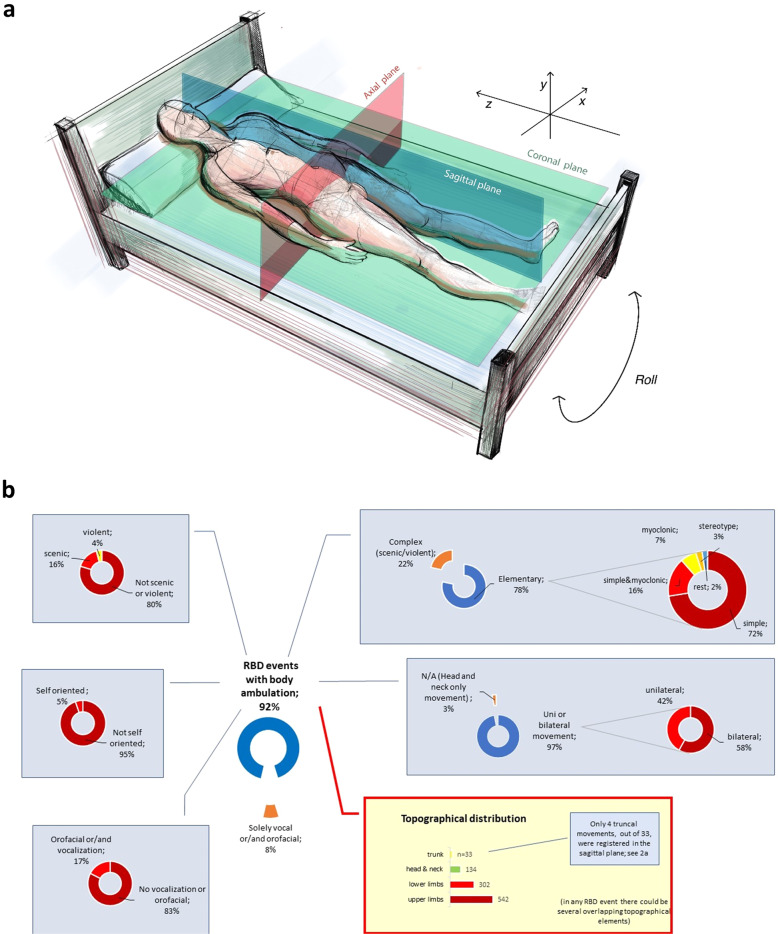
Unlike sleep-walkers, patients with rapid-eye-movement-behaviour disorder (RBD) rarely leave the bed during the re-enactment of their dreams. RBD movements may be independent of spatial co-ordinates of the ‘outside-world’, and instead rely on (allocentric) brain-generated virtual space-maps, as evident by patients’ limited truncal/axial movements. To confirm this, a semiology analysis of video-polysomnography records of 38 RBD patients was undertaken and paradoxically restricted truncal/thoraco-lumbar movements during complex dream re-enactments demonstrated.
Overview
The claims and statistics of this paper haven’t been checked yet.
Free: it reads the open-access text and checks the first 5 claims that cite a source we can check. Create a free account to check every claim.
Integrity signals
Registry
Cites
Statistics
Figures
Verification
Claims the paper makes
The claims and statistics of this paper haven’t been checked yet.
Free: it reads the open-access text and checks the first 5 claims that cite a source we can check. Create a free account to check every claim.
Claims other papers make about this one
Each is checked against this paper’s own text: does it say what the citing paper says it does?
The cited source says what the claim attributes to it.
In the citing paper
“Contrary to REM sleep behavior disorder (RBD), eyes during DoA episodes are wide open [26], even during minor episodes, and movements more often involve the trunk [27].”
From Diagnosis and Management of NREM Sleep Parasomnias in Children and Adults (2023) · cites this paper as [27]
Self-check
Percentages, sums and reported differences re-computed from the paper’s own numbers.
The self-check needs the paper’s full text.
Citations
Cites
International Classification of Sleep Disorders-Third Edition
Sateia, M. J. (2014) · Chest · doi:10.1378/chest.14-0970 · Cited by 3,860
An information integration theory of consciousness
Tononi, G. (2004) · BMC Neuroscience · doi:10.1186/1471-2202-5-42 · Cited by 1,958
Self-citationRegional cerebral blood flow throughout the sleep-wake cycle. An H2(15)O PET study
Braun, A. (1997) · Brain · doi:10.1093/brain/120.7.1173 · Cited by 1,268
The reinterpretation of dreams: An evolutionary hypothesis of the function of dreaming
Revonsuo, A. (2000) · Behavioral and Brain Sciences · doi:10.1017/s0140525x00004015 · Cited by 676
Dauvilliers, Y., Schenck, C. H., Postuma, R. B., Iranzo, A., Luppi, P.-H., Plazzi, G., Montplaisir, J., & Boeve, B. (2018) · Nature Reviews Disease Primers · doi:10.1038/s41572-018-0016-5 · Cited by 492
Egocentric and allocentric spatial reference frames in aging: A systematic review
Colombo, D., Serino, S., Tuena, C., Pedroli, E., Dakanalis, A., Cipresso, P., & Riva, G. (2017) · Neuroscience & Biobehavioral Reviews · doi:10.1016/j.neubiorev.2017.07.012 · Cited by 251
The Cognitive Architecture of Spatial Navigation: Hippocampal and Striatal Contributions
Chersi, F., & Burgess, N. (2015) · Neuron · doi:10.1016/j.neuron.2015.09.021 · Cited by 240
REM sleep behavior disorder: motor manifestations and pathophysiology
Arnulf, I. (2012) · Movement Disorders · doi:10.1002/mds.24957 · Cited by 231
Fernández-Arcos, A., Iranzo, A., Serradell, M., Gaig, C., & Santamaria, J. (2016) · Sleep · doi:10.5665/sleep.5332 · Cited by 221
Aggressive dream content without daytime aggressiveness in REM sleep behavior disorder
Fantini, M. L., Corona, A., Clerici, S., & Ferini-Strambi, L. (2005) · Neurology · doi:10.1212/01.wnl.0000179346.39655.e0 · Cited by 208
Frauscher, B., Iranzo, A., Högl, B., Casanova-Molla, J., Salamero, M., Gschliesser, V., Tolosa, E., Poewe, W., Santamaria, J., & SINBAR (Sleep Innsbruck Barcelona) group (2008) · Sleep · doi:10.1093/sleep/31.5.724 · Cited by 178
Local Slow Waves in Superficial Layers of Primary Cortical Areas during REM Sleep
Funk, C. M., Honjoh, S., Rodriguez, A. V., Cirelli, C., & Tononi, G. (2016) · Current Biology · doi:10.1016/j.cub.2015.11.062 · Cited by 178
Self-citationNonviolent elaborate behaviors may also occur in REM sleep behavior disorder
Oudiette, D., De Cock, V. C., Lavault, S., Leu, S., Vidailhet, M., & Arnulf, I. (2009) · Neurology · doi:10.1212/01.wnl.0000341936.78678.3a · Cited by 158
Stereotypy of psychogenic nonepileptic seizures: Insights from video‐EEG monitoring
Seneviratne, U., Reutens, D., & D’Souza, W. (2010) · Epilepsia · doi:10.1111/j.1528-1167.2010.02560.x · Cited by 156
A novel somatosensory spatial navigation system outside the hippocampal formation
Long, X., & Zhang, S. (2021) · Cell Research · doi:10.1038/s41422-020-00448-8 · Cited by 152
Single-neuron activity and eye movements during human REM sleep and awake vision
Andrillon, T., Nir, Y., Cirelli, C., Tononi, G., & Fried, I. (2015) · Nature Communications · doi:10.1038/ncomms8884 · Cited by 150 · cited 1×
“Increasing body of work suggests that hippocampal plastic changes and neural reactivations during sleep, which underlie encoding and consolidation of long-term memories, are under a distinct homoeostatic control by subcortical neuromodulatory structures and the ponto-geniculate waves.(29) While their role in modulatio…”
Self-citationVideo analysis of motor events in REM sleep behavior disorder
Frauscher, B., Gschliesser, V., Brandauer, E., Ulmer, H., Peralta, C. M., Müller, J., Poewe, W., & Högl, B. (2007) · Movement Disorders · doi:10.1002/mds.21561 · Cited by 147
EEG Recording and Analysis for Sleep Research
Campbell, I. G. (2009) · Current Protocols in Neuroscience · doi:10.1002/0471142301.ns1002s49 · Cited by 145
Uguccioni, G., Golmard, J.-L., de Fontréaux, A. N., Leu-Semenescu, S., Brion, A., & Arnulf, I. (2013) · Sleep Medicine · doi:10.1016/j.sleep.2013.01.014 · Cited by 131
Cardiac Autonomic Activity During Wakefulness and Sleep in REM Sleep Behavior Disorder
Ferini-Strambi, L., Oldani, A., Zucconi, M., & Smirne, S. (1996) · Sleep · doi:10.1093/sleep/19.5.367 · Cited by 110
Dreams and nightmares in healthy adults and in patients with sleep and neurological disorders
Siclari, F., Valli, K., & Arnulf, I. (2020) · The Lancet Neurology · doi:10.1016/s1474-4422(20)30275-1 · Cited by 98
The Body Model Theory of Somatosensory Cortex
Brecht, M. (2017) · Neuron · doi:10.1016/j.neuron.2017.05.018 · Cited by 85
Sensory cortical control of movement
Karadimas, S. K., Satkunendrarajah, K., Laliberté, A. M., Ringuette, D., Weisspapir, I., Li, L., Gosgnach, S., & Fehlings, M. G. (2019) · Nature Neuroscience · doi:10.1038/s41593-019-0536-7 · Cited by 77
Entorhinal-retrosplenial circuits for allocentric-egocentric transformation of boundary coding
van Wijngaarden, J. B., Babl, S. S., & Ito, H. T. (2020) · eLife · doi:10.7554/elife.59816 · Cited by 77
Cygan, F., Oudiette, D., Leclair‐Visonneau, L., Leu‐Semenescu, S., & Arnulf, I. (2010) · Journal of Clinical Sleep Medicine · doi:10.5664/jcsm.27988 · Cited by 76
Oudiette (2012) · doi:10.1002/mds.24044 · Cited by 64
Diagnostic tools for REM sleep behavior disorder
Neikrug, A. B., & Ancoli-Israel, S. (2012) · Sleep Medicine Reviews · doi:10.1016/j.smrv.2011.08.004 · Cited by 61
Sleep‐related Minor Motor Events in Nocturnal Frontal Lobe Epilepsy
Terzaghi, M., Sartori, I., Mai, R., Tassi, L., Francione, S., Cardinale, F., Castana, L., Cossu, M., LoRusso, G., Manni, R., et al. (2007) · Epilepsia · doi:10.1111/j.1528-1167.2006.00929.x · Cited by 53
Valomon, A., Riedner, B. A., Jones, S. G., Nakamura, K., Tononi, G., Plante, D. T., Benca, R. M., & Boly, M. (2021) · Scientific Reports · doi:10.1038/s41598-021-83980-w · Cited by 44
Self-citationNguyen‐Michel, V., Solano, O., Leu‐Semenescu, S., Pierre-Justin, A., Gales, A. Z., Navarro, V., Baulac, M., Adam, C., Dupont, S., & Arnulf, I. (2018) · Seizure · doi:10.1016/j.seizure.2018.03.021 · Cited by 26
NREM parasomnia as a dream enacting behavior
Rocha, Á., & Arnulf, I. (2020) · Sleep Medicine · doi:10.1016/j.sleep.2020.02.024 · Cited by 25
Characterization of motor events in REM sleep behavior disorder
Bugalho, P., Lampreia, T., Miguel, R., Mendonça, M., Caetano, A., & Barbosa, R. P. (2017) · Journal of Neural Transmission · doi:10.1007/s00702-017-1759-y · Cited by 24
Wasserman, D., Bindman, D., Nesbitt, A. D., Cash, D., Milošević, M., Francis, P. T., Chaudhuri, К. R., Leschziner, G. D., Ferini‐Strambi, L., Ballard, C. G., et al. (2021) · Nature and Science of Sleep · doi:10.2147/nss.s267037 · Cited by 22
Self-citationNepožitek, J., Ünalp, C., Dostálová, S., Dušek, P., Kemlink, D., Příhodová, I., y Losada, V. I. L., Trnka, J., Zogala, D., Bezdíček, O., et al. (2021) · Sleep Medicine · doi:10.1016/j.sleep.2021.04.033 · Cited by 21
Poole, N. A., & Rosenzweig, I. (2020) · The Lancet Neurology · doi:10.1016/s1474-4422(20)30315-x · Cited by 5
Self-citationGelegen, Ç., Cash, D., Ilić, K., Sander, M., Kim, E., Simmons, C., Bernanos, M., Lama, J., Randall, K., Brown, J. T., et al. (2021) · bioRxiv (Cold Spring Harbor Laboratory) · doi:10.1101/2021.05.26.445845 · Cited by 2
Self-citation
Cited by
Diagnosis and Management of NREM Sleep Parasomnias in Children and Adults
Mainieri, G., Loddo, G., Provini, F., Nobili, L., Manconi, M., & Castelnovo, A. (2023) · Diagnostics · doi:10.3390/diagnostics13071261 · Cited by 34
“Contrary to REM sleep behavior disorder (RBD), eyes during DoA episodes are wide open [26], even during minor episodes, and movements more often involve the trunk [27].”
Sex differences in alpha-synucleinopathies: a systematic review
Raheel, K., Deegan, G., Giulio, I. D., Cash, D., Ilić, K., Gnoni, V., Chaudhuri, К. R., Drakatos, P., Moran, R., & Rosenzweig, I. (2023) · Frontiers in Neurology · doi:10.3389/fneur.2023.1204104 · Cited by 35
Self-citationGelegen, Ç., Cash, D., Ilić, K., Sander, M., Kim, E., Simmons, C., Bernanos, M., Lama, J., Randall, K., Brown, J. T., et al. (2022) · Scientific Reports · doi:10.1038/s41598-022-11516-x · Cited by 21
Self-citationOrexin and Sleep Disturbances in Alpha-Synucleinopathies: a Systematic Review
Raheel, K., See, Q. R., Munday, V., Fakhroo, B., Ivanenko, O., Salvatelli, M. L., Mutti, C., Goadsby, P. J., Delogu, A., Naismith, S. L., et al. (2024) · Current Neurology and Neuroscience Reports · doi:10.1007/s11910-024-01359-6 · Cited by 13
Self-citationDrakatos, P., O'Regan, D. J., Liao, Y., Panayiotou, C., Higgins, S. E., Kabiljo, R., Benson, J., Pool, N., Tahmasian, M., Romigi, A., et al. (2023) · Scientific Reports · doi:10.1038/s41598-023-36083-7 · Cited by 12
Self-citation
Metadata
- Authors
- Wasserman, D., Gullone, S., Duncan, I., Veronese, M., Gnoni, V., Higgins, S., Birdseye, A., Gelegen, E. C., Goadsby, P. J., Ashkan, K., Ray Chaudhuri, K., Tononi, G., Drakatos, P., & Rosenzweig, I.
- Affiliations
- Guy's Hospital (GB)
- King's College London (GB)
- King's College Hospital (GB)
- University of Wisconsin–Madison (US)
- Corresponding author
- Rosenzweig, Ivana
- ORCID
- Venue
- npj Parkinson's Disease
- Published
- 2022-03-15
- Volume
- 8
- Issue
- 1
- Pages
- 26-26
- ISSN
- 2373-8057 (ISSN-L)
- PMC
- PMC8924261
- OpenAlex
- W4220911146
- Cited by
- 18
- References
- 36
- Citations by year
- 2026: 2 · 2025: 2 · 2024: 5 · 2023: 5 · 2022: 4
- FWCI
- 2.11
- Type
- journal article
- Language
- en
- Open access
- gold
- doi.org
- Licence
- cc-by
- creativecommons.org/licenses/by/4.0 (tdm)
- creativecommons.org/licenses/by/4.0 (vor)
- Locations
- npj Parkinson s Disease (publishedVersion, cc-by)
- PubMed Central (publishedVersion, cc-by)
- PubMed (publishedVersion)
- DOAJ (DOAJ: Directory of Open Access Journals) (submittedVersion, cc-by-sa)
- Padua Research Archive (University of Padova) (submittedVersion, cc-by)
- Funders
- Wellcome Trust (103952/Z/14/Z)
- Topics
- Health Sciences › Medicine › Clinical Neurology › Parkinson's Disease Mechanisms and Treatments
- Social Sciences › Psychology › Experimental and Cognitive Psychology › Sleep and related disorders
- Life Sciences › Neuroscience › Cognitive Neuroscience › Sleep and Wakefulness Research
- Keywords
- axial movement, sleepwalking, video-polysomnography, semiology
About these checks
Registry, retraction, Cites and statistics results are computed, not judged, with one exception: a printed reference that no index lists is read once by a model before it counts as a citation error. Claims are extracted by a model and kept only when their quote appears verbatim in the text; each cited source is then checked, with a model’s help, for whether it says what the claim relies on. Those verdicts can be wrong — read the claim’s quote and the cited source before relying on one.
Statistics and arithmetic are recomputed, not judged.
Confidence bands are shown only for fields calibrated on our annotated test set. None is calibrated yet, so no band is shown.
What counts as a claim ›How we measure confidence ›How we check this ›
Are you an author, or do you see a problem with this page? Request a review
Data sources
Bibliographic data: Semantic Scholar, OpenAlex, Crossref.
Contains information from the Semantic Scholar Academic Graph Datasets, made available under the ODC Attribution License (ODC-BY 1.0).
Semantic Scholar’s data is described in: Kinney, R., et al. (2023). The Semantic Scholar Open Data Platform. arXiv:2301.10140.
