

The DOI matches its Crossref record; 42 of the 42 references it cites were found in a registry or an index.
Correcting coherent errors with surface codes
Open accessAbstract
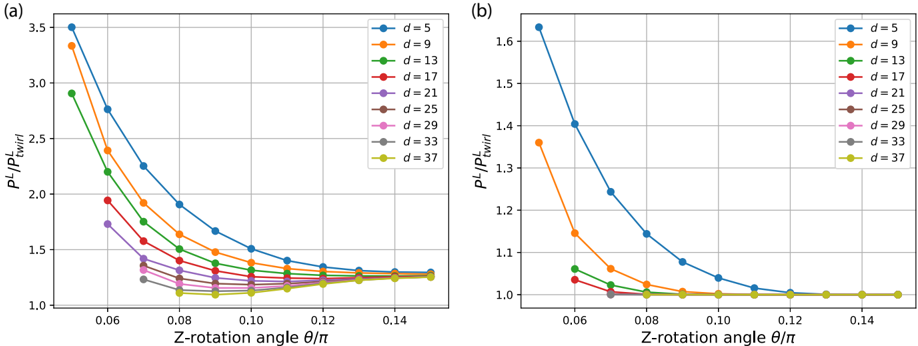
Surface codes are building blocks of quantum computing platforms based on 2D arrays of qubits responsible for detecting and correcting errors. The error suppression achieved by the surface code is usually estimated by simulating toy noise models describing random Pauli errors. However, Pauli noise models fail to capture coherent processes such as systematic unitary errors caused by imperfect control pulses. Here we report the first large-scale simulation of quantum error correction protocols based on the surface code in the presence of coherent noise. We observe that the standard Pauli approximation provides an accurate estimate of the error threshold but underestimates the logical error rate in the sub-threshold regime. We find that for large code size the logical-level noise is well approximated by random Pauli errors even though the physical-level noise is coherent. Our work demonstrates that coherent effects do not significantly change the error correcting threshold of surface codes. This gives more confidence in the viability of the fault-tolerance architecture pursued by several experimental groups.
Overview
The claims and statistics of this paper haven’t been checked yet.
Free: it reads the open-access text and checks the first 5 claims that cite a source we can check. Create a free account to check every claim.
Integrity signals
Registry
Cites
Statistics
Figures
Verification
Claims the paper makes
The claims and statistics of this paper haven’t been checked yet.
Free: it reads the open-access text and checks the first 5 claims that cite a source we can check. Create a free account to check every claim.
Claims other papers make about this one
Each is checked against this paper’s own text: does it say what the citing paper says it does?
The source backs part of the claim, not all of it — or backs it for a different population, condition or comparison.
In the citing paper
“As well as the error-detecting benefits, it seems that the logical circuit is substantially more tolerant to coherent errors, exhibiting operation that is inherently digital, just with imperfect fidelity (see, for example, Extended Data Fig. 7a), consistent with theoretical predictions49.”
From Logical quantum processor based on reconfigurable atom arrays (2024) · cites this paper as [49]
Experimental — accuracy not yet measuredThe source backs part of the claim, not all of it — or backs it for a different population, condition or comparison.
In the citing paper
“First, empirically, it seems that the logical circuit is much more tolerant to coherent errors49,110,111, and understanding the manifestations of this is a subject of continuing investigation.”
From Logical quantum processor based on reconfigurable atom arrays (2024) · cites this paper as [49]
Experimental — accuracy not yet measuredThe source backs part of the claim, not all of it — or backs it for a different population, condition or comparison.
In the citing paper
“Specifically, it seems that the logical circuit realizes inherently digital operation, for which the small coherent errors do not substantially shift/distort the bitstring distribution but just reduce the overall fidelity49,110”
From Logical quantum processor based on reconfigurable atom arrays (2024) · cites this paper as [49]
Experimental — accuracy not yet measuredThe cited source says what the claim attributes to it.
In the citing paper
“For more general noise models, such as coherent noise, simulation methods for specific settings have also been found [176].”
From Quantum error correction and fault tolerance: A comprehensive tutorial (2026) · cites this paper as [176]
Self-check
Percentages, sums and reported differences re-computed from the paper’s own numbers.
The self-check needs the paper’s full text.
Citations
Cites
Fault-tolerant quantum computation by anyons
Kitaev, A. Y. (2003) · Annals of Physics · doi:10.1016/s0003-4916(02)00018-0 · Cited by 7,238
Anyons in an exactly solved model and beyond
Kitaev, A. (2006) · Annals of Physics · doi:10.1016/j.aop.2005.10.005 · Cited by 5,245
Dennis, E., Kitaev, A., Landahl, A., & Preskill, J. (2002) · Journal of Mathematical Physics · doi:10.1063/1.1499754 · Cited by 1,768
Superconducting quantum circuits at the surface code threshold for fault tolerance
Barends, R., Kelly, J., Megrant, A., Veitia, A., Sank, D., Jeffrey, E., White, T. C., Mutus, J., Fowler, A. G., Campbell, B., et al. (2014) · Nature · doi:10.1038/nature13171 · Cited by 1,733
Quantum computations: algorithms and error correction
Kitaev, A. Y. (1997) · Russian Mathematical Surveys · doi:10.1070/rm1997v052n06abeh002155 · Cited by 1,424
State preservation by repetitive error detection in a superconducting quantum circuit
Kelly, J., Barends, R., Fowler, A. G., Megrant, A., Jeffrey, E., White, T. C., Sank, D., Mutus, J. Y., Campbell, B., Chen, Y., et al. (2015) · Nature · doi:10.1038/nature14270 · Cited by 916
Fault-Tolerant Quantum Computation with High Threshold in Two Dimensions
Raussendorf, R., & Harrington, J. (2007) · Physical Review Letters · doi:10.1103/physrevlett.98.190504 · Cited by 812
Realization of three-qubit quantum error correction with superconducting circuits
Reed, M. D., DiCarlo, L., Nigg, S. E., Sun, L., Frunzio, L., Girvin, S. M., & Schoelkopf, R. J. (2012) · Nature · doi:10.1038/nature10786 · Cited by 585
Córcoles, A. D., Magesan, E., Srinivasan, S. J., Cross, A. W., Steffen, M., Gambetta, J. M., & Chow, J. M. (2015) · Nature Communications · doi:10.1038/ncomms7979 · Cited by 490
High-threshold universal quantum computation on the surface code
Fowler, A. G., Stephens, A. M., & Groszkowski, P. (2009) · Physical Review A · doi:10.1103/physreva.80.052312 · Cited by 486
Research works printed but not linked: 4
- Ofek, N. et al. Demonstrating quantum error correction that extends the lifetime of quantum information. arXiv. 1602, 04768 (2016).
- Gottesman, D. Stabilizer Codes and Quantum Error Correction. PhD thesis, California Inst. Technol. (1997).
- Bravyi, S. Lagrangian representation for fermionic linear optics. Quant. Inf. Comp. 5, 216–238 (2004).
- Bravyi, S. & Koenig, R. Classical simulation of dissipative fermionic linear optics. Quant. Inf. Comp. 12, 925 (2012).
Cited by
Logical quantum processor based on reconfigurable atom arrays
Bluvstein, D., Evered, S. J., Geim, A. A., Li, S. H., Zhou, H., Manovitz, T., Ebadi, S., Cain, M., Kalinowski, M., Hangleiter, D., et al. (2024) · Nature · doi:10.1038/s41586-023-06927-3 · Cited by 1,119
“1c, for the 500-μs mid-circuit imaging used in this work, we are able to achieve unchanged coherence (identical within the error bars) of the data qubits with the local imaging light on as without it.”
BackgroundMethodSimulating quantum many-body dynamics on a current digital quantum computer
Smith, A., Kim, M. S., Pollmann, F., & Knolle, J. (2019) · npj Quantum Information · doi:10.1038/s41534-019-0217-0 · Cited by 278
Benchmarking Quantum Computers and the Impact of Quantum Noise
Resch, S., & Karpuzcu, U. R. (2021) · ACM Computing Surveys · doi:10.1145/3464420 · Cited by 218
Quantum Information and Algorithms for Correlated Quantum Matter
Head-Marsden, K., Flick, J., Ciccarino, C. J., & Narang, P. (2020) · Chemical Reviews · doi:10.1021/acs.chemrev.0c00620 · Cited by 155
Suzuki, Y., Endo, S., Fujii, K., & Tokunaga, Y. (2022) · PRX Quantum · doi:10.1103/prxquantum.3.010345 · Cited by 232
Metadata
- Authors
- Bravyi, S., Englbrecht, M., König, R., & Peard, N.
- Affiliations
- IBM (United States) (US)
- Universität Innsbruck (AT)
- Technical University of Munich (DE)
- Corresponding author
- König, Robert
- Venue
- npj Quantum Information
- Published
- 2018-10-31
- Volume
- 4
- Issue
- 1
- ISSN
- 2056-6387 (ISSN-L)
- OpenAlex
- W2762805862
- Cited by
- 157
- References
- 40
- Citations by year
- 2026: 18 · 2025: 36 · 2024: 25 · 2023: 27 · 2022: 19 · 2021: 13 · 2020: 9 · 2019: 7 · 2018: 2
- FWCI
- 4.34
- Type
- journal article
- Language
- en
- Open access
- gold
- doi.org
- Licence
- cc-by
- creativecommons.org/licenses/by/4.0 (tdm)
- creativecommons.org/licenses/by/4.0 (vor)
- Locations
- npj Quantum Information (publishedVersion, cc-by)
- arXiv (Cornell University) (submittedVersion)
- DOAJ (DOAJ: Directory of Open Access Journals) (submittedVersion)
- mediaTUM (Technical University of Munich) (submittedVersion, other-oa)
- arXiv (Cornell University)
- Funders
- National Science Foundation (PHY11- 25915, NSF PHY-11-25915, 1125915)
- European Commission (291763)
- Technische Universität München (291763)
- QuantERA
- Intelligence Advanced Research Projects Activity (W911NF-16-0114)
- Kavli Institute for Theoretical Physics, University of California, Santa Barbara (PHY-11-25915, NSF PHY11-25915)
- Topics
- Physical Sciences › Computer Science › Artificial Intelligence › Quantum Computing Algorithms and Architecture
- Physical Sciences › Physics and Astronomy › Atomic and Molecular Physics, and Optics › Quantum Information and Cryptography
- Physical Sciences › Physics and Astronomy › Atomic and Molecular Physics, and Optics › Quantum many-body systems
- Keywords
- surface code, quantum error correction, coherent noise, error threshold, logical error rate, fault tolerance, quantum computing hardware
About these checks
Registry, retraction, Cites and statistics results are computed, not judged, with one exception: a printed reference that no index lists is read once by a model before it counts as a citation error. Claims are extracted by a model and kept only when their quote appears verbatim in the text; each cited source is then checked, with a model’s help, for whether it says what the claim relies on. Those verdicts can be wrong — read the claim’s quote and the cited source before relying on one.
Statistics and arithmetic are recomputed, not judged.
Confidence bands are shown only for fields calibrated on our annotated test set. None is calibrated yet, so no band is shown.
What counts as a claim ›How we measure confidence ›How we check this ›
Are you an author, or do you see a problem with this page? Request a review
How to cite
Cite CoChat for the checks on this page, and the paper for its own findings.
- This page
- CoChat. (2026). Citation check: Correcting coherent errors with surface codes. https://app.cochat.ai/papers/10.1038/s41534-018-0106-y
- The paper
- Bravyi, S., Englbrecht, M., König, R., & Peard, N. (2018). Correcting coherent errors with surface codes. npj Quantum Information. https://doi.org/10.1038/s41534-018-0106-y
Data sources
Bibliographic data: Semantic Scholar, OpenAlex, Crossref.
Contains information from the Semantic Scholar Academic Graph Datasets, made available under the ODC Attribution License (ODC-BY 1.0).
Semantic Scholar’s data is described in: Kinney, R., et al. (2023). The Semantic Scholar Open Data Platform. arXiv:2301.10140.
