

Correcting coherent errors with surface codes
Open accessThe DOI matches its Crossref record; 43 of the 43 references it cites were found in a registry or an index.
Abstract
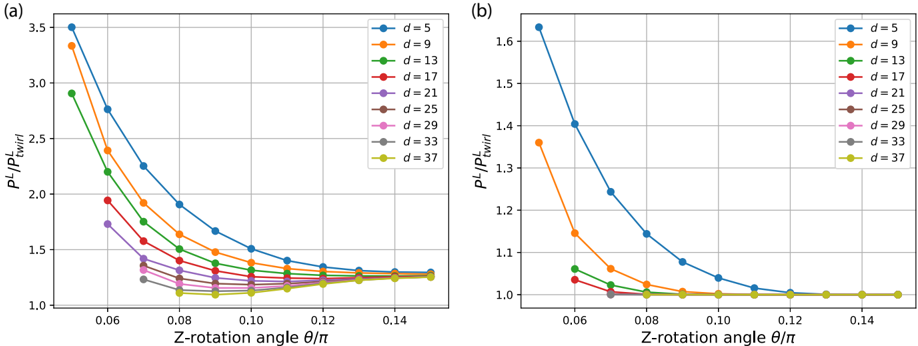
Surface codes are building blocks of quantum computing platforms based on 2D arrays of qubits responsible for detecting and correcting errors. The error suppression achieved by the surface code is usually estimated by simulating toy noise models describing random Pauli errors. However, Pauli noise models fail to capture coherent processes such as systematic unitary errors caused by imperfect control pulses. Here we report the first large-scale simulation of quantum error correction protocols based on the surface code in the presence of coherent noise. We observe that the standard Pauli approximation provides an accurate estimate of the error threshold but underestimates the logical error rate in the sub-threshold regime. We find that for large code size the logical-level noise is well approximated by random Pauli errors even though the physical-level noise is coherent. Our work demonstrates that coherent effects do not significantly change the error correcting threshold of surface codes. This gives more confidence in the viability of the fault-tolerance architecture pursued by several experimental groups.
Overview
The claims and statistics of this paper haven’t been checked yet.
Free: it reads the open-access text and checks the first 5 claims that cite a source we can check. Create a free account to check every claim.
Integrity signals
Registry
Cites
Statistics
Figures
Verification
Claims the paper makes
The claims and statistics of this paper haven’t been checked yet.
Free: it reads the open-access text and checks the first 5 claims that cite a source we can check. Create a free account to check every claim.
Claims other papers make about this one
Each is checked against this paper’s own text: does it say what the citing paper says it does?
The source backs part of the claim, not all of it — or backs it for a different population, condition or comparison.
In the citing paper
“As well as the error-detecting benefits, it seems that the logical circuit is substantially more tolerant to coherent errors, exhibiting operation that is inherently digital, just with imperfect fidelity (see, for example, Extended Data Fig. 7a), consistent with theoretical predictions49.”
From Logical quantum processor based on reconfigurable atom arrays (2024) · cites this paper as [49]
Experimental — accuracy not yet measuredThe source backs part of the claim, not all of it — or backs it for a different population, condition or comparison.
In the citing paper
“First, empirically, it seems that the logical circuit is much more tolerant to coherent errors49,110,111, and understanding the manifestations of this is a subject of continuing investigation.”
From Logical quantum processor based on reconfigurable atom arrays (2024) · cites this paper as [49]
Experimental — accuracy not yet measuredThe source backs part of the claim, not all of it — or backs it for a different population, condition or comparison.
In the citing paper
“Specifically, it seems that the logical circuit realizes inherently digital operation, for which the small coherent errors do not substantially shift/distort the bitstring distribution but just reduce the overall fidelity49,110”
From Logical quantum processor based on reconfigurable atom arrays (2024) · cites this paper as [49]
Experimental — accuracy not yet measuredThe cited source says what the claim attributes to it.
In the citing paper
“For more general noise models, such as coherent noise, simulation methods for specific settings have also been found [176].”
From Quantum error correction and fault tolerance: A comprehensive tutorial (2026) · cites this paper as [176]
Self-check
Percentages, sums and reported differences re-computed from the paper’s own numbers.
The self-check needs the paper’s full text.
Citations
Cites
Fault-tolerant quantum computation by anyons
Kitaev, A. Y. (2003) · Annals of Physics · doi:10.1016/s0003-4916(02)00018-0 · Cited by 7,238
Anyons in an exactly solved model and beyond
Kitaev, A. (2006) · Annals of Physics · doi:10.1016/j.aop.2005.10.005 · Cited by 5,245
Dennis, E., Kitaev, A., Landahl, A., & Preskill, J. (2002) · Journal of Mathematical Physics · doi:10.1063/1.1499754 · Cited by 1,768
Superconducting quantum circuits at the surface code threshold for fault tolerance
Barends, R., Kelly, J., Megrant, A., Veitia, A., Sank, D., Jeffrey, E., White, T. C., Mutus, J., Fowler, A. G., Campbell, B., et al. (2014) · Nature · doi:10.1038/nature13171 · Cited by 1,733
Quantum computations: algorithms and error correction
Kitaev, A. Y. (1997) · Russian Mathematical Surveys · doi:10.1070/rm1997v052n06abeh002155 · Cited by 1,424
State preservation by repetitive error detection in a superconducting quantum circuit
Kelly, J., Barends, R., Fowler, A. G., Megrant, A., Jeffrey, E., White, T. C., Sank, D., Mutus, J. Y., Campbell, B., Chen, Y., et al. (2015) · Nature · doi:10.1038/nature14270 · Cited by 916
Fault-Tolerant Quantum Computation with High Threshold in Two Dimensions
Raussendorf, R., & Harrington, J. (2007) · Physical Review Letters · doi:10.1103/physrevlett.98.190504 · Cited by 812
Stabilizer Codes and Quantum Error Correction
Gottesman, D. (1997) · arXiv · doi:10.48550/arxiv.quant-ph/9705052 · Cited by 753
Realization of three-qubit quantum error correction with superconducting circuits
Reed, M. D., DiCarlo, L., Nigg, S. E., Sun, L., Frunzio, L., Girvin, S. M., & Schoelkopf, R. J. (2012) · Nature · doi:10.1038/nature10786 · Cited by 585
Córcoles, A. D., Magesan, E., Srinivasan, S. J., Cross, A. W., Steffen, M., Gambetta, J. M., & Chow, J. M. (2015) · Nature Communications · doi:10.1038/ncomms7979 · Cited by 490
High-threshold universal quantum computation on the surface code
Fowler, A. G., Stephens, A. M., & Groszkowski, P. (2009) · Physical Review A · doi:10.1103/physreva.80.052312 · Cited by 486
Quantum Orders in an Exact Soluble Model
Wen, X.-G. (2003) · Physical Review Letters · doi:10.1103/physrevlett.90.016803 · Cited by 422
Quantum codes on a lattice with boundary
Bravyi, S. B., & Kitaev, A. Y. (1998) · arXiv · doi:10.48550/arxiv.quant-ph/9811052 · Cited by 394
Self-citationSurface code quantum computing with error rates over 1%
Wang, D. S., Fowler, A. G., & Hollenberg, L. C. L. (2011) · Physical Review A · doi:10.1103/physreva.83.020302 · Cited by 343
Classical simulation of noninteracting-fermion quantum circuits
Terhal, B. M., & DiVincenzo, D. P. (2002) · Physical Review A · doi:10.1103/physreva.65.032325 · Cited by 329
Low-distance surface codes under realistic quantum noise
Tomita, Y., & Svore, K. M. (2014) · Physical Review A · doi:10.1103/physreva.90.062320 · Cited by 281
Symmetrized Characterization of Noisy Quantum Processes
Emerson, J., Silva, M., Moussa, O., Ryan, C., Laforest, M., Baugh, J., Cory, D. G., & Laflamme, R. (2007) · Science · doi:10.1126/science.1145699 · Cited by 264
Towards Practical Classical Processing for the Surface Code
Fowler, A. G., Whiteside, A. C., & Hollenberg, L. C. L. (2012) · Physical Review Letters · doi:10.1103/physrevlett.108.180501 · Cited by 204
Demonstration of Weight-Four Parity Measurements in the Surface Code Architecture
Takita, M., Córcoles, A. D., Magesan, E., Abdo, B., Brink, M., Cross, A., Chow, J. M., & Gambetta, J. M. (2016) · Physical Review Letters · doi:10.1103/physrevlett.117.210505 · Cited by 200
Estimating the coherence of noise
Wallman, J., Granade, C., Harper, R., & Flammia, S. T. (2015) · New Journal of Physics · doi:10.1088/1367-2630/17/11/113020 · Cited by 192
Optimal resources for topological two-dimensional stabilizer codes: Comparative study
Bombin, H., & Martin-Delgado, M. A. (2007) · Physical Review A · doi:10.1103/physreva.76.012305 · Cited by 178
Comparing Experiments to the Fault-Tolerance Threshold
Kueng, R., Long, D. M., Doherty, A. C., & Flammia, S. T. (2016) · Physical Review Letters · doi:10.1103/physrevlett.117.170502 · Cited by 130
Bounding quantum gate error rate based on reported average fidelity
Sanders, Y. R., Wallman, J. J., & Sanders, B. C. (2015) · New Journal of Physics · doi:10.1088/1367-2630/18/1/012002 · Cited by 119
From Majorana fermions to topological order
Terhal, B. M., Hassler, F., & Divincenzo, D. P. (2012) · Physical Review Letters · doi:10.1103/physrevlett.108.260504 · Cited by 96
Tensor-Network Simulations of the Surface Code under Realistic Noise
Darmawan, A. S., & Poulin, D. (2017) · Physical Review Letters · doi:10.1103/physrevlett.119.040502 · Cited by 88
Bringing Order through Disorder: Localization of Errors in Topological Quantum Memories
Wootton, J. R., & Pachos, J. K. (2011) · Physical Review Letters · doi:10.1103/physrevlett.107.030503 · Cited by 83
Modeling quantum noise for efficient testing of fault-tolerant circuits
Magesan, E., Puzzuoli, D., Granade, C., & Cory, D. G. (2013) · Physical Review A · doi:10.1103/physreva.87.012324 · Cited by 78
Approximation of realistic errors by Clifford channels and Pauli measurements
Gutiérrez, M., Svec, L., Vargo, A., & Brown, K. R. (2013) · Physical Review A · doi:10.1103/physreva.87.030302 · Cited by 71
Fermionic Linear Optics and Matchgates
Knill, E. H. (2001) · arXiv (Cornell University) · doi:10.48550/arxiv.quant-ph/0108033 · Cited by 71
Modeling coherent errors in quantum error correction
Greenbaum, D., & Dutton, Z. (2018) · Quantum Science and Technology · doi:10.1088/2058-9565/aa9a06 · Cited by 70
Scalable protocol for identification of correctable codes
Silva, M., Magesan, E., Kribs, D. W., & Emerson, J. (2008) · Physical Review A · doi:10.1103/physreva.78.012347 · Cited by 68
Disorder-Assisted Error Correction in Majorana Chains
Bravyi, S. B., & König, R. (2012) · Communications in Mathematical Physics · doi:10.1007/s00220-012-1606-9 · Cited by 68
Self-citationExact performance of concatenated quantum codes
Rahn, B., Doherty, A. C., & Mabuchi, H. (2002) · Physical Review A · doi:10.1103/physreva.66.032304 · Cited by 65
Localization of Toric Code Defects
Stark, C., Pollet, L., İmamoğlu, A., & Renner, R. (2011) · Physical Review Letters · doi:10.1103/physrevlett.107.030504 · Cited by 59
Proof of Finite Surface Code Threshold for Matching
Fowler, A. G. (2012) · Physical Review Letters · doi:10.1103/physrevlett.109.180502 · Cited by 55
Tractable simulation of error correction with honest approximations to realistic fault models
Puzzuoli, D., Granade, C., Haas, H., Criger, B., Magesan, E., & Cory, D. G. (2014) · Physical Review A · doi:10.1103/physreva.89.022306 · Cited by 47
Quantum error-correction failure distributions: Comparison of coherent and stochastic error models
Barnes, J. P., Trout, C. J., Lucarelli, D. G., & Clader, B. D. (2017) · Physical Review A · doi:10.1103/physreva.95.062338 · Cited by 45
Simple scheme for encoding and decoding a qubit in unknown state for various topological codes
Łodyga, J., Mazurek, P., Grudka, A., & Horodecki, M. (2015) · Scientific Reports · doi:10.1038/srep08975 · Cited by 44
Fault tolerance with bare ancillary qubits for a [[7,1,3]] code
Li, M., Gutiérrez, M., David, S. E., Hernandez, A., & Brown, K. R. (2017) · Physical Review A · doi:10.1103/physreva.96.032341 · Cited by 42
Linear-time general decoding algorithm for the surface code
Darmawan, A. S., & Poulin, D. (2018) · Physical Review E · doi:10.1103/physreve.97.051302 · Cited by 38
Suzuki, Y., Fujii, K., & Koashi, M. (2017) · Physical Review Letters · doi:10.1103/physrevlett.119.190503 · Cited by 37
Hard decoding algorithm for optimizing thresholds under general Markovian noise
Chamberland, C., Wallman, J., Beale, S., & Laflamme, R. (2017) · Physical Review A · doi:10.1103/physreva.95.042332 · Cited by 36
Generalized Performance of Concatenated Quantum Codes—A Dynamical Systems Approach
Fern, J., Kempe, J., Simic, S. N., & Sastry, S. (2006) · IEEE Transactions on Automatic Control · doi:10.1109/tac.2006.871942 · Cited by 16
Research works printed but not linked: 3
- 5. Ofek, N. et al. Demonstrating quantum error correction that extends the lifetime of quantum information. arXiv. 1602, 04768 (2016).
- 44. Bravyi, S. Lagrangian representation for fermionic linear optics. Quant. Inf. Comp. 5, 216-238 (2004).
- 46. Bravyi, S. & Koenig, R. Classical simulation of dissipative fermionic linear optics. Quant. Inf. Comp. 12, 925 (2012).
Cited by
Logical quantum processor based on reconfigurable atom arrays
Bluvstein, D., Evered, S. J., Geim, A. A., Li, S. H., Zhou, H., Manovitz, T., Ebadi, S., Cain, M., Kalinowski, M., Hangleiter, D., et al. (2024) · Nature · doi:10.1038/s41586-023-06927-3 · Cited by 1,119
“1c, for the 500-μs mid-circuit imaging used in this work, we are able to achieve unchanged coherence (identical within the error bars) of the data qubits with the local imaging light on as without it.”
BackgroundMethodSimulating quantum many-body dynamics on a current digital quantum computer
Smith, A., Kim, M. S., Pollmann, F., & Knolle, J. (2019) · npj Quantum Information · doi:10.1038/s41534-019-0217-0 · Cited by 278
Benchmarking Quantum Computers and the Impact of Quantum Noise
Resch, S., & Karpuzcu, U. R. (2022) · ACM Computing Surveys · doi:10.1145/3464420 · Cited by 131
Quantum Information and Algorithms for Correlated Quantum Matter
Head-Marsden, K., Flick, J., Ciccarino, C. J., & Narang, P. (2020) · Chemical Reviews · doi:10.1021/acs.chemrev.0c00620 · Cited by 156
Suzuki, Y., Endo, S., Fujii, K., & Tokunaga, Y. (2022) · PRX Quantum · doi:10.1103/prxquantum.3.010345 · Cited by 125
Metadata
- Authors
- Bravyi, S., Englbrecht, M., König, R., & Peard, N.
- Affiliations
- IBM (United States) (US)
- Universität Innsbruck (AT)
- Technical University of Munich (DE)
- Corresponding author
- König, Robert
- Venue
- npj Quantum Information
- Published
- 2018-10-31
- Volume
- 4
- Issue
- 1
- ISSN
- 2056-6387 (ISSN-L)
- OpenAlex
- W2762805862
- Cited by
- 157
- References
- 40
- Citations by year
- 2026: 18 · 2025: 36 · 2024: 25 · 2023: 27 · 2022: 19 · 2021: 13 · 2020: 9 · 2019: 7 · 2018: 2
- FWCI
- 4.34
- Type
- journal article
- Language
- en
- Open access
- gold
- doi.org
- Licence
- cc-by
- creativecommons.org/licenses/by/4.0 (tdm)
- creativecommons.org/licenses/by/4.0 (vor)
- Locations
- npj Quantum Information (publishedVersion, cc-by)
- arXiv (Cornell University) (submittedVersion)
- DOAJ (DOAJ: Directory of Open Access Journals) (submittedVersion)
- mediaTUM (Technical University of Munich) (submittedVersion, other-oa)
- arXiv (Cornell University)
- Funders
- National Science Foundation (PHY11- 25915, NSF PHY-11-25915, 1125915)
- European Commission (291763)
- Technische Universität München (291763)
- QuantERA
- Intelligence Advanced Research Projects Activity (W911NF-16-0114)
- Kavli Institute for Theoretical Physics, University of California, Santa Barbara (PHY-11-25915, NSF PHY11-25915)
- Topics
- Physical Sciences › Computer Science › Artificial Intelligence › Quantum Computing Algorithms and Architecture
- Physical Sciences › Physics and Astronomy › Atomic and Molecular Physics, and Optics › Quantum Information and Cryptography
- Physical Sciences › Physics and Astronomy › Atomic and Molecular Physics, and Optics › Quantum many-body systems
- Keywords
- surface code, quantum error correction, coherent noise, error threshold, logical error rate, fault tolerance, quantum computing hardware
About these checks
Registry, retraction, Cites and statistics results are computed, not judged, with one exception: a printed reference that no index lists is read once by a model before it counts as a citation error. Claims are extracted by a model and kept only when their quote appears verbatim in the text; each cited source is then checked, with a model’s help, for whether it says what the claim relies on. Those verdicts can be wrong — read the claim’s quote and the cited source before relying on one.
Statistics and arithmetic are recomputed, not judged.
Confidence bands are shown only for fields calibrated on our annotated test set. None is calibrated yet, so no band is shown.
What counts as a claim ›How we measure confidence ›How we check this ›
Are you an author, or do you see a problem with this page? Request a review
Data sources
Bibliographic data: Semantic Scholar, OpenAlex, Crossref.
Contains information from the Semantic Scholar Academic Graph Datasets, made available under the ODC Attribution License (ODC-BY 1.0).
Semantic Scholar’s data is described in: Kinney, R., et al. (2023). The Semantic Scholar Open Data Platform. arXiv:2301.10140.
