

Correcting coherent errors with surface codes
Open accessThe DOI matches its Crossref record; 43 of the 43 references it cites were found in a registry or an index.
Abstract
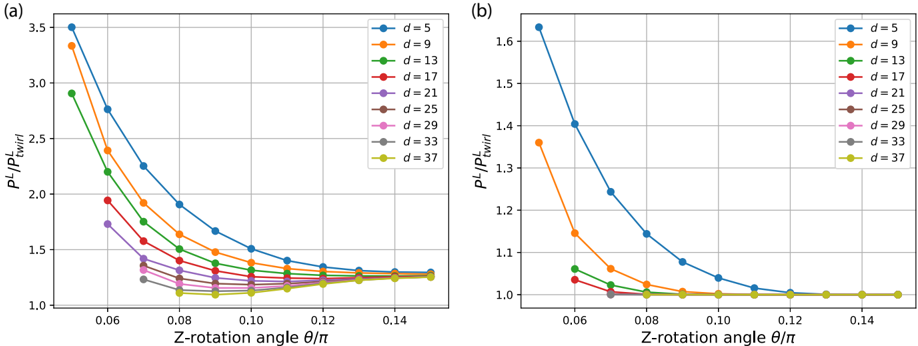
Surface codes are building blocks of quantum computing platforms based on 2D arrays of qubits responsible for detecting and correcting errors. The error suppression achieved by the surface code is usually estimated by simulating toy noise models describing random Pauli errors. However, Pauli noise models fail to capture coherent processes such as systematic unitary errors caused by imperfect control pulses. Here we report the first large-scale simulation of quantum error correction protocols based on the surface code in the presence of coherent noise. We observe that the standard Pauli approximation provides an accurate estimate of the error threshold but underestimates the logical error rate in the sub-threshold regime. We find that for large code size the logical-level noise is well approximated by random Pauli errors even though the physical-level noise is coherent. Our work demonstrates that coherent effects do not significantly change the error correcting threshold of surface codes. This gives more confidence in the viability of the fault-tolerance architecture pursued by several experimental groups.
Overview
The claims and statistics of this paper haven’t been checked yet.
Free: it reads the open-access text and checks the first 5 claims that cite a source we can check. Create a free account to check every claim.
Integrity signals
Registry
Cites
Statistics
Figures
Verification
Claims the paper makes
The claims and statistics of this paper haven’t been checked yet.
Free: it reads the open-access text and checks the first 5 claims that cite a source we can check. Create a free account to check every claim.
Claims other papers make about this one
Each is checked against this paper’s own text: does it say what the citing paper says it does?
The source backs part of the claim, not all of it — or backs it for a different population, condition or comparison.
In the citing paper
“As well as the error-detecting benefits, it seems that the logical circuit is substantially more tolerant to coherent errors, exhibiting operation that is inherently digital, just with imperfect fidelity (see, for example, Extended Data Fig. 7a), consistent with theoretical predictions49.”
From Logical quantum processor based on reconfigurable atom arrays (2024) · cites this paper as [49]
Experimental — accuracy not yet measuredThe source backs part of the claim, not all of it — or backs it for a different population, condition or comparison.
In the citing paper
“First, empirically, it seems that the logical circuit is much more tolerant to coherent errors49,110,111, and understanding the manifestations of this is a subject of continuing investigation.”
From Logical quantum processor based on reconfigurable atom arrays (2024) · cites this paper as [49]
Experimental — accuracy not yet measuredThe source backs part of the claim, not all of it — or backs it for a different population, condition or comparison.
In the citing paper
“Specifically, it seems that the logical circuit realizes inherently digital operation, for which the small coherent errors do not substantially shift/distort the bitstring distribution but just reduce the overall fidelity49,110”
From Logical quantum processor based on reconfigurable atom arrays (2024) · cites this paper as [49]
Experimental — accuracy not yet measuredThe cited source says what the claim attributes to it.
In the citing paper
“For more general noise models, such as coherent noise, simulation methods for specific settings have also been found [176].”
From Quantum error correction and fault tolerance: A comprehensive tutorial (2026) · cites this paper as [176]
Self-check
Percentages, sums and reported differences re-computed from the paper’s own numbers.
The self-check needs the paper’s full text.
Citations
Cites
Fault-tolerant quantum computation by anyons
Kitaev, A. Y. (2003) · Annals of Physics · doi:10.1016/s0003-4916(02)00018-0 · Cited by 7,238
Anyons in an exactly solved model and beyond
Kitaev, A. (2006) · Annals of Physics · doi:10.1016/j.aop.2005.10.005 · Cited by 5,245
Dennis, E., Kitaev, A., Landahl, A., & Preskill, J. (2002) · Journal of Mathematical Physics · doi:10.1063/1.1499754 · Cited by 1,768
Superconducting quantum circuits at the surface code threshold for fault tolerance
Barends, R., Kelly, J., Megrant, A., Veitia, A., Sank, D., Jeffrey, E., White, T. C., Mutus, J., Fowler, A. G., Campbell, B., et al. (2014) · Nature · doi:10.1038/nature13171 · Cited by 1,733
Quantum computations: algorithms and error correction
Kitaev, A. Y. (1997) · Russian Mathematical Surveys · doi:10.1070/rm1997v052n06abeh002155 · Cited by 1,424
State preservation by repetitive error detection in a superconducting quantum circuit
Kelly, J., Barends, R., Fowler, A. G., Megrant, A., Jeffrey, E., White, T. C., Sank, D., Mutus, J. Y., Campbell, B., Chen, Y., et al. (2015) · Nature · doi:10.1038/nature14270 · Cited by 916
Fault-Tolerant Quantum Computation with High Threshold in Two Dimensions
Raussendorf, R., & Harrington, J. (2007) · Physical Review Letters · doi:10.1103/physrevlett.98.190504 · Cited by 812
Stabilizer Codes and Quantum Error Correction
Gottesman, D. (1997) · arXiv · doi:10.48550/arxiv.quant-ph/9705052 · Cited by 753
Realization of three-qubit quantum error correction with superconducting circuits
Reed, M. D., DiCarlo, L., Nigg, S. E., Sun, L., Frunzio, L., Girvin, S. M., & Schoelkopf, R. J. (2012) · Nature · doi:10.1038/nature10786 · Cited by 585
Córcoles, A. D., Magesan, E., Srinivasan, S. J., Cross, A. W., Steffen, M., Gambetta, J. M., & Chow, J. M. (2015) · Nature Communications · doi:10.1038/ncomms7979 · Cited by 490
Research works printed but not linked: 3
- 5. Ofek, N. et al. Demonstrating quantum error correction that extends the lifetime of quantum information. arXiv. 1602, 04768 (2016).
- 44. Bravyi, S. Lagrangian representation for fermionic linear optics. Quant. Inf. Comp. 5, 216-238 (2004).
- 46. Bravyi, S. & Koenig, R. Classical simulation of dissipative fermionic linear optics. Quant. Inf. Comp. 12, 925 (2012).
Cited by
Items 101–159 of 159
High-rate amplitude-damping Shor codes with immunity to collective coherent errors
Chang, E.-J., & Lai, C. (2025) · Physical Review A · doi:10.1103/physreva.111.052602 · Cited by 6
Quantum noise modeling through reinforcement learning
Bordoni, S., Papaluca, A., Buttarini, P., Sopena, A., Giagu, S., & Carrazza, S. (2025) · Quantum Science and Technology · doi:10.1088/2058-9565/ae1e98 · Cited by 11
LeBlond, T., Groszkowski, P., Lietz, J. G., Seck, C. M., & Bennink, R. S. (2025) · Physical Review Research · doi:10.1103/ktb3-gcxr · Cited by 12
Fault-tolerant quantum computation using low-cost joint measurements
Kang, Y., Lee, J., Ha, J., & Heo, J. (2024) · Quantum Information Processing · doi:10.1007/s11128-024-04389-8 · Cited by 4
Robustness of optimal quantum annealing protocols
Funcke, N., & Berberich, J. (2024) · New Journal of Physics · doi:10.1088/1367-2630/ad7b6b · Cited by 6
Experiment-Driven Quantum Error Reduction
Werner, K., Wereszczyński, K., & Michalczuk, A. (2022) · Lecture notes in computer science · doi:10.1007/978-3-031-08760-8_17 · Cited by 4
Understanding the Impact of Cutting in Quantum Circuits Reliability to Transient Faults
Casciola, N., Giusto, E., Dri, E., Oliveira, D., Rech, P., & Montrucchio, B. (2022) · IEEE International On-Line Testing Symposium (IOLTS) · doi:10.1109/iolts56730.2022.9897308 · Cited by 5
Maximally Sensitive Sets of StatesPreprint
Gottesman, D. (2019) · arXiv (Cornell University) · doi:10.48550/arxiv.1907.05950 · Cited by 13
Zhao, Y., & Liu, D. E. (2025) · PNAS Nexus · doi:10.1093/pnasnexus/pgaf063 · Cited by 5
Noise resilience in adaptive and symmetric monitored quantum circuits
Ivaki, M. N., Ojanen, T., & Moghaddam, A. G. (2025) · npj Quantum Information · doi:10.1038/s41534-025-01057-2 · Cited by 5
Overhead in Quantum Circuits with Time-Multiplexed Qubit Control
Richter, M., Strandberg, I., Gasparinetti, S., & Kockum, A. F. (2026) · PRX Quantum · doi:10.1103/82cj-lfzy · Cited by 9
Intrinsic Heralding and Optimal Decoders for Non-Abelian Topological Order
Jing, D., Sala, P., Jiang, L., & Verresen, R. (2026) · Physical Review Letters · doi:10.1103/ccj7-ctd8 · Cited by 21
Surface Code Error Correction with Crosstalk Noise
Zhou, Z., Ji, A., & Ding, Y. (2025) · IEEE International Conference on Quantum Computing and Engineering (QCE) · doi:10.1109/qce65121.2025.00074 · Cited by 28
Quantum Codes Do Not Increase Fidelity against Isotropic Errors
de Lacalle, J. G. L., Coronado, L. M. P., de Oliveira, A. L. F., & Martin-Cuevas, R. (2023) · Journal of Applied Mathematics and Physics · doi:10.4236/jamp.2023.112034 · Cited by 3
Quiroga, D., & Kyrillidis, A. (2023) · IEEE International Conference on Rebooting Computing (ICRC) · doi:10.1109/icrc60800.2023.10386455 · Cited by 7
Optimal number of stabilizer measurement rounds in an idling surface code patch
Márton, Á., & Asbóth, J. K. (2025) · Quantum · doi:10.22331/q-2025-06-12-1767 · Cited by 9
Machine Learning Methods as Robust Quantum Noise Estimators
Gardeazabal-Gutierrez, J., Terres-Escudero, E. B., & Bringas, P. G. (2024) · Lecture notes in computer science · doi:10.1007/978-3-031-74183-8_20 · Cited by 2
Generalizing the matching decoder for the Chamon code
Schwartzman-Nowik, Z., & Brown, B. J. (2025) · Quantum · doi:10.22331/q-2025-06-18-1775 · Cited by 4
Implementation of magic state injection within heavy-hexagon architectures
Kim, H., Choi, W., & Kwon, Y. (2025) · Quantum Information Processing · doi:10.1007/s11128-025-05004-0 · Cited by 5
Manabe, H., Suzuki, Y., & Darmawan, A. S. (2025) · New Journal of Physics · doi:10.1088/1367-2630/ae1529 · Cited by 13
On Variable Strength Quantum ECC
Resch, S., & Karpuzcu, U. R. (2022) · IEEE Computer Architecture Letters · doi:10.1109/lca.2022.3200204 · Cited by 2
About Implementation of Magic State Injection in Heavy-Hexagon Structure
Kim, H., Choi, W., & Kwon, Y. (2025) · Mathematics · doi:10.3390/math13233874 · Cited by 2
On the Fault‐Tolerance Threshold for Surface Codes with General Noise
Chai, J. H., & Ng, H. K. (2022) · Advanced Quantum Technologies · doi:10.1002/qute.202200008 · Cited by 2
Qudit surface codes and hypermap codes
Lei, Z. (2023) · Quantum Information Processing · doi:10.1007/s11128-023-04060-8 · Cited by 1
Understanding the Effect of Transpilation in the Reliability of Quantum Circuits
Dilillo, N., Giusto, E., Dri, E., Baheri, B., Guan, Q., Montrucchio, B., & Rech, P. (2023) · IEEE International Conference on Quantum Computing and Engineering (QCE) · doi:10.1109/qce57702.2023.10220 · Cited by 2
Kaushik, M., Sindhwani, N., & Saxena, K. (2024) · Advances in computer and electrical engineering book series · doi:10.4018/979-8-3693-1168-4.ch020 · Cited by 1
Coherent and non-unitary errors in ZZ-generated gates
Müller, T., Stollenwerk, T., Headley, D., Epping, M., & Wilhelm, F. K. (2024) · Quantum Science and Technology · doi:10.1088/2058-9565/ad9be2 · Cited by 4
RETRACTED: The Open Mind: A Phenomenology
Adler, J. (2017) · Open Journal of Philosophy · doi:10.4236/ojpp.2017.72009 · Cited by 2
RetractedMarkov Chains and Hitting Times for Error Accumulation in Quantum Circuits
Ma, L., & Sanders, J. (2021) · Lecture notes of the Institute for Computer Sciences, Social Informatics and Telecommunications Engineering · doi:10.1007/978-3-030-92511-6_3 · Cited by 1
Pulse-level characterization of qubits on quantum devices
Salamanca, Q., & Andrés, D. B. (2021) · Cited by 1
Engineering for transformation
Universidad, E. I. A., Fondo Editorial, E. I. A., & de Ingeniería, U. D. A. F. (2022) · doi:10.24050/9786289528718 · Cited by 1
Suzuki, Y., Endo, S., Fujii, K., & Tokunaga, Y. (2020) · arXiv (Cornell University) · doi:10.48550/arxiv.2010.03887 · Cited by 1
The Open Mind: A Phenomenology
Adler, J. (2021) · Open Journal of Philosophy · doi:10.4236/ojpp.2021.112019
Tailoring quantum error correction to spin qubits
Hetényi, B., & Wootton, J. R. (2023) · arXiv (Cornell University) · doi:10.48550/arxiv.2306.17786 · Cited by 3
Deep learning as a tool of quantum error reduction in quantum image processingPreprint
Werner, K., Wereszczyński, K., Potempa, R., & Cyran, K. A. (2023) · Preprints.org · doi:10.20944/preprints202310.0073.v1
Ghosh, D. (2024) · Advances in computer and electrical engineering book series · doi:10.4018/979-8-3693-1168-4.ch017
Benchmarking and Analysis of Quantum Error Correction Codes
Timmaraju, R. (2023) · Journal of Student Research · doi:10.47611/jsrhs.v12i3.5127
Optimal Decoding of 2D Compass Codes Under Coherent Noise
Pató, B., Miao, Q., & Brown, K. R. (2024) · IEEE International Conference on Quantum Computing and Engineering (QCE) · doi:10.1109/qce60285.2024.10349
Pineda, S. M., Cabobos, K., Rebulanan, B. N., Rodriguez, J. B., & Tubola, O. D. (2025) · ECTI Transactions on Computer and Information Technology (ECTI-CIT) · doi:10.37936/ecti-cit.2025191.257554
Resilience–runtime tradeoff relations for quantum algorithms
García-Pintos, L. P., O’Leary, T., Biswas, T., Bringewatt, J., Cincio, Ł., Brady, L. T., & Liu, Y.-K. (2025) · Reports on Progress in Physics · doi:10.1088/1361-6633/adac8b · Cited by 7
González-Contreras, J. F., Zamora, E., Montiel-Pérez, J. Y., Sossa, H., Rubio-Espino, E., & Ponce-Ponce, V. H. (2025) · Mathematics · doi:10.3390/math13132041
Observation of a fault tolerance threshold with concatenated codes
Sommers, G. M., Foss‐Feig, M., Hayes, D., Huse, D. A., & Gullans, M. J. (2025) · Physical Review Research · doi:10.1103/v477-jw8l · Cited by 6
Quantum dual extended Hamming code immune to collective coherent errors
Chang, E.-J. (2025) · Physical Review A · doi:10.1103/qzd2-b2mx
Simulation of thermal-relaxation noise for quantum error correction
Garner, S. R., Myers, N. M., Wang, M., Stein, S., Liu, C., & Li, A. (2026) · Physical Review Research · doi:10.1103/hgnj-v4j7 · Cited by 2
Unbiased observable estimation with approximate channels in fault-tolerant quantum computation
Khitrin, D., Brown, K. R., & Anand, A. (2026) · Quantum Science and Technology · doi:10.1088/2058-9565/ae2efa · Cited by 4
Enhancing decoding performance using efficient error learning
Iyer, P. S., Jain, A., Bartlett, S. D., & Emerson, J. (2026) · Physical Review Applied · doi:10.1103/vtj7-nh6l · Cited by 6
Logical Accreditation: A Framework for Efficient Certification of Fault-Tolerant Computations
Mills, J. K., Sireesh, A., Leichtle, D., Roffe, J., & Kashefi, E. (2026) · PRX Quantum · doi:10.1103/7pj4-gcbq · Cited by 7
Scalable fluxonium-transmon architecture for error-corrected quantum processors
Heunisch, L., Huang, L., Eckstein, T., Tasler, S., Schirk, J., Wallner, F., Feulner, V., Sarma, B., Liegener, K., Schneider, C. M. F., et al. (2026) · Physical Review Research · doi:10.1103/ts1j-nfg1 · Cited by 6
Error reduction for image encoding - reconstruction for quantum photonic systems
Werner, K., Wereszczyński, K., Michalczuk, A., Kordasz, M., Potempa, R., & Cyran, K. A. (2025) · International Conference on Control, Decision and Information Technologies (CoDIT) · doi:10.1109/codit66093.2025.11321676
Fidelity of the sum of independent quantum computing errors
Lacalle, J., Coronado, L. M. P., & Martin-Cuevas, R. (2026) · Quantum Information Processing · doi:10.1007/s11128-025-05037-5 · Cited by 1
Impact of leakage on the dynamics of an ST 0 qubit implemented in a double quantum dot device
del Moral, J. O., Larrarte, O. S., Dastbasteh, R., Martínez, J. E., & Otxoa, R. M. (2026) · Physical review. B./Physical review. B · doi:10.1103/6p7p-w1lc · Cited by 2
Fault-Tolerant Quantum Input/Output
Christandl, M., Fawzi, O., & Goswami, A. (2026) · IEEE Transactions on Information Theory · doi:10.1109/tit.2026.3672442 · Cited by 18
Quantum teleportation with partially entangled joint measurements induced by coherent errors
Shin, J., Lee, J., Lee, S., & Lee, S.-W. (2026) · Physical Review A · doi:10.1103/py1h-hmn9 · Cited by 1
Wang, X., Huang, C., & Fan, X. (2026) · Applied Sciences · doi:10.3390/app16115409
Foster, M. S., Guo, H., Jian, C., & Ludwig, A. W. W. (2026) · Physical review. B./Physical review. B · doi:10.1103/874y-tk4t · Cited by 5
Saxena, A., Saini, D. K., & Kushwaha, S. S. (2026) · Discover Artificial Intelligence · doi:10.1007/s44163-026-01841-9
Correcting non-Pauli noise with detector error models estimated from syndrome measurements
Anonymous, & Brown, K. R. (2026) · Physical Review A · doi:10.1103/s46l-pnlq · Cited by 3
Coherent error induced phase transition
Anonymous, & Chen, X. (2026) · Physical review. B./Physical review. B · doi:10.1103/jly5-q9mx · Cited by 7
Quantum error correction and fault tolerance: A comprehensive tutorial
Spencer, D. J., Jain, S. P., Tanggara, A., Sun, Z., Haug, T., Khu, D., & Bharti, K. (2026) · arXiv
Metadata
- Authors
- Bravyi, S., Englbrecht, M., König, R., & Peard, N.
- Affiliations
- IBM (United States) (US)
- Universität Innsbruck (AT)
- Technical University of Munich (DE)
- Corresponding author
- König, Robert
- Venue
- npj Quantum Information
- Published
- 2018-10-31
- Volume
- 4
- Issue
- 1
- ISSN
- 2056-6387 (ISSN-L)
- OpenAlex
- W2762805862
- Cited by
- 157
- References
- 40
- Citations by year
- 2026: 18 · 2025: 36 · 2024: 25 · 2023: 27 · 2022: 19 · 2021: 13 · 2020: 9 · 2019: 7 · 2018: 2
- FWCI
- 4.34
- Type
- journal article
- Language
- en
- Open access
- gold
- doi.org
- Licence
- cc-by
- creativecommons.org/licenses/by/4.0 (tdm)
- creativecommons.org/licenses/by/4.0 (vor)
- Locations
- npj Quantum Information (publishedVersion, cc-by)
- arXiv (Cornell University) (submittedVersion)
- DOAJ (DOAJ: Directory of Open Access Journals) (submittedVersion)
- mediaTUM (Technical University of Munich) (submittedVersion, other-oa)
- arXiv (Cornell University)
- Funders
- National Science Foundation (PHY11- 25915, NSF PHY-11-25915, 1125915)
- European Commission (291763)
- Technische Universität München (291763)
- QuantERA
- Intelligence Advanced Research Projects Activity (W911NF-16-0114)
- Kavli Institute for Theoretical Physics, University of California, Santa Barbara (PHY-11-25915, NSF PHY11-25915)
- Topics
- Physical Sciences › Computer Science › Artificial Intelligence › Quantum Computing Algorithms and Architecture
- Physical Sciences › Physics and Astronomy › Atomic and Molecular Physics, and Optics › Quantum Information and Cryptography
- Physical Sciences › Physics and Astronomy › Atomic and Molecular Physics, and Optics › Quantum many-body systems
- Keywords
- surface code, quantum error correction, coherent noise, error threshold, logical error rate, fault tolerance, quantum computing hardware
About these checks
Registry, retraction, Cites and statistics results are computed, not judged, with one exception: a printed reference that no index lists is read once by a model before it counts as a citation error. Claims are extracted by a model and kept only when their quote appears verbatim in the text; each cited source is then checked, with a model’s help, for whether it says what the claim relies on. Those verdicts can be wrong — read the claim’s quote and the cited source before relying on one.
Statistics and arithmetic are recomputed, not judged.
Confidence bands are shown only for fields calibrated on our annotated test set. None is calibrated yet, so no band is shown.
What counts as a claim ›How we measure confidence ›How we check this ›
Are you an author, or do you see a problem with this page? Request a review
Data sources
Bibliographic data: Semantic Scholar, OpenAlex, Crossref.
Contains information from the Semantic Scholar Academic Graph Datasets, made available under the ODC Attribution License (ODC-BY 1.0).
Semantic Scholar’s data is described in: Kinney, R., et al. (2023). The Semantic Scholar Open Data Platform. arXiv:2301.10140.
