

The Born supremacy: quantum advantage and training of an Ising Born machine
Open accessThe DOI matches its Crossref record; 127 of the 127 references it cites were found in a registry or an index.
Abstract
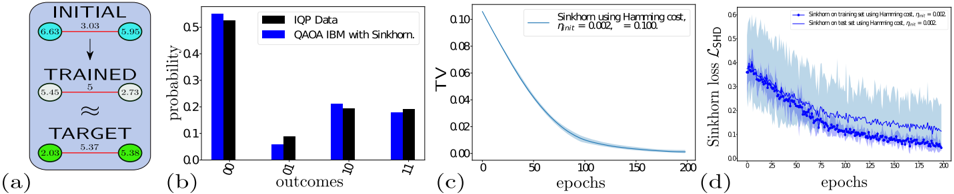
The search for an application of near-term quantum devices is widespread. Quantum machine learning is touted as a potential utilisation of such devices, particularly those out of reach of the simulation capabilities of classical computers. In this work, we study such an application in generative modelling, focussing on a class of quantum circuits known as Born machines. Specifically, we define a subset of this class based on Ising Hamiltonians and show that the circuits encountered during gradient-based training cannot be efficiently sampled from classically up to multiplicative error in the worst case. Our gradient-based training methods use cost functions known as the Sinkhorn divergence and the Stein discrepancy, which have not previously been used in the gradient-based training of quantum circuits, and we also introduce quantum kernels to generative modelling. We show that these methods outperform the previous standard method, which used maximum mean discrepancy (MMD) as a cost function, and achieve this with minimal overhead. Finally, we discuss the ability of the model to learn hard distributions and provide formal definitions for ‘quantum learning supremacy’. We also exemplify the work of this paper by using generative modelling to perform quantum circuit compilation.
Overview
The claims and statistics of this paper haven’t been checked yet.
Free: it reads the open-access text and checks the first 5 claims that cite a source we can check. Create a free account to check every claim.
Integrity signals
Registry
Cites
Statistics
Figures


Verification
Claims the paper makes
The claims and statistics of this paper haven’t been checked yet.
Free: it reads the open-access text and checks the first 5 claims that cite a source we can check. Create a free account to check every claim.
Claims other papers make about this one
Each is checked against this paper’s own text: does it say what the citing paper says it does?
The cited source says what the claim attributes to it.
In the citing paper
“The idea of training a parameterized quantum circuit for a QML implementation can also be applied for a generative model [169-171], which is an unsupervised statistical learning task with the goal of learning a probability distribution that generates a given data set.”
From Variational quantum algorithms (2021) · cites this paper as [171]
The cited source says what the claim attributes to it.
In the citing paper
“The representation power of the generative model has been investigated in Ref. [171].”
From Variational quantum algorithms (2021) · cites this paper as [171]
In the citing paper
“It has been shown that QCBMs can potentially outperform classical computers as they are able to sample from probability distributions that are difficult for classical computers (Coyle et al. , 2020b; Du et al. , 2020).”
From Noisy intermediate-scale quantum algorithms (2022) · cites this paper as Coyle et al. , 2020b
Self-check
Percentages, sums and reported differences re-computed from the paper’s own numbers.
The self-check needs the paper’s full text.
Citations
Cites
Adam: A Method for Stochastic Optimization
Kingma, D. P., & Ba, J. (2014) · arXiv · doi:10.48550/arxiv.1412.6980 · Cited by 98,946
GAN(Generative Adversarial Nets)
(2017) · Journal of Japan Society for Fuzzy Theory and Intelligent Informatics · doi:10.3156/jsoft.29.5_177_2 · Cited by 19,270
Quantum Computing in the NISQ era and beyond
Preskill, J. (2018) · Quantum · doi:10.22331/q-2018-08-06-79 · Cited by 8,830 · cited 8×
“The circuit is kept as shallow as possible so as to be suitable for NISQ devices.”
BackgroundInfluentialPolynomial-time algorithms for prime factorization and discrete logarithms on a quantum computer
Shor, P. W. (1997) · SIAM Journal on Computing · doi:10.1137/s0097539795293172 · Cited by 8,472
Quantum Computation and Quantum Information: 10th Anniversary Edition
Nielsen, M. A., & Chuang, I. L. (2012) · doi:10.1017/cbo9780511976667 · Cited by 8,436
Quantum supremacy using a programmable superconducting processor
Arute, F., Arya, K., Babbush, R., Bacon, D., Bardin, J. C., Barends, R., Biswas, R., Boixo, S., Brandao, F. G. S. L., Buell, D. A., et al. (2019) · Nature · doi:10.1038/s41586-019-1666-5 · Cited by 7,720
(2017) · International Conference on Machine Learning · Cited by 6,382
Information theory, inference, and learning algorithms
(2004) · Choice Reviews Online · doi:10.5860/choice.41-5949 · Cited by 6,362
Generative Adversarial Networks
Goodfellow, I. J., Pouget-Abadie, J., Mirza, M., Xu, B., Warde-Farley, D., Ozair, S., Courville, A., & Bengio, Y. (2014) · arXiv · doi:10.48550/arxiv.1406.2661 · Cited by 4,477 · cited 1×
“Generative models range from simple naive Bayes 11 models to complicated neural networks, like generative adversarial networks (GANs) 12 .”
Villani, C. (2009) · Grundlehren der mathematischen Wissenschaften · doi:10.1007/978-3-540-71050-9 · Cited by 3,669 · cited 1×
“This problem of optimal transport has been widely studied, and has a rich history, so we refer to [75] for a thorough treatment.”
Research works printed but not linked: 5
- Goodfellow, I. J. et al. Generative Adversarial Nets. In Advances in Neural Infor- mation Processing Systems 27 (eds Ghahramani, Z., Welling, M., Cortes, C., Lawr- ence, N. D. & Weinberger, K. Q.), pp. 2672-2680 (
- Chia, N.-H., Lin, H.-H. & Wang, C. Quantum-inspired sublinear classical algorithms for solving low-rank linear systems. Preprint at http://arxiv.org/abs/1811.04852 (2018). · arXiv
- Arjovsky, M., Chintala, S. & Bottou, L. Wasserstein Generative Adversarial Net- works. In Proceedings of the 34th International Conference on Machine Learning, Proceedings of Machine Learning Research 70, 214-223 (eds Doina, P. & Yee, W. T.), International Convention Centre, Sydney, Australia, (PMLR, 2017).
- Amin, M. H., Andriyash, E., Rolfe, J., Kulchytskyy, B. & Melko, R. Quantum Boltz- mann machine. Phys. Rev. X 8, 021050 (2018).
- Coyle, B., Mills, D., Danos, V. & Kashefi, E. The Born supremacy: quantum advantage and training of an Ising Born machine. Preprint at http://arxiv.org/abs/ 1904.02214 (2019).
Cited by
Variational quantum algorithms
Cerezo, M., Arrasmith, A., Babbush, R., Benjamin, S. C., Endo, S., Fujii, K., McClean, J. R., Mitarai, K., Yuan, X., Cincio, L., et al. (2021) · Nature Reviews Physics · doi:10.1038/s42254-021-00348-9 · Cited by 3,385
“Finally, it has been shown that quantum circuit Born machines can simulate the restricted Boltzmann machine and perform a sampling task that is hard for a classical computer [147].”
BackgroundNoisy intermediate-scale quantum algorithms
Bharti, K., Cervera-Lierta, A., Kyaw, T. H., Haug, T., Alperin-Lea, S., Anand, A., Degroote, M., Heimonen, H., Kottmann, J. S., Menke, T., et al. (2022) · Reviews of Modern Physics · doi:10.1103/revmodphys.94.015004 · Cited by 2,231
Parameterized quantum circuits as machine learning models
Benedetti, M., Lloyd, E., Sack, S., & Fiorentini, M. (2019) · Quantum Science and Technology · doi:10.1088/2058-9565/ab4eb5 · Cited by 1,144
“It is natural to explore similar connections between quantum supremacy and machine learning [75, 113].”
BackgroundRobust data encodings for quantum classifiers
LaRose, R., & Coyle, B. (2020) · Physical Review A · doi:10.1103/physreva.102.032420 · Cited by 326
Self-citationBarren plateaus in variational quantum computing
Larocca, M., Thanasilp, S., Wang, S., Sharma, K., Biamonte, J., Coles, P. J., Cincio, L., McClean, J. R., Holmes, Z., & Cerezo, M. (2025) · Nature Reviews Physics · doi:10.1038/s42254-025-00813-9 · Cited by 257
Metadata
- Authors
- Coyle, B., Mills, D., Danos, V., & Kashefi, E.
- Affiliations
- University of Edinburgh (GB)
- Centre National de la Recherche Scientifique (FR)
- Corresponding author
- Coyle, Brian
- Venue
- npj Quantum Information
- Published
- 2020-07-08
- Volume
- 6
- Issue
- 1
- Pages
- 60
- ISSN
- 2056-6387 (ISSN-L)
- OpenAlex
- W2926552232
- Cited by
- 155
- References
- 124
- Citations by year
- 2026: 18 · 2025: 22 · 2024: 29 · 2023: 30 · 2022: 19 · 2021: 25 · 2020: 8
- FWCI
- 8.05
- Type
- journal article
- Language
- en
- Open access
- gold
- doi.org
- Licence
- cc-by
- creativecommons.org/licenses/by/4.0 (tdm)
- creativecommons.org/licenses/by/4.0 (vor)
- Locations
- npj Quantum Information (publishedVersion, cc-by)
- arXiv (Cornell University) (publishedVersion)
- Edinburgh Research Explorer (University of Edinburgh) (submittedVersion, cc-by)
- HAL (submittedVersion)
- HAL (submittedVersion, other-oa)
- arXiv (Cornell University)
- Funders
- University of Edinburgh (FA9550-17-1-0055)
- Engineering and Physical Sciences Research Council (EP/L01503X/1, N003829/1, EP/N003829/1)
- Topics
- Physical Sciences › Computer Science › Artificial Intelligence › Quantum Computing Algorithms and Architecture
- Physical Sciences › Physics and Astronomy › Atomic and Molecular Physics, and Optics › Quantum many-body systems
- Physical Sciences › Physics and Astronomy › Atomic and Molecular Physics, and Optics › Quantum Information and Cryptography
- Keywords
- Ising Hamiltonian, quantum generative models, quantum machine learning, quantum advantage, Sinkhorn divergence, maximum mean discrepancy, quantum kernels, gradient-based learning, quantum circuit compilation
About these checks
Registry, retraction, Cites and statistics results are computed, not judged, with one exception: a printed reference that no index lists is read once by a model before it counts as a citation error. Claims are extracted by a model and kept only when their quote appears verbatim in the text; each cited source is then checked, with a model’s help, for whether it says what the claim relies on. Those verdicts can be wrong — read the claim’s quote and the cited source before relying on one.
Statistics and arithmetic are recomputed, not judged.
Confidence bands are shown only for fields calibrated on our annotated test set. None is calibrated yet, so no band is shown.
What counts as a claim ›How we measure confidence ›How we check this ›
Are you an author, or do you see a problem with this page? Request a review
How to cite
Cite CoChat for the checks on this page, and the paper for its own findings.
- This page
- CoChat. (2026). Citation check: The Born supremacy: quantum advantage and training of an Ising Born machine. https://app.cochat.ai/papers/10.1038/s41534-020-00288-9
- The paper
- Coyle, B., Mills, D., Danos, V., & Kashefi, E. (2020). The Born supremacy: quantum advantage and training of an Ising Born machine. npj Quantum Information. https://doi.org/10.1038/s41534-020-00288-9
Data sources
Bibliographic data: Semantic Scholar, OpenAlex, Crossref.
Contains information from the Semantic Scholar Academic Graph Datasets, made available under the ODC Attribution License (ODC-BY 1.0).
Semantic Scholar’s data is described in: Kinney, R., et al. (2023). The Semantic Scholar Open Data Platform. arXiv:2301.10140.
