

The Born supremacy: quantum advantage and training of an Ising Born machine
Open accessThe DOI matches its Crossref record; 127 of the 127 references it cites were found in a registry or an index.
Abstract
The search for an application of near-term quantum devices is widespread. Quantum machine learning is touted as a potential utilisation of such devices, particularly those out of reach of the simulation capabilities of classical computers. In this work, we study such an application in generative modelling, focussing on a class of quantum circuits known as Born machines. Specifically, we define a subset of this class based on Ising Hamiltonians and show that the circuits encountered during gradient-based training cannot be efficiently sampled from classically up to multiplicative error in the worst case. Our gradient-based training methods use cost functions known as the Sinkhorn divergence and the Stein discrepancy, which have not previously been used in the gradient-based training of quantum circuits, and we also introduce quantum kernels to generative modelling. We show that these methods outperform the previous standard method, which used maximum mean discrepancy (MMD) as a cost function, and achieve this with minimal overhead. Finally, we discuss the ability of the model to learn hard distributions and provide formal definitions for ‘quantum learning supremacy’. We also exemplify the work of this paper by using generative modelling to perform quantum circuit compilation.
Overview
The claims and statistics of this paper haven’t been checked yet.
Free: it reads the open-access text and checks the first 5 claims that cite a source we can check. Create a free account to check every claim.
Integrity signals
Registry
Cites
Statistics
Figures


Verification
Claims the paper makes
The claims and statistics of this paper haven’t been checked yet.
Free: it reads the open-access text and checks the first 5 claims that cite a source we can check. Create a free account to check every claim.
Claims other papers make about this one
Each is checked against this paper’s own text: does it say what the citing paper says it does?
The cited source says what the claim attributes to it.
In the citing paper
“The idea of training a parameterized quantum circuit for a QML implementation can also be applied for a generative model [169-171], which is an unsupervised statistical learning task with the goal of learning a probability distribution that generates a given data set.”
From Variational quantum algorithms (2021) · cites this paper as [171]
The cited source says what the claim attributes to it.
In the citing paper
“The representation power of the generative model has been investigated in Ref. [171].”
From Variational quantum algorithms (2021) · cites this paper as [171]
In the citing paper
“It has been shown that QCBMs can potentially outperform classical computers as they are able to sample from probability distributions that are difficult for classical computers (Coyle et al. , 2020b; Du et al. , 2020).”
From Noisy intermediate-scale quantum algorithms (2022) · cites this paper as Coyle et al. , 2020b
Self-check
Percentages, sums and reported differences re-computed from the paper’s own numbers.
The self-check needs the paper’s full text.
Citations
Cites
Adam: A Method for Stochastic Optimization
Kingma, D. P., & Ba, J. (2014) · arXiv · doi:10.48550/arxiv.1412.6980 · Cited by 98,946
GAN(Generative Adversarial Nets)
(2017) · Journal of Japan Society for Fuzzy Theory and Intelligent Informatics · doi:10.3156/jsoft.29.5_177_2 · Cited by 19,270
Quantum Computing in the NISQ era and beyond
Preskill, J. (2018) · Quantum · doi:10.22331/q-2018-08-06-79 · Cited by 8,830 · cited 8×
“The circuit is kept as shallow as possible so as to be suitable for NISQ devices.”
BackgroundInfluentialPolynomial-time algorithms for prime factorization and discrete logarithms on a quantum computer
Shor, P. W. (1997) · SIAM Journal on Computing · doi:10.1137/s0097539795293172 · Cited by 8,472
Quantum Computation and Quantum Information: 10th Anniversary Edition
Nielsen, M. A., & Chuang, I. L. (2012) · doi:10.1017/cbo9780511976667 · Cited by 8,436
Quantum supremacy using a programmable superconducting processor
Arute, F., Arya, K., Babbush, R., Bacon, D., Bardin, J. C., Barends, R., Biswas, R., Boixo, S., Brandao, F. G. S. L., Buell, D. A., et al. (2019) · Nature · doi:10.1038/s41586-019-1666-5 · Cited by 7,720
(2017) · International Conference on Machine Learning · Cited by 6,382
Information theory, inference, and learning algorithms
(2004) · Choice Reviews Online · doi:10.5860/choice.41-5949 · Cited by 6,362
Generative Adversarial Networks
Goodfellow, I. J., Pouget-Abadie, J., Mirza, M., Xu, B., Warde-Farley, D., Ozair, S., Courville, A., & Bengio, Y. (2014) · arXiv · doi:10.48550/arxiv.1406.2661 · Cited by 4,477 · cited 1×
“Generative models range from simple naive Bayes 11 models to complicated neural networks, like generative adversarial networks (GANs) 12 .”
Villani, C. (2009) · Grundlehren der mathematischen Wissenschaften · doi:10.1007/978-3-540-71050-9 · Cited by 3,669 · cited 1×
“This problem of optimal transport has been widely studied, and has a rich history, so we refer to [75] for a thorough treatment.”
(2012) · MPG.PuRe (Max Planck Society) · doi:10.5555/2188385.2188410 · Cited by 3,603
Quantum Algorithm for Linear Systems of Equations
Harrow, A. W., Hassidim, A., & Lloyd, S. (2009) · Physical Review Letters · doi:10.1103/physrevlett.103.150502 · Cited by 3,325 · cited 3×
“By utilising quantum mechanics in machine learning we hope to be able to develop algorithms to be applied in the classical domain in areas such as accelerating recommendation systems or support vector machines [3, 11–13].”
Quantum Computation and Quantum Information: 10th Anniversary Edition
Nielsen, M. A., & Chuang, I. L. (2011) · Cited by 2,724
Supervised learning with quantum-enhanced feature spaces
Havlíček, V., Córcoles, A. D., Temme, K., Harrow, A. W., Kandala, A., Chow, J. M., & Gambetta, J. M. (2019) · Nature · doi:10.1038/s41586-019-0980-2 · Cited by 2,572 · cited 10×
“Kernel methods are a popular technique, for example in dimensionality reduction, and are beginning to be brought into the quantum realm [55, 56].”
BackgroundMethodInfluentialBarren plateaus in quantum neural network training landscapes
McClean, J. R., Boixo, S., Smelyanskiy, V. N., Babbush, R., & Neven, H. (2018) · Nature Communications · doi:10.1038/s41467-018-07090-4 · Cited by 2,329 · cited 1×
“Now, a random initialisation of parameterised quantum circuits has been shown to lead to ‘barren plateaus’, [53], in which the gradient with respect to some quantum circuits becomes exponentially small, and so one would need exponential resources to estimate it.”
BackgroundArjovsky, M., Chintala, S., & Bottou, L. (2017) · arXiv · doi:10.48550/arxiv.1701.07875 · Cited by 2,225
A Kernel Method for the Two-Sample-Problem
Gretton, A., Borgwardt, K. M., Rasch, M., Schölkopf, B., & Smola, A. J. (2007) · Advances in Neural Information Processing Systems 19 · doi:10.7551/mitpress/7503.003.0069 · Cited by 2,167
Quantum Support Vector Machine for Big Data Classification
Rebentrost, P., Mohseni, M., & Lloyd, S. (2014) · Physical Review Letters · doi:10.1103/physrevlett.113.130503 · Cited by 1,951 · cited 1×
“By utilising quantum mechanics in machine learning we hope to be able to develop algorithms to be applied in the classical domain in areas such as accelerating recommendation systems or support vector machines [3, 11–13].”
Quantum Machine Learning in Feature Hilbert Spaces
Schuld, M., & Killoran, N. (2019) · Physical Review Letters · doi:10.1103/physrevlett.122.040504 · Cited by 1,840 · cited 7×
“However, the computation of this kernel is likely to not be feasible for near term quantum devices, but does illustrate the potential of quantum kernels first explored in [56, 57].”
InfluentialA Quantum Approximate Optimization Algorithm
Farhi, E., Goldstone, J., & Gutmann, S. (2014) · arXiv · doi:10.48550/arxiv.1411.4028 · Cited by 1,789 · cited 10×
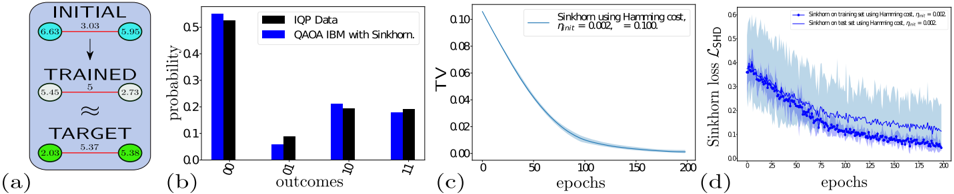
“Error bars represent mean, maximum, and minimum values achieved over fi ve independent training runs on the same data set. a Initial (cyan) and trained (grey) QAOA circuit parameters for two qubits.”
Influential(1972) · Elsevier eBooks · doi:10.1016/c2013-0-06164-6 · Cited by 1,728
Integrating structured biological data by Kernel Maximum Mean Discrepancy
Borgwardt, K. M., Gretton, A., Rasch, M. J., Kriegel, H.-P., Schölkopf, B., & Smola, A. J. (2006) · Bioinformatics · doi:10.1093/bioinformatics/btl242 · Cited by 1,674 · cited 2×
“shown that the MMD is exactly the difference in mean embeddings (35) between the two distributions, [61, 65]:”
Mitarai, K., Negoro, M., Kitagawa, M., & Fujii, K. (2018) · Physical Review A · doi:10.1103/physreva.98.032309 · Cited by 1,639 · cited 3×
“It is known [8, 31] that the gradient of an observable of the circuit, B, with respect to a parameter, η, is given by: ∂〈B〉η ∂η = 1 2 ( 〈B〉η+ − 〈B〉η− ) (59)”
Dudley, R. M. (2002) · Cambridge University Press eBooks · doi:10.1017/cbo9780511755347 · Cited by 1,281
Characterizing quantum supremacy in near-term devices
Boixo, S., Isakov, S. V., Smelyanskiy, V. N., Babbush, R., Ding, N., Jiang, Z., Bremner, M. J., Martinis, J. M., & Neven, H. (2018) · Nature Physics · doi:10.1038/s41567-018-0124-x · Cited by 1,175 · cited 1×
“Potential solutions currently include including some bias in the circuit which could be checked, [5, 17], making assumptions about the device using cross-entropy benchmarking, [15, 92] or by computing certain probabilities of the circuit [14].”
On Choosing and Bounding Probability Metrics
Gibbs, A. L., & Su, F. E. (2002) · International Statistical Review · doi:10.1111/j.1751-5823.2002.tb00178.x · Cited by 1,163 · cited 2×
“From [93], we get the following inequalities for a discrete space, X 18: dmin TV(pθ, pH) ≤ OT0(pθ, pH) ≤ diam(X )TV(pθ, pH) (124) where diam(X ) = max{d(x,y),x,y ∈ X}, dmin = minx 6=y d(x,y), and d(x,y) is the ground metric used in the Wasserstein Distance, (81).”
Quantum Computation Over Continuous Variables
Lloyd, S., & Braunstein, S. L. (1999) · Physical Review Letters · doi:10.1103/physrevlett.82.1784 · Cited by 1,145 · cited 1×
“In [56], the authors investigate kernels which are classically efficiently computable in order to facilitate testing of their classification algorithm, for example they only study socalled Gaussian states, a key ingredient in continuous variable quantum computing, [59], which are known to be classically simulable.”
Parameterized quantum circuits as machine learning models
Benedetti, M., Lloyd, E., Sack, S., & Fiorentini, M. (2019) · Quantum Science and Technology · doi:10.1088/2058-9565/ab4eb5 · Cited by 1,144
Evaluating analytic gradients on quantum hardware
Schuld, M., Bergholm, V., Gogolin, C., Izaac, J., & Killoran, N. (2019) · Physical Review A · doi:10.1103/physreva.99.032331 · Cited by 1,072 · cited 1×
“This formula is actually valid for the parameter in any unitary which has at most two distinct eigenvalues [67].”
BackgroundA Relationship Between Arbitrary Positive Matrices and Doubly Stochastic Matrices
Sinkhorn, R. (1964) · The Annals of Mathematical Statistics · doi:10.1214/aoms/1177703591 · Cited by 1,032 · cited 1×
“These are computed using the Sinkhorn Algorithm, which gives the divergence its name, [80].”
Stein, C. (1972) · Probability Theory · doi:10.1525/9780520423671-036 · Cited by 1,029
Property testing and its connection to learning and approximation
Goldreich, O., Goldwasser, S., & Ron, D. (1998) · Journal of the ACM · doi:10.1145/285055.285060 · Cited by 1,020
Computational Optimal Transport
Peyré, G., & Cuturi, M. (2019) · now publishers, Inc. eBooks · doi:10.1561/9781680835519 · Cited by 847
Supervised Learning with Quantum Computers
Schuld, M., & Petruccione, F. (2018) · Quantum Science and Technology · doi:10.1007/978-3-319-96424-9 · Cited by 730 · cited 3×
“However, this assumes that we have access only to classical samples from the distribution, and the possibility of gaining an advantage using quantum samples 38,58 is unexplored in the context of distribution learning.”
InfluentialKernel Measures of Conditional Dependence
Fukumizu, K., Gretton, A., Sun, X., & Schölkopf, B. (2007) · neural information processing systems · Cited by 724
Classification with Quantum Neural Networks on Near Term Processors
Farhi, E., & Neven, H. (2018) · arXiv · doi:10.48550/arxiv.1802.06002 · Cited by 598 · cited 3×
“This approach can be compared to [9] where the authors use QCL in a classification algorithm.”
BackgroundMethodQuantum Generative Adversarial Learning
Lloyd, S., & Weedbrook, C. (2018) · Physical Review Letters · doi:10.1103/physrevlett.121.040502 · Cited by 576 · cited 1×
“Quantum models of GANs have also been defined, for example, [27, 77] and an experimental implementation [78].”
Automatic Indexing: An Experimental Inquiry
Maron, M. E. (1961) · Journal of the ACM · doi:10.1145/321075.321084 · Cited by 570
A kernelized stein discrepancy for goodness-of-fit tests
Liu, Q., Lee, J. D., & Jordan, M. I. (2016) · International Conference on Machine Learning · Cited by 566
Integral Probability Metrics and Their Generating Classes of Functions
Müller, A. (1997) · Advances in Applied Probability · doi:10.1017/s000186780002807x · Cited by 548
Quantum Computation by Adiabatic Evolution
Farhi, E., Goldstone, J., Gutmann, S., & Sipser, M. (2000) · arXiv · doi:10.48550/arxiv.quant-ph/0001106 · Cited by 536 · cited 1×
“IQP circuits are named to re fl ect the commuting nature of elements in the produce de fi ning the unitary U z , while QAOA 27 was originally developed as an approximate version of the quantum adiabatic algorithm 28 .”
BackgroundAmin, M. H., Andriyash, E., Rolfe, J., Kulchytskyy, B., & Melko, R. (2018) · Physical Review X · doi:10.1103/physrevx.8.021050 · Cited by 520
Quantum generative adversarial networks
Dallaire-Demers, P.-L., & Killoran, N. (2018) · Physical Review A · doi:10.1103/physreva.98.012324 · Cited by 506
On Wasserstein Two-Sample Testing and Related Families of Nonparametric Tests
Ramdas, A., Trillos, N., & Cuturi, M. (2017) · Entropy · doi:10.3390/e19020047 · Cited by 443
Monte Carlo Methods of Inference for Implicit Statistical Models
Diggle, P. J., & Gratton, R. J. (1984) · Journal of the Royal Statistical Society Series B: Statistical Methodology · doi:10.1111/j.2517-6161.1984.tb01290.x · Cited by 427
Learning Generative Models with Sinkhorn DivergencesPreprint
Genevay, A., Peyré, G., & Cuturi, M. (2017) · arXiv (Cornell University) · doi:10.48550/arxiv.1706.00292 · Cited by 426 · cited 1×
“It is likely in practice, however, that a much lower value of ϵ could be chosen without a blow up in sample complexity 49,54 .”
Kernel Mean Embedding of Distributions: A Review and Beyond
Muandet, K., Fukumizu, K., Sriperumbudur, B., & Schölkopf, B. (2017) · Foundations and Trends® in Machine Learning · doi:10.1561/2200000060 · Cited by 409
Quantum-assisted quantum compiling
Khatri, S., LaRose, R., Poremba, A., Cincio, L., Sornborger, A. T., & Coles, P. J. (2019) · Quantum · doi:10.22331/q-2019-05-13-140 · Cited by 382
A generative modeling approach for benchmarking and training shallow quantum circuits
Benedetti, M., Garcia-Pintos, D., Perdomo, O., Leyton-Ortega, V., Nam, Y., & Perdomo-Ortiz, A. (2019) · npj Quantum Information · doi:10.1038/s41534-019-0157-8 · Cited by 379 · cited 5×
“Training We provide novel training methods for the model, which could outperform those given in the literature [8, 10, 26].”
InfluentialA quantum-inspired classical algorithm for recommendation systems
Tang, E. (2019) · Proceedings of the 51st Annual ACM SIGACT Symposium on Theory of Computing · doi:10.1145/3313276.3316310 · Cited by 360
Continuous-variable quantum neural networks
Killoran, N., Bromley, T. R., Arrazola, J. M., Schuld, M., Quesada, N., & Lloyd, S. (2018) · DSpace@MIT (Massachusetts Institute of Technology) · Cited by 360
An initialization strategy for addressing barren plateaus in parametrized quantum circuits
Grant, E., Wossnig, L., Ostaszewski, M., & Benedetti, M. (2019) · UCL Discovery (University College London) · Cited by 338
Classification with Quantum Neural Networks on Near Term Processors
Farhi, E., & Neven, H. (2020) · doi:10.37686/qrl.v1i2.80 · Cited by 332 · cited 3×
“This approach can be compared to [9] where the authors use QCL in a classification algorithm.”
BackgroundMethodQuantum Supremacy through the Quantum Approximate Optimization Algorithm
Farhi, E., & Harrow, A. W. (2016) · arXiv · doi:10.48550/arxiv.1602.07674 · Cited by 331 · cited 1×
“This worst case hardness holds for IQP /QAOA circuits, [16, 32], which we will illustrate in Section 2.”
BackgroundExpressive power of parametrized quantum circuits
Du, Y., Hsieh, M.-H., Liu, T., & Tao, D. (2020) · Physical Review Research · doi:10.1103/physrevresearch.2.033125 · Cited by 318 · cited 7×
“(16) since these correspond to circuits whose parameters are updated as follows: θ d ; ± k θ ± π = 2.”
InfluentialAverage-Case Complexity Versus Approximate Simulation of Commuting Quantum Computations
Bremner, M. J., Montanaro, A., & Shepherd, D. J. (2016) · Physical Review Letters · doi:10.1103/physrevlett.117.080501 · Cited by 299 · cited 7×
“Where δ is ideally a constant but will depend on the hard distribution pH , for example, with IQP, δ = 1/384 [35].”
InfluentialÜber Die Praktische Auflösung von Integralgleichungen mit Anwendungen auf Randwertaufgaben
Nyström, E. J. (1930) · Acta Mathematica · doi:10.1007/bf02547521 · Cited by 281
Differentiable learning of quantum circuit Born machines
Liu, J.-G., & Wang, L. (2018) · Physical Review A · doi:10.1103/physreva.98.062324 · Cited by 279 · cited 10×
“Previous approaches, [8, 25] do not add parameters to the entangling gates, (CNOT gates in those cases), which has an advantage from an experimental point of view, but immediately increases the circuit depth.”
BackgroundMethodResultInfluentialWeed, J., & Bach, F. (2019) · Bernoulli · doi:10.3150/18-bej1065 · Cited by 275 · cited 1×
“As mentioned above, the sample complexity of the MMD scales as O(1/ √ N), and it is known that the Wasserstein Distance scales as O(1/Nd) [82] for a distribution supported on a subset of Rd.”
BackgroundOn the learnability of discrete distributions
Kearns, M., Mansour, Y., Ron, D., Rubinfeld, R., Schapire, R. E., & Sellie, L. (1994) · Proceedings of the twenty-sixth annual ACM symposium on Theory of computing - STOC '94 · doi:10.1145/195058.195155 · Cited by 273 · cited 2×
“We now provide de fi nitions to meet the requirements of point 2, adapting de fi nitions from distribution learning theory 25 for this purpose.”
Quantum Recommendation Systems
Kerenidis, I., & Prakash, A. (2016) · arXiv · doi:10.48550/arxiv.1603.08675 · Cited by 270
Unsupervised Generative Modeling Using Matrix Product States
Han, Z.-Y., Wang, J., Fan, H., Wang, L., & Zhang, P. (2018) · Physical Review X · doi:10.1103/physrevx.8.031012 · Cited by 256
The Speed of Mean Glivenko-Cantelli Convergence
Dudley, R. M. (1969) · The Annals of Mathematical Statistics · doi:10.1214/aoms/1177697802 · Cited by 253
Quantum Recommendation Systems
Kerenidis, I., & Prakash, A. (2016) · DR-NTU (Nanyang Technological University) · doi:10.4230/lipics.itcs.2017.49 · Cited by 250
Equivalence of restricted Boltzmann machines and tensor network states
Chen, J., Cheng, S., Xie, H., Wang, L., & Xiang, T. (2018) · Physical Review B · doi:10.1103/physrevb.97.085104 · Cited by 243 · cited 1×
“The Born Machine definition originated from tensor network approaches to define generative algorithms and the connection between physical systems and machine learning problems [43–49].”
A Kernel Method for the Two-Sample ProblemPreprint
Gretton, A., Borgwardt, K., Rasch, M. J., et al. (2008) · arXiv (Cornell University) · doi:10.48550/arxiv.0805.2368 · Cited by 242 · cited 2×
“From the MMD, the following cost function 35,36 can be de fi ned: The MMD has some very favourable properties; it is a metric on the space of probability distributions, and it is relatively easy to compute (due to low sample complexity).”
Universality, Characteristic Kernels and RKHS Embedding of Measures
Sriperumbudur, B. K., Fukumizu, K., & Lanckriet, G. R. G. (2011) · Journal of Machine Learning Research · doi:10.5555/1953048.2021077 · Cited by 236
Measuring Sample Quality with Stein's MethodPreprint
Gorham, J., & Mackey, L. W. (2015) · arXiv (Cornell University) · doi:10.48550/arxiv.1506.03039 · Cited by 236 · cited 1×
“The discrepancy is derived 41,44 from the (discrete) Stein identity 43 , given by: A π ϕ ð x Þ : ¼ s π ð x Þ ϕ ð x Þ (cid”
Complexity-Theoretic Foundations of Quantum Supremacy Experiments
Aaronson, S., & Chen, L. (2016) · arXiv · doi:10.48550/arxiv.1612.05903 · Cited by 218 · cited 1×
“Potential solutions currently include including some bias in the circuit which could be checked, [5, 17], making assumptions about the device using cross-entropy benchmarking, [15, 91] or by computing certain probabilities of the circuit [14].”
BackgroundA Practical Quantum Instruction Set Architecture
Lee, D., Perrelle, V., Valiron, B., & Xu, Z. (2016) · arXiv (Cornell University) · doi:10.4230/lipics.fsttcs.2021.51 · Cited by 217 · cited 2×
“For example, in the case of Rigetti ’ s Aspen QPU, the native gates are { R x (± π /2), R z ( θ ), CZ } 57,60 , and any unitary which a user wishes to implement must be compiled into a unitary V that contains only these ingredients.”
BackgroundMethodClassical simulation of commuting quantum computations implies collapse of the polynomial hierarchy
Bremner, M. J., Jozsa, R., Shepherd, D. J., et al. (2010) · Cited by 216
Machine learning by unitary tensor network of hierarchical tree structure
Liu, D., Ran, S.-J., Wittek, P., Peng, C., García, R. B., Su, G., & Lewenstein, M. (2019) · New Journal of Physics · doi:10.1088/1367-2630/ab31ef · Cited by 205 · cited 1×
“The Born Machine definition originated from tensor network approaches to define generative algorithms and the connection between physical systems and machine learning problems [43–49].”
A new universal and fault-tolerant quantum basis
Boykin, P. O., Mor, T., Pulver, M., Roychowdhury, V., & Vatan, F. (2000) · Information Processing Letters · doi:10.1016/s0020-0190(00)00084-3 · Cited by 194
Achieving quantum supremacy with sparse and noisy commuting quantum computations
Bremner, M. J., Montanaro, A., & Shepherd, D. J. (2017) · Quantum · doi:10.22331/q-2017-04-25-8 · Cited by 191
Sample Complexity of Sinkhorn divergencesPreprint
Genevay, A., Chizat, L., Bach, F., Cuturi, M., & Peyré, G. (2018) · arXiv (Cornell University) · doi:10.48550/arxiv.1810.02733 · Cited by 189 · cited 3×
“A similar result can be derived using a concentration bound 54 , such that, with probability 1 − δ , where we have chosen the same scaling for ϵ as in Eq.”
Romero, J., & Aspuru‐Guzik, A. (2021) · Advanced Quantum Technologies · doi:10.1002/qute.202000003 · Cited by 186 · cited 1×
“Since then, other works have given variants of the original definition [25], adversarial training approaches for the model [49], and adaptions to the continuous variable regime [50].”
BackgroundHilbert space embeddings and metrics on probability measures
Sriperumbudur, B. K., Gretton, A., Fukumizu, K., Schölkopf, B., & Lanckriet, G. R. G. (2009) · arXiv (Cornell University) · doi:10.48550/arxiv.0907.5309 · Cited by 183
Injective hilbert space embeddings of probability measures
Sriperumbudur, B. K., Gretton, A., Fukumizu, K., Lanckriet, G. R. G., & Schölkopf, B. (2008) · Max Planck Institute for Plasma Physics · Cited by 170
Property Testing: A Learning Theory Perspective
Ron, D. (2008) · Foundations and Trends® in Machine Learning · doi:10.1561/2200000004 · Cited by 158
Learning in Implicit Generative Models
Mohamed, S., & Lakshminarayanan, B. (2016) · arXiv (Cornell University) · doi:10.48550/arxiv.1610.03483 · Cited by 157
Guest Column: A Survey of Quantum Learning Theory
Arunachalam, S., & de Wolf, R. (2017) · ACM SIGACT News · doi:10.1145/3106700.3106710 · Cited by 152
A quantum machine learning algorithm based on generative models
Gao, X., Zhang, Z.-Y., & Duan, L.-M. (2018) · Science Advances · doi:10.1126/sciadv.aat9004 · Cited by 147
Tang, E. (2018) · arXiv · doi:10.48550/arxiv.1811.00414 · Cited by 141
Tang, E. (2021) · Physical Review Letters · doi:10.1103/physrevlett.127.060503 · Cited by 140
Temporally unstructured quantum computation
Shepherd, D., & Bremner, M. J. (2009) · Proceedings of the Royal Society A: Mathematical, Physical and Engineering Sciences · doi:10.1098/rspa.2008.0443 · Cited by 135 · cited 1×
“We choose this structure in order to easily recover two well-known circuit classes, namely instantaneous quantum polynomial time 26 (IQP) circuits, and the shallowest depth ( p = 1) version of the quantum approximate optimisation algorithm 27 (QAOA).”
Deep Learning and Quantum Entanglement: Fundamental Connections with Implications to Network DesignPreprint
Levine, Y., Yakira, D., Cohen, N., & Shashua, A. (2017) · arXiv (Cornell University) · doi:10.48550/arxiv.1704.01552 · Cited by 135
Interpolating between Optimal Transport and MMD using Sinkhorn Divergences
Feydy, J., Séjourné, T., Vialard, F., Амари, Ш.-И., Trouvé, A., & Gabriel Peyré, A. (2018) · arXiv (Cornell University) · doi:10.48550/arxiv.1810.08278 · Cited by 110 · cited 2×
“This is a relatively new method to compare probability distributions 48 – 50 , de fi ned by the following: OT c ϵ ð p θ ; π Þ : ¼ min (24) where ϵ (cid:8) 0 is a regularisation parameter, c ( x , y ) is a Lipschitz ‘ cost ’ function, and Uð p ; π Þ is the set of all couplings between p θ and π ,…”
Information Perspective to Probabilistic Modeling: Boltzmann Machines versus Born Machines
Cheng, S., Chen, J., & Wang, L. (2018) · Entropy · doi:10.3390/e20080583 · Cited by 104 · cited 3×
“In this spirit we utilise a learning model called the Born Machine [7, 8] to perform Quantum Circuit Learning (QCL) [9, 10] with NISQ devices.”
MethodA Spectral Approach to Gradient Estimation for Implicit DistributionsPreprint
Shi, J., Sun, S., & Zhu, J. (2018) · arXiv (Cornell University) · doi:10.48550/arxiv.1806.02925 · Cited by 99 · cited 1×
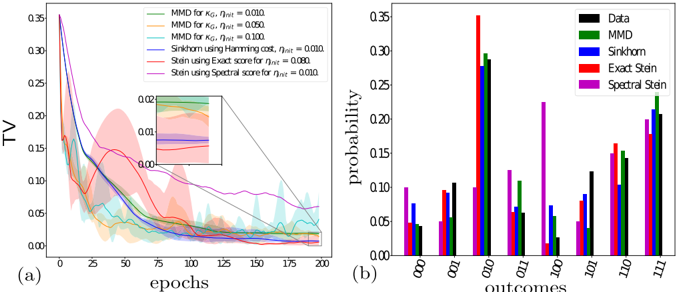
“We refer to the second as the ‘ Spectral ’ method since it uses a spectral decomposition 46 of a kernel to approximate the score.”
Expressive power of parametrized quantum circuits
Du, Y., Hsieh, M.-H., Liu, T., & Tao, D. (2018) · UTS ePRESS (University of Technology Sydney) · Cited by 99
Learning and inference on generative adversarial quantum circuits
Zeng, J., Wu, Y., Liu, J.-G., Wang, L., & Hu, J. (2019) · Physical Review A · doi:10.1103/physreva.99.052306 · Cited by 94
Quantum Supremacy for Simulating a Translation-Invariant Ising Spin Model
Gao, X., Wang, S.-T., & Duan, L.-M. (2017) · Physical Review Letters · doi:10.1103/physrevlett.118.040502 · Cited by 93 · cited 1×
“Using the decomposition from [51], the relationship between a CZij(α) gate between qubit i and j, and an Ising interaction, exp(iαZi ⊗ Zj) is as follows: CZij(α) = e iα|1〉〈1|i⊗|1〉〈1|j = e iα 4 (1i−Zi)⊗(1j−Zj) = e iα 4 1i⊗1je− iα 4 1i⊗Zje− iα 4 Zi⊗1je iα 4 Zi⊗Zj (22)”
Classification of the MNIST data set with quantum slow feature analysis
Kerenidis, I., & Luongo, A. (2020) · Physical Review A · doi:10.1103/physreva.101.062327 · Cited by 89
Gradient Estimators for Implicit ModelsPreprint
Li, Y., & Turner, R. E. (2017) · arXiv (Cornell University) · doi:10.48550/arxiv.1705.07107 · Cited by 87 · cited 1×
“The fi rst of these we call the ‘ Identity ’ method since it inverts Stein ’ s identity 45 from Eq.”
A quantum algorithm to train neural networks using low-depth circuits
Verdon, G., Broughton, M., & Biamonte, J. (2017) · arXiv · doi:10.48550/arxiv.1712.05304 · Cited by 87 · cited 2×
“This is the same simple toy example which was used to train a Quantum Boltzmann Machine, [86], and the Quantum Approximate Boltzmann Machine (QABoM) [39].”
BackgroundMethodOn Universal and Fault-Tolerant Quantum Computing
Boykin, P. O., Mor, T., Pulver, M., Roychowdhury, V., & Vatan, F. (1999) · arXiv (Cornell University) · doi:10.48550/arxiv.quant-ph/9906054 · Cited by 79
On integral probability metrics, ϕ-divergences and binary classification
Sriperumbudur, B. K., Fukumizu, K., Gretton, A., Schölkopf, B., & Lanckriet, G. R. G. (2009) · arXiv (Cornell University) · doi:10.48550/arxiv.0901.2698 · Cited by 78 · cited 7×
“As shown in [58], the above (56) demonstrates both consistency and lack of bias, and furthermore it converges fast in probability to the true MMD: |γ̃MMD(PN , QM )− γMMD(P,Q)| ≤ OP,Q(N +M−1/2) (57)”
BackgroundInfluentialGoodness-of-Fit Testing for Discrete Distributions via Stein Discrepancy
Yang, J., Liu, Q., Rao, V., & Neville, J. (2018) · International Conference on Machine Learning · Cited by 77
The Computational Complexity of Linear Optics
Aaronson, S., & Arkhipov, A. (2014) · Research in Optical Sciences · doi:10.1364/qim.2014.qth1a.2 · Cited by 75
Learning to learn with quantum neural networks via classical neural networks
Verdon, G., Broughton, M., McClean, J. R., Sung, K. J., Babbush, R., Zhang, J., Neven, H., & Mohseni, M. (2019) · arXiv (Cornell University) · doi:10.48550/arxiv.1907.05415 · Cited by 73
Quantum generative adversarial learning in a superconducting quantum circuit
Hu, L., Wu, S.-H., Cai, W., Ma, Y., Mu, X., Xu, Y., Wang, H., Song, Y., Deng, D.-L., Zou, C., et al. (2019) · Bulletin of the American Physical Society · Cited by 71
Quantum-inspired classical algorithms for principal component analysis and supervised clustering.Preprint
Tang, E. (2018) · arXiv (Cornell University) · Cited by 70
Analysis and synthesis of feature map for kernel-based quantum classifier
Suzuki, Y., Yano, H., Gao, Q., Uno, S., Tanaka, T., Akiyama, M., & Yamamoto, N. (2020) · Quantum Machine Intelligence · doi:10.1007/s42484-020-00020-y · Cited by 70
Learning hard quantum distributions with variational autoencoders
Rocchetto, A., Grant, E., Strelchuk, S., Carleo, G., & Severini, S. (2018) · UCL Discovery (University College London) · doi:10.3929/ethz-b-000276431 · Cited by 67
Sinkhorn Distances: Lightspeed Computation of Optimal Transportation Distances
Cuturi, M. (2013) · arXiv (Cornell University) · doi:10.48550/arxiv.1306.0895 · Cited by 64 · cited 1×
“Now, as noted in [79], (one) regularised version of optimal transport introduces an entropy term, in the form of the KL Divergence as follows:”
Quantum-inspired low-rank stochastic regression with logarithmic dependence on the dimension
Gilyén, A., Lloyd, S., & Tang, E. (2018) · arXiv · doi:10.48550/arxiv.1811.04909 · Cited by 63
Impossibility of Classically Simulating One-Clean-Qubit Model with Multiplicative Error
Fujii, K., Kobayashi, H., Morimae, T., Nishimura, H., Tamate, S., & Tani, S. (2018) · Physical Review Letters · doi:10.1103/physrevlett.120.200502 · Cited by 59 · cited 1×
“As noted in [34], it would be desirable to have a quantum sampler which could achieve the bound, (2), but this is not believed to be an experimentally reachable goal5.”
"Quantum Supremacy" and the Complexity of Random Circuit Sampling
Bouland, A., Fefferman, B., Nirkhe, C., & Vazirani, U. V. (2018) · arXiv (Cornell University) · doi:10.4230/lipics.itcs.2019.15 · Cited by 57
Generative model benchmarks for superconducting qubits
Hamilton, K. E., Dumitrescu, E. F., & Pooser, R. C. (2019) · Physical Review A · doi:10.1103/physreva.99.062323 · Cited by 57
Complexity-Theoretic Foundations of Quantum Supremacy Experiments
Aaronson, S., & Chen, L. (2016) · arXiv (Cornell University) · doi:10.14288/1.0343134 · Cited by 54
Robust quantum compilation and circuit optimisation via energy minimisation
Jones, T., & Benjamin, S. C. (2018) · arXiv · doi:10.48550/arxiv.1811.03147 · Cited by 54
Robust implementation of generative modeling with parametrized quantum circuits
Leyton‐Ortega, V., Perdomo‐Ortiz, A., & Perdomo, O. M. (2021) · Quantum Machine Intelligence · doi:10.1007/s42484-021-00040-2 · Cited by 51 · cited 3×
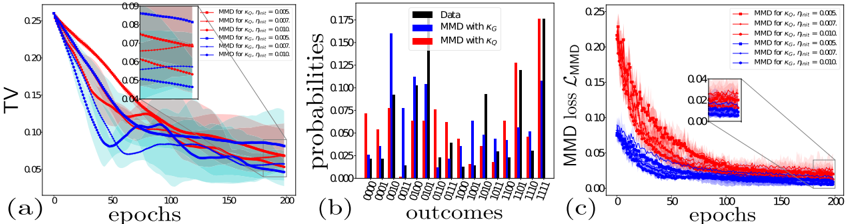
“We chose TV as an objective measure, as opposed to, say the KL divergence as chosen in [52], for a couple of reasons.”
BackgroundMethodResultInfluentialCommuting quantum circuits and complexity of Ising partition functions
Fujii, K., & Morimae, T. (2017) · New Journal of Physics · doi:10.1088/1367-2630/aa5fdb · Cited by 48 · cited 2×
“With the restrictions set discussed above, the term in the exponent of the diagonal unitary (18) can be written as an Ising Model Hamiltonian, [32, 35]: ∑”
Sample Complexity of Device-Independently Certified “Quantum Supremacy”
Hangleiter, D., Kliesch, M., Eisert, J., & Gogolin, C. (2019) · Physical Review Letters · doi:10.1103/physrevlett.122.210502 · Cited by 45 · cited 1×
“The best prospect for this is the quantum supremacy distributions we know of (for example, IQP), but they are not ef fi ciently testable 63 .”
A Survey of Quantum Learning Theory
Arunachalam, S., & de Wolf, R. (2017) · arXiv (Cornell University) · doi:10.48550/arxiv.1701.06806 · Cited by 43 · cited 1×
“This concept is tightly related to the theory of PAC (Probably Approximately Correct) Learning which has been introduced to the quantum realm, [89], and in fact the theory of distribution learning was inspired by the PAC framework [40].”
BackgroundRobust Implementation of Generative Modeling with Parametrized Quantum Circuits
Leyton-Ortega, V., Perdomo-Ortiz, A., & Perdomo, O. (2019) · arXiv · doi:10.48550/arxiv.1901.08047 · Cited by 38 · cited 3×
“We chose TV as an objective measure, as opposed to, say the KL divergence as chosen in [52], for a couple of reasons.”
BackgroundMethodResultInfluentialQuantum Hardness of Learning Shallow Classical Circuits
Arunachalam, S., Grilo, A. B., & Sundaram, A. (2021) · SIAM Journal on Computing · doi:10.1137/20m1344202 · Cited by 35
Chia, N.-H., Gilyén, A., Lin, H.-H., Lloyd, S., Tang, E., & Wang, C. (2018) · arXiv (Cornell University) · doi:10.4230/lipics.isaac.2020.47 · Cited by 33
Quantum compilation and circuit optimisation via energy dissipationPreprint
Jones, T., & Benjamin, S. C. (2018) · arXiv (Cornell University) · Cited by 30
On Solving Linear Systems in Sublinear Time
Andoni, A., Krauthgamer, R., & Pogrow, Y. (2018) · DROPS (Schloss Dagstuhl – Leibniz Center for Informatics) · doi:10.4230/lipics.itcs.2019.3 · Cited by 20 · cited 1×
“(20) and (22) can be computed efficiently, even when the quantum kernel κQ from Eq.”
An efficient quantum algorithm for generative machine learningPreprint
Gao, X., Zhang, Z., & Duan, L. (2017) · arXiv (Cornell University) · doi:10.48550/arxiv.1711.02038 · Cited by 18
Quantum mean embedding of probability distributions
Kübler, J., Muandet, K., & Schölkopf, B. (2019) · MPG.PuRe (Max Planck Society) · Cited by 16
The Expressive Power of Parameterized Quantum CircuitsPreprint
Du, Y., Hsieh, M., Liu, T., & Tao, D. (2018) · arXiv (Cornell University) · doi:10.48550/arxiv.1810.11922 · Cited by 14
Entanglement Entropy of Target Functions for Image Classification and Convolutional Neural NetworkPreprint
Zhang, Y.-H. (2017) · arXiv (Cornell University) · doi:10.48550/arxiv.1710.05520 · Cited by 12
Bayesian Quantum CircuitPreprint
Du, Y., Liu, T., & Tao, D. (2018) · arXiv (Cornell University) · doi:10.48550/arxiv.1805.11089 · Cited by 6 · cited 8×
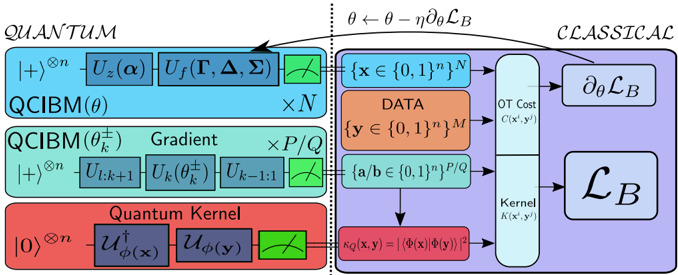
“For gradient-based methods, a cost function or metric is required, L B p θ ð x Þ ; π ð y Þ ð Þ to compare the Born Machine distribution, p θ ( x ), and the data distribution, π ( y ).”
InfluentialBrianCoyle/IsingBornMachine: Ising Born Machine
Coyle, B., & danmills (2020) · Edinburgh Research Explorer (University of Edinburgh) · doi:10.5281/zenodo.3779865 · Cited by 1
Self-citationBrianCoyle/IsingBornMachine: Ising Born Machine
Coyle, B., & Danmills0 (2020) · Edinburgh Research Explorer (University of Edinburgh) · doi:10.5281/zenodo.3779864 · Cited by 1
Self-citation
Research works printed but not linked: 5
- Goodfellow, I. J. et al. Generative Adversarial Nets. In Advances in Neural Infor- mation Processing Systems 27 (eds Ghahramani, Z., Welling, M., Cortes, C., Lawr- ence, N. D. & Weinberger, K. Q.), pp. 2672-2680 (
- Chia, N.-H., Lin, H.-H. & Wang, C. Quantum-inspired sublinear classical algorithms for solving low-rank linear systems. Preprint at http://arxiv.org/abs/1811.04852 (2018). · arXiv
- Arjovsky, M., Chintala, S. & Bottou, L. Wasserstein Generative Adversarial Net- works. In Proceedings of the 34th International Conference on Machine Learning, Proceedings of Machine Learning Research 70, 214-223 (eds Doina, P. & Yee, W. T.), International Convention Centre, Sydney, Australia, (PMLR, 2017).
- Amin, M. H., Andriyash, E., Rolfe, J., Kulchytskyy, B. & Melko, R. Quantum Boltz- mann machine. Phys. Rev. X 8, 021050 (2018).
- Coyle, B., Mills, D., Danos, V. & Kashefi, E. The Born supremacy: quantum advantage and training of an Ising Born machine. Preprint at http://arxiv.org/abs/ 1904.02214 (2019).
Cited by
Variational quantum algorithms
Cerezo, M., Arrasmith, A., Babbush, R., Benjamin, S. C., Endo, S., Fujii, K., McClean, J. R., Mitarai, K., Yuan, X., Cincio, L., et al. (2021) · Nature Reviews Physics · doi:10.1038/s42254-021-00348-9 · Cited by 3,385
“Finally, it has been shown that quantum circuit Born machines can simulate the restricted Boltzmann machine and perform a sampling task that is hard for a classical computer [147].”
BackgroundNoisy intermediate-scale quantum algorithms
Bharti, K., Cervera-Lierta, A., Kyaw, T. H., Haug, T., Alperin-Lea, S., Anand, A., Degroote, M., Heimonen, H., Kottmann, J. S., Menke, T., et al. (2022) · Reviews of Modern Physics · doi:10.1103/revmodphys.94.015004 · Cited by 2,231
Parameterized quantum circuits as machine learning models
Benedetti, M., Lloyd, E., Sack, S., & Fiorentini, M. (2019) · Quantum Science and Technology · doi:10.1088/2058-9565/ab4eb5 · Cited by 1,144
“It is natural to explore similar connections between quantum supremacy and machine learning [75, 113].”
BackgroundRobust data encodings for quantum classifiers
LaRose, R., & Coyle, B. (2020) · Physical Review A · doi:10.1103/physreva.102.032420 · Cited by 326
Self-citationBarren plateaus in variational quantum computing
Larocca, M., Thanasilp, S., Wang, S., Sharma, K., Biamonte, J., Coles, P. J., Cincio, L., McClean, J. R., Holmes, Z., & Cerezo, M. (2025) · Nature Reviews Physics · doi:10.1038/s42254-025-00813-9 · Cited by 257
Metadata
- Authors
- Coyle, B., Mills, D., Danos, V., & Kashefi, E.
- Affiliations
- University of Edinburgh (GB)
- Centre National de la Recherche Scientifique (FR)
- Corresponding author
- Coyle, Brian
- Venue
- npj Quantum Information
- Published
- 2020-07-08
- Volume
- 6
- Issue
- 1
- Pages
- 60
- ISSN
- 2056-6387 (ISSN-L)
- OpenAlex
- W2926552232
- Cited by
- 155
- References
- 124
- Citations by year
- 2026: 18 · 2025: 22 · 2024: 29 · 2023: 30 · 2022: 19 · 2021: 25 · 2020: 8
- FWCI
- 8.05
- Type
- journal article
- Language
- en
- Open access
- gold
- doi.org
- Licence
- cc-by
- creativecommons.org/licenses/by/4.0 (tdm)
- creativecommons.org/licenses/by/4.0 (vor)
- Locations
- npj Quantum Information (publishedVersion, cc-by)
- arXiv (Cornell University) (publishedVersion)
- Edinburgh Research Explorer (University of Edinburgh) (submittedVersion, cc-by)
- HAL (submittedVersion)
- HAL (submittedVersion, other-oa)
- arXiv (Cornell University)
- Funders
- University of Edinburgh (FA9550-17-1-0055)
- Engineering and Physical Sciences Research Council (EP/L01503X/1, N003829/1, EP/N003829/1)
- Topics
- Physical Sciences › Computer Science › Artificial Intelligence › Quantum Computing Algorithms and Architecture
- Physical Sciences › Physics and Astronomy › Atomic and Molecular Physics, and Optics › Quantum many-body systems
- Physical Sciences › Physics and Astronomy › Atomic and Molecular Physics, and Optics › Quantum Information and Cryptography
- Keywords
- Ising Hamiltonian, quantum generative models, quantum machine learning, quantum advantage, Sinkhorn divergence, maximum mean discrepancy, quantum kernels, gradient-based learning, quantum circuit compilation
About these checks
Registry, retraction, Cites and statistics results are computed, not judged, with one exception: a printed reference that no index lists is read once by a model before it counts as a citation error. Claims are extracted by a model and kept only when their quote appears verbatim in the text; each cited source is then checked, with a model’s help, for whether it says what the claim relies on. Those verdicts can be wrong — read the claim’s quote and the cited source before relying on one.
Statistics and arithmetic are recomputed, not judged.
Confidence bands are shown only for fields calibrated on our annotated test set. None is calibrated yet, so no band is shown.
What counts as a claim ›How we measure confidence ›How we check this ›
Are you an author, or do you see a problem with this page? Request a review
Data sources
Bibliographic data: Semantic Scholar, OpenAlex, Crossref.
Contains information from the Semantic Scholar Academic Graph Datasets, made available under the ODC Attribution License (ODC-BY 1.0).
Semantic Scholar’s data is described in: Kinney, R., et al. (2023). The Semantic Scholar Open Data Platform. arXiv:2301.10140.
