

Reconfigurable continuously-coupled 3D photonic circuit for Boson Sampling experiments
Open accessThe DOI matches its Crossref record; 79 of the 79 references it cites were found in a registry or an index.
Abstract
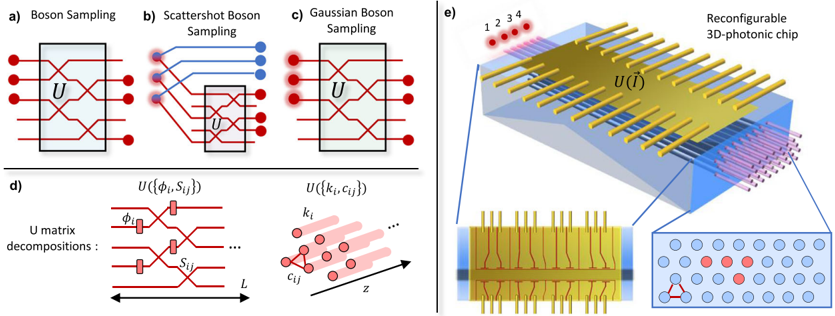
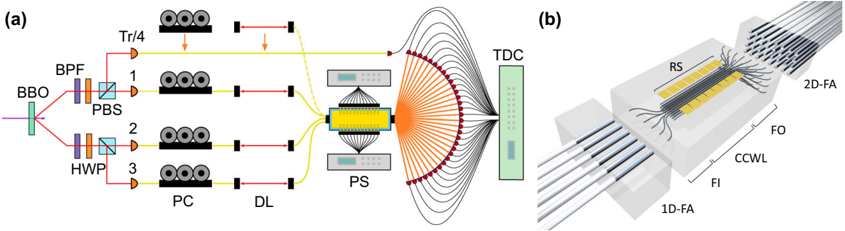
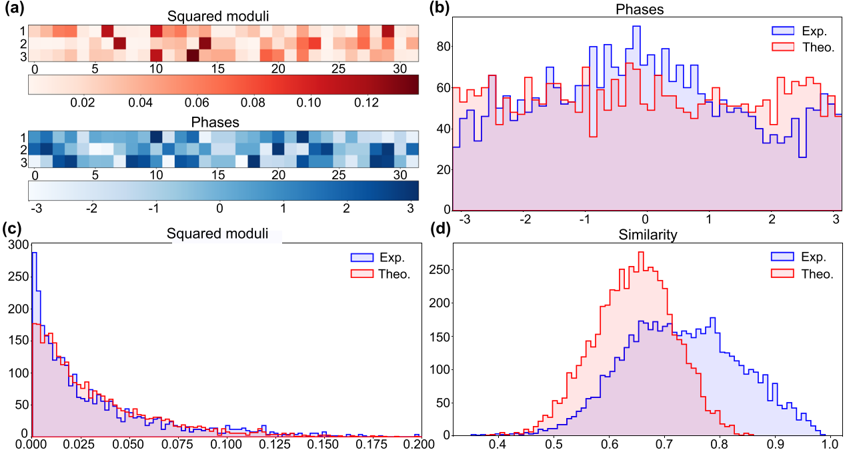
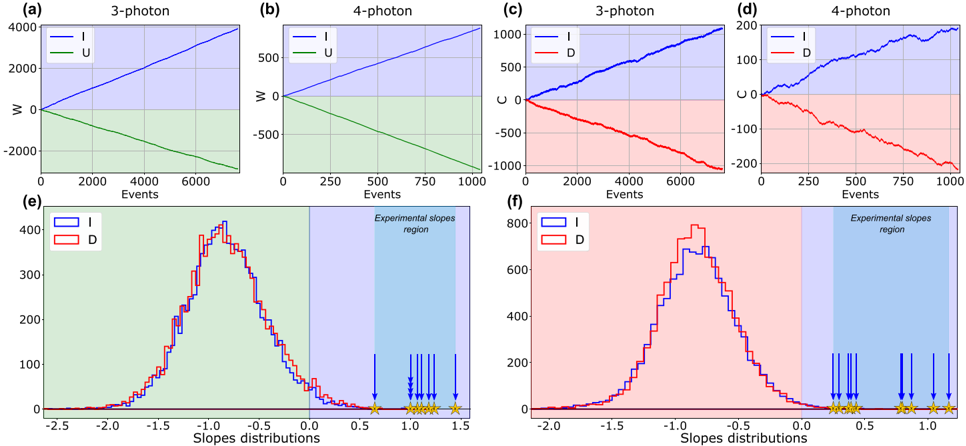
Boson Sampling is a computational paradigm representing one of the most viable and pursued approaches to demonstrate the regime of quantum advantage. Recent results have shown significant technological leaps in single-photon generation and detection, leading to progressively larger instances of Boson Sampling experiments in different photonic systems. However, a crucial requirement for a fully-fledged platform solving this problem is the capability of implementing large-scale interferometers, that must simultaneously exhibit low losses, high degree of reconfigurability and the realization of arbitrary transformations. In this work, we move a step forward in this direction by demonstrating the adoption of a compact and reconfigurable 3D-integrated platform for photonic Boson Sampling. We perform 3- and 4-photon experiments by using such platform, showing the possibility of programming the circuit to implement a large number of unitary transformations. These results show that such compact and highly-reconfigurable layout can be scaled up to experiments with larger number of photons and modes, and can provide a viable direction for hybrid computing with photonic processors.
Overview
The claims and statistics of this paper haven’t been checked yet.
Free: it reads the open-access text and checks the first 5 claims that cite a source we can check. Create a free account to check every claim.
Integrity signals
Registry
Cites
Statistics
Figures
Verification
Claims the paper makes
The claims and statistics of this paper haven’t been checked yet.
Free: it reads the open-access text and checks the first 5 claims that cite a source we can check. Create a free account to check every claim.
Claims other papers make about this one
Each is checked against this paper’s own text: does it say what the citing paper says it does?
The cited source says what the claim attributes to it.
In the citing paper
“Unlike discrete photonic circuits, which manipulate photons step-by-step using a series of optical elements, arrays of coupled waveguides enable photons to interfere continuously across the entire structure.”
From Tailoring quantum walks in integrated photonic lattices (2025) · cites this paper as [8]
Self-check
Percentages, sums and reported differences re-computed from the paper’s own numbers.
The self-check needs the paper’s full text.
Citations
Cites
Quantum computation and quantum information
Law, J. (2001) · ACM SIGSOFT Software Engineering Notes · doi:10.1145/505482.505499 · Cited by 18,842
Quantum supremacy using a programmable superconducting processor
Arute, F., Arya, K., Babbush, R., Bacon, D., Bardin, J. C., Barends, R., Biswas, R., Boixo, S., Brandao, F. G. S. L., Buell, D. A., et al. (2019) · Nature · doi:10.1038/s41586-019-1666-5 · Cited by 7,720
Simulating physics with computers
Feynman, R. P. (1982) · International Journal of Theoretical Physics · doi:10.1007/bf02650179 · Cited by 7,691
Measurement of subpicosecond time intervals between two photons by interference
Hong, C. K., Ou, Z. Y., & Mandel, L. (1987) · Physical Review Letters · doi:10.1103/physrevlett.59.2044 · Cited by 4,369
Femtosecond laser micromachining in transparent materials
Gattass, R. R., & Mazur, E. (2008) · Nature Photonics · doi:10.1038/nphoton.2008.47 · Cited by 3,247
Quantum computational advantage using photons
Zhong, H.-S., Wang, H., Deng, Y.-H., Chen, M.-C., Peng, L.-C., Luo, Y.-H., Qin, J., Wu, D., Ding, X., Hu, Y., et al. (2020) · Science · doi:10.1126/science.abe8770 · Cited by 2,405
Experimental realization of any discrete unitary operator
Reck, M., Zeilinger, A., Bernstein, H. J., & Bertani, P. (1994) · Physical Review Letters · doi:10.1103/physrevlett.73.58 · Cited by 2,155 · cited 3×
“We adopt the scheme proposed by Clements et al. [39], which is indeed more compact than the earlier scheme by Reck et al. [38], and which has an optical depth of m beam splitters.”
MethodIntegrated photonic quantum technologies
Wang, J., Sciarrino, F., Laing, A., & Thompson, M. G. (2020) · Nature Photonics · doi:10.1038/s41566-019-0532-1 · Cited by 1,576
Self-citationNear-optimal single-photon sources in the solid state
Somaschi, N., Giesz, V., De Santis, L., Loredo, J. C., Almeida, M. P., Hornecker, G., Portalupi, S. L., Grange, T., Antón, C., Demory, J., et al. (2016) · Nature Photonics · doi:10.1038/nphoton.2016.23 · Cited by 1,229
Optimal design for universal multiport interferometers
Clements, W. R., Humphreys, P. C., Metcalf, B. J., Kolthammer, W. S., & Walsmley, I. A. (2016) · Optica · doi:10.1364/optica.3.001460 · Cited by 1,216 · cited 3×
“We adopt the scheme proposed by Clements et al. [39], which is indeed more compact than the earlier scheme by Reck et al. [38], and which has an optical depth of m beam splitters.”
Method
Cited by
A versatile single-photon-based quantum computing platform
Maring, N., Fyrillas, A., Pont, M., Ivanov, E., Stepanov, P., Margaria, N., Hease, W., Pishchagin, A., Lemaître, A., Sagnes, I., et al. (2024) · Nature Photonics · doi:10.1038/s41566-024-01403-4 · Cited by 247
“The number of modes in the photonic chip can be increased while reducing photon transmission loss 16,17,57 .”
Photonic multiplexing techniques for neuromorphic computing
Bai, Y., Xu, X., Tan, M., Sun, Y., Li, Y., Wu, J., Morandotti, R., Mitchell, A., Xu, K., & Moss, D. J. (2023) · Nanophotonics · doi:10.1515/nanoph-2022-0485 · Cited by 235
20-Mode Universal Quantum Photonic Processor
Taballione, C., Anguita, M. C., de Goede, M., Venderbosch, P., Kassenberg, B., Snijders, H., Kannan, N., Vleeshouwers, W., Smith, D. H., Epping, J. P., et al. (2023) · Quantum · doi:10.22331/q-2023-08-01-1071 · Cited by 128
Chen, C., Zhan, Y., Wang, T., Wang, Y., Gao, K., Wu, J., Wang, J., Qiu, J., & Tan, D. (2024) · Nature Communications · doi:10.1038/s41467-024-53371-6 · Cited by 91
Integrated photonics in quantum technologies
Giordani, T., Hoch, F., Carvacho, G., Spagnolo, N., & Sciarrino, F. (2023) · Rivista Del Nuovo Cimento · doi:10.1007/s40766-023-00040-x · Cited by 71
“in small [83–86] and large scale [87] realization of integrated devices.”
BackgroundSelf-citationIntegrated Photonic Computing beyond the von Neumann Architecture
Xu, X.-Y., & Jin, X. (2023) · ACS Photonics · doi:10.1021/acsphotonics.2c01543 · Cited by 64
Programmable high-dimensional Hamiltonian in a photonic waveguide array
Yang, Y., Chapman, R. J., Haylock, B., Lenzini, F., Joglekar, Y. N., Lobino, M., & Peruzzo, A. (2024) · Nature Communications · doi:10.1038/s41467-023-44185-z · Cited by 64
“I would suggest the authors to add a discussion on this aspect.”
BackgroundPentangelo, C., Giano, N. D., Piacentini, S., Arpe, R., Ceccarelli, F., Crespi, A., & Osellame, R. (2024) · Nanophotonics · doi:10.1515/nanoph-2023-0636 · Cited by 44
“Even though larger circuits have been already reported in the literature [18, 26], our processors provide the highest level of control and reconfigurability demonstrated to date in a FLW platform, with the additional feature of producing polarization-independent optical transformations.”
BackgroundSelf-citationFock state-enhanced expressivity of quantum machine learning models
Gan, B. Y., Leykam, D., & Angelakis, D. G. (2022) · EPJ Quantum Technology · doi:10.1140/epjqt/s40507-022-00135-0 · Cited by 57
Femtosecond-laser-written low-loss multiscan waveguides in fused silica
Skryabin, N. N., Zhuravitskii, S. A., Dyakonov, I. V., Straupe, S. S., Kalinkin, A. A., & Kulik, S. P. (2024) · Physical Review Applied · doi:10.1103/physrevapplied.22.064079 · Cited by 32
“…the origin of the use of integrated interferometers in quantum optical experiments [14, 15], which was followed by a series of works aimed at the development of single-qubit [16–18] and multi-qubit gates [19–24], and also at carrying out quantum walks [25–31] and boson sampling experiments [32–38].”
Boson bunching is not maximized by indistinguishable particles
Seron, B., Novo, L., & Cerf, N. J. (2023) · Nature Photonics · doi:10.1038/s41566-023-01213-0 · Cited by 48
Two-qubit quantum photonic processor manufactured by femtosecond laser writing
Skryabin, N. N., Kondratyev, I. V., Dyakonov, I. V., Borzenkova, O. V., Kulik, S. P., & Straupe, S. S. (2023) · Applied Physics Letters · doi:10.1063/5.0137728 · Cited by 19
Programmable quantum circuits in a large-scale photonic waveguide array
Yang, Y., Chapman, R. J., Youssry, A., Haylock, B., Lenzini, F., Lobino, M., & Peruzzo, A. (2025) · npj Quantum Information · doi:10.1038/s41534-024-00934-6 · Cited by 27
“A multi-channel AWG is used to generate pulses that are applied to electrodes to program the 11-RWA.”
Toward Higher Integration Density in Femtosecond-Laser-Written Programmable Photonic Circuits
Albiero, R., Pentangelo, C., Gardina, M., Atzeni, S., Ceccarelli, F., & Osellame, R. (2022) · Micromachines · doi:10.3390/mi13071145 · Cited by 22
“2× 10⁻⁶ [18], making them compatible with polarization-encoded protocols), and can be easily exploited for the fabrication of complex structures in a three-dimensional fashion [19,20].”
BackgroundSelf-citationCharacterization of multimode linear optical networks
Hoch, F., Giordani, T., Spagnolo, N., Crespi, A., Osellame, R., & Sciarrino, F. (2023) · Advanced Photonics Nexus · doi:10.1117/1.apn.2.1.016007 · Cited by 17
“They are very useful when the structure is inaccessible, untrusted, or too complex to be modeled.(23) A black box method for linear optical circuits was proposed in Ref.”
Self-citationQuantum logical controlled-NOT gate in a lithium niobate-on-insulator photonic quantum walk
Chapman, R. J., Häusler, S., Finco, G., Kaufmann, F., & Grange, R. (2023) · Quantum Science and Technology · doi:10.1088/2058-9565/ad0a48 · Cited by 21
“Tunable waveguide arrays are being actively researched, using thermo-and electro-optics to reconfigure the dynamics of QWs in silica and proton-exchange LN waveguides [46, 47].”
BackgroundMulti-particle quantum walks on 3D integrated photonic chip
Zhou, W.-H., Wang, X.-W., Ren, R.-J., Fu, Y.-X., Chang, Y.-J., Xu, X.-Y., Tang, H., & Jin, X.-M. (2024) · Light: Science & Applications · doi:10.1038/s41377-024-01627-7 · Cited by 16
“2c. Compared to the 1D waveguide array, the advantages of 3D fabrication allow for ef fi cient expansion of the structure size and experimental scale, providing an excellent platform for multi-photon experiments such as quantum walks and boson sampling 56 – 58 .”
MethodModular quantum-to-quantum Bernoulli factory in an integrated photonic processor
Hoch, F., Giordani, T., Castello, L., Carvacho, G., Spagnolo, N., Ceccarelli, F., Pentangelo, C., Piacentini, S., Crespi, A., Osellame, R., et al. (2024) · Nature Photonics · doi:10.1038/s41566-024-01526-8 · Cited by 19
“In particular, its unique three-dimensional capabilities may be beneficial in compactifying circuit designs 37,38 and in enabling random transformations 39,40 .”
Self-citationTunable Generation of Spatial Entanglement in Nonlinear Waveguide Arrays
Raymond, A., Zecchetto, A., Palomo, J., Morassi, M., Lemaître, A., Raineri, F., Amanti, M. I., Ducci, S., & Baboux, F. (2024) · Physical Review Letters · doi:10.1103/physrevlett.133.233602 · Cited by 11
“Compared to quantum walks in passive circuits [18–20], the walkers are here generated directly inside the device and the generation can take place at any position along the propagation axis [27].”
BackgroundToward scalable fault-tolerant photonic quantum computers
AbuGhanem, M. (2026) · The Journal of Supercomputing · doi:10.1007/s11227-025-08132-7 · Cited by 17
Certification of Gaussian Boson Sampling via graphs feature vectors and kernels
Giordani, T., Mannucci, V., Spagnolo, N., Fumero, M., Rampini, A., Rodolà, E., & Sciarrino, F. (2022) · Quantum Science and Technology · doi:10.1088/2058-9565/ac969b · Cited by 11
Self-citationThe SWITCH test for discriminating quantum evolutions
Chamorro‐Posada, P., & García-Escartín, J. C. (2023) · Journal of Physics A Mathematical and Theoretical · doi:10.1088/1751-8121/acecc5 · Cited by 11
Large-scale free-space photonic circuits in two dimensions
Ammendola, M. G., Colandrea, F. D., Marrucci, L., & Cardano, F. (2025) · Advanced Photonics · doi:10.1117/1.ap.7.1.016006 · Cited by 13
“4 Optical processors based on linear circuits provide key applications in optical computing 5,6 and are emerging as building blocks of future optical neural networks and AI systems.”
Gualandi, G., Atzeni, S., Gardina, M., Caime, A., Corrielli, G., Labanca, I. G., Gulinatti, A., Rech, I., Osellame, R., Acconcia, G., et al. (2025) · Light Science & Applications · doi:10.1038/s41377-025-01854-6 · Cited by 7
Self-citationA learning theory for quantum photonic processors and beyond
Rosati, M. (2024) · Quantum · doi:10.22331/q-2024-08-08-1433 · Cited by 18
“In particular, the recent demonstration of a quantum computational advantage via photonic circuits [1, 2] finally paves the way for the realization of full-fledged quantum information processing with light, a solution that bears intrinsic advantages with respect to other platforms, in terms of scalability, robustness…”
BackgroundAdhikary, M., Kozoň, M., Uppu, R., & Vos, W. L. (2024) · Physical Review Research · doi:10.1103/physrevresearch.6.043235 · Cited by 9
Ruiqi, 王. W., Yuliang, 唐. T., & Li, Y. (2025) · Laser & Optoelectronics Progress · doi:10.3788/lop250995 · Cited by 5
Experimental Boson Sampling Enabling Cryptographic One-Way Function
Wang, X., Zhou, W.-H., Fu, Y.-X., Gao, J., Lu, Y., Chang, Y.-J., Qiao, L., Ren, R.-J., Jiang, Z.-K., Jiao, Z., et al. (2023) · Physical Review Letters · doi:10.1103/physrevlett.130.060802 · Cited by 9
Research progress of integrated photonic quantum simulation
Chen, Y., Zhang, T., Guo, G., & Ren, X. (2022) · Acta Physica Sinica · doi:10.7498/aps.71.20221938 · Cited by 6
Full Software Control on MZI-Based Photonic Integrated Circuit
Kwon, Y. S., Bernard, M., Limongi, L., Piccoli, G., Ghulinyan, M., & Choi, B.-S. (2024) · IEEE Access · doi:10.1109/access.2024.3474014 · Cited by 3
“Experiments of programming or software control exist on large-sacle photonic processors following this approach [7], [10], [11], [19], [20], [21], [22], [23].”
BackgroundInfluentialToward Universal Transformations of Orbital Angular Momentum of a Single Photon
Chen, D., Wang, Y., Wang, F., Zhao, J., & Yang, C. (2023) · Laser & Photonics Review · doi:10.1002/lpor.202300277 · Cited by 4
Minhan, 楼. L., & Dezhi, 谭. T. (2024) · Chinese Journal of Lasers · doi:10.3788/cjl231385 · Cited by 2
A 24-mode laser-written universal photonic processor in a glass-based platform
Barzaghi, A., Bénéfice, M., Ceccarelli, F., Corrielli, G., Galli, V., Gardina, M., Grimaldi, V., Kaczorowski, J., Malaspina, F., Osellame, R., et al. (2025) · Quantum Computing, Communication, and Simulation · doi:10.1117/12.3043829 · Cited by 4
Self-citationPhotonic Multiplexing Techniques for Optical Neuromorphic ComputingPreprint
Moss, D. (2022) · Preprints.org · doi:10.20944/preprints202208.0470.v1 · Cited by 1
Tailoring quantum walks in integrated photonic lattices
Raymond, A., Cathala, P., Morassi, M., Lemaître, A., Raineri, F., Ducci, S., & Baboux, F. (2025) · Optics Express · doi:10.1364/oe.571522 · Cited by 1
“An alternative approach leverages instead continuously-coupled waveguides, where photons spread transversely, interfering along the entire propagation length rather than solely at discrete beamsplitters [7, 8].”
Finding eigenvectors with a quantum variational algorithm
García-Escartín, J. C. (2024) · Quantum Information Processing · doi:10.1007/s11128-024-04461-3 · Cited by 3
“There exist many successful experimental realizations of configurable optical circuits with integrated optics [51–57] that offer a linear optical system that can be controlled electronically.”
Universal programmable waveguide arrays
Youssry, A., & Peruzzo, A. (2025) · Quantum Science and Technology · doi:10.1088/2058-9565/add802 · Cited by 4
Implementation of Leaking Quantum Walks on a Photonic Processor
Stefanutti, E., Philipps, J., Bütow, J., Guidara, A., Nuvoli, M., Chiuri, A., & Sansoni, L. (2026) · Applied Sciences · doi:10.3390/app16041976 · Cited by 4
Ultrafast Laser-Fabricated Three-Dimensional Photonic Chips Empowering Diverse Applications
Wang, J., Wang, J., Cai, C., Wang, K., & Ding, S. (2026) · IEEE Journal of Selected Topics in Quantum Electronics · doi:10.1109/jstqe.2026.3669125 · Cited by 1
Photonic Unitary Circuits for Quantum Information Processing
Zelaya, K., Pérez-Leija, A., Shetewy, A. E., Friedman, J., He, M., Jamshidi, K., & Miri, M. (2026) · Advanced Quantum Technologies · doi:10.1002/qute.202500812 · Cited by 1
“Indeed, these universal unitary photonic architectures now underpin applications ranging from boson sampling [ 26 ] and quantum simulation [ 27 ] to reconfigurable linear-optical processors for machine learning and signal processing [ 28 ].”
Integrated photonic quantum computing
Zhang, Y. Y. (2024) · Elsevier eBooks · doi:10.1016/b978-0-323-91765-0.00008-6 · Cited by 2
Variational Learning of Integrated Quantum Photonic Circuits via Genetic Algorithm
Zhang, H., Yang, C., Mok, W., Wan, L., Cai, H. N., Li, Q., Gao, F., Luo, X., Lo, G., Chin, L. K., et al. (2024) · Laser & Photonics Review · doi:10.1002/lpor.202400359 · Cited by 2
Photonic multiplexing architectures for optical neuromorphic computationPreprint
Moss, D. (2022) · OSF Preprints (OSF Preprints) · doi:10.31219/osf.io/82mf3 · Cited by 3
Photonic multiplexing methods for optical neuromorphic computingPreprint
Moss, D. (2022) · TechRxiv · doi:10.36227/techrxiv.20656833.v1
Photonic multiplexing methods for optical neuromorphic computingPreprint
Moss, D. (2022) · TechRxiv · doi:10.36227/techrxiv.20656833
Programmable high-dimensional Hamiltonian in a photonic waveguide arrayPreprint
Yang, Y., Chapman, R. J., Haylock, B., Lenzini, F., Joglekar, Y. N., Lobino, M., & Peruzzo, A. (2023) · arXiv (Cornell University) · doi:10.3929/ethz-b-000651898
Multiplexing approaches for optical neuromorphic networksPreprint
Moss, D. (2024) · OSF Preprints (OSF Preprints) · doi:10.31219/osf.io/5cwjt
Some Applications of Quantum Photonic Technology
Thyagarajan, K. (2025) · Graduate texts in physics · doi:10.1007/978-3-031-85728-7_25
Chengkun, 蔡. C., & Jian, 王. W. (2026) · Acta Optica Sinica · doi:10.3788/aos251865 · Cited by 1
Hasnaoui, H., Limongi, L., Giordani, T., Polacchi, B., Quaranta, A., Bernard, M., Sciarrino, F., & Lobino, M. (2026) · Applied Physics Reviews · doi:10.1063/5.0308063 · Cited by 2
Self-citationProof of Concept of an On-Chip Fourier Transform Spectrometer Written Using a Femtosecond Laser
Bourdel, S., Tryoen, A., Druart, G., Lancry, M., & Gazzano, O. (2026) · Journal of Lightwave Technology · doi:10.1109/jlt.2026.3714890
“The active modulation of the circuit is harder to achieve but thermal heaters located on the sample top surface can be used [23] or using electro-optical effects on crystals such as KTN [24].”
Metadata
- Authors
- Hoch, F., Piacentini, S., Giordani, T., Tian, Z.-N., Iuliano, M., Esposito, C., Camillini, A., Carvacho, G., Ceccarelli, F., Spagnolo, N., Crespi, A., Sciarrino, F., & Osellame, R.
- Affiliations
- Sapienza University of Rome (IT)
- Istituto di Fotonica e Nanotecnologie (IT)
- Jilin University (CN)
- Corresponding author
- Sciarrino, Fabio
- Osellame, Roberto
- ORCID
- Venue
- npj Quantum Information
- Published
- 2022-05-12
- Volume
- 8
- Issue
- 1
- ISSN
- 2056-6387 (ISSN-L)
- OpenAlex
- W4280631776
- Cited by
- 51
- References
- 79
- Citations by year
- 2026: 7 · 2025: 8 · 2024: 16 · 2023: 12 · 2022: 8
- FWCI
- 3.62
- Type
- journal article
- Language
- en
- Open access
- gold
- doi.org
- Licence
- cc-by
- creativecommons.org/licenses/by/4.0 (tdm)
- creativecommons.org/licenses/by/4.0 (vor)
- Locations
- npj Quantum Information (publishedVersion, cc-by)
- arXiv (Cornell University) (submittedVersion)
- Virtual Community of Pathological Anatomy (University of Castilla La Mancha) (submittedVersion, cc-by)
- DOAJ (DOAJ: Directory of Open Access Journals) (submittedVersion, cc-by-sa)
- IRIS Research product catalog (Sapienza University of Rome) (submittedVersion, cc-by)
- arXiv (Cornell University)
- Funders
- EC | Horizon 2020 Framework Programme (899544, 742745)
- Ministero dell'Istruzione, dell'Università e della Ricerca (2017SRNBRK)
- Topics
- Physical Sciences › Computer Science › Artificial Intelligence › Quantum Computing Algorithms and Architecture
- Physical Sciences › Engineering › Electrical and Electronic Engineering › Photonic and Optical Devices
- Physical Sciences › Physics and Astronomy › Atomic and Molecular Physics, and Optics › Quantum Information and Cryptography
- Keywords
- boson sampling, reconfigurable photonic circuits, quantum advantage, photonic processors, hybrid quantum computing, multiphoton interference
About these checks
Registry, retraction, Cites and statistics results are computed, not judged, with one exception: a printed reference that no index lists is read once by a model before it counts as a citation error. Claims are extracted by a model and kept only when their quote appears verbatim in the text; each cited source is then checked, with a model’s help, for whether it says what the claim relies on. Those verdicts can be wrong — read the claim’s quote and the cited source before relying on one.
Statistics and arithmetic are recomputed, not judged.
Confidence bands are shown only for fields calibrated on our annotated test set. None is calibrated yet, so no band is shown.
What counts as a claim ›How we measure confidence ›How we check this ›
Are you an author, or do you see a problem with this page? Request a review
Data sources
Bibliographic data: Semantic Scholar, OpenAlex, Crossref.
Contains information from the Semantic Scholar Academic Graph Datasets, made available under the ODC Attribution License (ODC-BY 1.0).
Semantic Scholar’s data is described in: Kinney, R., et al. (2023). The Semantic Scholar Open Data Platform. arXiv:2301.10140.
