

Efficient quantum state tomography with convolutional neural networks
Open accessThe DOI matches its Crossref record; 51 of the 51 references it cites were found in a registry or an index.
Abstract
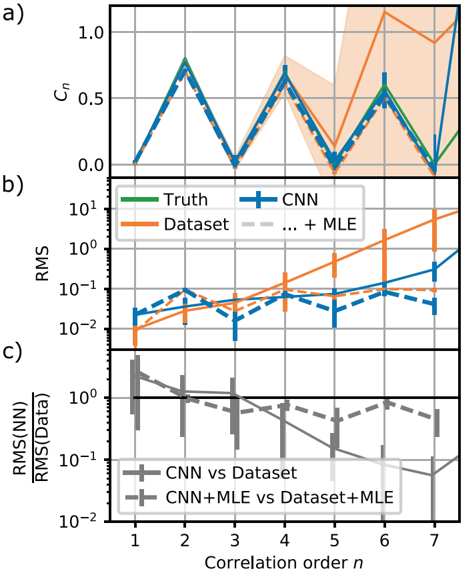
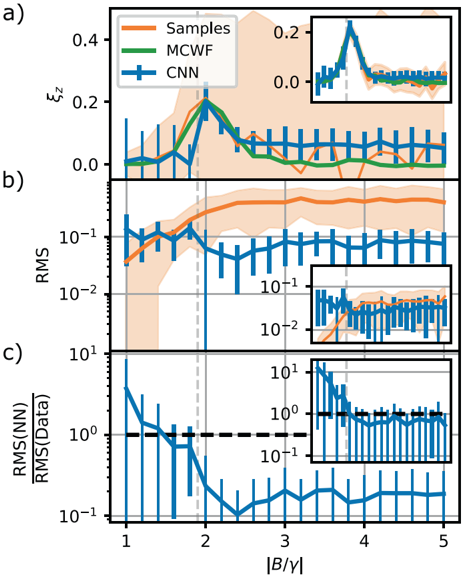
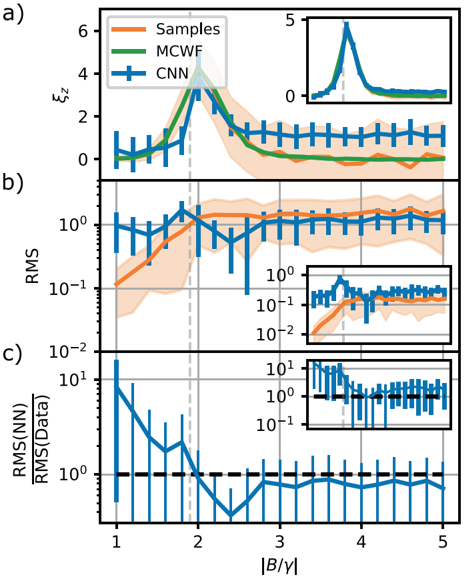
Modern day quantum simulators can prepare a wide variety of quantum states but the accurate estimation of observables from tomographic measurement data often poses a challenge. We tackle this problem by developing a quantum state tomography scheme which relies on approximating the probability distribution over the outcomes of an informationally complete measurement in a variational manifold represented by a convolutional neural network. We show an excellent representability of prototypical ground- and steady states with this ansatz using a number of variational parameters that scales polynomially in system size. This compressed representation allows us to reconstruct states with high classical fidelities outperforming standard methods such as maximum likelihood estimation. Furthermore, it achieves a reduction of the estimation error of observables by up to an order of magnitude compared to their direct estimation from experimental data.
Overview
The claims and statistics of this paper haven’t been checked yet.
Free: it reads the open-access text and checks the first 5 claims that cite a source we can check. Create a free account to check every claim.
Integrity signals
Registry
Cites
Statistics
Figures
Verification
Claims the paper makes
The claims and statistics of this paper haven’t been checked yet.
Free: it reads the open-access text and checks the first 5 claims that cite a source we can check. Create a free account to check every claim.
Self-check
Percentages, sums and reported differences re-computed from the paper’s own numbers.
The self-check needs the paper’s full text.
Citations
Cites
Adam: A Method for Stochastic Optimization
Kingma, D. P., & Ba, J. (2014) · arXiv · doi:10.48550/arxiv.1412.6980 · Cited by 98,946
Multilayer feedforward networks are universal approximators
Hornik, K., Stinchcombe, M., & White, H. (1989) · Neural Networks · doi:10.1016/0893-6080(89)90020-8 · Cited by 21,728 · cited 1×
“motivated by universal approximation theorems [20, 21] and the observation that many NQS can efficiently encode volume-law entanglement and thereby have higher representational power compared to most tensor-network based approaches [22–24] as well as a favorable generalization to higher dimensions.”
BackgroundQuantum Computing in the NISQ era and beyond
Preskill, J. (2018) · Quantum · doi:10.22331/q-2018-08-06-79 · Cited by 8,830 · cited 3×
“[19] G. Torlai and R. G. Melko, Machine-learning quantum states in the NISQ era, Annu.”
BackgroundInfluentialApproximation capabilities of multilayer feedforward networks
Hornik, K. (1991) · Neural Networks · doi:10.1016/0893-6080(91)90009-t · Cited by 6,091 · cited 1×
“motivated by universal approximation theorems [20, 21] and the observation that many NQS can efficiently encode volume-law entanglement and thereby have higher representational power compared to most tensor-network based approaches [22–24] as well as a favorable generalization to higher dimensions.”
BackgroundMonte Carlo Strategies in Scientific Computing
Liu, J. S. (2004) · Springer Series in Statistics · doi:10.1007/978-0-387-76371-2 · Cited by 2,690
QuTiP 2: A Python framework for the dynamics of open quantum systems
Johansson, J. R., Nation, P. D., & Nori, F. (2013) · Computer Physics Communications · doi:10.1016/j.cpc.2012.11.019 · Cited by 2,242 · cited 1×
“Monte-Carlo wave function trajectories were computed using the Qutip library [53].”
MethodSolving the quantum many-body problem with artificial neural networks
Carleo, G., & Troyer, M. (2017) · Science · doi:10.1126/science.aag2302 · Cited by 2,215
The quantum-jump approach to dissipative dynamics in quantum optics
Plenio, M. B., & Knight, P. L. (1998) · Reviews of Modern Physics · doi:10.1103/revmodphys.70.101 · Cited by 1,515 · cited 1×
“We use the Monte-Carlo wave function approach [52], to simulate the”
MethodPredicting many properties of a quantum system from very few measurements
Huang, H.-Y., Kueng, R., & Preskill, J. (2020) · Nature Physics · doi:10.1038/s41567-020-0932-7 · Cited by 1,240 · cited 1×
“(7) with antiferromagnetic coupling J < 0, B < 0 and”
BackgroundQuantum State Tomography via Compressed Sensing
Gross, D., Liu, Y.-K., Flammia, S. T., Becker, S., & Eisert, J. (2010) · Physical Review Letters · doi:10.1103/physrevlett.105.150401 · Cited by 1,093 · cited 5×
“i;j jri rjj(2)ðhσi σj i hσi ihσj iÞ: (12)”
BackgroundInfluential
Research works printed but not linked: 3
- Deng, D.-L., Li, X. & Das Sarma, S. Quantum entanglement in neural network states. Phys. Rev. X 7, 021021 (2017).
- Huang, H. & Situ, H. Investigating reconstruction of quantum state distributions with neural networks. Eur. Phys. J. 136, 204 (2021).
- Lohani, S., Kirby, B. T., Brodsky, M., Danaci, O. & Glasser, R. T. Machine learning assisted quantum state estimation. Mach. Learn.: Sci. Technol. 1, 035007 (2020).
Cited by
From architectures to applications: a review of neural quantum states
Lange, H., de Walle, A. V., Abedinnia, A., & Bohrdt, A. (2024) · Quantum Science and Technology · doi:10.1088/2058-9565/ad7168 · Cited by 185
Modern applications of machine learning in quantum sciencesPreprint
Dawid, A., Arnold, J., Requena, B., Gresch, A., Płodzień, M., Donatella, K., Nicoli, K. A., Stornati, P., Koch, R., Büttner, M., et al. (2022) · arXiv (Cornell University) · doi:10.48550/arxiv.2204.04198 · Cited by 181
Beyond-classical computation in quantum simulation
King, A. D., Nocera, A., Rams, M. M., Dziarmaga, J., Wiersema, R., Bernoudy, W., Raymond, J., Kaushal, N., Heinsdorf, N., Harris, R., et al. (2025) · Science · doi:10.1126/science.ado6285 · Cited by 138
Artificial intelligence for quantum computing
Alexeev, Y., Farag, M. H., Patti, T. L., Wolf, M. E., Ares, N., Aspuru‐Guzik, A., Benjamin, S. C., Cai, Z., Cao, S., Chamberland, C., et al. (2025) · Nature Communications · doi:10.1038/s41467-025-65836-3 · Cited by 140
“But these limitations are solvable and present an important direction for further investigation.”
Variational Monte Carlo with large patched transformers
Sprague, K., & Czischek, S. (2024) · Communications Physics · doi:10.1038/s42005-024-01584-y · Cited by 74
Optimizing design choices for neural quantum states
Reh, M., Schmitt, M., & Gärttner, M. (2023) · Physical review. B./Physical review. B · doi:10.1103/physrevb.107.195115 · Cited by 70
“CNNs allow to be made more expressive by tuning the depth (D), filter size (SF ) and the number of filters/channels (NF ).”
BackgroundInfluentialSelf-citationQuantum Machine Learning: A Hands-on Tutorial for Machine Learning Practitioners and ResearchersPreprint
Du, Y., Wang, X., Guo, N., Yu, Z., Yang, Q., Zhang, K., Hsieh, M.-H., Rebentrost, P., & Tao, D. (2025) · arXiv (Cornell University) · doi:10.48550/arxiv.2502.01146 · Cited by 61
Quantum computing and artificial intelligence: status and perspectivesPreprint
Acampora, G., Ambainis, A., Ares, N., Banchi, L., Bhardwaj, P., Binosi, D., Briggs, G. A. D., Calarco, T., Dunjko, V., Eisert, J., et al. (2025) · arXiv (Cornell University) · doi:10.48550/arxiv.2505.23860 · Cited by 61
“Examples of ML meth-ods used in this field include conditional generative adversarial networks [182], convolutional neural networks [183], attention-based tomography [184], and recurrent neural networks; ML-inspired gradient-descent methods have also been proposed [185].”
Self-citationAdaptive Quantum State Tomography with Active Learning
Lange, H., Kebrič, M., Buser, M., Schollwöck, U., Grusdt, F., & Bohrdt, A. (2023) · Quantum · doi:10.22331/q-2023-10-09-1129 · Cited by 53
A Survey of Quantum-cognitively Inspired Sentiment Analysis Models
Liu, Y., Li, Q., Wang, B., Zhang, Y., & Song, D. (2023) · ACM Computing Surveys · doi:10.1145/3604550 · Cited by 49
“While ANNs have been used for parameterizing [23] and estimating [104, 108] quantum states, deep neural networks provide an effective parameter learning and model training mechanism, which allows end-to-end training of quantum-inspired models.”
MethodQuantum state tomography using quantum machine learning
Innan, N., Siddiqui, O. I., Arora, S., Ghosh, T., Kocak, Y. P., Paragas, D., Galib, A. A. O., Khan, M. A.-Z., & Bennai, M. (2024) · Quantum Machine Intelligence · doi:10.1007/s42484-024-00162-3 · Cited by 48
“In [12], Schmale et al use Convolutional Neural Networks (CNNs) to reconstruct quantum states.”
Lauro, L. D., Sciara, S., Fischer, B., Dong, J., Alamgir, I., Wetzel, B., Genty, G., Nichols, M., Eshaghi, A., Moss, D., et al. (2025) · Advances in Optics and Photonics · doi:10.1364/aop.533504 · Cited by 59
Many-Body Entropies and Entanglement from Polynomially Many Local Measurements
Vermersch, B., Ljubotina, M., Cirac, J. I., Zoller, P., Serbyn, M., & Piroli, L. (2024) · Physical Review X · doi:10.1103/physrevx.14.031035 · Cited by 42
“…in the context of matrix-product states (MPSs) [59 – 62], while recently extended to matrix-product density operators (MPDOs) [63 – 67], Gibbs states [68 – 73], permutation-invariant states [74 – 76], low-rank states [77], stabilizers [78], and tensor-and neural-network wave functions [79 – 84].”
BackgroundMachine learning for estimation and control of quantum systems
Ma, H., Qi, B., Petersen, I. R., Wu, R.-B., RABITZ, H. A., & Dong, D. (2025) · National Science Review · doi:10.1093/nsr/nwaf269 · Cited by 40
Quantum reservoir computing for photonic entanglement witnessing
Zia, D., Innocenti, L., Minati, G., Lorenzo, S., Suprano, A., Bartolo, R. D., Spagnolo, N., Giordani, T., Cimini, V., Palma, G. M., et al. (2025) · Science Advances · doi:10.1126/sciadv.ady7987 · Cited by 42
Quantum State Tomography via Nonconvex Riemannian Gradient Descent
Hsu, M.-C., Kuo, E.-J., Yu, W.-H., Cai, J., & Hsieh, M.-H. (2024) · Physical Review Letters · doi:10.1103/physrevlett.132.240804 · Cited by 36
Tomography of Quantum States From Structured Measurements via Quantum-Aware Transformer
Ma, H., Sun, Z., Dong, D., Chen, C., & RABITZ, H. A. (2025) · IEEE Transactions on Cybernetics · doi:10.1109/tcyb.2025.3556466 · Cited by 31
Learning quantum properties from short-range correlations using multi-task networks
Wu, Y., Zhu, Y., Wang, Y., & Chiribella, G. (2024) · Nature Communications · doi:10.1038/s41467-024-53101-y · Cited by 30
Mixed-state quantum denoising diffusion probabilistic model
Kwun, G., Zhang, B., & Zhuang, Q. (2025) · Physical Review A · doi:10.1103/physreva.111.032610 · Cited by 28
Efficient learning for linear properties of bounded-gate quantum circuits
Du, Y., Hsieh, M.-H., & Tao, D. (2025) · Nature Communications · doi:10.1038/s41467-025-59198-z · Cited by 27
Quantum Similarity Testing with Convolutional Neural Networks
Wu, Y., Zhu, Y., Bai, G., Wang, Y., & Chiribella, G. (2023) · Physical Review Letters · doi:10.1103/physrevlett.130.210601 · Cited by 28
“[24] Tobias Schmale, Moritz Reh, and Martin Gärttner, “Efficient quantum state tomography with convolutional neural networks,” npj Quantum Inf.”
BackgroundEnhancing quantum state tomography via resource-efficient attention-based neural networks
Palmieri, A. M., Müller-Rigat, G., Srivastava, A. K., Lewenstein, M., Rajchel-Mieldzioć, G., & Płodzień, M. (2024) · Physical Review Research · doi:10.1103/physrevresearch.6.033248 · Cited by 29
Quantum artificial intelligence: A survey
Acampora, G., Chiatto, A., Schiattarella, R., & Vitiello, A. (2025) · Computer Science Review · doi:10.1016/j.cosrev.2025.100807 · Cited by 25
Multimodal Deep Representation Learning for Quantum Cross-Platform Verification
Qian, Y., Du, Y., He, Z., Hsieh, M.-H., & Tao, D. (2024) · Physical Review Letters · doi:10.1103/physrevlett.133.130601 · Cited by 24
Gradient-descent methods for fast quantum state tomography
Gaikwad, A., Torres, M. S., Ahmed, S., & Kockum, A. F. (2025) · Quantum Science and Technology · doi:10.1088/2058-9565/ae0baa · Cited by 23
“There is also a vast range of advanced algorithms inspired by data-driven approaches and ML methods that have been applied to many quantum information processing tasks, including QST and QPT [75–78].”
Quantum state tomography with tensor train cross approximationPreprint
Lidiak, A., Jameson, C., Qin, Z., Tang, G., Wakin, M. B., Zhu, Z., & Gong, Z. (2022) · arXiv (Cornell University) · doi:10.48550/arxiv.2207.06397 · Cited by 22
Artificial intelligence for representing and characterizing quantum systems
Du, Y., Zhu, Y., Zhang, Y., Hsieh, M.-H., Rebentrost, P., Gao, W., You, Y., Eisert, J., Chiribella, G., Tao, D., et al. (2026) · Nature Reviews Physics · doi:10.1038/s42254-026-00962-5 · Cited by 21
“Unlike property prediction tasks, most DL models for quantum state reconstruction [6, 49, 54, 223, 237, 252, 300] follow a simple and standardized approach to dataset construction.”
Predicting topological entanglement entropy in a Rydberg analogue simulator
Mauron, L., Denis, Z., Nys, J., & Carleo, G. (2025) · Nature Physics · doi:10.1038/s41567-025-02944-3 · Cited by 21
“Another very promising prospect is quantum state tomography with variational Ans¨atze [120, 126, 127], where a variational state is optimized to best mimic the distribution of outcomes measured in real-world experiments.”
Oldfield, N. H., Laaber, C., Yue, T., & Ali, S. (2025) · ACM Transactions on Software Engineering and Methodology · doi:10.1145/3714468 · Cited by 23
Neural network approach to quasiparticle dispersions in doped antiferromagnets
Lange, H., Döschl, F., Carrasquilla, J., & Bohrdt, A. (2024) · Communications Physics · doi:10.1038/s42005-024-01678-7 · Cited by 18
Efficient learning of mixed-state tomography for photonic quantum walk
Wang, Q.-Q., Dong, S., Li, X.-W., Xu, X., Wang, C., Han, S., Yung, M., Han, Y., Li, C., & Guo, G. (2024) · Science Advances · doi:10.1126/sciadv.adl4871 · Cited by 16
“The collimated and filtered signal photons are adopted as the walker and sent to the QW module.”
Deep neural networks as variational solutions for correlated open quantum systems
Mellak, J., Arrigoni, E., & von der Linden, W. (2024) · Communications Physics · doi:10.1038/s42005-024-01757-9 · Cited by 15
Process tomography of structured optical gates with convolutional neural networks
Jaouni, T., Colandrea, F. D., Amato, L., Cardano, F., & Karimi, E. (2024) · Machine Learning Science and Technology · doi:10.1088/2632-2153/ad9ba8 · Cited by 15
Empirical Sample Complexity of Neural Network Mixed State Reconstruction
Zhao, H., Carleo, G., & Vicentini, F. (2024) · Quantum · doi:10.22331/q-2024-05-23-1358 · Cited by 14
“The POVM-NQS is an autoregressive dense NN with 2 layers of 10 neurons [30].”
BackgroundMethodInfluentialDetecting High-Dimensional Entanglement in Cold-Atom Quantum Simulators
Euler, N., & Gärttner, M. (2023) · PRX Quantum · doi:10.1103/prxquantum.4.040338 · Cited by 12
“…that the prepared state has reduced rank, and methods using variational ansatz functions, such as neural-network quantum state tomography [84–87] or matrix-product state tomography [88– 90], which restricts its search space to weakly entangled states—operating exactly in the opposite regime…”
MethodSelf-citationQuantum noise modeling through reinforcement learning
Bordoni, S., Papaluca, A., Buttarini, P., Sopena, A., Giagu, S., & Carrazza, S. (2025) · Quantum Science and Technology · doi:10.1088/2058-9565/ae1e98 · Cited by 11
Learning a Quantum Computer's Capability
Hothem, D., Young, K. C., Catanach, T., & Proctor, T. J. (2024) · IEEE Transactions on Quantum Engineering · doi:10.1109/tqe.2024.3430215 · Cited by 11
“…for a device’s errors is chosen (e.g., process matrices within unknown entries [8]), and best-fit values for the model’s unknown parameters are estimated from data, using techniques such as gate set tomography (GST) [7], randomized benchmarking (RB) [2, 4–6], or Pauli noise estimation [16, 17].”
MethodShadowNet for Data-Centric Quantum System Learning
Du, Y., Yang, Y., Liu, T., Lin, Z., Clifton, D. A., Ghanem, B., & Tao, D. (2026) · IEEE Transactions on Pattern Analysis and Machine Intelligence · doi:10.1109/tpami.2026.3724021 · Cited by 12
Machine learning the Kondo entanglement cloud from local measurements
Aikebaier, F., Ojanen, T., & Lado, J. L. (2024) · Physical review. B./Physical review. B · doi:10.1103/physrevb.109.195125 · Cited by 9
“Machine learning methods have been demonstrated to be highly successful in extracting Hamiltonians from experimental data[29–39], and and for automatic tuning of quantum systems without human intervention[40–47].”
BackgroundSelective and efficient quantum state tomography for multiqubit systems
Patel, A., Gaikwad, A., Huang, T., Kockum, A. F., & Abad, T. (2026) · Physical Review Research · doi:10.1103/hynl-kxl2 · Cited by 9
Learning Quantum Distributions with Variational Diffusion Models
Wang, Y., Cheng, S., Li, L., & Chen, J. (2023) · IFAC-PapersOnLine · doi:10.1016/j.ifacol.2023.10.095 · Cited by 8
Near-Optimal Simultaneous Estimation of Quantum State MomentsPreprint
Shi, X. L., Jiang, J., Wu, X., Xie, J., Yao, H., & Wang, X. (2025) · arXiv (Cornell University) · doi:10.48550/arxiv.2509.24842 · Cited by 8
“Despite advances based on compressed sensing [32, 33], neural-network post-processing [34, 35], and other heuristics tailored for structured states like tensor networks [36, 37], its measurement settings and classical workload still grow exponentially with the number of qubits for generic states…”
Effective detection of quantum discord by using convolutional neural networks
Taghadomi, N., Mani, A., Fahim, A., & Bakouei, A. (2025) · Quantum Machine Intelligence · doi:10.1007/s42484-025-00267-3 · Cited by 7
“Explicitly,theCNNmethod has been shown to be useful in many quantum problems, such as efficient quantum state tomography (Schmale et al. 2022), determining the phase diagram (Monaco et al. 2023), reducing the computing complexity in the noisy intermediate-scale quantum (NISQ) era (Wei et al. 2022),…”
Maximal Entropy Formalism and the Restricted Boltzmann Machine
Singh, V., Gupta, R., Sajjan, M., Remacle, F., Levine, R. D., & Kais, S. (2025) · The Journal of Physical Chemistry A · doi:10.1021/acs.jpca.5c02349 · Cited by 6
Tsai, Z.-L., Wang, H., & Chen, H. (2025) · New Journal of Physics · doi:10.1088/1367-2630/adfe89 · Cited by 6
Quantum Computer Benchmarking: An Explorative Systematic Literature Review
Rohe, T., Ruiloba, F. H., Egger, S., von Beck, S., Stein, J., & Linnhoff–Popien, C. (2025) · arXiv (Cornell University) · doi:10.48550/arxiv.2509.03078 · Cited by 6
Quantum Machine Learning for Security Data Analysis
Bandi, D., Shi, Y., Shahriar, H., Lo, D. C.-T., Suo, K., Chi, H., & Qian, K. (2023) · IEEE World AI IoT Congress (AIIoT) · doi:10.1109/aiiot58121.2023.10174430 · Cited by 6
“While a quantum neural network can effectively do this task, traditional computers find it extremely challenging [8].”
BackgroundQuantum state reconstruction via disentanglement with sequential optimization algorithm
Yao, J. (2024) · Machine Learning Science and Technology · doi:10.1088/2632-2153/ad88d6 · Cited by 6
Tensorization of neural networks for improved privacy and interpretability
Monturiol, J. R. P., Pozas-Kerstjens, A., & Pérez-García, D. (2025) · SciPost Physics Core · doi:10.21468/scipostphyscore.8.4.095 · Cited by 6
“…of architectures has been utilized in these applications, including Restricted Boltzmann Machines (RBMs) [ 13,15 ] , Convolutional Neural Networks (CNN) [ 11 ] , as well as Recurrent Neural Networks [ 16 ] , and transformer-based models [ 17 ] , inspired by the progress in language modeling.”
Efficient quantum state tomography with mode-assisted training
Zhang, Y., & Ventra, M. D. (2022) · Physical Review A · doi:10.1103/physreva.106.042420 · Cited by 6
Generalized Quantum State Tomography With Hybrid Denoising Priors
Xue, D., Dai, W., Zheng, Z., Li, C., Zou, J., & Xiong, H. (2025) · IEEE Transactions on Signal Processing · doi:10.1109/tsp.2025.3546655 · Cited by 6
Schmidt, P., Marquardt, F., & Mohseni, N. (2025) · Quantum Science and Technology · doi:10.1088/2058-9565/adbd6d · Cited by 5
Recovery of quantum correlations using machine learning
Steele, E. W., Reising, D. R., & Li, T. (2025) · Physical Review Applied · doi:10.1103/physrevapplied.23.034083 · Cited by 5
“Leveraging advanced ML techniques such as convolutional neural networks [22, 23], adaptive neural networks [24], deep learning [25], and most recently quantum machine learning [18], ML-QST enables efficient processing of large datasets, reduces measurement requirements, and enhances noise…”
Neural Quantum States Based on Selected Configurations
Solanki, M. J., Ding, L., & Reiher, M. (2026) · The Journal of Physical Chemistry Letters · doi:10.1021/acs.jpclett.6c00520 · Cited by 5
Unveiling the nonclassicality within quasi-distribution representations through deep learning
Chen, H., Liu, C., Lai, K.-L., Tseng, B., Lo, P., Chen, Y.-N., & Yu, C. (2024) · Quantum Science and Technology · doi:10.1088/2058-9565/ad8ef0 · Cited by 5
Learning Informative Latent Representation for Quantum State Tomography
Ma, H., Sun, Z., Dong, D., & Gong, D. (2025) · IEEE Transactions on Emerging Topics in Computational Intelligence · doi:10.1109/tetci.2025.3543767 · Cited by 5
Abhignan, V., Boruah, B. B., Srikanth, R., & Singh, A. (2025) · Physica Scripta · doi:10.1088/1402-4896/ade1b2 · Cited by 4
“The optimization involved in its de fi nition is the main source of this dif fi culty [ 47 ] .”
Deep neural network-assisted improvement of quantum compressed sensing tomography
Palmieri, A. M., Zambrano, L., Lewenstein, M., Acín, A., & Farina, D. (2025) · Physica Scripta · doi:10.1088/1402-4896/ae1ada · Cited by 4
Ansatz-Agnostic Exponential Resource Saving in Variational Quantum Algorithms Using Shallow Shadows
Basheer, A., Feng, Y., Ferrie, C., & Li, S. (2024) · International Joint Conference on Artificial Intelligence · doi:10.24963/ijcai.2024/410 · Cited by 4
Learning energy-based representations of quantum many-body states
Jayakumar, A., Vuffray, M., & Lokhov, A. Y. (2024) · Physical Review Research · doi:10.1103/physrevresearch.6.033201 · Cited by 4
Machine learning applications in cold atom quantum simulatorsPreprint
Schlömer, H., & Bohrdt, A. (2025) · arXiv (Cornell University) · doi:10.48550/arxiv.2509.08011 · Cited by 4
Machine learning approach to reconstruct density matrices from quantum marginals
Contreras, D. U., Guerra, A., Niklitschek, S., & Delgado, A. (2025) · Machine Learning Science and Technology · doi:10.1088/2632-2153/ade48d · Cited by 3
“In quantum mechanics, ML techniques have been applied to tasks such as quantum state tomography [6, 7] and quantum process tomography [8], which become computationally prohibitive as system complexity increases.”
High-Accuracy Entanglement Detection via a Convolutional Neural Network with Noise Resistance
Sun, Q., Song, Y., Liao, Z., & Jiang, N. (2024) · Applied Sciences · doi:10.3390/app14209418 · Cited by 3
Improved Tomographic Estimates by Specialized Neural Networks
Guarneri, M., Gianani, I., Barbieri, M., & Chiuri, A. (2023) · Advanced Quantum Technologies · doi:10.1002/qute.202300027 · Cited by 4
Batch Entanglement Detection in Parameterized Qubit States using Classical Bandit Algorithms
Bharati, K., Siddhu, V., & Jagannathan, K. (2026) · Transactions on machine learning research · doi:10.48550/arxiv.2406.19738 · Cited by 3
AiDE-Q: Synthetic Labeled Datasets Can Enhance Learning Models for Quantum Property Estimation
Wang, X., Du, Y., Lou, Z., Qian, Y., Zhang, K., Luo, Y., Du, B., & Tao, D. (2025) · neural information processing systems · doi:10.52202/085713-3064 · Cited by 2
“…various neural architectures for effectively constructing classical representations of the quantum states, including restricted Boltzmann machines [26, 28, 98], multi-layer perceptions [40, 41, 48], convolutional neural networks [29, 43, 47], and attention-based neural networks [35, 42, 49, 50].”
Entanglement Distillation Optimization Using Fuzzy Relations for Quantum State Tomography
Ganesan, T., & Elamvazuthi, I. (2023) · Algorithms · doi:10.3390/a16070313 · Cited by 2
Learning Quantum Distributions Based on Normalizing Flow
Li, L., Wang, Y., Cheng, S., & Liu, L. (2023) · Conference proceedings/Conference proceedings - IEEE International Conference on Systems, Man, and Cybernetics · doi:10.1109/smc53992.2023.10394048 · Cited by 2
Wang, W., & Dai, E. (2024) · IEEE Access · doi:10.1109/access.2024.3369036 · Cited by 2
“This section provides a brief explanation of the principle and purpose of each CNN component, using the structure of LeNet as an example [14].”
MethodBaláž, P., Krawczyk, M., Pawłowski, J., & Roszak, K. (2025) · Physical Review A · doi:10.1103/zgfy-yyw8 · Cited by 2
Learning quantum tomography from incomplete measurementsPreprint
Krawczyk, M., Baláž, P., Roszak, K., & Pawłowski, J. (2025) · arXiv (Cornell University) · doi:10.48550/arxiv.2506.19428 · Cited by 2
“On the other hand, classical shadow tomography [15, 16] utilizes the fact that predicting important properties of a many-body state (without necessarily fully characterizing the quantum state) requires only a polynomially-growing number of measurements [17].”
Hua, E., van Ommen, S., Yu, K. Y., van Leeuven, J., Bishnoi, R., Abunahla, H., Nur, S., Feld, S., & Ishihara, R. (2025) · arXiv (Cornell University) · doi:10.48550/arxiv.2507.23007 · Cited by 2
Fast and noise-robust quantum state tomography based on ELM
Wu, X.-D., & Cong, S. (2023) · International Journal of Quantum Information · doi:10.1142/s0219749923500521 · Cited by 1
A permutation-equivariant deep learning model for quantum state characterization
Maragnano, D., Cusano, C., & Liscidini, M. (2025) · APL Machine Learning · doi:10.1063/5.0258853 · Cited by 1
Neural Network Enhanced Robustness for Noisy Quantum Applications
Breslawski, D., Crimmins, A., & Alarcón, S. L. (2024) · IEEE International Conference on Rebooting Computing (ICRC) · doi:10.1109/icrc64395.2024.10937016 · Cited by 1
“Schmale et al. [9] use the density matrix representation of states as an encoding to choose a favorable convolutional neural network architecture for QST, and contrast the results to the most popular tomographic tool, maximum likelihood estimation (MLE).”
Efficient quantum state tomography with auxiliary systems
Zhao, W., Zhang, D., Zhang, H., Yu, H., & Yin, Z. (2026) · Physical Review A · doi:10.1103/rn6f-sp1l · Cited by 1
Three-qubit W state tomography via full and marginal state reconstructions on ibm_osaka
Talath, H., Govindaraja, B. P., Divyamani, B. G., Akshata Shenoy, H., Devi, U. A. R., & Sudha (2025) · Quantum Information Processing · doi:10.1007/s11128-025-04964-7 · Cited by 1
Quantum machine learning for state tomography using classical data
Jabeen, S., Kurdydyk, D., Palnitkar, A., Talati, M., Yan, J., & Yang, J. (2026) · Quantum Machine Intelligence · doi:10.1007/s42484-026-00345-0 · Cited by 1
“…( 2022 ); Singh et al. ( 2025 ); Kokaew et al. ( 2024 ); Neugebauer et al. ( 2020); Melkani et al. ( 2020 ); Li et al. ( 2024 ); Cha et al. ( 2022); Wei et al. ( 2024 ); Xin et al. ( 2019 ); Schmale et al. ( 2022); Ahmed et al. ( 2021 ); Gaikwad and Bihani ( 2024) use neural networks for QST.”
InfluentialStatistical inference for quantum singular modelsPreprint
Yano, H., Maeda, Y., & Yamamoto, N. (2024) · arXiv (Cornell University) · doi:10.48550/arxiv.2411.16396 · Cited by 1
A Physics-Informed Neuro-Fuzzy Framework for Quantum Error AttributionPreprint
Hassan, M. R., & Kaabouch, N. (2026) · arXiv.org · doi:10.48550/arxiv.2602.21253 · Cited by 1
“Schmale et al. [44] showed that convolutional neural networks can reduce estimation error by an order of magnitude compared to linear inversion methods.”
Learning high-dimensional quantum entanglement through physics-guided neural networksPreprint
Xu, Y., Zhang, H., Zhang, W., Niu, L., Amooei, M., Carbajo, S., & Boyd, R. W. (2026) · arXiv (Cornell University) · doi:10.48550/arxiv.2604.03482 · Cited by 1
“In optics and quantum information science, deep neural networks are now being used alongside with, or even instead of, traditional techniques like quantum state tomography [41, 42], entanglement detection [43, 44], and system identification [45, 46].”
Learning quantum ground states in the space of measurement outcomesPreprint
Agarwal, K. (2026) · arXiv (Cornell University) · doi:10.48550/arxiv.2605.28931 · Cited by 1
“Since the POVM outcome distribution corresponds directly to experimentally measurable quantities, it is naturally compatible with teacher-forcing and supervised learning protocols using experimental data [40, 41].”
Large Scale Entanglement Structure Detection in 100-Qubit Systems via Local Joint MeasurementsPreprint
Li, R., Wang, Y., Du, C., Zhang, S., Qin, Z., Li, W., Zhang, H., & Xiao, Z. (2026) · arXiv (Cornell University) · doi:10.48550/arxiv.2608.20170 · Cited by 1
“Our protocol partitions an N -qubit chain into overlapping local subsystems of R contiguous qubits [27].”
Uncertainty Quantification for Quantum Fidelity EstimationPreprint
Aditi, K., & Becker, S. (2026) · arXiv (Cornell University) · doi:10.48550/arxiv.2610.10885 · Cited by 1
Bayesian Modelling Approaches for Quantum States -- The Ultimate Gaussian Process States HandbookPreprint
Rath, Y. (2023) · arXiv (Cornell University) · doi:10.48550/arxiv.2308.07669
A machine learning ride in the physics theme park: from quantum to biophysics
Requena, B. (2024) · UPCommons institutional repository (Universitat Politècnica de Catalunya) · doi:10.5821/dissertation-2117-409132
Statistical mechanics and machine learning of the α -Rényi ensemble
Jreissaty, A., & Carrasquilla, J. (2025) · Physical Review Research · doi:10.1103/physrevresearch.7.013070
Quantum superposition state feature recognition method based on convolutional neural networks
Zhang, T., & Zhao, C. (2025) · Journal of the Optical Society of America B · doi:10.1364/josab.544692
Júnior, S. J. D. S. (2024) · Digital Library of Theses and Dissertations (Universidade de São Paulo) · doi:10.11606/d.43.2024.tde-12062025-180055
Quantum Adaptive Learning Rate
Hoffnagle, M., Alarcón, S. L., & Merkel, C. E. (2025) · Computing in Science & Engineering · doi:10.1109/mcse.2025.3581848
“It expands from quantum-inspired classical algorithms 4 or ML enhanced quantum technology and tomography 5 to quantum NNs (QNNs) implementations to classify classical or quantum data.”
Learning quantum computers' errors using interpretable neural networks
(NNSA), U. N. N. S. A., Proctor, T. J., & Sandia National Laboratories (SNL-CA), L. (2025) · OSTI OAI (U.S. Department of Energy Office of Scientific and Technical Information) · doi:10.2172/2589601
Du, Y., Wang, X., Guo, N., Yu, Z., Qian, Y., Zhang, K., Hsieh, M.-H., Rebentrost, P., & Tao, D. (2025) · Springer eBooks · doi:10.1007/978-981-95-1284-3_2
Yang, 王. W., Shixin, 马. M., Zhan, 李. L., Qingxue, 姚. Y., Chuanyi, 卢. L., Jie, 黄. H., & Xiaogang, 强. Q. (2025) · Acta Optica Sinica · doi:10.3788/aos251369
Bayesian perspectives for quantum states and application to ab initio quantum chemistryPreprint
Rath, Y., Bortone, M., & Booth, G. H. (2025) · arXiv (Cornell University) · doi:10.48550/arxiv.2508.21729
Wang, Q. P., Liang, C., Ma, X., & Zhu, L. (2025) · International Conference on Artificial Intelligence, Automation and High Performance Computing (AIAHPC) · doi:10.1109/aiahpc66801.2025.11290541
“In recent years, artificial intelligence (AI) has been widely applied in the field of quantum systems, such as solving quantum many-body problems [1], reconstructing the density matrix of high-dimensional quantum systems [2], and even designing quantum experiments [3], [4].”
Learning-based quantum estimation, control, and compression
Ma, H. (2024) · UNSWorks (UNSW Sydney) · doi:10.26190/unsworks/30226
Detection of Quantum Phase Transitions with a Lee-Yang Formalism and Many-Body Algorithms
Vecsei, P. M. (2025) · Aaltodoc (Aalto University)
The Physics of Computing with Memory
Zhang, Y. (2024) · eScholarship (California Digital Library)
Report on scipost_202503_00007v2
(2025) · SciPost Physics Core · doi:10.21468/scipost.report.12130
Report on scipost_202503_00007v1
(2025) · SciPost Physics Core · doi:10.21468/scipost.report.10781
Metadata
- Authors
- Schmale, T., Reh, M., & Gärttner, M.
- Affiliations
- Heidelberg University (DE)
- Corresponding author
- Schmale, Tobias
- Reh, Moritz
- Gärttner, Martin
- Venue
- npj Quantum Information
- Published
- 2022-09-23
- Volume
- 8
- Issue
- 1
- ISSN
- 2056-6387 (ISSN-L)
- OpenAlex
- W4296836560
- Cited by
- 76
- References
- 51
- Citations by year
- 2026: 13 · 2025: 31 · 2024: 20 · 2023: 11 · 2022: 1
- FWCI
- 5.18
- Type
- journal article
- Language
- en
- Open access
- gold
- doi.org
- Licence
- cc-by
- creativecommons.org/licenses/by/4.0 (tdm)
- creativecommons.org/licenses/by/4.0 (vor)
- Locations
- npj Quantum Information (publishedVersion, cc-by)
- arXiv (Cornell University) (submittedVersion)
- DOAJ (DOAJ: Directory of Open Access Journals) (submittedVersion, cc-by-sa)
- arXiv (Cornell University)
- Funders
- Deutsche Forschungsgemeinschaft (EXC2181/1-390900948, SFB 1225, INST 40/575-1 FUGG)
- Gauss Centre for Supercomputing e.V.
- Topics
- Physical Sciences › Computer Science › Artificial Intelligence › Quantum Computing Algorithms and Architecture
- Physical Sciences › Physics and Astronomy › Atomic and Molecular Physics, and Optics › Quantum many-body systems
- Physical Sciences › Physics and Astronomy › Atomic and Molecular Physics, and Optics › Quantum Information and Cryptography
- Keywords
- quantum state tomography, convolutional neural networks, variational ansatz, informationally complete measurements, density estimation, quantum simulators, ground state, steady state, maximum likelihood estimation
About these checks
Registry, retraction, Cites and statistics results are computed, not judged, with one exception: a printed reference that no index lists is read once by a model before it counts as a citation error. Claims are extracted by a model and kept only when their quote appears verbatim in the text; each cited source is then checked, with a model’s help, for whether it says what the claim relies on. Those verdicts can be wrong — read the claim’s quote and the cited source before relying on one.
Statistics and arithmetic are recomputed, not judged.
Confidence bands are shown only for fields calibrated on our annotated test set. None is calibrated yet, so no band is shown.
What counts as a claim ›How we measure confidence ›How we check this ›
Are you an author, or do you see a problem with this page? Request a review
Data sources
Bibliographic data: Semantic Scholar, OpenAlex, Crossref.
Contains information from the Semantic Scholar Academic Graph Datasets, made available under the ODC Attribution License (ODC-BY 1.0).
Semantic Scholar’s data is described in: Kinney, R., et al. (2023). The Semantic Scholar Open Data Platform. arXiv:2301.10140.
