

Efficient quantum state tomography with convolutional neural networks
Open accessThe DOI matches its Crossref record; 50 of the 51 references it cites were found in a registry or an index.
Abstract
Modern day quantum simulators can prepare a wide variety of quantum states but the accurate estimation of observables from tomographic measurement data often poses a challenge. We tackle this problem by developing a quantum state tomography scheme which relies on approximating the probability distribution over the outcomes of an informationally complete measurement in a variational manifold represented by a convolutional neural network. We show an excellent representability of prototypical ground- and steady states with this ansatz using a number of variational parameters that scales polynomially in system size. This compressed representation allows us to reconstruct states with high classical fidelities outperforming standard methods such as maximum likelihood estimation. Furthermore, it achieves a reduction of the estimation error of observables by up to an order of magnitude compared to their direct estimation from experimental data.
Overview
The claims and statistics of this paper haven’t been checked yet.
Free: it reads the open-access text and checks the first 5 claims that cite a source we can check. Create a free account to check every claim.
Integrity signals
Registry
Cites
Statistics
Figures
Verification
Claims the paper makes
The claims and statistics of this paper haven’t been checked yet.
Free: it reads the open-access text and checks the first 5 claims that cite a source we can check. Create a free account to check every claim.
Self-check
Percentages, sums and reported differences re-computed from the paper’s own numbers.
The self-check needs the paper’s full text.
Citations
Cites
Multilayer feedforward networks are universal approximators
Hornik, K., Stinchcombe, M., & White, H. (1989) · Neural Networks · doi:10.1016/0893-6080(89)90020-8 · Cited by 21,728 · cited 1×
“motivated by universal approximation theorems [20, 21] and the observation that many NQS can efficiently encode volume-law entanglement and thereby have higher representational power compared to most tensor-network based approaches [22–24] as well as a favorable generalization to higher dimensions.”
BackgroundQuantum Computing in the NISQ era and beyond
Preskill, J. (2018) · Quantum · doi:10.22331/q-2018-08-06-79 · Cited by 8,830 · cited 3×
“[19] G. Torlai and R. G. Melko, Machine-learning quantum states in the NISQ era, Annu.”
BackgroundInfluentialApproximation capabilities of multilayer feedforward networks
Hornik, K. (1991) · Neural Networks · doi:10.1016/0893-6080(91)90009-t · Cited by 6,091 · cited 1×
“motivated by universal approximation theorems [20, 21] and the observation that many NQS can efficiently encode volume-law entanglement and thereby have higher representational power compared to most tensor-network based approaches [22–24] as well as a favorable generalization to higher dimensions.”
BackgroundMonte Carlo Strategies in Scientific Computing
Liu, J. S. (2004) · Springer Series in Statistics · doi:10.1007/978-0-387-76371-2 · Cited by 2,690
QuTiP 2: A Python framework for the dynamics of open quantum systems
Johansson, J. R., Nation, P. D., & Nori, F. (2013) · Computer Physics Communications · doi:10.1016/j.cpc.2012.11.019 · Cited by 2,242 · cited 1×
“Monte-Carlo wave function trajectories were computed using the Qutip library [53].”
MethodSolving the quantum many-body problem with artificial neural networks
Carleo, G., & Troyer, M. (2017) · Science · doi:10.1126/science.aag2302 · Cited by 2,215
The quantum-jump approach to dissipative dynamics in quantum optics
Plenio, M. B., & Knight, P. L. (1998) · Reviews of Modern Physics · doi:10.1103/revmodphys.70.101 · Cited by 1,515 · cited 1×
“We use the Monte-Carlo wave function approach [52], to simulate the”
MethodPredicting many properties of a quantum system from very few measurements
Huang, H.-Y., Kueng, R., & Preskill, J. (2020) · Nature Physics · doi:10.1038/s41567-020-0932-7 · Cited by 1,240 · cited 1×
“(7) with antiferromagnetic coupling J < 0, B < 0 and”
BackgroundQuantum State Tomography via Compressed Sensing
Gross, D., Liu, Y.-K., Flammia, S. T., Becker, S., & Eisert, J. (2010) · Physical Review Letters · doi:10.1103/physrevlett.105.150401 · Cited by 1,093 · cited 5×
“i;j jri rjj(2)ðhσi σj i hσi ihσj iÞ: (12)”
BackgroundInfluentialNeural-network quantum state tomography
Torlai, G., Mazzola, G., Carrasquilla, J., Troyer, M., Melko, R., & Carleo, G. (2018) · Nature Physics · doi:10.1038/s41567-018-0048-5 · Cited by 843 · cited 1×
“no exponentially large state representations and makes no assumption on the target state’s purity, generalizing previous approaches [18, 19].”
Background(2004) · Lecture Notes in Physics · doi:10.1007/b98673 · Cited by 823
Efficient quantum state tomography
Cramer, M., Plenio, M. B., Flammia, S. T., Somma, R., Gross, D., Bartlett, S. D., Landon-Cardinal, O., Poulin, D., & Liu, Y.-K. (2010) · Nature Communications · doi:10.1038/ncomms1147 · Cited by 666 · cited 3×
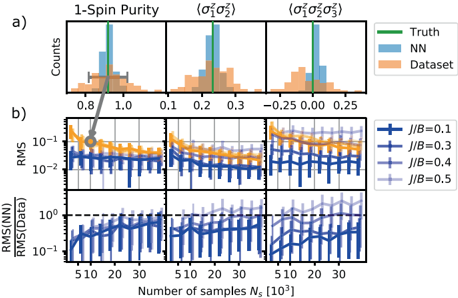
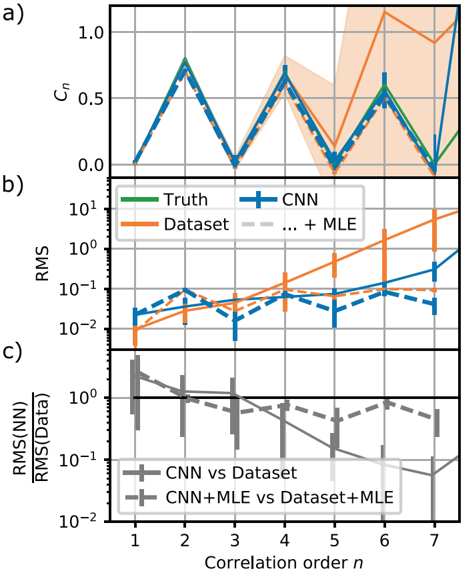
“(9), b residual RMS error, c residual network RMS normalized to dataset RMS.”
BackgroundMethodInfluentialOptimal, reliable estimation of quantum states
Blume-Kohout, R. (2010) · New Journal of Physics · doi:10.1088/1367-2630/12/4/043034 · Cited by 393
Fuchs, C. A., & Schack, R. (2013) · Reviews of Modern Physics · doi:10.1103/revmodphys.85.1693 · Cited by 321 · cited 1×
“We finally point out, that the positivity condition on the density matrix is not known to easily translate into the POVM formalism, without introducing exponential scaling [43].”
BackgroundReconstructing quantum states with generative models
Carrasquilla, J., Torlai, G., Melko, R. G., & Aolita, L. (2019) · Nature Machine Intelligence · doi:10.1038/s42256-019-0028-1 · Cited by 317 · cited 7×
“In the following we briefly summarize the employed learning rule and the POVM formalism, and direct to [25], as well as [33, 40, 41] for further details on NQS in combination with POVMs.”
BackgroundMethodInfluentialIterative maximum-likelihood reconstruction in quantum homodyne tomography
Lvovsky, A. I. (2004) · Journal of Optics B: Quantum and Semiclassical Optics · doi:10.1088/1464-4266/6/6/014 · Cited by 304 · cited 4×
“parametrizing the full density matrix and maximizing the likelihood of this reproducing the dataset, as it presents the go-to choice for many small scale qubit systems and is commonly used in experiments [3, 48], as well as direct estimation of observables from the dataset.”
BackgroundMethodInfluentialJUWELS: Modular Tier-0/1 Supercomputer at the Jülich Supercomputing Centre
Krause, D. (2019) · Journal of large-scale research facilities JLSRF · doi:10.17815/jlsrf-5-171 · Cited by 271
Deep Autoregressive Models for the Efficient Variational Simulation of Many-Body Quantum Systems
Sharir, O., Levine, Y., Wies, N., Carleo, G., & Shashua, A. (2020) · Physical Review Letters · doi:10.1103/physrevlett.124.020503 · Cited by 256 · cited 10×
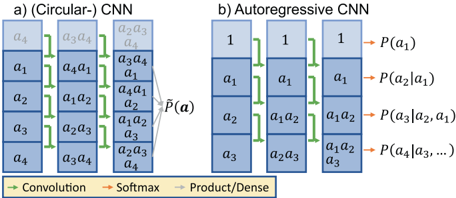
“The second architecture is a 1D autoregressive CNN (ARCNN) [46, 47], illustrated in Fig.”
BackgroundInfluentialEfficient tomography of a quantum many-body system
Lanyon, B. P., Maier, C., Holzäpfel, M., Baumgratz, T., Hempel, C., Jurcevic, P., Dhand, I., Buyskikh, A. S., Daley, A. J., Cramer, M., et al. (2017) · Nature Physics · doi:10.1038/nphys4244 · Cited by 244
Permutationally Invariant Quantum Tomography
Tóth, G., Wieczorek, W., Gross, D., Krischek, R., Schwemmer, C., & Weinfurter, H. (2010) · Physical Review Letters · doi:10.1103/physrevlett.105.250403 · Cited by 234 · cited 1×
“restricts its search space to weakly entangled states; compressed sensing (CS) [12–14], which restricts to low-rank density matrices, and permutationally invariant (PI) tomography [15, 16], which restricts to PI states.”
BackgroundQuantum Entanglement in Deep Learning Architectures
Levine, Y., Sharir, O., Cohen, N., & Shashua, A. (2019) · Physical Review Letters · doi:10.1103/physrevlett.122.065301 · Cited by 206 · cited 9×
“To better explain the obtained parameter counts for the neural networks, we briefly explain the convolution operation in more detail, which the CNNs perform iteratively (here shown for the 1D case).”
BackgroundMethodInfluentialDomain-wall confinement and dynamics in a quantum simulator
Tan, W. L., Becker, P., Liu, F., Pagano, G., Collins, K. S., De, A., Feng, L., Kaplan, H., Kyprianidis, A., Lundgren, R., et al. (2021) · Nature Physics · doi:10.1038/s41567-021-01194-3 · Cited by 178 · cited 1×
“For a more experimentally motivated [49] example, we look at ground states |ψ0〉 of a 16-site, long-range interacting ion chain Hamiltonian”
BackgroundExperimental neural network enhanced quantum tomography
Palmieri, A. M., Kovlakov, E., Bianchi, F., Yudin, D., Straupe, S., Biamonte, J. D., & Kulik, S. (2020) · npj Quantum Information · doi:10.1038/s41534-020-0248-6 · Cited by 174
Quantum State Tomography with Conditional Generative Adversarial Networks
Ahmed, S., Sánchez Muñoz, C., Nori, F., & Kockum, A. F. (2021) · Physical Review Letters · doi:10.1103/physrevlett.127.140502 · Cited by 164
Experimental quantum compressed sensing for a seven-qubit system
Riofrío, C. A., Gross, D., Flammia, S. T., Monz, T., Nigg, D., Blatt, R., & Eisert, J. (2017) · Nature Communications · doi:10.1038/ncomms15305 · Cited by 151
Adaptive quantum state tomography with neural networks
Quek, Y., Fort, S., & Ng, H. K. (2021) · npj Quantum Information · doi:10.1038/s41534-021-00436-9 · Cited by 150
Integrating Neural Networks with a Quantum Simulator for State Reconstruction
Torlai, G., Timar, B., van Nieuwenburg, E. P. L., Levine, H., Omran, A., Keesling, A., Bernien, H., Greiner, M., Vuletić, V., Lukin, M. D., et al. (2019) · Physical Review Letters · doi:10.1103/physrevlett.123.230504 · Cited by 143
Latent Space Purification via Neural Density Operators
Torlai, G., & Melko, R. G. (2018) · Physical Review Letters · doi:10.1103/physrevlett.120.240503 · Cited by 141 · cited 1×
“While RBM purifications [44] are one means of”
BackgroundNeural tensor contractions and the expressive power of deep neural quantum states
Sharir, O., Shashua, A., & Carleo, G. (2022) · Physical review. B./Physical review. B · doi:10.1103/physrevb.106.205136 · Cited by 137 · cited 2×
“Motivations for using this architecture are its established representational power when operating on pure states [24, 39], the ability to represent 1D and 2D states, as well as the ability to encode symmetries such as translation invariance without increasing the computational complexity.”
BackgroundMethodSuperfast maximum-likelihood reconstruction for quantum tomography
Shang, J., Zhang, Z., & Ng, H. K. (2017) · Physical Review A · doi:10.1103/physreva.95.062336 · Cited by 129
Measurement-Based Quantum Computation with Trapped Ions
Lanyon, B. P., Jurcevic, P., Zwerger, M., Hempel, C., Martinez, E. A., Dür, W., Briegel, H. J., Blatt, R., & Roos, C. F. (2013) · Physical Review Letters · doi:10.1103/physrevlett.111.210501 · Cited by 120 · cited 1×
“parametrizing the full density matrix and maximizing the likelihood of this reproducing the dataset, as it presents the go-to choice for many small scale qubit systems and is commonly used in experiments [3, 48], as well as direct estimation of observables from the dataset.”
MethodPermutationally invariant state reconstruction
Moroder, T., Hyllus, P., Tóth, G., Schwemmer, C., Niggebaum, A., Gaile, S., Gühne, O., & Weinfurter, H. (2012) · New Journal of Physics · doi:10.1088/1367-2630/14/10/105001 · Cited by 118 · cited 1×
“restricts its search space to weakly entangled states; compressed sensing (CS) [12–14], which restricts to low-rank density matrices, and permutationally invariant (PI) tomography [15, 16], which restricts to PI states.”
BackgroundScalable Reconstruction of Density Matrices
Baumgratz, T., Gross, D., Cramer, M., & Plenio, M. B. (2013) · Physical Review Letters · doi:10.1103/physrevlett.111.020401 · Cited by 118
Attention-based quantum tomography
Cha, P., Ginsparg, P., Wu, F., Carrasquilla, J., McMahon, P. L., & Kim, E.-A. (2021) · Machine Learning Science and Technology · doi:10.1088/2632-2153/ac362b · Cited by 116 · cited 3×
“Other network architectures that also make use of this property include recurrent neural networks [25] and Transformers [27].”
BackgroundMethodMachine-Learning Quantum States in the NISQ Era
Torlai, G., & Melko, R. G. (2020) · Annual Review of Condensed Matter Physics · doi:10.1146/annurev-conmatphys-031119-050651 · Cited by 103 · cited 1×
“no exponentially large state representations and makes no assumption on the target state’s purity, generalizing previous approaches [18, 19].”
BackgroundExperimental Estimation of Quantum State Properties from Classical Shadows
Struchalin, G. I., Zagorovskii, Y. A., Kovlakov, E. V., Straupe, S. S., & Kulik, S. P. (2021) · PRX Quantum · doi:10.1103/prxquantum.2.010307 · Cited by 94 · cited 2×
“tection schemes [5, 6] as well as shadow tomography [7, 8] give up on requirement (iii).”
BackgroundExperimental Comparison of Efficient Tomography Schemes for a Six-Qubit State
Schwemmer, C., Tóth, G., Niggebaum, A., Moroder, T., Gross, D., Gühne, O., & Weinfurter, H. (2014) · Physical Review Letters · doi:10.1103/physrevlett.113.040503 · Cited by 89 · cited 2×
“(13) a periodic boundary condition implies that xi+j wraps around to x0 when i+ j reaches the length of x.”
BackgroundPhase diagram of the dissipative quantum Ising model on a square lattice
Jin, J., Biella, A., Viyuela, O., Ciuti, C., Fazio, R., & Rossini, D. (2018) · Physical review. B./Physical review. B · doi:10.1103/physrevb.98.241108 · Cited by 81 · cited 2×
“[51], with potential applications to Rydberg systems.”
BackgroundNeural-network quantum state tomography in a two-qubit experiment
Neugebauer, M., Fischer, L. E., Jäger, A., Czischek, S., Jochim, S., Weidemüller, M., & Gärttner, M. (2020) · Physical Review A · doi:10.1103/physreva.102.042604 · Cited by 81 · cited 2×
“While this scheme has been demonstrated for specific classes of states and network architectures [25], applications to experimental systems have not exceeded the few qubit regime [27, 33].”
MethodSelf-citationPrecise measurement of quantum observables with neural-network estimators
Torlai, G., Mazzola, G., Carleo, G., & Mezzacapo, A. (2020) · Physical Review Research · doi:10.1103/physrevresearch.2.022060 · Cited by 80
Entanglement classification via neural network quantum states
Harney, C., Pirandola, S., Ferraro, A., & Paternostro, M. (2020) · New Journal of Physics · doi:10.1088/1367-2630/ab783d · Cited by 79 · cited 1×
“tection schemes [5, 6] as well as shadow tomography [7, 8] give up on requirement (iii).”
BackgroundNeural Network Representation of Tensor Network and Chiral States
Huang, Y., & Moore, J. E. (2021) · Physical Review Letters · doi:10.1103/physrevlett.127.170601 · Cited by 68
Experimental quantum homodyne tomography via machine learning
Tiunov, E. S., Tiunova (Vyborova), V. V., Ulanov, A. E., Lvovsky, A. I., & Fedorov, A. K. (2020) · Optica · doi:10.1364/optica.389482 · Cited by 68
Time-Dependent Variational Principle for Open Quantum Systems with Artificial Neural Networks
Reh, M., Schmitt, M., & Gärttner, M. (2021) · Physical Review Letters · doi:10.1103/physrevlett.127.230501 · Cited by 56 · cited 1×
“In the following we briefly summarize the employed learning rule and the POVM formalism, and direct to [25], as well as [33, 40, 41] for further details on NQS in combination with POVMs.”
MethodSelf-citationProbabilistic simulation of quantum circuits using a deep-learning architecture
Carrasquilla, J., Luo, D., Pérez, F., Milsted, A., Clark, B. K., Volkovs, M., & Aolita, L. (2021) · Physical Review A · doi:10.1103/physreva.104.032610 · Cited by 53 · cited 1×
“In the following we briefly summarize the employed learning rule and the POVM formalism, and direct to [25], as well as [33, 40, 41] for further details on NQS in combination with POVMs.”
MethodScaling of Neural‐Network Quantum States for Time Evolution
Lin, S.-H., & Pollmann, F. (2022) · physica status solidi (b) · doi:10.1002/pssb.202100172 · Cited by 51 · cited 10×
“The second architecture is a 1D autoregressive CNN (ARCNN) [46, 47], illustrated in Fig.”
BackgroundInfluentialEigenstate extraction with neural-network tomography
Melkani, A., Gneiting, C., & Nori, F. (2020) · Physical Review A · doi:10.1103/physreva.102.022412 · Cited by 45
Efficient Quantum State Sample Tomography with Basis-Dependent Neural Networks
Smith, A. W. R., Gray, J., & Kim, M. S. (2021) · PRX Quantum · doi:10.1103/prxquantum.2.020348 · Cited by 40
Mixed state entanglement classification using artificial neural networks
Harney, C., Paternostro, M., & Pirandola, S. (2021) · New Journal of Physics · doi:10.1088/1367-2630/ac0388 · Cited by 30 · cited 1×
“tection schemes [5, 6] as well as shadow tomography [7, 8] give up on requirement (iii).”
BackgroundOptimized observable readout from single-shot images of ultracold atoms via machine learning
Lode, A. U. J., Lin, R., Büttner, M., Papariello, L., Lévêque, C., Chitra, R., Tsatsos, M. C., Jaksch, D., & Molignini, P. (2021) · Physical Review A · doi:10.1103/physreva.104.l041301 · Cited by 27
Research works printed but not linked: 4
- Deng, D.-L., Li, X. & Das Sarma, S. Quantum entanglement in neural network states. Phys. Rev. X 7, 021021 (2017).
- Huang, H. & Situ, H. Investigating reconstruction of quantum state distributions with neural networks. Eur. Phys. J. 136, 204 (2021).
- Lohani, S., Kirby, B. T., Brodsky, M., Danaci, O. & Glasser, R. T. Machine learning assisted quantum state estimation. Mach. Learn.: Sci. Technol. 1, 035007 (2020).
- Kingma, D. P. & Ba, J. Adam: A method for stochastic optimization. arXiv:1412.6980. http://arxiv.org/abs/1412.6980 (2017). · arXiv
Cited by
From architectures to applications: a review of neural quantum states
Lange, H., de Walle, A. V., Abedinnia, A., & Bohrdt, A. (2024) · Quantum Science and Technology · doi:10.1088/2058-9565/ad7168 · Cited by 185
Modern applications of machine learning in quantum sciencesPreprint
Dawid, A., Arnold, J., Requena, B., Gresch, A., Płodzień, M., Donatella, K., Nicoli, K. A., Stornati, P., Koch, R., Büttner, M., et al. (2022) · arXiv (Cornell University) · doi:10.48550/arxiv.2204.04198 · Cited by 181
Beyond-classical computation in quantum simulation
King, A. D., Nocera, A., Rams, M. M., Dziarmaga, J., Wiersema, R., Bernoudy, W., Raymond, J., Kaushal, N., Heinsdorf, N., Harris, R., et al. (2025) · Science · doi:10.1126/science.ado6285 · Cited by 138
Artificial intelligence for quantum computing
Alexeev, Y., Farag, M. H., Patti, T. L., Wolf, M. E., Ares, N., Aspuru‐Guzik, A., Benjamin, S. C., Cai, Z., Cao, S., Chamberland, C., et al. (2025) · Nature Communications · doi:10.1038/s41467-025-65836-3 · Cited by 140
“But these limitations are solvable and present an important direction for further investigation.”
Variational Monte Carlo with large patched transformers
Sprague, K., & Czischek, S. (2024) · Communications Physics · doi:10.1038/s42005-024-01584-y · Cited by 74
Metadata
- Authors
- Schmale, T., Reh, M., & Gärttner, M.
- Affiliations
- Heidelberg University (DE)
- Corresponding author
- Schmale, Tobias
- Reh, Moritz
- Gärttner, Martin
- Venue
- npj Quantum Information
- Published
- 2022-09-23
- Volume
- 8
- Issue
- 1
- ISSN
- 2056-6387 (ISSN-L)
- OpenAlex
- W4296836560
- Cited by
- 76
- References
- 51
- Citations by year
- 2026: 13 · 2025: 31 · 2024: 20 · 2023: 11 · 2022: 1
- FWCI
- 5.18
- Type
- journal article
- Language
- en
- Open access
- gold
- doi.org
- Licence
- cc-by
- creativecommons.org/licenses/by/4.0 (tdm)
- creativecommons.org/licenses/by/4.0 (vor)
- Locations
- npj Quantum Information (publishedVersion, cc-by)
- arXiv (Cornell University) (submittedVersion)
- DOAJ (DOAJ: Directory of Open Access Journals) (submittedVersion, cc-by-sa)
- arXiv (Cornell University)
- Funders
- Deutsche Forschungsgemeinschaft (EXC2181/1-390900948, SFB 1225, INST 40/575-1 FUGG)
- Gauss Centre for Supercomputing e.V.
- Topics
- Physical Sciences › Computer Science › Artificial Intelligence › Quantum Computing Algorithms and Architecture
- Physical Sciences › Physics and Astronomy › Atomic and Molecular Physics, and Optics › Quantum many-body systems
- Physical Sciences › Physics and Astronomy › Atomic and Molecular Physics, and Optics › Quantum Information and Cryptography
- Keywords
- quantum state tomography, convolutional neural networks, variational ansatz, informationally complete measurements, density estimation, quantum simulators, ground state, steady state, maximum likelihood estimation
About these checks
Registry, retraction, Cites and statistics results are computed, not judged, with one exception: a printed reference that no index lists is read once by a model before it counts as a citation error. Claims are extracted by a model and kept only when their quote appears verbatim in the text; each cited source is then checked, with a model’s help, for whether it says what the claim relies on. Those verdicts can be wrong — read the claim’s quote and the cited source before relying on one.
Statistics and arithmetic are recomputed, not judged.
Confidence bands are shown only for fields calibrated on our annotated test set. None is calibrated yet, so no band is shown.
What counts as a claim ›How we measure confidence ›How we check this ›
Are you an author, or do you see a problem with this page? Request a review
Data sources
Bibliographic data: Semantic Scholar, OpenAlex, Crossref.
Contains information from the Semantic Scholar Academic Graph Datasets, made available under the ODC Attribution License (ODC-BY 1.0).
Semantic Scholar’s data is described in: Kinney, R., et al. (2023). The Semantic Scholar Open Data Platform. arXiv:2301.10140.
