

The DOI matches its Crossref record; 57 of the 57 references it cites were found in a registry or an index.
Orbital-optimized pair-correlated electron simulations on trapped-ion quantum computers
Open accessAbstract
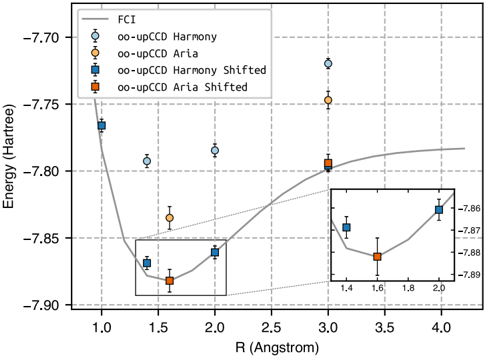
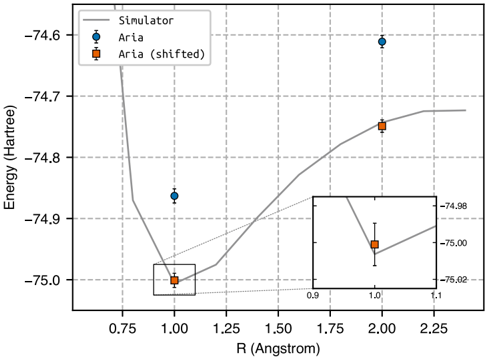
Variational quantum eigensolvers (VQE) are among the most promising approaches for solving electronic structure problems on near-term quantum computers. A critical challenge for VQE in practice is that one needs to strike a balance between the expressivity of the VQE ansatz versus the number of quantum gates required to implement the ansatz, given the reality of noisy quantum operations on near-term quantum computers. In this work, we consider an orbital-optimized pair-correlated approximation to the unitary coupled cluster with singles and doubles (uCCSD) ansatz and report a highly efficient quantum circuit implementation for trapped-ion architectures. We show that orbital optimization can recover significant additional electron correlation energy without sacrificing efficiency through measurements of low-order reduced density matrices (RDMs). In the dissociation of small molecules, the method gives qualitatively accurate predictions in the strongly-correlated regime when running on noise-free quantum simulators. On IonQ’s Harmony and Aria trapped-ion quantum computers, we run end-to-end VQE algorithms with up to 12 qubits and 72 variational parameters—the largest full VQE simulation with a correlated wave function on quantum hardware. We find that even without error mitigation techniques, the predicted relative energies across different molecular geometries are in excellent agreement with noise-free simulators.
Overview
The claims and statistics of this paper haven’t been checked yet.
Free: it reads the open-access text and checks the first 5 claims that cite a source we can check. Create a free account to check every claim.
Integrity signals
Registry
Cites
Statistics
Figures





Verification
Claims the paper makes
The claims and statistics of this paper haven’t been checked yet.
Free: it reads the open-access text and checks the first 5 claims that cite a source we can check. Create a free account to check every claim.
Self-check
Percentages, sums and reported differences re-computed from the paper’s own numbers.
The self-check needs the paper’s full text.
Citations
Cites
1 retracted
Quantum computational quantification of protein–ligand interactions
Kirsopp, J. J. M., Di Paola, C., Manrique, D. Z., Krompiec, M., Greene‐Diniz, G., Guba, W., Meyder, A., Wolf, D., Strahm, M., & Muñoz Ramo, D. (2022) · International Journal of Quantum Chemistry · doi:10.1002/qua.26975 · Cited by 59 · cited 2×
“[30] Josh JM Kirsopp, Cono Di Paola, David Zsolt Manrique, Michal Krompiec, Gabriel Greene-Diniz, Wolfgang Guba, Agnes Meyder, Detlef Wolf, Martin Strahm, and David Muñoz Ramo, “Quantum computational quantification of protein–ligand interactions,” International Journal of Quantum Chemistry 122, e26975 (2022).”
BackgroundRetractedQuantum supremacy using a programmable superconducting processor
Arute, F., Arya, K., Babbush, R., Bacon, D., Bardin, J. C., Barends, R., Biswas, R., Boixo, S., Brandao, F. G. S. L., Buell, D. A., et al. (2019) · Nature · doi:10.1038/s41586-019-1666-5 · Cited by 7,720
A variational eigenvalue solver on a photonic quantum processor
Peruzzo, A., McClean, J., Shadbolt, P., Yung, M.-H., Zhou, X.-Q., Love, P. J., Aspuru-Guzik, A., & O’Brien, J. L. (2014) · Nature Communications · doi:10.1038/ncomms5213 · Cited by 4,552 · cited 2×
“Forging [33] H2O 5 3 Yes Yes IBM 2021 HEA [3] LiH (dipole moment) 4 16 Yes Yes IBM 2021 HEA [25] TADF 2 4 Yes Yes IBM 2021 qubit CC [34] H10 2 3 No Yes IonQ 2021 HEA [35] Li2O4 model 2 4 Yes Yes IBM 2020 Hartree-Fock [14] H12 12 36 Yes Yes Google 2020 upCCD [15] H2O 3 3 Yes No IonQ 2019 HEA [24] LiH 4 20 Yes Yes IBM 2…”
BackgroundMethodThe density-matrix renormalization group
Schollwöck, U. (2005) · Reviews of Modern Physics · doi:10.1103/revmodphys.77.259 · Cited by 3,323
Hardware-efficient variational quantum eigensolver for small molecules and quantum magnets
Kandala, A., Mezzacapo, A., Temme, K., Takita, M., Brink, M., Chow, J. M., & Gambetta, J. M. (2017) · Nature · doi:10.1038/nature23879 · Cited by 2,982
P y SCF: the Python‐based simulations of chemistry framework
Sun, Q., Berkelbach, T. C., Blunt, N. S., Booth, G. H., Guo, S., Li, Z., Liu, J., McClain, J. D., Sayfutyarova, E. R., Sharma, S., et al. (2018) · WIREs Computational Molecular Science · doi:10.1002/wcms.1340 · Cited by 1,741
Quantum Chemistry in the Age of Quantum Computing
Cao, Y., Romero, J., Olson, J. P., Degroote, M., Johnson, P. D., Kieferová, M., Kivlichan, I. D., Menke, T., Peropadre, B., Sawaya, N. P. D., et al. (2019) · Chemical Reviews · doi:10.1021/acs.chemrev.8b00803 · Cited by 1,560
Simulated Quantum Computation of Molecular Energies
Aspuru-Guzik, A., Dutoi, A. D., Love, P. J., & Head-Gordon, M. (2005) · Science · doi:10.1126/science.1113479 · Cited by 1,418
Quantum Chemistry in the Age of Quantum Computing
Cao, Y., Romero, J., Olson, J., Degroote, M., Johnson, P., Kieferová, M., Kivlichan, I., Menke, T., Peropadre, B., Sawaya, N., et al. (n.d.) · OPUS - Open Publications of UTS Scholars (University of Technology Sydney) · Cited by 1,265
Scalable Quantum Simulation of Molecular Energies
O’Malley, P. J. J., Babbush, R., Kivlichan, I. D., Romero, J., McClean, J. R., Barends, R., Kelly, J., Roushan, P., Tranter, A., Ding, N., et al. (2016) · Physical Review X · doi:10.1103/physrevx.6.031007 · Cited by 1,059
Research works printed but not linked: 5
- Parr, R. G. & Yang, W. Density-Functional Theory of Atoms and Molecules (Oxford University Press, New York, 1989).
- Nielsen, M. A. & Chuang, I. L. Quantum Computation and Quantum Information (Cambridge University Press, Cambridge, 2010).
- Hempel, C. et al. Quantum Chemistry Calculations on a Trapped-Ion Quantum Computer. Phys. Rev. X 8, 031022 (2018).
- Gao, Q. et al. Applications of Quantum Computing for Investigations of Electronic Transitions in Phenylsulfonyl-carbazole TADF Emitters. npj Quant. Inf. 7, 70 (2021).
- Khan, I. et al. Chemically Aware Unitary Coupled Cluster with ab initio Calculations on System Model H1: A Refrigerant Chemicals Application. J. Comp. Phys. 158, 214114 (2023).
Cited by
Chemistry beyond the scale of exact diagonalization on a quantum-centric supercomputer
Moreno, J. R., Motta, M., Haas, H., Javadi-Abhari, A., Jurcevic, P., Kirby, W., Martiel, S., Sharma, K., Sharma, S., Shirakawa, T., et al. (2025) · Science Advances · doi:10.1126/sciadv.adu9991 · Cited by 430
Experimental quantum computational chemistry with optimized unitary coupled cluster ansatz
Guo, S., Sun, J., Qian, H., Gong, M., Zhang, Y., Chen, F., Ye, Y., Wu, Y., Cao, S., Liu, K., et al. (2024) · Nature Physics · doi:10.1038/s41567-024-02530-z · Cited by 115
Quantum support vector machines for classification and regression on a trapped-ion quantum computer
Suzuki, T., Hasebe, T., & Miyazaki, T. (2024) · Quantum Machine Intelligence · doi:10.1007/s42484-024-00165-0 · Cited by 91
Feniou, C., Hassan, M., Traoré, D., Giner, E., Maday, Y., & Piquemal, J. (2023) · Communications Physics · doi:10.1038/s42005-023-01312-y · Cited by 77
Motta, M., Sung, K. J., Whaley, K. B., Head‐Gordon, M., & Shee, J. (2023) · Chemical Science · doi:10.1039/d3sc02516k · Cited by 139
Metadata
- Authors
- Zhao, L., Goings, J., Shin, K., Kyoung, W., Fuks, J. I., Kevin Rhee, J.-K., Rhee, Y. M., Wright, K., Nguyen, J., Kim, J., & Johri, S.
- Affiliations
- IonQ (United States) (US)
- Hyundai Motors (South Korea) (KR)
- Korea Advanced Institute of Science and Technology (KR)
- Corresponding author
- Zhao, Luning
- Shin, Kyujin
- ORCID
- Venue
- npj Quantum Information
- Published
- 2023-06-23
- Volume
- 9
- Issue
- 1
- ISSN
- 2056-6387 (ISSN-L)
- OpenAlex
- W4381803783
- Cited by
- 73
- References
- 54
- Citations by year
- 2026: 13 · 2025: 21 · 2024: 33 · 2023: 6
- FWCI
- 6.88
- Type
- journal article
- Language
- en
- Open access
- gold
- doi.org
- Licence
- cc-by
- creativecommons.org/licenses/by/4.0 (tdm)
- creativecommons.org/licenses/by/4.0 (vor)
- Locations
- npj Quantum Information (publishedVersion, cc-by)
- arXiv (Cornell University) (submittedVersion)
- DOAJ (DOAJ: Directory of Open Access Journals) (submittedVersion, cc-by-sa)
- arXiv (Cornell University) (cc-by)
- Funders
- Hyundai Motor Group
- Topics
- Physical Sciences › Computer Science › Artificial Intelligence › Quantum Computing Algorithms and Architecture
- Physical Sciences › Physics and Astronomy › Atomic and Molecular Physics, and Optics › Advanced Chemical Physics Studies
- Physical Sciences › Physics and Astronomy › Atomic and Molecular Physics, and Optics › Quantum many-body systems
- Keywords
- variational quantum eigensolver, orbital optimization, trapped-ion quantum computer, reduced density matrix, electron correlation energy, molecular dissociation, strongly correlated molecules, quantum circuit implementation, IonQ
About these checks
Registry, retraction, Cites and statistics results are computed, not judged, with one exception: a printed reference that no index lists is read once by a model before it counts as a citation error. Claims are extracted by a model and kept only when their quote appears verbatim in the text; each cited source is then checked, with a model’s help, for whether it says what the claim relies on. Those verdicts can be wrong — read the claim’s quote and the cited source before relying on one.
Statistics and arithmetic are recomputed, not judged.
Confidence bands are shown only for fields calibrated on our annotated test set. None is calibrated yet, so no band is shown.
What counts as a claim ›How we measure confidence ›How we check this ›
Are you an author, or do you see a problem with this page? Request a review
How to cite
Cite CoChat for the checks on this page, and the paper for its own findings.
- This page
- CoChat. (2026). Citation check: Orbital-optimized pair-correlated electron simulations on trapped-ion quantum computers. https://app.cochat.ai/papers/10.1038/s41534-023-00730-8
- The paper
- Zhao, L., Goings, J., Shin, K., Kyoung, W., Fuks, J. I., Kevin Rhee, J.-K., Rhee, Y. M., Wright, K., Nguyen, J., Kim, J., & Johri, S. (2023). Orbital-optimized pair-correlated electron simulations on trapped-ion quantum computers. npj Quantum Information. https://doi.org/10.1038/s41534-023-00730-8
Data sources
Bibliographic data: Semantic Scholar, OpenAlex, Crossref.
Contains information from the Semantic Scholar Academic Graph Datasets, made available under the ODC Attribution License (ODC-BY 1.0).
Semantic Scholar’s data is described in: Kinney, R., et al. (2023). The Semantic Scholar Open Data Platform. arXiv:2301.10140.
