

Spatial and temporal boundaries of NMDA receptor hypofunction leading to schizophrenia
Open accessThe DOI matches its Crossref record; 147 of the 147 references it cites were found in a registry or an index.
Abstract
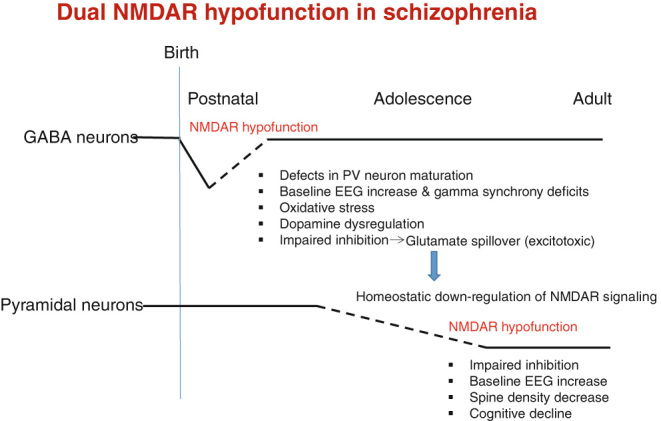
The N -methyl- d -aspartate receptor hypofunction is one of the most prevalent models of schizophrenia. For example, healthy subjects treated with uncompetitive N -methyl- d -aspartate receptor antagonists elicit positive, negative, and cognitive-like symptoms of schizophrenia. Patients with anti- N -methyl- d -aspartate receptor encephalitis, which is likely caused by autoantibody-mediated down-regulation of cell surface N -methyl- d -aspartate receptors, often experience psychiatric symptoms similar to schizophrenia initially. However, where and when N -methyl- d -aspartate receptor hypofunction occurs in the brain of schizophrenic patients is poorly understood. Here we review the findings from N -methyl- d- aspartate receptor antagonist and autoantibody models, postmortem studies on N -methyl- d -aspartate receptor subunits, as well as the global and cell-type-specific knockout mouse models of subunit GluN1. We compare various conditional GluN1 knockout mouse strains, focusing on the onset of N -methyl- d -aspartate receptor deletion and on the cortical cell-types. Based on these results, we hypothesize that N -methyl- d -aspartate receptor hypofunction initially occurs in cortical GABAergic neurons during early postnatal development. The resulting GABA neuron maturation deficit may cause reduction of intrinsic excitability and GABA release, leading to disinhibition of pyramidal neurons. The cortical disinhibition in turn could elicit glutamate spillover and subsequent homeostatic down regulation of N -methyl- d -aspartate receptor function in pyramidal neurons in prodromal stage. These two temporally-distinct N -methyl- d -aspartate receptor hypofunctions may be complimentary, as neither alone may not be able to fully explain the entire schizophrenia pathophysiology. Potential underlying mechanisms for N -methyl- d -aspartate receptor hypofunction in cortical GABA neurons are also discussed, based on studies of naturally-occurring N -methyl- d -aspartate receptor antagonists, neuregulin/ErbB4 signaling pathway, and theoretical analysis of excitatory/inhibitory balance.
Overview
The claims and statistics of this paper haven’t been checked yet.
Free: it reads the open-access text and checks the first 5 claims that cite a source we can check. Create a free account to check every claim.
Integrity signals
Registry
Cites
Statistics
Figures
Verification
Claims the paper makes
The claims and statistics of this paper haven’t been checked yet.
Free: it reads the open-access text and checks the first 5 claims that cite a source we can check. Create a free account to check every claim.
Claims other papers make about this one
Each is checked against this paper’s own text: does it say what the citing paper says it does?
The source backs part of the claim, not all of it — or backs it for a different population, condition or comparison.
In the citing paper
“It has thus been postulated that the NMDA hypofunction in SZ mainly occurs in cortical GABAergic interneurons 165.”
From Mechanisms of synaptic transmission dysregulation in the prefrontal cortex: pathophysiological implications (2022) · cites this paper as [165]
Experimental — accuracy not yet measuredIn the citing paper
“There is strong support for NMDA hypofunction in SZ, as treatment with NMDAR antagonists, such as MK-801 or phencyclidine, can induce SZ-like symptoms in both human subjects 165 and in animals 166.”
From Mechanisms of synaptic transmission dysregulation in the prefrontal cortex: pathophysiological implications (2022) · cites this paper as [165]
Self-check
Percentages, sums and reported differences re-computed from the paper’s own numbers.
The self-check needs the paper’s full text.
Citations
Cites
Biological insights from 108 schizophrenia-associated genetic loci
Schizophrenia Working Group of the Psychiatric Genomics Consortium (2014) · Nature · doi:10.1038/nature13595 · Cited by 7,577
Anti-NMDA-receptor encephalitis: case series and analysis of the effects of antibodies
Dalmau, J., Gleichman, A. J., Hughes, E. G., Rossi, J. E., Peng, X., Lai, M., Dessain, S. K., Rosenfeld, M. R., Balice-Gordon, R., & Lynch, D. R. (2008) · The Lancet Neurology · doi:10.1016/s1474-4422(08)70224-2 · Cited by 3,488
Titulaer, M. J., McCracken, L., Gabilondo, I., Armangué, T., Glaser, C., Iizuka, T., Honig, L. S., Benseler, S. M., Kawachi, I., Martinez-Hernandez, E., et al. (2013) · The Lancet Neurology · doi:10.1016/s1474-4422(12)70310-1 · Cited by 3,165
The Dopamine Hypothesis of Schizophrenia: Version III--The Final Common Pathway
Howes, O. D., & Kapur, S. (2009) · Schizophrenia Bulletin · doi:10.1093/schbul/sbp006 · Cited by 2,693
Parvalbumin neurons and gamma rhythms enhance cortical circuit performance
Sohal, V. S., Zhang, F., Yizhar, O., & Deisseroth, K. (2009) · Nature · doi:10.1038/nature07991 · Cited by 2,606 · cited 1×
“More importantly, induction of gamma oscillation driven by PV neuron-selective optogenetic activation was impaired in the mutants,(112) which strongly supports the idea that PV neuron is necessary for generation of gamma-band oscillations.(113,114) Notably, baseline gamma power increase and sensory-evoked gamma oscill…”
Driving fast-spiking cells induces gamma rhythm and controls sensory responses
Cardin, J. A., Carlén, M., Meletis, K., Knoblich, U., Zhang, F., Deisseroth, K., Tsai, L.-H., & Moore, C. I. (2009) · Nature · doi:10.1038/nature08002 · Cited by 2,603 · cited 1×
“More importantly, induction of gamma oscillation driven by PV neuron-selective optogenetic activation was impaired in the mutants,(112) which strongly supports the idea that PV neuron is necessary for generation of gamma-band oscillations.(113,114) Notably, baseline gamma power increase and sensory-evoked gamma oscill…”
Clinical experience and laboratory investigations in patients with anti-NMDAR encephalitis
Dalmau, J., Lancaster, E., Martinez-Hernandez, E., Rosenfeld, M. R., & Balice-Gordon, R. (2011) · The Lancet Neurology · doi:10.1016/s1474-4422(10)70253-2 · Cited by 2,435 · cited 1×
“Clinical expression of this disease consists of a variable presentation of psychiatric symptoms such as hallucinations, delusions, mania, catatonia, and insomnia days after the prodromal phase.(38) About 65% of adults first present with psychiatric symptoms and the majority are initially assessed by the psychiatric se…”
BackgroundThe essential role of hippocampal CA1 NMDA receptor-dependent synaptic plasticity in spatial memory.
Tsien, J. Z., Huerta, P. T., & Tonegawa, S. (1996) · Cell · doi:10.1016/s0092-8674(00)81827-9 · Cited by 1,782 · cited 2×
“Spatial reference memory in Morris water maze test is intact in PV-cre/GluN1 KO mice(112) but is severely impaired in αCaMKII promoter-driven GluN1 knockout mice.(101) It is plausible that cognitive decline observed in a subtype of chronic patients may be explained by NMDAR hypofunction in cortical pyramidal neurons.”
BackgroundMethodJentsch, J. (1999) · Neuropsychopharmacology · doi:10.1016/s0893-133x(98)00060-8 · Cited by 1,314
Gresa-Arribas, N., Titulaer, M. J., Torrents, A., Aguilar, E., McCracken, L., Leypoldt, F., Gleichman, A. J., Balice-Gordon, R., Rosenfeld, M. R., Lynch, D., et al. (2014) · The Lancet Neurology · doi:10.1016/s1474-4422(13)70282-5 · Cited by 1,306
Cited by
Yan, Z., & Rein, B. (2022) · Molecular Psychiatry · doi:10.1038/s41380-021-01092-3 · Cited by 300
“There is strong support for NMDA hypofunction in SZ, as treatment with NMDAR antagonists, such as MK-801 or phencyclidine, can induce SZ-like symptoms in both human subjects [165] and in animals [166].”
BackgroundThe origin of NMDA receptor hypofunction in schizophrenia
Nakazawa, K., & Sapkota, K. (2020) · Pharmacology & Therapeutics · doi:10.1016/j.pharmthera.2019.107426 · Cited by 275
Self-citationNMDA receptor functions in health and disease: Old actor, new dimensions
Dupuis, J. P., Nicole, O., & Groc, L. (2023) · Neuron · doi:10.1016/j.neuron.2023.05.002 · Cited by 172
NMDAR Hypofunction Animal Models of Schizophrenia
Lee, G., & Zhou, Y. (2019) · Frontiers in Molecular Neuroscience · doi:10.3389/fnmol.2019.00185 · Cited by 160
“, 2005), suggesting that hyper-glutamatergia in the PFC may require MK-801’s effects in other brain regions such as the hippocampus (Jodo, 2013; Nakazawa et al., 2017).”
BackgroundStructural insights into the functional roles of 14-3-3 proteins
Obsilova, V., & Obsil, T. (2022) · Frontiers in Molecular Biosciences · doi:10.3389/fmolb.2022.1016071 · Cited by 126
“These studies have suggested that stabilizing the interaction between NMDARs and 14-3-3 proteins may be an efficient therapeutic approach because NMDAR hypofunction triggers symptoms of schizophrenia and its associated behaviors (reviewed in (Nakazawa et al., 2017)).”
BackgroundGlutamate in schizophrenia: Neurodevelopmental perspectives and drug development.
Egerton, A., Grace, A., Stone, J., Bossong, M., Sand, M., & Mcguire, P. (2020) · Schizophrenia Research · doi:10.1016/j.schres.2020.09.013 · Cited by 101
Advantages and Limitations of Animal Schizophrenia Models
Białoń, M., & Wąsik, A. (2022) · International Journal of Molecular Sciences · doi:10.3390/ijms23115968 · Cited by 113
“Pharmacological animal models of schizophrenia seem to be the most popular and are based on the hyperactivity of DAergic brain pathways, primarily midbrain DA projections to limbic regions [9,10], or the hypofunction of the N-methyl-D-aspartate (NMDA) receptor, which is expressed in most cells in the central nervous s…”
BackgroundNMDA receptor hypofunction for schizophrenia revisited: perspectives from epigenetic mechanisms
Snyder, M. A., & Gao, W. (2019) · Schizophrenia Research · doi:10.1016/j.schres.2019.03.010 · Cited by 80
“Although it remains unclear what changes induce the onset of cognitive dysfunction, NMDAR hypofunction appears to be a convergence point for progression and symptoms of SZ, especially for cognitive deficits (Cohen et al., 2015; Coyle, 2006; Lisman et al., 2008; Marek, 2010; Moghaddam, 2003; Nakazawa et al., 2017; Snyd…”
BackgroundStein, H., Barbosa, J., Rosa-Justícia, M., Prades, L., Morató, A., Galan-Gadea, A., Ariño, H., Martínez‐Hernández, E., Castro‐Fornieles, J., Dalmau, J. O., et al. (2020) · Nature Communications · doi:10.1038/s41467-020-18033-3 · Cited by 96
Gao, W., Yang, S.-S., Mack, N. R., & Chamberlin, L. A. (2021) · Molecular Psychiatry · doi:10.1038/s41380-021-01196-w · Cited by 72
Electrophysiological evidence for abnormal glutamate-GABA association following psychosis onset
Koshiyama, D., Kirihara, K., Tada, M., Nagai, T., Fujioka, M., Ichikawa, E., Ohta, K., Tani, M., Tsuchiya, M., Kanehara, A., et al. (2018) · Translational Psychiatry · doi:10.1038/s41398-018-0261-0 · Cited by 73
Johansson, E. M., Bouchet, D., Tamouza, R., Ellul, P., Morr, A., Avignone, E., Germi, R., Leboyer, M., Perron, H., & Groc, L. (2020) · Science Advances · doi:10.1126/sciadv.abc0708 · Cited by 73
Rosch, R. E., Auksztulewicz, R., Leung, P. D., Friston, K. J., & Baldeweg, T. (2019) · Biological Psychiatry: Cognitive Neuroscience and Neuroimaging · doi:10.1016/j.bpsc.2018.07.003 · Cited by 56
NMDA-receptor antibodies alter cortical microcircuit dynamics
Rosch, R. E., Wright, S. K., Cooray, G., Papadopoulou, M., Goyal, S., Lim, M. J., Vincent, A. C., Upton, A. L., Baldeweg, T., & Friston, K. J. (2018) · Proceedings of the National Academy of Sciences · doi:10.1073/pnas.1804846115 · Cited by 55
“NMDAR hypofunction is also a hallmark of psychiatric conditions such as schizophrenia and acute psychosis (10, 11) whose clinical features resemble the neuropsychiatric symptoms also seen in early NMDAR-Ab encephalitis.”
BackgroundAlonso-Sánchez, M. F., Limongi, R., Gati, J. S., & Palaniyappan, L. K. (2022) · Schizophrenia Research · doi:10.1016/j.schres.2022.04.007 · Cited by 55
Schizophrenia-Like Dopamine Release Abnormalities in a Mouse Model of NMDA Receptor Hypofunction
Nakao, K., Jeevakumar, V., Jiang, S. Z., Fujita, Y., Diaz, N. B., Annan, C. A. P., Jaunarajs, K. L. E., Hashimoto, K., Belforte, J. E., & Nakazawa, K. (2018) · Schizophrenia Bulletin · doi:10.1093/schbul/sby003 · Cited by 45
Self-citationFachim, H., Loureiro, C. M., Zuelli, F. M. D. G. C., Shuhama, R., Louzada‐Júnior, P., Menezes, P. R., Dalton, C., Del‐Ben, C. M., & Reynolds, G. P. (2019) · Epigenomics · doi:10.2217/epi-2018-0127 · Cited by 47
Léger, C., Dupré, N., Aligny, C., Bénard, M., Lebon, A., Henry, V., Hauchecorne, M., Galas, L., Frébourg, T., Leroux, P., et al. (2019) · Cellular and Molecular Life Sciences · doi:10.1007/s00018-019-03248-5 · Cited by 49
Pafundo, D. E., Miyamae, T., Lewis, D. A., & González‐Burgos, G. (2018) · Biological Psychiatry · doi:10.1016/j.biopsych.2018.01.018 · Cited by 40
Nawwar, D. A., Zaki, H. F., & Sayed, R. H. (2021) · Inflammopharmacology · doi:10.1007/s10787-022-01031-w · Cited by 43
Structural basis of subtype-selective competitive antagonism for GluN2C/2D-containing NMDA receptors
Wang, J. X., Irvine, M. W., Burnell, E. S., Sapkota, K., Thatcher, R. J., Li, M., Simorowski, N., Volianskis, A., Collingridge, G. L., Monaghan, D. T., et al. (2020) · Nature Communications · doi:10.1038/s41467-020-14321-0 · Cited by 37
Yohn, S. E., Harvey, P. D., Brannan, S. K., & Horan, W. P. (2024) · Frontiers in Psychiatry · doi:10.3389/fpsyt.2024.1421554 · Cited by 41
“NMDA receptor hypofunction is a convergence point for the development and diverse symptoms of schizophrenia, especially cognitive de fi cits (43, 44).”
BackgroundYang, H., Zhang, M., Shi, J., Zhou, Y., Wan, Z., Wang, Y., Wan, Y.-H., Li, J., Wang, Z., & Fei, J. (2017) · Neural Plasticity · doi:10.1155/2017/4526417 · Cited by 36
“The hypofunction of postsynaptic NMDAR on inhibitory neurons that leads to disinhibition of glutamate transmission and glutamate excitotoxicity has formed the bedrock of the glutamate hypothesis of SZ.”
BackgroundUttl, L., Petrásek, T., Sengül, H., Svojanovská, M., Lobellová, V., Valeš, K., Radostová, D., Tsenov, G., Kubová, H., Mikulecká, A., et al. (2018) · Frontiers in Pharmacology · doi:10.3389/fphar.2018.00042 · Cited by 34
Bygrave, A. M., Kilonzo, K., Kullmann, D. M., Bannerman, D. M., & Kätzel, D. (2019) · Frontiers in Psychiatry · doi:10.3389/fpsyt.2019.00835 · Cited by 43
Alvarez, R. J., Pafundo, D. E., Zold, C. L., & Belforte, J. E. (2020) · Journal of Neuroscience · doi:10.1523/jneurosci.1897-19.2020 · Cited by 33
“However, evidence linking NMDAR hypofunction to GABAergic interneurons is still limited (Nakazawa et al., 2017).”
BackgroundExtrasynaptic NMDA Receptors Bidirectionally Modulate Intrinsic Excitability of Inhibitory Neurons
Yao, L., Rong, Y., Ma, X., Li, H., Deng, D., Chen, Y., Yang, S., Peng, T., Ye, T., Liang, F., et al. (2022) · Journal of Neuroscience · doi:10.1523/jneurosci.2065-21.2022 · Cited by 32
Murueta‐Goyena, A., Morera‐Herreras, T., Miguélez, C., Gutiérrez-Ceballos, A., Ugedo, L., Lafuente, J. V., & Bengoetxea, H. (2019) · European Neuropsychopharmacology · doi:10.1016/j.euroneuro.2019.03.009 · Cited by 29
Neural and neuronal discoordination in schizophrenia: from ensembles through networks to symptoms
Krajcovic, B., Fajnerova, I., Horacek, J., Kelemen, E., Kubik, S., Svoboda, J., & Stuchlik, A. (2019) · Acta Physiologica · doi:10.1111/apha.13282 · Cited by 29
Connectome development and a novel extension to the neurodevelopmental model of schizophrenia
Collin, G., & Keshavan, M. S. (2018) · Dialogues in Clinical Neuroscience · doi:10.31887/dcns.2018.20.2/gcollin · Cited by 32
Towards a neurodynamical understanding of the prodrome in schizophrenia
Mikanmaa, E., Grent-‘t-Jong, T., Hua, L., Recasens, M., Thuné, H., & Uhlhaas, P. J. (2017) · NeuroImage · doi:10.1016/j.neuroimage.2017.11.026 · Cited by 34
Liu, X., Li, J., Guo, C., Wang, H., Sun, Y., Wang, H., Su, Y., Li, K., & Si, T. (2018) · Frontiers in Behavioral Neuroscience · doi:10.3389/fnbeh.2017.00260 · Cited by 35
Pafundo, D. E., Annan, C. A. P., Fulginiti, N. M., & Belforte, J. E. (2021) · Schizophrenia Bulletin · doi:10.1093/schbul/sbab030 · Cited by 30
Alteration of NMDA receptor trafficking as a cellular hallmark of psychosis
Espana, A., Seth, H., Jézéquel, J., Huang, T., Bouchet, D., Lepleux, M., Gréa, H., Bechter, K., Schneider, M., Hanse, E., et al. (2021) · Translational Psychiatry · doi:10.1038/s41398-021-01549-7 · Cited by 30
Dong, B., Yang, Y., Han, D., & Wang, Y. (2023) · Frontiers in Molecular Neuroscience · doi:10.3389/fnmol.2023.1174738 · Cited by 37
“Hypofunction of NMDAR induces progressive symptoms of SZ, such as cognitive impairment and psychosis, by intervening in local deficits of gamma-aminobutyric acid (GABA; Snyder and Gao, 2013; Cohen et al., 2015; Nakazawa et al., 2017; Datta and Arnsten, 2018) and longrange disconnections between regions of the brain (H…”
BackgroundOgundele, O. M., & Lee, C. C. (2017) · Brain Research Bulletin · doi:10.1016/j.brainresbull.2017.11.007 · Cited by 27
“Since PFC GABAergic neurons are involved in the mitigation of learning and cognition (de Jonge et al., 2017; Nakazawa et al., 2017) our results suggest that induced NMDAR hypofunction may facilitate behavioral change in part by altering cortical GABAergic function.”
Endogenous antagonists of N‐methyl‐ d ‐aspartate receptor in schizophrenia
Jorratt, P., Höschl, C., & Ovsepian, S. V. (2020) · Alzheimer s & Dementia · doi:10.1002/alz.12244 · Cited by 30
Advances in the Treatment of Cognitive Impairment in Schizophrenia: Targeting NMDA Receptor Pathways
Zhang, T., Liu, C., Zhong, N., Wang, Y., Huang, Y., & Zhang, X. (2024) · International Journal of Molecular Sciences · doi:10.3390/ijms251910668 · Cited by 31
Autoimmunity and NMDA receptor in brain disorders: Where do we stand?
Hunter, D., Jamet, Z., & Groc, L. (2020) · Neurobiology of Disease · doi:10.1016/j.nbd.2020.105161 · Cited by 31
“Understanding the dysfunction of the NMDAR signalling in various brain disorders has captured a lot of attention over the past decades (Hardingham, 2019; Myers et al., 2019; Nakazawa et al., 2017).”
de Bartolomeis, A., Ciccarelli, M., Simone, G. D., Mazza, B., Barone, A., & Vellucci, L. (2023) · International Journal of Molecular Sciences · doi:10.3390/ijms24065945 · Cited by 32
Drugs Based on NMDAR Hypofunction Hypothesis in Schizophrenia
Wu, Q., Huang, J., & Wu, R. (2021) · Frontiers in Neuroscience · doi:10.3389/fnins.2021.641047 · Cited by 26
Jami, S. A., Cameron, S., Wong, J. M., Daly, E. R., McAllister, A. K., & Gray, J. A. (2021) · Journal of Neurophysiology · doi:10.1152/jn.00661.2020 · Cited by 27
Białoń, M., Żarnowska, M., Antkiewicz‐Michaluk, L., & Wąsik, A. (2020) · Psychopharmacology · doi:10.1007/s00213-020-05484-1 · Cited by 25
Mice lacking a functional NMDA receptor exhibit social subordination in a group‐housed environment
Ujita, W., Kohyama‐Koganeya, A., Endo, N., Saito, T., & Ōyama, H. (2017) · FEBS Journal · doi:10.1111/febs.14334 · Cited by 19
Yamazaki, M., Honda, S., Tamaki, K., Irie, M., & Mihara, T. (2020) · PLoS ONE · doi:10.1371/journal.pone.0236363 · Cited by 21
Sun, Z., Gu, L.-H., Ma, D., Wang, M., Yang, C., Zhang, L., Li, X., Zhang, J., & Li, L. (2021) · Brain Research Bulletin · doi:10.1016/j.brainresbull.2021.06.007 · Cited by 18
Mahadevan, V., Mitra, A., Zhang, Y., Yuan, X. Q., Peltekian, A., Chittajallu, R., Esnault, C., Maric, D., Rhodes, C. T., Pelkey, K. A., et al. (2021) · Frontiers in Molecular Neuroscience · doi:10.3389/fnmol.2021.712609 · Cited by 21
“An impairment in NMDAR signaling within GABAergic interneurons is emerging to be a key driver of juvenile-onset neural circuit disorders (Belforte et al., 2010; Rico and Marín, 2011; Nakazawa et al., 2017; Nakazawa and Sapkota, 2020).”
The Bayesian brain and cooperative communication in schizophrenia
Palaniyappan, L. K., & Venkatasubramanian, G. (2022) · Journal of Psychiatry and Neuroscience · doi:10.1503/jpn.210231 · Cited by 20
Mäki‐Marttunen, T., Devor, A., Phillips, W. A., Dale, A. M., Andreassen, O. A., & Einevoll, G. T. (2019) · Frontiers in Computational Neuroscience · doi:10.3389/fncom.2019.00066 · Cited by 33
“…genes as studied here) could lead to increased E / I ratio and glutamate spillover in a fashion similar to the hypothesized mechanism of NMDA receptor hypofunction in GABAergic neurons (Nakazawa et al., 2017) and could have symptomatic consequences as well (Phillips et al., 2016).”
ResultDifferential depletion of GluN2A induces heterogeneous schizophrenia-related phenotypes in mice
Lu, Y., Mu, L., Elstrott, J., Fu, C., Sun, C., Su, T., Ma, X., Yan, J., Jiang, H., Hanson, J. E., et al. (2024) · EBioMedicine · doi:10.1016/j.ebiom.2024.105045 · Cited by 13
“40,44 We explored whether adult depletion of GluN2A would induce schizophrenia-related phenotypes and whether this outcome depended on the cell type in which GluN2A was ablated.”
BackgroundPrefrontal cortical circuits in social behaviors: an overview
Cao, W., Li, H., & Luo, J. (2024) · Journal of Zhejiang University SCIENCE B · doi:10.1631/jzus.b2300743 · Cited by 19
“Consequently, it is postulated that the NMDAR hypofunction in SCZ primarily affects cor ‐ tical GABAergic interneurons (Nakazawa et al., 2017).”
Adraoui, F. W., Douw, L., Martens, G. J. M., & Maas, D. A. (2023) · International Journal of Molecular Sciences · doi:10.3390/ijms24097680 · Cited by 31
SK Channel Modulates Synaptic Plasticity by Tuning CaMKIIα/β Dynamics
Shrestha, A., Sultana, R., Lee, C. C., & Ogundele, O. M. (2019) · Frontiers in Synaptic Neuroscience · doi:10.3389/fnsyn.2019.00018 · Cited by 15
Weilnhammer, V. A., Rothkirch, M., Yilmaz, D., Fritsch, M., Ptasczynski, L. E., Reichenbach, K., Roediger, L., Corlett, P. R., & Sterzer, P. (2025) · Brain · doi:10.1093/brain/awaf011 · Cited by 17
“13 While these NMDAR-dependent mechanisms are likely critical for perceptual inference, it is yet to be determined how NMDAR hypofunction may cause the symptoms of schizophrenia.”
Biphasic Modulation of NMDA Receptor Function by Metabotropic Glutamate Receptors
O’Neill, N., McLaughlin, C., Komiyama, N. H., & Sylantyev, S. (2018) · Journal of Neuroscience · doi:10.1523/jneurosci.1000-18.2018 · Cited by 13
“It has been widely accepted that NMDAR hypofunction is one of the key factors provoking schizophrenia development (Steullet et al., 2016; Nakazawa et al., 2017).”
BackgroundKANPHOS: A Database of Kinase-Associated Neural Protein Phosphorylation in the Brain
Ahammad, R. U., Nishioka, T., Yoshimoto, J., Kannon, T., Amano, M., Funahashi, Y., Tsuboi, D., Faruk, M. O., Yamahashi, Y., Yamada, K., et al. (2021) · Cells · doi:10.3390/cells11010047 · Cited by 13
“The glutamate hypothesis has also been proposed, since long-term administration of phencyclidine, an NMDA-R antagonist, causes schizophrenia-like symptoms [59].”
BackgroundJanz, P., Nicolás, M. J., Redondo, R. L., & Valencia, M. (2022) · Journal of Neurochemistry · doi:10.1111/jnc.15602 · Cited by 14
“This model recapitulates many symptoms associated with psychiatric disorders (Lee & Zhou, 2019), but comes with the limitation of inducing only acute effects instead of the longterm disruption of NMDAR- signaling that may occur during brain development (Nakazawa et al., 2017).”
BackgroundN-Methyl-D-Aspartate Receptors in Hematopoietic Cells: What Have We Learned?
Kalev‐Zylinska, M. L., Hearn, J. I., Makhro, A., & Bogdanova, A. Y. (2020) · Frontiers in Physiology · doi:10.3389/fphys.2020.00577 · Cited by 16
Valeš, K., & Holubová, K. (2021) · Neuroscience Letters · doi:10.1016/j.neulet.2021.136098 · Cited by 15
Computer Simulations Predict High Structural Heterogeneity of Functional State of NMDA Receptors
Sinitskiy, A. V., & Pande, V. S. (2018) · Biophysical Journal · doi:10.1016/j.bpj.2018.06.023 · Cited by 11
Zhang, J., Duan, J., Li, W., Wang, X., Ren, S., Ye, L., Liu, F., Tian, X., Xie, Y., Huang, Y., et al. (2025) · Science Advances · doi:10.1126/sciadv.adq0444 · Cited by 14
“For example, in schizophrenia, recent evidence has highlighted the critical role of NMDAR hypofunction in cortical GABAergic neurons, particularly where GluN2D subunits are prominently expressed ( 16 , 17 ).”
Fournier, L. A., Phadke, R. A., Salgado, M., Brack, A., Nocon, J. C., Bolshakova, S., Grant, J. R., Padró-Luna, N. M., Sen, K., & Cruz‐Martín, A. (2024) · iScience · doi:10.1016/j.isci.2024.110800 · Cited by 9
“From the decades-enduring synaptic hypothesis of SCZ first proposed by Irwin Feinberg 70 tomodernhypothesesofNMDARhypofunction, 82,150,156 manyofthedominatingviewsofSCZpathogenesisfeaturedisruptionsin spike-timing and resultant deficits in the effective flow of information from one neuron to the next.”
Camporesi, S., Xin, L., Golay, P., Eap, C. B., Cleusix, M., Cuénod, M., Fournier, M., Hashimoto, K., Jenni, R., Ramain, J., et al. (2024) · Molecular Psychiatry · doi:10.1038/s41380-024-02631-4 · Cited by 11
Singh, M., Sapkota, K., Sakimura, K., Kano, M., Cowell, R. M., Overstreet‐Wadiche, L., Hablitz, J. J., & Nakazawa, K. (2022) · Neuroscience · doi:10.1016/j.neuroscience.2023.01.007 · Cited by 8
“We previously demonstrated that Grin1 deletion from immature cortical FS interneurons by Ppp1r2cre recombination, but not PVcre recombination, causes the emergence of SCZ-like phenotypes in mice (Nakazawa et al., 2017).”
BackgroundSelf-citationOlfaction, among the First Senses to Develop and Decline
Brai, E., & Alberi, L. A. (2018) · InTech eBooks · doi:10.5772/intechopen.75061 · Cited by 16
“As a compensatory mechanism, a progressive homeostatic downregulation of glutamatergic of NMDA transmission, results in NMDA hypofunction of cortical excitatory networks in the adult [206].”
BackgroundCheng, B.-F., Liang, Y., & Wu, Q. (2025) · World Journal of Psychiatry · doi:10.5498/wjp.v15.i11.107604 · Cited by 8
López‐Caballero, F., Auksztulewicz, R., Howard, Z. L., Rosch, R. E., Todd, J., & Salisbury, D. F. (2024) · Clinical EEG and Neuroscience · doi:10.1177/15500594241238294 · Cited by 8
“42 Interestingly, the fi rst NMDA hypofunction occurs in GABAergic interneurons, 43 thus suggesting glutamatergic and GABAergic dysfunction may interact in their impact on MMN in psychosis.”
Vinnakota, C., Schroeder, A., Du, X., Ikeda, K., Ide, S., Mishina, M., Hudson, M. R., Jones, N. C., Sundram, S., & Hill, R. (2023) · Journal of Neuroscience Research · doi:10.1002/jnr.25257 · Cited by 6
“This would in turn increase prefrontal glutamate release resulting in cortical hyperex-citability, disrupting the excitatory:inhibitory balance required for higher order cognitive function (Nakazawa et al., 2017 ; Nakazawa & Sapkota, 2020 ; Starc et al., 2017 ).”
BackgroundSultana, R., Ghandi, T., Davila, A. M., Lee, C. C., & Ogundele, O. M. (2018) · ASN NEURO · doi:10.1177/1759091418817641 · Cited by 6
“Previous studies have shown that the efficiency of this process is altered in some neuropsychiatric disorders (Decker et al., 2010; Dibue et al., 2013; Dibue-Adjei et al., 2017; Nakazawa et al., 2017).”
BackgroundXia, D., Zhang, X., Deng, D., Ma, X., Masri, S., Wang, J., Bao, S., Hu, S., & Zhou, Q. (2022) · Frontiers in Pharmacology · doi:10.3389/fphar.2021.796179 · Cited by 5
Lee, J., Huh, S., Park, K., Kang, N., Yu, H. S., Park, H. G., Kim, Y. S., Kang, U. G., Won, S., & Kim, S. H. (2023) · Psychopharmacology · doi:10.1007/s00213-023-06511-7 · Cited by 8
“…the apoptotic effects of NMDA receptor antagonism is high (Lim et al. 2012a; Ritter et al. 2002), which can cause defects in dopamine regulation and parvalbumin neuron maturation, subsequently producing schizophrenia-like phenotypes (Abekawa et al. 2007; Belforte et al. 2010; Nakazawa et al. 2017).”
Effects of curcumin nanodelivery on schizophrenia and glioblastoma
Bulnes, S., Picó-Gallardo, M., Bengoetxea, H., & Lafuente, J. V. (2023) · International review of neurobiology · doi:10.1016/bs.irn.2023.05.013 · Cited by 5
Chen, P., Chiu, C., Chang, C., Lu, M., Huang, C., Chen, C.-H., & Huang, M. (2024) · Journal of Psychopharmacology · doi:10.1177/02698811231225610 · Cited by 5
“…PV + fast-spiking GABAergic interneurons in the cortex and hippocampus decreases GABAergic inhibition of downstream glutamatergic pyramidal neurons, which in turn leads to excessive glutamate release (Nakazawa et al., 2017) as well as downstream hyperdopaminer-gic activity (Grace and Gomes, 2019).”
BackgroundCA1 Spike Timing is Impaired in the 129S Inbred Strain During Cognitive Tasks
Adeyelu, T. T., Shrestha, A., Adeniyi, P. A., Lee, C. C., & Ogundele, O. M. (2021) · Neuroscience · doi:10.1016/j.neuroscience.2021.11.021 · Cited by 6
Matoušová, M., Souček, R., Tloušťová, E., Slavíková, B., Chodounská, H., Mertlíková‐Kaiserová, H., & Kudová, E. (2018) · Steroids · doi:10.1016/j.steroids.2018.09.012 · Cited by 4
“Positive allosteric modulators (PAMs) [7] that increase the activity of NMDARs may provide a therapeutic aid for patients suffering from neuropsychiatric disorders where NMDAR hypofunction is thought to be involved, such as intellectual disability [8], autism spectrum disorder [9,10], anti-NMDAR encephalitis [11,12],…”
BackgroundDimitriades, M. E., Markovic, A., Gefferie, S. R., Buckley, A. W., Driver, D. I., Rapoport, J. L., Nosadini, M., Rostasy, K. M., Sartori, S., Suppiej, A., et al. (2023) · Frontiers in Psychiatry · doi:10.3389/fpsyt.2023.1055459 · Cited by 5
“Specifically, the explicit antibody-mediated reduction of functional NMDAR in NMDARE may not entirely mimic the far less clear beginning and timing of abnormalities on the NMDAR during development and its impact on GABAergic activity and thalamocortical integrity in SZ (57, 58).”
BackgroundSmith, E. C. C., Au, E., Pereira, S., Sharma, E., Venkatasubramanian, G., Remington, G. J., Agarwal, S. M., & Hahn, M. (2023) · Psychiatry Research · doi:10.1016/j.psychres.2023.115472 · Cited by 6
Stein, H., Barbosa, J., Rosa-Justícia, M., Prades, L., Morató, A., Galan, A., Ariño, H., Martínez‐Hernández, E., Castro‐Fornieles, J., Dalmau, J. O., et al. (2019) · bioRxiv (Cold Spring Harbor Laboratory) · doi:10.1101/830471 · Cited by 4
Premature commitment to uncertain beliefs during human NMDA receptor hypofunctionPreprint
Salvador, A., Arnal, L. H., Vinckier, F., Domenech, P., Raphaël Gaillard, B., & Wyart, V. (2020) · bioRxiv (Cold Spring Harbor Laboratory) · doi:10.1101/2020.06.17.156539 · Cited by 4
An Emerging Paradigm for ABCC5/MRP5 Function in Human Physiology
Chinoy, J., Meller, C., & de Wet, H. (2025) · International Journal of Molecular Sciences · doi:10.3390/ijms26189211 · Cited by 3
“…pyramidal neuron disinhibition in the early post-natal period leads to glutamate spillover, excitatory/inhibitory imbalances, and ensuing homeostatic pyramidal cell NMDAR downregulation, which ultimately may provide an explanation for the negative and cognitive symptoms of schizophrenia [40,41].”
Strzelecki, D., Kotlicka‐Antczak, M., Kaczmarek, B., Jerczyńska, H., & Wysokiński, A. (2020) · Human Psychopharmacology Clinical and Experimental · doi:10.1002/hup.2770 · Cited by 3
Long-term adaptation of prefrontal circuits in a mouse model of NMDAR hypofunction
Ponserre, M., Ionescu, T. M., Franz, A. A., Deiana, S., Schuelert, N., Lamla, T., Williams, R. H., Wotjak, C. T., Hobson, S., Dine, J., et al. (2024) · Neuropharmacology · doi:10.1016/j.neuropharm.2024.109970 · Cited by 5
Trombka, D., & Meiron, O. (2025) · International Journal of Molecular Sciences · doi:10.3390/ijms26157514 · Cited by 4
Yang, F., Pan, Y., Zheng, Y., & Tsai, S. (2025) · Schizophrenia Bulletin · doi:10.1093/schbul/sbaf031 · Cited by 4
Hosseini, L., Abolhasanpour, N., Seyedaghamiri, F., Hassanzadeh, P., Shahabi, P., Mafikandi, V., Kalejahi, P., Rajabi, M., Shokri, Z., & Fakhari, A. (2025) · Molecular Brain · doi:10.1186/s13041-025-01255-1 · Cited by 2
“N-methyl-D-aspartate (NMDA) receptors, which are ionotropic glutamate receptors, play a central role in the pathophysiology of SCZ, with evidence pointing to their hypofunction as a key contributor to the disorder’s development and symptoms [5, 6].”
da Rosa, J. L. O., Brivio, P., Rossato, D. R., Fontoura, M. B., de Souza, L. E. M., Fumagalli, F., Calabrese, F., & Bürger, M. E. (2025) · Progress in Neuro-Psychopharmacology and Biological Psychiatry · doi:10.1016/j.pnpbp.2025.111376 · Cited by 2
Datta, A., Rana, H., Singh, S., & Singh, T. G. (2025) · Progress in Neuro-Psychopharmacology and Biological Psychiatry · doi:10.1016/j.pnpbp.2025.111535 · Cited by 3
Evaluation of preclinical antipsychotic models used to support first‐in‐human clinical trials
Nguyen, T. V. H., McKernan, D. P., & Kelly, J. P. (2025) · British Journal of Pharmacology · doi:10.1111/bph.70284 · Cited by 1
“…parvalbumin-positive (PV + ) GABAergic interneurons, cortical excitation/inhibition imbalance, dendritic spine loss, as well as biomarker alterations paralleling clinical schizophrenia, such as reduced BDNF and neuroinflammation (Ben-Azu et al., 2018; Nakazawa et al., 2017; Ponserre et al., 2024).”
Schizophrenia and frontotemporal dementia: distinct diseases with converging circuit dysfunctions
Casile, A., Sapienza, J., Vasciaveo, V., Barzon, B., Nasini, S., Guarato, G., Ave, C., Martini, F., Bosia, M., & Comai, S. (2026) · Neuroscience · doi:10.1016/j.neuroscience.2026.04.003 · Cited by 1
Hong, H., Donlon, J., Schaefer, M., Sarkar, S., Bugarski‐Kirola, D., Shad, M. U., Hou, W., Kirschner, M., Varghese, S. P., Mitrev, L. V., et al. (2025) · Clinical Drug Investigation · doi:10.1007/s40261-025-01465-4 · Cited by 3
Speers, L. J., Sissons, D. J., Cleland, L., & Bilkey, D. K. (2023) · Journal of Psychopharmacology · doi:10.1177/02698811231187339 · Cited by 1
“…neurotransmission creates an imbalance of glutamate and γ-aminobutyric acid (GABA) signaling in several key regions known to be involved in schizophrenia pathophysiology, including the hippocampus (Frohlich and Van Horn, 2014; Moghaddam and Javitt, 2012; Nakazawa et al., 2017; Uno and Coyle, 2019).”
BackgroundMolecular and Synaptic Alterations in the Striatum of GluN1-Deficient Mice
Chen, Y. (2018) · TSpace (University of Toronto)
Frederick, A. L., Yang, J. H., Guido-Estrada, N., Soria-Lopez, J. A., & Sattar, S. (2020) · Journal of Pediatric Epilepsy · doi:10.1055/s-0040-1718723
On the role of parvalbumin interneurons in neuronal network activity in the prefrontal cortex
Guyon, N. (2021) · Figshare
Loureiro, C. M. (2021) · Digital Library of Theses and Dissertations (Universidade de São Paulo) · doi:10.11606/t.17.2021.tde-04082021-134444
Lecouflet, P., Maldera, S., Potier, B., Pollegioni, L., & Mothet, J. (2022) · Research Square · doi:10.21203/rs.3.rs-1323674/v1
Singh, M., Sapkota, K., Sakimura, K., Kano, M., Cowell, R. M., Overstreet‐Wadiche, L., Hablitz, J. J., & Nakazawa, K. (2022) · SSRN Electronic Journal · doi:10.2139/ssrn.4170636
Self-citationDevelopmental Manipulation-Induced Changes in Cognitive Functioning
Kaki, S., DeRosa, H., Timmerman, B. M., Brummelte, S., Hunter, R. G., & Kentner, A. C. (2022) · Current topics in behavioral neurosciences · doi:10.1007/7854_2022_389
Salcido, F. A. M., Torres-Flores, M. I., Ordaz, B., & Peña‐Ortega, F. (2023) · Research Square · doi:10.21203/rs.3.rs-2719057/v1
Amaral, D. S. (2023) · Digital Library of Theses and Dissertations (Universidade de São Paulo) · doi:10.11606/d.17.2023.tde-08052023-105940
Metadata
- Authors
- Nakazawa, K., Jeevakumar, V., & Nakao, K.
- Affiliations
- University of Alabama at Birmingham (US)
- Corresponding author
- Nakazawa, Kazu
- Venue
- npj Schizophrenia
- Published
- 2017-02-03
- Volume
- 3
- Issue
- 1
- Pages
- 7-7
- ISSN
- 2334-265X (ISSN-L)
- PMC
- PMC5441533
- OpenAlex
- W2580207551
- Cited by
- 110
- References
- 147
- Citations by year
- 2026: 6 · 2025: 13 · 2024: 9 · 2023: 15 · 2022: 10 · 2021: 14 · 2020: 13 · 2019: 12 · 2018: 14 · 2017: 4
- FWCI
- 9.65
- Type
- journal article
- Language
- en
- Open access
- gold
- doi.org
- Licence
- cc-by
- creativecommons.org/licenses/by/4.0 (tdm)
- creativecommons.org/licenses/by/4.0 (vor)
- Locations
- Schizophrenia (publishedVersion, cc-by)
- Europe PMC (PubMed Central) (publishedVersion, cc-by)
- PubMed Central (publishedVersion, cc-by)
- PubMed (publishedVersion)
- DOAJ (DOAJ: Directory of Open Access Journals) (submittedVersion, cc-by-sa)
- Funders
- National Institutes of Health
- National Institute of Mental Health (R01MH110681, K22MH099164)
- Topics
- Health Sciences › Medicine › Psychiatry and Mental health › Schizophrenia research and treatment
- Life Sciences › Neuroscience › Cellular and Molecular Neuroscience › Neuroscience and Neuropharmacology Research
- Life Sciences › Neuroscience › Cellular and Molecular Neuroscience › Neurotransmitter Receptor Influence on Behavior
- Keywords
- NMDA receptor hypofunction, anti-NMDA receptor encephalitis, glutamate spillover, excitation-inhibition balance, postnatal development, prodromal schizophrenia
About these checks
Registry, retraction, Cites and statistics results are computed, not judged, with one exception: a printed reference that no index lists is read once by a model before it counts as a citation error. Claims are extracted by a model and kept only when their quote appears verbatim in the text; each cited source is then checked, with a model’s help, for whether it says what the claim relies on. Those verdicts can be wrong — read the claim’s quote and the cited source before relying on one.
Statistics and arithmetic are recomputed, not judged.
Confidence bands are shown only for fields calibrated on our annotated test set. None is calibrated yet, so no band is shown.
What counts as a claim ›How we measure confidence ›How we check this ›
Are you an author, or do you see a problem with this page? Request a review
Data sources
Bibliographic data: Semantic Scholar, OpenAlex, Crossref.
Contains information from the Semantic Scholar Academic Graph Datasets, made available under the ODC Attribution License (ODC-BY 1.0).
Semantic Scholar’s data is described in: Kinney, R., et al. (2023). The Semantic Scholar Open Data Platform. arXiv:2301.10140.
