

A randomised crossover trial of nitrate and breakfast on prefrontal cognitive and haemodynamic response functions
Open accessThe DOI matches its Crossref record; 52 of the 53 references it cites were found in a registry or an index.
Abstract
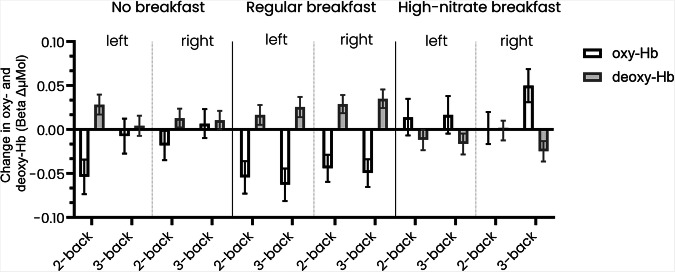
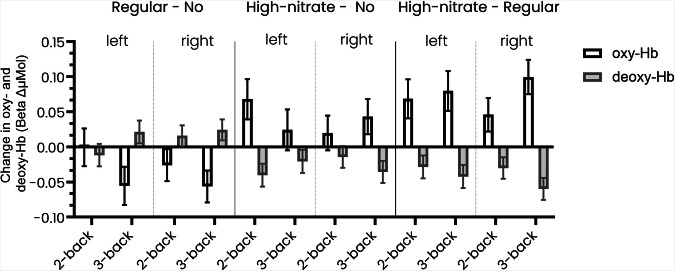
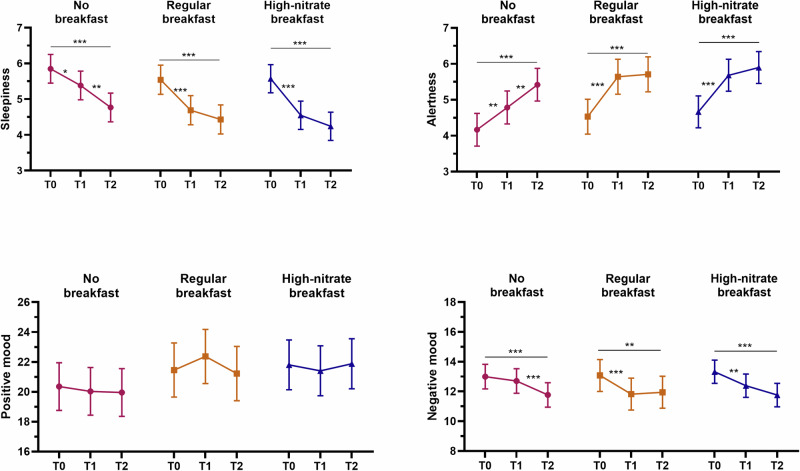
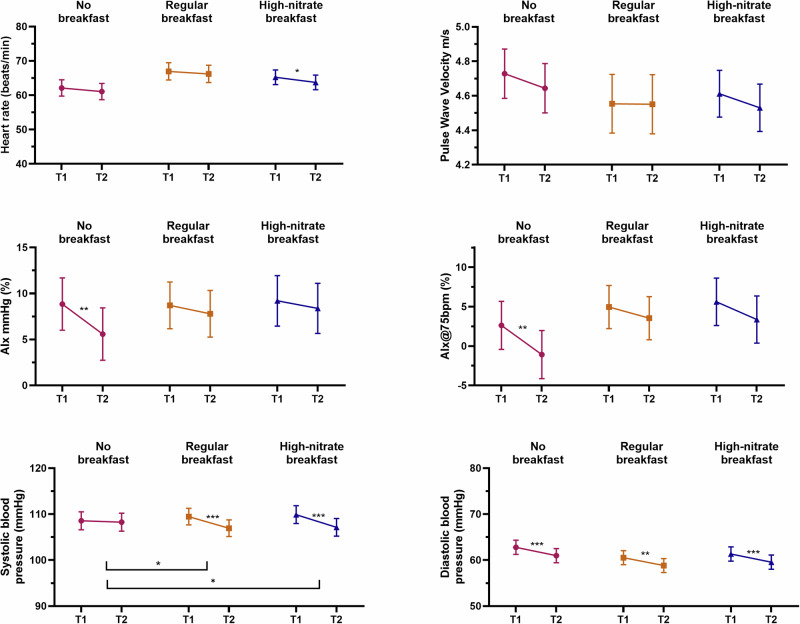
It remains unknown whether dietary nitrate and breakfast may enhance working memory (WM) performance by augmenting physiological mechanisms and subjective psychological well-being. We performed a 3-arm randomised within-subject crossover study, with pretest-posttest comparisons, to test whether nitrate consumption via breakfast with a beetroot juice shot or regular breakfast compared to no breakfast improved WM (measured with n-back tests) and cognitive task-related changes in prefrontal cortical haemodynamic response (oxygenated- and deoxygenated-haemoglobin derived from functional near-infrared spectroscopy). In addition, effects on peripheral vascular function and self-reported psychological factors were assessed. In 60 adolescents (13–15 years old; 66% girls), WM improved in all conditions, with no intervention effects. Intervention effects were seen for oxygenated-haemoglobin changes, such that it increased after the breakfast with a nitrate shot during the WM tests and decreased after the regular breakfast. Thus, different neurophysiological mechanisms may be at play to preserve WM in adolescents depending on their breakfast composition. The trial was registered in the ISRCTN registry (ISRCTN16596056) on 21/02/2022.
Overview
The claims and statistics of this paper haven’t been checked yet.
Free: it reads the open-access text and checks the first 5 claims that cite a source we can check. Create a free account to check every claim.
Integrity signals
Registry
Cites
Statistics
Figures

Verification
Claims the paper makes
The claims and statistics of this paper haven’t been checked yet.
Free: it reads the open-access text and checks the first 5 claims that cite a source we can check. Create a free account to check every claim.
Claims other papers make about this one
Each is checked against this paper’s own text: does it say what the citing paper says it does?
The source backs part of the claim, not all of it — or backs it for a different population, condition or comparison.
In the citing paper
“though no change in cognitive performance was observed [172].”
From Dietary Nitrate-Rich Vegetables as Natural Modulators of Health: Mechanisms and Benefits in Ageing Populations (2026) · cites this paper as [172]
Experimental — accuracy not yet measuredThe cited source says what the claim attributes to it.
In the citing paper
“a crossover study in adolescents revealed that nitrate-rich beetroot juice increased oxygenated haemoglobin in prefrontal regions during working memory tasks”
From Dietary Nitrate-Rich Vegetables as Natural Modulators of Health: Mechanisms and Benefits in Ageing Populations (2026) · cites this paper as [172]
Self-check
Percentages, sums and reported differences re-computed from the paper’s own numbers.
The self-check needs the paper’s full text.
Citations
Cites
Development and validation of brief measures of positive and negative affect: The PANAS scales.
Watson, D., Clark, L. A., & Tellegen, A. (1988) · Journal of Personality and Social Psychology · doi:10.1037/0022-3514.54.6.1063 · Cited by 32,433
Calibration of two objective measures of physical activity for children
Evenson, K. R., Catellier, D. J., Gill, K., Ondrak, K. S., & McMurray, R. G. (2008) · Journal of Sports Sciences · doi:10.1080/02640410802334196 · Cited by 2,677
Stereotaxic Display of Brain Lesions
Rorden, C., & Brett, M. (2000) · Behavioural Neurology · doi:10.1155/2000/421719 · Cited by 2,590
Van Bortel, L. M., Laurent, S., Boutouyrie, P., Chowienczyk, P., Cruickshank, J. K., De Backer, T., Filipovsky, J., Huybrechts, S., Mattace-Raso, F. U. S., Protogerou, A. D., et al. (2012) · Journal of Hypertension · doi:10.1097/hjh.0b013e32834fa8b0 · Cited by 2,010 · cited 1×
“PWVwasassessed betweencarotidandfemoralarteriesandwascalculatedbytheformula:PWV (m/s)=distancebetweenmeasurementlocation(m)/transittime(s) 44 .”
Age differences in short-term retention of rapidly changing information.
Kirchner, W. K. (1958) · Journal of Experimental Psychology · doi:10.1037/h0043688 · Cited by 1,798 · cited 1×
“Computerised n-back tests (1, 2-, and 3-back) 38 developed in E-Prime 2.0 (Psychology Software Tools) were used to assess working memory reaction time (ms) and accuracy (number of correct responses).”
MethodInfluentialActivity-Based Sleep-Wake Identification: An Empirical Test of Methodological Issues
Sadeh, A., Sharkey, M., & Carskadon, M. A. (1994) · Sleep · doi:10.1093/sleep/17.3.201 · Cited by 1,487
Webb, A. J., Patel, N., Loukogeorgakis, S., Okorie, M., Aboud, Z., Misra, S., Rashid, R., Miall, P., Deanfield, J., Benjamin, N., et al. (2008) · Hypertension · doi:10.1161/hypertensionaha.107.103523 · Cited by 1,078 · cited 1×
“Aftertimepoint0andthe fi rst measurements, the participants sat for 130 min to allow for the plasma nitrite to peak 37 before the last measure-mentsweretaken.”
MethodNitrate in vegetables: toxicity, content, intake and EC regulation
Santamaria, P. (2006) · Journal of the Science of Food and Agriculture · doi:10.1002/jsfa.2351 · Cited by 1,064 · cited 1×
“The amount of nitrate was restricted to the daily acceptable limit of 3.7 mg per kg body weight per day 36 .”
BackgroundInfluentialNitric oxide signaling in health and disease
Lundberg, J. O., & Weitzberg, E. (2022) · Cell · doi:10.1016/j.cell.2022.06.010 · Cited by 826
Govoni, M., Jansson, E. Å., Weitzberg, E., & Lundberg, J. O. (2008) · Nitric Oxide · doi:10.1016/j.niox.2008.08.003 · Cited by 602 · cited 1×
“Additionally, participants were also prohibited from using chewing gum or anti-bacterial mouthwash on experimental test days as these can inhibit oral nitrate metabolism 18,35 .”
Background
Research works printed but not linked: 1
- Sawai, A., Nie, N. Y., Sawai, S., Tsuzuki, K. & Tochikubo, O. Effect of skipping breakfast on cerebral blood flow and cardio-vascular function under a mental load in healthy female students. Prog. Nutr. 22, 462–470 (2020).
Cited by
A rethinking of nitrate, nitrite, and nitric oxide for food preservation and human health
Tian, X., Tian, Y., Shao, L., Li, Y., Meng, S., Zhao, J., & Wang, W. (2025) · Food Science and Human Wellness · doi:10.26599/fshw.2024.9250434 · Cited by 7
Nowak, A., Szymańska, A., Kwaśniewska, M., Kochan, E., & Lipert, A. (2025) · Nutrients · doi:10.3390/nu17243954 · Cited by 5
Kurhaluk, N., Kołodziejska, R., Buyun, L., Kamiński, P., & Tkaczenko, H. (2026) · International Journal of Molecular Sciences · doi:10.3390/ijms27083461 · Cited by 3
“For instance, a crossover study in adolescents revealed that nitrate-rich beetroot juice increased oxygenated haemoglobin in prefrontal regions during working memory tasks, suggesting enhanced neurovascular responsiveness, though no change in cognitive performance was observed [172].”
Yang, J., Xiang, J., Zhang, R., Xu, T., & Feng, T. (2026) · NeuroImage · doi:10.1016/j.neuroimage.2026.122003
Mohamed, R. S., Fouda, K. A., El‐Damhougy, S. T., & Hussein, M. M. (2026) · Letters in Applied NanoBioScience · doi:10.33263/lianbs152.066
“This cascade from nitrite to NO can be accelerated by a nitrate-rich diet, which may have physiological consequences that enhance prefrontal-dominant cognitive tasks, including executive function tasks that are essential for all performance [9].”
Oral microbiome signatures of ageing and cognitive function across distinct geographical cohorts
L’Heureux, J. E., Roelands, B., Wylie, L. J., MEEUSEN, R. R., JONES, A. M., & Vanhatalo, A. (2026) · PLoS ONE · doi:10.1371/journal.pone.0359559
“Supplementation with inorganic dietary nitrate may enhance cognitive performance, likely mediated through increasing NO bioavailability [66,67].”
Regulatory mechanisms of the kidneys under nitrate and nitrite exposures
Филипец, Н. Д., KMET, T. I., Filipets, О. О., Геруш, О. В., & Гоженко, А. І. (2026) · Ukrainian Journal of Occupational Health · doi:10.33573/ujoh2026.02.147
Metadata
- Authors
- Heiland, E. G., Lindh, F., Regan, C., Ekblom, Ö., Kjellenberg, K., Larsen, F. J., Fernström, M., Nyberg, G., Ekblom, M. M., & Helgadóttir, B.
- Affiliations
- Uppsala University (SE)
- Swedish School of Sport and Health Sciences (SE)
- Karolinska Institutet (SE)
- Corresponding author
- Heiland, Emerald G.
- ORCID
- Venue
- npj Science of Food
- Published
- 2024-09-13
- Volume
- 8
- Issue
- 1
- Pages
- 64-64
- ISSN
- 2396-8370 (ISSN-L)
- PMC
- PMC11399140
- OpenAlex
- W4402513371
- Cited by
- 7
- References
- 53
- Citations by year
- 2026: 5 · 2025: 2
- FWCI
- 2.90
- Type
- journal article
- Language
- en
- Open access
- gold
- doi.org
- Licence
- cc-by
- creativecommons.org/licenses/by/4.0 (tdm)
- creativecommons.org/licenses/by/4.0 (vor)
- Locations
- npj Science of Food (publishedVersion, cc-by)
- PubMed Central (publishedVersion, cc-by)
- PubMed (publishedVersion)
- KTH Publication Database DiVA (KTH Royal Institute of Technology) (submittedVersion, cc-by)
- Uppsala University Publications (Uppsala University) (submittedVersion, cc-by)
- DOAJ (DOAJ: Directory of Open Access Journals) (submittedVersion)
- Funders
- Stiftelsen för Kunskaps- och Kompetensutveckling (20180040)
- Topics
- Health Sciences › Medicine › Public Health, Environmental and Occupational Health › Nutritional Studies and Diet
- Social Sciences › Psychology › Experimental and Cognitive Psychology › Cognitive Abilities and Testing
- Health Sciences › Medicine › Cardiology and Cardiovascular Medicine › Cardiovascular Health and Disease Prevention
- Keywords
- dietary nitrate, beetroot juice, breakfast, working memory, prefrontal cortex, oxygenated haemoglobin, adolescents, peripheral vascular function, psychological well-being
About these checks
Registry, retraction, Cites and statistics results are computed, not judged, with one exception: a printed reference that no index lists is read once by a model before it counts as a citation error. Claims are extracted by a model and kept only when their quote appears verbatim in the text; each cited source is then checked, with a model’s help, for whether it says what the claim relies on. Those verdicts can be wrong — read the claim’s quote and the cited source before relying on one.
Statistics and arithmetic are recomputed, not judged.
Confidence bands are shown only for fields calibrated on our annotated test set. None is calibrated yet, so no band is shown.
What counts as a claim ›How we measure confidence ›How we check this ›
Are you an author, or do you see a problem with this page? Request a review
Data sources
Bibliographic data: Semantic Scholar, OpenAlex, Crossref.
Contains information from the Semantic Scholar Academic Graph Datasets, made available under the ODC Attribution License (ODC-BY 1.0).
Semantic Scholar’s data is described in: Kinney, R., et al. (2023). The Semantic Scholar Open Data Platform. arXiv:2301.10140.
