

The DOI matches its Crossref record; 97 of the 97 references it cites were found in a registry or an index.
Phase separation and ageing of glycine-rich protein from tick adhesive
Open accessPublished version of a preprint
Abstract
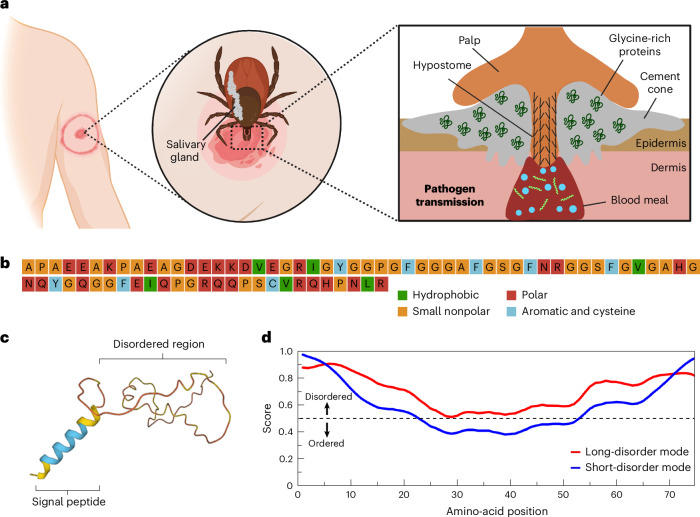
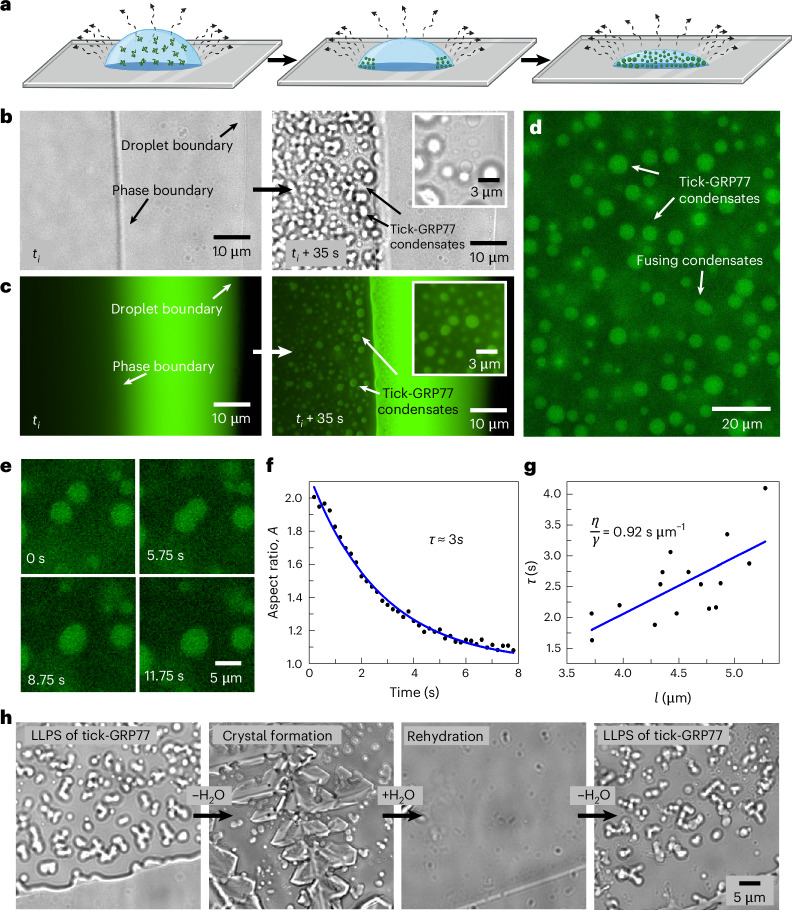
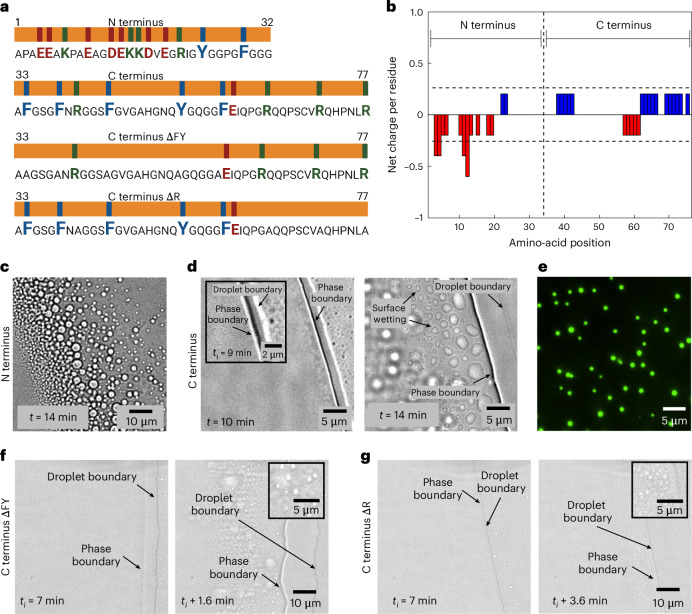
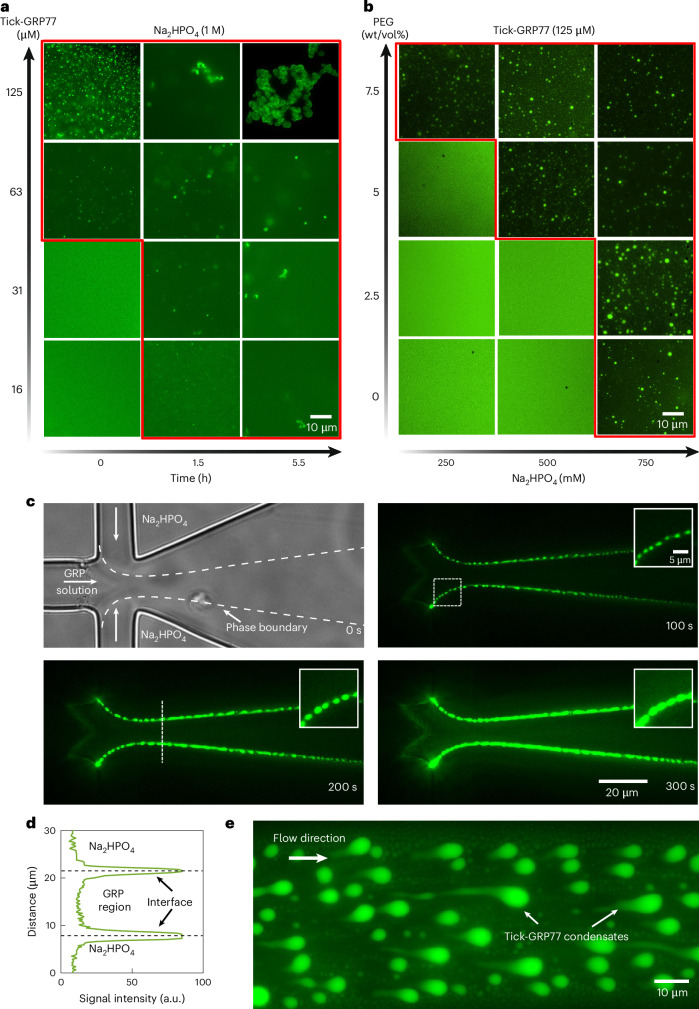
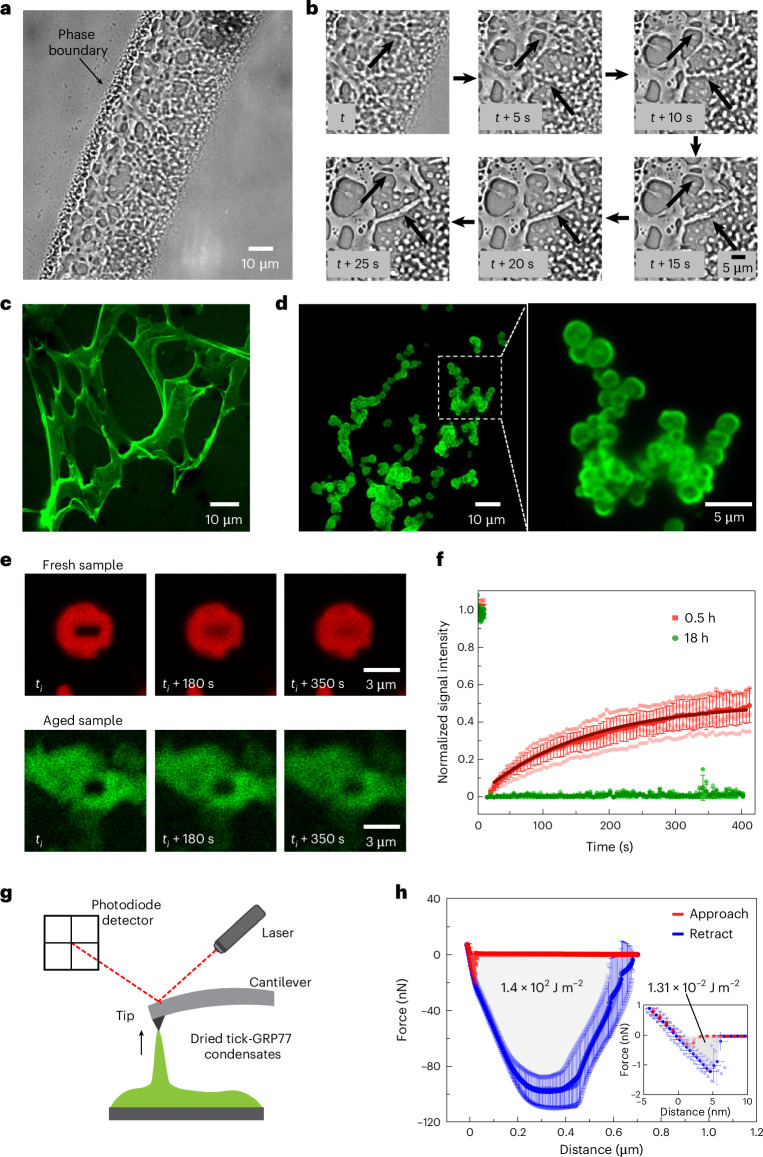
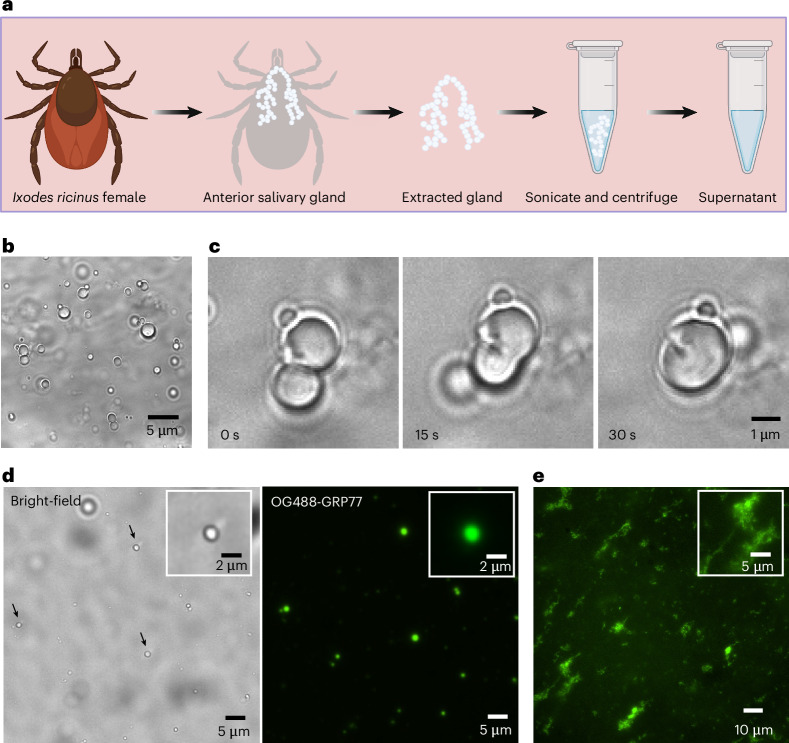
Hard ticks feed on their host for multiple days. To ensure firm attachment, they secrete a protein-rich saliva that eventually forms a solid cement cone. The underlying mechanism of this liquid-to-solid transition is currently not understood. This study focuses on the phase transitions of a disordered glycine-rich protein (GRP) found in tick saliva. We show that GRP undergoes liquid–liquid phase separation via simple coacervation to form biomolecular condensates in salty environments. Cation– π and π – π interactions mediated by periodically placed arginine and aromatic amino-acid residues are the primary driving forces that promote phase separation. Interestingly, GRP condensates exhibit ageing by undergoing liquid-to-gel transition over time and exhibit adhesive properties, similar to the naturally occurring cement cone. Finally, we provide evidence for protein-rich condensates in natural tick saliva. Our findings provide a starting point to gain further insights into the bioadhesion of ticks, to develop novel tick control strategies, and towards achieving biomedical applications such as tissue sealants.
Overview
The claims and statistics of this paper haven’t been checked yet.
Run the check — free, no account needed. It reads the open-access text and checks the sources it cites.
Integrity signals
Registry
Cites
Statistics
Figures
Verification
Claims the paper makes
The claims and statistics of this paper haven’t been checked yet.
Run the check — free, no account needed. It reads the open-access text and checks the sources it cites.
Self-check
Percentages, sums and reported differences re-computed from the paper’s own numbers.
The self-check needs the paper’s full text.
Citations
Cites
Highly accurate protein structure prediction with AlphaFold
Jumper, J., Evans, R., Pritzel, A., Green, T., Figurnov, M., Ronneberger, O., Tunyasuvunakool, K., Bates, R., Žídek, A., Potapenko, A., et al. (2021) · Nature · doi:10.1038/s41586-021-03819-2 · Cited by 43,764
Capillary flow as the cause of ring stains from dried liquid drops
Deegan, R. D., Bakajin, O., Dupont, T. F., Huber, G., Nagel, S. R., & Witten, T. A. (1997) · Nature · doi:10.1038/39827 · Cited by 6,453
Liquid phase condensation in cell physiology and disease
Shin, Y., & Brangwynne, C. P. (2017) · Science · doi:10.1126/science.aaf4382 · Cited by 4,213
Liquid-Liquid Phase Separation in Biology
Hyman, A. A., Weber, C. A., & Jülicher, F. (2014) · Annual Review of Cell and Developmental Biology · doi:10.1146/annurev-cellbio-100913-013325 · Cited by 3,155
Alberti, S., Gladfelter, A., & Mittag, T. (2019) · Cell · doi:10.1016/j.cell.2018.12.035 · Cited by 2,856
Interactions between macromolecules and ions: the Hofmeister series
Zhang, Y., & Cremer, P. S. (2006) · Current Opinion in Chemical Biology · doi:10.1016/j.cbpa.2006.09.020 · Cited by 2,100
The global importance of ticks
JONGEJAN, F., & UILENBERG, G. (2004) · Parasitology · doi:10.1017/s0031182004005967 · Cited by 2,091
Wang, J., Choi, J.-M., Holehouse, A. S., Lee, H. O., Zhang, X., Jahnel, M., Maharana, S., Lemaitre, R., Pozniakovsky, A., Drechsel, D., et al. (2018) · Cell · doi:10.1016/j.cell.2018.06.006 · Cited by 2,076
Nott, T. J., Petsalaki, E., Farber, P., Jervis, D., Fussner, E., Plochowietz, A., Craggs, T. D., Bazett-Jones, D. P., Pawson, T., Forman-Kay, J. D., et al. (2015) · Molecular Cell · doi:10.1016/j.molcel.2015.01.013 · Cited by 1,803
Mussel-Inspired Adhesives and Coatings
Lee, B. P., Messersmith, P. B., Israelachvili, J. N., & Waite, J. H. (2011) · Annual Review of Materials Research · doi:10.1146/annurev-matsci-062910-100429 · Cited by 1,668
Research works printed but not linked: 1
- Sonenshine, D. E. & Roe, R. M. Biology of Ticks Vol. 2 (Oxford Univ. Press, 2014).
Metadata
- Authors
- Ganar, K. A., Nandy, M., Turbina, P., Chen, C., Suylen, D., Nihoul, E., Pascoe, E. L., van der Beelen, S., Plaum, M., van den Bos, L., Koenraadt, C. J. M., Dijkgraaf, I., & Deshpande, S.
- Affiliations
- Wageningen University & Research (NL)
- Maastricht University (NL)
- Fondazione Edmund Mach (IT)
- Corresponding author
- Dijkgraaf, Ingrid
- Deshpande, Siddharth
- ORCID
- Venue
- Nature Chemistry
- Published
- 2024-11-29
- Volume
- 17
- Issue
- 2
- Pages
- 186-197
- ISSN
- 1755-4330 (ISSN-L)
- 1755-4349
- PMC
- PMC11794139
- OpenAlex
- W4404860401
- Cited by
- 42
- References
- 97
- Citations by year
- 2026: 26 · 2025: 14 · 2024: 1
- FWCI
- 3.86
- Type
- journal article
- Language
- en
- Open access
- hybrid
- doi.org
- Licence
- cc-by
- creativecommons.org/licenses/by/4.0 (tdm)
- creativecommons.org/licenses/by/4.0 (vor)
- Locations
- Nature Chemistry (publishedVersion, cc-by)
- bioRxiv (Cold Spring Harbor Laboratory) (acceptedVersion, cc-by-nc-nd)
- PubMed Central (publishedVersion, cc-by)
- PubMed (publishedVersion)
- Socio-Environmental Systems Modeling (submittedVersion, cc-by)
- Research Publications (Maastricht University) (submittedVersion, cc-by)
- Funders
- Nederlandse Organisatie voor Wetenschappelijk Onderzoek (OCENW.KLEIN.465)
- Topics
- Physical Sciences › Materials Science › Biomaterials › Supramolecular Self-Assembly in Materials
- Life Sciences › Biochemistry, Genetics and Molecular Biology › Molecular Biology › Protein Structure and Dynamics
- Life Sciences › Biochemistry, Genetics and Molecular Biology › Molecular Biology › RNA Research and Splicing
- Keywords
- glycine-rich proteins, tick saliva, liquid-liquid phase separation, coacervation, biomolecular condensates, cation-π interactions, π-π stacking, bioadhesion, tick control, tissue sealants
- MeSH terms
- Phase Separation, Adhesives, Animals, Glycine, Saliva, Salivary Proteins and Peptides, Ticks, Phase Transition
About these checks
Registry, retraction, Cites and statistics results are computed, not judged, with one exception: a printed reference that no index lists is read once by a model before it counts as a citation error. Claims are extracted by a model and kept only when their quote appears verbatim in the text; each cited source is then checked, with a model’s help, for whether it says what the claim relies on. Those verdicts can be wrong — read the claim’s quote and the cited source before relying on one.
Statistics and arithmetic are recomputed, not judged.
Confidence bands are shown only for fields calibrated on our annotated test set. None is calibrated yet, so no band is shown.
What counts as a claim ›How we measure confidence ›How we check this ›
Are you an author, or do you see a problem with this page? Request a review
How to cite
Cite CoChat for the checks on this page, and the paper for its own findings.
- This page
- CoChat. (2026). Citation check: Phase separation and ageing of glycine-rich protein from tick adhesive. https://app.cochat.ai/papers/10.1038/s41557-024-01686-8
- The paper
- Ganar, K. A., Nandy, M., Turbina, P., Chen, C., Suylen, D., Nihoul, E., Pascoe, E. L., van der Beelen, S., Plaum, M., van den Bos, L., Koenraadt, C. J. M., Dijkgraaf, I., & Deshpande, S. (2025). Phase separation and ageing of glycine-rich protein from tick adhesive. Nature Chemistry. https://doi.org/10.1038/s41557-024-01686-8
Data sources
Bibliographic data: Semantic Scholar, OpenAlex, Crossref.
Contains information from the Semantic Scholar Academic Graph Datasets, made available under the ODC Attribution License (ODC-BY 1.0).
Semantic Scholar’s data is described in: Kinney, R., et al. (2023). The Semantic Scholar Open Data Platform. arXiv:2301.10140.
