

The DOI matches its Crossref record; 118 of the 118 references it cites were found in a registry or an index.
Priority list of biodiversity metrics to observe from space
Abstract
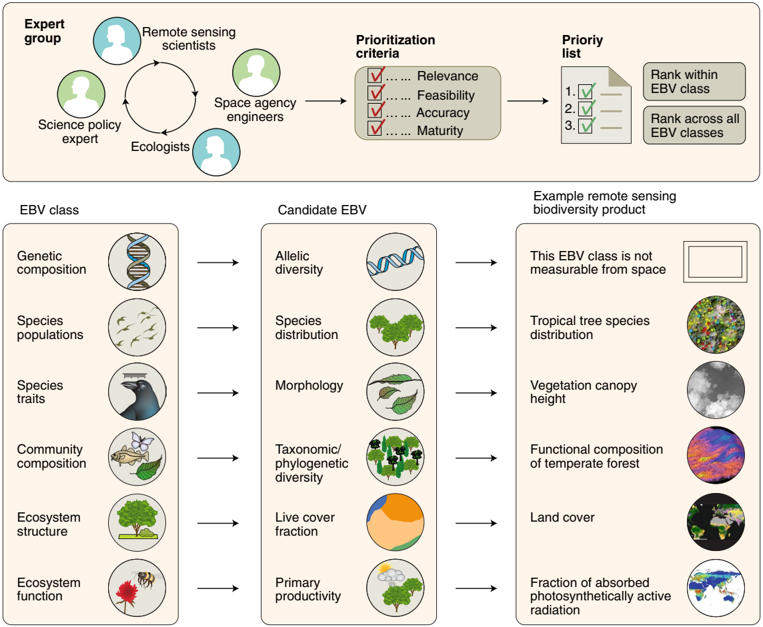
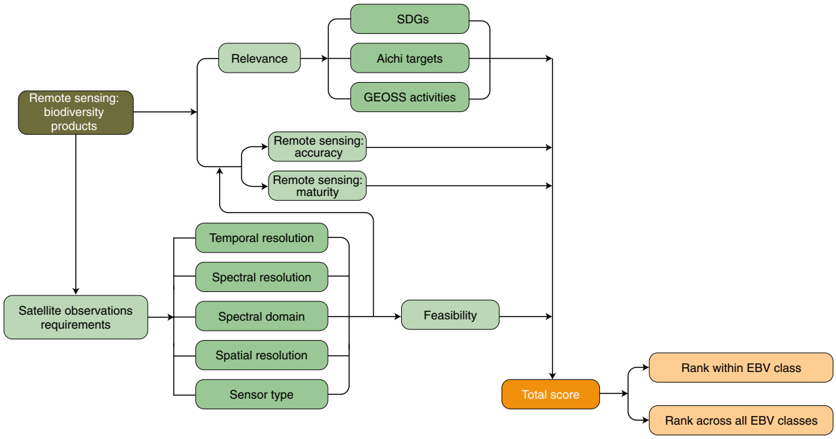
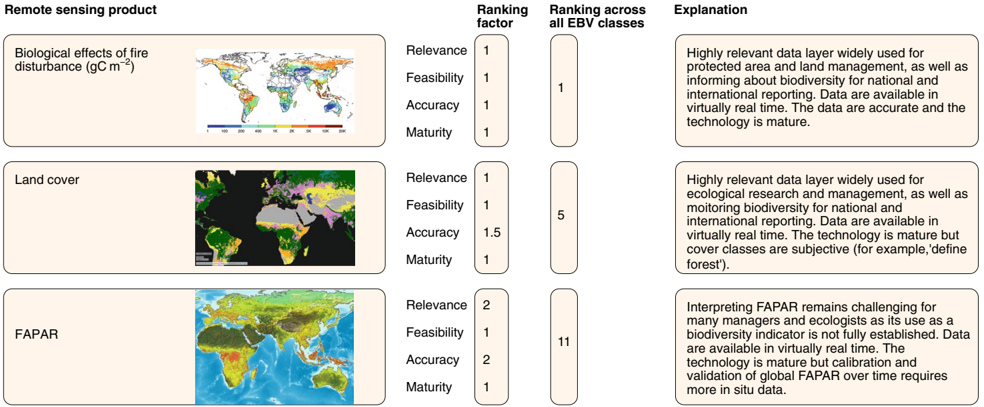
Monitoring global biodiversity from space through remotely sensing geospatial patterns has high potential to add to our knowledge acquired by field observation. Although a framework of essential biodiversity variables (EBVs) is emerging for monitoring biodiversity, its poor alignment with remote sensing products hinders interpolation between field observations. This study compiles a comprehensive, prioritized list of remote sensing biodiversity products that can further improve the monitoring of geospatial biodiversity patterns, enhancing the EBV framework and its applicability. The ecosystem structure and ecosystem function EBV classes, which capture the biological effects of disturbance as well as habitat structure, are shown by an expert review process to be the most relevant, feasible, accurate and mature for direct monitoring of biodiversity from satellites. Biodiversity products that require satellite remote sensing of a finer resolution that is still under development are given lower priority (for example, for the EBV class species traits). Some EBVs are not directly measurable by remote sensing from space, specifically the EBV class genetic composition. Linking remote sensing products to EBVs will accelerate product generation, improving reporting on the state of biodiversity from local to global scales.
Overview
The claims and statistics of this paper haven’t been checked yet.
Run the check — free, no account needed. It reads the open-access text and checks the sources it cites.
Integrity signals
Registry
Cites
Statistics
Figures
Verification
Claims the paper makes
The claims and statistics of this paper haven’t been checked yet.
Run the check — free, no account needed. It reads the open-access text and checks the sources it cites.
Claims other papers make about this one
Each is checked against this paper’s own text: does it say what the citing paper says it does?
In the citing paper
“At high spatial resolution, canopy height models (CHMs) directly characterize habitat heterogeneity9, which is why canopy height has been ranked as a high-priority biodiversity variable to be observed from space5.”
From A high-resolution canopy height model of the Earth (2023) · cites this paper as [5]
Self-check
Percentages, sums and reported differences re-computed from the paper’s own numbers.
The self-check needs the paper’s full text.
Citations
Cites
High-Resolution Global Maps of 21st-Century Forest Cover Change
Hansen, M. C., Potapov, P. V., Moore, R., Hancher, M., Turubanova, S. A., Tyukavina, A., Thau, D., Stehman, S. V., Goetz, S. J., Loveland, T. R., et al. (2013) · Science · doi:10.1126/science.1244693 · Cited by 11,704
Novel methods improve prediction of species’ distributions from occurrence data
Elith*, J., H. Graham*, C., P. Anderson, R., Dudík, M., Ferrier, S., Guisan, A., J. Hijmans, R., Huettmann, F., R. Leathwick, J., Lehmann, A., et al. (2006) · Ecography · doi:10.1111/j.2006.0906-7590.04596.x · Cited by 9,088
High-resolution mapping of global surface water and its long-term changes
Pekel, J.-F., Cottam, A., Gorelick, N., & Belward, A. S. (2016) · Nature · doi:10.1038/nature20584 · Cited by 5,513
Self-citationLavorel, S., & Garnier, E. (2002) · Functional Ecology · doi:10.1046/j.1365-2435.2002.00664.x · Cited by 3,452
The global spectrum of plant form and function
Díaz, S., Kattge, J., Cornelissen, J. H. C., Wright, I. J., Lavorel, S., Dray, S., Reu, B., Kleyer, M., Wirth, C., Colin Prentice, I., et al. (2016) · Nature · doi:10.1038/nature16489 · Cited by 3,365
Global products of vegetation leaf area and fraction absorbed PAR from year one of MODIS data
Myneni, R. B., Hoffman, S., Knyazikhin, Y. V., Privette, J. L., Glassy, J. M., Yuhong Tian, A., Wang, Y., Song, X., Zhang, Y., Smith, G. R., et al. (2002) · Remote Sensing of Environment · doi:10.1016/s0034-4257(02)00074-3 · Cited by 1,996
Improvements of the MODIS terrestrial gross and net primary production global data set
Zhao, M., Heinsch, F. A., Nemani, R., & Running, S. W. (2005) · Remote Sensing of Environment · doi:10.1016/j.rse.2004.12.011 · Cited by 1,693
Leaf Life‐Span in Relation to Leaf, Plant, and Stand Characteristics among Diverse Ecosystems
Reich, P. B., Walters, M. B., & Ellsworth, D. S. (1992) · Ecological Monographs · doi:10.2307/2937116 · Cited by 1,646
Terrestrial animal tracking as an eye on life and planet
Kays, R., Crofoot, M. C., Jetz, W., & Wikelski, M. (2015) · Science · doi:10.1126/science.aaa2478 · Cited by 1,638
Research works printed but not linked: 2
- Morsdorf, F. et al. in Remote Sensing of Plant Biodiversity (eds Cavender-Bares, J. et al.) 83–104 (Springer International, 2020).
- National Academies of Sciences, Engineering, and Medicine Thriving on Our Changing Planet: A Decadal Strategy for Earth Observation from Space (National Academies Press, 2018).
Cited by
A high-resolution canopy height model of the Earth
Lang, N., Jetz, W., Schindler, K., & Wegner, J. D. (2023) · Nature Ecology & Evolution · doi:10.1038/s41559-023-02206-6 · Cited by 810
Moudrý, V., Gábor, L., Marselis, S., Pracná, P., Barták, V., Prošek, J., Navrátilová, B., Novotný, J., Potůčková, M., Gdulová, K., et al. (2024) · Ecosphere · doi:10.1002/ecs2.70026 · Cited by 43
Self-citation
Metadata
- Authors
- Skidmore, A. K., Coops, N. C., Neinavaz, E., Ali, A., Schaepman, M. E., Paganini, M., Kissling, W. D., Vihervaara, P., Darvishzadeh, R., Feilhauer, H., Fernandez, M., Fernández, N., Gorelick, N., Geijzendorffer, I., Heiden, U., Heurich, M., Hobern, D., Holzwarth, S., Muller-Karger, F. E., Van De Kerchove, R., Lausch, A., Leitão, P. J., Lock, M. C., Mücher, C. A., O’Connor, B., Rocchini, D., Roeoesli, C., Turner, W., Vis, J. K., Wang, T., Wegmann, M., & Wingate, V.
- ORCID
- Skidmore, Andrew K.
- Coops, Nicholas C.
- Neinavaz, Elnaz
- Schaepman, Michael E.
- Kissling, W. Daniel
- Vihervaara, Petteri
- Darvishzadeh, Roshanak
- Feilhauer, Hannes
- Fernandez, Miguel
- Fernández, Néstor
- Gorelick, Noel
- Heiden, Uta
- Heurich, Marco
- Holzwarth, Stefanie
- Muller-Karger, Frank E.
- Lausch, Angela
- Leitão, Pedro J.
- Lock, Marcelle C.
- Rocchini, Duccio
- Wang, Tiejun
- Wegmann, Martin
- Venue
- Nature Ecology & Evolution
- Published
- 2021-05-13
- Volume
- 5
- Issue
- 7
- Pages
- 896-906
- ISSN
- 2397-334X
- Cited by
- 278
- References
- 118
- Language
- en
- Licence
- www.springernature.com/gp/researchers/text-and-data-mining (tdm)
- www.springernature.com/gp/researchers/text-and-data-mining (vor)
About these checks
Registry, retraction, Cites and statistics results are computed, not judged, with one exception: a printed reference that no index lists is read once by a model before it counts as a citation error. Claims are extracted by a model and kept only when their quote appears verbatim in the text; each cited source is then checked, with a model’s help, for whether it says what the claim relies on. Those verdicts can be wrong — read the claim’s quote and the cited source before relying on one.
Statistics and arithmetic are recomputed, not judged.
Confidence bands are shown only for fields calibrated on our annotated test set. None is calibrated yet, so no band is shown.
What counts as a claim ›How we measure confidence ›How we check this ›
Are you an author, or do you see a problem with this page? Request a review
Data sources
Bibliographic data: Semantic Scholar, OpenAlex, Crossref.
Contains information from the Semantic Scholar Academic Graph Datasets, made available under the ODC Attribution License (ODC-BY 1.0).
Semantic Scholar’s data is described in: Kinney, R., et al. (2023). The Semantic Scholar Open Data Platform. arXiv:2301.10140.
