

Search for topological defect dark matter with a global network of optical magnetometers
Open accessPublished version of a preprint
The DOI matches its Crossref record; 58 of the 70 references it cites were found in a registry or an index.
Abstract
Ultralight bosons such as axion-like particles are viable candidates for dark matter. They can form stable, macroscopic field configurations in the form of topological defects that could concentrate the dark matter density into many distinct, compact spatial regions that are small compared with the Galaxy but much larger than the Earth. Here we report the results of the search for transient signals from the domain walls of axion-like particles by using the global network of optical magnetometers for exotic (GNOME) physics searches. We search the data, consisting of correlated measurements from optical atomic magnetometers located in laboratories all over the world, for patterns of signals propagating through the network consistent with domain walls. The analysis of these data from a continuous month-long operation of GNOME finds no statistically significant signals, thus placing experimental constraints on such dark matter scenarios.
Overview
The claims and statistics of this paper haven’t been checked yet.
Free: it reads the open-access text and checks the first 5 claims that cite a source we can check. Create a free account to check every claim.
Integrity signals
Registry
Cites
Statistics
Figures
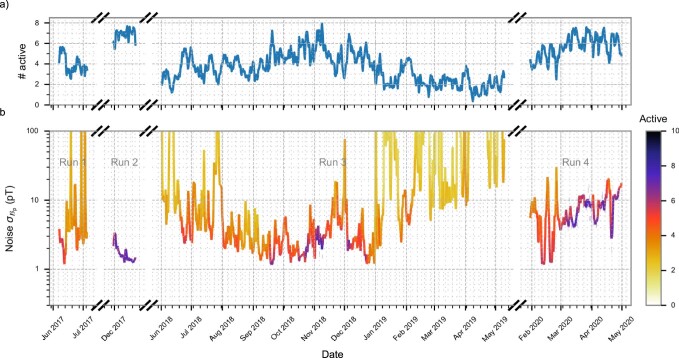
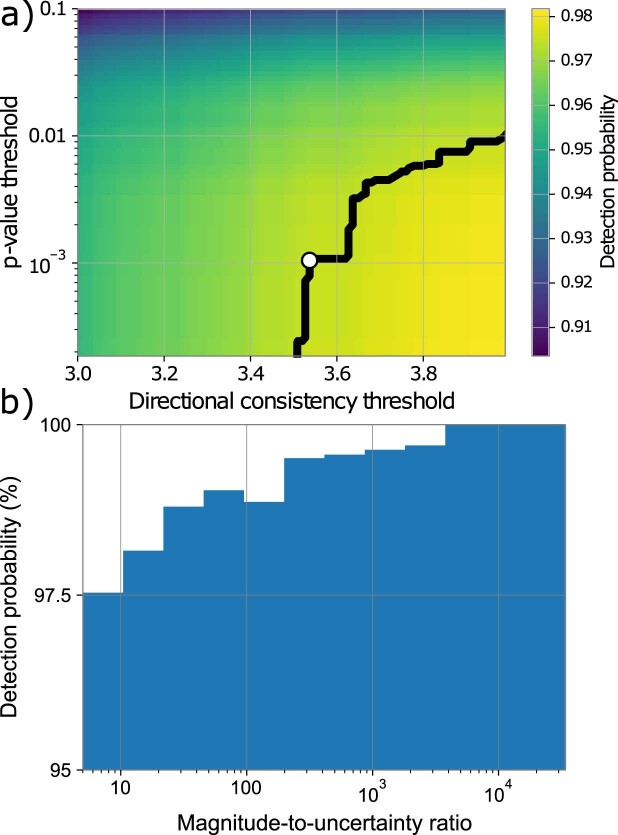
Verification
Claims the paper makes
The claims and statistics of this paper haven’t been checked yet.
Free: it reads the open-access text and checks the first 5 claims that cite a source we can check. Create a free account to check every claim.
Claims other papers make about this one
Each is checked against this paper’s own text: does it say what the citing paper says it does?
In the citing paper
“A Global Network of Optical Magnetometers for Exotic physics searches (GNOME) was proposed to reach higher sensitivities (Afach et al. 2021).”
From Fundamental constants: from measurement to the universe, a window on gravitation and cosmology (2025) · cites this paper as Afach et al. 2021
Self-check
Percentages, sums and reported differences re-computed from the paper’s own numbers.
The self-check needs the paper’s full text.
Citations
Cites
Particle dark matter: evidence, candidates and constraints
Bertone, G., Hooper, D., & Silk, J. (2005) · Physics Reports · doi:10.1016/j.physrep.2004.08.031 · Cited by 4,979 · cited 1×
“The nature of dark matter, an invisible substance comprising over 80% of the mass of the universe [1, 2], is one of the most profound mysteries of modern physics.”
BackgroundCosmology of the invisible axion
Preskill, J., Wise, M. B., & Wilczek, F. (1983) · Physics Letters B · doi:10.1016/0370-2693(83)90637-8 · Cited by 3,293 · cited 1×
“One of the leading hypotheses is that dark matter consists of ultralight bosons such as axions [4] or axion-like particles (ALPs) [5–7].”
BackgroundCan confinement ensure natural CP invariance of strong interactions?
Shifman, M. A., Vainshtein, A. I., & Zakharov, V. I. (1980) · Nuclear Physics B · doi:10.1016/0550-3213(80)90209-6 · Cited by 2,402
Cosmic strings and domain walls
Vilenkin, A. (1985) · Physics Reports · doi:10.1016/0370-1573(85)90033-x · Cited by 2,091 · cited 1×
“Here we present the results of such a search for ALP domain walls, a class of topological defects which can form between regions of space with different vacua of an ALP field [8, 9].”
BackgroundMarsh, D. J. E. (2016) · Physics Reports · doi:10.1016/j.physrep.2016.06.005 · Cited by 2,001
Svrcek, P., & Witten, E. (2006) · Journal of High Energy Physics · doi:10.1088/1126-6708/2006/06/051 · Cited by 1,566
Search for new physics with atoms and molecules
Safronova, M. S., Budker, D., DeMille, D., Kimball, D. F. J., Derevianko, A., & Clark, C. W. (2018) · Reviews of Modern Physics · doi:10.1103/revmodphys.90.025008 · Cited by 1,560 · cited 6×
“Pseudoscalar bosonic dark matter generally produces no observable effects in clock networks [3] but does couple to atomic spins via the interaction described by Eq.”
BackgroundInfluentialSelf-citationHigh-Sensitivity Atomic Magnetometer Unaffected by Spin-Exchange Relaxation
Allred, J. C., Lyman, R. N., Kornack, T. W., & Romalis, M. V. (2002) · Physical Review Letters · doi:10.1103/physrevlett.89.130801 · Cited by 1,049 · cited 15×
“The Hefei SERF magnetometer operates in the low-spin-polarization mode.”
BackgroundMethodInfluentialSelf-citationColeman, S. (1985) · Nuclear Physics B · doi:10.1016/0550-3213(85)90286-x · Cited by 1,040
New experimental approaches in the search for axion-like particles
Irastorza, I. G., & Redondo, J. (2018) · Progress in Particle and Nuclear Physics · doi:10.1016/j.ppnp.2018.05.003 · Cited by 745 · cited 1×
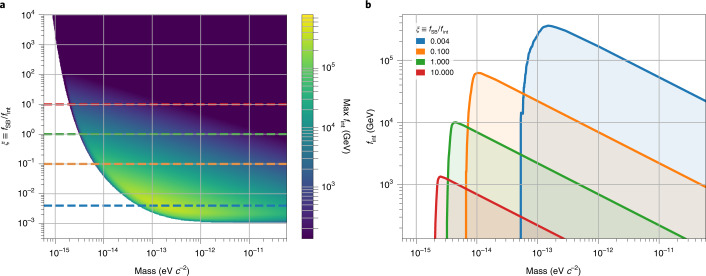
“However, for ALPs a vast array of possibilities for the generation of ALP masses and couplings are opened by a variety of beyond-the-standard-model theories, meaning that the values of fint and ma explored in our search are theoretically possible (see, for example, the reviews [44, 45] and references therein).”
BackgroundAxions, Domain Walls, and the Early Universe
Sikivie, P. (1982) · Physical Review Letters · doi:10.1103/physrevlett.48.1156 · Cited by 729
Experimental Searches for the Axion and Axion-Like Particles
Graham, P. W., Irastorza, I. G., Lamoreaux, S. K., Lindner, A., & van Bibber, K. A. (2015) · Annual Review of Nuclear and Particle Science · doi:10.1146/annurev-nucl-102014-022120 · Cited by 692 · cited 1×
“In most theories, the coupling constants fint describing the interaction between Standard Model fermions and the ALP field are proportional to fSB; however, fint can differ between electrons, neutrons, and protons by model-dependent factors that can be significant [3, 5].”
BackgroundCosmological Relaxation of the Electroweak Scale
Graham, P. W., Kaplan, D. E., & Rajendran, S. (2015) · Physical Review Letters · doi:10.1103/physrevlett.115.221801 · Cited by 657
The PyCBC search for gravitational waves from compact binary coalescence
Usman, S. A., Nitz, A. H., Harry, I. W., Biwer, C. M., Brown, D. A., Cabero, M., Capano, C. D., Canton, T. D., Dent, T., Fairhurst, S., et al. (2016) · Classical and Quantum Gravity · doi:10.1088/0264-9381/33/21/215004 · Cited by 645
New experimental approaches in the search for axion-like particles
Irastorza, I., & Redondo, J. (2018) · MPG.PuRe (Max Planck Society) · Cited by 608
Nuclear Spin Gyroscope Based on an Atomic Comagnetometer
Kornack, T. W., Ghosh, R. K., & Romalis, M. V. (2005) · Physical Review Letters · doi:10.1103/physrevlett.95.230801 · Cited by 565 · cited 1×
“Furthermore, by upgrading to noble-gas-based comagnetometers [46, 47] for future science runs (Advanced GNOME), we expect to significantly improve the sensitivity to ALP domain walls.”
MethodSelf-citationHunting for topological dark matter with atomic clocks
Derevianko, A., & Pospelov, M. (2014) · Nature Physics · doi:10.1038/nphys3137 · Cited by 522
Self-citationGW150914: First results from the search for binary black hole coalescence with Advanced LIGO
Abbott, B. P., Abbott, R., Abbott, T. D., Abernathy, M. R., Acernese, F., Ackley, K., Adams, C., Adams, T., Addesso, P., Adhikari, R. X., et al. (2016) · Physical Review D · doi:10.1103/physrevd.93.122003 · Cited by 496 · cited 1×
“This method is used to generate background data with noise characteristics closely reproducing those of the search data [53].”
MethodON THE LOCAL DARK MATTER DENSITY
Bovy, J., & Tremaine, S. (2012) · The Astrophysical Journal · doi:10.1088/0004-637x/756/1/89 · Cited by 345
On the local dark matter densityPreprint
Bovy, J., & Tremaine, S. D. (2016) · Cited by 341
Dynamical evolution of domain walls in an expanding universe
Press, W. H., Ryden, B. S., & Spergel, D. N. (1989) · The Astrophysical Journal · doi:10.1086/168151 · Cited by 286
Dynamics of Two Overlapping Spin Ensembles Interacting by Spin Exchange
Kornack, T. W., & Romalis, M. V. (2002) · Physical Review Letters · doi:10.1103/physrevlett.89.253002 · Cited by 229 · cited 1×
“Furthermore, by upgrading to noble-gas-based comagnetometers [46, 47] for future science runs (Advanced GNOME), we expect to significantly improve the sensitivity to ALP domain walls.”
MethodSelf-citationEarly-Universe Simulations of the Cosmological Axion
Buschmann, M., Foster, J. W., & Safdi, B. R. (2020) · Physical Review Letters · doi:10.1103/physrevlett.124.161103 · Cited by 228
Bucher, M., & Spergel, D. (1999) · Physical Review D · doi:10.1103/physrevd.60.043505 · Cited by 202
Relaxion stars and their detection via atomic physics
Banerjee, A., Budker, D., Eby, J., Kim, H., & Perez, G. (2020) · Communications Physics · doi:10.1038/s42005-019-0260-3 · Cited by 181 · cited 1×
“Additionally, GNOME data can be searched for other signatures of physics beyond the Standard Model such as boson stars [12], relaxion halos [48], and bursts of ex-”
Self-citationQ-Ball Candidates for Self-Interacting Dark Matter
Kusenko, A., & Steinhardt, P. J. (2001) · Physical Review Letters · doi:10.1103/physrevlett.87.141301 · Cited by 165 · cited 1×
“We note that while some models suggest that axion domain walls cannot survive to the present epoch [13–15], there do exist a number of ALP models demonstrating the theoretical possibility that ALP domain walls or composite dark matter objects with similar characteristics [12, 16, 17] can survive to modern times [18–20…”
BackgroundFlambaum, V. V., & Tedesco, A. F. (2006) · Physical Review C · doi:10.1103/physrevc.73.055501 · Cited by 163 · cited 2×
“[10, 11] and to the results of detailed nuclear shell-model calculations where available [12–14].”
MethodIs there a supernova bound on axions?
Bar, N., Blum, K., & D’Amico, G. (2020) · Physical Review D · doi:10.1103/physrevd.101.123025 · Cited by 162 · cited 1×
“Although astrophysical observations suggest that fint & 2 × 10(8) GeV, there are a variety of scenarios in which such astrophysical constraints can be evaded [40, 41].”
BackgroundAxion cosmology with long-lived domain walls
Hiramatsu, T., Kawasaki, M., Saikawa, K., & Sekiguchi, T. (2013) · Journal of Cosmology and Astroparticle Physics · doi:10.1088/1475-7516/2013/01/001 · Cited by 158
Detecting Domain Walls of Axionlike Models Using Terrestrial Experiments
Pospelov, M., Pustelny, S., Ledbetter, M. P., Kimball, D. F. J., Gawlik, W., & Budker, D. (2013) · Physical Review Letters · doi:10.1103/physrevlett.110.021803 · Cited by 156 · cited 7×
“Here we present the results of such a search for ALP domain walls, a class of topological defects which can form between regions of space with different vacua of an ALP field [8, 9].”
BackgroundInfluentialSelf-citationBraaten, E., Mohapatra, A., & Zhang, H. (2016) · Physical Review Letters · doi:10.1103/physrevlett.117.121801 · Cited by 156
Sound of Dark Matter: Searching for Light Scalars with Resonant-Mass Detectors
Arvanitaki, A., Dimopoulos, S., & Van Tilburg, K. (2016) · Physical Review Letters · doi:10.1103/physrevlett.116.031102 · Cited by 144
Search for domain wall dark matter with atomic clocks on board global positioning system satellites
Roberts, B. M., Blewitt, G., Dailey, C., Murphy, M., Pospelov, M., Rollings, A., Sherman, J., Williams, W., & Derevianko, A. (2017) · Nature Communications · doi:10.1038/s41467-017-01440-4 · Cited by 143 · cited 3×
“Searches for macroscopic dark-matter objects based on similar ideas were carried out using atomic clock networks [10, 23, 32, 33], and there are a number of experimental proposals utilizing other sensor networks [34–37].”
MethodInfluentialSelf-citationStadnik, Y. V., & Flambaum, V. V. (2016) · Physical Review A · doi:10.1103/physreva.93.063630 · Cited by 138
Nonlinear magneto-optical rotation with frequency-modulated light
Budker, D., Kimball, D. F. J., Yashchuk, V. V., & Zolotorev, M. S. (2002) · Physical Review A · doi:10.1103/physreva.65.055403 · Cited by 135
Self-citationHidden sector monopole, vector dark matter and dark radiation with Higgs portal
Baek, S., Ko, P., & Park, W.-I. (2014) · Journal of Cosmology and Astroparticle Physics · doi:10.1088/1475-7516/2014/10/067 · Cited by 129 · cited 1×
“We note that while some models suggest that axion domain walls cannot survive to the present epoch [13–15], there do exist a number of ALP models demonstrating the theoretical possibility that ALP domain walls or composite dark matter objects with similar characteristics [12, 16, 17] can survive to modern times [18–20…”
BackgroundPredictions for axion couplings from ALP cogenesis
Co, R. T., Hall, L. J., & Harigaya, K. (2021) · Journal of High Energy Physics · doi:10.1007/jhep01(2021)172 · Cited by 124
Experimental constraint on dark matter detection with optical atomic clocks
Wcisło, P., Morzyński, P., Bober, M., Cygan, A., Lisak, D., Ciuryło, R., & Zawada, M. (2016) · Nature Astronomy · doi:10.1038/s41550-016-0009 · Cited by 116
Roberts, B. M., Delva, P., Al-Masoudi, A., Amy-Klein, A., Bærentsen, C., Baynham, C. F. A., Benkler, E., Bilicki, S., Bize, S., Bowden, W., et al. (2020) · New Journal of Physics · doi:10.1088/1367-2630/abaace · Cited by 112
Nonlinear magneto-optical rotation with amplitude modulated light
Gawlik, W., Krzemień, L., Pustelny, S., Sangla, D., Zachorowski, J., Graf, M., Sushkov, A. O., & Budker, D. (2006) · Applied Physics Letters · doi:10.1063/1.2190457 · Cited by 107 · cited 3×
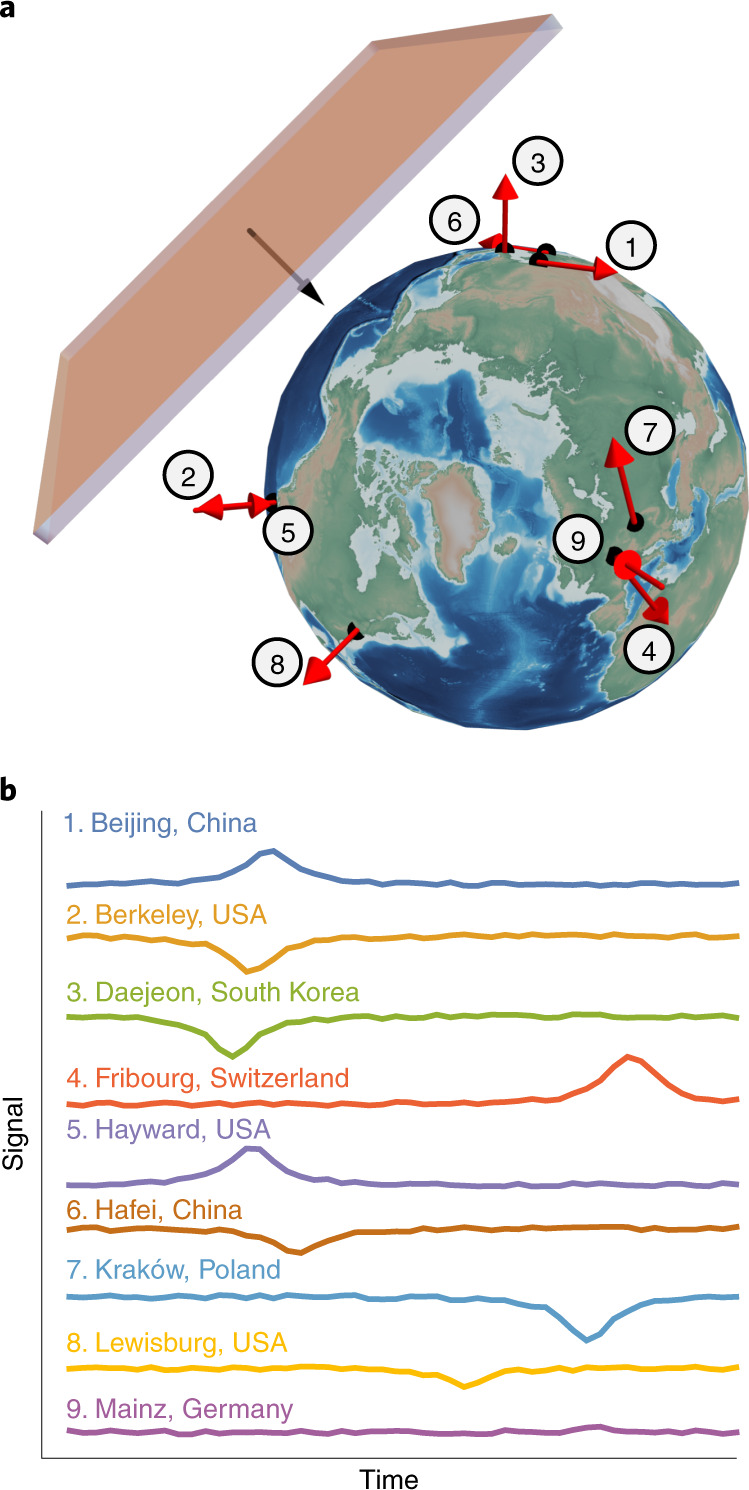
“The station name, location in longitude and latitude, orientation of the sensitive axis, type of magnetometer (NMOR [50, 51], rf-driven [26], or SERF [52]), and probed transition are listed.”
BackgroundSelf-citationPustelny, S., Jackson Kimball, D. F., Pankow, C., Ledbetter, M. P., Wlodarczyk, P., Wcislo, P., Pospelov, M., Smith, J. R., Read, J., Gawlik, W., et al. (2013) · Annalen der Physik · doi:10.1002/andp.201300061 · Cited by 99 · cited 2×
“The domain-wall thickness is determined by the ALP mass, and is on the order of the ALP reduced Compton wavelength λa [22],”
BackgroundSelf-citationPredictions for axion couplings from ALP cogenesis
Co, R. T., Hall, L. J., & Harigaya, K. (2021) · eScholarship (California Digital Library) · doi:10.1007/jhep01%282021%29172 · Cited by 80
Nuclear spin content and constraints on exotic spin-dependent couplings
Kimball, D. F. J. (2015) · New Journal of Physics · doi:10.1088/1367-2630/17/7/073008 · Cited by 79 · cited 3×
“[29], a reasonable estimate for K, Rb, and Cs nuclei can be obtained from the nuclear shell model by assuming that the nuclear spin I is due to the orbital motion and intrinsic spin of only the valence nucleon and that the spin and orbital angular momenta of all other nucleons sum to zero.”
BackgroundInfluentialQuantum sensor networks as exotic field telescopes for multi-messenger astronomy
Dailey, C., Bradley, C., Kimball, D. F. J., Sulai, I., Pustelny, S., Wickenbrock, A., & Derevianko, A. (2020) · Nature Astronomy · doi:10.1038/s41550-020-01242-7 · Cited by 79 · cited 2×
“otic low-mass fields from black-hole mergers [31].”
BackgroundSelf-citationExploring the robustness of stellar cooling constraints on light particles
DeRocco, W., Graham, P. W., & Rajendran, S. (2020) · Physical review. D/Physical review. D. · doi:10.1103/physrevd.102.075015 · Cited by 75 · cited 1×
“Although astrophysical observations suggest that fint & 2 × 10(8) GeV, there are a variety of scenarios in which such astrophysical constraints can be evaded [40, 41].”
BackgroundUpper limits on gravitational-wave signals based on loudest events
Brady, P. R., Creighton, J. D. E., & Wiseman, A. G. (2004) · Classical and Quantum Gravity · doi:10.1088/0264-9381/21/20/020 · Cited by 67 · cited 2×
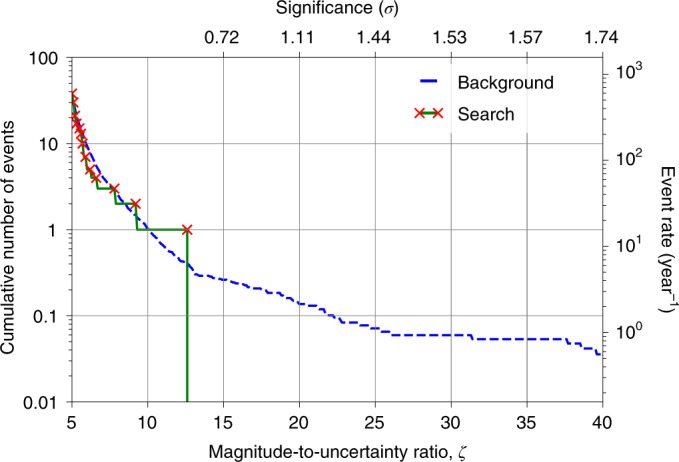
“Assuming that the domain-wall encounters follow Poisson statistics, a bound on the observable rate of events above ζmax with 90% confidence is set as [38],”
BackgroundSearching for axion stars and Q -balls with a terrestrial magnetometer network
Kimball, D. F. J., Budker, D., Eby, J., Pospelov, M. E., Pustelny, S., Scholtes, T., Stadnik, Y. V., Weis, A., & Wickenbrock, A. (2018) · Physical review. D/Physical review. D. · doi:10.1103/physrevd.97.043002 · Cited by 67 · cited 6×
“Separate analyses to search for transient oscillatory signals associated with boson stars [12] and bursts of exotic low-mass”
BackgroundInfluentialSelf-citationCharacterization of the global network of optical magnetometers to search for exotic physics (GNOME)
Afach, S., Budker, D., DeCamp, G., Dumont, V., Grujić, Z. D., Guo, H., Jackson Kimball, D. F., Kornack, T. W., Lebedev, V., Li, W., et al. (2018) · Physics of the Dark Universe · doi:10.1016/j.dark.2018.10.002 · Cited by 65 · cited 3×
“The station name, location in longitude and latitude, orientation of the sensitive axis, type of magnetometer (NMOR [50, 51], rf-driven [26], or SERF [52]), and probed transition are listed.”
BackgroundSelf-citationDynamics of domain wall networks with junctions
Avelino, P. P., Martins, C. J. A. P., Menezes, J., Menezes, R., & Oliveira, J. C. R. E. (2008) · Physical review. D. Particles, fields, gravitation, and cosmology/Physical review. D. Particles and fields · doi:10.1103/physrevd.78.103508 · Cited by 58
The tensor force between two protons at long range
Ramsey, N. F. (1979) · Physica A Statistical Mechanics and its Applications · doi:10.1016/0378-4371(79)90217-6 · Cited by 54 · cited 1×
“This goes beyond that excluded by previous direct laboratory experiments searching for ALP-mediated exotic pseudoscalar interactions between protons which have shown that fint & 300 GeV over the ALP mass range probed by the GNOME [39].”
BackgroundMagnetic shielding and exotic spin-dependent interactions
Kimball, D. F. J., Dudley, J., Li, Y., Thulasi, S., Pustelny, S., Budker, D., & Zolotorev, M. S. (2016) · Physical review. D/Physical review. D. · doi:10.1103/physrevd.94.082005 · Cited by 50 · cited 1×
“[5].”
Self-citationAnalysis method for detecting topological defect dark matter with a global magnetometer network
Masia-Roig, H., Smiga, J. A., Budker, D., Dumont, V., Grujic, Z., Kim, D., Kimball, D. F. J., Lebedev, V., Monroy, M., Pustelny, S., et al. (2020) · Physics of the Dark Universe · doi:10.1016/j.dark.2020.100494 · Cited by 45
Self-citationMulti-channel data acquisition system with absolute time synchronization
Włodarczyk, P., Pustelny, S., Budker, D., & Lipiński, M. (2014) · Nuclear Instruments and Methods in Physics Research Section A Accelerators Spectrometers Detectors and Associated Equipment · doi:10.1016/j.nima.2014.05.126 · Cited by 41
Self-citationStadnik, Y. V. (2020) · Physical Review D · doi:10.1103/physrevd.102.115016 · Cited by 31
Analysis method for detecting topological defect dark matter with a global magnetometer network
Masia‐Roig, H., A.Smiga, J., Budker, D., et al. (2020) · RERO DOC (Universität Bern) · Cited by 29
Self-citationAstronomical Signatures of Dark Matter
Gorenstein, P., & Tucker, W. H. (2014) · Advances in High Energy Physics · doi:10.1155/2014/878203 · Cited by 26 · cited 1×
“The nature of dark matter, an invisible substance comprising over 80% of the mass of the universe [1, 2], is one of the most profound mysteries of modern physics.”
BackgroundConstraining domain wall dark matter with a network of superconducting gravimeters and LIGO
McNally, R. L., & Zelevinsky, T. (2020) · The European Physical Journal D · doi:10.1140/epjd/e2020-100632-0 · Cited by 21
Resonant bar detector constraints on macro dark matter
Jacobs, D. M., Weltman, A., & Starkman, G. D. (2015) · Physical review. D. Particles, fields, gravitation, and cosmology/Physical review. D. Particles and fields · doi:10.1103/physrevd.91.115023 · Cited by 19
Research works printed but not linked: 1
- Yashchuk, V. V., Lee, S.-K. & Paperno, E. in Optical Magnetometry (eds Budker, D. & Kimball, D. F. J.) Ch. 2 (Cambridge Univ. Press, 2013).
Cited by
How to build a magnetometer with thermal atomic vapor: a tutorial
Fabricant, A. M., Novikova, I. V., & Bison, G. (2023) · New Journal of Physics · doi:10.1088/1367-2630/acb840 · Cited by 162
Ultrasensitive Atomic Comagnetometer with Enhanced Nuclear Spin Coherence
Wei, K., Zhao, T., Fang, X., Xu, Z., Liu, C., Cao, Q., Wickenbrock, A., Hu, Y., Ji, W., Fang, J., et al. (2023) · Physical Review Letters · doi:10.1103/physrevlett.130.063201 · Cited by 122
Self-citationComagnetometer probes of dark matter and new physics
Terrano, W. A., & Romalis, M. V. (2021) · Quantum Science and Technology · doi:10.1088/2058-9565/ac1ae0 · Cited by 131
Spin-dependent exotic interactions
Cong, L., Ji, W., Fadeev, P., Ficek, F., Jiang, M., Flambaum, V. V., Guan, H., Kimball, D. F. J., Kozlov, M. G., Stadnik, Y. V., et al. (2025) · Reviews of Modern Physics · doi:10.1103/revmodphys.97.025005 · Cited by 87
Self-citationQuantum sensing for particle physics
Bass, S. D., & Doser, M. (2024) · Nature Reviews Physics · doi:10.1038/s42254-024-00714-3 · Cited by 96
Metadata
- Authors
- Afach, S., Buchler, B. C., Budker, D., Dailey, C., Derevianko, A., Dumont, V., Figueroa, N. L., Gerhardt, I., Grujić, Z. D., Guo, H., Hao, C., Hamilton, P. S., Hedges, M., Jackson Kimball, D. F., Kim, D., Khamis, S., Kornack, T., Lebedev, V., Lu, Z.-T., Masia-Roig, H., Monroy, M., Padniuk, M., Palm, C. A., Park, S. Y., Paul, K. V., Penaflor, A., Peng, X., Pospelov, M., Preston, R., Pustelny, S., Scholtes, T., Segura, P. C., Semertzidis, Y. K., Sheng, D., Shin, Y. C., Smiga, J. A., Stalnaker, J. E., Sulai, I., Tandon, D., Wang, T., Weis, A., Wickenbrock, A., Wilson, T., Wu, T., Wurm, D., Xiao, W., Yang, Y., Yu, D., & Zhang, J.
- Affiliations
- GSI Helmholtz Centre for Heavy Ion Research (DE)
- Australian National University (AU)
- University of Nevada, Reno (US)
- Lawrence Berkeley National Laboratory (US)
- Max Planck Institute for Solid State Research (DE)
- University of Fribourg (CH)
- Peking University (CN)
- University of Science and Technology of China (CN)
- University of California, Los Angeles (US)
- Korea Advanced Institute of Science and Technology (KR)
- Twinleaf (United States) (US)
- California State University, East Bay (US)
- Jagiellonian University (PL)
- Joint Institute for Laboratory Astrophysics (US)
- University of Minnesota (US)
- Harvard University (US)
- Institute for Basic Science (KR)
- Oberlin College (US)
- Bucknell University (US)
- Princeton University (US)
- Technical University of Munich (DE)
- Corresponding author
- Smiga, Joseph A.
- ORCID
- Buchler, Ben C.
- Budker, Dmitry
- Dailey, Conner
- Derevianko, Andrei
- Dumont, Vincent
- Figueroa, Nataniel L.
- Gerhardt, Ilja
- Grujić, Zoran D.
- Guo, Hong
- Hao, Chuanpeng
- Hamilton, Paul S.
- Hedges, Morgan
- Jackson Kimball, Derek F.
- Kim, Dongok
- Khamis, Sami
- Kornack, Thomas
- Lebedev, Victor
- Lu, Zheng-Tian
- Masia-Roig, Hector
- Padniuk, Mikhail
- Park, Sun Yool
- Paul, Karun V.
- Peng, Xiang
- Pospelov, Maxim
- Pustelny, Szymon
- Scholtes, Theo
- Segura, Perrin C.
- Semertzidis, Yannis K.
- Sheng, Dong
- Shin, Yun Chang
- Smiga, Joseph A.
- Stalnaker, Jason E.
- Sulai, Ibrahim
- Tandon, Dhruv
- Wang, Tao
- Weis, Antoine
- Wickenbrock, Arne
- Wilson, Tatum
- Wu, Teng
- Wurm, David
- Xiao, Wei
- Yang, Yucheng
- Yu, Dongrui
- Zhang, Jianwei
- Venue
- Nature Physics
- Published
- 2021-12
- Volume
- 17
- Issue
- 12
- Pages
- 1396-1401
- ISSN
- 1745-2473 (ISSN-L)
- 1745-2481
- PMC
- PMC8654677
- OpenAlex
- W4200414884
- Cited by
- 126
- References
- 70
- Citations by year
- 2026: 19 · 2025: 30 · 2024: 26 · 2023: 20 · 2022: 25 · 2021: 6
- FWCI
- 5.06
- Type
- journal article
- Language
- en
- Open access
- hybrid
- doi.org
- Licence
- cc-by
- creativecommons.org/licenses/by/4.0 (tdm)
- creativecommons.org/licenses/by/4.0 (vor, 6 d)
- Locations
- Nature Physics (publishedVersion, cc-by)
- Research Square (acceptedVersion, cc-by)
- PubMed Central (publishedVersion, cc-by)
- PubMed (publishedVersion)
- arXiv (Cornell University) (submittedVersion)
- ANU Open Research (Australian National University) (submittedVersion, cc-by)
- Jagiellonian University Repository (Jagiellonian University) (submittedVersion, cc-by-nc-nd)
- OSTI OAI (U.S. Department of Energy Office of Scientific and Technical Information) (submittedVersion, other-oa)
- GSI Repository (German Federal Government) (submittedVersion, cc-by)
- arXiv (Cornell University)
- Funders
- National Science Foundation (1707803, 1912465, 1806672, 1707875)
- U.S. Department of Energy (DESC0011842)
- Gordon and Betty Moore Foundation
- Institute of Physics Belgrade
- European Commission (HORIZON2020, 695405)
- Deutsche Forschungsgemeinschaft (439720477)
- Schweizerischer Nationalfonds zur Förderung der Wissenschaftlichen Forschung (172686, 200021)
- National Natural Science Foundation of China (61225003, 62071012)
- Bundesministerium für Bildung und Forschung (13N15064, FKZ 13N15064)
- Ministarstvo Prosvete, Nauke i Tehnološkog Razvoja
- University of Science and Technology of China
- GSI Helmholtzzentrum für Schwerionenforschung
- Topics
- Physical Sciences › Physics and Astronomy › Nuclear and High Energy Physics › Dark Matter and Cosmic Phenomena
- Physical Sciences › Physics and Astronomy › Atomic and Molecular Physics, and Optics › Atomic and Subatomic Physics Research
- Physical Sciences › Physics and Astronomy › Nuclear and High Energy Physics › Neutrino Physics Research
- Keywords
- topological defects, dark matter, axion-like particles, domain walls, gnomes, ultralight bosons, experimental constraints
About these checks
Registry, retraction, Cites and statistics results are computed, not judged, with one exception: a printed reference that no index lists is read once by a model before it counts as a citation error. Claims are extracted by a model and kept only when their quote appears verbatim in the text; each cited source is then checked, with a model’s help, for whether it says what the claim relies on. Those verdicts can be wrong — read the claim’s quote and the cited source before relying on one.
Statistics and arithmetic are recomputed, not judged.
Confidence bands are shown only for fields calibrated on our annotated test set. None is calibrated yet, so no band is shown.
What counts as a claim ›How we measure confidence ›How we check this ›
Are you an author, or do you see a problem with this page? Request a review
Data sources
Bibliographic data: Semantic Scholar, OpenAlex, Crossref.
Contains information from the Semantic Scholar Academic Graph Datasets, made available under the ODC Attribution License (ODC-BY 1.0).
Semantic Scholar’s data is described in: Kinney, R., et al. (2023). The Semantic Scholar Open Data Platform. arXiv:2301.10140.
