

The human body at cellular resolution: the NIH Human Biomolecular Atlas Program
Open accessThe DOI matches its Crossref record; 50 of the 50 references it cites were found in a registry or an index.
Abstract
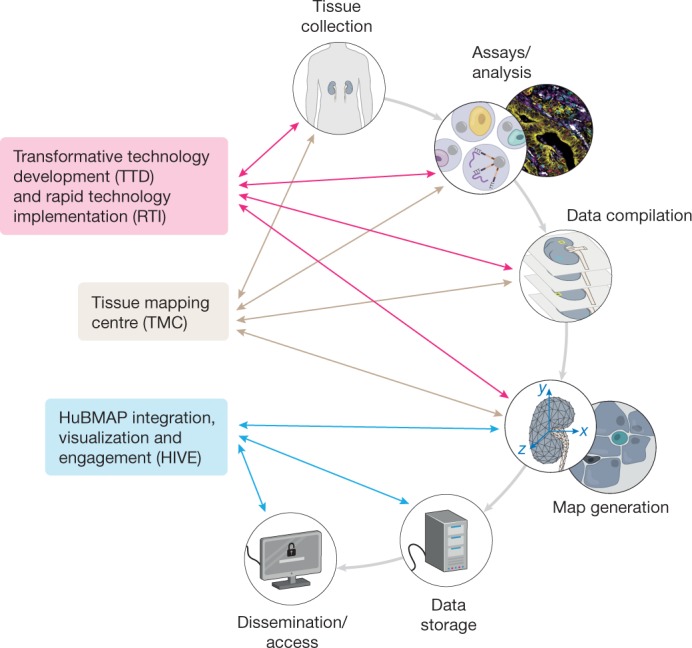
Transformative technologies are enabling the construction of three-dimensional maps of tissues with unprecedented spatial and molecular resolution. Over the next seven years, the NIH Common Fund Human Biomolecular Atlas Program (HuBMAP) intends to develop a widely accessible framework for comprehensively mapping the human body at single-cell resolution by supporting technology development, data acquisition, and detailed spatial mapping. HuBMAP will integrate its efforts with other funding agencies, programs, consortia, and the biomedical research community at large towards the shared vision of a comprehensive, accessible three-dimensional molecular and cellular atlas of the human body, in health and under various disease conditions.
Overview
The claims and statistics of this paper haven’t been checked yet.
Free: it reads the open-access text and checks the first 5 claims that cite a source we can check. Create a free account to check every claim.
Integrity signals
Registry
Cites
Statistics
Figures
Verification
Claims the paper makes
The claims and statistics of this paper haven’t been checked yet.
Free: it reads the open-access text and checks the first 5 claims that cite a source we can check. Create a free account to check every claim.
Claims other papers make about this one
Each is checked against this paper’s own text: does it say what the citing paper says it does?
The source backs part of the claim, not all of it — or backs it for a different population, condition or comparison.
In the citing paper
“A reference map of human proteoforms can serve a similar function at the protein level as we seek to understand the spatial and temporal dynamics of proteins operative in human tissue (13).”
From The Blood Proteoform Atlas: A reference map of proteoforms in human hematopoietic cells (2022) · cites this paper as [13]
Experimental — accuracy not yet measuredIn the citing paper
“These groups are actively in the process of defining all human cell types in an organized and interoperable ontology.”
From The Human Proteoform Project: Defining the human proteome (2021) · cites this paper as [40]
Self-check
Percentages, sums and reported differences re-computed from the paper’s own numbers.
The self-check needs the paper’s full text.
Citations
Cites
The FAIR Guiding Principles for scientific data management and stewardship
Wilkinson, M. D., Dumontier, M., Aalbersberg, I. J., Appleton, G., Axton, M., Baak, A., Blomberg, N., Boiten, J.-W., da Silva Santos, L. B., Bourne, P. E., et al. (2016) · Scientific Data · doi:10.1038/sdata.2016.18 · Cited by 18,423
Integrating single-cell transcriptomic data across different conditions, technologies, and species
Butler, A., Hoffman, P., Smibert, P., Papalexi, E., & Satija, R. (2018) · Nature Biotechnology · doi:10.1038/nbt.4096 · Cited by 13,174
Self-citationGenetic effects on gene expression across human tissues
GTEx Consortium (2017) · Nature · doi:10.1038/nature24277 · Cited by 4,036
Spatially resolved, highly multiplexed RNA profiling in single cells
Chen, K. H., Boettiger, A. N., Moffitt, J. R., Wang, S., & Zhuang, X. (2015) · Science · doi:10.1126/science.aaa6090 · Cited by 2,969
Batch effects in single-cell RNA-sequencing data are corrected by matching mutual nearest neighbors
Haghverdi, L., Lun, A. T. L., Morgan, M. D., & Marioni, J. C. (2018) · Nature Biotechnology · doi:10.1038/nbt.4091 · Cited by 2,416
Self-citationMazziotta, J., Toga, A., Evans, A., Fox, P., Lancaster, J., Zilles, K., Woods, R., Paus, T., Simpson, G., Pike, B., et al. (2001) · Philosophical Transactions of the Royal Society of London. Series B: Biological Sciences · doi:10.1098/rstb.2001.0915 · Cited by 2,347
Single-cell chromatin accessibility reveals principles of regulatory variation
Buenrostro, J. D., Wu, B., Litzenburger, U. M., Ruff, D., Gonzales, M. L., Snyder, M. P., Chang, H. Y., & Greenleaf, W. J. (2015) · Nature · doi:10.1038/nature14590 · Cited by 2,308
Self-citationRegev, A., Teichmann, S. A., Lander, E. S., Amit, I., Benoist, C., Birney, E., Bodenmiller, B., Campbell, P., Carninci, P., Clatworthy, M., et al. (2017) · eLife · doi:10.7554/elife.27041 · Cited by 2,232
Self-citationTranscriptome-scale super-resolved imaging in tissues by RNA seqFISH
Eng, C.-H. L., Lawson, M., Zhu, Q., Dries, R., Koulena, N., Takei, Y., Yun, J., Cronin, C., Karp, C., Yuan, G.-C., et al. (2019) · Nature · doi:10.1038/s41586-019-1049-y · Cited by 1,754
Self-citationDeep profiling of mouse splenic architecture with CODEX multiplexed imaging
Goltsev, Y., Samusik, N., Kennedy-Darling, J., Bhate, S., Hale, M., Vazquez, G., Black, S., & Nolan, G. P. (2018) · Cell · doi:10.1016/j.cell.2018.07.010 · Cited by 1,501
Self-citation
Research works printed but not linked: 1
- National Research Council of the National Academies. Enhancing the Effectiveness of Team Science (National Academies Press, 2015). 26247083
Cited by
Items 601–619 of 619
Combinatorial transcription factor interactions drive modular gene regulatory networksPreprint
Duan, J., Li, B., Kulkarni, K., Orquera-Tornakian, G., Barth, D., Wang, L. H., Pandit, V., Liou, J., Munshi, N. V., & Hon, G. C. (2026) · eLife · doi:10.7554/elife.111977
Bridging Biomedical Atlas Ecosystem: Cross-Atlas Alignment And Scalable Tissue Specimen RegistrationPreprint
Jain, Y., Desai, B., Qaurooni, D., Bhavsar, A., Kienle, P., Pouch, A. M., O’Neill, K. E., Apte, S., Herr, B. W., Fisher, S. A., et al. (2026) · bioRxiv (Cold Spring Harbor Laboratory) · doi:10.64898/2026.08.13.744704
Self-citationMeyer, L., Haefliger, S., Schulz, D., Fischer, J. R., & Bodenmiller, B. (2026) · Nature Reviews Methods Primers · doi:10.1038/s43586-026-00518-y
“Finally, beyond disease models, IMC has also been used to characterize the cellular composition and spatial organization of healthy tissues in support of Human Atlas projects 139 .”
Self-citationReversing the pipeline: a ‘human-first’ multi-omics approach to cardiovascular discovery
Parnasa, E., Rokach, Y., Abedat, S., Amir, O., Ben‐Dov, I. Z., & Asleh, R. (2026) · Experimental & Molecular Medicine · doi:10.1038/s12276-026-01835-8 · Cited by 1
“The Human BioMolecular Atlas Program further extends this concept by developing spatially resolved, single-cell-level maps of human tissues, providing a framework for understanding molecular organization within intact tissue architecture 89 .”
Spatial Logic and Evolutionary Innovation in Human PlacentationPreprint
Luo, Z., Wang, C., Zhou, Y., Guha, T. K., Narasimhan, P., Mason, S. L., Smit, A., Sun, X., Snyder, M. P., Shaw, G. M., et al. (2026) · bioRxiv (Cold Spring Harbor Laboratory) · doi:10.64898/2026.09.04.749511
“We first prioritized antibodies that were validated and available through our HuBMAP CODEX workflow, 31,32 and from this set selected markers that captured established cell types (Fig.”
Self-citationFrom What Is Life to Life Digitalization: Building a Reusable Data Foundation
Qian, Y., & Fei, S. (2026) · Data Express in Life Digitalization · doi:10.3724/deld-20260017
Rovatti, P. E. (n.d.) · Archivio Istituzionale della Ricerca - Università Vita-Salute San Raffaele
Standardizing Cell Ontology terms for cross-study integration in the female reproductive tract
Ong, H. T., Saunders, D. C., Eastwood, C., Puig-Barbe, A., Kochersberger, A., Galligos, A. M., Marshall, B., Johnson, B. K., Kratka, C. E., Jin, C., et al. (2026) · Science Advances · doi:10.1126/sciadv.aef2358 · Cited by 2
Kimler, K., Lance, C., Bohár, B., Ahmed, A., Zhou, R. R., Bartolomé-Casado, R., Gudiño, V., Flores, R. O. R., Junghus, F. V., Mörbe, U., et al. (2026) · bioRxiv (Cold Spring Harbor Laboratory) · doi:10.64898/2026.10.09.753994
Self-citationVirtualSkin integrates skin-cell identity with intervention-response predictionPreprint
Velland, M., Norwick, E., Ardene, S., Marwick, T., Corven, L., Solmere, A., Calder, N., Quillon, R., Renn, I., & Elian, M. (2026) · bioRxiv (Cold Spring Harbor Laboratory) · doi:10.64898/2026.10.06.756877
“25,31,32,33 The intervention arm covered five cohorts and four intervention classes: two genetic screens, a drug-exposure study, photodynamic treatment of photoaged skin and mechanical skin expansion.”
Virtual cells: progress and challenges from mechanistic modeling to data-driven integration
Ma, N., Wang, Z., Yang, X., Yang, G., Yang, R., Wang, Z., Jiang, Q., & Chu, Y. (2026) · Briefings in Bioinformatics · doi:10.1093/bib/bbag562
Multi-organ imaging genetics: towards an integrated view of brain, body and brain diseases
Fan, Z., & Zhao, B. (2026) · Nature Reviews Neurology · doi:10.1038/s41582-026-01276-x
FAIRsharing record for: NIH Human BioMolecular Atlas Program Data Portal
FAIRsharing Team, & Anderson, L. (2023) · FAIRsharing.org · doi:10.25504/fairsharing.2fe38c
Radtke, A. J. (2024) · Discovery Research Portal (University of Dundee) · doi:10.17867/10000199
A meta-modeler’s guide to the cellular interface and its composition patterns
Agmon, E. (2026) · Seminars in Cell and Developmental Biology · doi:10.1016/j.semcdb.2026.103705
Honoring the Impact and Legacy of Richard M. Caprioli, Professor Emeritus, Vanderbilt University
Schey, K. L., de Plas, R. V., & Spraggins, J. M. (2026) · Journal of the American Society for Mass Spectrometry · doi:10.1021/jasms.6c00428
Self-citationGeneralizable virtual staining from histopathology to spatial proteomics across biological scalesPreprint
Liu, Y., Falik, O., Zhong, Z., Yu, L., Luo, R., Jin, C., Chen, H., Mayer, A. T., Trevino, A. E., Chou, P., et al. (2026) · bioRxiv (Cold Spring Harbor Laboratory) · doi:10.64898/2026.11.02.763811
Self-citationAbeysuriya, V., Alwis, M. S. N., & Abeysuriya, V. (2026) · Journal of the Egyptian National Cancer Institute · doi:10.1186/s43046-026-00422-2
Metadata
- Authors
- HuBMAP Consortium, Writing Group, Snyder, M. P., Lin, S., Posgai, A., Atkinson, M., Regev, A., Rood, J., Rozenblatt-Rosen, O., Gaffney, L., Hupalowska, A., Satija, R., Gehlenborg, N., Shendure, J., Laskin, J., Harbury, P., Nystrom, N. A., Silverstein, J. C., Bar-Joseph, Z., Zhang, K., Börner, K., Lin, Y., Conroy, R., Procaccini, D., Roy, A. L., Pillai, A., Brown, M., Galis, Z. S., Caltech-UW, T. M. C., Cai, L., Shendure, J., Trapnell, C., Lin, S., Jackson, D., Stanford-WashU, T. M. C., Snyder, M. P., Nolan, G., Greenleaf, W. J., Lin, Y., Plevritis, S., Ahadi, S., Nevins, S. A., Lee, H., Schuerch, C. M., Black, S., Venkataraaman, V. G., Esplin, E., Horning, A., Bahmani, A., TMC, U., Zhang, K., Sun, X., Jain, S., Hagood, J., Pryhuber, G., Kharchenko, P., University of Florida TMC, Atkinson, M., Bodenmiller, B., Brusko, T., Clare-Salzler, M., Nick, H., Otto, K., Posgai, A., Wasserfall, C., Jorgensen, M., Brusko, M., Maffioletti, S., Vanderbilt University TMC, Caprioli, R. M., Spraggins, J. M., Gutierrez, D., Patterson, N. H., Neumann, E. K., Harris, R., deCaestecker, M., Fogo, A. B., van de Plas, R., Lau, K., California Institute of Technology TTD, Cai, L., Yuan, G.-C., Zhu, Q., Dries, R., Harvard, T. T. D., Yin, P., Saka, S. K., Kishi, J. Y., Wang, Y., Goldaracena, I., Purdue, T. T. D., Laskin, J., Ye, D., Burnum-Johnson, K. E., Piehowski, P. D., Ansong, C., Zhu, Y., Stanford, T. T. D., Harbury, P., Desai, T., Mulye, J., Chou, P., Nagendran, M., HuBMAP Integration, V., Bar-Joseph, Z., Teichmann, S. A., Paten, B., Murphy, R. F., Ma, J., Kiselev, V. Y., Kingsford, C., Ricarte, A., Keays, M., Akoju, S. A., Ruffalo, M., Harvard Medical School, T. C., Gehlenborg, N., Kharchenko, P., Vella, M., McCallum, C., Indiana University Bloomington, M. C., Börner, K., Cross, L. E., Friedman, S. H., Heiland, R., Herr, B., Macklin, P., Quardokus, E. M., Record, L., Sluka, J. P., Weber, G. M., Pittsburgh Supercomputing Center and University of Pittsburgh, I. A. E. C., Nystrom, N. A., Silverstein, J. C., Blood, P. D., Ropelewski, A. J., Shirey, W. E., Scibek, R. M., University of South Dakota, C. C., Mabee, P., Lenhardt, W. C., Robasky, K., Michailidis, S., New York Genome Center, M. C., Satija, R., Marioni, J., Regev, A., Butler, A., Stuart, T., Fisher, E., Ghazanfar, S., Rood, J., Gaffney, L., Eraslan, G., Biancalani, T., Vaishnav, E. D., NIH HuBMAP Working Group, Conroy, R., Procaccini, D., Roy, A., Pillai, A., Brown, M., Galis, Z., Srinivas, P., Pawlyk, A., Sechi, S., Wilder, E., & Anderson, J.
- Affiliations
- University of South Dakota (US)
- Broad Institute (US)
- Howard Hughes Medical Institute (US)
- University of Pittsburgh (US)
- Stanford Medicine (US)
- University of California San Diego (US)
- Washington University in St. Louis (US)
- University of North Carolina at Chapel Hill (US)
- Harvard University (US)
- University of Florida Health (US)
- University of Zurich (CH)
- Vanderbilt University (US)
- California Institute of Technology (US)
- Dana-Farber Cancer Institute (US)
- Marquette University (US)
- Pacific Northwest National Laboratory (US)
- Wellcome Sanger Institute (GB)
- University of California, Santa Cruz (US)
- Carnegie Mellon University (US)
- Indiana University Bloomington (US)
- Opto-Knowledge Systems (United States) (US)
- Pittsburgh Supercomputing Center (US)
- University of Cambridge (GB)
- National Institutes of Health (US)
- Corresponding author
- Caprioli, Richard M.
- Spraggins, Jeffrey M.
- Yin, Peng
- Teichmann, Sarah A.
- Paten, Benedict
- Mabee, Paula
- ORCID
- Hupalowska, Anna
- Trapnell, Cole
- Jackson, Dana
- Nolan, Garry
- Greenleaf, William James
- Plevritis, Sylvia
- Ahadi, Sara
- Lee, Hayan
- Horning, Aaron
- Bahmani, Amir
- Sun, Xin
- Jain, Sanjay
- Hagood, James
- Pryhuber, Gloria
- Bodenmiller, Bernd
- Brusko, Todd
- Clare-Salzler, Michael
- Nick, Harry
- Otto, Kevin
- Wasserfall, Clive
- Jorgensen, Marda
- Brusko, Maigan
- Caprioli, Richard M.
- Spraggins, Jeffrey M.
- Gutierrez, Danielle
- Patterson, Nathan Heath
- Neumann, Elizabeth K.
- Harris, Raymond
- deCaestecker, Mark
- Fogo, Agnes B.
- Lau, Ken
- Yuan, Guo-Cheng
- Zhu, Qian
- Dries, Ruben
- Yin, Peng
- Saka, Sinem K.
- Kishi, Jocelyn Y.
- Wang, Yu
- Goldaracena, Isabel
- Burnum-Johnson, Kristin E.
- Piehowski, Paul D.
- Ansong, Charles
- Zhu, Ying
- Desai, Tushar
- Teichmann, Sarah A.
- Paten, Benedict
- Murphy, Robert F.
- Ma, Jian
- Kiselev, Vladimir Yu.
- Kingsford, Carl
- Keays, Maria
- Akoju, Sushma A.
- Ruffalo, Matthew
- Vella, Margaret
- McCallum, Chuck
- Cross, Leonard E.
- Friedman, Samuel H.
- Heiland, Randy
- Herr, Bruce
- Macklin, Paul
- Quardokus, Ellen M.
- Sluka, James P.
- Weber, Griffin M.
- Blood, Philip D.
- Ropelewski, Alexander J.
- Mabee, Paula
- Lenhardt, W. Christopher
- Robasky, Kimberly
- Marioni, John
- Butler, Andrew
- Stuart, Tim
- Fisher, Eyal
- Ghazanfar, Shila
- Biancalani, Tommaso
- Vaishnav, Eeshit D.
- Srinivas, Pothur
- Wilder, Elizabeth
- Anderson, James
- Venue
- Nature
- Published
- 2019-10-09
- Volume
- 574
- Issue
- 7777
- Pages
- 187-192
- ISSN
- 0028-0836 (ISSN-L)
- 1476-4687
- PMC
- PMC6800388
- OpenAlex
- W2922020904
- Cited by
- 595
- References
- 50
- Citations by year
- 2026: 71 · 2025: 83 · 2024: 96 · 2023: 99 · 2022: 100 · 2021: 88 · 2020: 50 · 2019: 7
- FWCI
- 20.34
- Type
- journal article
- Language
- en
- Open access
- hybrid
- doi.org
- Licence
- cc-by
- creativecommons.org/licenses/by/4.0 (tdm)
- creativecommons.org/licenses/by/4.0 (vor)
- Locations
- Nature (publishedVersion, cc-by)
- PubMed Central (publishedVersion, cc-by)
- PubMed (publishedVersion)
- arXiv (Cornell University) (submittedVersion)
- OSTI OAI (U.S. Department of Energy Office of Scientific and Technical Information) (submittedVersion, other-oa)
- CaltechAUTHORS (California Institute of Technology) (submittedVersion, cc-by)
- eScholarship (California Digital Library) (submittedVersion)
- eScholarship (California Digital Library) (submittedVersion, cc-by)
- IUScholarWorks Open (Indiana University) (submittedVersion)
- Apollo (University of Cambridge) (submittedVersion, cc-by)
- arXiv (Cornell University) (cc-by)
- Apollo (cc-by)
- Funders
- Cancer Research UK (22231)
- National Institutes of Health (OT2OD026677, OT2OD026675, 1ug3hl145623-01, OT2OD026673, OT2OD026671, OT2OD026682, OT2OD026663)
- National Heart, Lung, and Blood Institute (UG3 HL145623, UG3HL145593, UG3HL145609, U54HL145611, U54HL145608, UG3HL145600)
- National Human Genome Research Institute (U54HG010426)
- NIH Office of the Director (OT2OD026682, UG3HL145609)
- National Institute of Allergy and Infectious Diseases (U54AI142766)
- National Institute of Diabetes and Digestive and Kidney Diseases (U54DK120058)
- Office of Strategic Coordination (OT2OD026675, OT2OD026663, UG3HL145593)
- Common Fund (OT2OD026671)
- Topics
- Life Sciences › Biochemistry, Genetics and Molecular Biology › Molecular Biology › Single-cell and spatial transcriptomics
- Life Sciences › Biochemistry, Genetics and Molecular Biology › Molecular Biology › Genomics and Chromatin Dynamics
- Life Sciences › Biochemistry, Genetics and Molecular Biology › Biophysics › Cell Image Analysis Techniques
- Keywords
- HuBMAP, single-cell atlas, spatial mapping, single-cell resolution, molecular atlas, disease states, data sharing
- MeSH terms
- Aging, Atlases as Topic, Female, Health, Humans, International Cooperation, Male, Models, Anatomic, Molecular Biology, National Institutes of Health (U.S.), Organ Specificity, United States, Biomedical Research, Single-Cell Analysis
About these checks
Registry, retraction, Cites and statistics results are computed, not judged, with one exception: a printed reference that no index lists is read once by a model before it counts as a citation error. Claims are extracted by a model and kept only when their quote appears verbatim in the text; each cited source is then checked, with a model’s help, for whether it says what the claim relies on. Those verdicts can be wrong — read the claim’s quote and the cited source before relying on one.
Statistics and arithmetic are recomputed, not judged.
Confidence bands are shown only for fields calibrated on our annotated test set. None is calibrated yet, so no band is shown.
What counts as a claim ›How we measure confidence ›How we check this ›
Are you an author, or do you see a problem with this page? Request a review
Data sources
Bibliographic data: Semantic Scholar, OpenAlex, Crossref.
Contains information from the Semantic Scholar Academic Graph Datasets, made available under the ODC Attribution License (ODC-BY 1.0).
Semantic Scholar’s data is described in: Kinney, R., et al. (2023). The Semantic Scholar Open Data Platform. arXiv:2301.10140.
