

Array programming with NumPy
Open accessThe DOI matches its Crossref record; 43 of the 43 references it cites were found in a registry or an index.
Abstract
Abstract Array programming provides a powerful, compact and expressive syntax for accessing, manipulating and operating on data in vectors, matrices and higher-dimensional arrays. NumPy is the primary array programming library for the Python language. It has an essential role in research analysis pipelines in fields as diverse as physics, chemistry, astronomy, geoscience, biology, psychology, materials science, engineering, finance and economics. For example, in astronomy, NumPy was an important part of the software stack used in the discovery of gravitational waves 1 and in the first imaging of a black hole 2 . Here we review how a few fundamental array concepts lead to a simple and powerful programming paradigm for organizing, exploring and analysing scientific data. NumPy is the foundation upon which the scientific Python ecosystem is constructed. It is so pervasive that several projects, targeting audiences with specialized needs, have developed their own NumPy-like interfaces and array objects. Owing to its central position in the ecosystem, NumPy increasingly acts as an interoperability layer between such array computation libraries and, together with its application programming interface (API), provides a flexible framework to support the next decade of scientific and industrial analysis.
Overview
The claims and statistics of this paper haven’t been checked yet.
Free: it reads the open-access text and checks the first 5 claims that cite a source we can check. Create a free account to check every claim.
Integrity signals
Registry
Cites
Statistics
Figures
Verification
Claims the paper makes
The claims and statistics of this paper haven’t been checked yet.
Free: it reads the open-access text and checks the first 5 claims that cite a source we can check. Create a free account to check every claim.
Claims other papers make about this one
Each is checked against this paper’s own text: does it say what the citing paper says it does?
The cited source says what the claim attributes to it.
In the citing paper
“Each subset is saved in NumPy39 npz format, named as <data> mnist.npz for MedMNIST2D and <data> mnist3d.npz for MedMNIST3D, and is comprised of 6 keys (“train_images”, “train_labels”, “val_images”, “val_labels”, “test_images”, “test_labels”).”
From MedMNIST v2 - A large-scale lightweight benchmark for 2D and 3D biomedical image classification (2023) · cites this paper as [39]
The check wasn’t confident either way, so it gives no verdict — never disputed.
In the citing paper
“But there is no reason to suppose that the same system, absent human-generated inputs, would spontaneously develop a disposition to think analogically, as apparently happened at some point in human evolution.”
From Emergent analogical reasoning in large language models (2023) · cites this paper as [62]
Experimental — accuracy not yet measuredIn the citing paper
“RivGraph relies on functionality from the following Python packages: GDAL (GDAL/OGR contributors, 2020), NumPy (Harris et al., 2020), Matplotlib (Hunter, 2007), GeoPandas (Jordahl et al., 2020), Shapely (Gillies & others, 2007), Fiona (Gillies & others, 2011), pyproj (Snow et al., 2020), scikit-image (van der Walt et al., 2014), OpenCV (Bradski, 2000), networkx (Hagberg et al., 2008), and fastdtw”
From RivGraph: Automatic extraction and analysis of river and delta channel network topology (2021) · cites this paper as Harris et al., 2020
Self-check
Percentages, sums and reported differences re-computed from the paper’s own numbers.
The self-check needs the paper’s full text.
Citations
Cites
Scikit-learn: Machine Learning in Python
Pedregosa, F., Varoquaux, G., Gramfort, A., Michel, V., Thirion, B., Grisel, O., Blondel, M., Müller, A., Nothman, J., Louppe, G., et al. (2012) · arXiv · doi:10.48550/arxiv.1201.0490 · Cited by 71,016 · cited 3×
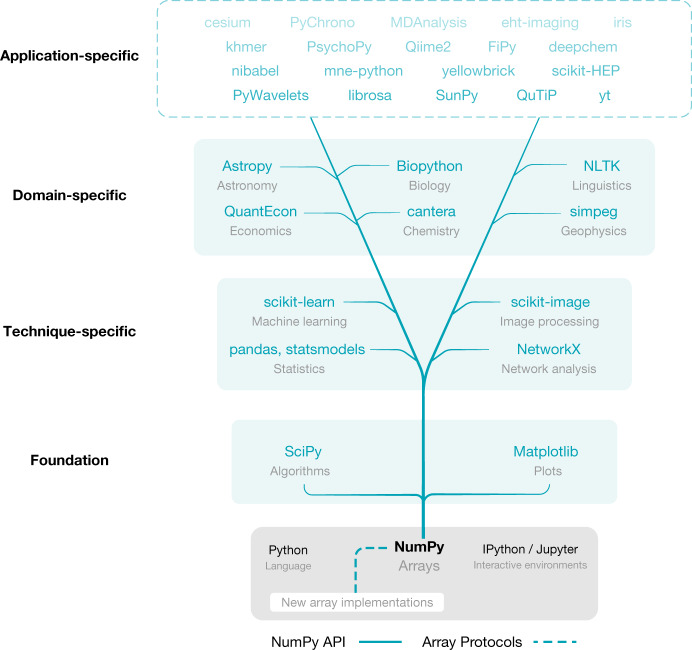
“2) builds on top of this foundation to provide several, widely used technique specific libraries [16, 17, 23], that in turn underlay numerous domain specific projects [24, 25, 26, 27, 28, 29].”
BackgroundSelf-citationMatplotlib: a 2D graphics environment
Hunter, J. D. (2007) · Computing in Science & Engineering · doi:10.1109/mcse.2007.55 · Cited by 39,249 · cited 2×
“[14] J.”
BackgroundSciPy 1.0: fundamental algorithms for scientific computing in Python
Virtanen, P., Gommers, R., Oliphant, T. E., Haberland, M., Reddy, T., Cournapeau, D., Burovski, E., Peterson, P., Weckesser, W., Bright, J., et al. (2020) · Nature Methods · doi:10.1038/s41592-019-0686-2 · Cited by 38,430 · cited 2×
“Now, fifteen years later, NumPy underpins almost every Python library that does scientific or numerical computation including SciPy [13], Matplotlib [14], pandas [15], scikit-learn [16], and scikit-image [17].”
BackgroundSelf-citationPyTorch: An Imperative Style, High-Performance Deep Learning Library
Paszke, A., Gross, S., Massa, F., Lerer, A., Bradbury, J., Chanan, G., Killeen, T., Lin, Z., Gimelshein, N., Antiga, L., et al. (2019) · arXiv · doi:10.48550/arxiv.1912.01703 · Cited by 31,473 · cited 2×
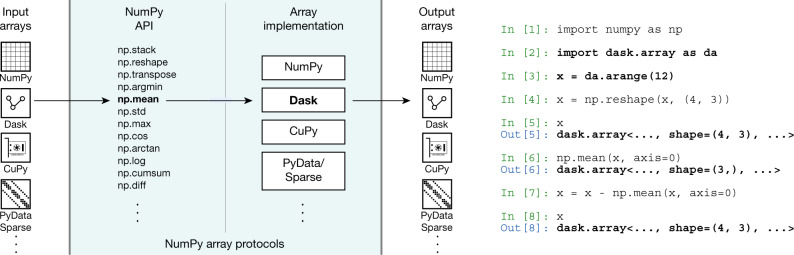
“For example, each deep learning framework created its own arrays; PyTorch [38], Tensorflow [39], Apache MXNet [40], and JAX arrays all have the capability to run on CPUs and GPUs, in a distributed fashion, utilizing lazy evaluation to allow for additional performance optimizations.”
MethodAstropy: A community Python package for astronomy
The Astropy Collaboration, Robitaille, T. P., Tollerud, E. J., Greenfield, P., Droettboom, M., Bray, E., Aldcroft, T., Davis, M., Ginsburg, A., Price-Whelan, A. M., et al. (2013) · Astronomy & Astrophysics · doi:10.1051/0004-6361/201322068 · Cited by 14,620 · cited 3×
“Astropy [24, 25] handles standard astronomical file formats and computes time/coordinate transformations.”
BackgroundObservation of Gravitational Waves from a Binary Black Hole Merger
Abbott, B. P., Abbott, R., Abbott, T. D., Abernathy, M. R., Acernese, F., Ackley, K., Adams, C., Adams, T., Addesso, P., Adhikari, R. X., et al. (2016) · Physical Review Letters · doi:10.1103/physrevlett.116.061102 · Cited by 14,151
TensorFlow: A system for large-scale machine learning
Abadi, M., Barham, P., Chen, J., Chen, Z., Davis, A., Dean, J., Devin, M., Ghemawat, S., Irving, G., Isard, M., et al. (2016) · arXiv (Cornell University) · doi:10.48550/arxiv.1605.08695 · Cited by 11,822
R: A Language for Data Analysis and Graphics
Ihaka, R., & Gentleman, R. (1996) · Journal of Computational and Graphical Statistics · doi:10.1080/10618600.1996.10474713 · Cited by 11,220 · cited 2×
“The design of this new tool was informed by other powerful interactive programming languages for scientific computing such as Basis [47], Yorick [48], R [49], and APL [50], as well as commercial languages and environments like IDL and MATLAB.”
MethodData Structures for Statistical Computing in Python
McKinney, W. (2010) · Proceedings of the Python in Science Conference · doi:10.25080/majora-92bf1922-00a · Cited by 11,032 · cited 2×
“Now, fifteen years later, NumPy underpins almost every Python library that does scientific or numerical computation including SciPy [13], Matplotlib [14], pandas [15], scikit-learn [16], and scikit-image [17].”
BackgroundSciPy 1.0: fundamental algorithms for scientific computing in Python
Virtanen, P., Gommers, R., Oliphant, T. E., Haberland, M., Reddy, T., Cournapeau, D., Burovski, E., Peterson, P., Weckesser, W., Bright, J., et al. (2019) · Apollo - University of Cambridge Repository · doi:10.17863/cam.64134 · Cited by 10,460
Self-citation
Research works printed but not linked: 11
- Yang, T.-Y., Furnish, G. & Dubois, P. F. Steering object-oriented scientific computations. In Proc. TOOLS USA 97. Intl Conf. Technology of Object Oriented Systems and Languages (eds Ege, R., Singh, M. & Meyer, B.) 112–119 (IEEE, 1997).
- Hamman, J., Rocklin, M. & Abernathy, R. Pangeo: a big-data ecosystem for scalable Earth system science. In EGU General Assembly Conf. Abstracts 12146 (2018).
- van der Walt, S. The SciPy Documentation Project (technical overview). In Proc. 7th Python in Science Conf. (SciPy 2008) (eds Varoquaux, G., Vaught, T. & Millman, K. J.) 27–28 (2008).
- Harrington, J. The SciPy Documentation Project. In Proc. 7th Python in Science Conference (SciPy 2008) (eds Varoquaux, G., Vaught, T. & Millman, K. J.) 33–35 (2008).
- Harrington, J. & Goldsmith, D. Progress report: NumPy and SciPy documentation in 2009. In Proc. 8th Python in Science Conf. (SciPy 2009) (eds Varoquaux, G., van der Walt, S. & Millman, K. J.) 84–87 (2009).
- Entschev, P. Distributed multi-GPU computing with Dask, CuPy and RAPIDS. In EuroPython 2019 https://ep2019.europython.eu/media/conference/slides/fX8dJsD-distributed-multi-gpu-computing-with-dask-cupy-and-rapids.pdf (2019).
- Barrett, K. A., Chiu, Y. H., Painter, J. F., Motteler, Z. C. & Dubois, P. F. Basis System, Part I: Running a Basis Program—A Tutorial for Beginners UCRL-MA-118543, Vol. 1 (Lawrence Livermore National Laboratory 1995).
- Dubois, P. F. & Motteler, Z. Basis System, Part II: Basis Language Reference Manual UCRL-MA-118543, Vol. 2 (Lawrence Livermore National Laboratory, 1995).
- Chiu, Y. H. & Dubois, P. F. Basis System, Part III: EZN User Manual UCRL-MA-118543, Vol. 3 (Lawrence Livermore National Laboratory, 1995).
- Chiu, Y. H. & Dubois, P. F. Basis System, Part IV: EZD User Manual UCRL-MA-118543, Vol. 4 (Lawrence Livermore National Laboratory, 1995).
- Lattner, C. & Adve, V. LLVM: a compilation framework for lifelong program analysis and transformation. In Proc. 2004 Intl Symp. Code Generation and Optimization (CGO’04) 75–88 (IEEE, 2004).
Cited by
Highly accurate protein structure prediction with AlphaFold
Jumper, J., Evans, R., Pritzel, A., Green, T., Figurnov, M., Ronneberger, O., Tunyasuvunakool, K., Bates, R., Žídek, A., Potapenko, A., et al. (2021) · Nature · doi:10.1038/s41586-021-03819-2 · Cited by 43,764
Learning Transferable Visual Models From Natural Language Supervision
Radford, A., Kim, J. W., Hallacy, C., Ramesh, A., Goh, G., Agarwal, S., Sastry, G., Askell, A., Mishkin, P., Clark, J., et al. (2021) · arXiv · doi:10.48550/arxiv.2103.00020 · Cited by 15,293
AutoDock Vina 1.2.0: New Docking Methods, Expanded Force Field, and Python Bindings
Eberhardt, J., Santos-Martins, D., Tillack, A. F., & Forli, S. (2021) · Journal of Chemical Information and Modeling · doi:10.1021/acs.jcim.1c00203 · Cited by 7,546
seaborn: statistical data visualization
Waskom, M. (2021) · Journal of Open Source Software · doi:10.21105/joss.03021 · Cited by 7,310
“…further tweaking – reducing the chance of interpretive errors – but seaborn also accepts data from a variety of more basic formats, including numpy (Harris et al., 2020) arrays and simple Python collection types. seaborn also offers multiple built-in themes that users can select to modify the…”
BackgroundCellpose: a generalist algorithm for cellular segmentation
Stringer, C., Wang, T., Michaelos, M., & Pachitariu, M. (2021) · Nature Methods · doi:10.1038/s41592-020-01018-x · Cited by 4,369
Metadata
- Authors
- Harris, C. R., Millman, K. J., van der Walt, S. J., Gommers, R., Virtanen, P., Cournapeau, D., Wieser, E., Taylor, J., Berg, S., Smith, N. J., Kern, R., Picus, M., Hoyer, S., van Kerkwijk, M. H., Brett, M., Haldane, A., del Río, J. F., Wiebe, M., Peterson, P., Gérard-Marchant, P., Sheppard, K., Reddy, T., Weckesser, W., Abbasi, H., Gohlke, C., & Oliphant, T. E.
- Affiliations
- University of California, Berkeley (US)
- Quansight (United States) (US)
- University of Jyväskylä (FI)
- University of Cambridge (GB)
- Enthought (United States) (US)
- Google (United States) (US)
- University of Birmingham (GB)
- Temple University (US)
- Amazon (United States) (US)
- Tallinn University of Technology (EE)
- University of Georgia (US)
- University of Oxford (GB)
- Los Alamos National Laboratory (US)
- University of California, Irvine (US)
- Corresponding author
- Millman, K. Jarrod
- Gommers, Ralf
- ORCID
- Venue
- Nature
- Published
- 2020-09-16
- Volume
- 585
- Issue
- 7825
- Pages
- 357-362
- ISSN
- 0028-0836 (ISSN-L)
- 1476-4687
- PMC
- PMC7759461
- OpenAlex
- W3035965352
- Semantic Scholar
- 024a2c03be8e468e7c4fdf9bda36cdc0eaae85fb
- Cited by
- 23,826
- References
- 40
- Citations by year
- 2026: 4948 · 2025: 5392 · 2024: 4557 · 2023: 3671 · 2022: 3110 · 2021: 1994 · 2020: 142
- FWCI
- 77.10
- Type
- journal article
- Language
- en
- Open access
- hybrid
- doi.org
- Licence
- cc-by
- creativecommons.org/licenses/by/4.0 (tdm)
- creativecommons.org/licenses/by/4.0 (vor)
- Locations
- Nature (publishedVersion, cc-by)
- Europe PMC (PubMed Central) (publishedVersion, other-oa)
- PubMed Central (publishedVersion, cc-by)
- PubMed (publishedVersion)
- arXiv (Cornell University) (submittedVersion)
- Jyväskylä University Digital Archive (University of Jyväskylä) (submittedVersion, cc-by)
- eScholarship (California Digital Library) (submittedVersion, cc-by)
- arXiv (Cornell University) (cc-by)
- Funders
- Alfred P. Sloan Foundation (g-2017-9960, 2013-10-27)
- Gordon and Betty Moore Foundation (GBMF5447, GBMF3834)
- Topics
- Physical Sciences › Computer Science › Software › Computational Physics and Python Applications
- Social Sciences › Decision Sciences › Information Systems and Management › Scientific Computing and Data Management
- Physical Sciences › Computer Science › Hardware and Architecture › Parallel Computing and Optimization Techniques
- Keywords
- array programming, NumPy, Python, scientific computing, multidimensional arrays, matrix-vector operations, scientific data analysis, scientific Python ecosystem, gravitational waves, black hole imaging
- MeSH terms
- Mathematics, Programming Languages, Software Design, Computational Biology
About these checks
Registry, retraction, Cites and statistics results are computed, not judged, with one exception: a printed reference that no index lists is read once by a model before it counts as a citation error. Claims are extracted by a model and kept only when their quote appears verbatim in the text; each cited source is then checked, with a model’s help, for whether it says what the claim relies on. Those verdicts can be wrong — read the claim’s quote and the cited source before relying on one.
Statistics and arithmetic are recomputed, not judged.
Confidence bands are shown only for fields calibrated on our annotated test set. None is calibrated yet, so no band is shown.
What counts as a claim ›How we measure confidence ›How we check this ›
Are you an author, or do you see a problem with this page? Request a review
How to cite
Cite CoChat for the checks on this page, and the paper for its own findings.
- This page
- CoChat. (2026). Citation check: Array programming with NumPy. https://app.cochat.ai/papers/10.1038/s41586-020-2649-2
- The paper
- Harris, C. R., Millman, K. J., van der Walt, S. J., Gommers, R., Virtanen, P., Cournapeau, D., Wieser, E., Taylor, J., Berg, S., Smith, N. J., Kern, R., Picus, M., Hoyer, S., van Kerkwijk, M. H., Brett, M., Haldane, A., del Río, J. F., Wiebe, M., Peterson, P., . . . Oliphant, T. E. (2020). Array programming with NumPy. Nature. https://doi.org/10.1038/s41586-020-2649-2
Data sources
Bibliographic data: Semantic Scholar, OpenAlex, Crossref.
Contains information from the Semantic Scholar Academic Graph Datasets, made available under the ODC Attribution License (ODC-BY 1.0).
Semantic Scholar’s data is described in: Kinney, R., et al. (2023). The Semantic Scholar Open Data Platform. arXiv:2301.10140.
