

SciPy 1.0: fundamental algorithms for scientific computing in Python
Open accessThe DOI matches its Crossref record; 74 of the 74 references it cites were found in a registry or an index.
Abstract
SciPy is an open-source scientific computing library for the Python programming language. Since its initial release in 2001, SciPy has become a de facto standard for leveraging scientific algorithms in Python, with over 600 unique code contributors, thousands of dependent packages, over 100,000 dependent repositories and millions of downloads per year. In this work, we provide an overview of the capabilities and development practices of SciPy 1.0 and highlight some recent technical developments.
Overview
The claims and statistics of this paper haven’t been checked yet.
Free: it reads the open-access text and checks the first 5 claims that cite a source we can check. Create a free account to check every claim.
Integrity signals
Registry
Cites
Statistics
Figures

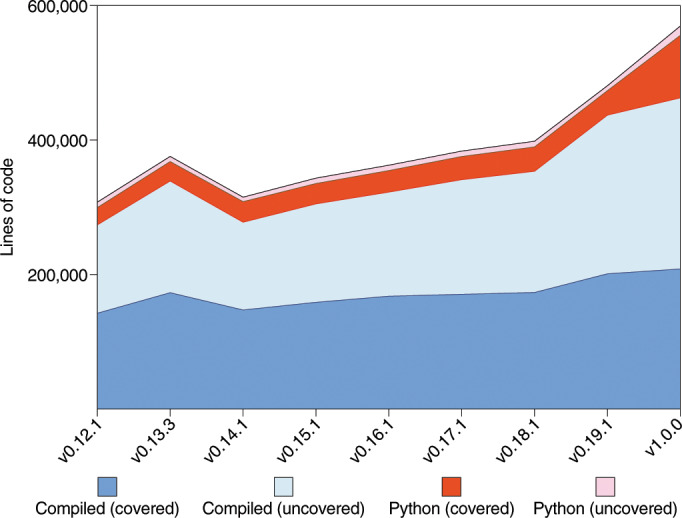
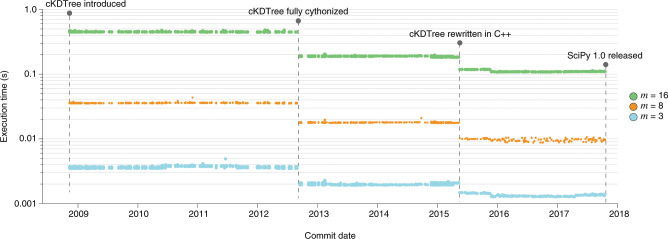
Verification
Claims the paper makes
The claims and statistics of this paper haven’t been checked yet.
Free: it reads the open-access text and checks the first 5 claims that cite a source we can check. Create a free account to check every claim.
Claims other papers make about this one
Each is checked against this paper’s own text: does it say what the citing paper says it does?
The cited source says what the claim attributes to it.
In the citing paper
“We recently updated Circuitscape [34], a widely used, open-source connectivity analysis software package, by migrating it from Python [35] to the Julia programming language [33].”
From Circuitscape in julia: empowering dynamic approaches to connectivity assessment (2021) · cites this paper as [35]
The cited source says what the claim attributes to it.
In the citing paper
“It made heavy use of several of Python's numerical code libraries (numpy [182], scipy [35] and pyamg [183]), which improved computational efficiency, and allowed users to solve problems with millions of nodes.”
From Circuitscape in julia: empowering dynamic approaches to connectivity assessment (2021) · cites this paper as [35]
Self-check
Percentages, sums and reported differences re-computed from the paper’s own numbers.
The self-check needs the paper’s full text.
Citations
Cites
Scikit-learn: Machine Learning in Python
Pedregosa, F., Varoquaux, G., Gramfort, A., Michel, V., Thirion, B., Grisel, O., Blondel, M., Müller, A., Nothman, J., Louppe, G., et al. (2012) · arXiv · doi:10.48550/arxiv.1201.0490 · Cited by 71,016
Self-citationStorn, R., & Price, K. (1997) · Journal of Global Optimization · doi:10.1023/a:1008202821328 · Cited by 29,569
A Simplex Method for Function Minimization
Nelder, J. A., & Mead, R. (1965) · The Computer Journal · doi:10.1093/comjnl/7.4.308 · Cited by 28,905
Observation of Gravitational Waves from a Binary Black Hole Merger
Abbott, B. P., Abbott, R., Abbott, T. D., Abernathy, M. R., Acernese, F., Ackley, K., Adams, C., Adams, T., Addesso, P., Adhikari, R. X., et al. (2016) · Physical Review Letters · doi:10.1103/physrevlett.116.061102 · Cited by 14,151
<tt>emcee</tt>: The MCMC Hammer
Foreman-Mackey, D., Hogg, D. W., Lang, D., & Goodman, J. (2013) · Publications of the Astronomical Society of the Pacific · doi:10.1086/670067 · Cited by 12,414
de Boor, C. (1978) · Applied Mathematical Sciences · doi:10.1007/978-1-4612-6333-3 · Cited by 11,944
GW170817: Observation of Gravitational Waves from a Binary Neutron Star Inspiral
Abbott, B. P., Abbott, R., Abbott, T. D., Acernese, F., Ackley, K., Adams, C., Adams, T., Addesso, P., Adhikari, R. X., Adya, V. B., et al. (2017) · Physical Review Letters · doi:10.1103/physrevlett.119.161101 · Cited by 9,473
Self-citationThe NumPy Array: A Structure for Efficient Numerical Computation
van der Walt, S., Colbert, S. C., & Varoquaux, G. (2011) · Computing in Science & Engineering · doi:10.1109/mcse.2011.37 · Cited by 9,381
The Astropy Project: Building an Open-science Project and Status of the v2.0 Core Package*
The Astropy Collaboration, Price-Whelan, A. M., Sipőcz, B. M., Günther, H. M., Lim, P. L., Crawford, S. M., Conseil, S., Shupe, D. L., Craig, M. W., Dencheva, N., et al. (2018) · The Astronomical Journal · doi:10.3847/1538-3881/aabc4f · Cited by 7,687
Self-citationExploring Network Structure, Dynamics, and Function Using NetworkX
Hagberg, A. A., Schult, D. A., & Swart, P. J. (2008) · Proceedings of the Python in Science Conference · doi:10.25080/tcwv9851 · Cited by 7,477 · cited 2×
“For example, SciPy provides what one expects to find in a statistics textbook (probability distributions, hypothesis tests, frequency statistics, correlation functions, and more), whereas Statsmodels 45 provides more advanced statistical estimators and inference methods, scikit-learn 3 covers machine learning, and PyM…”
Method
Research works printed but not linked: 15
- 16. Oliphant, T. E. Moving forward from the last decade of SciPy. Presentation slides, https://conference.scipy.org/scipy2010/slides/travis_oliphant_keynote.pdf (1 July 2010).
- 19. Peterson P F2PY: a tool for connecting Fortran and Python programs Int. J. Comput. Sci. Eng. 2009 4 296 305
- 25. Vaught, T. N. [ANN] SciPy ‘02 - Python for Scientific Computing Workshop, https://mail.python.org/pipermail/numpy-discussion/2002-June/001511.html (2002).
- 27. Greenfield, P. How Python slithered Into astronomy. Presentation, https://conference.scipy.org/scipy2011/slides/greenfield_keynote_astronomy.pdf (2011).
- 33. Harrington, J. The SciPy documentation project. In Proceedings of the 7th Python in Science Conference (eds G. Varoquaux, G., Vaught, T. & Millman, K. J.) 33–35 (2008).
- 34. van der Walt, S. The SciPy documentation project (technical overview). In Proceedings of the 7th Python in Science Conference (eds G. Varoquaux, G., Vaught, T. & Millman, K. J.) 27–28 (2008).
- 36. Pérez, F., Langtangen, H. P. & LeVeque, R. Python for scientific computing. In SIAM Conference on Computational Science and Engineering,42 (5) (2009).
- 61. Kernighan, B. W. & Ritchie, D. M. The C Programming Language 2nd edn (Prentice Hall Professional Technical Reference, 1988).
- 72. Cormen, T. H., Stein, C., Rivest, R. L. & Leiserson, C. E. Introduction to Algorithms 2nd edn (McGraw-Hill Higher Education, 2001).
- 80. Andersen ED Andersen KD Presolving in linear programming Math. Program. 1995 71 221 245
- 84. Dierckx, P. Curve and Surface Fitting with Splines (Oxford Univ. Press, 1993). · DOI · Paper page
- 91. Beck, K. Test-driven Development: By Example (Addison-Wesley, 2003).
- 103. Powell MJD A view of algorithms for optimization without derivatives Math. Today Bull. Inst. Math. Appl. 2007 43 170 174
- 104. Polak E Ribiere G Note sur la convergence de methodes de directions conjuguees Rev. française d’informatique et. de. Rech. op.érationnelle 1969 3 35 43
- 105. Nocedal, J. & Wright, S. Numerical Optimization 2nd edn (Springer Science & Business Media, 2006).
Cited by
Harris, C. R., Millman, K. J., van der Walt, S. J., Gommers, R., Virtanen, P., Cournapeau, D., Wieser, E., Taylor, J., Berg, S., Smith, N. J., et al. (2020) · Nature · doi:10.1038/s41586-020-2649-2 · Cited by 23,826
“Now, fifteen years later, NumPy underpins almost every Python library that does scientific or numerical computation including SciPy [13], Matplotlib [14], pandas [15], scikit-learn [16], and scikit-image [17].”
BackgroundSelf-citationHarris, C., Millman, K., van der Walt, S., Gommers, R., Virtanen, P., Cournapeau, D., Wieser, E., Taylor, J., Berg, S., Smith, N., et al. (2020) · RePEc: Research Papers in Economics · Cited by 17,844
Self-citationLearning Transferable Visual Models From Natural Language Supervision
Radford, A., Kim, J. W., Hallacy, C., Ramesh, A., Goh, G., Agarwal, S., Sastry, G., Askell, A., Mishkin, P., Clark, J., et al. (2021) · arXiv · doi:10.48550/arxiv.2103.00020 · Cited by 15,293
The Astropy Collaboration, Price-Whelan, A. M., Lim, P. L., Earl, N., Starkman, N., Bradley, L., Shupe, D. L., Patil, A. A., Corrales, L., Brasseur, C. E., et al. (2022) · The Astrophysical Journal · doi:10.3847/1538-4357/ac7c74 · Cited by 5,022
“…domain specific, this landscape now includes packages that provide core numerical analysis functionality like numpy Harris et al. (2020) and scipy Virtanen et al. (2020), visualization frameworks like matplotlib (Hunter 2007), machine-learning and data analysis packages like tensorflow (Abadi et…”
MethodSelf-citationGaia Early Data Release 3: Summary of the contents and survey properties
Gaia Collaboration, Brown, A. G. A., Vallenari, A., Prusti, T., de Bruijne, J. H. J., Babusiaux, C., Biermann, M., Creevey, O. L., Evans, D. W., Eyer, L., et al. (2021) · Astronomy & Astrophysics · doi:10.1051/0004-6361/202039657 · Cited by 578
Metadata
- Authors
- Virtanen, P., Gommers, R., Oliphant, T. E., Haberland, M., Reddy, T., Cournapeau, D., Burovski, E., Peterson, P., Weckesser, W., Bright, J., van der Walt, S. J., Brett, M., Wilson, J., Millman, K. J., Mayorov, N., Nelson, A. R. J., Jones, E., Kern, R., Larson, E., Carey, C. J., Polat, İ., Feng, Y., Moore, E. W., VanderPlas, J., Laxalde, D., Perktold, J., Cimrman, R., Henriksen, I., Quintero, E. A., Harris, C. R., Archibald, A. M., Ribeiro, A. H., Pedregosa, F., van Mulbregt, P., Contributors, S. 1. 0., Vijaykumar, A., Bardelli, A. P., Rothberg, A., Hilboll, A., Kloeckner, A., Scopatz, A., Lee, A., Rokem, A., Woods, C. N., Fulton, C., Masson, C., Häggström, C., Fitzgerald, C., Nicholson, D. A., Hagen, D. R., Pasechnik, D. V., Olivetti, E., Martin, E., Wieser, E., Silva, F., Lenders, F., Wilhelm, F., Young, G., Price, G. A., Ingold, G.-L., Allen, G. E., Lee, G. R., Audren, H., Probst, I., Dietrich, J. P., Silterra, J., Webber, J. T., Slavič, J., Nothman, J., Buchner, J., Kulick, J., Schönberger, J. L., de Miranda Cardoso, J. V., Reimer, J., Harrington, J., Rodríguez, J. L. C., Nunez-Iglesias, J., Kuczynski, J., Tritz, K., Thoma, M., Newville, M., Kümmerer, M., Bolingbroke, M., Tartre, M., Pak, M., Smith, N. J., Nowaczyk, N., Shebanov, N., Pavlyk, O., Brodtkorb, P. A., Lee, P., McGibbon, R. T., Feldbauer, R., Lewis, S., Tygier, S., Sievert, S., Vigna, S., Peterson, S., More, S., Pudlik, T., Oshima, T., Pingel, T. J., Robitaille, T. P., Spura, T., Jones, T. R., Cera, T., Leslie, T., Zito, T., Krauss, T., Upadhyay, U., Halchenko, Y. O., & Vázquez-Baeza, Y.
- Affiliations
- University of Jyväskylä (FI)
- Quansight (United States) (US)
- Brigham Young University (US)
- California Polytechnic State University (US)
- Los Alamos National Laboratory (US)
- National Research University Higher School of Economics (RU)
- Tallinn University of Technology (EE)
- University of California, Berkeley (US)
- University of Birmingham (GB)
- WayRay (Russia) (RU)
- Australian Nuclear Science and Technology Organisation (AU)
- Enthought (United States) (US)
- University of Washington (US)
- University of Massachusetts Amherst (US)
- Bruker (United States) (US)
- University of West Bohemia in Pilsen (CZ)
- Utah State University Space Dynamics Laboratory (US)
- University of Amsterdam (NL)
- Universidade Federal de Minas Gerais (BR)
- Tata Institute of Fundamental Research (IN)
- University of Bremen (DE)
- University of Illinois Urbana-Champaign (US)
- Centre National de la Recherche Scientifique (FR)
- Federal Reserve Board of Governors (US)
- Orexplore (Sweden) (SE)
- University of California, Davis (US)
- Emory University (US)
- Applied BioMath (United States) (US)
- Fondazione Bruno Kessler (IT)
- University of Cambridge (GB)
- Heidelberg University (DE)
- Lawrence Berkeley National Laboratory (US)
- University of Augsburg (DE)
- Applied Research Laboratories, The University of Texas at Austin (US)
- Cincinnati Children's Hospital Medical Center (US)
- École nationale supérieure de techniques avancées Bretagne (FR)
- Excellence Cluster Universe (DE)
- Chan Zuckerberg Biohub San Francisco (US)
- University of Ljubljana (SI)
- The University of Sydney (AU)
- Pontificia Universidad Católica de Chile (CL)
- University of Stuttgart (DE)
- Christian-Albrechts-Universität zu Kiel (DE)
- University of Central Florida (US)
- Monash University (AU)
- University of Colorado Boulder (US)
- Johns Hopkins University (US)
- University of Chicago (US)
- University of Tübingen (DE)
- Two Sigma Investments (United States) (US)
- Technical University of Munich (DE)
- Intel (United States) (US)
- D. E. Shaw Research (US)
- University of Vienna (AT)
- University of Manchester (GB)
- University of Wisconsin–Madison (US)
- University of Milan (IT)
- Kavli Institute for the Physics and Mathematics of the Universe (JP)
- Niigata University (JP)
- Virginia Tech (US)
- Broad Institute (US)
- Humboldt-Universität zu Berlin (DE)
- Max Planck Society (DE)
- Dartmouth College (US)
- University of California San Diego (US)
- Corresponding author
- Gommers, Ralf
- Haberland, Matt
- Reddy, Tyler
- ORCID
- Virtanen, Pauli
- Gommers, Ralf
- Haberland, Matt
- Reddy, Tyler
- Burovski, Evgeni
- van der Walt, Stéfan J.
- Millman, K. Jarrod
- Nelson, Andrew R. J.
- Polat, İlhan
- Laxalde, Denis
- Henriksen, Ian
- Quintero, E. A.
- Archibald, Anne M.
- Ribeiro, Antônio H.
- van Mulbregt, Paul
- Vijaykumar, Aditya
- Lee, Antony
- Rokem, Ariel
- Hagen, David R.
- Olivetti, Emanuele
- Wieser, Eric
- Silva, Fabrice
- Lenders, Felix
- Ingold, Gert-Ludwig
- Audren, Hervé
- Webber, James T
- Slavič, Janko
- Harrington, Joseph
- Nunez-Iglesias, Juan
- McGibbon, Robert T.
- Feldbauer, Roman
- Tygier, Sam
- Pingel, Thomas J.
- Spura, Thomas
- Jones, Thouis R.
- Zito, Tiziano
- Halchenko, Yaroslav O.
- Venue
- Nature Methods
- Published
- 2020-02-03
- Volume
- 17
- Issue
- 3
- Pages
- 261-272
- ISSN
- 1548-7091 (ISSN-L)
- 1548-7105
- PMC
- PMC7056644
- OpenAlex
- W3003257820
- Cited by
- 38,430
- References
- 70
- Citations by year
- 2026: 7003 · 2025: 8153 · 2024: 6915 · 2023: 5719 · 2022: 4839 · 2021: 3960 · 2020: 1561
- FWCI
- 138.34
- Type
- journal article
- Language
- en
- Update notices
- correction (2020-02-24)
- Open access
- hybrid
- doi.org
- Licence
- cc-by
- creativecommons.org/licenses/by/4.0 (tdm)
- creativecommons.org/licenses/by/4.0 (vor)
- Locations
- Nature Methods (publishedVersion, cc-by)
- PubMed Central (publishedVersion, cc-by)
- PubMed (publishedVersion)
- arXiv (Cornell University) (submittedVersion)
- Archivio Istituzionale della Ricerca (Universita Degli Studi Di Milano) (submittedVersion, cc-by)
- Institutional Research Information System (Università degli Studi di Trento) (submittedVersion, cc-by)
- Jyväskylä University Digital Archive (University of Jyväskylä) (submittedVersion, cc-by)
- OSTI OAI (U.S. Department of Energy Office of Scientific and Technical Information) (submittedVersion)
- Monash University Research Portal (Monash University) (submittedVersion, cc-by)
- HAL (submittedVersion, cc-by)
- Digital Library (University of West Bohemia) (submittedVersion)
- eScholarship (California Digital Library) (submittedVersion, cc-by)
- Cambridge University Engineering Department Publications Database (submittedVersion)
- mediaTUM – the media and publications repository of the Technical University Munich (Technical University Munich) (submittedVersion, other-oa)
- Research Explorer (The University of Manchester) (submittedVersion, other-oa)
- Science and Technology Facilities Council (submittedVersion)
- OPUS (Augsburg University) (submittedVersion, cc-by)
- arXiv (Cornell University) (cc-by)
- Funders
- U.S. Department of Energy (#89233218CNA000001)
- Kessler Foundation
- Emory University
- University of Wisconsin-Madison
- Cincinnati Children's Hospital Medical Center
- University of Chicago
- Virginia Polytechnic Institute and State University
- University of Washington
- Johns Hopkins University
- University of Central Florida
- University of Cincinnati
- Dartmouth College
- University of Texas at Austin
- Università degli Studi di Milano
- Broad Institute
- University of Oxford
- Tata Institute of Fundamental Research
- University of Sydney
- Monash University
- Eberhard Karls Universität Tübingen
- Universität Wien
- Centre National de la Recherche Scientifique
- Technische Universität Braunschweig
- Technische Universität München
- Université de Bordeaux
- Birla Institute of Technology and Science, Pilani
- Univerza v Ljubljani
- Universität Bremen
- Universität Stuttgart
- Pontificia Universidad Católica de Chile
- University of Illinois at Urbana-Champaign
- National Nuclear Security Administration (89233218C-NA000001)
- University of California, San Diego
- Science and Technology Facilities Council (ST/P002056/1)
- Lawrence Berkeley National Laboratory
- Los Alamos National Laboratory (89233218CNA 000001)
- Topics
- Physical Sciences › Computer Science › Software › Computational Physics and Python Applications
- Social Sciences › Decision Sciences › Information Systems and Management › Scientific Computing and Data Management
- Physical Sciences › Mathematics › Modeling and Simulation › Modeling and Simulation Systems
- Keywords
- SciPy, scientific computing, Python, open source software, numerical algorithms, software development practices
- MeSH terms
- Algorithms, Computer Simulation, Models, Biological, Programming Languages, Signal Processing, Computer-Assisted, Software, Linear Models, Nonlinear Dynamics, Computational Biology, History, 20th Century, History, 21st Century
About these checks
Registry, retraction, Cites and statistics results are computed, not judged, with one exception: a printed reference that no index lists is read once by a model before it counts as a citation error. Claims are extracted by a model and kept only when their quote appears verbatim in the text; each cited source is then checked, with a model’s help, for whether it says what the claim relies on. Those verdicts can be wrong — read the claim’s quote and the cited source before relying on one.
Statistics and arithmetic are recomputed, not judged.
Confidence bands are shown only for fields calibrated on our annotated test set. None is calibrated yet, so no band is shown.
What counts as a claim ›How we measure confidence ›How we check this ›
Are you an author, or do you see a problem with this page? Request a review
How to cite
Cite CoChat for the checks on this page, and the paper for its own findings.
- This page
- CoChat. (2026). Citation check: SciPy 1.0: fundamental algorithms for scientific computing in Python. https://app.cochat.ai/papers/10.1038/s41592-019-0686-2
- The paper
- Virtanen, P., Gommers, R., Oliphant, T. E., Haberland, M., Reddy, T., Cournapeau, D., Burovski, E., Peterson, P., Weckesser, W., Bright, J., van der Walt, S. J., Brett, M., Wilson, J., Millman, K. J., Mayorov, N., Nelson, A. R. J., Jones, E., Kern, R., Larson, E., . . . Vázquez-Baeza, Y. (2020). SciPy 1.0: fundamental algorithms for scientific computing in Python. Nature Methods. https://doi.org/10.1038/s41592-019-0686-2
Data sources
Bibliographic data: Semantic Scholar, OpenAlex, Crossref.
Contains information from the Semantic Scholar Academic Graph Datasets, made available under the ODC Attribution License (ODC-BY 1.0).
Semantic Scholar’s data is described in: Kinney, R., et al. (2023). The Semantic Scholar Open Data Platform. arXiv:2301.10140.
