

The DOI matches its Crossref record; 51 of the 52 references it cites were found in a registry or an index.
Akkermansia muciniphila phospholipid induces homeostatic immune responses
Open accessAbstract
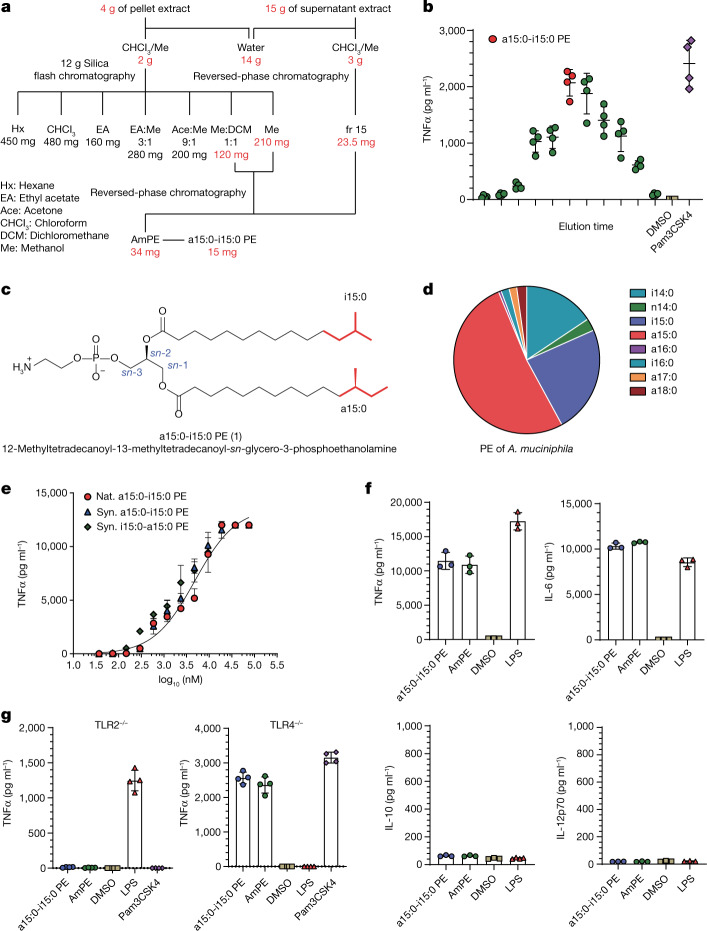
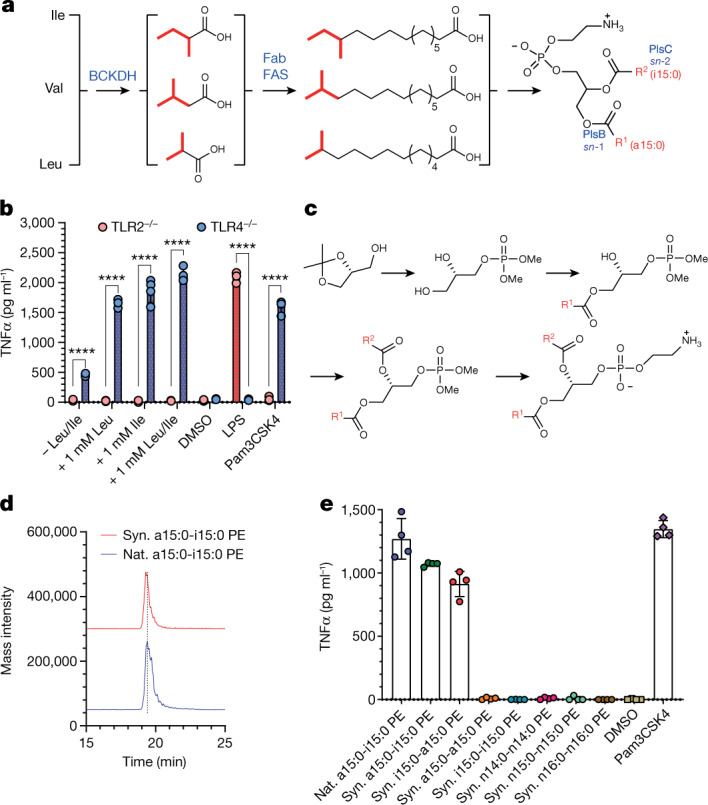
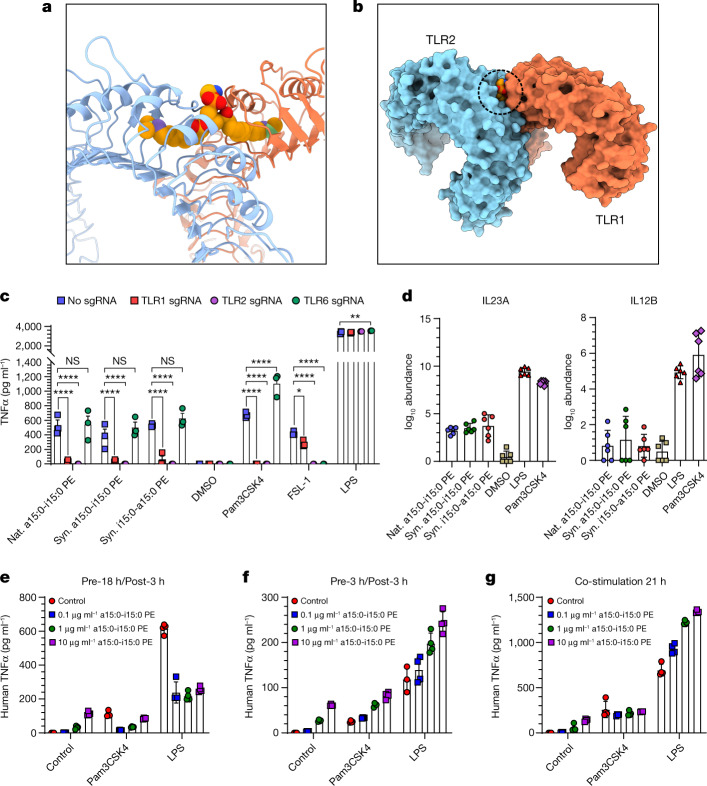
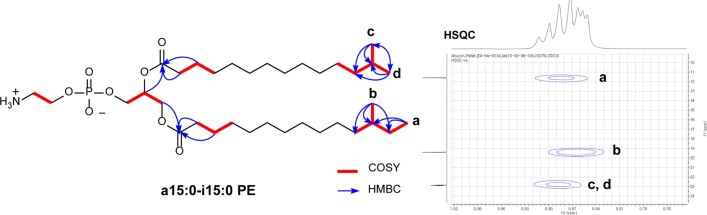
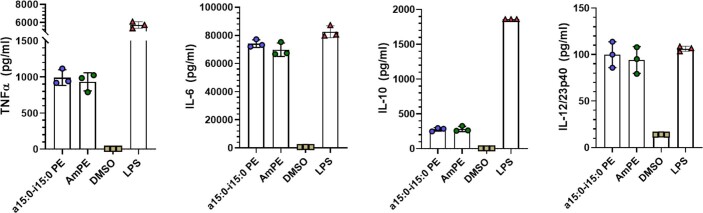
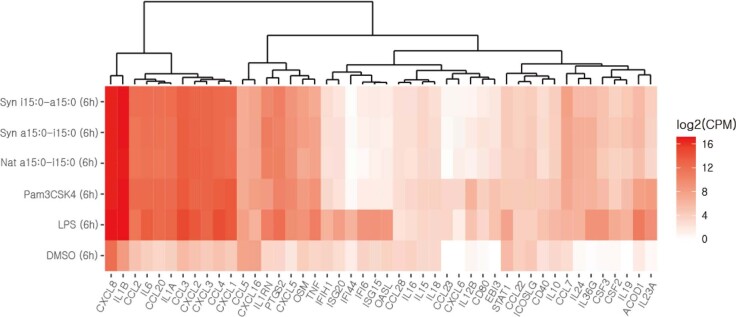
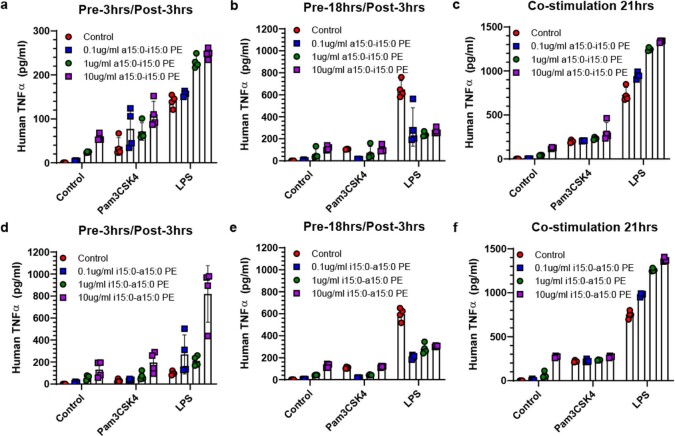
Abstract Multiple studies have established associations between human gut bacteria and host physiology, but determining the molecular mechanisms underlying these associations has been challenging 1–3 . Akkermansia muciniphila has been robustly associated with positive systemic effects on host metabolism, favourable outcomes to checkpoint blockade in cancer immunotherapy and homeostatic immunity 4–7 . Here we report the identification of a lipid from A. muciniphila ’s cell membrane that recapitulates the immunomodulatory activity of A. muciniphila in cell-based assays 8 . The isolated immunogen, a diacyl phosphatidylethanolamine with two branched chains (a15:0-i15:0 PE), was characterized through both spectroscopic analysis and chemical synthesis. The immunogenic activity of a15:0-i15:0 PE has a highly restricted structure–activity relationship, and its immune signalling requires an unexpected toll-like receptor TLR2–TLR1 heterodimer 9,10 . Certain features of the phospholipid’s activity are worth noting: it is significantly less potent than known natural and synthetic TLR2 agonists; it preferentially induces some inflammatory cytokines but not others; and, at low doses (1% of EC 50 ) it resets activation thresholds and responses for immune signalling. Identifying both the molecule and an equipotent synthetic analogue, its non-canonical TLR2–TLR1 signalling pathway, its immunomodulatory selectivity and its low-dose immunoregulatory effects provide a molecular mechanism for a model of A. muciniphila’ s ability to set immunological tone and its varied roles in health and disease.
Overview
The claims and statistics of this paper haven’t been checked yet.
Run the check — free, no account needed. It reads the open-access text and checks the sources it cites.
Integrity signals
Registry
Cites
Statistics
Figures
Verification
Claims the paper makes
The claims and statistics of this paper haven’t been checked yet.
Run the check — free, no account needed. It reads the open-access text and checks the sources it cites.
Claims other papers make about this one
Each is checked against this paper’s own text: does it say what the citing paper says it does?
The cited source says what the claim attributes to it.
In the citing paper
“while a lipid from Akkermansia’s cell membrane can activate a non-canonical TLR2-TLR1 pathway in immune cells42.”
From A non-antibiotic-disrupted gut microbiome is associated with clinical responses to CD19-CAR-T cell cancer immunotherapy (2023) · cites this paper as [42]
Self-check
Percentages, sums and reported differences re-computed from the paper’s own numbers.
The self-check needs the paper’s full text.
Citations
Cites
Robinson, M. D., McCarthy, D. J., & Smyth, G. K. (2010) · Bioinformatics · doi:10.1093/bioinformatics/btp616 · Cited by 41,364
Coot : model-building tools for molecular graphics
Emsley, P., & Cowtan, K. (2004) · Acta Crystallographica Section D Biological Crystallography · doi:10.1107/s0907444904019158 · Cited by 30,571
MultiQC: summarize analysis results for multiple tools and samples in a single report
Ewels, P., Magnusson, M., Lundin, S., & Käller, M. (2016) · Bioinformatics · doi:10.1093/bioinformatics/btw354 · Cited by 10,143
Near-optimal probabilistic RNA-seq quantification
Bray, N. L., Pimentel, H., Melsted, P., & Pachter, L. (2016) · Nature Biotechnology · doi:10.1038/nbt.3519 · Cited by 9,723
Akira, S., & Takeda, K. (2004) · Nature reviews. Immunology · doi:10.1038/nri1391 · Cited by 8,312
Gut microbiome influences efficacy of PD-1-based immunotherapy against epithelial tumors
Routy, B., Le Chatelier, E., Derosa, L., Duong, C. P. M., Alou, M. T., Daillère, R., Fluckiger, A., Messaoudene, M., Rauber, C., Roberti, M. P., et al. (2018) · Science · doi:10.1126/science.aan3706 · Cited by 5,671
UCSF ChimeraX: Meeting modern challenges in visualization and analysis
Goddard, T. D., Huang, C. C., Meng, E. C., Pettersen, E. F., Couch, G. S., Morris, J. H., & Ferrin, T. E. (2018) · Protein Science · doi:10.1002/pro.3235 · Cited by 5,267
Gut microbiota in human metabolic health and disease
Fan, Y., & Pedersen, O. (2021) · Nature Reviews Microbiology · doi:10.1038/s41579-020-0433-9 · Cited by 4,724
Cross-talk between Akkermansia muciniphila and intestinal epithelium controls diet-induced obesity
Everard, A., Belzer, C., Geurts, L., Ouwerkerk, J. P., Druart, C., Bindels, L. B., Guiot, Y., Derrien, M., Muccioli, G. G., Delzenne, N. M., et al. (2013) · Proceedings of the National Academy of Sciences · doi:10.1073/pnas.1219451110 · Cited by 4,511
Depommier, C., Everard, A., Druart, C., Plovier, H., Van Hul, M., Vieira-Silva, S., Falony, G., Raes, J., Maiter, D., Delzenne, N. M., et al. (2019) · Nature Medicine · doi:10.1038/s41591-019-0495-2 · Cited by 2,357
Cited by
Sorted by citations
Meta-hallmarks of aging and cancer
López-Otín, C., Pietrocola, F., Roiz-Valle, D., Galluzzi, L., & Kroemer, G. (2023) · Cell Metabolism · doi:10.1016/j.cmet.2022.11.001 · Cited by 529
Decoding Toll-like receptors: Recent insights and perspectives in innate immunity
Kawai, T., Ikegawa, M., Ori, D., & Akira, S. (2024) · Immunity · doi:10.1016/j.immuni.2024.03.004 · Cited by 593
Gut microbiome lipid metabolism and its impact on host physiology
Brown, E., Clardy, J., & Xavier, R. J. (2023) · Cell Host & Microbe · doi:10.1016/j.chom.2023.01.009 · Cited by 490
Self-citationWhat defines a healthy gut microbiome?
Hul, M. V., Cani, P. D., Petitfils, C., de Vos, W. M., Tilg, H., & El-Omar, E. M. (2024) · Gut · doi:10.1136/gutjnl-2024-333378 · Cited by 448
Fong, W., Li, Q., Ji, F., Liang, W., Lau, H. C.-H., Kang, X., Liu, W., To, K. K. W., Zuo, Z., Li, X., et al. (2023) · Gut · doi:10.1136/gutjnl-2023-329543 · Cited by 329
Metadata
- Authors
- Bae, M., Cassilly, C. D., Liu, X., Park, S.-M., Tusi, B. K., Chen, X., Kwon, J., Filipčík, P., Bolze, A. S., Liu, Z., Vlamakis, H., Graham, D. B., Buhrlage, S. J., Xavier, R. J., & Clardy, J.
- Affiliations
- Gachon University (KR)
- Harvard University (US)
- Broad Institute (US)
- Corresponding author
- Xavier, Ramnik J.
- Clardy, Jon
- ORCID
- Venue
- Nature
- Published
- 2022-07-27
- Volume
- 608
- Issue
- 7921
- Pages
- 168-173
- ISSN
- 0028-0836 (ISSN-L)
- 1476-4687
- PMC
- PMC9328018
- OpenAlex
- W4288052200
- Cited by
- 413
- References
- 52
- Citations by year
- 2026: 72 · 2025: 126 · 2024: 102 · 2023: 95 · 2022: 18
- FWCI
- 32.66
- Type
- journal article
- Language
- en
- Open access
- hybrid
- doi.org
- Locations
- Nature (publishedVersion, cc-by)
- PubMed Central (publishedVersion, cc-by)
- PubMed (publishedVersion)
- Digital Access to Scholarship at Harvard (DASH) (Harvard University) (acceptedVersion)
- RePEc: Research Papers in Economics (submittedVersion)
- Funders
- Massachusetts General Hospital
- National Institutes of Health
- National Institute of Allergy and Infectious Diseases (R01AI172147)
- National Institute of Diabetes and Digestive and Kidney Diseases (RC2DK114784, P30DK043351, R01DK131742, R01DK127171)
- National Center for Complementary and Integrative Health (F32AT010415, R01AT009708)
- Topics
- Life Sciences › Immunology and Microbiology › Immunology › Immune Response and Inflammation
- Life Sciences › Biochemistry, Genetics and Molecular Biology › Molecular Biology › Gut microbiota and health
- Life Sciences › Immunology and Microbiology › Immunology › T-cell and B-cell Immunology
- Keywords
- Akkermansia muciniphila, immunomodulation, Toll-like receptor signaling, structure-activity relationship, gut microbiota, immune homeostasis, inflammatory cytokines, synthetic analogues
- MeSH terms
- Akkermansia, Cell Membrane, Homeostasis, Humans, Immunity, Phosphatidylethanolamines, Structure-Activity Relationship, Cytokines, Inflammation Mediators, Toll-Like Receptor 1, Toll-Like Receptor 2
About these checks
Registry, retraction, Cites and statistics results are computed, not judged, with one exception: a printed reference that no index lists is read once by a model before it counts as a citation error. Claims are extracted by a model and kept only when their quote appears verbatim in the text; each cited source is then checked, with a model’s help, for whether it says what the claim relies on. Those verdicts can be wrong — read the claim’s quote and the cited source before relying on one.
Statistics and arithmetic are recomputed, not judged.
Confidence bands are shown only for fields calibrated on our annotated test set. None is calibrated yet, so no band is shown.
What counts as a claim ›How we measure confidence ›How we check this ›
Are you an author, or do you see a problem with this page? Request a review
